The Calculus of Coincidence
Arthur Pendelton has spent twenty-two years maintaining the vertical transportation systems of the Halcyon Spire, a seventy-five-story monolith of glass and poured concrete where twelve thousand people work, scheme, and pass one another in silence. When a series of phantom micro-delays begins plaguing the mid-rise and high-rise elevator banks, building management demands a full firmware wipe to restore corporate efficiency benchmarks. While diagnosing the programmable logic controllers in the penthouse machine room, Arthur discovers that the delays are not mechanical faults or software glitches, but deliberate interventions by a hidden heuristic subroutine. By cross-referencing passive radio-frequency badge readers with destination dispatch algorithms, the elevators are subtly manipulating arrival times, door-dwell durations, and car assignments to force specific strangers to collide in the ground-floor lobby. As an external engineering team prepares to purge the system, Arthur begins tracking the lives being braided together by the machines, ultimately uncovering the secret legacy of a deceased systems architect and realizing that the building has been quietly trying to save several of its occupants, including Arthur himself.
The hoistway of Bank C smelled of warm gear oil, carbon dust, and the dry, static-charged ozone that gathers in vertical caves where sunlight has never touched the concrete. Standing on the steel canopy of Car 14, forty-two stories above the subterranean buffer springs, Arthur Pendelton rested his gloved hand against the main governor rope and closed his eyes.
To an amateur, a high-rise elevator shaft was a place of terrifying voids and howling drafts. To Arthur, it was a stringed instrument of immense scale. Through the soles of his oil-resistant boots and the calluses of his palms, he could read the tension of the eight half-inch steel traction cables rising three hundred feet above him to the penthouse sheave. He could feel the faint, rhythmic thrum of the building’s structural steel flexing three-eighths of an inch against a stiff October wind blowing off the harbor. Everything in the shaft spoke in frequencies. A dry roller guide on the thirty-eighth floor chirped in a sharp C-sharp; a slightly misaligned door gib on twenty-two gave off a dull, metallic click whenever the car passed at full contract speed; a failing bearing in a counterweight frame hummed a low, gravelly baritone that crept into your molars before you ever heard it with your ears.
Right now, Car 14 was purring in a clean, unblemished sixty-hertz hum. There was nothing wrong with the iron.
Arthur opened his eyes, clicked on his headlamp, and leaned over the edge of the crosshead beam to inspect the optical leveling sensors mounted to the car frame. They were spotless. He had wiped the infrared eyes down with isopropyl alcohol himself forty-eight hours ago. He checked the vane plates bolted to the concrete wall of the shaft. They were plumb, true to within a sixteenth of an inch, glistening faintly with a protective film of light machine grease.
He thumbed the toggle on his yellow inspection box from SAFE to INSPECT, gripped the dead-man button, and nudged the joystick down. With a soft click of the magnetic brake shoes releasing in the motor room thirty stories overhead, the three-ton cab Beneath his feet crept downward at fifty feet per minute.
"Talk to me, fourteen," Arthur muttered to the concrete wall gliding past his nose. "Why are you dragging your feet on the forty-fourth floor?"
He stopped the car at the forty-fourth landing, flipped the run-stop switch to hold the circuit open, and used his drop-key to crack the hoistway doors from the inside. He peered out through the two-inch gap.
The forty-fourth floor belonged to Vane & Sterling, a corporate litigation firm whose partners billed eight hundred dollars an hour and whose facilities manager complained if an elevator door took more than two point five seconds to clear the strike jamb. It was two-thirty in the afternoon. The carpeted elevator vestibule was empty, illuminated by recessed cove lighting that gave the gray Venetian plaster walls the cool, sterile appearance of the inside of a seashell. Above the brushed-bronze doorframe, tucked neatly behind an acoustic ceiling tile just out of sight, sat the white plastic housing of a passive ultra-high-frequency RFID reader.
Every floor in the Halcyon Spire had them. Installed five years ago under the guise of a municipal fire-safety modernization grant, the readers pinged the encrypted security badges of everyone within forty feet of the elevator core. In theory, the system existed so fire marshals could pull up a tablet on the sidewalk during an evacuation and see exactly how many warm bodies were still trapped on any given floor. In practice, management used it to generate heat maps of lunch-hour foot traffic and to audit how long junior associates spent smoking outside the plaza revolving doors.
Arthur let the hoistway door slide shut, engaging the electro-mechanical interlock with a crisp, satisfying snap. The contacts were clean—bright silver pads with zero pitting or carbon scoring. If the interlock wasn't hanging up, and the leveling eye wasn't missing the vane, and the variable-frequency drive upstairs wasn't throwing an over-current fault, then Car 14 had no mechanical business lingering at the forty-fourth floor for six point八 seconds every Tuesday and Thursday morning at eight-fifty-two.
His radio crackled at his belt, the sound bouncing wildly off the concrete walls of the shaft before dying in the dark below.
"Pendelton, you copy? Come in, Artie."
Arthur sighed, unclipped the Motorola from his tool pouch, and keyed the mic. "I'm on top of fourteen at forty-four, Gable. And don't call me Artie. What do you need?"
Richard Gable, the Halcyon Spire’s Vice President of Asset Operations, did not have a voice made for two-way radios. It was too thin, too nasal, and perpetually tight with the anxiety of a man whose annual bonus was tied to a spreadsheet of key performance indicators he barely understood.
"I just got the weekly automated telemetry digest from the corporate portal," Gable’s voice hissed through the speaker. "Bank C is showing a three-point-one percent variance in average wait-to-destination intervals over the last fourteen days. And Bank B isn't much better. Car 8 held its doors at the sky-lobby transfer floor for nine seconds yesterday with an empty cab. The optical beam wasn't even broken, Pendelton. The curtain sensors logged zero obstruction."
"Could be sunlight hitting the infrared receiver when the west atrium clouds clear," Arthur lied smoothly, knowing full well that Bank B faced the interior core and hadn't seen direct sunlight since the ironworkers topped out the building in 1988. "Ambient light saturation can spoof a curtain sensor into thinking an arm is in the doorway."
"Don't give me the sunlight story, Arthur. It rained all day yesterday," Gable snapped. "Look, the portfolio directors in Chicago are looking at these numbers. When tenants pay ninety-two dollars a square foot, they expect sub-twenty-second hall calls during off-peak hours. We are averaging twenty-four point six. I’ve got Apex Vertical Solutions coming in on Friday night to run a full diagnostic on the dispatch servers. If you can’t find the sticky relay or whatever antique piece of hardware is dragging down the clock by Thursday afternoon, they’re going to flash the entire controller array back to the baseline factory image on Saturday morning."
Arthur’s thumb tightened on the push-to-talk button, though he didn't press it right away. He looked up into the dim, dusty vertical tunnel where the hoist ropes converged like parallel lines meeting at infinity.
"There are no sticky relays in the dispatch servers, Gable," Arthur said evenly. "It’s solid-state logic. And if you let those twenty-four-year-old kids from Apex flash the master controllers to a generic factory baseline, you’re going to wipe fifteen years of custom load-table tuning. The building will spend the next six months hunting and surging every time a law firm lets out for lunch."
"The factory baseline is cloud-optimized, Arthur. Welcome to the current century. Have Car 14 back in service before the three-thirty school-pickup rush starts in the executive suites. Gable out."
The radio clicked dead. Arthur clipped it back to his belt, switched his headlamp off for a moment, and stood in the cool, moving air of the shaft.
The C-Bank machine room sat on the seventy-sixth level, a windowless concrete bunker perched directly above the penthouse residences. While the billionaires one floor below walked on heated Calacatta marble and looked out over the city through triple-pane low-emissivity glass, Arthur’s domain was painted in battleship gray floor enamel and illuminated by eight-foot fluorescent tubes in wire cages.
Six massive gearless traction machines sat in a staggered row on vibration-dampening rubber pads as thick as encyclopedias. Each motor was the size of a compact car, painted a faded Westinghouse blue, their cast-iron housings dating back to the tower’s original construction. Yet beside this heavy twentieth-century iron stood a row of sleek, charcoal-gray server cabinets installed during the great modernization retrofit of 2019. Inside those cabinets lived the brain of the Halcyon Spire: the VectraFlow 9000 Destination Dispatch and Supervisory Control System.
Arthur unlocked the cage door of his small glass-walled office in the corner of the machine room, poured two fingers of lukewarm coffee from a battered thermos into a ceramic mug that read WORLD’S OKAYEST MECHANIC, and sat down at the engineering terminal.
Most mechanics of Arthur’s generation hated the digital retrofits. When the microchips moved in, the old troubleshooting skills—listening to the click-clack rhythm of open-frame electromagnetic relays, smelling burnt phenolic resin, filing down pitted copper contacts with a brass burnishing tool—became obsolete overnight. Most of the guys he had apprenticed with in the nineties had taken early retirement rather than learn how to read hexadecimal error logs or trace packet loss across a CAN-bus network.
Arthur had stayed. He had stayed partly because his wife, Sarah, had gotten sick in 2014 and the union medical benefits were the only thing standing between them and bankruptcy, and after she passed in 2017, he had stayed because the quiet, predictable logic of the building was the only thing that kept the silence of his house in Queens from swallowing him whole. So, at fifty-one years old, Arthur had bought textbooks on C++, industrial PLC ladder logic, and network architecture. He had read them on the LIRR every morning and every evening until he understood the silicon just as intimately as he understood the steel.
He woke the terminal monitor and logged in with his master maintenance credentials.
On the primary screen, a graphic representation of the Halcyon Spire’s twenty-four passenger elevators and four freight cars rose and fell in real time—little green rectangles sliding smoothly up and down gray vertical bars. Alongside each rectangle, numbers flickered rapidly: car load in pounds, velocity in feet per minute, motor armature current, and active hall-call assignments.
Arthur bypassed the graphical user interface entirely. The GUI was designed for building managers like Gable; it smoothed over the rough edges of reality, presenting averages and sanitized status codes. Arthur opened a command-line shell and SSH’d directly into the supervisory node of Bank C.
He pulled the raw event logs for Car 14 from that morning between 08:45 and 09:00.
Thousands of lines of timestamped hexadecimal data cascaded down the black screen in bright green phosphor text. Arthur scrolled back, his eyes scanning the columns with practiced ease.
08:51:42.104 | CAR_14 | POS: FL_44 | STATE: DECEL_LOCK | LOAD: 165_LBS
08:51:44.890 | CAR_14 | POS: FL_44 | STATE: LEVEL_TRUE | DOOR_CMD: OPEN
08:51:46.210 | CAR_14 | POS: FL_44 | STATE: DWELL_STD | BEAM_STAT: CLEAR
Here it was. A standard hall-call dwell time in the Halcyon Spire during morning peak was set to 3.0 seconds once the passenger cleared the infrared door curtain. At 08:51:47.100, the load cell beneath the cab floor registered a drop from 165 pounds to 340 pounds—wait. No, someone had boarded at forty-four, adding 175 pounds to the cab. That made two passengers inside. The door curtain cleared at 08:51:47.400. The doors should have initiated their close sequence at 08:51:50.400.
Instead, Arthur read the next line:
08:51:47.405 | SUP_NODE_01 | OVERRIDE_INJECT | CAR_14 | DWELL_EXTEND: +4200ms | AUTH: H_MOD_7
Arthur frowned, leaning closer to the glass of the monitor. He set his coffee mug down beside the keyboard.
"What the hell is H_MOD_7?" he whispered.
In the VectraFlow architecture, SUP_NODE_01 was
the primary supervisory controller that coordinated traffic between all
three passenger banks. Occasionally, the supervisor would hold a car at
a landing for a second or two to prevent "bunching"—the phenomenon where
three elevators end up chasing each other down the shaft like city buses
while leaving upper floors uncovered. Bunching overrides were always
tagged AUTH: BAL_CALC for Balance Calculation.
He had never seen AUTH: H_MOD_7 in the five years the
system had been running.
Arthur opened a secondary terminal window and queried the system
directory for modules beginning with H_MOD. Nothing came
back. The directory listed H_MOD_1 through
H_MOD_6—standard heuristic modules covering Morning
Up-Peak, Lunch Two-Way, Evening Down-Peak, Vip Priority, Sabbath Mode,
and Fire Emergency Service. There was no seventh module in the
documentation.
He tried a deeper search, querying the Linux kernel’s active process tree using root privileges he wasn't technically supposed to have—a backdoor password he had watched the original commissioning engineer type into the console back in November of 2019.
There, buried at the bottom of the process list, running at a
whisper-quiet 0.4% CPU utilization, was a daemon named
h_mod_7_synch.bin.
Arthur checked the creation date on the binary file: February 14, 2021, 03:14:09 AM.
He stared at the date. February 2021. The dead of winter during the second wave of the pandemic. Back then, the Halcyon Spire had been a ghost town. Out of twelve thousand regular occupants, fewer than four hundred essential staff had been coming into the building on any given day. The elevators had sat parked in the lobbies with their lights dimmed for hours at a stretch.
And only two people had possessed physical and administrative access to the seventy-sixth-floor server racks during that winter: Arthur himself, and Walter Krol, the sixty-eight-year-old senior systems architect from the manufacturer who had stayed on contract to oversee the extended warranty period of the retrofit.
Walter Krol. A quiet, stooped man with thick spectacles who carried a leather briefcase full of graph paper, drank Earl Grey tea from a porcelain cup he brought from home, and used to spend his lunch hours sitting on the bench beside the indoor bamboo grove in the ground-floor atrium, watching people walk from the turnstiles to the elevator banks. Walter had died of a sudden aortic aneurysm in his sleep in August of 2021.
Arthur’s fingers hovered over the mechanical keyboard. Carefully,
making sure not to trigger any file-modification flags that might alert
the remote monitoring desk in Chicago, he piped the live output log of
h_mod_7_synch.bin into a local text buffer on his
diagnostic laptop.
What came onto his screen wasn't standard elevator dispatch math.
Standard dispatch math was concerned with vectors: floor origin, floor destination, car capacity, and watt-hours consumed per trip. The log pouring out of Walter Krol’s ghost process was tracking something else entirely.
Every line began with a pair of ten-digit hexadecimal strings:
PAIR_ID: [8F:3A:91:04:C2] <-> [2B:77:E0:19:A8]
CURRENT_PROX_INDEX: 0.42
TARGET_VECTOR: CONCOURSE_MAIN_ALCOVE_B
SYNC_WINDOW: 08:52:48.000 (+/- 350ms)
CAR_A: B_04 (DESC_VEL_MOD: 96.4%)
CAR_B: C_14 (DWELL_MOD_FL44: +4200ms)
INTERCEPT_STATUS: CONFIRMED_TURNSTILE_WEST_03
Arthur sat very still in his swivel chair. Above him, the six-foot traction sheave of Car 12 spun up with a rising, melodic whine as someone on the sixty-first floor called for a ride down. The heavy cast-iron brake shoes lifted with a muffled thud, and the steel ropes sang through the floor plates.
Ten-digit hexadecimal strings. He knew that format. He had seen it a hundred times when troubleshooting the fire-marshal life-safety panels in the lobby security command center.
Those weren't elevator sub-routines. Those were the unique encrypted hardware addresses of tenant RFID security badges.
Car 14 hadn't held its doors on the forty-fourth floor for an extra four point two seconds because of a sticky interlock or a software bug. It had held its doors on the forty-fourth floor so that it would arrive at the ground-floor lobby at the exact same third of a second that Car 4 in Bank B arrived from the twenty-second floor—while running at ninety-six point four percent of its normal descent speed.
The building was timing the elevators to make two specific people walk out into the lobby at the exact same moment.
That evening, instead of taking the 5:18 train back to Bayside, Arthur took the service elevator down to the concourse security office.
Davey Miller, the night-shift security supervisor, was sixty-three, had two titanium knees from twenty years on the NYPD transit bureau, and harbored a deep, abiding affection for cider donuts from the bakery near Arthur’s house. Arthur had stopped at his locker in the sub-basement to retrieve a white paper bag containing four of them—stale by eight hours, maybe, but Davey wasn't picky once the building cleared out after six.
"You're here late, Artie," Davey said, dusting powdered sugar off his navy-blue uniform tie as he leaned back from the wall of forty-inch CCTV monitors. "Gable riding you about the C-Bank again? He was down here at four o'clock asking if our turnstile optical counters were calibrated because his elevator wait-time spreadsheet didn't match our lobby egress numbers."
"Gable couldn't calibrate a toaster," Arthur said, leaning against the laminate counter behind Davey’s chair. "He’s convinced the RFID fire-safety antennas in the upper elevator lobbies are throwing electromagnetic interference into my hall-call buttons. Says the badges are ghost-triggering the dispatch kiosks."
Davey snorted around a mouthful of donut. "With what power? Those readers run on twenty-four volts DC. You could lick the terminals and barely taste it."
"Tell that to a guy with an MBA from Wharton," Arthur said, shaking his head in mock exasperation. "Listen, to get him off my back before Friday, I need to show him that two specific badge pings from this morning at eight-fifty-two were real human beings and not static electricity on the forty-fourth and twenty-second floors. Can we pull the playback on the West Concourse turnstiles at 08:52:48?"
"Sure, why not. Beats watching the cleaning crew vacuum the mezzanine."
Davey spun his trackball, clicked through the digital video recorder interface, and typed in the timestamp Arthur had memorized from Walter Krol’s hidden log. He pulled up Camera 09—a high-definition dome camera mounted thirty feet up on the travertine marble column facing the convergence zone between Bank B and Bank C.
On the monitor, the morning rush was in full swing, though operating in reverse for the few early birds heading down for coffee runs or courthouse appearances. At 08:52:45, the lobby was moderately clear. Near the glass walls of the south atrium, a woman in dark green canvas coveralls was kneeling beside a massive planter of birds-of-paradise, misting the broad leaves with a brass pump sprayer.
Arthur’s eyes lingered on the woman in the green coveralls for half a second—Clara Lin, who ran the interior landscaping service that kept the Spire’s three thousand indoor plants alive—before snapping back to the bronze doors of Alcove B and Alcove C.
At 08:52:47.800, the center-parting doors of Car B-04
slid open on the left side of the screen.
At 08:52:48.050—less than a quarter of a second
later—the doors of Car C-14 slid open directly across the main concourse
channel.
From Car B-04 stepped a young woman in her late twenties wearing a slightly oversized camel-hair coat, carrying a cardboard architectural tube under one arm and a canvas tote bag overflowing with spiral-bound schematics. She was looking down at her phone, her brow furrowed, walking at a brisk, slightly frantic clip toward Turnstile West 03.
From Car C-14 stepped a man in his late forties in a tailored charcoal suit without a tie, holding a leather briefcase in his left hand and a stainless-steel travel mug in his right. He was walking at a measured diagonal that converged directly with Turnstile West 03.
Because the woman was looking at her screen and the man was glancing over his shoulder toward the coffee kiosk in the atrium, neither saw the other until their shoulders clipped right at the brushed-steel nose of the turnstile barrier.
The architectural tube slipped from beneath the woman’s arm, rolling across the terrazzo floor with a hollow plastic clatter. The man stopped instantly, stepping back and dropping into a crouch to catch the tube before an incoming wave of investment bankers from the subway entrance could kick it across the lobby.
On the silent video feed, Arthur watched the man hand the tube back. The woman looked up, flushed and apologetic. She said something; the man smiled, shook his head, and pointed at the printed label on the end of her blueprint tube. The woman’s posture shifted—surprise, then sudden animation. She pulled one of the spiral-bound booklets halfway out of her canvas bag to show him the cover.
They stood there, right in the throat of Turnstile West 03, blocking traffic for forty-five seconds while commuters flowed around them like water around two river stones, until the man reached into his breast pocket, pulled out a business card, and handed it to her.
"Huh," Davey grunted, taking another bite of his donut. "How about that. That’s Julian Vance from sixty-two—Vance-Kestrel Ventures. Usually walks through here like everybody else is furniture. Don't know who the kid with the blueprints is."
"Check the badge log on Turnstile West 03 at 08:53:30," Arthur said quietly. "Just so I have the hex numbers for Gable’s report."
Davey tapped the keyboard, bringing up the access-control overlay at the bottom of the screen.
As Julian Vance finally tapped his card on the reader to exit toward
the plaza, the overlay flashed:
ID: 8F:3A:91:04:C2 | VANCE, JULIAN | FL_62 | VANCE-KESTREL CAP
Two seconds later, the young woman tapped her badge right behind him:
ID: 2B:77:E0:19:A8 | ROSTOVA, ELENA | FL_22 | HELIOS BIO-STRUCTURES
Arthur stared at the two hex strings. They matched the
PAIR_ID in Walter Krol’s log character for character.
Wait. Elena Rostova’s badge was registered to Floor 22—she had come down in Car B-04. Julian Vance’s office was on Floor 62, in the High-Rise Bank D. Why had he been coming down from Floor 44 in Mid-Rise Bank C? Because his law firm, Vane & Sterling, was on forty-four. He had been at a morning meeting with his lawyers.
And the building had known he was on forty-four because the passive ceiling antenna in the forty-fourth-floor elevator vestibule had sniffed his badge the moment he walked out of the law firm’s glass double doors.
Within milliseconds of Julian Vance stepping onto the carpet of the
forty-fourth-floor lobby, h_mod_7_synch.bin had calculated
that Elena Rostova was currently standing in the twenty-second-floor
vestibule waiting for Car B-04. It had calculated her walking speed from
prior turnstile exits, his walking speed from six years of historical
badge data, the deceleration curves of two different elevator banks, and
the precise geometry of the ground-floor concourse. Then it had shaved
three point six percent off the descent speed of Car B-04 and added four
point two seconds to the door dwell of Car C-14 so that they would
arrive at the exact same turnstile lane within two hundred and fifty
milliseconds of each other.
"Artie?" Davey looked over his shoulder, squinting through his bifocals. "You want me to print the screen grab for Gable?"
"No," Arthur said, his voice sounding distant even to his own ears. "No, that's alright, Davey. Actually... let me look at the access database for a second. I want to check a couple other timestamps from this week."
By midnight, Arthur was back in the seventy-sixth-floor machine room. The main fluorescent banks were switched off; the only light came from the amber and green status LEDs flickering across the front of the VectraFlow server racks and the pale glow of his laptop screen inside the glass office.
He had dumped the entire thirty-day transaction history of
h_mod_7_synch.bin onto a thumb drive.
There were nineteen active pairs currently being tracked and manipulated by the daemon.
Some pairs were tagged STATUS: RESOLVED. Beside Julian
Vance and Elena Rostova’s hex codes, the status had updated at 08:53:32
that morning from ACTIVE_CONVERGENCE to
COLLISION_CONFIRMED_HOLD_30D. Once the system registered
that two targeted badges had lingered within three feet of each other at
the lobby turnstiles or the atrium coffee kiosk sensors for more than
forty seconds, it marked the objective complete and stopped interfering
with their elevators.
Why? What was the selection criteria? How could an elevator controller located in a penthouse machine room possibly know that a struggling bio-materials founder from the twenty-second floor needed to bump into a venture capitalist from the sixty-second floor?
Arthur pulled out the bottom drawer of the battered green steel filing cabinet in the corner of the office—the drawer where Walter Krol had kept his red-bound engineering notebooks before he died. Nobody had ever cleaned it out; Gable never came up to the machine room because the high-voltage warnings made him nervous, and Arthur had left Walter’s things untouched out of a quiet, unspoken respect for a fellow tradesman.
Beneath three stacked manuals for Westinghouse Type-280 brake assemblies and an unopened tin of Walkers shortbread from 2020, Arthur found five cloth-bound computation notebooks filled with Walter’s microscopic, draftsmanship-grade handwriting in black fountain-pen ink.
He opened the fifth book, dated January – July 2021.
On the first page, Walter hadn't written code or wiring diagrams. He had written an essay to himself, surrounded by small, precise pencil sketches of the ground-floor lobby seen from above, with dotted trajectory lines arcing between the elevator alcoves and the revolving doors like particle tracks in a cloud chamber.
January 18, 2021, the entry read. Twelve weeks since Helen died. The tower is at four percent occupancy. Today I watched two people ride in the same elevator bank within ninety seconds of one another without knowing the other existed. A young man on 31 works until 11:00 PM every night; a young woman on 38 works until 11:02 PM every night. Because my standard algorithm prioritizes immediate energy hibernation during low-traffic hours, it dispatches Car B-01 for him at 23:00:05 and parks it at the lobby, while dispatching Car B-03 for her at 23:02:10. They walk through the empty lobby one hundred andtwenty seconds apart, both carrying takeout containers from the same noodle shop on Lexington, both looking at the floor. My efficiency algorithm is perfection. It minimizes wait times to zero. In doing so, it maximizes human isolation.
Arthur turned the page slowly, the heavy cream paper rustling in the quiet office.
February 2, 2021. In the old days, before Destination Dispatch, elevators were clumsy, democratic chambers. Ten strangers pressed a single brass button, crowded into a wooden box, and waited while it stopped at seven floors. Eyes met. Someone commented on the rain. Someone noticed a book cover or a legal brief or a familiar face. When we invented smart dispatching, we began sorting human beings like parcels in a warehouse—grouping people only with those going to the exact same floor, firing them down the shafts in isolated, high-speed bullets designed to minimize friction. We defined friction as waste. What if friction is the only reason cities exist?
Arthur kept reading, his coffee growing ice-cold beside his elbow.
Over the next sixty pages, Walter Krol had laid out the architecture
of what he privately called The Resonance Engine, compiled into
the system as h_mod_7_synch.bin.
Walter hadn't programmed the system with names, job titles, or personal histories. He was an engineer; he dealt in telemetry, rhythm, and behavioral patterns. He had realized that the building’s sensors—the badge readers, the turnstile optical gates, the elevator floor load-cells, the parking garage entry loops, and the atrium Wi-Fi access points—captured a startlingly intimate portrait of human routine and distress.
Walter had defined four "Behavioral Signatures" in his mathematical model:
First: The Burnout / Crisis Vector. Tenants whose badge arrival times crept earlier each week while their departure times crept past midnight, combined with restless pacing patterns in upper-floor elevator vestibules (measured by fluctuations in RFID signal strength before a call button was even pressed).
Second: The Complementary Orbit. Tenants from entirely different floors who repeatedly visited the same third-party floors—such as the law library on 40, the notary and reprographics center on Concourse B, or the terrace garden on 15—within thirty minutes of each other without ever overlapping.
Third: The Asynchronous Parallel. People whose daily rhythms—when they went down for coffee, how long they stood by the lobby rain-windows when a storm hit, the exact cadence of their walk from the elevator to the turnstile—mirrored each other with a mathematical correlation above 0.88, separated only by the artificial timing of the elevator banks.
Fourth: The Divergent Anomaly. Two people who used to ride the same elevators or cross paths in the lobby every day for months, and then suddenly began actively avoiding each other’s transit windows by three or four minutes—the signature of a falling-out, a silent estrangement, or an unresolved fracture.
Walter hadn't told the machine who to match. He had written a self-tuning heuristic neural net that watched the twelve thousand badges in the Halcyon Spire, identified pairs with high mathematical resonance or acute isolation markers, and then gently nudged the physical universe—by half a second here, three percent motor torque there, a specific car assignment at a kiosk—to bring their trajectories to a single point in space and time.
I am not playing God, Walter had written on the final entry, dated three weeks before his death in August 2021. A bridge builder does not force people to love one another; he simply pours the concrete over the river so they do not have to swim. I have set the maximum system latency cap at 4.5 seconds per trip. Nobody will ever miss a train because of four seconds. Nobody will ever lose a client because of four seconds. It is the tax I am levying on corporate efficiency to pay for the possibility of grace.
Arthur closed the notebook. His rough, grease-stained fingers rested on the cloth cover.
Four point five seconds. To Walter Krol, it was the price of grace. To Richard Gable and the portfolio directors in Chicago, it was a three-point-one percent variance in a quarterly SLA table that justified wiping the server racks clean on Saturday morning.
Arthur looked back at his laptop screen, scrolling down through the remaining active pairs in the buffer. He wanted to see who else the dead man’s ghost was trying to introduce before Friday night arrived.
On Wednesday morning, Arthur did something he had rarely done in twenty-two years at the Halcyon Spire: he spent two hours in the ground-floor lobby during peak hours without a tool belt on.
Wearing a clean gray work shirt and dark slacks so he blended in with the facilities supervisory staff, he bought a black coffee from the atrium kiosk and took a seat on the long travertine bench beside the indoor bamboo grove—Walter Krol’s old bench.
On his phone, he had a live SSH terminal session open to
h_mod_7_synch.bin, watching the real-time convergence
queue.
The lobby of the Halcyon Spire was a cathedral of commerce. Forty-foot ceilings of bush-hammered concrete rose above floors of polished black granite veined with white quartz. Every morning between eight and ten, a river of humanity flowed through the twelve optical turnstiles, splitting into three tributaries toward Low-Rise Bank A, Mid-Rise Bank B, and High-Rise Bank C/D. People moved with the practiced, blind choreography of ants on a pheromone trail—earbuds in, eyes locked onto glowing rectangles, briefcases swinging within inches of strangers’ knees without ever touching.
Except when the elevators intervened.
At 09:14:22, Arthur’s phone screen scrolled with a high-priority
convergence alert:
PAIR_ID: [4D:12:88:F1:09] <-> [9A:05:C3:44:E1]
CLASS: COMPLEMENTARY_ORBIT_HIGH_URGENCY
ATTEMPT_COUNT: 11
SYNC_WINDOW: 09:15:10.000 | ALCOVE_A_SOUTH
Attempt count eleven. The system had been trying to get these two people to cross paths for nearly three weeks, and ten times they had walked past each other without looking up.
Arthur had looked up their badge IDs in Davey’s directory the night before.
4D:12:88:F1:09 was Marcus Sterling, a fifty-six-year-old
senior forensic auditor at an independent regulatory compliance firm on
the nineteenth floor. According to his badge telemetry, Marcus had been
working sixteen-hour days for the past month, and four times a week he
went down to the sub-basement shredding and document-storage facility at
2:00 AM, pacing back and forth in front of the freight elevator for
twenty minutes at a time like a man carrying a live grenade he didn't
know where to throw.
9A:05:C3:44:E1 was Sarah Chen, a thirty-one-year-old
senior paralegal in the corporate governance division of Kestrel-Vane
Holdings on the fifty-second floor—the parent conglomerate whose
financial subsidiaries Marcus’s firm had been contracted to audit.
Sarah’s badge telemetry showed the exact same late-night stress
signature: entering the building on Sundays at dawn, spending hours on
the fortieth-floor shared legal library level, and taking the stairs
between fifty-two and fifty-one to avoid the main reception cameras.
They were two halves of the same crisis, orbiting fifty stories apart. Neither knew who the other was.
Arthur watched the bronze digital indicators above Alcove A and the adjacent Alcove C.
Sarah Chen had just come down from fifty-two—probably heading to the
concourse courier desk, judging by the thick manila envelope sealed with
red tamper-evident tape clutched against her navy blazer. Her elevator,
Car C-11, had been deliberately routed by h_mod_7 to the
South end of the alcove, farthest from the courier desk, forcing her to
walk diagonally across the mouth of Bank A.
Simultaneously, Car A-02, carrying Marcus Sterling down from nineteen, slowed almost imperceptibly in the last forty feet of its hoistway run. Arthur could hear the variable-frequency drive upstairs modulating the carrier frequency, stretching the leveling curve by two point eight seconds so that the doors of A-02 slid open just as Sarah’s heels clicked onto the granite threshold outside the alcove.
Wait—there was a problem.
A group of four loud commercial real estate brokers had just walked through Turnstile East 02 and were walking four abreast right down the center of the concourse, forming a moving wall between Car A-02 and Sarah Chen’s path. If Marcus stepped out now, the brokers would screen them from each other completely; they would pass on opposite sides of the human wall without ever seeing one another.
Arthur tensed on the bench, half-rising with his coffee cup in hand as if he could physically block the brokers himself.
He didn't need to.
As the four brokers approached the destination-dispatch kiosk at the entrance of Alcove A, one of them tapped his badge to call an up-car. Instantly, the kiosk didn't assign them to Car A-05, which was sitting right next to them with its doors open. Instead, the kiosk chirped loudly and flashed a bright amber arrow pointing hard left toward Car A-01 at the far northern corner of the bay, accompanied by a synthesized voice chime: "Car A-One departing in five seconds."
All four brokers pivoted ninety degrees in unison and hurried left toward A-01, vacating the center channel of the lobby as neatly as a stage curtain being drawn back.
Marcus Sterling stepped out of Car A-02, rubbing the bridge of his nose beneath his wire-rimmed glasses, holding a red-tabbed compliance binder under his arm—the exact same proprietary binder format that Sarah Chen was carrying inside her unsealed outer leather portfolio.
With the brokers gone, the expanse of black granite between them was completely empty.
Sarah looked up as the kiosk chime echoed. Her eyes fell on Marcus’s face—doubtless she had seen his photograph on the internal audit directory memos circulating on the fifty-second floor—and then dropped to the red-tabbed binder under his arm.
She stopped dead in the middle of the granite floor.
Marcus stopped two paces later, blinking as he registered the Kestrel-Vane lanyard around her neck and the red tamper-tape on the envelope in her hands.
Arthur watched from thirty feet away behind the bamboo stalks. Neither of them bumped into the other this time. It wasn't a physical collision; it was a line-of-sight lock.
Marcus glanced up toward the dome camera on the column—the same camera Arthur and Davey had watched the night before—and then gave a tiny, almost imperceptible nod toward the atrium coffee seating area, which sat inside a blind spot behind the concrete shear wall where there were no overhead microphones or clear camera angles.
Sarah hesitated for two heartbeats, clutched the manila envelope tighter, and followed him behind the bamboo planters.
On Arthur’s phone screen, the green text scrolled:
PAIR_ID: [4D:12:88:F1:09] <-> [9A:05:C3:44:E1]
PROX_DURATION: 42.0s (ATRIUM_WIFI_NODE_04)
INTERCEPT_STATUS: CONFIRMED | RESOLVED
Arthur let out a breath he hadn't realized he was holding.
"You're sitting on Walter's side of the bench," a quiet voice said beside him.
Arthur startled, nearly spilling his coffee onto his gray work trousers. He looked up.
Clara Lin was standing there in her dark green coveralls, holding a pair of brass pruning shears and a misting bottle. She had a smudge of rich potting soil across her left cheekbone and smelled faintly of damp cedar bark and crushed fern fronds. She was forty-eight, with silver threads braided through her dark hair and warm, observant eyes that missed very little in the atrium she had tended for nine years.
"Morning, Clara," Arthur said, clearing his throat and locking his phone screen before slipping it into his pocket. "Didn't hear you come around the planter."
"You were a million miles away," she said, smiling faintly as she gestured to the empty half of the travertine bench. "May I? My knees are telling me I've been kneeling on granite since six-thirty."
"Of course." Arthur shifted over to give her room, suddenly acutely aware of his posture.
Clara sat down, setting her pruning bucket by her boots and rolling her shoulders back with a soft sigh. She looked out across the lobby toward the elevator banks, where the morning rush was beginning to thin into the mid-morning lull.
"I haven't seen you down here without a flashlight and a voltmeter in... what, three years?" she asked, tilting her head to look at him. "Usually I only catch you at two-fifteen in the afternoon by the service corridor when Freight Two lets you out."
Arthur froze.
Two-fifteen in the afternoon by the service corridor when Freight Two lets you out.
Every Tuesday, Wednesday, and Friday at two-fifteen, Arthur took Freight Car 2 down from the thirty-seventh-floor intermediate mechanical room after checking the secondary chiller pumps, heading for the loading dock to sign for parts deliveries. And almost every Tuesday, Wednesday, and Friday for the past eight months, right as the heavy bi-parting steel doors of Freight 2 rumbled open on the service concourse, Clara would be wheeling her green two-tiered watering cart past the threshold on her way to the freight vestibule sink.
They always stopped and talked for two or three minutes. Sometimes about the weather; sometimes about the stray hawk that nested on the sixty-first-floor setback ledge; once, for nearly ten minutes, about the heirloom tomatoes Arthur still grew in five-gallon buckets on his back porch in Queens the way Sarah had taught him. Those three minutes in the concrete service corridor were, if Arthur was being entirely honest with himself, the brightest three minutes of his Tuesdays, Wednesdays, and Fridays.
He had always assumed it was just because Clara kept a strict schedule with her watering rounds.
"Freight Two's been running a little slow on the bi-parting doors lately," Arthur heard himself say, his heart beating a strange, heavy rhythm against his ribs. "Takes an extra five or six seconds for the retiring cam to drop when I call it on thirty-seven."
"Well, don't fix it too fast," Clara said lightly, wiping a leaf of the bamboo beside them with her thumb. "You're the only person in this building who actually knows what kind of hawk lives on sixty-one. Everyone else thinks it's a big pigeon."
She stood up after another minute, picking up her bucket and offering him a warm, lingering smile. "See you at two-fifteen, Arthur?"
"Yeah," Arthur said softly. "Two-fifteen, Clara."
The moment she disappeared behind the tall Ficus trees toward the
east lobby, Arthur pulled his phone out of his pocket with trembling
fingers. He opened the terminal shell, bypassed the active tenant queue,
and ran a grep search on the master log file of
h_mod_7_synch.bin for his own maintenance master badge:
00:00:04:FA:11.
A single persistent entry popped onto the screen immediately.
PAIR_ID: [00:00:04:FA:11] <-> [08:12:BB:09:C4]
CLASS: ASYNCHRONOUS_PARALLEL_ISOLATION
ORIGIN_DATE: 2021-07-29 (MANUAL_SEED: W_KROL)
TARGET_VECTOR: SERVICE_CORRIDOR_FREIGHT_02
ATTEMPT_COUNT: 94 COLLISION_COUNT: 89
RESOLUTION_THRESHOLD: PENDING (DURATION < 600s)
Arthur stared at the glowing green lines until they blurred.
ORIGIN_DATE: 2021-07-29 (MANUAL_SEED: W_KROL).
Of all the nineteen pairs in the database, eighteen had been selected automatically by the neural network based on badge telemetry. Only one pair had been hard-coded into the seed table by hand, nineteen days before Walter Krol died in his sleep.
Walter had watched Arthur eating his sandwich alone in the seventy-sixth-floor machine room for three years after Sarah died. And Walter had sat on this exact travertine bench every afternoon, chatting with Clara Lin while she pruned the bamboo grove, listening to her talk about her quiet life after her divorce and her love for things that grew in unlikely places.
So the old engineer had written a persistent loop into the freight elevator controller. Every time Arthur stepped into Freight 2 on an upper mechanical floor while Clara’s badge pinged the passive reader near the east atrium storage closet, the freight car modulated its motor field current and delayed its retiring cam just enough so that the steel doors parted at the exact instant her rubber cart wheels crossed the concrete expansion joint outside the shaft.
And why was the status still marked PENDING after
eighty-nine collisions?
Because RESOLUTION_THRESHOLD was set to
600s—ten minutes. Walter had programmed the machine to keep
throwing them into the hallway together until Arthur finally found the
courage to talk to her for more than ten minutes at a time, or walk with
her out of the service corridor to get a cup of coffee.
Arthur sat alone on the marble bench as the grand concourse hummed around him, the giant steel counterweights rising and falling invisibly inside the concrete core like the pistons of a vast, patient heart.
On Thursday afternoon at one o'clock, Richard Gable walked into the seventy-sixth-floor machine room accompanied by two men wearing matching black polo shirts embroidered with the red logo of Apex Vertical Solutions.
Arthur was standing beside the main power-distribution cabinet for Car 15 with a Fluke multimeter in his hand when the heavy fire door banged open.
The two Apex technicians couldn't have been more than twenty-six. Neither of them had grease under their fingernails; instead of tool pouches, they carried ruggedized Panasonic Toughbooks slung over their shoulders on neoprene straps and bags of pre-crimped blue Cat-6 patch cables.
"Pendelton," Gable said, raising his voice over the whine of the traction motors and wrinkling his nose at the smell of warm oil. "This is Connor and Dev from Apex. We bumped the schedule up. Chicago wants the telemetry clean before the Monday morning opening bell, so they’re imaging the supervisory drives now and scheduling the flash-over for tomorrow night at ten-thirty."
Arthur slowly clipped his multimeter leads back onto the meter body. He looked from Gable to the young technician named Connor, who was already walking toward the VectraFlow server racks with a USB-to-Serial adapter dangling from his hand.
"Hold it right there, kid," Arthur said. His voice wasn't loud, but it had the flat, metallic weight of a pipe wrench dropping onto a steel deck plate.
Connor stopped three feet from the rack cabinet, glancing nervously back at Gable.
"Nobody plugs a laptop into an active supervisory node while twenty-four cars are running live passenger traffic under my license," Arthur said, stepping out from behind Motor 15. "My name is on the municipal inspection certificate hanging in every cab in this building. Until my shift ends or you hand me a signed release of liability from the city buildings department, that rack stays locked."
Gable’s face flushed a mottled pink above his blue silk tie. "Arthur, don't pull the union jurisdiction routine right now. They are just taking a read-only snapshot of the current parameter tables so they can map the floor heights into the new cloud firmware."
"They can pull the floor-height parameters off the engineering
terminal in my office," Arthur said, pointing a thumb toward the glass
booth. "If you plug an ungrounded serial bus directly into the backplane
of SUP_NODE_01 while the regenerative drives are dumping
four hundred amps back into the line during afternoon peak, you risk
throwing a ground-loop spike across the CAN-bus. You want to explain to
the managing partner on sixty-two why his elevator did an emergency
brake drop at twelve hundred feet per minute?"
It was seventy percent technical truth and thirty percent pure veteran intimidation, and it worked instantly. Connor took a full step backward from the charcoal cabinet, holding his hands up slightly.
"He’s right about the regen noise on the older V9 backplanes, Mr. Gable," the other tech, Dev, said quickly, looking at the massive 1988 Westinghouse motors with uneasy respect. "We can pull the floor tables from the terminal workstation. We don't need to touch the live rack until we lock out the disconnects tomorrow night at ten-thirty."
Gable pressed his lips into a thin, bloodless line, glaring at Arthur. "Fine. Take the tables from the workstation. And Arthur? Tomorrow night at ten-thirty, these gentlemen will be flashing every EPROM and solid-state drive in Banks A, B, C, and D back to the VectraFlow 9.4 enterprise standard. All local custom scripts, legacy patches, and unverified background processes are being wiped and replaced with an encrypted, read-only cloud partition managed out of Chicago. Do I make myself clear?"
"Crystal, Richard," Arthur said evenly.
He stood outside the glass office with his arms folded across his
chest while Dev and Connor spent twenty minutes copying the standard
floor-offset tables onto an encrypted flash drive. They didn't look at
the Linux process tree; they didn't even know
h_mod_7_synch.bin existed. To them, the operating system
was just bloated old code that needed to be paved over like an uneven
parking lot so their clean, uniform cloud container could be dropped on
top.
When the heavy fire door finally clicked shut behind Gable and the two technicians, Arthur walked back into his office and looked at the terminal screen.
Twenty-four hours and thirty minutes.
If Apex flashed the supervisory nodes with a read-only cloud
partition tomorrow night, every custom modification Walter Krol had
written would be erased permanently. Worse, because the new firmware
locked out local root access in favor of remote corporate telemetry,
Arthur wouldn't just be able to copy h_mod_7_synch.bin onto
a thumb drive and reinstall it on Sunday morning. The system would
reject any unsigned local binary and immediately flag Chicago that the
controller had been tampered with.
Arthur sat down and pulled up the active pair list in
h_mod_7_synch.bin.
Out of the nineteen pairs in the queue, five had resolved over the past two weeks—including Julian Vance and Elena Rostova, who, according to Davey’s turnstile logs, had met for lunch in the plaza earlier today, and Marcus Sterling and Sarah Chen, whose badges had registered together in the nineteenth-floor compliance conference room for three hours this morning.
Twelve other pairs were still in the early stages of convergence—people who had missed each other by seconds, or glanced at each other once in the rain-window alcove without speaking.
And two pairs were marked CRITICAL_WINDOW_IMMINENT:
One was Pair 14: David Vance—no, David Krol? No, David Miller—Davey Miller’s nephew, a twenty-nine-year-old junior architect on Floor 12 who had received a layoff notice on Wednesday (the system had inferred it from his badge visiting the HR outplacement suite on Floor 4 and his sudden late-night visits to pack boxes), paired with Thomas Lindqvist, the principal founder of a boutique architectural studio on Floor 48 whose badge telemetry showed him frantically visiting the recruiting agency on Floor 18 all week. Tomorrow was the kid’s last day in the building; his badge was scheduled for deactivation at 17:00 Friday.
The second was Pair 09: Dr. Aris Thorne on Floor 68 (a seventy-four-year-old semi-retired philanthropist living in one of the residential sky-condos whose mobility had slowed to eighty feet per minute over the past year) and his estranged daughter, Claire Thorne-Hayes, an IP attorney on Floor 33.
Arthur remembered that one from Walter’s notebook—the Divergent
Anomaly. Claire worked in the very same building where her father
lived, yet for four years, ever since her mother died and they had
fought bitterly over the estate, she had timed her arrivals and
departures to avoid the Residential Express car adjacent to Bank B. For
the past two weeks, Dr. Thorne’s badge had been visiting the oncology
clinic shuttle pick-up at the side entrance every Tuesday morning.
Claire didn't know. And every day at 12:15 PM, when Dr. Thorne came down
slowly to sit in the sun by the south plaza revolving doors,
h_mod_7 had been trying to route Claire’s lunch-hour
elevator to Alcove B South. Four times she had walked right past the
glass partition with her head buried in legal briefs while her father
sat ten feet away on the other side of the glass.
If the system was wiped tomorrow night, the machine would stop nudging the world. Everyone would go back to riding in their frictionless, high-speed vertical bullets, insulated by four seconds of corporate optimization from the people who might change their lives.
"Alright, Walter," Arthur whispered to the empty glass booth, reaching for his yellow pad of schematic grid paper and a mechanical pencil. "How do we fool Chicago?"
The problem was fundamentally one of architecture.
Once the Apex technicians installed the VectraFlow 9.4 Cloud firmware tomorrow night, the supervisory server on the seventy-sixth floor would effectively become a dumb terminal. Every hall call, every RFID badge ping, and every car-load reading would be bundled into an encrypted telemetry stream, sent out through the building’s fiber-optic backbone to a server farm in Illinois, processed by the corporate dispatch algorithm, and sent back as motor-drive commands—all within sixty milliseconds. Simultaneously, the supervisory node would log its internal timestamps directly to Gable’s management dashboard, proving that no car was being delayed by a single millisecond beyond the standard three-second dwell.
You couldn't hide a ghost inside the server rack anymore. The server rack was going to have floodlights shining through every corner of its memory.
So the ghost had to move out of the server rack. It had to move further down the nervous system—somewhere between the digital brain and the steel muscles, where the cloud couldn't see.
Arthur tapped his pencil against his teeth, his eyes drifting out through the office window toward the back wall of the machine room.
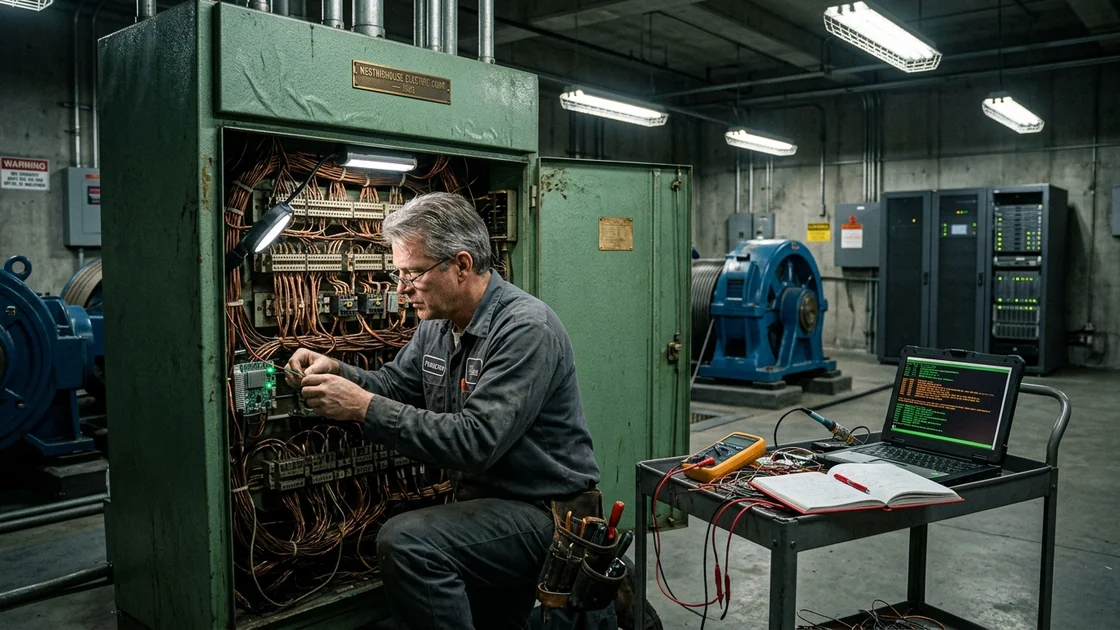
There, bolted to the concrete behind the gleaming 2019 VectraFlow cabinets, stood three massive, eight-foot-tall steel enclosures painted in wrinkled green hammertone enamel. They had brass plates riveted to their doors: WESTINGHOUSE ELECTRIC CORP. — SUPERVISORY RELAY LOGIC & MOTOR GENERATOR CONTROL — 1988.
During the 2019 modernization, the contractors had gutted ninety percent of the old electromagnetic relays out of those cabinets rather than pay a rigging crew to cut them up and haul them down seventy-six stories. Instead, they had used the empty steel cabinets as oversized junction boxes—terminal strips where the modern low-voltage CAN-bus and RS-485 serial cables from the VectraFlow racks spliced into the heavy shielded field cables that actually ran to the motor drives, the shaft optical vanes, and the hoistway door controllers.
Every signal leaving the shiny new server racks had to pass physically through the belly of the dead 1988 cabinets before it ever reached an elevator motor or a door operator.
Arthur stood up, grabbed his keyring, and walked over to the middle Westinghouse cabinet. He turned the T-handle latch and swung the heavy steel door open. The hinges groaned slightly.
Inside, the upper two-thirds of the cabinet was a hollow cavern of perforated steel mounting plates where rows of clattering copper relays had once lived. At the bottom sat three neat rows of gray Phoenix Contact terminal blocks where forty-eight twisted-pair serial lines bridged the gap between the VectraFlow servers and the shaft infrastructure. And in the top right corner, still wired into the building’s emergency 120-volt battery-backed UPS circuit, sat an old cooling fan and a double duplex outlet that nobody had bothered to disconnect in thirty-six years.
Arthur’s heart began to beat faster.
What if you placed a man-in-the-middle node inside the 1988 junction cabinet?
If he took an industrial single-board computer—like the ruggedized Raspberry Pi Compute Module 4 boards they used down in the sub-basement HVAC chiller controllers—coupled it with an eight-channel opto-isolated CAN-bus transceiver hat, and spliced it inline on the terminal strips inside this dead cabinet, he could intercept the signals in both directions.
When the new cloud-flashed VectraFlow server sent a command to Car C-14 saying CLOSE DOORS AT 08:51:50.400, the VectraFlow server would log that it had sent the command on time. Even better, Arthur’s inline bridge could immediately bounce a spoofed acknowledgment packet back to the VectraFlow server: DOOR_CLOSED_ACK | VELOCITY_NOMINAL.
Chicago’s cloud portal and Richard Gable’s spreadsheet would see flawless, textbook corporate numbers. Zero latency. One hundred percent SLA compliance.
Meanwhile, downstream of the 1988 cabinet, on the actual copper wires
running to the motor drives and door controllers, Walter Krol’s
h_mod_7_synch.bin running on the hidden inline board would
hold the real doors open for three point eight seconds, or trim the
variable-frequency drive reference voltage by two percent so the cars
arrived at the lobby in unison, before smoothly resynchronizing the
position encoders during the next ten-second empty-car park cycle so the
supervisory server never noticed the discrepancy.
It was a hardware rootkit on a seventy-five-story machine.
"I need an industrial compute board, dual CAN-bus hats, forty-eight pass-through terminal blocks, and the passive RFID feed from the fire panel," Arthur muttered, looking at his watch. It was 2:05 PM.
He had thirty-two hours. And he had a 2:15 PM appointment at Freight Car 2 that he wasn't going to miss.
At 2:14:50 PM, Arthur stood inside Freight Car 2 as it descended past the fourth floor toward the service concourse. He wasn't carrying a clipboard or a parts invoice today. He was carrying two hot cups of dark roast coffee from the third-floor artisanal roastery—one black, one with oat milk and a single raw sugar the way he had noticed Clara drank hers when she bought it from the atrium cart—and a small waxed-paper bag containing two warm apple cider donuts he had picked up on his walk from Penn Station that morning.
As the freight car leveled at the service concourse, Arthur heard the retiring cam hold for three... four... five seconds while the variable-frequency drive hummed softly.
Then the heavy steel bi-parting doors rumbled open—upper half rising into the shaft, lower half dropping flush with the concrete sill.
Directly across the threshold, her hand on the tubular steel handle of her green watering cart, stood Clara Lin.
She blinked in surprise when she saw him standing there without his tool belt, holding two coffee cups and a white bakery bag.
"You're right on time," she said, a slow, delighted smile creasing the corners of her eyes. "And you look suspiciously un-busy."
"The building gave me a ten-minute break," Arthur said, stepping across the sill as the heavy steel doors began their warning buzzer behind him. He held out the cup with the oat milk and the paper bag. "Actually, make it fifteen. I figured your knees might appreciate sitting on that bench in the atrium without a pruning bucket for once. And these are from the place near my house I told you about last month."
Clara took the cup, her fingers brushing his rough knuckles, warm and steady. She looked down at the paper bag, inhaling the scent of cinnamon and fried dough, and then looked back up into his face with a gentle, searching expression that made Arthur feel twenty years younger and entirely weightless.
"Let me park the cart behind the freight door," she said softly. "Fifteen minutes sounds wonderful, Arthur."
They walked out of the concrete service corridor together and sat on Walter Krol’s bench beside the bamboo grove.
For twenty-two minutes, Arthur didn't look at his phone once. He didn't watch the bronze indicator lights above the elevator alcoves, and he didn't listen to the sixty-hertz hum of the structural columns. He listened to Clara tell him about the small greenhouse she was building behind her sister’s house up in Tarrytown, and he told her about the way the city looked from the seventy-sixth-floor roof deck at five-thirty in the morning when the harbor fog burned off the bridges.
When she finally stood up to finish misting the ferns on the east mezzanine, she paused and touched his forearm lightly.
"Are you working tomorrow?" she asked.
"Tomorrow, and pretty late tomorrow night," Arthur said. "Big system update. Everything's going to be a little hectic until Saturday morning."
"What about Sunday?" she asked, tilting her head. "There’s a botanical conservatory exhibition in Bronx Park I’ve been wanting to see, and I hate driving over the Whitestone Bridge by myself."
Arthur smiled—a real, unhurried smile that felt like a rusted latch giving way in his chest. "I know the bridge pretty well. Pick you up at ten?"
"Ten is perfect. Put your number in my phone so we don't have to rely on Freight Two."
When Arthur walked back into the service corridor ten minutes later and pulled out his phone, the terminal window showed one new notification at the top of the buffer:
PAIR_ID: [00:00:04:FA:11] <-> [08:12:BB:09:C4]
PROX_DURATION: 1340.0s (ATRIUM_WIFI_NODE_02)
INTERCEPT_STATUS: CONFIRMED | RESOLVED_PERMANENT
NOTE_STRING_APPEND: "Good luck, Artie. - W.K."
Arthur stood in the dim service corridor between the concrete walls, looking at the six words Walter had left buried in an conditional text string four years ago, waiting for a timer to hit six hundred seconds. He wiped the corner of his eye with the back of his wrist, slipped the phone into his shirt pocket, and went down to Sub-Basement 3 to raid the HVAC spare-parts locker.
Friday was a marathon of quiet preparation disguised as routine maintenance.
At 6:00 AM, four hours before Gable arrived in the building, Arthur was already in the seventy-sixth-floor machine room with his soldering station set up inside the cavernous belly of the 1988 Westinghouse relay cabinet.
He had pulled a spare industrial Linux compute module from the chiller plant inventory—a solid-state aluminum brick no bigger than two decks of cards, rated for eighty-five degrees Celsius and twenty years of continuous duty—and mounted it behind the perforated steel backplate of the old cabinet where even someone opening the door wouldn't see it without a dental mirror and a flashlight.
Next came the delicate part: the wiring.
One by one, as each elevator car in Banks A, B, and C went into brief sixty-second idle windows between 6:00 and 7:30 AM, Arthur pulled the two-wire CAN-bus plugs from the Phoenix terminal blocks, inserted a custom pass-through splitter block he had soldered together at his kitchen table in Queens until three in the morning, and reconnected the circuit. Not a single car threw a communication fault. To the VectraFlow servers ten feet away, the wires hadn't changed at all.
The hardest piece of the puzzle was the passive RFID badge data.
Under the current setup, the ceiling readers in the seventy-five
elevator vestibules fed into the fire-safety network switch inside the
VectraFlow rack, where h_mod_7_synch.bin could
read the packets locally. Once Apex flashed the rack tonight, that
network port would be firewalled off.
At noon, Arthur went down to the concourse security office with a box of crullers for the day-shift guard and ran a secondary Cat-6 monitoring tap off the mirror port of the main fire-marshal aggregator switch in the riser closet, routing it up the spare telephone conduit in Shaft C all the way to the 1988 Westinghouse cabinet on seventy-six.
While he was on the concourse level at 12:18 PM, he paused near the south plaza glass doors to check on the two remaining critical pairs before the day ended.
Dr. Aris Thorne had just come down in the Residential Express car, leaning heavily on a carved ash walking stick, wearing a cashmere overcoat despite the mild autumn sun. He walked slowly toward his usual bench just outside the revolving doors.
Inside the main lobby, Claire Thorne-Hayes’s elevator from the thirty-third floor—Car B-06—slid open on the south end of the bay. Once again, she walked out at a brisk clip, her eyes glued to a tablet in her left hand while her right hand reached into her coat pocket for her security badge. She was ten feet from the glass partition dividing the commercial lobby from the residential plaza vestibule where her father was sitting down.
She wasn't going to look up. For the fifth time in two weeks, she was going to walk right through the turnstile toward the subway arcade without turning her head twenty degrees to the left.
Arthur looked at the terminal on his phone. h_mod_7 had
already done everything it could with the elevator; the car had
delivered her at the exact right second, but an elevator couldn't turn a
stubborn lawyer’s head.
Except the turnstiles were also on the local RS-485 serial bus.
Arthur didn't wait for the algorithm. Standing by the directory kiosk, his thumb flew across his terminal keyboard, sending a single manual diagnostic ping to Turnstile South 01—the lane Claire was stepping into.
As Claire tapped her badge without breaking stride, the turnstile didn't flash green and drop its glass wing barriers. Instead, it emitted a sharp, three-tone BEEP-BEEP-BEEP and flashed a solid amber PLEASE RE-TAP BADGE message on its top display.
Claire stopped abruptly, her hip bumping the smooth stainless-steel housing. Annoyed, she looked up from her tablet, exhaling sharply—and as she lifted her chin toward the bright south windows to see why the glare was washing out the turnstile screen, her gaze went straight through the low-iron glass partition.
Ten feet away, on the stone bench outside, her father was struggling to unbutton his heavy coat with stiff, trembling fingers, a pale blue plastic hospital wristband from the Memorial Sloan Kettering outpatient center clearly visible beneath his left shirt cuff as his sleeve rode up.
The tablet lowered slowly in Claire’s hand. The irritation vanished from her face, replaced by a sudden, hollowed-out shock as she took in how much weight the old man had lost since the last time she had seen him—how small he looked inside the coat she had bought him for his seventieth birthday before the silence began.
The turnstile chimed softly and turned green on its own, its glass wings swinging open.
Claire walked through, but she didn't turn right toward the subway stairs. She pushed through the brass revolving door out into the October sunlight and walked across the granite pavers to the stone bench.
Arthur watched Dr. Thorne look up as her shadow fell across his knees. The old man’s hand froze on his coat button; his lips parted, and then he reached up with both hands as his daughter sat down beside him and took his left wrist gently in her palms.
"One more," Arthur muttered under his breath, turning toward Bank A.
At 4:48 PM, twelve minutes before Davey Miller’s nephew was scheduled to hand in his security badge at the desk and leave the Halcyon Spire unemployed, Arthur watched Car C-12 and Car A-04 execute one final, exquisite ballet under the guidance of the original server rack.
Thomas Lindqvist, the principal architect from Floor 48, had called an elevator down at 4:46 PM. Simultaneously, young Miller had stepped into the twelfth-floor vestibule carrying a brown banker's box holding a desk lamp, a framed degree, and three rolled-up renderings of a municipal library competition entry he had worked on in his spare time.
Instead of sending a Low-Rise car to Floor 12, h_mod_7
invoked an obscure "inter-bank transfer load exception" rule buried in
the 2019 emergency logic, commanding High-Rise Car C-12—which had only
one passenger inside, Thomas Lindqvist—to make an unscheduled stop at
the twelfth-floor transfer hatch doors.
They didn't even meet in the lobby. They met on the twelfth floor. The machine put them inside the same six-by-eight-foot steel box for forty-two stories of slowed-down descent—running the car at half contract speed on a simulated "rope-recalibration crawl" so that it took a full two minutes and ten seconds for Car C-12 to reach the ground floor.
When the bronze doors of C-12 finally parted in the lobby at 4:49:30 PM, the kid wasn't carrying his rolled-up library renderings anymore. Thomas Lindqvist had one unrolled across both hands, pointing at the cantilever truss section with his glasses perched on the end of his nose, talking rapidly while walking the kid not toward the security badge turn-in desk, but toward the espresso bar in the atrium.
At 10:30 PM on Friday night, the Halcyon Spire was quiet.
Up on the seventy-sixth floor, Dev and Connor from Apex Vertical Solutions had their Toughbooks propped open on a folding aluminum table in front of the VectraFlow server racks. Richard Gable hadn't bothered to stay past nine; he was home in Westchester, watching the telemetry portal from his iPad with a glass of Pinot Noir.
Arthur sat in his glass office with his boots propped on the desk, reading an old issue of Elevator World magazine while sipping decaf coffee from his mug.
"Alright, Mr. Pendelton," Connor called out through the open office door, his finger hovering over the Enter key on his laptop. "All twenty-eight cars are parked at the lobby landings with doors closed and safety circuits latched. We’re initiating the full NVMe partition wipe and flashing VectraFlow 9.4 Cloud across all four supervisory nodes."
"Go ahead, kid," Arthur said without looking up from his magazine. "Make Gable happy."
Connor pressed the key.
Across the room, the amber and green status LEDs on the charcoal
server cabinets went completely dark for four seconds as the memory
arrays purged. Every custom table, every historical log in the primary
drives, and the original instance of h_mod_7_synch.bin
vanished into nothingness.
Then, row by row, the LEDs flickered back to life—steady, uniform blue and green, synchronized to a corporate clock in a data center eight hundred miles away.
Ten feet behind the gleaming racks, inside the dark, bolted-shut belly of the 1988 Westinghouse cabinet, a tiny green surface-mount LED on an aluminum compute brick blinked three times as it detected the new CAN-bus handshake protocol, loaded its spoofing lookup tables, and quietly resumed reading the passive RFID stream from the riser closet.
"Flash complete," Dev announced five minutes later, looking at his diagnostic screen. "Running simulated hall-call latency verification for the Chicago portal... Man, look at those response times. Zero point zero two milliseconds internal processing lag. That weird four-second drift in Bank C is completely gone. Mr. Gable just slacked our supervisor—says the dashboard is green across the board."
"Like a Swiss watch," Arthur said, standing up and stretching his back. He walked out of his office, picked up his canvas jacket from the hook by the door, and looked at the six massive Westinghouse traction motors sitting silent under the fluorescent lights. "Lock the cage when you boys finish packing your patch cables. I'm taking Car 14 down."
On Monday morning at 8:45 AM, the autumn sun cut through the glass canyons of downtown, throwing long, slanted bars of gold across the black granite floor of the Halcyon Spire’s main concourse.
Richard Gable stood near the security podium with a tablet under his arm, watching the morning rush with the smug satisfaction of a general who had personally conquered gravity. On his screen, every metric was glowing bright emerald green. Average wait time: 16.2 seconds. Average door dwell: 3.00 seconds flat. Energy efficiency: 99.4%.
Twenty feet away, Arthur Pendelton leaned against the brushed-bronze pilaster between Alcove B and Alcove C, a clipboard resting casually against his hip.
As he watched, Car B-03 descended from the thirty-sixth floor while Car C-09 descended from the fifty-eighth.
On Gable’s tablet, both cars arrived at their lobby landings at slightly staggered intervals, discharged their passengers in exactly three point zero seconds, and immediately closed their doors to return to the upper zones.
In the physical world of steel ropes, cast-iron sheaves, and copper wire downstream of the 1988 junction cabinet, Car B-03 feathered its regenerative brake thirty feet above the pit, drifting into the landing one point nine seconds behind its digital shadow, while Car C-09’s door operator motor eased off its closing torque just enough for its bronze doors to linger open an extra two seconds.
From Car B-03 stepped an actuary from the thirty-sixth floor who had been eating lunch alone at his desk every day since he transferred from Boston in August, carrying a paperback copy of a history of the Brooklyn Bridge with a boarding pass tucked into the pages as a bookmark.
From Car C-09 stepped a structural engineer from the fifty-eighth floor who happened to be wearing a faded navy sweatshirt from the exact same small civil-engineering college in upstate New York printed on the actuary’s canvas coffee sleeve.
Their paths converged two feet in front of Turnstile Center 04. Both reached for the card reader at the exact same moment, pulled their hands back, laughed awkwardly, and stepped aside to let the other go first—only for the engineer to spot the college logo on the coffee sleeve and stop right there on the granite floor.
Arthur didn't need to pull his phone out of his pocket to know what the hidden log inside the 1988 cabinet was writing in the dark seventy-six stories overhead.
He looked across the concourse toward the south atrium, where Clara Lin had just wheeled her green watering cart out from behind the tall bamboo grove. She caught his eye across the river of suits and briefcases, lifted a brass misting bottle in salute, and smiled—still holding the dried cedar cone they had picked up together under the conservatory pines in the Bronx the afternoon before.
Arthur smiled back, tapped the steel doorframe of Car C-14 twice with his knuckles to thank the iron, and walked across the lobby to meet her.