The Bronze Logic of Karpathos
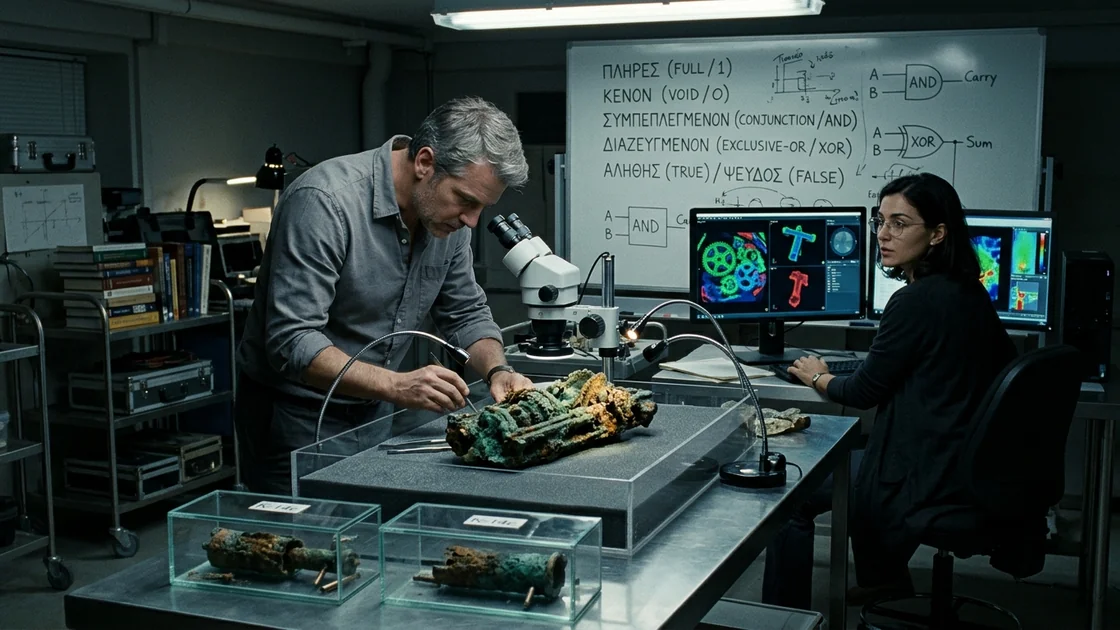
Dr. Julian Vance, a specialist in Hellenistic technical epigraphy, is summoned to a marine archaeology institute in Crete to translate the microscopic Greek inscriptions on a heavily calcified bronze mechanism recovered from a deep-water Roman-era shipwreck near the island of Karpathos. Initially presumed by museum directors to be an astronomical calculator similar to the famous Antikythera mechanism, the artifact defies all conventional philological expectations when Julian discovers that its dials and sliding plates contain no references to zodiac constellations, lunar cycles, or Egyptian calendar months. Instead, the dense Doric engravings use the vocabulary of Stoic propositional logic, specifically the binary truth-value definitions pioneered by the philosopher Chrysippus of Soli. Working alongside Dr. Elena Papadopoulos, a computational imaging specialist and mechanical conservationist, Julian maps the internal kinematics of the corroded bronze block through high-energy synchrotron tomography. Together, they realize that the interlocking sliders, bell-cranks, and intermittent gears do not measure continuous celestial motion, but operate strictly in two discrete mechanical states corresponding to true and false. As they reconstruct the schematic of the ancient device, they uncover a breathtaking anachronism: an eight-bit mechanical arithmetic logic unit capable of executing bitwise operations, binary addition with ripple-carry propagation, and conditional branching, driven by a programmable pinned cylinder. By translating the machine's operational manual and running the ancient program preserved on its corroded memory drum, Julian and Elena unlock a two-thousand-year-old message from a forgotten school of Rhodian engineers who bridged the gap between philosophy and computation centuries before the modern era.
I. The Lexicon of Corrosion
The sea does not destroy bronze; it reimagines it. Over twenty-one centuries at a depth of four hundred meters in the Karpathos Strait, the cold, oxygen-poor currents of the eastern Mediterranean had slowly exchanged the copper atoms of the artifact for chloride ions from the salt water, blooming into a dense, jade-colored crust of paratacamite and malachite. Where the iron pins had once held the outer frame together, clouds of orange-brown ferric oxide had bled into the surrounding limestone concretion, cementing shells, sand, and the shattered ribs of Rhodian wine amphorae into a single, stony tumor roughly the size of a butcher’s block.
Julian Vance leaned over the stainless-steel examination table in the basement of the Institute for Mediterranean Subsea Epigraphy, his eyes aching from six hours behind the binocular microscope. The laboratory smelled of deionized water, ethanol, and the faint, metallic tang of ancient seabed that no amount of ventilation could ever fully purge from the concrete walls. Outside, the relentless August sun of Heraklion baked the whitewashed roofs of the city, Vision shimmering above the Venetian harbor, but down here in the climate-controlled vault, the temperature was kept at a rigid eighteen degrees Celsius.
"You’re looking at Plate Gamma again," a voice said from the doorway.
Julian didn’t lift his head from the oculars. His right hand remained steady on the micrometer knob, shifting the focal plane by fractions of a millimeter across a jagged canyon of green cuprite. "Because Plate Gamma is offending my sense of Greek grammar, Elena. And my sense of mechanical propriety."
Dr. Elena Papadopoulos walked across the anti-static floor mats, carrying two paper cups of thick, lukewarm Greek coffee. She set one down beside Julian’s elbow—far enough from the acrylic containment tray to satisfy conservation protocol—and leaned against the workstation, folding her arms. Behind her, three dual-monitor workstations glowed with volumetric renderings: ghostly, semi-transparent slices of the artifact’s interior captured two weeks earlier at the European Synchrotron Radiation Facility in Grenoble.
"Stavros called from Athens twenty minutes ago," Elena said, her dark eyes crinkling with dry amusement behind her wire-rimmed glasses. "He wants to know if you’ve found the parapetasma calendar yet. He’s already drafted a press release comparing the Karpathos find to the Antikythera mechanism. He used the phrase 'The Second Sun of Archimedes' twice in the first paragraph."
Julian finally pulled back from the microscope, rubbing the bridge of his nose where the rubber eyecups had left twin red indentations. At forty-four, he had the slightly stooped shoulders of a man who had spent a quarter-century hunching over broken marble stelae, papyrus fragments, and lead curse tablets. His hair, once dark brown, had gone silver at the temples, looking not unlike the tin-rich specular bronze fragments sitting in the petri dishes around him.
"Tell Director Nikolaidis that if he publishes that press release, he’ll be the laughingstock of every philology department from Oxford to Berlin," Julian said, reaching for the coffee. He took a sip, wincing slightly at the bitter grounds settling at the bottom. "There is no sun in this machine, Elena. There is no moon. There are no stations of Venus, no Metonic cycles, no Saros eclipse predictors, and not a single syllable referring to the constellations of the zodiac."
"Perhaps they’re on the lower casing," she suggested mildly, though she already knew the answer. She had spent the last ten days segmenting the X-ray tomography data, isolating individual bronze components from the stony matrix in virtual space. "Fragment Delta is still heavily obscured by the lead-tin solder pooling from the hull plating."
"It doesn’t matter what’s under the solder on Fragment Delta," Julian replied, tapping his pencil against his legal pad. The yellow paper was covered in neat columns of transcribed Greek capitals, flanked by question marks and frustrated marginalia. "Look at the structural layout of the Antikythera mechanism. Even when Price and Wright and Freeth were working with partial fragments, the nature of the vocabulary was unmistakable. You find words like Stērigmos—stationary point. You find Synodos—conjunction. You find the names of the Corinthian months etched right into the circular scales. An astronomical calculator requires continuous cyclical ratios. Its language is the language of circles, orbits, and time."
He gestured toward the acrylic tray in the center of the table. Inside, resting on a custom-molded bed of inert polyethylene foam, lay Artifact K-14. It was thirty-four centimeters long, twenty-two centimeters wide, and twelve centimeters thick. Unlike the Antikythera device, which was dominated by a large central four-spoked main drive wheel and concentric circular rings, K-14 was ruthlessly orthogonal. Even through the blistered green patina and calcified marine worms, one could see that its architecture was built around a grid of parallel channels, rectangular bronze buses, and eight identical, modular assemblies arranged in a strict vertical column.
"So what is the language of K-14?" Elena asked, stepping closer to look at his notepad.
"Doric Greek, mid-to-late second century BCE, judging by the paleography," Julian said, flipping back a page to show her his tracings of the letterforms. "Look at the pi—the right vertical stroke is still slightly shorter than the left, though they’re nearly equal, and the crossbar extends past both verticals. The sigma has parallel top and bottom bars, not the four-bar splayed angle of the third century, nor the lunate form we see later in the Roman period. The alpha has a broken crossbar. It’s textbook Rhodian or Cnidian engraving from around 150 to 120 BCE. The craftsman used a hardened iron burin with a sixty-degree V-point and a pair of divider calipers to lay out guide lines only one point two millimeters apart."
"That’s the script," Elena said. "I meant the vocabulary. What is it actually saying?"
Julian turned to the high-resolution monitor beside the microscope, where a Polynomial Texture Mapping (PTM) image of Fragment Gamma was displayed. By photographing the corroded bronze plate under a dome of sixty-four strobe lights firing from different angles, the software allowed Julian to drag a virtual light source across the surface, exaggerating the microscopic valleys of the chiseled letters and stripping away the visual noise of the green oxidation.
He moved the mouse, sweeping the virtual raking light across the upper right quadrant of the bronze plate. A row of tiny, razor-sharp letters leaped out of the shadows.
"Read this column header," Julian said, pointing the tip of his mechanical pencil at the screen. "Right above the eight rectangular slots on the primary register plate."
Elena squinted at the screen. Her modern Greek was native, and she knew enough ancient Greek from her years in archaeological conservation to sound out the capitals, though the lack of word spaces and diacritics always slowed her down. "Kappa... epsilon... nu... omicron... nu. Kenon. Empty? Void?"
"Void," Julian confirmed. "And immediately adjacent to it, over the twin track of the slider detent?"
"Pi... lambda... eta... rho... epsilon... sigma. Plēres. Full."
"Full and Void," Julian said softly. "Plenum and Vacuum. That is the language of the early atomists—Leucippus and Democritus—or the physical treatises of Hero and Philo when they discuss pneumatics and siphons. When I first read those two words on Tuesday, I assumed we were looking at a water-clock regulator or an automated pneumatic organ, something in the tradition of Ctesibius of Alexandria. A valve plate that marks whether a cylinder is full of air or evacuated."
"A reasonable hypothesis," Elena said. "Except there are no pneumatic cylinders in K-14. No leather gaskets, no bronze pistons, no water reservoirs. It’s entirely dry kinematics. Levers, sliding racks, and ratchets."
"Precisely. Which is why I spent the last forty-eight hours translating the eighty-two lines of continuous inscription etched into the side flange of Plate Gamma." Julian slid his legal pad across the desk toward her. "It isn’t a pneumatic manual. And it isn’t astronomy. Listen to lines twelve through nineteen."
He cleared his throat, reading from his transcription, his voice falling into the measured, rhythmic cadence of ancient didactic prose:
"‘Whenever the first and the second are both set toward the Full, the conjoined slider is driven upward into the Truth; if either the first or the second falls back into the Void, the conjoined slider remains bound in the False. Yet in the adjacent gate of the Disjunctive, if the first is Full and the second is Void, or if the first is Void and the second is Full, the lever of the Disjunctive rises into the Truth; whereas if both share the same state, whether both Full or both Void, the lever is cast down into the False.’"
Silence settled over the laboratory, broken only by the low hum of the dehumidifiers and the rhythmic ticking of the cooling fan inside the workstation tower.
Elena stared at the yellow pad, her coffee cup frozen halfway to her mouth. Slowly, she lowered the cup back to the table. She looked from Julian’s handwritten translation to the glowing green X-ray cross-sections on her own monitors, and then back to Julian.
"Julian," she said, her voice dropping an octave. "Are you translating this literally, or are you paraphrasing using modern terminology?"
"Every single word is literal," Julian said, a strange, electric tension tightening his chest. He had hoped—or perhaps feared—that she would have this exact reaction. "The word I translated as 'Truth' is Alethēs. The word for 'False' is Pseudos. The word I rendered as 'conjoined' is Sympeplegmenon, and 'Disjunctive' is Diezeugmenon."
"Those are Greek words for logic gates," Elena whispered. "You just read me the exact truth tables for an AND gate and an Exclusive-OR gate."
"I read you the exact terminology of Chrysippus of Soli, the third head of the Stoic school at Athens, who died around 206 BCE," Julian corrected, though his hand was trembling slightly as he adjusted his glasses. "Most people, even classicists, think ancient logic begins and ends with Aristotle. Syllogisms. 'All men are mortal; Socrates is a man; therefore Socrates is mortal.' That’s term logic. It deals with categories and properties. You can’t easily build a simple gear train out of Aristotelian categories."
He stood up and walked over to the whiteboard mounted on the far wall, uncapping a dry-erase marker.
"But the Stoics—and before them, the Megarian dialecticians like Philo and Diodorus Cronus—rejected Aristotle’s focus on terms," Julian continued, writing rapidly on the board in both Greek and English. "They developed propositional logic. They didn't care about relationships between nouns; they cared about relationships between whole statements— what they called lekta—and they insisted that every proposition must possess strictly one of two states: Alethēs or Pseudos. True or False. One or Zero."
He underlined the two Greek words twice.
"Chrysippus wrote over three hundred books on logic," Julian said, turning back to face her. "Almost all of them were lost, surviving only in fragments quoted by Sextus Empiricus, Diogenes Laertius, and Galen. But from those fragments, we know how Chrysippus defined his logical connectives. He called a compound AND statement a sympeplegmenon—literally, 'that which is woven together.' And he called an Exclusive-OR statement a diezeugmenon—'that which is cloven apart.' Unlike modern logicians, who usually default to inclusive OR, the Stoics were obsessed with exclusive disjunction: either it is day, or it is night, never both at once."
Elena walked slowly over to her main computer terminal. Her fingers flew across the keyboard, bringing up the 3D volumetric model of the eight modular assemblies inside Artifact K-14. She rotated the model on screen, slicing away the outer bronze casing and the calcified marine sediment with a virtual clipping plane until only the high-density bronze internal parts remained floating in the black void of the viewport.
"For two weeks, I’ve been trying to figure out the gear ratios in these eight vertical bays," she murmured, zooming in on the third bay from the top. "I kept looking for teeth counts. You know how the Antikythera mechanism works—a gear with sixty-four teeth meshes with a gear of thirty-eight teeth to create a fractional ratio. When I ran the edge-detection algorithms on K-14’s internal arbors, the software kept throwing errors. It told me the gears only had two or three teeth each, and that the sliding bars had irregular rectangular notches."
"Because they aren't gears," Julian said, stepping up behind her shoulder to look at the high-resolution synchrotron slice. "Not in the continuous rotational sense."
"No," Elena breathed, her eyes wide as she highlighted a pair of interlocking bronze rockers in neon blue and red on the screen. "They’re bistable mechanical latches. Look at this assembly right here, directly underneath the inscription you just read."
She manipulated the 3D mouse, rotating a tiny, T-shaped bronze bell-crank that was pinned between two parallel sliding bars.
"See these two horizontal input bars?" she pointed to two long, slender bronze rods with square cross-sections that ran from the front face of the machine into the interior. "They correspond to the slots labeled Plēres and Kenon. Each bar can only slide forward or backward by four millimeters before hitting a bronze stop-pin. Two discrete positions. Let’s call forward 'Full'—One—and backward 'Void'—Zero."
"Go on," Julian said, leaning in so close his breath fogged the edge of her monitor.
"Now look at how they interact with this floating rocker arm between them," Elena traced the geometry with her cursor. "If Input Bar A is pushed forward, its angled cam-lobe lifts the left side of the rocker. If Input Bar B is pushed forward, its cam-lobe lifts the right side. Beneath the center pivot of the rocker is a vertical output rod—what your inscription calls the sympeplegmenon slider. Because the rocker is hinged in the middle like a whippletree on a chariot, pushing only one input bar just tilts the rocker in place; the center pivot doesn't rise high enough to clear the detent pawl. Both Input A and Input B have to be pushed forward simultaneously to raise the center pivot and engage the output hook."
Julian felt the fine hairs on his arms stand up. "And the adjacent linkage? The diezeugmenon?"
Elena panned the virtual camera three millimeters to the right, deeper into the bronze matrix. "It uses the exact same two input bars, tapped via secondary pins! Look at the geometry of that T-lever. If Input A pushes from the left, the center tongue swings up into the active channel. If Input B pushes from the right, the center tongue also swings up into the active channel from the opposite side. Wait—look at the scissor-link attached to the base. If both A and B push forward at the same time, the two opposing cams pinch the scissor-link closed, which pulls the center tongue back down out of the channel!"
She let go of the 3D mouse and sat back in her chair, her face pale in the blue glow of the monitor.
"It’s a mechanical XOR gate coupled in parallel with a mechanical AND gate," she said. Her voice was barely above a whisper. "Julian... in digital circuit design, what do you get when you wire an XOR gate and an AND gate in parallel to the same two binary inputs?"
Julian was a philologist, not an electrical engineer, but you could not work with digital humanities and computational tomography for ten years without learning the foundational architecture of the machines you used. Even so, the words felt impossibly heavy, almost blasphemous, in his mouth.
"A half-adder," Julian said. "The XOR gate computes the Sum bit. The AND gate computes the Carry bit."
Elena zoomed out until all eight identical modular bays were visible in a vertical stack, connected by a cascading diagonal train of tiny bronze bell-cranks that linked the Carry output of each bay directly into a secondary half-adder stage in the bay above it.
"It’s not a half-adder," Elena said, her fingers trembling as she traced the diagonal cascade from the bottom of the bronze block to the top. "Each bay has two stages. One for the two primary inputs, and a second one that accepts the output lever from the bay below it. Eight bays. Eight bits. Ripple-carry propagation from bottom to top."
She turned her head to look up at him.
"Julian, this isn't a water clock. And it isn't an astrolabe. Someone in the second century before Christ built an eight-bit binary Arithmetic Logic Unit out of bronze."
II. The Architecture of the Stoa
They did not go home that night. At midnight, Elena brewed a fresh pot of coffee on the hotplate in the breakroom while Julian wheeled three mobile rolling racks of reference books from the institute’s library down into the basement vault. He stacked volumes of Hans von Arnim’s Stoicorum Veterum Fragmenta, Diels-Kranz’s Die Fragmente der Vorsokratiker, Marsden’s Greek and Roman Artillery, and Drachmann’s The Mechanical Technology of Greek and Roman Antiquity across the examination tables like defensive ramparts.
By two in the morning, the whiteboard was completely filled with a hybrid notation that had never existed before in human history: standard IEEE logic gate symbols—D-shaped AND gates, curved shield-shaped OR and XOR gates, triangular inverters—each labeled not with A, B, and Y, but with Πρῶτον (First), Δεύτερον (Second), and Ἐπιφορά (Conclusion).
"Walk me through the torque problem," Julian said, pacing the length of the rubber floor mat with a legal pad tucked under his arm. His tie was gone, his collar unbuttoned, and his fingers were stained blue-black with dry-erase ink. "When Babbage tried to build the Analytical Engine in the nineteenth century, his biggest headache was mechanical friction in the carry mechanism. If you try to push a train of twenty or thirty bronze gears or levers using only the finger-pressure of setting an input slider, the system jams. Metal binds against metal. How did our Rhodian engineer prevent the ripple-carry from locking up across eight consecutive stages?"
"He didn't use the inputs to power the gates," Elena said. She was wearing headphones around her neck, her eyes locked on a split-screen view where a kinematic simulation software package was importing the STL meshes she had extracted from the synchrotron scans. "That was the mistake I made when I first looked at the main drive crank on the right side of the chassis. On the Antikythera mechanism, turning the side crank directly rotates the gears to show the passage of time. Here, the input sliders are completely passive."
She rotated the 3D rendering to highlight a heavy, cylindrical bronze shaft running the entire length of the artifact’s spine, fitted with sixteen eccentric cam lobes positioned at staggered forty-five-degree angles around the circumference.
"Look at the main arbor," she explained, pointing to the heavy shaft. "It’s driven by a hand crank through a four-to-one worm gear reduction at the bottom. When you set the input sliders on the front plate to Plēres or Kenon, you aren't actually pushing the logic gates into their final states. You’re just positioning small, lightweight bronze interposers—floating pins that weigh less than two grams each. They offer almost zero mechanical resistance."
"Like Konrad Zuse’s Z1 computer in 1938," Julian murmured, recalling a history of computing seminar he had attended in Munich years ago. "Or the mechanical regenerators in early teletypes."
"Exactly like Zuse’s mechanical logic, only executed in cast and hand-filed unleaded bronze," Elena said, a note of fierce professional awe in her voice. "Once the inputs are set, the operator turns the main side crank through one full revolution. The eccentric cams on the central spine fire sequentially from Bay One at the bottom up to Bay Eight at the top. Each cam drives a heavy bail-bar that provides fresh mechanical power directly from the operator’s hand, forcing the interposer through the gate and locking the output latch before the next cam in the sequence fires ten degrees later."
"A clocked ripple-carry," Julian said, stopping in his tracks. "The camshaft is a system clock. Each revolution of the crank is one clock cycle, phased into eight sub-cycles so the carry bit from Bay One is physically settled and locked before Bay Two evaluates its inputs."
"More than eight sub-cycles," Elena corrected, pointing to the upper four cams on the shaft. "There are twelve phases per revolution. Eight for the bit-by-bit ripple propagation, two beforehand to clear and pre-charge the latches, one afterward to transfer the result into the accumulator rack, and a final phase to advance the auxiliary pins."
Julian walked back to the microscope and looked down at the calcified lump of green stone and metal resting in the tray. In the harsh white light of the fiber-optic gooseneck lamps, Artifact K-14 looked utterly dead—a silent relic of a sunken galley that had gone down in a winter storm somewhere between Rhodes and Alexandria while Sulla was marching on Athens. Yet inside that stone cocoon sat a frozen symphony of discrete mathematics.
"Look at the selector bar along the left flange," Julian said, turning back to his PTM images on the secondary monitor. "What we labeled Fragment Beta. There is a vertical bronze rule that can be shifted into five distinct detents by a knurled bronze knob at the top. Next to each detent is an engraved Greek word in the genitive or dative case, acting as an operational mode."
He zoomed in on the five engraved labels along the left track and read them off one by one, matching them to the mechanical linkages Elena had isolated in the tomography:
"Position One: ΣΥΝΘΕΣΙΣ (Synthesis). Addition. In this position, the selector bar shifts the internal bell-cranks so that the XOR sum and the AND carry cascades are both active, feeding the full-adder outputs to the main result display."
"Wait," Elena interrupted, her cursor hovering over a secondary rack of sliding teeth that ran perpendicular to the adder bays. "What happens when you pull the selector bar down one notch to Position Two? In the scan, pulling that bar down physically decouples the carry-propagation levers and drops a solid block of bronze across all eight carry channels."
Julian checked his transcription of the second detent label. "Position Two is labeled ΔΙΑΙΡΕΣΙΣ (Diairesis)—or wait, no, the third letter is a zeta, not an iota. The corrosion obscured the bottom bar. It reads ΔΙΑΖΕΥΞΙΣ (Diazeuxis). Disjunction! By blocking the carry cascade and routing only the first stage of each bay to the output, the machine stops doing arithmetic addition and performs an eight-bit parallel bitwise XOR operation!"
Elena laughed aloud—a sharp, startled sound in the quiet vault. She clapped her hands over her mouth, staring at the schematic. "Of course! Because a full adder already contains the XOR and AND gates! All the designer had to do was add a mechanical clutch bar that selects which internal tap gets connected to the output pins! What are the other three positions on the selector knob?"
Julian leaned over his notes, his pencil flying as he cross-referenced the bruised Greek letters on Fragment Beta with the kinematic paths on Elena’s screen.
"Position Three: ΣΥΜΠΛΟΚΗ (Symplokē). Interweaving, or Conjunction. Looking at your model, sliding the selector to the third notch shifts the output pickup hooks three millimeters to the left, bypassing the XOR rockers entirely and hooking directly onto the first-stage AND levers. That’s an eight-bit bitwise AND."
"Position Four?"
"Position Four is labeled ΑΝΤΙΘΕΣΙΣ (Antithesis). Opposition, or Negation." Julian’s eyes widened as he traced the simple, brutal elegance of the fourth linkage on the tomography slice. "When you slide the selector to Antithesis, it engages a set of eight tiny reversing rockers—simple first-class levers pivoted at their centers—that invert the motion of Input Register A before it reaches the output latches. Pull becomes push. Plēres becomes Kenon. It’s a bitwise NOT gate. A mechanical inverter."
"Wait," Elena said, her brow furrowing as she rotated the model around the bottom of Bay One. "Look at the fifth position on the selector bar. It engages the Antithesis inverters on Input B, keeps the full-adder carry cascade active from Position One, and simultaneously pushes a tiny bronze wedge into the bottom of Bay One’s carry-in slot, forcing the initial carry-in bit into the Plēres state!"
She stared at the screen, her mouth slightly open.
"Julian... to subtract a binary number in a modern computer, you don't build a separate subtractor circuit. You invert all the bits of the second number using NOT gates, and then you add One by setting the initial Carry-In of the least significant bit to High. Two’s complement subtraction."
Julian looked down at the fifth and final word etched into the green bronze at the bottom of the selector track. The letters were partially eaten away by a colony of calcified serpulid worm tubes, but the first six characters were unmistakable under the raking virtual light.
"Position Five," Julian whispered. "ΑΦΑΙΡΕΣΙΣ (Aphairesis). Subtraction. And beside it, in smaller letters just above the bottom carry-in wedge: ΜΟΝΑΣ ΕΙΣΑΓΟΜΕΝΗ—'The Unit Introduced.'"
For a long time, neither of them spoke. Julian pulled up a metal lab stool and sat down heavily, his knees suddenly feeling too weak to support him.
For twenty years, he had studied the minds of the ancients. He knew how brilliant they were. He knew how Eratosthenes had measured the circumference of the Earth using the shadow of a stick in Alexandria and a well in Syene; he knew how Hipparchus had discovered the precession of the equinoxes; he knew how Archimedes had used the method of exhaustion to anticipate integral calculus by nearly two millennia, as revealed in the Archimedes Palimpsest. Whenever modern people assumed the ancients were primitive, Julian was always the first to correct them, pointing to the differential gear trains of Antikythera or the steam reaction turbine of Hero.
Yet even for Julian, there had always been an invisible wall separating antiquity from modernity. The ancients understood continuous geometry—lines, circles, cones, spheres, proportions. They were masters of the analog world. Binary arithmetic, two’s complement subtraction, and combinatorial logic gates belonged to the world of Boole, Babbage, Turing, and Shannon. They belonged to the silicon age.
Or so everyone had believed.
"How?" Elena asked quietly, voicing the exact question echoing inside Julian’s skull. "How could someone in 150 BCE invent two’s complement binary arithmetic? The Greeks didn't even have positional base-ten numerals like ours—they used alphabetic numerals! Alpha is one, Beta is two, Iota is ten, Rho is a hundred! How do you go from alphabetic numerals to eight-bit binary registers?"
"Because they weren't starting from commercial arithmetic," Julian said slowly, his mind racing through the scattered library of Hellenistic philosophy. "Wait. Think about how Greeks actually did calculations. They didn't do arithmetic by writing down letters on papyrus—you can't easily multiply ΚΔ by ΠΘ with ink. They used the abax—the counting board, with pebbles in parallel columns. And even more importantly, look at the inscription on Plate Gamma again. They aren't calling the eight bays 'ones, twos, fours, eights, sixteens' in the standard arithmetic sense until the very end of the manual."
He flipped rapidly through his legal pad to the bottom of the long inscription on the side flange—a section he had transcribed earlier that afternoon without fully understanding its context.
"Listen to lines fifty-four through sixty-eight," Julian said, his finger tracing the Greek text:
"‘As Chrysippus demonstrates in the third book of the Dialectics, concerning the combinations of the ten propositions: out of two simple propositions, four conjunctions arise; out of three, eight; out of four, sixteen; and out of eight ordered places, two hundred and fifty-six arrangements of Truth and Falsehood are generated, each distinct in species and number, ascending by the doubling of the dyad from the monad up to the eighth power.’"
Julian looked up from the pad.
"Plutarch actually quotes a version of that passage in his De Stoicorum Repugnantiis!" Julian said, jumping up from the stool to grab a volume of Plutarch’s Moralia from the book cart. He leafed wildly through the Greek text until he found section 1047. "Here! Look! Plutarch mocks Chrysippus for claiming that a million combinations can be made from ten propositions, and mentions that the mathematician Hipparchus refuted him by calculating the exact number of compound propositions! Hipparchus and the Stoics were explicitly calculating combinatorial truth tables by powers of two in the mid-second century BCE!"
"They came to binary through truth tables," Elena realized, her eyes lighting up with comprehension. "If you have eight logical variables arranged in a row, and each can be either Alethēs or Pseudos, there are \(2^8\)—two hundred and fifty-six—possible states! And once you build a mechanical rack to step systematically through all two hundred and fifty-six truth states by flipping levers—"
"—you inevitably discover that stepping from one truth-table row to the next is identical to counting in base two," Julian finished. "And once you map the 256 states onto the numbers from zero to 255, you realize that the logical operators for Diezeugmenon (XOR) and Sympeplegmenon (AND) are the exact same rules needed to add two binary rows together!"
"Wait," Elena said, turning back to her monitor and pointing at the top of Bay Eight, where two isolated bronze indicator flags sat beneath semicircular viewing windows cut into the upper faceplate. "If this is a complete eight-bit ALU, what are those two flags at the top of the register? Every modern ALU outputs status flags alongside the eight-bit result."
Julian leaned over the microscope and rolled the X-Y stage to bring the top edge of Fragment Gamma into the center of the lens field. The bronze here was remarkably well preserved, protected by a thick layer of calcareous algae that had flaked off cleanly during the initial mechanical cleaning in June.
Below the left semicircular window, where a tiny bronze vane was pivoted to swing into view only when a long vertical summation bar dropped into a collective notch across all eight output latches, a single word was chiseled in crisp, one-millimeter letters:
ΟΥΔΕΝ (Ouden). Nothing. Zero.
"The left window is the Zero Flag," Julian said, looking through the eyepieces. "If all eight output sliders fall into the Kenon state simultaneously, a weighted feeler bar drops into the aligned notches across the entire register and flips the Ouden vane into the viewing aperture."
He slid the stage four centimeters to the right, bringing the second semicircular window into focus. This window was linked directly to the final Carry-Out lever exiting the top of Bay Eight.
"And the right window," Julian read aloud, "is labeled ΥΠΕΡΒΟΛΗ (Hyperbolē). Excess. Overflow."
"A Zero flag and a Carry-Out Overflow flag," Elena said, shaking her head in disbelief. "It has the exact status register architecture of a microprocessor."
She paused, her gaze drifting from the main block of K-14 to the four smaller acrylic containment boxes sitting on the lower shelf of the steel examination cart. Inside those boxes lay the auxiliary fragments recovered from the same two-meter grid square on the Karpathos seabed—Fragments K-14b through K-14e—which the marine archaeologists had cataloged simply as "miscellaneous bronze architectural fittings and decorative cylindrical weights."
Elena stood up slowly and walked over to the cart. She lifted the lid off Box K-14c.
Inside lay a heavy, hollow bronze cylinder, fifteen centimeters long and eight centimeters in diameter, heavily encrusted with green verdigris and pitted with hundreds of tiny, regularly spaced square holes arranged in thirty-two circumferential rings. Sticking out of several dozen of those holes were tiny, square-headed bronze pegs, while other holes were empty.
"Julian," Elena said softly.
Julian turned from the microscope and walked over to stand beside her.
"Why does an ALU have a Zero flag and a Carry flag?" she asked, pointing down at the perforated bronze cylinder. "If a human being is just standing over the machine, setting sliders by hand to add two numbers together like an abacus, they don't need a mechanical Zero flag lever. They can just look at the output sliders with their own eyes and see that they’re all set to Void. The only reason you build physical output levers for Zero and Carry—levers that have mechanical hooks attached to their backsides—"
"—is if those flags are meant to physically trip another mechanism," Julian whispered, his eyes fixed on the rows of tiny bronze pegs protruding from the corroded cylinder. "Conditional branching."
"Hero of Alexandria used pegged cylinders wrapped in cords to program his automated theater," Elena said, her voice tight with sudden urgency. "We’ve known about Hero’s programmable automatons for a century. Everyone thought they were just toys—mechanical birds that sang, wooden statues of Dionysus that poured wine on a stage. Nobody ever asked what would happen if you coupled a pegged programming drum from Alexandria to a Stoic logic engine from Rhodes."
Julian reached out with a pair of gloved hands and lifted the tray containing the bronze cylinder onto the main examination table.
"We haven't even scanned K-14b through K-14e at high resolution yet," Elena said, glancing at the clock on the wall. It was 3:40 AM. "We only ran low-res scout scans in Grenoble because Stavros told the synchrotron team they were just decorative struts from the cabinet frame."
"Can our micro-CT cabinet in the next room penetrate the cylinder walls?" Julian asked.
"It’s a 225-kilovolt reflection target system," Elena said, already moving toward the heavy lead-lined door of the imaging bay. "The bronze walls on that drum are hollow—maybe three millimeters thick at most. If I run a four-hour helical scan with a copper-tin filter to suppress beam hardening, we can map every single peg, every empty socket, and every internal cam track inside those four fragments before Stavros even sits down for his morning espresso in Athens."
III. The Dialectical Engine
While the micro-CT scanner hummed behind its lead-glass window in Bay Two, shooting thousands of radiographic projections through the rotating bronze cylinder, Julian returned to the epigraphy of the outer casing.
Now that he understood the mechanical grammar of the device, the damaged inscriptions on Fragments Alpha, Delta, and Epsilon—which had seemed like gibberish forty-eight hours earlier—began to snap into focus like a stereoscopic image.
In classical philology, context is everything. A Greek word like logos can mean word, speech, account, ratio, proportion, reason, or cosmic principle depending on whether you are reading Homer, Euclid, an Athenian bank ledger, or the Gospel of John. Similarly, the word katallagē normally meant "exchange" or "reconciliation" in political treaties. When Julian had seen ΚΑΤΑΛΛΑΓΗ etched across a sliding bronze shuttle on Fragment Delta three days ago, he had wondered if the machine was somehow used for currency conversion between Rhodian drachms and Ptolemaic tetradrachms.
Now, looking at how the Katallagē shuttle physically linked the eight output latches of the ALU back to the eight input sliders of Register A through a bank of bi-stable toggle pins, the true meaning was blindingly obvious: it was the Accumulator Transfer bus. It "exchanged" the previous conclusion into the first premise for the next cycle of calculation.
At 6:15 AM, Julian’s desk phone rang. The shrill electronic tone made him jump, nearly knocking over his third cup of coffee. He picked up the receiver.
"Vance."
"Julian! Why are you in the lab at six in the morning? Wait—don't tell me. You found the eclipse dial!"
The booming baritone of Dr. Stavros Nikolaidis filled the earpiece. Even over a landline from Athens, the museum director managed to project the theatrical authority of a man who spent half his life giving television interviews in front of the Parthenon marbles and the other half lobbying the Ministry of Culture for funding.
"Good morning, Stavros," Julian said, rubbing his gritty eyes. "No. As I told Elena yesterday, there is no eclipse dial."
A pause on the line. "Then a planetary epicycle train? Mars? Jupiter? If it’s an inner-planet model from the school of Hipparchus, the Nature editorial board is willing to fast-track our preliminary report for the November issue. I have a call with London at noon."
"Cancel the call with London, Stavros. At least until you fly down here to Heraklion and see what we have."
"Cancel a call with Nature?" Nikolaidis sounded as though Julian had suggested taking a sledgehammer to the Mask of Agamemnon. "Have you lost your mind, Julian? The Ministry paid four hundred thousand euros for the Karpathos salvage recovery! They want a centerpiece exhibition by spring! What do the inscriptions say if not astronomy? Is it a medical calculator? Galenic humoral tables? A geographic odometer for maritime navigation?"
"If I tell you over the phone what the inscriptions say," Julian replied calmly, "you will think Elena and I have suffered carbon monoxide poisoning in the basement. Take the nine o’clock Aegean Airlines flight from Venizelos. You can be in the lab by ten-thirty. Bring someone from the National Technical University with you if you like—preferably a professor of computer engineering, not a classicist."
"Computer engineering?" Nikolaidis repeated, baffled. "We know how to build 3D animations of ancient gears, Julian, we don't need—"
"Not for the animations, Stavros. To verify the schematic of the artifact itself. See you at ten-thirty."
Julian hung up the phone before the director could launch into another tirade. He walked into the imaging bay, where Elena was slumped in an ergonomic chair, wrapped in a gray wool cardigan against the chill of the air conditioning, watching the reconstruction progress bar crawl across the main workstation monitor: 84%... 85%...
"Stavros is flying in at ten-thirty," Julian said, leaning against the doorframe.
Elena groaned without opening her eyes. "He’s going to hate it."
"Hate it? It’s the greatest archaeological discovery of the twenty-first century. It makes the Antikythera mechanism look like an egg timer."
"Stavros doesn't want a paradigm shift that requires five years of peer-reviewed battle to convince hostile historians," Elena said, opening her eyes and sitting up as the progress bar hit 92%. "You know how academia works, Julian. When Derek de Solla Price first published on the Antikythera mechanism in the 1950s, half the classical establishment accused him of hallucinating modern technology into ancient rust, or claimed a Renaissance clockmaker had dropped an astrolabe onto an ancient shipwreck! If we tell the world that a second-century BCE Greek engineer built an eight-bit programmable binary ALU with two’s complement subtraction, they’ll accuse us of perpetrating a hoax, or misinterpreting a decorative jewelry box."
"They can't call it a misinterpretation when the operational manual is literally engraved into the bronze in second-century Doric Greek," Julian said firmly. "You can argue about gear teeth counts when sixty percent of a wheel is corroded away. You cannot argue with eighty-two lines of explicit conditional truth tables chiseled underneath thirty-millimeter paratacamite crystals that took two thousand years to grow. No forger on Earth can synthesize stratified marine cuprite intergrown with fossilized benthic foraminifera."
The workstation chimed gently. Reconstruction Complete: Volume K-14c_Helical_40um.vol.
Elena sat forward, all fatigue vanishing from her posture. With practiced movements, she loaded the sixteen-gigabyte voxel dataset into the volume renderer, applied a density threshold filter to strip away the low-density calcareous encrustation and seawater residue, and rendered the metallic core in high-contrast silver.
The cylinder filled the thirty-inch monitor.
"Look at the resolution," Elena breathed. "Forty microns per voxel. You can see the hammer marks on the individual bronze pegs."
She sliced the cylinder longitudinally down its central axis and unfolded the cylindrical surface into a flat, two-dimensional Mercator-style projection grid—thirty-two rows high, corresponding to the thirty-two circumferential rings along the cylinder’s length, and twelve columns wide around the perimeter.
"Wait," Julian said, leaning over her shoulder and counting the vertical columns on the unfolded grid. "Twelve columns around the circumference? The ALU registers are eight bits wide. Why does the drum have twelve tracks per row?"
Elena zoomed in on Fragment K-14b—the rectangular bronze cradle that had held the cylinder against the back of the main ALU block. In the scan, twelve spring-loaded bronze feeler fingers—like the teeth of a music box comb, hammered out of work-hardened high-tin spring bronze—rested against the surface of the drum.
She traced the mechanical linkages leading away from those twelve feeler fingers into the main body of Artifact K-14.
"Look where the feeler levers go!" she exclaimed, highlighting the first eight levers in green and the remaining four levers in gold. "The rightmost eight tracks on the drum connect directly to the secondary input bus—what can either be routed into Register B as an immediate numerical constant, or used to select one of the eight sliding storage racks in Fragment K-14d!"
"And the four gold levers on the left?" Julian asked.
"Look at their linkage path! Three of those four levers connect through a mechanical decoder tree directly to that five-position selector bar you translated earlier—Synthesis, Diazeuxis, Symplokē, Antithesis, Aphairesis! And the fourth lever engages the Katallagē transfer clutch or the jump ratchet!"
Julian stared at the twelve-column grid on the screen. His heart was hammering against his ribs.
"It’s a twelve-bit instruction word," he whispered. "A four-bit opcode and an eight-bit operand."
"Thirty-two lines of code around the drum," Elena said, her fingers flying as she aligned the mechanical engagement of the drum ratchet with the Ouden (Zero) and Hyperbolē (Overflow) flags at the top of the ALU. "Look at the ratchet pawl that advances the cylinder! Normally, every revolution of the main drive crank advances the drum by one tooth—one row down the thirty-two-line sequence. That’s your Program Counter! Increment by one each cycle!"
"And when the Ouden or Hyperbolē flag is triggered?"
"If the four-bit opcode on the left side of the drum has Pegs One, Two, and Three set to a specific combination—look right here at the cam interceptor—it drops a dog-clutch onto the drum axle! Instead of advancing by one tooth, it releases a weighted return-rack that rotates the drum backward or forward until it hits a stop-pin determined by the eight-bit operand!"
"A conditional branch instruction," Julian said. "Branch if Zero. Branch if Carry."
He grabbed a clean legal pad and drew a grid of four columns for the opcode and eight columns for the operand.
"Wait," Julian said, looking back at Fragment Epsilon—the battered backplate of the bronze housing that had protected the drum assembly. Earlier, he had noticed a small, rectangular table of symbols etched into the corner of Fragment Epsilon, arranged in sixteen rows. He had ignored it because it looked like a simple mason’s tally table.
He pulled up the PTM image of Fragment Epsilon on the right-hand monitor and magnified the sixteen-row table to four hundred percent.
Each row began with four tiny circles and dashes—a circle with a dot in the center (Θ or a stylized Plēres symbol) and an empty horizontal bar (Kenon)—followed by a two-letter Greek abbreviation and a brief imperative phrase.
"Elena," Julian said, his voice trembling with the sheer ecstasy of a translator who has just stumbled upon a bilingual Rosetta Stone. "We don't even have to reverse-engineer the opcode linkages from the tomography. The engineer etched the entire four-bit Instruction Set Architecture table onto the backplate so the operator would know how to peg the drum."
"Read it to me," Elena said, opening a spreadsheet on her secondary screen to log the binary equivalents. "Use Zero for the horizontal bar and One for the dotted circle."
Julian adjusted the virtual light angle on the PTM viewer and began reading down the sixteen rows of ancient bronze micro-engraving:
"Row One: 0000 — ΜΗΔΕΝ ΠΟΙΕΙ (Mēden
poiei). 'Do nothing.' No Operation. NOP."
"Row Two: 0001 — ΕΙΣΑΓΕ Α (Eisage A).
'Introduce into the First.' Load the eight-bit operand from the drum
directly into Register A."
"Row Three: 0010 — ΕΙΣΑΓΕ Β (Eisage
B). 'Introduce into the Second.' Load the eight-bit operand from
the drum into Register B."
"Row Four: 0011 — ΛΑΒΕ ΕΚ ΜΝΗΜΗΣ (Labe ek
mnēmēs). 'Take from Memory!' Load into Register B the contents of
the sliding memory rack specified by the operand!"
Elena glanced at the scan of Fragment K-14d—a square cassette housing eight parallel rows of bistable bronze toggle-sliders that could be addressed by a mechanical demultiplexer tree. "Eight bytes of mechanical RAM. They literally called it Mnēmē—Memory. Keep going!"
"Row Five: 0100 — ΘΕΣ ΕΙΣ ΜΝΗΜΗΝ (Thes eis
mnēmēn). 'Place into Memory.' Store the current result from the
Accumulator into the memory rack specified by the operand."
"Row Six: 0101 — ΣΥΝΘΕΣ (Synthes).
'Add together.' Execute addition of A and B, and store the sum in
Register A."
"Row Seven: 0110 — ΑΦΕΛΕ (Aphele).
'Take away.' Subtract B from A using two’s complement, and store the
difference in Register A."
"Row Eight: 0111 — ΣΥΜΠΛΕΞΟΝ
(Symplexon). 'Weave together.' Bitwise AND of A and B."
"Row Nine: 1000 — ΔΙΑΖΕΥΞΟΝ
(Diazeuxon). 'Cleave apart.' Bitwise XOR of A and B."
"Row Ten: 1001 — ΑΝΤΙΘΕΣ (Antithes).
'Invert.' Bitwise NOT of Register A."
"Row Eleven: 1010 — ΜΕΤΑΒΙΒΑΣΟΝ ΔΕΞΙΑ
(Metabibason dexia). 'Shift to the right.' Mechanical right
bit-shift—dividing by two!"
"Row Twelve: 1011 — ΜΕΤΑΒΙΒΑΣΟΝ ΑΡΙΣΤΕΡΑ
(Metabibason aristera). 'Shift to the left.' Mechanical left
bit-shift—multiplying by two!"
"Row Thirteen: 1100 — ΠΗΔΑ (Pēda).
'Leap!' Unconditional Jump to the drum row specified by the
operand!"
"Row Fourteen: 1101 — ΠΗΔΑ ΕΑΝ ΟΥΔΕΝ (Pēda
ean ouden). 'Leap if Nothing!' Conditional Jump if the Zero Flag
(Ouden) is true!"
"Row Fifteen: 1110 — ΠΗΔΑ ΕΑΝ ΥΠΕΡΒΟΛΗ
(Pēda ean hyperbolē). 'Leap if Excess!' Conditional Jump if the
Carry/Overflow Flag (Hyperbolē) is true!"
"Row Sixteen: 1111 — ΣΤΗΣΟΝ (Stēson).
'Stand still!' Halt execution—locks the main drive crank with a
mechanical brake pawl!"
Julian stopped reading. He looked at the sixteen lines of Greek imperatives he had just written down, and then at Elena’s spreadsheet.
It was a Turing-complete—or at least finite-state bounded—von Neumann
or Harvard architecture instruction set. It had data movement
instructions (LOAD, STORE), arithmetic and
bitwise logic instructions (ADD, SUB,
AND, XOR, NOT, SHL,
SHR), unconditional and conditional branching
(JMP, JZ, JC), and a machine halt
(HLT).
"Look at the drum on the screen," Elena whispered, pointing at the unfolded Mercator projection of Cylinder K-14c. "Julian... the drum isn't empty."
Julian turned his head back to the main tomography monitor.
Across the thirty-two rows of the bronze cylinder, hundreds of tiny bronze pegs were still locked firmly in their square sockets, cemented in place by two thousand years of cuprite corrosion. Even where a few surface pegs had sheared off during the shipwreck, their square bronze shanks remained wedged deep inside the drilled holes of the drum wall, clearly visible in the high-energy X-ray slices against the empty, water-filled sockets beside them.
"There’s a program still loaded on the drum," Julian said.
"And look at the memory cassette in K-14d," Elena added, pulling up the scout scan of the eight-byte slider bank. "The corrosion froze the memory sliders in their exact positions on the day the ship sank. The initial data values are still sitting in the RAM registers."
IV. The Skeptic from Athens
At 10:42 AM, the heavy security doors of the basement laboratory swung open, and Dr. Stavros Nikolaidis swept into the room like a battleship entering a small fishing harbor. Sixty years old, impeccably dressed in a charcoal linen suit despite the Cretan heat, with a mane of white hair and a booming voice cultivated in the lecture halls of Paris and Athens, Nikolaidis was followed by a younger, thinner man carrying a leather briefcase.
"Julian! Elena!" Nikolaidis spread his arms wide, though his eyes immediately darted with suspicion toward the cluttered whiteboards covered in logic gate diagrams and truth tables. "I canceled my meeting with the Ministry Secretary and flew down here on two hours' notice! Let me introduce Professor Dimitris Kouris, Chair of Digital Systems and Computer Architecture at the National Technical University of Athens. He happened to be in Heraklion for an IEEE symposium at the Foundation for Research and Technology, so I dragged him out of his keynote session just as you asked!"
Professor Kouris stepped forward, shaking hands with Julian and Elena. He looked to be in his late thirties, with sharp, skeptical eyes and the polite, slightly guarded demeanor of a hard scientist who suspected he had been roped into an archaeological publicity stunt.
"Dr. Vance, Dr. Papadopoulos," Kouris said in crisp English. "Stavros told me in the taxi that you believe the Karpathos bronze mechanism is some form of discrete digital calculator rather than an analog gear train. Naturally, as an engineer, I’m intrigued, though I must confess I’m a bit skeptical of applying modern Boolean concepts to classical antiquity."
"I don't blame you, Professor Kouris," Julian said, gesturing toward the examination table and the glowing workstation monitors. "Until ten o’clock last night, I would have dismissed the idea out of hand myself. Please—don't take our word for it. Start with the tomography data on Elena’s screen, and then look through the microscope at the primary inscriptions on Fragment Gamma and Fragment Epsilon."
For the next forty-five minutes, the basement vault became a courtroom where two millennia of technological history stood on trial.
Nikolaidis paced impatiently behind them, muttering under his breath whenever Julian pointed out the complete absence of astronomical terms, while Kouris sat down in Elena’s chair, took control of the 3D mouse, and began dissecting the synchrotron volumetric scans with the cold, surgical precision of an hardware architect inspecting a silicon die layout.
At first, Kouris said very little. He zoomed in on Bay One, measuring the travel distances of the Plēres and Kenon input bars. He traced the whippletree rocker of the Sympeplegmenon (AND) gate and the scissor-link of the Diezeugmenon (XOR) gate. He checked the clearances of the interposer pins, the phasing angles of the twelve-lobe camshaft on the central drive spine, and the mechanical clutch of the five-position operation selector.
Slowly, the polite skepticism vanished from Kouris’s face, replaced first by a deep, furrowed concentration, and then by a creeping pallor that mirrored the exact look Elena had worn at two in the morning.
"Wait a moment," Kouris muttered, leaning to within six inches of the monitor as he isolated the bottom of Bay One during the Aphairesis (Subtraction) mode. "When the selector bar is in the fifth detent... it engages the mechanical inverters on Input B and forces the bottom carry-in interposer high?"
"Look at the Greek inscription right next to that cam wedge on the PTM monitor," Julian said quietly, tapping the right-hand screen. "ΜΟΝΑΣ ΕΙΣΑΓΟΜΕΝΗ. 'The Unit Introduced.' In two’s complement subtraction, \(A - B = A + \overline{B} + 1\)."
Kouris took off his glasses, wiped them on his shirt with a visibly shaking hand, and put them back on. "This isn't a conceptual similarity," he said, his voice tight. "This isn't some vague poetic metaphor that modern interpreters are reading into an ancient artifact, like people seeing helicopters in Egyptian hieroglyphs. This is a literal, bit-accurate, clocked eight-bit ripple-carry ALU with hardware two’s complement subtraction, zero-detect logic, carry-out trapping, an eight-byte mechanical latch register file, and a twelve-bit microcoded instruction drum."
He spun around in the chair to face Nikolaidis.
"Stavros," Kouris said, "where did your divers find this thing? Are you absolutely certain someone didn't dump a twentieth-century mechanical teaching aid off a boat in the 1960s?"
"A twentieth-century teaching aid?!" Nikolaidis bristled, his professional pride stung to the quick. "Dimitris, Artifact K-14 was excavated from beneath one point four meters of undisturbed marine sediment inside the timber hull of a late Hellenistic merchant ship at four hundred and ten meters depth! It was pinned directly beneath a stack of forty Rhodian amphorae stamped with the eponymous priest Archimbrotos, which dates the wreck precisely to the decade between 125 and 115 BCE! Look at the bronze in the tray! The paratacamite mineralization penetrates three millimeters into the intergranular boundaries of the alloy, and the outer concretion is interlayered with serpulid worm tubes that we already radiocarbon-dated at the Demokritos lab in June to 2,110 years Before Present, plus or minus thirty years!"
"And even if a twentieth-century engineer had built a mechanical ALU out of unleaded tin-bronze and thrown it into the sea," Julian added, "no twentieth-century engineer would have labeled the logic gates using the lost dialectics of Chrysippus of Soli in authentic second-century Rhodian Doric paleography, complete with broken-bar alphas and Stoic grammatical idioms that only survive in fragmentary quotations in Sextus Empiricus."
Kouris looked back at the screen, where the sixteen-row Instruction Set Architecture table from Fragment Epsilon was displayed alongside Elena’s binary spreadsheet.
"Who could have built this?" Kouris breathed. "Archimedes died at Syracuse in 212 BCE—almost a century before this ship sank. Ctesibius was third century BCE."
"Think about the geography and the timeline," Julian said, stepping over to the map of the Aegean pinned to the corkboard near the door. "The ship sank in the Karpathos Strait, right along the primary trade route between the island of Rhodes and Alexandria, carrying Rhodian amphorae. What was happening on Rhodes between 150 and 120 BCE?"
Nikolaidis blinked, his classical training finally catching up with the conversation. "Rhodes was the intellectual and technological capital of the Hellenistic world," the director said slowly. "Hipparchus of Nicaea was working on Rhodes right up until 120 BCE! And Posidonius of Apamea—the great Stoic polymath who Cicero says built a mechanical planetary sphere—established his school on Rhodes just a couple of decades later!"
"And who was the bridge between them?" Julian asked, his eyes shining. "Remember what we read in Plutarch earlier! Hipparchus was the exact mathematician who took Chrysippus’s Stoic propositional logic and calculated the exact combinatorial mathematics of compound truth tables! And Rhodes was also home to the great bronze foundries that cast the Colossus and the most advanced torsion catapults and geared automatons in the Mediterranean!"
"Wait," Kouris interrupted, pointing at the unfolded projection of Cylinder K-14c on the main monitor. "Have you decoded the peg pattern on the program drum yet? What algorithm was wired into this machine when the ship went down?"
"Elena and I were just finishing the transcription of the thirty-two instruction rows when your taxi pulled up," Julian said.
He picked up a printout from the laser printer tray and handed copies to Kouris and Nikolaidis.
"Here is the complete thirty-two-line assembly program extracted from the micro-CT scan of Cylinder K-14c," Elena said, pulling up the table on the big projector screen on the wall so all four of them could see it at once. "And next to it, the eight initial byte values frozen in the Mnēmē slider cassette (Fragment K-14d)."
Kouris studied the sheet intensely for thirty seconds, his pencil tapping rhythmically against the margin as he mentally executed the ancient Greek opcodes line by line.
ROW | OPCODE (BIN) | MNEMONIC (GREEK)       | OPERAND (BIN/DEC) | COMMENT / TRANSLATION
----+--------------+------------------------+-------------------+------------------------------------
00  | 0011         | LABE EK MNEMES         | 00000000 (Mem[0]) | Load Memory Rack 0 into Reg B
01  | 0001         | EISAGE A               | 00000000 (0)      | Clear Reg A (Load 0)
02  | 0101         | SYNTHES                | 00000000          | Reg A = Reg A + Reg B (A = Mem[0])
03  | 0011         | LABE EK MNEMES         | 00000001 (Mem[1]) | Load Memory Rack 1 into Reg B
04  | 1101         | PEDA EAN OUDEN         | 00001100 (Row 12) | If Zero Flag set, Jump to Row 12
05  | 0110         | APHELE                 | 00000000          | Reg A = Reg A - Reg B
06  | 1101         | PEDA EAN OUDEN         | 00001100 (Row 12) | If A == B (Zero Flag), Jump Row 12
07  | 1110         | PEDA EAN HYPERBOLE     | 00000101 (Row 05) | If Carry/No-Borrow (A>B), Loop Row 5
08  | 0101         | SYNTHES                | 00000000          | Restore Reg A (A = A + B)
09  | 0100         | THES EIS MNEMEN        | 00000000 (Mem[0]) | Store remainder into Mem[0]
10  | 0100         | THES EIS MNEMEN        | 00000001 (Mem[1]) | Swap/Update registers...
"Wait a second," Kouris said, his eyes darting down the first twelve lines of the code. "Look at lines 00 through 11. It loads two numbers from Memory Racks 0 and 1. Then in a loop between Row 05 and Row 07, it repeatedly subtracts the second number from the first number as long as the Carry flag (Hyperbolē) indicates no borrow—meaning as long as \(A\) is greater than \(B\). When \(A\) becomes smaller than \(B\), it restores the remainder, swaps the two numbers in memory, and jumps back to the start until the remainder hits Ouden (Zero)!"
"Book Seven, Proposition Two of Euclid’s Elements," Julian said softly. "Anthuphairesis. Mutual subtraction. The Euclidean Algorithm for finding the Greatest Common Measure of two numbers."
"The oldest nontrivial algorithm in the history of mathematics," Kouris marveled. "Donald Knuth starts Volume One of The Art of Computer Programming with Euclid’s algorithm from 300 BCE! And here it is, literally implemented as a machine-code subroutine on rows 00 through 11 of a second-century BCE bronze drum!"
"That’s just the first subroutine," Elena said, scrolling down to the second half of the thirty-two-line table, covering Rows 12 through 31. "Look at what happens after Row 12, once the Euclidean loop finishes."
Kouris squinted at the projector screen.
"At Row 12, it takes the greatest common divisor it just found,"
Kouris traced the code, "shifts it left twice using Metabibason
Aristera (1011), then loads a sequence of six
remaining bytes from Memory Racks 2 through 7 in an indexed loop,
performs a bitwise Diazeuxon (XOR) between each memory byte and
a running key derived from the Euclidean output, and writes the
transformed bytes back into the memory racks before executing
Stēson (1111 - Halt) at Row 31!"
Silence fell over the room.
"Wait," Nikolaidis said, frowning at the screen. "Why would you run Euclid’s greatest common measure algorithm on two numbers, and then use the result to perform a bitwise exclusive-OR across the other six memory racks?"
"Because XOR is its own inverse," Kouris said slowly, looking at Julian with wide eyes. "In cryptography, if you take a plaintext value \(P\) and XOR it with a key \(K\), you get ciphertext \(C\). If you take that ciphertext \(C\) and XOR it a second time with the exact same key \(K\), the key cancels out and restores the original plaintext \(P\). It’s a stream cipher! The program on the drum takes two seed numbers in Memory Racks 0 and 1, computes their greatest common divisor via Euclid's algorithm, generates a mathematical keystream by bit-shifting and adding, and decodes—or encodes—the six bytes sitting in Memory Racks 2 through 7!"
Julian walked over to the examination table and pointed at Fragment Alpha—the badly corroded upper front bezel of the machine, which he had spent the early morning hours cleaning under the microscope while the CT scanner was running.
"And how do you turn six bytes of eight-bit binary numbers into Greek text?" Julian asked.
He brought up the PTM image of Fragment Alpha on the monitor. Along the bottom edge of the output display register, directly beneath the eight output sliders, was a double-row lookup table etched into the bronze plate.
"Greek already had a system for mapping letters to numbers—isopsephy, or alphabetic numerals," Julian explained. "Normally, in standard Milesian numerals, the twenty-four letters of the Greek alphabet (plus three archaic letters, digamma, koppa, and sampi) represent units (1–9), tens (10–90), and hundreds (100–900). You can't fit numbers up to 900 into a single eight-bit register, which tops out at 255. So look at what our engineer did on the bezel of Fragment Alpha."
He zoomed in on the engraved table.
"He numbered the twenty-four letters of the standard Greek alphabet
sequentially in strict binary order from 1 to 24—Alpha is
00000001 (1), Beta is 00000010 (2), Gamma is
00000011 (3), all the way up to Omega at
00011000 (24)—and used the upper three bits of the
eight-bit byte as grammatical or punctuation flags, or to pack a second
five-bit character shift!"
"Like five-bit Baudot code or ASCII!" Kouris exclaimed.
"Have you run the simulation on the initial values frozen in Memory Racks 2 through 7?" Nikolaidis asked, his booming voice suddenly reduced to a hoarse whisper as the implications hit him. "If the memory sliders in Fragment K-14d are still in the positions they held when the ship sank..."
"We just finished extracting the slider coordinates from the tomography ten minutes before you walked in," Elena said. She sat back down at her workstation and opened a small Python script she had written to emulate the twelve-bit instruction set of K-14.
"Look at the eight initial values sitting in the Mnēmē cassette (Fragment K-14d) right now," she said, projecting the raw binary states of the eight corroded bronze slider banks onto the wall:
MEM[0]: 11010010 (Decimal 210)
MEM[1]: 00101101 (Decimal 45)
MEM[2]: 01011111 (Decimal 95)
MEM[3]: 01010110 (Decimal 86)
MEM[4]: 01000011 (Decimal 67)
MEM[5]: 01011001 (Decimal 89)
MEM[6]: 01001000 (Decimal 72)
MEM[7]: 01011011 (Decimal 91)
"Look at MEM[2] through MEM[7]," Julian
pointed out. "In their current raw state, those numbers—95, 86, 67, 89,
72, 91—are way above 24. They don't map to valid letters in the bezel
alphabet table. They’re encrypted."
"And look at the two seed numbers in MEM[0] and
MEM[1]," Kouris said, doing the mental math instantly. "210
and 45! If we run the Euclidean algorithm on 210 and 45: First pass:
\(210 - 45 = 165\). Second pass: \(165 - 45 = 120\). Third pass: \(120 - 45 = 75\). Fourth pass: \(75 - 45 = 30\). Now 30 is less than 45, so
the machine swaps them! Now \(A = 45\)
and \(B = 30\). Next pass: \(45 - 30 = 15\). Swap again! \(A = 30\) and \(B
= 15\). Next pass: \(30 - 15 =
15\); \(15 - 15 = 0\)! The
Ouden flag triggers! The Greatest Common Divisor of 210 and 45
is 15 (00001111)!"
"And at Row 12 of the drum," Elena said, her finger hovering over the
Enter key to run the emulator, "the program takes that Greatest
Common Divisor—15 (00001111)—and shifts it left twice via
Metabibason Aristera (1011), turning
00001111 (15) into 00111100 (60), and then
adds the loop index before XORing it against each of the six memory
slots!"
"Run it," Julian said.
Elena pressed Enter.
On the projector screen, the virtual registers stepped through the thirty-two-line drum program cycle by cycle, mirroring the exact mechanical clatter of bronze cams, interposers, and bell-cranks that had last moved aboard a rolling merchant ship in the Aegean over two thousand years ago.
Cycle 1... Cycle 5... Cycle 14... OUDEN FLAG HIGH -> JUMP TO ROW 12...
Cycle 18: DIAZEUXON (XOR) MEM[2]... Cycle 21: DIAZEUXON (XOR) MEM[3]... Cycle 24: DIAZEUXON (XOR) MEM[4]... Cycle 27: DIAZEUXON (XOR) MEM[5]... Cycle 30: DIAZEUXON (XOR) MEM[6]... Cycle 33: DIAZEUXON (XOR) MEM[7]... Cycle 34: STESON (HALT).
The six transformed bytes appeared at the bottom of the terminal window:
MEM[2] OUT: 00001011 (Decimal 11)
MEM[3] OUT: 00010010 (Decimal 18)
MEM[4] OUT: 00010101 (Decimal 21)
MEM[5] OUT: 00010000 (Decimal 16)
MEM[6] OUT: 00010100 (Decimal 20)
MEM[7] OUT: 00001111 (Decimal 15)
Every single number now fell cleanly between 1 and 24.
Julian stepped up to the whiteboard, holding his transcription of the bezel alphabet table from Fragment Alpha. His hand was remarkably steady as he matched the six binary outputs to the twenty-four letters of the ancient Greek alphabet:
00001011(11) = Κ (Kappa)00010010(18) = Ρ (Rho)00010101(21) = Υ (Upsilon)00010000(16) = Π (Pi)00010100(20) = Τ (Tau)00001111(15) = Ο (Omicron)
Julian wrote the six letters across the center of the board:
Κ Ρ Υ Π Τ Ο
"Krypto," Nikolaidis whispered. "Kryptos. Hidden. Or Kryptō—'I hide.'"
"Wait," Elena said, zooming in on the bottom edge of Cylinder K-14c in the tomography viewer. "Look at the end-cap of the bronze drum! This drum has a bayonet twist-lock mount on its spindle! And in Box K-14e—what the marine excavators labeled 'three corroded bronze pipe sleeves'—there are three more cylinders of the exact same diameter!"
V. The Library of Brass and Bone
Nobody left the Institute for Mediterranean Subsea Epigraphy for the next seventy-two hours.
Director Nikolaidis called Athens and canceled not only his meeting with the Nature editors, but his entire calendar for the month of August. He arranged for armed security guards from the Heraklion Archaeological Museum to be stationed outside the basement vault door twenty-four hours a day, and had beds, catering, and a secondary high-speed computing cluster brought down from the university.
One by one, Elena loaded the three remaining bronze cylinders from Box K-14e—now designated Drums Beta, Gamma, and Delta—into the 225-kilovolt micro-CT scanner.
While the X-ray beam penetrated the thick green crusts of the extra drums, Julian and Professor Kouris constructed a physical working model of a single bit-slice—Bay One of the ALU—using the institute’s CNC brass milling machine in the conservation workshop. They wanted to silence any potential critic before a single word was published. They milled the Plēres and Kenon input bars, the whippletree AND rocker, the scissor-link XOR gate, and the cam-driven interposer out of C360 free-machining brass to the exact tenth-of-a-millimeter tolerances measured on the synchrotron scans.
When Julian clamped the brass prototype to the workbench, set the two input sliders to Plēres, and turned the eccentric drive cam by hand, the bronze-colored bell-cranks clicked together with a crisp, authoritative snick. The Sympeplegmenon carry lever rose four millimeters into the active detent while the Diezeugmenon sum lever snapped cleanly down into the Kenon trough.
"Zero friction binding," Kouris said, testing the lever tension with a spring scale. "Because the cam bail does all the lifting after the interposer is positioned, you could stack thirty-two of these bays in a vertical column and drive the entire register with two fingers on a four-to-one worm crank. Whoever designed this kinematic latch geometry was an absolute genius. He understood mechanical impedance isolation better than Charles Babbage did in 1840."
"Look at the maker’s inscription I just uncovered on the underside of the worm-gear bracket," Julian said, calling them back to the PTM workstation on the third morning.
During the night, Julian had used an ultrasonic micro-scalpel under fifty-power magnification to flake away a stubborn patch of calcareous concretion from the inside face of the bronze frame where the drive crank entered the chassis—a spot shielded from seawater currents where the original golden-brown patina of the ancient bronze survived almost untouched beneath a wafer-thin layer of cuprite.
On the monitor, illuminated by the virtual raking light, three lines of exquisite Greek verse—an elegiac couplet followed by a signature line—shone out of the dark metal:
ΧΡΥΣΙΠΠΟΥ ΛΟΓΙΚΗΝ ΚΑΙ ΑΡΧΙΜΗΔΕΟΣ ΤΕΧΝΗΝ ΣΥΖΕΥΞΑΣ ΧΑΛΚΩΙ ΝΟΥΝ ΕΠΟΙΗΣΑ ΒΡΟΤΩΝ ΑΡΙΣΤΩΝ ΜΕΝΕΚΡΑΤΟΥΣ ΡΟΔΙΟΣ ΕΠΟΙΕΙ
Julian translated slowly, his voice echoing in the quiet laboratory:
"Having yoked together the logic of Chrysippus and the craft of Archimedes, In bronze I fashioned the mind of mortals. Ariston, son of Menecrates, of Rhodes, made it."
"‘In bronze I fashioned the mind of mortals,’" Nikolaidis repeated softly, staring at the screen with tears glistening in the corners of his eyes. "Ariston, son of Menecrates, of Rhodes. Do we know his name from any surviving papyri or inscriptions?"
"There is a Menecrates of Rhodes mentioned in passing by Vitruvius among the treatises on mechanics," Julian said, his mind leafing through the prosopography of Hellenistic Rhodes, "and an inscription from the acropolis of Lindos around 140 BCE records a family of bronze-casters and constructors of organa—precision instruments—by that name. But Ariston himself was completely unknown until five minutes ago."
"Not unknown anymore," Kouris said quietly. "In six months, his name will be printed on the first page of every computer science textbook on the planet, right before George Boole and Alan Turing."
"Julian, Stavros, Dimitris!" Elena’s voice rang out from the imaging bay. "The reconstruction of Drums Beta, Gamma, and Delta is finished! And look at how they’re organized!"
The three men hurried into the imaging room and crowded around her workstation.
On the dual monitors, all four bronze cylinders—Alpha (the one found inside the machine) and Beta, Gamma, and Delta (from Box K-14e)—were unfolded side by side into four thirty-two-row instruction grids.
"Look at the roman numerals—no, the Greek alphabetic numerals—punched into the top rim of each cylinder," Elena said, pointing to the high-contrast X-ray images of the drum flanges. "Drum Alpha is stamped Α (1). Drum Beta is stamped Β (2). Drum Gamma is Γ (3). Drum Delta is Δ (4)."
"A four-drum sequence," Julian realized. "Wait—Drum Alpha used the Euclidean algorithm on the two seed numbers (210 and 45) to generate the key 15, and decrypted the six bytes of memory into the word ΚΡΥΠΤΟ (Krypto). Why did it stop after six letters?"
"Because the machine only has six data registers available after
MEM[0] and MEM[1] are used for the Euclidean
seed!" Kouris said, snapping his fingers. "Look at Drums Beta, Gamma,
and Delta! They aren't running the Euclidean algorithm from
scratch—they’re chaining the final state of the memory registers from
the end of Drum Alpha as the input seed for Drum Beta! Each drum
processes the existing six registers in place using a combination of
bitwise shifts, additions, and XOR operations, transforming those exact
same six memory sliders into the next six letters of a
continuous twenty-four-character message!"
"It’s a cipher block chaining routine," Elena breathed. "If you try to run Drum Beta without running Drum Alpha first, the initial values in the memory registers are wrong, and the output is complete garbage! You have to run all four drums in strict sequence—Alpha, Beta, Gamma, Delta—passing the memory cassette state from one drum to the next!"
"Can you feed the final memory state from our emulation of Drum Alpha directly into the instruction table of Drum Beta?" Julian asked, his pulse racing.
"I’m already piping the output arrays together," Elena said, her fingers flying across the Python terminal as she transcribed the peg coordinates from the unfolded radiographic grids of Drums Beta, Gamma, and Delta.
Kouris leaned over her left shoulder, double-checking every four-bit opcode and eight-bit operand against the X-ray slices to ensure not a single corroded peg socket was misread.
"Row 14 on Drum Beta has a sheared peg in bit-position three," Kouris
noted, pointing to a faint gray shadow inside a socket halfway down the
second cylinder. "Wait—zoom in on the cross-section. The bronze shank is
still inside the blind hole. That’s definitely a One
(Plēres), making the opcode 1000
(Diazeuxon - XOR), not 0000 (NOP)."
"Fixed," Elena said, updating the array. "Drum Beta is verified.
Checking Drum Gamma... all thirty-two rows clean. Checking Drum Delta...
thirty-two rows verified, ending with 1111 (Stēson
- Halt) on Row 31."
She highlighted the entire four-drum pipeline in the terminal window.
"Four drums," Elena said. "Four blocks of six characters. Twenty-four Greek letters in total. Here we go."
She executed the script.
On the screen, the emulator stepped through Drum Alpha, outputting the first block of six numbers they had already seen:
Block 1 (Drum Alpha):
11, 18, 21, 16, 20, 15 -> Κ Ρ Υ Π Τ
Ο
Immediately, the script passed those six byte values—along with the updated seed registers—into the instruction set of Drum Beta. The virtual ALU executed twenty-nine cycles of two’s complement subtractions, carry-flag branches, and left-shifts before halting at the end of the second drum:
Block 2 (Drum Beta):
13, 01, 12, 15, 03, 15
Julian’s pencil translated the numbers into letters instantly from the bezel table:
13= Ν (Nu)01= Α (Alpha)12= Λ (Lambda)15= Ο (Omicron)03= Γ (Gamma)15= Ο (Omicron)
Combined with the first block: ΚΡΥΠΤΟΝ ΑΛΟΓΟ...
The emulator automatically loaded Drum Gamma, feeding the new register states through another thirty-one cycles of mechanical logic:
Block 3 (Drum Gamma):
09, 18, 23, 13, 01, 18
Julian wrote the letters beneath the numbers:
09= Ι (Iota)18= Ρ (Rho)23= Ψ (Psi)13= Ν (Nu)01= Α (Alpha)18= Ρ (Rho)
And finally, Drum Delta executed its thirty-two rows, terminating with the Stēson halt command:
Block 4 (Drum Delta):
09, 08, 12, 09, 15, 21
09= Ι (Iota)08= Θ (Theta)12= Λ (Lambda)09= Ι (Iota)15= Ο (Omicron)21= Υ (Upsilon)
Julian stepped back to the whiteboard and wrote all twenty-four decoded letters in a continuous line of Greek capitals, just as they would have appeared across the viewing windows of the machine in four successive runs:
ΚΡΥΠΤΟΝΑΛΟΓΟΙΡΨΝΑΡΙΘΛΙΟΥ
"Wait," Kouris frowned at the third and fourth blocks. "The first two blocks make perfect Greek sense: ΚΡΥΠΤΟΝ ΑΛΟΓΟΙΣ—wait, why is the thirteenth letter an Iota followed by Rho-Psi-Nu? I-R-PS-N-A-R-I-TH-L-I-O-U? Did we misread a peg on Drum Gamma?"
"Hold on," Julian said, his eyes narrowing as he looked at the
transition between Drum Beta and Drum Gamma. "Look at the last
instruction of Drum Beta, right before the Halt on Row 31! Opcode
1110—Pēda ean hyperbolē (Jump if Carry)! In our
simulation of Drum Beta, did the Carry flag stay latched across the drum
change?"
Elena gasped, slapping her forehead. "When you physically swap Drum
Beta out of the bronze cradle and slide Drum Gamma onto the spindle, the
operator has to pull back the main cam release lever! Look at the
mechanical linkage on Fragment K-14b! Pulling back the drum-release
lever automatically trips the Katallagē reset bar, which clears
the Hyperbolē carry latch back to Zero (Kenon) between
drums! My Python script carried the overflow bit 1 from the
end of Drum Beta into the first instruction of Drum Gamma!"
"Clear the Carry flag between drum swaps!" Kouris said, leaning over
the desk. "Set Carry = 0 at the initialization of each
drum!"
Elena modified two lines of code in the script and hit Enter again.
Blocks 1 and 2 remained identical, since Drum Alpha had ended with its Carry flag at zero anyway.
But on Blocks 3 and 4, clearing the residual carry bit changed the conditional branch path at Row 04 of Drum Gamma! The numbers shifted on the screen:
Block 1 (Drum Alpha):
11, 18, 21, 16, 20, 15 -> Κ Ρ Υ Π Τ Ο
Block 2 (Drum Beta):
13, 01, 12, 15, 03, 15 -> Ν Α Λ Ο Γ Ο
Block 3 (Drum Gamma):
09, 18, 01, 18, 09, 08 -> Ι Σ Α Ρ Ι Θ
Block 4 (Drum Delta):
12, 15, 18, 13, 15, 20 -> Μ Ο Σ Ν Ο
Υ
Julian wiped the last twelve letters off the whiteboard and wrote the corrected sequence of twenty-four characters in a single breath:
ΚΡΥΠΤΟΝΑΛΟΓΟΙΣΑΡΙΘΜΟΣΝΟΥ
He inserted the word divisions with four vertical slashes of his dry-erase marker:
ΚΡΥΠΤΟΝ | ΑΛΟΓΟΙΣ | ΑΡΙΘΜΟΣ | ΝΟΥ (Krypton alogois arithmos nou)
For ten full seconds, nobody in the imaging room made a sound. Even the hum of the micro-CT cooling pumps in the next room seemed to fade into the background.
"Translate it, Julian," Elena whispered.
Julian looked at the twenty-four letters on the board. As a philologist, he appreciated the razor-sharp double meaning embedded in the second word—alogois—which in Greek meant both "those without reason/the unreasoning" and, in Euclidean mathematics, "the irrational/incommensurable."
"‘Hidden from the unreasoning is the number of the mind,’" Julian translated softly. "Or, with the mathematical pun intact: ‘Hidden from the irrational is the calculation of thought.’"
Professor Kouris sat down slowly in a plastic chair by the wall, staring up at the four Greek words.
"Wait," Kouris said, his voice barely audible. "Look at the structure of that sentence. Arithmos nou. 'The calculation of thought.' 'The number of the mind.' Why would Ariston of Rhodes encrypt that specific sentence across four drums on a ship headed to Alexandria in 120 BCE?"
"Think about what was happening in the Mediterranean in 120 BCE," Julian said, turning back to face the three of them. "In 146 BCE, just twenty-five years earlier, the Roman Republic had utterly destroyed Corinth and Carthage. Seventy years before that, a Roman soldier had run Archimedes through with a sword at Syracuse while he was drawing geometrical figures in the sand.And in Alexandria, around 145 BCE, King Ptolemy VIII Physcon had carried out a massive purge of the intellectuals, expelling the scholars, philologists, and mathematicians of the Great Library and the Mouseion—an event historians call the Alexandrian expulsion, which scattered scientists all over the Aegean, particularly to Rhodes."
Julian walked back into the main lab and looked down at Artifact K-14 resting in its foam cradle.
"Furthermore, think about how the ancient philosophical schools viewed the mechanization of the mind," Julian continued. "Plutarch tells us that Plato was furious with Eudoxus and Archytas for using mechanical instruments to solve geometrical problems, claiming they were corrupting the pure, incorporeal world of Ideas by dragging it down into the realm of matter, bronze, and manual labor—the work of artisans and slaves. If Plato hated using a mechanical mesolabe just to find two mean proportionals, imagine how the dogmatists and priests would react to a bronze machine that reduced Logos itself—human reason, truth and falsehood, the dialectical soul—to the clicking of metal teeth!"
"They would have seen it as either impiety or dangerous sorcery," Nikolaidis murmured, nodding slowly. "Or worse, the Romans would have ignored it completely, just as they ignored the theoretical mechanics of Archimedes once the siege engines were no longer needed. Cicero tells us that within a century of Archimedes’ death, the citizens of Syracuse didn't even remember where his tomb was until Cicero himself found it overgrown with brambles."
"Ariston of Rhodes knew how fragile his creation was," Julian said, looking down at the green, calcified block of bronze. "He took the propositional logic of Chrysippus—the discovery that all rational deduction can be decomposed into binary states of Alethēs and Pseudos—and he combined it with the precision gear-cutting of the Rhodian workshops and the programmable pegged drums of the Alexandrian automatons. He realized that arithmetic and logic are the exact same process when expressed in powers of the dyad. Arithmos nou—thought is calculation."
"Just as Thomas Hobbes wrote in Leviathan eighteen hundred years later," Kouris whispered. "‘By ratiocination, I mean computation.’ And Gottfried Wilhelm Leibniz after him, when he dreamed of the calculus ratiocinator—a machine that would allow two philosophers to sit down and say to each other, Calculemus, let us calculate."
"Ariston didn't just dream of it," Elena said, touching the edge of the acrylic tray. "He built it. He cast it in bronze, filed the interposers by hand to a tenth of a millimeter, engraved the truth tables and the sixteen-instruction architecture onto the plates, loaded a four-drum cryptographic demonstration onto the spindles, and packed it onto a ship bound across the Karpathos Strait—perhaps to show a colleague in Alexandria, or perhaps fleeing political unrest."
"And then a winter gale came down off the mountains of Crete," Julian said quietly, "and sent the ship, the amphorae, and the world’s first computer four hundred meters to the bottom of the sea. Where it waited in the dark for two thousand, one hundred and forty years, while the Roman Empire rose and fell, while the monasteries copied Aristotle by candlelight, while Babbage struggled with his steam-driven gears in London, and while we reinvented the exact same eight-bit ALU out of vacuum tubes and silicon."
He looked from the corroded bronze block on the table to the glowing flat-screen monitors on the desk. Inside the computer tower beneath Elena’s desk, billions of microscopic silicon CMOS transistors were switching between High and Low voltage at four gigahertz, executing binary additions, two’s complement subtractions, bitwise XORs, and conditional jumps on Zero and Carry flags—using the exact same truth tables that sat frozen in green paratacamite three feet away.
"What do we call it in the paper?" Nikolaidis asked softly. All the bombast and theatrical bluster had drained out of the director; he looked like a man standing in the sanctuary of Delphi. "Not 'The Second Sun of Archimedes.' You were right, Julian. That name would be an insult to what this is."
Julian looked down at the three lines of elegiac verse gleaming on the PTM monitor, where the virtual light caught the chisel strokes of a long-dead Rhodian master craftsman:
ΣΥΖΕΥΞΑΣ ΧΑΛΚΩΙ ΝΟΥΝ ΕΠΟΙΗΣΑ ΒΡΟΤΩΝ ΑΡΙΣΤΩΝ ΜΕΝΕΚΡΑΤΟΥΣ ΡΟΔΙΟΣ ΕΠΟΙΕΙ
"He already named it himself, Stavros," Julian said. "And he signed his work. We call it the Ariston Engine. Or the Bronze Mind of Rhodes."
Elena reached over and switched off the high-intensity fiber-optic lamps above the examination table, letting the ancient bronze rest once more in the cool, gentle twilight of the vault, while on the monitors beside it, its children of light and silicon kept counting into the morning.