The Barometer of Unseen Skies
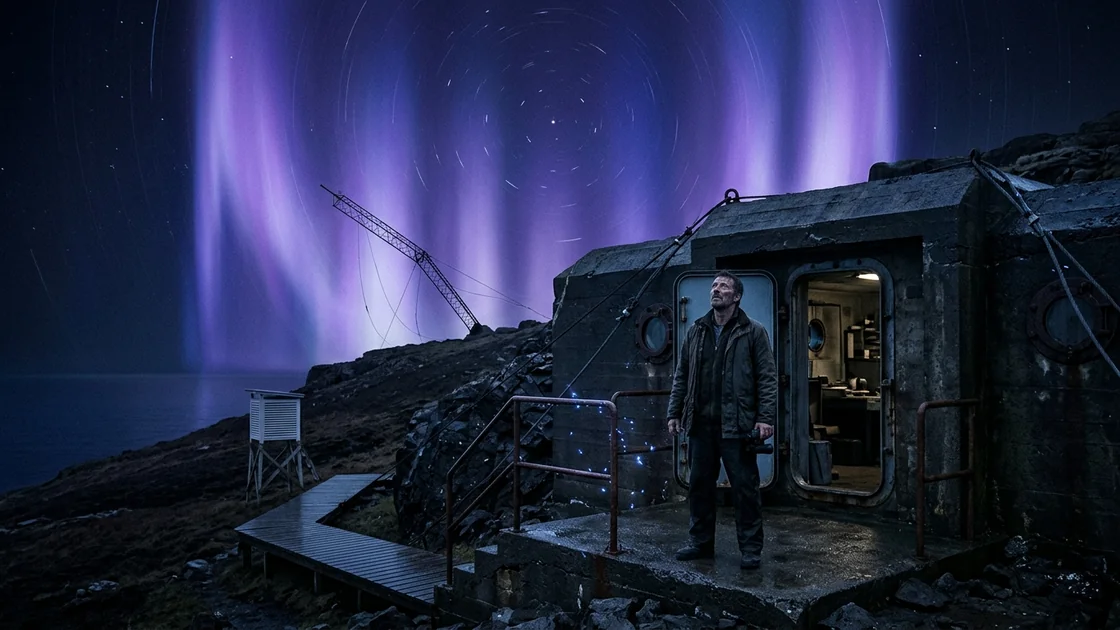
Arthur Lochlan, a solitary meteorological technician stationed on the remote North Atlantic outpost of Outstack Island, discovers that his atmospheric instruments are recording a massive, encroaching hurricane despite the sky outside remaining completely calm and clear. As he methodically troubleshoots his analog and digital sensor arrays, he realizes the equipment is not malfunctioning, but instead detecting a shadowy, phase-shifted storm system occupying the same physical space as the island. Cut off from the mainland by solar interference and skepticism from his superiors, Arthur watches the phantom cyclone intensify through his telemetry, eventually feeling its crushing barometric pressure and acoustic violence bleed into his reality. To survive the passage of the invisible eyewall, he must rely on his technical intuition and seal himself inside the station's concrete bunker before the pressure differential tears the outpost apart, leaving him with physical proof of an atmospheric layer science has never documented.
I. The Baseline of the Rock
Every six hours, regardless of the season or the temperament of the sea, Arthur Lochlan walked the timber boardwalk between the main living quarters and the Stevenson screen. It was a distance of one hundred and forty paces, bordered on the left by a sheer drop into the slate-gray churning of the North Atlantic and on the right by a slope of wet, lichen-scabbed basalt that rose toward the island’s central ridge.
Outstack Island did not appear on standard commercial maritime charts, except as a navigational hazard marked by a tiny cross and an elevation figure of eighty-two meters. It was three miles long, less than a mile wide at its waist, and shaped like a broken molar jutting out of the cold water two hundred miles northwest of the Outer Hebrides. For forty years, the Meteorological Office had maintained an outpost here because the island sat directly in the throat of the Iceland-Scotland gap, a natural wind tunnel where extratropical cyclones bred, deepened, and hurled themselves toward the European continent.
In the last decade, most of the work had been surrendered to automation. A lattice tower of galvanized steel stood at the crest of the ridge, bristling with Vaisala ultrasonic anemometers, laser ceilometers, platinum resistance thermometers, and net radiometers. Every sixty seconds, a Campbell Scientific data logger inside the fiberglass housing at the base of the tower polled the sensors, compiled their voltage outputs into a tidy string of ASCII characters, and beamed the packet upward to a geostationary satellite.
Arthur was there for the things the satellite could not do, and for the things the salt air inevitably ruined. Sea spray was a relentless, patient solvent. It crusted over the optical lenses of the visibility sensors; it corroded the delicate heating elements of the tipping-bucket rain gauges; it crept past neoprene gaskets and turned copper terminal blocks into powdery green verdigris. Without a human pair of hands to wipe the glass with distilled water, grease the guy-wire turnbuckles, and replace blown fuses after lightning strikes, Outstack Station would go blind and mute within six weeks.
More than that, Arthur was the custodian of the parallel record. Meteorological agencies are conservative institutions, obsessed with the continuity of data across centuries. Because a digital sensor measures the world differently than a column of mercury or a human eye, a purely automated station breaks the historical chain. Therefore, four times a day—at 0000, 0600, 1200, and 1800 Coordinated Universal Time—Arthur stepped out into the wind, unlocked the louvered wooden door of the Stevenson screen, and read the wet-bulb and dry-bulb mercury thermometers by the beam of a red-lens flashlight. He estimated the cloud cover in oktas. He judged the state of the sea according to the Douglas scale. Inside the station house, he tapped his knuckle lightly against the glass case of the Negretti & Zambra microbarograph and noted the position of its purple-inked nib upon the rotating brass drum.
He was fifty-four years old, a man whose divorces and career stalls had gradually distilled him down to someone who preferred the company of calibrated brass and predictable solitude. He had been on the rock for nine weeks of a sixteen-week winter rotation. The relief ship, the M.V. Pharos, was not due until late January.
On the morning of November fourteenth, at the 0600 observation, the weather was uncommonly dead.
Arthur stood on the boardwalk in his heavy fleece and oilskin trousers, his breath hanging in the dark air like woodsmoke. Usually, the wind on Outstack was a constant physical presence, a roaring, shoving weight that required you to lean into it at a fifteen-degree angle just to keep your boots on the planks. When the wind dropped below twenty knots, the silence felt unnatural, like an engine stalling in the middle of the night.
This morning, there was no wind at all. The cup anemometer on the auxiliary ten-meter mast hung completely motionless, its three black hemispherical spoons frozen against the starlight. Far below, at the base of the western cliffs, the ocean was a sheet of thick, oiled lead. Not even a long-period swell was running; the water merely breathed up and down against the kelp beds with a faint, rhythmic sigh.
Arthur unlatched the Stevenson screen. The dry-bulb thermometer read 4.2 degrees Celsius. The wet-bulb, its muslin wick drawing distilled water from a small brass reservoir, read 4.1. Nearly one hundred percent relative humidity, yet there was no fog. The air was crystalline. Above him, the constellations of Auriga and Gemini blazed with a hard, cold ferocity that he rarely saw through the usual blanket of low marine stratocumulus.
He jotted the figures into his waterproof Rite in the Rain notebook with a mechanical pencil, closed the louvered door, and walked back to the station house.
The station was a low, cast-concrete bunker built in the late nineteen-sixties, designed to survive hundred-knot gusts and rogue wave spray. Its roof was weighed down with steel cables anchored directly into the bedrock. Inside, it smelled permanently of diesel heating oil, damp wool, soldering rosin, and the stale coffee Arthur brewed in a battered aluminum percolator.
He shed his coat in the mudroom, stepped through the heavy bulkhead door into the instrument room, and went straight to the digital console to cross-check his manual readings against the automated synoptic message before it transmitted at ten minutes past the hour.
He woke the monitor with a tap of the spacebar. The green-and-white telemetry interface filled the screen, casting a pale glow across his stubbled cheeks.
Arthur frowned, leaning in over the desk.
The temperature figures matched closely enough: 4.18 degrees Celsius on the platinum probe. Relative humidity was 98.4 percent. Solar radiation was zero, as expected before dawn.
His eyes dropped to the wind and pressure fields, and his brow furrowed deeper.
WIND_DIR_10M: 245 DEG
WIND_SPD_10M: 38.4 KTS WIND_GST_10M: 46.1 KTS
PRES_SEA_LVL: 984.2 HPA
PRES_TEND_3H: -9.4 HPA (FALLING RAPIDLY)
Arthur blinked, rubbed the bridge of his nose, and looked toward the small, salt-rimmed porthole over the workbench. Through the thick glass, the dawn was just beginning to bruise the eastern horizon with a thin line of pewter light. The sea beyond the rocky headland was still flat. A stray gull sat perched on the railing of the outside walkway, its feathers entirely unruffled.
Thirty-eight knots was a fresh gale. At thirty-eight knots, the sea should have been heaped into long, breaking rollers with streaks of foam blowing downwind. The guy wires on the main tower should have been singing their low, mournful cello note that vibrated right through the concrete foundation into the soles of Arthur’s slippers.
And the pressure—984.2 hectopascals, down more than nine millibars in three hours. Three hours ago, at the midnight observation, the pressure had been a stout, stable 1018.6 hectopascals, sitting squarely under a stubborn ridge of Greenland high pressure. A drop of nine millibars in three hours was the kind of plunging barometer that heralded an explosive cyclogenesis—a weather bomb. A drop of thirty-four millibars since midnight was physically impossible without the sky falling in on his head.
"Water in the junction box," Arthur muttered aloud. His voice sounded rusty from twelve hours of disuse. "Has to be."
When salt moisture crept into the multiplexer on the main mast, it sometimes created parasitic resistances across the terminal strips, scrambling the analog-to-digital conversion and spitting out garbage numbers. Still, the Vaisala ultrasonic anemometer and the digital barometer were on entirely separate communications buses. The anemometer used RS-485 serial data; the barometer sat right here inside the heated building, vented to the outside only by a static pressure head on the roof connected via a silicone tube.
Arthur turned away from the computer screen and walked across the linoleum floor to the mahogany-framed Negretti & Zambra microbarograph sitting on its vibration-damping rubber pads on the rear shelf.
The microbarograph had no circuit boards, no serial buses, and no software. Its heart was a vertical stack of eight evacuated brass capsules—aneroid bellows—that expanded and contracted purely in response to the physical weight of the atmosphere pressing down on the island. That tiny mechanical motion was magnified through a delicate system of jeweled levers and pivots, moving a long silver arm tipped with a reservoir of purple ink across a paper chart wrapped around a clockwork-driven brass cylinder.
Arthur bent down and peered through the beveled glass.
For the first five days of the week, the purple line had traced a gentle, undulating plateau near the top of the chart, hovering lazily between 1015 and 1020 millibars.
Just after the two o’clock mark that morning, the line had turned downward. It was not a curve; it was a cliff. The purple trace plunged almost vertically across the grid lines, slicing through 1010, 1000, 990, and currently resting at 984, vibrating with tiny, jagged teeth that indicated rapid micro-fluctuations in pressure—the classic signature of severe turbulence and gusty winds pumping the air inside the room.
Arthur stared at the brass bellows. As he watched, the stack of disks gave a microscopic, visible shudder, expanding upward by another fraction of a millimeter, pulling the ink nib down another half-millibar.
He reached up and touched his own ears. They felt full, slightly tight, as though he had just driven down a steep mountain pass or begun the descent in a commercial airliner. He swallowed hard, and his eardrums gave a sharp, distinct pop.
He stood very still in the quiet room, listening to the ticking of the clockwork drum and the low hum of the computer power supply. Outside, the gull on the railing preened its left wing in the dead, windless air.
II. The Diagnostic Protocol
By 0830, the sun had cleared the horizon, though it looked less like
a star and more like a dull brass coin dropped into a bucket of clean
water. There were still no clouds. The laser ceilometer, which fired
vertical pulses of near-infrared light into the sky to measure the
height of cloud bases, was returning an endless series of
CLR codes—except every fourth or fifth scan, when it
inexplicably registered a dense, opaque scattering layer at four hundred
meters, followed immediately by clear sky again.
Arthur did not like mysteries. Mysteries in remote field stations almost always reduced down to human oversight, rodent teeth on coaxial cables, or degraded silicon. He poured himself a mug of black coffee, pulled down the thick three-ring binder labeled Outstack ASOS Maintenance & Calibration Manual, and began a methodical sweep of the station's architecture.
First, he checked the Fortin barometer.
The Fortin was the ultimate arbiter of truth in the station, mounted in a dark, windowless closet near the center of the concrete bunker where temperature variations were minimal. It was a four-foot-long glass tube filled with thirty pounds of triple-distilled liquid mercury, inverted into a leather-bottomed cistern. Gravity pulled the mercury down; the weight of the atmosphere pushing on the open cistern forced the mercury up. Nothing short of an alteration in the planet's gravitational constant or a true change in air pressure could make a Fortin barometer lie.
Arthur switched on the low-wattage fluorescent light inside the closet. He turned the brass thumbscrew at the bottom of the cistern, raising the leather bag until the surface of the mercury pool just kissed the tip of the ivory fiducial pointer—the zero mark. Once the meniscus and its reflection in the mercury formed a perfect, unbroken double-cone around the ivory tip, he raised his eyes to the upper scale and adjusted the vernier slide until its lower edge aligned with the top of the mercury column.
He read the millimeter scale, applied the correction for the ambient temperature of the closet (18.5 degrees Celsius) and the latitude correction for Outstack’s position at 59 degrees North.
976.8 hectopascals.
In the two and a half hours since the 0600 synoptic run, the pressure had fallen another seven and a half millibars.
Arthur let out a slow breath through his teeth. So the pressure drop was real. Or, wait—could the static pressure port on the roof be blocked?
The building itself wasn't hermetically sealed, of course, except during severe storm lock-downs when the storm shutters were bolted over the portholes and the heavy marine dogs were hammered down on the outer doors. Right now, the ventilation louvers in the generator room were open, and he had walked in and out of the mudroom twice. The air pressure inside the building had to be equalized with the outside air.
To be certain, he unlatched the Fortin barometer from its gimbaled wall bracket—a nerve-wracking procedure he had only performed once during a station refurbishment three years ago—and carried the heavy, fragile brass cylinder out through the mudroom and onto the concrete porch. He hung it from the calibration hook bolted into the exterior masonry wall, waited twenty minutes for the instrument's thermometer to equilibrate with the chilly morning air, and read it again.
975.1 hectopascals.
In the open air, under a cloudless, pale blue November sky with the ocean lying flat as a millpond below the cliffs, the atmospheric pressure on Outstack Island was equivalent to the interior of a Category 2 hurricane.
"That's not how fluid dynamics works," Arthur said to the empty porch.
Air was a fluid. It possessed mass and viscosity. If you excavated a thirty-five-millibar hole in the atmosphere over a patch of the North Atlantic, the surrounding air at higher pressure was obligated by the laws of physics to rush inward down the pressure gradient, deflected to the right by the Coriolis force, accelerating until the pressure gradient force balanced the centrifugal and frictional forces. You could not have a deep barometric trough without wind any more than you could carve a trench in the middle of the ocean without water pouring over the sides to fill it.
And yet, there was no wind.
Wait. He thought back to the computer screen. There was no wind against his skin, and no wind turning the aluminum cups on the backup mast. Why was the main tower reporting a gale?
Arthur went back inside, grabbed his digital multimeter, a set of insulated screwdrivers, and his climbing harness, and hiked up the gravel switchback toward the central ridge.
The climb took fifteen minutes, and by the time he reached the concrete pad at the base of the ten-meter lattice tower, he was breathing hard, a dull, throbbing headache gathering behind his eyes. The air felt thin, or rather, strangely attenuated, making him draw deeper breaths than the modest eighty-meter elevation warranted.
He looked up at the tower cross-arm. On the northern boom sat the R.M. Young mechanical wind monitor—a classic four-blade helicoid propeller mounted on a streamlined tail vane. It was completely stationary, the nose cone pointing lazily toward the southeast where the last light breeze had died the previous evening.
On the southern boom, six feet away, sat the Vaisala WMT700 ultrasonic wind sensor. It had no moving parts at all. It consisted of three heated stainless-steel arms arranged in an equilateral triangle, rising from a central mounting shaft. At the tip of each arm was an electro-acoustic transducer. The instrument worked by firing high-frequency ultrasonic pulses back and forth between the three pairs of transducers and measuring the transit time of the sound waves down to the nanosecond. Wind blowing through the triangle carried the sound waves along with it, speeding up the pulse in the direction of the wind and delaying the pulse traveling against it.
Arthur opened the fiberglass enclosure at the base of the tower and plugged his ruggedized service laptop into the Campbell data logger's diagnostic port. He brought up the raw, unaveraged serial stream from the two wind sensors, polling at four hertz.
The mechanical propeller output was a flat line of zeros:
0.00 m/s, 0.00 m/s, 0.00 m/s.
The ultrasonic sensor right beside it was screaming:
22.4 m/s @ 248 deg 24.1 m/s @ 251 deg
21.8 m/s @ 246 deg 26.9 m/s @ 249 deg
Twenty-six meters per second was over fifty knots.
Arthur clipped into the fall-arrest cable on the tower ladder and climbed the cold steel rungs to the top cross-arm. He locked his lanyard around the main stanchion and leaned out to inspect the ultrasonic array. Sometimes a spider built a dense web between the transducers, or salt crystals bridged the acoustic mirror, scattering the pulses and tricking the microprocessor into calculating phantom transit delays.
The transducers were immaculate. The matte black silicone rubber covers on the acoustic tips were clean, warm to the touch from their internal anti-icing heaters, and entirely free of salt or webbing. He held his bare hand directly inside the six-inch triangle between the three metal horns.
The air between the prongs was dead calm. Not a whisper of breeze cooled his skin.
Yet, when he looked down at the screen of the service laptop hanging
from its shoulder strap against his hip, the insertion of his hand had
only momentarily caused an ERR_BLOCKED code before he
pulled his fingers back, whereupon the sensor immediately resumed
reporting a fifty-knot gale from the west-southwest.
Arthur stared at the six inches of empty air between the steel prongs.
For an ultrasonic sensor to register a fifty-knot wind when the air was still, the speed of sound traveling from the southwestern transducer to the northeastern transducer had to be significantly faster than the speed of sound traveling in the opposite direction. In a stationary gas, the speed of sound is isotropic—the same in all directions, governed purely by the temperature and molecular weight of the air. Only a moving medium could create an directional asymmetry in acoustic transit time.
Unless there were two mediums occupying the same space, and one of them was moving very fast indeed.
Arthur laughed shortly, a dry, nervous sound that vanished into the quiet morning, and shook his head. That was the kind of crackpot thinking that got men pulled off island rotations and sent to occupational psychologists in Aberdeen. There was a physical explanation. Perhaps high-frequency electromagnetic interference from the satellite transmitter was coupling into the transducer wires, creating a phase shift in the timing circuit.
He climbed down the tower, disconnected the satellite transmitter entirely, and ran the data logger solely off its twelve-volt deep-cycle battery bank, isolating it from the station's AC mains.
The ultrasonic sensor now read fifty-four knots. And the barometer in the logger housing read 971.2 hectopascals.
III. The Synoptic Ghost
At 1000 hours, Arthur sat down at the communications desk in the station house and initiated a satellite link to the regional forecasting center in Aberdeen. Because high-bandwidth data over the maritime satellite cost the agency by the megabyte, routine communication was handled through an arcane, text-based messaging system called MetComm, or via high-frequency single-sideband voice radio when ionospheric conditions permitted.
First, he downloaded the latest North Atlantic surface analysis chart—a low-resolution black-and-white TIFF file showing isobars, frontal boundaries, and station plots across the ocean from Newfoundland to Norway.
The chart loaded line by line down the screen.
When it finished, Arthur leaned back in his swivel chair, staring at the map.
According to the Aberdeen analysts, the entire northeastern Atlantic was dominated by a sprawling, stagnant anticyclone—a high-pressure system centered just south of Iceland at 1028 hectopascals. The isobars were spaced hundreds of miles apart, indicating light, variable winds across the whole region. Ship reports from a container vessel eighty miles south of Outstack and a Norwegian weather buoy a hundred miles north both showed pressures above 1022 hectopascals and winds under ten knots.
Right in the middle of that tranquil dome of high pressure sat the
station plot for Outstack Island—station identifier
03001.
The automated plotting software in Aberdeen had dutifully ingested Outstack’s 0600 and 0900 synoptic transmissions, and then a human forecaster had drawn a gigantic red question mark over the island with a digital stylus, placing the entire station plot in brackets to flag it as corrupt data rejected by the numerical weather prediction models.
As Arthur looked at the map, the MetComm terminal chimed. A text message window popped open from M.Kerr@MetOffice.Aberdeen.
MORNING ARTHUR. YOUR ASOS IS THROWING WILD NUMBERS INTO THE GTS STREAM Since 0300Z. BARO READING 974 AND ULTRASONIC WINDS AT GALE FORCE UNDER A 1026MB HIGH. SATELLITE IR AND VISIBLE SHOW ZERO CLOUD OVER YOU. WE HAVE SUPPRESSED YOUR AUTO-REPORTS FROM THE MODEL INGEST. HAVE YOU HAD A POWER SURGE OR LIGHTNING DAMAGE TO THE LOGGER? — MALCOLM
Arthur’s fingers hovered over the mechanical keyboard. He glanced across the room at the Negretti & Zambra microbarograph. The purple ink line was now at 968 millibars, still angling downward at forty-five degrees. He looked at the thermos of coffee on his desk; when he had unscrewed the stopper ten minutes ago, the trapped air inside the thermos had hissed outward into the room like a carbonated soda bottle opening.
He began to type.
MORNING MALCOLM. NEGATIVE ON POWER SURGE. ISOLATED THE LOGGER ON BATTERY AND CHECKED RAW SERIAL STREAM. HERE IS THE KICKER: THE DIGITAL BARO IS NOT DRIFTING. I CHECKED IT AGAINST THE FORTIN MERCURY COLUMN AND THE MECHANICAL BAROGRAPH. ALL THREE AGREE WITHIN 0.3 HPA. CURRENT STATION PRESSURE IS 967.9 HPA AND FALLING AT 3 HPA PER HOUR.
He hit send and waited. Through the porthole, the daylight had taken on a peculiar, flat quality. There were still no clouds, not a single wisp of cirrus or tuft of cumulus, yet the blue of the sky looked bleached, almost violet-gray toward the zenith, as if he were viewing it through a pair of polarized sunglasses rotated at an odd angle.
Three minutes passed before the terminal chimed again.
ARTHUR, COME ON. IF YOU WERE SITTING IN A 967MB LOW INSIDE A 1026MB HIGH, THE PRESSURE GRADIENT ACROSS SIXTY MILES WOULD BE ALMOST ONE MILLIBAR PER MILE. YOU WOULD BE IN WINDS EXCEEDING 120 KNOTS. THE OCEAN WOULD BE WASHING OVER THE ROOF OF THE BUNKER. WHAT IS THE ACTUAL WEATHER OUTSIDE YOUR WINDOW?
Arthur typed slowly.
CALM. ZERO WIND ON THE CUP ANEMOMETER AND PROPELLER VANE. SEA STATE IS 0 TO 1, GLASSY CALM. VISIBILITY UNLIMITED. TEMPERATURE 4.5C. HOWEVER, THE VAISALA ULTRASONIC ANEMOMETER IS REPORTING 52 KNOTS SUSTAINED FROM 250 DEGREES, AND THE LASER CEILOMETER IS INTERMITTENTLY Pinging A DENSE LAYER AT 1200 FEET THAT IS NOT VISUALLY PRESENT.
A longer pause this time. Five minutes. Seven. Arthur could picture Malcolm Kerr in the brightly lit open-plan floor in Aberdeen, calling over a senior instrumentation engineer, the two of them squinting at the raw telemetry tables from Outstack.
Finally, the cursor blinked to life.
OKAY, WE JUST TALKED TO SYSTEMS ENGINEERING. ONLY TWO THINGS CAN DROP BOTH A FORTIN MERCURY BAROMETER AND AN ANEROID CAPSULE WHILE THE OUTSIDE AIR IS CALM: EITHER YOU HAVE SEALED THE BUNKER AND YOUR DIESEL EXHAUST FAN IS PULLING A MASSIVE VACUUM ON THE BUILDING INTERIOR, OR SOMEONE DROPPED THE FORTIN AND SPILLED MERCURY FROM THE CISTERN WHILE SIMULTANEOUSLY BENDING THE LINKAGE ARM ON THE BAROGRAPH. CHECK YOUR VENTILATION LOUVERS, ARTHUR. AND SERIOUSLY, CHECK YOUR CO DETECTOR.
Arthur felt a flash of professional irritation, sharp and hot. He had been calibrating precision meteorological instruments when Malcolm Kerr was still in secondary school learning what an isobar was.
I CARRIED THE FORTIN OUTSIDE ONTO THE PORCH, MALCOLM. IT READ 975 IN OPEN AIR AN HOUR AGO. MY CARBON MONOXIDE DETECTOR READS ZERO PPM. MY EARS ARE POPPING EVERY TWENTY MINUTES. THE PRESSURE DROP IS PHYSICAL. ALSO, I AM GOING TO DO AN EXTRAORDINARY RADIOSONDE LAUNCH AT 1100Z TO PROFILE THE UPPER AIR. WATCH THE TELEMETRY.
DO NOT WASTE HELIUM ON A GLITCH, ARTHUR. WE ONLY SEND YOU FOUR CYLINDERS PER ROTATION. SWITCH THE ASOS MULTIPLEXER TO THE SECONDARY CHANNEL AND REBOOT THE CAMPBELL LOGGER.
Arthur did not reply. He minimized the terminal window, stood up, and pulled his heavy canvas coveralls off their peg by the door.
IV. The Ascent into the Shear
The balloon inflation shed stood thirty yards south of the main bunker, built into the lee of a granite outcrop so that during normal winter gales a technician could inflate a six-foot latex envelope without having it ripped from his hands the moment the rollup door was raised.
Inside, the shed smelled sharply of talcum powder and synthetic rubber. Four tall, olive-drab steel cylinders of compressed helium stood chained to the concrete wall.
Arthur worked with the practiced economy of a man who had performed this ritual two thousand times. He took a fresh Vaisala RS41 radiosonde from its cardboard shipping box. The sonde was a sleek little brick of white expanded polystyrene, weighing less than four ounces, with a thin silver stalk protruding from the top that held the capacitive temperature bead and the heated humidity sensor. Inside the foam casing sat a GPS receiver, a silicon pressure sensor, a lithium battery, and a 403-megahertz radio transmitter.
He placed the sonde into the ground-check calibration unit on the workbench. The unit initialized the sonde, synchronized its radio frequency with the station’s L-band tracking antenna, and verified its sensors against a laboratory-grade reference inside the chamber.
Wait a second, Arthur thought, watching the ground-check LED blink green. The reference sensor inside the ground-check box had to agree with the sonde's internal barometer before it would pass calibration.
He looked at the diagnostic readout on the ground-check screen.
SONDE_PRES: 963.4 HPA REF_PRES: 963.5 HPA
CALIBRATION: PASS
"Four separate barometric systems," Arthur whispered. The Fortin mercury column, the Negretti & Zambra brass bellows, the ASOS silicon bridge, and now a factory-sealed radiosonde pulled straight out of a vacuum-foil pouch. Every single one of them insisted that the weight of the atmosphere above Outstack Island had diminished by nearly six percent since midnight.
He unrolled a creamy latex Totex balloon onto the felt-covered inflation table, attached the nozzle to the helium regulator, and cracked the brass valve. The loud, dry hiss of expanding gas filled the cold shed. The latex skin swelled, lifting itself off the table like a living lung, growing into a taut, translucent sphere five feet in diameter until its buoyancy lifted the brass nozzle weight straight off the bench—the precise measure of lift required to carry the sonde upward at three hundred meters per minute.
Arthur tied off the neck with heavy waxed twine, attached the biodegradable paper parachute and the thirty-meter unwinder spool, and clipped the white radiosonde to the bottom of the rig.
He rolled up the corrugated steel door of the shed and stepped out into the brightness.
There was still no wind. Usually, launching a balloon on Outstack was a violent athletic contest—sprinting downwind along the rocky path, waiting for a lull between gusts, and hurling the balloon upward while praying the downdraft over the cliff didn't slam the eighty-dollar sensor package straight into the boulders. Today, the giant white sphere floated straight up above Arthur’s head on its short tether, tugged only by the pure vertical vector of Archimedes' principle.
Yet, as he walked the balloon out onto the gravel launch pad, he noticed something that made him stop in his tracks.
The balloon was vibrating.
It wasn't swaying side to side; its center of mass remained directly above his outstretched hand. Instead, the taut latex membrane was shivering with high-frequency ripples, as though someone were playing a bass guitar right next to it, or as if a powerful stream of invisible, non-viscous particles were sleeting right through the rubber skin. A faint, dry humming sound came from the waxed twine between his fingers, the exact pitch a fishing line makes when drawn tight through a fast current.
Arthur swallowed, his throat dry, and opened his hand.
The balloon shot straight upward into the cloudless sky. The red plastic unwinder spool spun wildly, paying out the thirty meters of suspension cord as the balloon climbed at a perfect ninety-degree angle above the concrete pad.
Arthur hurried back into the station house to monitor the flight on the DigiCORA sounding workstation.
For the first sixty seconds, he watched through the porthole with a pair of 7x50 marine binoculars while glancing back and forth at the telemetry screen.
Through the binoculars, the white sphere was rising straight up like an elevator. It showed no lateral drift whatsoever. By two minutes into the flight, at an altitude of roughly six hundred meters, it was still positioned directly over the island’s central ridge, a bright white pearl shrinking steadily against the strange, violet-tinged dome of the sky.
He lowered the binoculars and looked at the workstation monitor.
The telemetry made no sense at all.
First, the thermodynamic profile—the Skew-T log-P diagram that plotted temperature and dew point against pressure altitude—was completely alien to the sub-polar North Atlantic in November.
At the surface, the sonde had recorded 4.4 degrees Celsius. Within the first two hundred meters of ascent, however, the temperature had not dropped according to the normal adiabatic lapse rate; it had spiked. At 940 hectopascals, the sonde was reporting a temperature of 18.2 degrees Celsius and a relative humidity of 100 percent. It was climbing through a warm, saturated, tropical air mass. The wet-bulb potential temperature was off the charts for sixty degrees north latitude—it looked like a sounding taken inside the eyewall of a West Pacific super-typhoon over the Philippine Sea.
Second, the wind profile—derived from the sonde's onboard GPS receiver tracking its horizontal movement—was completely divorced from what Arthur had just seen with his own eyes through the binoculars.
According to the GPS telemetry on the screen, the balloon was not floating straight up over the island. The data stream showed the sonde being violently accelerated toward the northeast at 84 knots, spiraling around a tight cyclonic radius less than fifteen miles away. The telemetry map showed the balloon already three miles off the northeastern tip of Outstack, hurtling out over the open ocean in a screaming low-level jet stream.
Arthur grabbed the binoculars again and ran out onto the porch, craning his neck straight back until the vertebrae popped.
High overhead, directly at the zenith, the tiny white dot of the latex balloon hung in the calm sky above the station roof.
He looked down at his watch, then back up through the lenses. He braced his elbows against the porch railing to steady the image. The balloon was right there, directly above him, rising serenely through the still, freezing air.
Yet the radio signal coming down from the 403-megahertz transmitter hanging beneath that very balloon was reporting that its GPS receiver was reading satellite pseudorange delays corresponding to a position four miles away, inside a warm, saturated hurricane blowing at ninety knots, with the turbulence sensor registering violent four-G vertical updrafts and downdrafts.
Wait. GPS pseudorange delays.
Arthur lowered the binoculars slowly, his mind racing through the physics of the instrumentation. How did a GPS receiver know where it was? It did not have eyes. It listened to faint microwave timing signals from a constellation of satellites twelve thousand miles up, and it calculated its distance from each satellite by multiplying the travel time of the radio wave by the speed of light, adjusted for delays through the ionosphere and troposphere.
Just like the ultrasonic anemometer on the tower measured the transit time of sound waves through the air between its prongs.
If the atmospheric medium above Outstack Island was somehow warped—if the refractive index of the air, its acoustic impedance, and its barometric density were being governed by a second, invisible structure occupying the exact same geographic coordinates—then every wave passing through it, whether sound, infrared laser light, or L-band microwave telemetry, was being bent, delayed, and Doppler-shifted by that phantom structure.
Wait—what about the temperature and humidity sensors on the sonde? Those didn't use waves! The temperature sensor was a tiny platinum wire whose electrical resistance changed with heat; the humidity sensor was a thin polymer film whose capacitance changed as water molecules absorbed into its microscopic pores.
If the sonde was reading eighteen degrees Celsius and one hundred percent humidity at two thousand feet, then something up there was genuinely imparting thermal energy and dielectric permittivity to the sensor stalk, even while the visible sky remained clear and four degrees above freezing.
Suddenly, through the binoculars, Arthur saw the balloon die.
It was at an altitude of roughly three thousand meters—barely a third of the way to the tropopause where latex balloons normally expanded to thirty feet across and burst in the thin stratospheric air. Instead of swelling gracefully and popping into harmless shreds, the white dot overhead abruptly flattened into a distorted, elongated teardrop, as if a giant invisible fist had slammed down on it from above.
A fraction of a second later, it tore in half horizontally. Even from ten thousand feet below, in the dead silence of the island, Arthur thought he heard a faint, dull thump—not the sharp crack of bursting rubber, but the low-frequency concussion of a pressure wave hitting an obstacle.
Inside the station house, the DigiCORA workstation emitted a long,
flat warning beep:
SONDE SIGNAL LOST — ALTITUDE 3140M — LAST WIND 118 KTS — LAST PRES 612 HPA.
V. The Acoustic Bleed
By 1400 hours, the sun was already sinking toward the southwestern horizon, though the sky had changed in a way that made Arthur’s skin prickle every time he looked out the window.
There were still no clouds made of water droplets or ice crystals. You could look right up and see the pale disk of the waxing moon in the afternoon sky. Yet the air was no longer transparent. It had developed a visible grain, like heated air shimmering above a hot asphalt highway in July, except the shimmer was organized into vast, sweeping, concentric bands that raced across the zenith from the southwest to the northeast.
When the sun’s low rays struck these bands at a grazing angle, they produced bizarre optical phenomena: brief, bruised smears of iridescence—magenta, teal, and tarnished gold—that flared in the empty blue air and vanished in less than a second, like oil slicks spreading across invisible glass.
In the station house, the Negretti & Zambra microbarograph had reached the bottom margin of its paper chart.
Standard barograph paper was printed with a scale running from 950 to 1050 millibars. Only during the most historic North Atlantic tempests—like the Braer Storm of 1993, which bottomed out at 914 millibars—did a technician ever have to reset the zero-adjusting thumbscrew on the linkage arm to shift the pen back onto the paper so it wouldn't jam against the brass baseplate.
At 1345, the purple ink nib had hit the 950-millibar bottom line and flattened out against the brass flange.
Arthur had opened the glass case, carefully turned the knurled brass
adjustment screw to shift the baseline by fifty millibars, and written
in neat block letters with a red ballpoint pen directly on the paper
drum:
BASELINE SHIFTED -50 HPA AT 1350Z. LINE NOW READS 900-1000 HPA.
Now, twenty minutes later, the purple line was at 942 hectopascals and still plunging.
His physical body was beginning to revolt against the environment. The headache behind his temples had sharpened into a steady, rhythmic vise. His knees and the old healed fracture in his left collarbone ached with a fierce, toothache throb—barometric arthralgia, magnified tenfold. Every time he moved from one room to another, his ears crackled and popped.
When he went into the galley at 1415 to make a pot of tea, he noticed that the electric kettle came to a rolling boil much faster than usual. Curious, he took a digital probe thermometer from his toolkit and stuck it into the boiling water.
At normal sea-level pressure of 1013 hectopascals, pure water boils at 100 degrees Celsius. Inside the Outstack galley, the violently boiling water inside the kettle measured 97.9 degrees Celsius.
The ambient air pressure inside his kitchen was genuinely low enough to depress the boiling point of water by more than two degrees. In the pantry, sealed Mylar bags of salted peanuts and freeze-dried emergency rations were puffed up tight as footballs, their seams straining outward against the reduced external pressure, occasionally giving off little snapping sounds as the foil crinkled.
He carried his mug of lukewarm tea back to the communications console. He had sent the radiosonde file to Aberdeen two hours ago, along with a detailed text message explaining the boiling-point test and the barograph baseline shift.
There had been no reply from Malcolm Kerr.
In fact, when Arthur looked at the satellite modem status panel, the
green LINK light was dark, replaced by a rapidly flashing
amber SYNC LOSS LED.
He brought up the satellite modem’s diagnostic page on the browser. The dish on the roof was still bolted rigidly to its steel pier, pointed at the exact azimuth and elevation of the Inmarsat bird over the equator. There were no clouds in the sky to cause rain fade. Yet the signal-to-noise ratio had collapsed from a healthy 14 decibels down to -3 decibels, buried under a massive floor of broadband microwave noise, and the phase-locked loop could not hold the carrier frequency because the incoming signal was being Doppler-shifted up and down by several kilohertz every second.
He was cut off from the satellite.
Arthur switched on the Icom high-frequency single-sideband transceiver, put on the heavy padded headphones, and tuned across the marine emergency frequencies—2182 kilohertz, 4125, 6215, 8291.
Usually, the HF bands were alive with the reassuring chatter of the ocean: Scottish fishing trawlers arguing over catch quotas off Rockall, automated Volmet weather broadcasts reading out robotic aviation forecasts from Shannon and Gander, Coastguard navigational warnings from Stornoway.
Today, the headphones delivered nothing but a deafening, terrifying roar.
It was not ordinary atmospheric static—not the crisp crackle of distant lightning sferics or the steady white-noise hiss of cosmic background radiation. It sounded like wind. It was a deep, resonant, cyclonic howling that rose and fell in long, rhythmic cadences through the radio speaker, as though the copper dipole antenna stretched between the station roof and the generator shed were acting as a microphone plugged directly into another dimension's tempest.
Arthur pulled the headphones off one ear and froze.
The howling did not stop when he removed the earpiece.
A fainter, lower version of the exact same sound was coming through the three-foot-thick reinforced concrete walls of the bunker.
He set the headphones down on the desk, walked into the mudroom, and opened the heavy steel exterior door.
He stepped out onto the concrete porch.
The ocean below the cliffs was still flat. The aluminum cups on the backup mast were still dead stationary. When he held up a wet finger, the air around his hand was utterly motionless and cold.
And yet, the island was roaring.
The sound came from everywhere and nowhere at once—from the basalt rock beneath his boots, from the empty air ten feet above his head, from the steel guy wires of the silent tower up on the ridge. It was the unmistakable acoustic signature of a major hurricane: the deep, freight-train rumble of a seventy-knot sustained wind tearing across rough terrain, mixed with the higher, shrieking whistle of vortices shedding off sharp edges, and beneath it all, the booming, rhythmic concussion of forty-foot breakers slamming against the cliff face below.
Arthur walked to the wooden safety railing at the edge of the boardwalk and looked straight down into the cove.
The water in the cove was like dark green glass. He could clearly see the submerged boulders twenty feet down and the brown fronds of laminar kelp swaying lazily in the gentle tidal current. Not a single ripple broke the surface.
At the exact same moment, a deafening CRASH of invisible surf detonated against the cliff right below him, so loud and low in frequency that he felt the concussion vibrate through his sternum, followed by the distinct, hissing roar of thousands of tons of phantom whitewater cascading back down the dry, black rock.
A flock of six fulmars—hardy oceanic seabirds built to glide effortlessly through the worst winter gales—came skimming low around the southern point of the island, flying fast and panicked just above the flat water.
Arthur watched them with rising dread. The birds were flying through calm air, their wings beating frantic, erratic strokes, clearly disoriented by the terrible pressure drop and the roaring acoustic chaos. As the lead fulmar crossed an invisible line fifty yards off the rocky point, it did not hit anything visible—it simply folded up in mid-air as if struck sideways by a solid wall moving at eighty miles an hour. Its neck snapped back, a puff of gray contour feathers exploded outward in a tight spiral, and the broken body tumbled straight down, hitting the mirror-flat surface of the sea with a tiny, lonely plop that sent out the only concentric ripples in the entire cove.
The remaining five birds banked wildly to the east, only for two more of them to be caught in an unseen vertical shear zone; they were slammed straight downward into the flat water hard enough to leave small white splashes before floating motionless on the glass-calm swell.
Arthur backed away from the railing, his heart hammering against his ribs.
The storm was coupling.
Whatever phase-separation or atmospheric boundary had kept the cyclone's kinetic energy locked away in a state that only affected acoustic waves, electromagnetic radiation, and barometric density was breaking down as the central pressure deepened. The pressure gradients were becoming so violent, so steep, that they were beginning to drag at physical matter—shearing the birds out of the sky, shaking the bedrock, and leaking raw acoustic violence into the quiet afternoon.
VI. Mapping the Anomaly
Inside the bunker, Arthur’s hands trembled slightly as he pulled a blank North Atlantic plotting chart from the map drawer and laid it across the light table.
If he was trapped in the path of this thing, he was not going to sit in the dark waiting for it like a frightened rabbit. He was a meteorologist. Even when the sky broke the rules of physics, a cyclone still had geometry. It had a center of circulation, a translational velocity, a radius of maximum winds, and a barometric tendency curve. If he could plot it using the single-station methods taught to mariners before the age of weather satellites, he could figure out where he was inside the storm's structure and when the worst of it would pass over the rock.
He pulled out his parallel rulers, a brass divider, and his logbook containing every fifteen-minute automated dump from the Campbell data logger since midnight.
He applied Buys Ballot’s Law: in the Northern Hemisphere, if you stand with your back to the wind, the center of low pressure lies to your left and slightly ahead of you, angled inward by ten to twenty degrees due to surface friction.
Wait—did this storm experience surface friction against the ocean and the island?
He looked at the ultrasonic wind direction history from the tower:
- 0300Z:
242 DEG @ 22 KTS - 0600Z:
245 DEG @ 38 KTS - 0900Z:
249 DEG @ 52 KTS - 1200Z:
251 DEG @ 68 KTS - 1500Z:
254 DEG @ 86 KTS
The wind direction was backing or veering by barely twelve degrees over twelve hours while the speed quadrupled and the pressure plunged from 1018 down to 934 hectopascals.
In a normal moving cyclone passing north or south of a station, the wind direction shifts steadily through a ninety- to one-hundred-and-eighty-degree arc as the circulation center moves past. There is only one scenario where the wind direction remains nearly constant while the wind speed rockets upward and the barometer falls off a cliff:
The center of the storm is not passing to the north or south. It is tracking straight down the bearing line directly toward the observer.
If the wind was blowing from 250 degrees—west-southwest—then the center of the low lay to the north-northwest, except... wait. If the storm was coming from the northwest and the wind was from the west-southwest, the wind would be shifting. Unless the storm was stationary and rapidly deepening in place, or its inflow angle was radically different from a normal baryonic fluid because it didn't interact with the ocean surface the same way.
Let's look at the laser ceilometer and net radiometer logs, Arthur thought, pulling the second printout across the desk.
The net radiometer measured incoming shortwave solar radiation and incoming longwave infrared radiation from the sky. Even though the sky looked visually clear to Arthur’s eyes, the pyrgeometer—the longwave infrared sensor that looks at heat radiated downward by clouds and greenhouse gases in the 4.5 to 42 micrometer band—was registering 430 watts per square meter of downward infrared flux!
Four hundred and thirty watts per square meter of downward thermal infrared was impossible under a clear polar sky, which normally read around 210 watts per square meter. That reading meant there was an overcast, optically thick, warm canopy sitting directly overhead in the thermal infrared spectrum, radiating heat downward like a giant blackbody blanket at twenty degrees Celsius, completely invisible to human vision in the 400 to 700 nanometer optical band, yet opaque to the pyrgeometer and the 905-nanometer laser ceilometer!
"It's not phase-shifted," Arthur whispered, staring at the numbers. His pencil tip snapped against the chart paper. "It's spectrally decoupled."
Or rather, it was an atmospheric mass composed of something that interacted normally with gravity and mass-pressure—hence the Fortin barometer and the aneroid capsules feeling its weight, and the ambient air pressure dropping as the two fluids displaced one another—and interacted strongly with infrared radiation, microwaves, and high-frequency acoustic waves, while remaining almost entirely non-interactive with visible light and low-velocity mechanical shear against large solid objects... until the kinetic energy density crossed a threshold.
And that threshold was being crossed right now.
At 1600 hours, as the pale, bruised twilight settled over the island, a sound like a rifle shot rang out from the ridge above the bunker.
Arthur flinched, looking toward the ceiling. A moment later, the telemetry terminal on his desk began flashing red alarm banners across every data field:
WARN: MAST_10M_TILT_EXCEEDED
ERR: PYRGEOMETER_OPEN_CIRCUIT
ERR: CEILOMETER_OPTICS_FAULT
WIND_SPD_10M: 114.6 KTS
WIND_GST_10M: 138.2 KTS
PRES_SEA_LVL: 911.4 HPA
Arthur ran to the northern porthole, pressed his forehead against the thick marine glass, and looked up the slope toward the main instrument ridge.
In the gathering gloom, the thirty-foot galvanized steel lattice tower was still standing against the cloudless, twilight sky. The mechanical propeller vane on its northern boom was still completely motionless, pointing lazily toward the southeast.
Yet the tower itself was bending.
One of the heavy three-quarter-inch braided steel guy wires on the windward—southwestern—side had snapped cleanly in two at the turnbuckle; its loose end hung limp and straight down beside the concrete anchor block, entirely unswayed by any breeze. Meanwhile, the steel lattice mast was bowed over toward the northeast at a terrifying twenty-degree curve, its bolted angle-iron struts groaning and popping under tons of invisible lateral load, even as the loose weeds and heather growing around its concrete base stood straight up without a tremor.
As Arthur watched, a second guy wire parted with a bright orange spark of friction and a sharp, metallic twang that echoed through the bunker walls. Bereft of its windward tension, the top fifteen feet of the steel tower folded over onto itself with a slow, agonizing shriek of tearing metal, buckled at the midpoint, and remained hanging there at right angles, suspended horizontally in mid-air as if pinned against an unseen wall.
The telemetry screen behind him went entirely black, save for the internal barometer inside the bunker and the battery voltage monitor:
PRES_SEA_LVL: 906.8 HPA
Nine hundred and six hectopascals. Only a handful of tropical cyclones in the entire history of human meteorology had ever deepened below nine hundred and ten millibars, and none of them had ever occurred at fifty-nine degrees north latitude in the cold Atlantic.
VII. Lockdown
A sharp, crystalline crack sounded three feet from Arthur’s left ear.
He spun around. The outer pane of the double-glazed storm window in the galley—quarter-inch tempered marine glass—had just spiderwebbed from corner to corner. It hadn't been struck from outside; it was bulging outward toward the porch.
Arthur stared at the bowed glass for half a second before his technician’s brain caught up with the danger.
"Pressure differential," he gasped.
Earlier in the day, when the pressure was falling at three millibars per hour, the air inside the bunker had been able to bleed out rapidly enough through the generator vents and door gaskets to stay equalized with the dropping pressure outside.
Now, the pressure outside was collapsing at an insane, vertical rate—passing through the steepest part of the hurricane’s inner pressure funnel, dropping half a millibar every sixty seconds. The semi-sealed concrete bunker was retaining its higher internal pressure like an airplane cabin ascending into the stratosphere too fast for its outflow valves.Wait—no! Why was the Fortin barometer inside the building reading 906 if the building was holding pressure? Because the digital barometer on the console was vented directly to the roof via a sealed silicone tube, reading the external static pressure port!
He sprinted to the closet and looked at the Fortin mercury barometer, which measured the air inside the room. The mercury column read 924 hectopascals.
The console barometer, reading the roof port outside, read 904 hectopascals.
There was a twenty-hectopascal—twenty-millibar—pressure differential between the inside of the bunker and the outside air! Twenty millibars does not sound like much to a layman, until you convert it into force per unit area: twenty hectopascals equals two thousand Pascals, or two thousand Newtons of outward force on every single square meter of wall, door, and window glass—over forty pounds per square foot pushing outward from inside the rooms!
If he opened the exterior doors to equalize the pressure, the explosive decompression might tear the doors off their hinges, or expose the interior of the bunker directly to the acoustic and structural shear that had just folded a galvanized steel tower in half outside. If he sealed the storm shutters inside the portholes, the glass might still blow outward, and Then the air inside would vent immediately, dropping the interior pressure to 900 hectopascals in a second—a decompression that could rupture his eardrums or cause mild decompression sickness.
No—he had to vent the building gradually while securing the structural armor.
Arthur moved faster than he had moved in twenty years. First, he grabbed a pair of heavy foam aviation ear defenders from the generator room peg and clamped them over his head, leaving a tiny gap under the left cup so his middle ear wouldn't trap air. The deafening, low-frequency freight-train roar vibrating through the concrete walls dropped to a dull, bone-shaking rumble inside his skull.
Next, he ran from porthole to porthole around the bunker perimeter, swinging the half-inch-thick hinged steel deadlights—the circular storm plates bolted into the interior concrete frames—shut over the glass and spinning the heavy brass dogs tight with a spanner wrench.
As he slammed the third deadlight shut over the galley window, the cracked outer pane finally gave way behind the steel plate with a muffled whump, the inner pane holding only because the steel deadlight pressed against its rubber gasket.
Now he had to bleed the interior air safely without opening a large aperture.
He ran into the generator room at the back of the bunker. The room had two six-inch circular steel ventilation pipes that ran up through the concrete roof, fitted with manual butterfly damper valves to keep sea water out during extreme waves. Currently, the dampers were half-closed, choked with fine mesh spark-arrestor screens that were restricting the airflow.
Arthur grabbed the steel lever on the exhaust damper and wrenched it to the fully open position.
Immediately, a shriek like a jet engine spooling up erupted from the six-inch pipe as the higher-pressure air inside the bunker blasted upward through the roof vent into the deep barometric hole outside. Bits of dust, loose paper calibration tags, and a plastic funnel from the workbench were sucked across the floor and pinned tightly against the wire mesh at the base of the pipe.
Arthur braced himself against the diesel fuel tank, swallowing repeatedly, working his jaw side to side as the room's internal pressure plummeted down to meet the outside trough. His ears popped once, twice, three times in rapid succession, a sharp stabbing pain lancing through his sinuses as the trapped air in his frontal cavities expanded and forced its way out. In the adjoining room, an empty glass jam jar that had its metal lid screwed on tight suddenly exploded on the counter with a sharp bang.
Within ninety seconds, the shrieking whistle in the vent pipe subsided to a deep, pulsating groan.
Arthur stumbled back into the instrument room, holding a hand to his nose; when he pulled his fingers away, there was a bright smear of crimson blood from a ruptured capillary in his nasal passage.
He wiped it on his sleeve and looked at the Negretti & Zambra microbarograph.
The purple ink nib was now at 888 hectopascals.
Eight hundred and eighty-eight. That was sixteen millibars lower than Typhoon Tip, the most intense tropical cyclone ever recorded on Earth.
And the bunker was no longer quiet inside. Even with the aviation ear defenders clamped over his head and the steel deadlights dogged tight over every window, the physical coupling of the invisible eyewall had reached a terrifying crescendo.
The air inside the room felt bizarrely thick and thin at the same time—starved of partial pressure of oxygen, so that every breath felt like inhaling at fourteen thousand feet in the Andes, yet quivering with a dense, electrostatic viscosity. Every metal object in the station was singing. The copper plumbing pipes along the baseboard vibrated at a high, harmonic whine; the steel filing cabinets drummed like kettle drums; the fluorescent light tubes in the ceiling fixtures flickered with eerie, purplish-white corona discharges even when Arthur flipped the wall switch to turn them off, excited purely by the massive triboelectric static charge building up across the concrete roof.
Look at the compass, he thought suddenly.
Mounted on the bulkhead above the radio desk was an old brass ships' binnacle compass salvaged from a decommissioned weather ship thirty years ago. Its magnetized card, floating in a bath of clear kerosene, was spinning slowly and steadily counterclockwise at thirty revolutions per minute, pulled by a rotating magnetic field tied to the storm's core.
Suddenly, a violent structural shudder hit the western wall of the bunker.
It was not the diffuse vibration of wind; it was a discrete, localized impact, as though a two-ton boulder or a solid wall of invisible water had slammed horizontally into the two-foot-thick reinforced concrete. Hairline cracks instantly shot diagonally across the white painted plaster of the interior bulkhead, puffing white masonry dust into the air. A bookshelf ripped free of its Rawlplug anchors and crashed face-down onto the linoleum floor, scattering forty years of bound meteorological annals across the room.
Arthur dropped to his knees beside the heavy oak communications desk, bracing his back against the central load-bearing pillar in the middle of the bunker.
On the floor five feet away, the wooden door to the mudroom was flexing inward and outward in its steel frame by half an inch at a time, hammered by oscillating pressure waves—acoustic infrasound at four or five hertz with an amplitude approaching a hundred and六十 decibels. At that frequency and intensity, infrasound didn't just shake buildings; it resonated with the human eyeball and the thoracic cavity. Arthur’s vision blurred into vibrating double-images, and each time a low-frequency trough passed through the concrete walls, he felt his lungs physically compressed inside his ribcage, forcing the breath out of his mouth in involuntary grunts.
Through the blurred, vibrating room, he watched the microbarograph on its shelf.
Miraculously, the rubber vibration pads were keeping the heavy brass case from sliding off the bracket. The purple ink nib was jittering up and down across a ten-millibar band—885 to 895 hectopascals—painting a solid purple ribbon half an inch wide on the rotating paper drum as the mesovortices inside the invisible eyewall passed directly over the station.
Then, at 1712 hours, the ink nib dropped one final notch—touching 882.4 hectopascals—and stopped jittering.
VIII. The Eye of the Other
The silence did not arrive gradually; it fell like a guillotine blade.
Between one heartbeat and the next, the infrasonic hammering against the western bulkhead vanished. The screaming jet-whistle in the generator room vent pipe stopped dead. The purple corona glow inside the dark fluorescent tubes winked out, and the fine white plaster dust hanging in the air began to settle straight down onto the scattered books on the floor.
Arthur stayed curled against the central concrete pillar for three full minutes, his chest heaving as he sucked in deep lungfuls of the thin, 882-millibar air, waiting for the next crushing blow.
Nothing happened.
Slowly, painfully, he pulled the ear defenders off his head.
The station house was completely silent, save for the rapid, delicate tick-tick-tick of the brass clockwork cylinder inside the microbarograph and the steady drip of water from a loosened pipe joint in the galley sink.
He climbed to his feet, his legs unsteady and rubbery, and looked at the instruments.
The Fortin mercury column, the microbarograph, and the digital console all read 882.5 hectopascals, dead flat. The ultrasonic wind sensor on the broken tower outside had somehow survived its ninety-degree bend; its cable was still intact, and on the black diagnostic screen, one last line of serial data was still updating every second from the dangling cross-arm:
WIND_SPD_10M: 1.2 KTS WIND_DIR_10M: VAR
The eye.
He was standing in the geometric center of the cyclone. Judging by the four hours it had taken the forward flank of the storm to pass over the island, and assuming a standard ratio between eyewall thickness and eye diameter, he had somewhere between twenty and forty minutes of calm before the rear eyewall—blowing from the exact opposite direction, the northeast—struck the station.
A sudden, overwhelming compulsion seized him. He was the observer on duty. In a hundred andfifty years of synoptic meteorology, nobody had ever stood inside an 882-hectopascal eye, let alone an eye belonging to a storm that existed outside the visible spectrum of ordinary matter. If he stayed locked inside this concrete tomb, he would never know what the center of the anomaly looked like.
Arthur walked to the mudroom door, his hand hesitating on the brass handle. He checked the differential gauge he had rigged earlier—the interior and exterior pressures were completely equalized through the open generator pipe.
He unbolted the inner door, stepped into the mudroom, and undogged the heavy steel exterior bulkhead door.
It swung open smoothly onto the concrete porch.
Arthur stepped outside and looked up.
For a long time, he could not process what his eyes were showing him.
Night had fallen over the North Atlantic, and at fifty-nine degrees north in mid-November, the sky should have been an ink-black vault dusted with cold northern stars, with perhaps the faint green curtain of an aurora low on the northern horizon.
Instead, he was standing at the bottom of a colossal, vertical cylinder of shimmering violet light that rose from the flat black surface of the sea straight up into the stratosphere—the stadium effect of a super-typhoon’s eye, rendered not in water vapor and cumulus clouds, but in pure atmospheric refraction and Cherenkov-like luminescence.
Ten miles away in every direction, forming a perfect circular ring around Outstack Island, stood the inner wall of the invisible storm. While the storm had been invisible from underneath during the daylight hours, here in the darkness of the eye, the sheer density gradient of the spinning eyewall was bending and scattering the starlight and the faint upper-atmospheric airglow into a towering, rotating amphitheater of translucent silver and deep indigo striations that reached ten miles high into the night sky.
Directly overhead, framed by the circular rim of that impossible canyon, the stars of Cassiopeia and Cepheus were visible, but they were magnified and distorted as if viewed through a giant concave lens of liquid crystal, their light smeared into delicate concentric arcs.
And the air around him on the porch was warm.
It was not the four-degree sub-polar marine air that had been sitting on the island that morning. Even though the mercury thermometer in the Stevenson screen ten yards away probably still read four degrees for the ordinary baryonic nitrogen and oxygen molecules, Arthur’s skin felt a distinct, radiant warmth pouring down from the towering violet walls of the cylinder—that 430 watts per square meter of downward thermal infrared radiation he had seen on the pyrgeometer log, warming his face and bare hands like the glow of a distant bank of electric heaters in a freezing room.
In the air around the porch railing, tiny motes of pale blue static electricity drifted lazily like summer fireflies, forming and vanishing with soft, microscopic pops of ozone that smelled like a thunderstorm in the tropics.
He walked fifty paces down the timber boardwalk to the Stevenson screen, his boots making no sound in the thin, hushed air.
Halfway there, he looked up at the central ridge. In the faint violet illumination of the eyewall, he could see the ten-meter steel tower folded cleanly in half, its upper section pointing toward the northeast like a broken arm. Closer to the boardwalk, the stout wooden post supporting the backup cup anemometer had been sheared off at the base, lying in the heather, yet the delicate aluminum cups on the fallen shaft weren't even dented.
He reached the Stevenson screen and opened the little louvered door.
Inside the white wooden box, the glass tubes of both the dry-bulb and wet-bulb mercury thermometers had shattered—not from impact, as the wooden box was untouched, but from the rapid barometric expansion of the microscopic air bubble trapped at the top of the capillary tubes, combined with the acoustic resonance of the eyewall passage. Little silver beads of liquid mercury lay pooled on the wooden slats at the bottom of the cage.
Arthur looked out toward the northeastern horizon.
The ten-mile-wide cylinder of violet light was drifting steadily toward the east-southeast. Already, the northeastern wall of the amphitheater was looming closer, its towering indigo striations leaning inward over the island, and a low, sub-audible tremor was beginning to vibrate through the wooden planks of the boardwalk beneath his boots.
The back side of the eyewall was less than five minutes away.
Arthur turned and ran back toward the concrete bunker, his lungs burning in the thin air, sucking in greedy, shallow breaths as he sprinted onto the porch, hauled the steel bulkhead door shut behind him, and hammered the four heavy iron dogs down onto their wedges just as the first northeast gust hit the island with the sound of an artillery barrage.
IX. The Barogram
The passage of the rear eyewall lasted from 1740 until nearly midnight, though to Arthur, wedged back against the central concrete pillar with the aviation ear defenders clamped over his bleeding ears, time lost all linear meaning.
Now that the wind vector had reversed by one hundred and eighty degrees—blowing from the northeast at over a hundred and thirty knots in the acoustic and barometric domain—the structural loads on the bunker were reversed as well. Concrete that had been under compression during the afternoon was now thrown into tension. At 1900 hours, the heavy cast-iron chimney stack for the diesel stove on the roof was sheared off flush with the concrete slab; the resulting pressure wave down the flue blew the cast-iron door off the stove in the main room, filling the bunker with a blinding cloud of black greasy soot that settled over the consoles, the maps, and Arthur’s face.
Yet, as the hours ground on, the purple ink nib on the Negretti & Zambra microbarograph began its slow, jagged climb back up the rotating brass drum.
890 hectopascals at 1830. 915 hectopascals at 2000. 948 hectopascals at 2200.
At midnight, when Arthur dragged himself across the soot-blackened floor to reset the barograph baseline screw back up by fifty millibars to its normal 950–1050 scale, the pressure had recovered to 972 hectopascals, and the deafening freight-train roar inside the concrete walls had subsided to a hollow, mournful moaning in the roof vents.
By 0600 the next morning—twenty-four hours after he had first noticed the impossible numbers on his screen—the purple ink line was back at 1016.4 hectopascals, tracing a gentle, flat line across the top of the chart.
Arthur took off his ear defenders, unbolted the steel doors, and walked out into the cold gray dawn.
A light, normal five-knot breeze was blowing from the northwest, carrying the familiar, damp smell of seaweed and salt spray. Overhead, a deck of ordinary marine stratocumulus clouds sat at two thousand feet, gray and comforting. Down in the cove, a gentle three-foot swell rolled in from the Atlantic, breaking in white lace over the kelp beds.
Outstack Island looked as though it had been struck by a selective, surgical bombardment.
The heather and coarse grass on the slopes were completely undamaged, upright and green. The loose gravel on the footpaths hadn't been blown out of place. Yet every rigid, engineered structure that stood above six feet tall had been subjected to immense mechanical stress. The ten-meter steel lattice tower was folded at a ninety-degree angle. The fiberglass dome over the L-band tracking antenna had imploded inward during the pressure rebound, lying in jagged white shards around the pedestal. Four of the bunker's thick marine portholes were cracked behind their steel deadlights, and the bodies of three dozen dead seabirds—fulmars, gannets, and kittiwakes—lay scattered across the rocks where they had flown into invisible shear boundaries.
Back inside the bunker, the satellite modem’s green LINK
light was glowing steadily once more. Without the microwave scattering
and Doppler distortion of the anomaly overhead, the dish on the roof had
reacquired the Inmarsat bird automatically.
Arthur sat down in his soot-covered swivel chair, his face gray with exhaustion and dried blood under his nostrils, and woke the computer monitor.
Thirty-four unread messages sat in the MetComm queue from Aberdeen.
He scrolled through them from oldest to newest. They progressed from annoyed technical troubleshooting at noon the previous day, to alarm when his 1100Z radiosonde data arrived showing a 960-millibar tropical cyclone profile before abruptly cutting off, to frantic emergency pings from Coastguard Stornoway when his satellite carrier vanished completely at 1430Z while his last automated packet reported a pressure of 911 hectopascals.
The final message had been sent twenty minutes ago by Dr. Evelyn Vance, Chief of Observational Networks in Exeter:
ARTHUR, IF YOU RECEIVE THIS, RESPOND IMMEDIATELY. YOUR SATELLITE LINK JUST RESTORED AT 0540Z REPORTING NORMAL PRESSURE (1016 HPA) AND TOTAL SENSOR FAILURE ON THE MAIN MAST. COASTGUARD HELICOPTER WAS PLACED ON STANDBY LAST NIGHT WHEN YOU WENT DARK, BUT SATELLITE IMAGERY AND BUOY NETWORKS SHOWED COMPLETELY CLEAR, CALM WEATHER OVER OUTSTACK ALL NIGHT. WE ASSUME YOU EXPERIENCED A CASCADING ELECTRICAL FIRE OR VOLTAGE REGULATOR FAILURE IN THE LOGGER HOUSE THAT CORRUPTED YOUR TELEMETRY BEFORE BURNING OUT THE TRANSMITTER. PLEASE CONFIRM YOUR PHYSICAL SAFETY.
Arthur stared at the screen for a long time.
Satellite imagery and buoy networks showed completely clear, calm weather over Outstack all night.
The Norwegian buoy a hundred miles north hadn't felt it? Wait—at 0530Z, a second routine administrative bulletin had come through on the automated GTS marine broadcast feed, copied to all northern stations:
NOTICE TO MARINERS: NORWEGIAN METEOROLOGICAL INSTITUTE BUOY 64002 (140 NM ENE OF OUTSTACK) CEASED TRANSMISSION AT 0415Z FOLLOWING BRIEF ERRONEOUS TELEMETRY SPIKE (BARO 894 HPA / WIND 112 KTS). DRIFTING BUOY HULL PRESUMED STRUCK BY SUBMERGED VESSEL OR EXPERIENCED BATTERY EXPLOSION IN CALM SEAS.
One hundred and forty nautical miles east-northeast in eleven hours. Moving at roughly thirteen knots along a track of 070 degrees, heading straight toward the Norwegian Sea.
Arthur looked across the room at the Negretti & Zambra microbarograph.
Through the beveled glass, the seven-day paper chart told the story in permanent purple ink. There was the flat plateau of Monday and Tuesday; there was the vertical, terrifying plunge that required him to shift the baseline by fifty millibars just to keep the pen on the drum; there was the jagged, ink-soaked trough at 882.4 hectopascals with the tiny, flat notch of the eye at 1712Z; and there was the steep climb back to 1016 by dawn.
An electrical fire could scramble a Campbell Scientific data logger. A bad voltage regulator could make an ultrasonic sensor spit out random ASCII numbers.
Nothing on God’s earth could make a mechanical clockwork drum and a stack of evacuated brass bellows draw a textbook, symmetrical trace of an 882-millibar Category 5 hurricane while simultaneously shattering the mercury thermometers in the yard, exploding sealed glass jars in the pantry, and bending a two-inch galvanized steel tower in half without disturbing a blade of grass around its base.
His hands hovered over the keyboard. He began to type a frantic, comprehensive report—about the boiling point of water in his kettle, the violet stadium of refracted starlight in the eye, the acoustic infrasound, the spectral decoupling in the thermal infrared band, and the Norwegian buoy that had been destroyed in its path ten hours later.
Halfway through the third paragraph, he stopped.
He read his own words on the glowing monitor. Looking at them objectively, through the eyes of a mid-level bureaucrat sitting in a warm, carpeted office in Exeter or Aberdeen while looking at a spotless Meteosat visible-light photograph of a cloudless North Atlantic, the report read like the textbook clinical breakdown of an isolated technician suffering from acute cabin fever, carbon monoxide poisoning, or a psychotic episode.
If he sent this text, they would send the Coastguard helicopter out from Stornoway today. They would take him off the island in a medical harness, sedate him in the sickbay, and invalid him out of the service on a psychiatric pension. And when the relief crew arrived on the M.V. Pharos to repair the broken tower, they would attribute the buckled steel to metal fatigue and a rusted turnbuckle, throw the shattered thermometers in the rubbish bin, and toss the ink-stained paper barogram from the Negretti & Zambra into the incinerator as the product of a delirious man tampering with the linkage screw during a nervous breakdown.
The data would be destroyed.
Arthur pressed the backspace key, holding it down until the three paragraphs of frantic explanation vanished letter by letter, leaving only a blinking green cursor in the empty box.
Slowly, deliberately, he typed a new reply:
MORNING DR. VANCE, MALCOLM. SORRY FOR THE SCARE. WE HAD A SEVERE SHORT CIRCUIT IN THE MAIN JUNCTION BOX THAT BACK-FED AC VOLTAGE INTO THE DATA LOGGER AND SAT MODEM BEFORE TRIPPING THE MAIN BREAKER. ALSO LOST A GUY WIRE TURNBUCKLE ON THE 10M MAST TO SALT CORROSION, WHICH TOOK DOWN THE TOP CROSS-ARM AND SNAPPED THE CABLES. I AM UNINJURED. RUNNING ON AUXILIARY SENSORS AND MANUAL OBSERVATIONS UNTIL THE JANUARY RELIEF SHIP BRINGS SPARE MAST SECTIONS. — ARTHUR
He hit send.
Then he stood up, walked over to the mahogany microbarograph, and lifted the hinged glass cover. With careful, steady fingers, he unclipped the brass retaining strip on the clockwork cylinder, slid the heavy paper chart off the drum, and replaced it with a fresh blank sheet for the remainder of the week.
He carried the completed chart back to the workbench. At the bottom margin, beneath the deep purple chasm that dropped into an unseen abyss of the earth’s atmosphere, he wrote the date, the station coordinates, the Fortin mercury calibration corrections, and his initials in neat, waterproof India ink.
He rolled the paper chart carefully, slid it into a watertight brass map tube, and hid it at the very bottom of his personal sea chest beneath his spare wool sweaters.
The atmosphere was deeper than they knew. Above and through the thin envelope of nitrogen and oxygen that human instruments were built to measure, other currents moved—vast, cyclonic engines of density and radiation that only brushed against our world when their troughs grew deep enough to drag along the bottom of reality.
At 1155 hours, Arthur Lochlan put on his heavy oilskin coat, picked up his waterproof notebook and a fresh pair of mercury thermometers from the spare parts locker, and walked out along the timber boardwalk to set his instruments in order for the noon observation.