The Ashes of Sector Zero
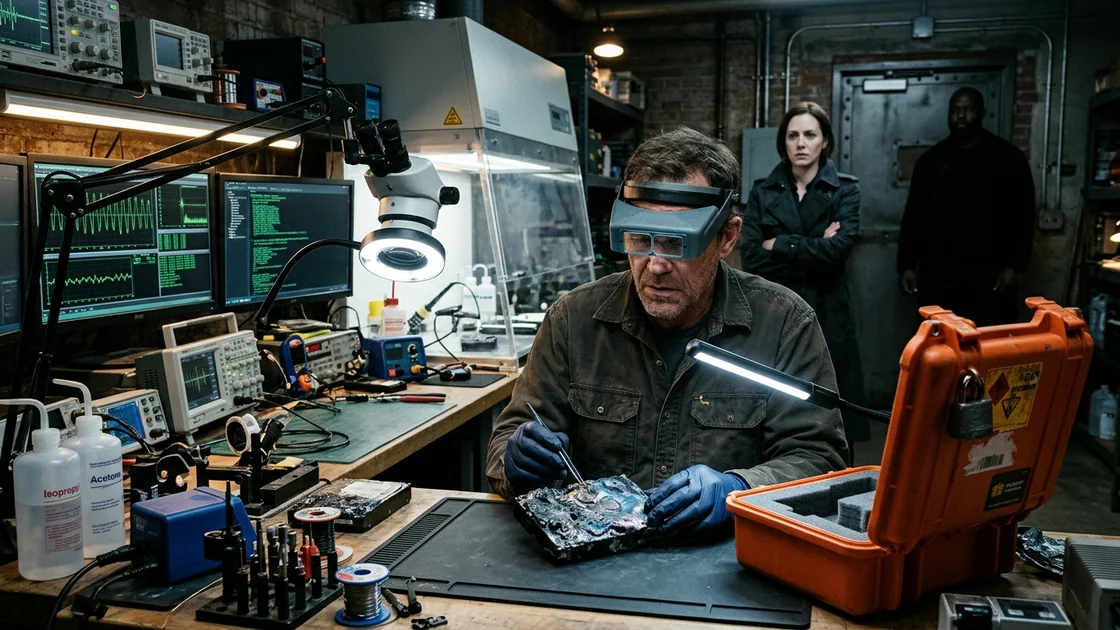
Aris Thorne is a reclusive forensic data recovery specialist who operates an underground laboratory in the industrial fringes of Seattle, taking on impossible salvage jobs that corporate and government labs have written off as total losses. His quiet routine is shattered when a woman named Evelyn Vance arrives in the dead of night carrying a radiation-shielded containment case that holds a partially melted enterprise hard drive pulled from the subterranean ruins of a secret mountain research facility. As Aris subjects the slag-encrusted drive to chemical stripping, microscopic laser profiling, and magnetic force imaging to extract its surviving bitstreams, he uncovers a terrifying discrepancy between his client's story and the telemetry recorded on the platters. Caught between a ruthless cleanup crew closing in on his workshop and a corrupt handler who intends to silence him the moment the encryption breaks, Aris must reconstruct the final minutes of the doomed scientists and use the deadly tools of his cleanroom to survive the night with the truth intact.
The rain in Georgetown did not fall so much as it condensed out of the grease and exhaust hanging between the brick warehouses, slicking the rusted rail spurs that ran dead-ended into the weeds outside Aris Thorne’s workshop. Inside, the air smelled of ozone, isopropyl alcohol, and old solder. Aris sat hunched over a stereomicroscope, his breath held in the shallow, rhythmic cadence he had practiced for twenty years, using a pair of titanium micro-forceps to nudge a bent read-write slider away from the mirror-bright surface of a Western Digital platter.
A single speck of skin dander, at this scale, looked like a limestone boulder. A fingerprint was a catastrophic oil spill. On the monitor to his left, a green waveform jittered as the piezoelectric actuator compensated for a microscopic warp in the aluminum-magnesium substrate. He was fishing for the ledger of a bankrupt maritime logistics firm whose chief accountant had taken a ballpeen hammer to four redundant RAID arrays before jumping off the Aurora Bridge. It was tedious, delicate, unglamorous work, and it paid four hundred dollars an hour.
When the perimeter buzzer sounded, Aris did not flinch. His fingers remained steady on the micromanipulator dials, retracting the head assembly onto its parking ramp with a turn of the knurled brass screw before he exhaled. Only when the safety lock clicked did he push back his stool and peel off his nitrile gloves.
He looked up at the four-way split screen mounted above the laminar flow hood. Standing beneath the sodium vapor lamp in the alley was a woman in a charcoal wool trench coat, her collar turned up against the drizzle. Beside her stood a man built like a commercial safe, holding an orange Pelicase by its thick polymer handle. The case had a heavy steel padlock threaded through its latches and a faded hazard decal peeled halfway off the lid.
Aris did not advertise. He had no website, no listed phone number, and his business license was registered under the name of a defunct barometer repair shop. People found him through three channels: federal bankruptcy judges, maritime insurance adjusters, or a single encrypted bulletin board used by defense contractors who had lost telemetry pods in the desert.
He walked to the intercom panel by the reinforced steel door and pressed the talk switch. "The shop is closed," he said. "And I don't take walk-ins."
The woman looked directly into the pinhole lens concealed inside the rusted conduit box above the lintel. Even in low-resolution monochrome, her eyes were striking—pale, unblinking, and ringed with the bruised hollows of someone who had not slept in forty-eight hours. She reached into her coat, produced a flat square of anodized black aluminum, and held it two inches from the glass.
Aris leaned closer to the monitor. Etched into the black metal via laser ablation was a twelve-digit hexadecimal string, followed by the Greek letter Phi.
It was a voucher token from Marcus Vance, the man who had taught Aris everything he knew about magnetic domain crystallography at Lawrence Livermore twenty-two years ago, before Marcus had disappeared into the black budget labyrinth of the Department of Energy. Aris hadn't seen one of those tokens in eight years.
He released the talk switch, threw the deadbolts, and pulled the heavy door open six inches against its security chain. The damp chill of the alley rushed in, carrying the metallic tang of the Duwamish Waterway.
"Marcus is dead," the woman said before Aris could speak. Her voice was a dry rasp, like sandpaper over pine. "Coronary in his sleep three winters ago. He left that token in a safe-deposit box in Boise with instructions to bring it to this address if the sky ever fell."
"And did it?" Aris asked, looking down at the orange case.
"Yesterday morning at four-fifteen," she said. "Can we come in? The rain is getting into my boots, and the men looking for this box aren't using umbrellas."
Aris studied the street behind them. The alley was empty save for overflowing dumpsters and the distant amber flash of a forklift at the bottling plant two blocks south. He unhooked the chain and stepped back.
They moved into the anteroom with the practiced efficiency of people accustomed to secure facilities. The big man set the Pelicase on the rubberized receiving bench and immediately took up a position by the inner door, his hands clasped over his belt buckle, eyes sweeping the exposed conduit, the suppression tanks, and the thick Lexan window that separated the dirty shop from the Class-10 cleanroom in the center of the floor.
"I'm Evelyn Vance," the woman said, unbuttoning her damp coat. "Marcus was my uncle. This is Miller. He doesn't talk much, and he doesn't touch precision equipment."
"Aris Thorne," Aris said, locking the steel door and engaging the magnetic shear-locks. He tapped a key on a wall terminal, dropping a grounded Faraday mesh curtain over the transom windows. "If you're Marcus's niece, you know the rules. No transmitters, no active silicon past this line. Cell phones, smartwatches, key fobs go in the copper box."
Evelyn reached into her pockets and dropped two burner phones with removed batteries into the mesh-lined wooden box on the counter. Miller produced a single satellite communicator and laid it beside them.
"What's in the box, Ms. Vance?"
Evelyn stepped to the bench, drew a brass key from a chain around her neck, and popped the padlock. When she threw the latches, the pressure relief valve hissed—not letting air in, as it would if it had come down from altitude, but venting a faint, acrid puff of trapped gas out into the room.
Aris smelled it instantly. It wasn't ordinary woodsmoke or electrical insulation. It was the sharp, sweet-metallic stench of fluorinated cooling fluids, vaporized beryllium, and burnt epoxy resin.
Evelyn lifted the lid. Nestling inside custom-cut gray foam that had been hastily carved out with a utility knife was a jagged, fist-sized lump of blackened slag.
Aris reached under the bench, pulled out a handheld Geiger-Müller pancake probe, and flipped the toggle. The speaker emitted a lazy, sporadic click—fourteen counts per minute. Normal background radiation for a brick building in the Pacific Northwest. He switched the sensor to a chemical photoionization detector. Volatile organic compounds registered at four parts per million, mostly hexafluoropropylene and hydrofluoric acid off-gassing in trace amounts.
"You should have left this under a fume hood," Aris murmured, flipping a switch that spun up the exhaust turbines above the receiving bench. "Where did you pull this from? A reactor core?"
"A subterranean laboratory in the Sawtooth Range," Evelyn said. "A private research consortium called Aethelgard. Officially, they were doing high-temperature superconductor synthesis for compact fusion magnets. Unofficially, I don't know what they were doing, because forty hours ago the sub-basement experienced a catastrophic thermal event."
"A fire," Aris said, pulling on a pair of thick Kevlar-lined chemical gloves and picking up a magnifying loupe.
"Not a normal fire," she said quietly. "The suppression system dumped four thousand gallons of liquid nitrogen and Halon 1301 into the vault within six seconds of the alarm. The fire kept burning anyway. When the breach teams finally drilled through the blast doors yesterday afternoon, the ambient temperature was still two hundred degrees Celsius. The server racks were puddles of silicon and copper on the concrete. Except for this."
Aris leaned over the foam cavity, holding a high-intensity LED wand at an oblique angle to the object.
To an untrained eye, it looked like a metallic meteorite or a piece of industrial foundry dross. The outer shell was a grotesque drip-sculpture of resolidified aluminum alloy, rippled with iridescent blue and violet oxide films. Embedded in the frozen ripples were shards of shattered ceramic, twisted copper traces from a burned-away printed circuit board, and a crust of white, chalky residue. Yet, beneath the deformed exterior, the unmistakable rectangular geometry of a three-and-a-half-inch enterprise drive chassis remained partially intact along one edge.
"Why did this one survive?" Aris asked, not looking up.
"It wasn't in the main server rack," Evelyn said. "It was inside an asynchronous local telemetry recorder bolted to the inside of a secondary containment bulkhead. One of the lead physicists had unmounted the carrier tray from the housing and was trying to push it into a pneumatic drop-chute when the thermal front hit the corridor."
Aris adjusted his loupe. Near the bottom left corner of the drive casing, where the molten aluminum had pooled and frozen against the stainless-steel mounting bracket, something small and yellow gleamed through the soot. He used a dental pick to gently scrape away a flake of carbonized flesh and ash.
It was a segment of a fourteen-karat gold band, fused halfway into the aluminum casing, with a porous, calcined fragment of a proximal phalanx bone still trapped inside the curve of the ring.
Aris set the dental pick down. The quiet hum of the cleanroom filtration blowers filled the silence.
"You didn't get this from a breach team," Aris said softly, looking up at her. "Official recovery teams don't hack a drive out of a dead man's hand with a pry bar and put it in a Pelicase without logging it into evidence."
Evelyn met his gaze without flinching. "I'm a senior risk auditor for the insurance syndicate that underwrote Aethelgard's primary liability bond. Nine hundred million dollars. When the seismic sensors registered the blast, the board sent me in with the first private assessment helicopter before the federal containment teams could establish a cordon. When I got down the elevator shaft, I realized the board hadn't sent me to assess the damage. They sent a sanitization team behind me to thermite anything that survived the original fire."
"And you took a souvenir."
"I took the only thing the chief scientist died trying to get out of that room," she said. "My uncle told me once that if a piece of iron had ever seen a magnetic field, you could read its memory, even if it had been dropped into a volcano. Was he exaggerating?"
Aris looked back down at the scorched lump of metal. His mind was already running the thermodynamic calculations, sorting through melting points, crystal lattices, and phase transitions.
"Aluminum-silicon casting alloy," Aris said, tapping the gray slag with the tip of his forceps, "melts at roughly five hundred and eighty to six hundred and sixty degrees Celsius. That looks catastrophic, and for a standard consumer drive, it would be. Above three hundred and fifty degrees, the thermal agitation of the atoms overwhelms the magnetic alignment of a standard cobalt-chromium-platinum recording layer. That's the Curie point. Once a platter hits its Curie temperature, the magnetic domains randomize. The ones and zeroes don't just get corrupted; they cease to exist. The metal forgets."
Evelyn’s shoulders sagged fractionally. "So it's a brick. People died for a melted paperweight."
"Hold on," Aris said, holding up a gloved finger. "Look at the manufacturer stamp on the surviving corner of the stainless-steel top cover." He angled the light so she could see the faint laser-etched serial block beneath the blistered Kapton tape. "That's a customized Ultrastar Helium-18 chassis, modified by Kestrel Defense Systems. They don't use standard aluminum-substrate platters, and they don't use conventional perpendicular magnetic recording."
He walked over to a towering metal cabinet, pulled out a thick binder of manufacturer schematics, and flipped through the plastic sleeves until he found a diagram of a Kestrel ruggedized data module.
"These drives use Heat-Assisted Magnetic Recording—HAMR," Aris explained, his voice taking on the brisk, focused cadence that always came over him when a puzzle revealed its seams. "To pack twenty terabytes into a single brick that can survive high-vibration environments, the platters are coated with an iron-platinum alloy in an ordered L10 crystalline phase. In normal operation, a tiny laser built into the read-write head has to heat each microscopic bit to over four hundred and fifty degrees Celsius for a nanosecond just to lower its magnetic coercivity enough to write data to it."
"Meaning what, in plain English?" Miller spoke for the first time, his voice a low baritone rumble from the doorway.
"Meaning the data layer on these platters was specifically engineered to resist heat," Aris said. "Its Curie point is close to seven hundred and fifty degrees Kelvin—around four hundred and eighty Celsius—and the substrate underneath the magnetic film isn't aluminum, which warps like warm taffy. It's aluminosilicate glass-ceramic. The same material used for missile nose cones and telescope mirrors. Furthermore, the aluminum outer casing melted and wicked heat away through latent heat of fusion, and if the room was flooded with liquid nitrogen six seconds into the event, the thermal pulse might never have soaked all the way through the helium cavity to the inner spindle."
Evelyn leaned both hands on the workbench. "Can you pull the files?"
"There are six glass-ceramic platters inside that fused tomb," Aris said. "The neodymium voice-coil magnets that move the heads inside will have disintegrated into magnetic dust and bonded to the surfaces. The lubricant layer—perfluoropolyether—will have boiled into hydrofluoric acid and etched the glass. The spindle motor bearings will be welded solid into their races. I can't just swap the circuit board and plug it into a USB port. I will have to mill away the slag under liquid cooling, dissolve the oxidized metal with selective acid washes, extract the platters without shattering the heat-stressed glass, clean them at the nanometer scale, and read the magnetic domains directly with a custom spin-stand or a scanning probe microscope."
"How long?"
"In a normal lab? Three weeks. With what I have behind that glass?" Aris nodded toward the cleanroom. "Forty-eight hours for the critical sectors, assuming you know what file structures I'm looking for and assuming the encryption keys are stored on the controller chip—which, if we're lucky, is buried under that charred thermal pad on the underside."
Evelyn reached into her coat and placed a second item on the counter. It wasn't a voucher token. It was a cold-storage hardware wallet on a steel lanyard.
"Two hundred and fifty thousand dollars in Monero," she said. "Half the keys now, the other half when I see a readable directory tree."
Aris looked from the hardware wallet to the fragment of human bone fused into the casing. Money was useful; he needed a new interferometric laser stage from Stuttgart, and those didn't come cheap. But more than the money, he felt the familiar, fatal itch that had ruined his marriage and driven him out of government service: the refusal to let a machine keep a secret when someone had paid with their life to record it.
"I don't want your crypto until the job is done," Aris said. "Because if the thermal soak reached the inner spindle, there's nothing inside that casing but blank glass, and I don't charge for autopsies on ghosts. Sit on the couch in the office. Don't touch the glass, don't open the street door, and if the barometer on the wall drops below twenty-nine inches, tell me—it means the positive-pressure seals on my cleanroom are leaking."
The transformation from Aris Thorne, tired middle-aged hermit, into a cleanroom technician required twenty minutes of ritualized decontamination.
In the gowning airlock, stripped down to surgical scrubs, he stepped onto the tacky blue polymer mat to pull the dust from his shoe covers, then pulled on the non-linting Tyvek bunny suit, the hood, the face shield, the double layer of powder-free nitrile gloves taped at the wrists, and the portable belt-pack respirator that filtered his own exhaled breath through a HEPA cartridge.
When the inner airlock door hissed open, he stepped into another world.
The cleanroom was twenty feet square, lit by tear-drop yellow LED fixtures that emitted no ultraviolet wavelengths, giving the space the amber, timeless quality of the inside of a fossilized resin bead. Downward-flowing curtains of air moved at a constant ninety feet per minute from the ceiling filters through the perforated raised floor grates, sweeping every stray sub-micron particle out of existence.
Before the melted drive could ever cross that threshold, it had to be broken in the "grey room"—the wet-chemistry and micro-machining bay adjacent to the airlock.
Aris placed the scorched Ultrastar unit into the vise of a computer-numerically-controlled micro-mill encased in a clear acrylic glovebox. Before clamping it down, he spent forty minutes with a three-dimensional structured-light scanner, mapping every dribble of frozen aluminum, every crack in the frame, and every warped mounting boss to a tolerance of five microns.
On his workstation monitor, the three-dimensional mesh of the ruined drive rotated slowly. Over it, he overlaid the pristine CAD blueprint of an intact Kestrel-modified Ultrastar He18.
"Look at the Z-axis deflection along the spindle boss," Aris muttered to himself, zooming in on the cross-section. The top cover, made of hydroformed stainless steel, had bowed inward by one point four millimeters near the actuator pivot, pinned down by a glob of melted aluminum from the external server chassis that had dripped onto it like candle wax and contracted as it cooled.
First, he had to recover the Printed Circuit Board Assembly—or what remained of it—from the bottom of the drive.
In modern enterprise drives, no two platters are identical at the sub-micron level. During manufacturing, the factory maps out the microscopic defects on each platter and writes these calibration parameters—along with the hardware encryption root keys—onto a tiny serial flash memory chip, an eight-legged EEPROM, soldered to the drive's external circuit board. Without that chip, even if Aris recovered every single bit from the platters, the data would be an incomprehensible scramble of shifted tracks and AES-256 cipher blocks.
Aris flipped the drive over in the glovebox vise. The fiberglass board was black char, delaminated into flaky layers like burnt puff pastry. Copper traces curled upward like dead worms. Most of the surface-mount capacitors had exploded from internal vapor pressure.
However, Kestrel Defense Systems had potted the central controller and the adjacent EEPROM chip in a thick bead of black, thermally resistant cycloaliphatic epoxy to prevent vibration failure and physical tampering. The epoxy was blistered and cracked, resembling dried lava, but it had shielded the silicon dies underneath from direct flame contact.
Using a precision ultrasonic scalpel and a syringe dripping fuming nitric acid heated to sixty degrees Celsius, Aris began the agonizing process of decapsulating the memory chip. Drop by drop, the acid ate away the carbonized epoxy without attacking the gold bond wires or the silicon substrate Inside. A miniature vacuum nozzle sucked away the brown, toxic fumes of nitrogen dioxide before they could corrode the mill head.
Through the microscope oculars, the landscape of the ruined chip emerged like an archaeological dig in the desert.
"Come on, little brother," Aris whispered, rinsing the site with deionized water and anhydrous acetone. "Show me your legs."
The outer metal leads of the SOIC-8 package had melted away completely when the solder liquefied. A lesser technician would have given up. Aris switched the ultrasonic scalpel for a diamond-tipped scribe mounted on a hydraulic micromanipulator. Moving the controls with increments of ten microns, he scraped away the protective ceramic crust directly above the silicon die until the microscopic aluminum bond pads—each no wider than a human red blood cell—gleamed in the amber light.
He rotated his flying-probe station into place. Four tungsten needles, etched to points finer than a wasp's stinger, descended under camera guidance. He lowered the first needle onto the ground pad. The contact sensor beeped softly. He lowered the second onto the clock line. The third onto data-in. The fourth onto data-out.
Outside the window, Evelyn Vance had risen from the leather sofa in the office and was standing by the thick glass, watching his hands move inside the glovebox. Miller remained seated in the corner, his eyes half-closed, though Aris noticed the big man’s right hand never strayed more than four inches from the lapel of his jacket.
Aris routed the tungsten probes to a custom logic analyzer and applied a conservative 1.8-volt current ramped over five hundred milliseconds to prevent thermal shock to the degraded semiconductor junctions.
On his terminal screen, a status bar flickered.
SPI BUS DETECTED. CLOCK SYNC: 100 kHz (SAFE MODE). READING ADDRESS 0x000000 TO 0x1FFFFF...
A waterfall of hexadecimal pairs cascaded down the black screen. Near
address 0x04A200, the transfer stalled. CRC ERROR: BIT
FLIP DETECTED.
The intense heat of the fire had caused electron migration across the floating gates of the flash memory cells, lowering their charge states until the chip could no longer tell whether a gate held a one or a zero.
Aris didn't panic. Flash memory didn't just hold digital values; at the physical level, it held an analog voltage level. A "1" might be three volts, and a "0" might be zero volts. Heat caused those charges to leak down to 1.4 volts—the forbidden middle zone where standard readers threw up their hands and reported an error.
He switched the analyzer to analog threshold mode, lowering the reference voltage in steps of ten millivolts, reading the chip fifty times in succession at twenty different temperatures controlled by a Peltier cooling wand pressed against the underside of the silicon. By comparing the statistical drift of the leaking electrons across all fifty reads, his software ran a Bayesian probability matrix to deduce what the original charge had been before the fire.
RECONSTRUCTION COMPLETE. CHECKSUM VALIDATED. ADAPTIVE ROM PARAMETERS: INTACT. HARDWARE KEY SLOT 0: RECOVERED.
Aris let out a breath he felt he'd been holding since three in the morning. He saved the two-megabyte binary file to three separate air-gapped solid-state drives. That tiny file was the Rosetta Stone for the twenty terabytes locked inside the melted hull.
Now came the surgery.
He flooded the CNC mill enclosure with a continuous mist of chilled fluorocarbon dielectric fluid and brought the diamond-coated end mill down toward the drive casing.
The high-pitched whine of the forty-thousand-RPM spindle vibrated through the concrete floor. Slowly, at a feed rate of half a millimeter per minute, the diamond bit chewed away the resolidified aluminum slag that had welded the top cover to the base casting. Aris watched the thermal camera feed intently; if the friction of the cutting bit raised the local temperature of the casing by more than two degrees Celsius, the differential expansion might crack the glass platters resting just two millimeters beneath the steel skin.
For three hours, the machine shaved away metal, layer by microscopic layer. Gray aluminum ribbons washed away in the clear fluid, followed by the bright silver sparks of the stainless-steel perimeter weld, which Aris had to trace around the entire circumference of the drive to break the hermetic seal that had once held the internal helium atmosphere.
At 6:14 AM, the final corner of the perimeter weld gave way.
Aris shut down the mill, drained and dried the enclosure, and transferred the scored drive assembly through the pass-through airlock into the heart of the Class-10 cleanroom.
Under the laminar flow hood, he clamped the drive base into a heavy brass fixture. He attached four miniature suction cups—connected to a balanced vertical lift—onto the stainless-steel top cover. If the cover had warped inward and touched the top platter, lifting it straight up at an angle would cause the steel edge to gouge the magnetic coating like a chisel.
He turned the vertical micrometer screw one-quarter turn.
A dry, crystalline tink echoed through the stethoscope tubes Aris wore in his ears.
He froze.
Through the high-power borescope he had threaded through a milled inspection port, he saw the problem. The fluoroelastomer gasket that sealed the lid had not melted; it had vulcanized and carbonized into a brittle black cement, gluing the lid to the tip of the central platter spindle. Worse, the top read-write head had fused directly to the surface of Platter 1, near the outer diameter, welded there by a droplet of boiled slider lubricant.
If he pulled the lid up, the spindle screw would pull the top clamp, and the fused head would rip a radial trench across the glass platter, shattering it like a Prince Rupert’s drop.
Aris reached for his micro-syringe rack. He drew up three microliters of a proprietary solvent—a ruthless cocktail of perfluorinated polyether solvent and buffered tetramethylammonium hydroxide—and threaded the hair-thin fused-silica capillary tube through the gap under the lid.
Under the borescope view, a tiny translucent droplet formed at the tip of the needle and touched the black crust binding the head slider to the platter surface.
Capillary action wicked the fluid between the silicon-carbide slider and the glass platter. For twenty minutes, Aris watched the screen as microscopic gas bubbles formed and dissolved along the interface. Using a piezoelectric buzzer clamped to the brass fixture, he introduced a gentle, high-frequency acoustic vibration into the chassis—just enough to agitate the solvent molecules without flexing the platters.
Suddenly, on the monitor, the spring-loaded steel suspension arm of the head assembly twitched. Free of the melted lubricant, its natural tension snapped it backward by half a millimeter, clear of the platter surface.
"One down," Aris murmured behind his face shield.
With a micro-laser cutter, he severed the vulcanized rubber gasket around the perimeter, bypassed the central spindle screw by milling its head off from above with a hollow core drill, and lifted the stainless-steel lid straight up on the guide rails.
The interior of the drive lay exposed to the yellow light for the first time since it had been sealed in a cleanroom in Singapore three years earlier.
Aris leaned over the stereomicroscope and adjusted the focus. Even after everything he had seen in twenty years of catastrophe recovery, the sight made his stomach tighten.
The inside of the drive looked like a winter landscape after an ice storm. The helium had escaped through a pinhole blow-out near the actuator connector during the fire, allowing superheated air and smoke particulates from the burning laboratory to be sucked inside as the drive cooled and contracted.
The six glass-ceramic platters were still intact—none had shattered—and their surfaces still possessed that hypnotic, dark-chrome luster characteristic of iron-platinum media. However, radiating outward from the breathing port on the right side of the casting was a fan-shaped rainbow discoloration: a baked-on film of condensed heavy hydrocarbons, fluoropolymers, and microscopic soot.
Worse still was the voice coil assembly in the corner. The neodymium-iron-boron permanent magnets that drove the head actuator had suffered catastrophic thermal degradation and brittle fracture. When the liquid nitrogen from the room's fire suppression system had hit the outside of the hot drive, the thermal shock had caused the magnet's nickel plating to blister and spall, peppering the outer edges of the top two platters with jagged, magnetic shrapnel no larger than grains of pollen.
And the head stack itself—twelve delicate read-write sliders suspended on whisper-thin stainless-steel arms between the platters—was twisted like a crippled hand. The heat had relaxed the spring tension in the gimble mounts; half the heads were dragging directly against the magnetic surfaces.
Aris took a high-resolution panoramic photograph of the interior, walked to the intercom on the cleanroom wall, and keyed the switch to the office.
"Ms. Vance," he said.
Evelyn was at the window in two seconds. She looked ghostly pale in the yellow light filtering through the Lexan. "Is it there?"
"The glass didn't shatter," Aris said, pointing to the large slave monitor mounted on the wall outside the cleanroom so she could see the microscope feed. "That's the good news. The bad news is that the thermal gradient across the drive was extreme. The side facing the bulkhead stayed around two hundred degrees Celsius. The side facing the corridor hit five hundred and fifty. That means the platters didn't just get dirty; they expanded unevenly and then got flash-quenched by the nitrogen."
"They're warped," she said, reading the geometry on the screen with surprising acuity.
"Potato-chipped," Aris confirmed. "Only by about four to six microns from peak to trough, which you couldn't see with the naked eye or feel with your fingers. But a modern hard drive head flies across the platter on a cushion of air—or helium—at a height of just two nanometers. That's less than the width of a strand of DNA. If I take these platters out, clean them, and put them into an identical donor drive and spin them up to seven thousand two hundred RPM, those six-micron waves in the glass will hit the read heads like six-foot concrete walls. The heads will detonate on impact and turn the data layer into silver dust within three milliseconds."
Evelyn stared at the magnified image of the rainbow-stained chrome disc. "Then how do you read a warped platter that can't be spun at speed?"
"I don't use a donor drive," Aris said. "I use a custom air-bearing spin-stand with an active laser interferometer looking three millimeters ahead of the read head. As the platter turns at a fraction of normal speed, the laser measures the height of the wave coming toward the head and fires a piezoelectric crystal that lifts and lowers the head in real time to surf the warp. And for the inner tracks where the thermal demagnetization was worst..." He glanced toward the heavy granite optical table sitting on pneumatic isolation legs in the corner of the cleanroom. "We won't use a drive head at all. We'll map the magnetic fields directly."
"How long to get the first files?" she asked, her voice tight. "Just the index. Just enough to prove to me what project was on this unit."
"I have to unstack the platters without letting those dragging heads scratch them, run them through four stages of ultrasonic plasma and chemical cleaning to strip the hydrocarbon varnish without stripping the two-nanometer carbon overcoat over the magnetic layer, and mount Platter 3—which looks the cleanest—onto the spin-stand." Aris checked the digital clock on the wall. It was 7:05 AM. "Give me until two this afternoon. Get some sleep. You look like hell."
Evelyn didn't move from the glass. Her reflection overlapped with the magnified image of the dead scientist's drive. "There was a second team at the Blackwood Ridge site, Aris. Not corporate security. Not federal emergency management. They arrived in unmarked Bell helicopters with stripped tail numbers while Miller and I were hiking out through the drainage tunnels. If they figure out that the telemetry module was pried off Bulkhead 4, they won't call the police."
"Nobody knows you came here," Aris said. "Even Marcus didn't have this address written down on paper."
"Marcus didn't," Evelyn said quietly. "But the token he gave me had a serial number on it. And I had to open a safe-deposit box under my grandmother's maiden name to get it. Banks have cameras. Cameras have facial recognition. And the people who built Aethelgard wrote the algorithms the federal government uses to track fugitives."
She turned away from the glass and walked back toward the darkened office. "Work fast, Mr. Thorne."
Extracting six platters from a seized spindle when twelve read-write heads are clamped between them like the jaws of a bear trap is an exercise in three-dimensional geometry and sheer mechanical nerve.
Normally, a technician slips a plastic comb between the head arms to wedge them apart and slide the assembly safely off the edge of the discs. Here, the arms were bent at erratic angles, and two of the sliders were still partially spot-welded to the middle platters by degraded fluorocarbon lubricant.
Aris couldn't force a comb in; he would snap the brittle silicon-carbide sliders off their gimbals and drag their razor-sharp edges across the tracks.
Instead, he worked from the top down, turning the extraction into a twelve-stage amputation.
Using a femtosecond pulsed laser—which delivered energy in bursts so brief that it vaporized metal into cold plasma before heat could conduct into the surrounding material—he severed the four suspension arms resting on the top and bottom of Platter 1, leaving the stuck sliders sitting harmlessly on the glass like tiny rafts on a frozen lake. Once all four arms were cut back and extracted with vacuum tweezers, he used the solvent-and-ultrasonic technique to float the severed sliders off the surface inside a containment ring of liquid perfluorohexane, sucking them up into a glass pipette before they could touch down again.
Then he unbolted the top clamping ring—milling out two titanium Torx screws whose heads had stripped from heat expansion—and slid a pair of custom-machined Teflon-coated forks beneath Platter 1.
When he lifted it clear, he held his breath. The underside was remarkably clean. Platter 1 had acted as a sacrificial heat shield and particle umbrella for the rest of the stack.
He repeated the process down through the stack: cut the arms, dissolve the bonds, pipette the severed heads, remove the precision spacer ring, lift the platter.
By eleven in the morning, his lower back was a solid knot of pain inside the bunny suit, and his eyes burned from staring into the microscope oculars. All six platters sat in a vertical quartz cassette rack.
Platters 1 and 6—the top and bottom surfaces of the stack—were severely compromised, their outer tracks blistered where the carbon protective overcoat had oxidized away. Platters 2 through 5, however, had been sandwiched inside the narrow helium gaps between the discs. Aside from the crescent of smoky hydrocarbon condensate near the breather port and the microscopic four-micron warp, their magnetic coatings looked optically intact.
He lowered the quartz cassette into the first chamber of the automated cleaning station.
First came a bath in heated hydrofluoroether to dissolve the degraded lubricant and organic smoke residue, agitated by megasonic transducers pulsing at one megahertz—gentle enough to prevent cavitation bubbles from blasting craters into the glass, energetic enough to dislodge sub-micron soot particles. Second came a rinse in ultra-pure deionized water with a resistivity of eighteen megohms. Third came a low-temperature oxygen-argon plasma ash cycle to vaporize any stubborn carbon chains without heating the iron-platinum layer above forty degrees Celsius. Finally, a dip-coating bath applied a fresh, single-molecule-thick layer of Z-dol perfluoropolyether lubricant to give the test heads something to glide over.
At 12:40 PM, Aris mounted Platter 3 onto the air-bearing spindle of his primary spin-stand.
The spin-stand was the centerpiece of his laboratory, bolted to a two-ton block of black Swedish granite that floated on compressed nitrogen pistons to isolate it from the rumble of freight trains outside and even the footsteps of Miller pacing in the outer room. Surrounding the spindle was a spiderweb of micrometer stages, fiber-optic laser pickups, and liquid-nitrogen-cooled preamplifiers.
Because a single hard drive platter holds only fragments of files—modern controllers stripe data across all twelve surfaces simultaneously like a dealer dealing cards around a table—reading Platter 3 alone wouldn't give him complete gigabyte-sized video files. However, the system metadata, the Master File Table, and the redundant journal logs of enterprise Linux or QNX real-time operating systems were almost always mirrored across the primary inner tracks of the middle platters for fault tolerance.
Aris calibrated the optical profilometer first. A red helium-neon laser beam bounced off the spinning chrome surface of Platter 3 at six hundred RPM—less than a tenth of its normal operating speed. On his secondary monitor, a false-color topographical map bloomed into existence.
The platter looked like a saddle. Two opposite quadrants rose four point eight microns above the plane; the other two dipped three point two microns below it. Near the outer edge, where the fire had been hottest, there was a sharp ridge—a thermal shock line where the liquid nitrogen had hit the casing.
"Okay," Aris murmured, typing parameters into the servo-control loop. "We stay three millimeters inside the outer diameter. We slave the Z-axis piezo to the interferometer feed with a twelve-microsecond lead time. And we use a donor HAMR head with the write-laser disabled and the fly-height biased up by one point five nanometers."
Flying the head higher meant the magnetic signal would be weaker—magnetic flux drops off exponentially with distance—requiring him to run the analog signal through his cryogenic low-noise amplifier and average multiple revolutions to pull the data out of the static. Simply put, it was the difference between trying to read Braille with bare fingertips versus reading it through winter gloves. You had to press harder with your mind and go over the bumps ten times to be sure.
He brought the donor head assembly in from the side on the linear stage. Under the microscope camera, the tiny black slider moved over the spinning mirror of the disc, paused as the air bearing established lift, and settled into its dance—rising and falling four microns twice per revolution, forty times a second, in absolute synchrony with the invisible waves in the glass.
On the oscilloscope screen, the green trace exploded into a dense, furry band of high-frequency analog peaks.
Magnetic transitions. Domains flipping from north to south, south to north. Ones and zeroes, surviving after all.
Aris felt a fierce, quiet rush of triumph. "Marcus was right," he whispered. "The iron remembered."
He piped the raw analog waveform into a software-defined read channel running on a rack of field-programmable gate arrays (FPGAs), loaded the adaptive calibration parameters he had pulled from the scorched EEPROM chip hours earlier, and initiated a continuous spiral read across the metadata zone of Surface 3A.
Track by track, sector by sector, the green blocks on the sector map filled in. Scattered yellow blocks indicated sectors that required ten or twenty re-reads to resolve weak magnetic domains. Occasional red blocks marked tiny pinholes where hot soot particles had pitted the coating.
At 1:52 PM, the software had assembled a four-gigabyte contiguous chunk of the primary journal partition.
Aris fed the hardware AES key from the EEPROM into the decryption engine. For three seconds, the terminal cursor blinked. Then the entropy meter dropped from 7.999 bits per byte—pure random noise—down to 4.21 bits per byte.
Structured data. Text. Headers.
On the main workstation screen, an EXT4 file system directory tree populated.
\root\aethelgard\sublevel_4\telemetry_node_09\
\root\aethelgard\sublevel_4\cinder_protocol\trial_88_raw\
\root\aethelgard\sublevel_4\containment_logs\2026_03_28_emergency.log
\root\aethelgard\sublevel_4\video_buffer\cam_bulkhead_04.mp4.part
Before calling Evelyn to the glass, Aris did what he always did when a client brought him a drive soaked in blood and lies: he opened the plain-text emergency log himself.
He double-clicked 2026_03_28_emergency.log. The text
file was truncated at the bottom where the stripe jumped to Platter 4,
which was still sitting in the quartz rack, but the first four hundred
lines were intact.
It was an automated system console combined with internal intercom transcriptions generated by the laboratory's voice-to-text black box.
03:58:12.004 [SYS] ANOMALOUS RESONANCE DETECTED IN CHAMBER C-04. HARMONIC AMPLITUDE EXCEEDS 140 dB (MAGNETO-ACOUSTIC).
03:58:19.112 [VOICE - DR. H. CHEN] Shut down the field coils! Cut the bias current on the lattice now!
03:58:24.890 [VOICE - DR. R. KOVACS] The breakers are open, Helen! It’s not drawing power from the grid anymore. The silicon substrate in the test array is self-oscillating. It's pulling thermal energy straight out of the ambient room heat and converting it into magnetic flux!
03:58:41.002 [SYS] WARNING: SILICON CARBIDE CONTAINMENT LINER DEGRADING. SELF-PROPAGATING LATTICE DECAY DETECTED IN SENSORS 1 THROUGH 8.
03:58:55.340 [VOICE - DR. H. CHEN] It's jumping the air gap to the control racks! Look at the oscilloscopes—the crystal defect is replicating across the copper buses! Dump the nitrogen! Freeze the lattice before it reaches the main conduit!
03:59:02.110 [SYS] MANUAL OVERRIDE REQUESTED: BLAST DOOR 04 (EVACUATION CORRIDOR).
03:59:02.450 [SYS] OVERRIDE DENIED BY EXTERNAL TERMINAL: SEC_AUDIT_01 (USER: VANCE, E.)
Aris’s fingers went cold inside his double nitrile gloves.
He read the line again.
03:59:02.450 [SYS] OVERRIDE DENIED BY EXTERNAL TERMINAL: SEC_AUDIT_01 (USER: VANCE, E.)
He scrolled down quickly, his eyes darting across the timestamps.
03:59:14.200 [VOICE - DR. H. CHEN] Evelyn? Evelyn, we can see you on the upper deck monitor! Open the bulkhead! The lattice decay only travels through doped semiconductors and ferromagnetic alloys, it isn't biological! Let us out!
03:59:22.880 [VOICE - INTERCOM / VANCE, E.] I have my instructions from the syndicate, Helen. If the Cinder lattice is self-sustaining at room temperature, the patent defaults to the sovereign defense tranche. And I can't have seven witnesses testifying that the cascade breaks down commercial silicon out to fifty meters.
03:59:30.105 [SYS] EXTERNAL COMMAND RECEIVED (USER: VANCE, E.): ENGAGE PLASMA INCINERATION PURGE - SUBLEVEL 4.
03:59:31.004 [SYS] EXTERNAL COMMAND RECEIVED (USER: VANCE, E.): DUMP LIQUID NITROGEN AT T+180 SECONDS TO PRESERVE PRIMARY DATA CORE.
03:59:38.600 [VOICE - DR. R. KOVACS] She's cooking the room to kill us and then freezing the racks so she can salvage the lattice calibration models! Helen, pull the telemetry brick out of Bulkhead 4! Get it into the ceramic slag chute—if the plasma torch hits the aluminum casing directly, destroy the wave-table files on Sector— [EOF / STRIPE BOUNDARY PLATTER 4]
Aris sat motionless under the amber light of the cleanroom. The hum of the ceiling blowers sounded suddenly deafening, like the roar of a distant furnace.
Evelyn Vance hadn't arrived by helicopter after the fire. She didn't represent an insurance syndicate trying to figure out what went wrong. And the thermal event hadn't been an accident caused by a runaway experiment.
The scientists in Sub-Level 4 had accidentally discovered—or been forced to create—a self-propagating acoustic-magnetic resonance in silicon and iron lattices. A physical waveform that turned ordinary electronics into induction furnaces, melting them down while feeding on their heat. And when they tried to shut it down and evacuate, Evelyn Vance had locked the blast doors from the upper observation deck, triggered the laboratory's high-temperature plasma sterilization torches to burn the scientists alive, and then flooded the room with liquid nitrogen three minutes later to quench the fire before the HAMR drives containing the resonance wave-tables could reach their Curie point.
Dr. Kovacs—the man whose gold wedding band and finger bone were still sitting in a glass petri dish in Aris’s grey room—had realized what she was doing in his final thirty seconds of life. Instead of leaving the drive safely inside its insulated bulkhead enclosure where Evelyn wanted it to survive, he had unmounted it and held it directly into the path of the plasma jet, trying to melt it with his own body in the doorway before the nitrogen dump froze the room.
And now Evelyn was standing twenty feet away in Aris’s office, waiting for him to hand her the rest of the drive.
Once he extracted the wave-table files from Platters 4 and 5, she wouldn't leave two hundred and fifty thousand dollars in Monero on his counter. She had just murdered seven physicists to make sure nobody knew the Cinder Protocol existed. She certainly wasn't going to leave a grumpy data recovery specialist alive in a Seattle warehouse with a working copy of the raw bitstream on his servers.
Aris did not look up toward the observation window. He knew that if his posture stiffened, or if he turned his head to check where Miller was standing, Evelyn would read it instantly. People like her lived by watching the micro-expressions of cornered animals.
Instead, he slumped his shoulders slightly, rubbed the bridge of his nose through his face shield as if frustrated, and clicked open a secondary terminal window. With three quick keystrokes, he hid the decrypted log window and brought up a fabricated diagnostic screen he kept on hand for difficult corporate clients—a red-and-yellow sector map showing eighty percent unrecoverable read errors and a corrupted Master File Table.
Then he stood up and walked to the intercom.
"Ms. Vance," he said, pitching his voice to sound exhausted and mildly annoyed.
Evelyn walked out of the office, followed closely by Miller. She stepped right up to the Lexan glass. "Tell me that directory tree on your screen is real."
Aris tapped a command that pushed a sanitized, partial version of the
directory tree to the slave monitor above her head—showing the folder
names \cinder_protocol\trial_88_raw\, but flagging every
file inside with a flashing red
[MISSING STRIPE: PLATTER 4/5 - CORRUPTED HEADER]
warning.
"I got the directory headers off Platter 3," Aris said, pointing at the monitor with a gloved finger. "Whatever you're after—this 'trial 88' folder—it's a massive fifty-gigabyte wave-table array. The RAID controller striped it across Platters 2, 3, 4, and 5 in sixty-four-kilobyte blocks. Worse, the encryption uses a chained cipher-block mode. Without the initialization vectors sitting on the inner tracks of Platter 5, the chunks I pulled off Platter 3 are just encrypted garbage."
Evelyn’s pale eyes narrowed as she studied the directory structure. "Can you get the vectors off Platter 5?"
"That's the problem," Aris said, turning slightly to gesture toward the platter cassette rack. "Look at Platter 5. It was near the bottom of the casing, right above the controller board that caught fire. The thermal soak down there didn't just warp the glass; it weakened the magnetic domains until their flux strength is down near the thermal noise floor. My spin-stand head can't read them. Every time I try, the signal-to-noise ratio drops below two decibels."
"You said earlier you had another way to read weak domains," Evelyn said. Her voice was very quiet, very steady. "You pointed to the granite table in the corner."
"Magnetic Force Microscopy," Aris said, nodding slowly. "MFM. Instead of spinning the platter under a drive head, I put the motionless platter into a vacuum chamber and scan a magnetized atomic-force probe tip across the tracks at a height of half a nanometer. It measures the actual physical tug of the magnetic atoms on the needle and builds an image of the bits one square micron at a time."
"Do it," she said.
"Ms. Vance, MFM is a nanoscale imaging process," Aris said. "It isn't built for bulk data transfer. Scanning a whole twenty-terabyte platter with an atomic probe would take twelve years. Since I have the file allocation pointers from Platter 3, I know the exact physical cylinder and sector coordinates where the encryption vectors and the missing stripe headers live on Platter 5. Even targeting just those three square millimeters of glass, the scan will take six hours. And once the MFM starts, nobody can open the outer door, nobody can flush a toilet, and the high-voltage power supply will draw forty amps continuously."
Evelyn looked at her watch, then glanced back at Miller. A silent communication passed between them—a fractional tilt of Miller’s chin.
"Why did Miller just look at the street monitor?" Aris asked, keeping his tone conversational, slightly defensive.
Evelyn looked back at Aris through the glass. "Because twenty minutes ago, a gray municipality van parked three blocks north on Airport Way and deployed a directional spectrum analyzer on its roof. They aren't looking for radio signals; they're sniffing for the sixty-hertz harmonic signature of high-draw industrial equipment in a neighborhood that's supposed to be shut down for the night."
Whether she was telling the truth about a rival team or simply manufacturing urgency to keep him compliant, Aris realized his timeline had just collapsed.
"If I run the MFM with the liquid nitrogen cryo-pumps engaged to stabilize the tip, I can push the piezo scan rate to four hundred hertz," Aris lied smoothly. "That cuts the window to three hours. Five o'clock. You'll have your complete wave-tables compiled and decrypted by five."
"Start the scan," Evelyn said. "And Mr. Thorne? Leave the intercom switch latched open while you work. I like to hear the machines running."
"Suit yourself," Aris said. "Just don't talk while the probe is landing, or the acoustic vibration through the glass will snap a two-thousand-dollar cantilever tip."
He had three hours. In reality, he needed ninety minutes to pull the remainder of the actual data using the spin-stand, and another ninety minutes to figure out how a fifty-two-year-old physicist armed with tweezers and petri dishes was going to survive two professional killers standing outside the only exit to a windowless steel box.
Aris worked with methodical, split-brain precision.
First, to satisfy Evelyn’s eyes and ears, he made a tremendous show of mounting Platter 5 into the stainless-steel vacuum bell of the Magnetic Force Microscope on the corner granite table. He connected the loud rotary roughing pump, let it clatter for ten minutes until the chamber hit millitorr vacuum, and switched on the cryogenic turbomolecular pump, which emitted a high, turbine-like whine that carried clearly over the open intercom.
On the large wall monitor visible from the office, he routed a stored calibration feed from an old MFM job—a mesmerizing, slow-scrolling orange-and-black bitmap of magnetic bit transitions appearing row by row, looking like microscopic bar codes etched in rust. To anyone who hadn't spent ten years building scanning probe software from scratch, it looked entirely authentic.
Meanwhile, hidden behind the wide shroud of the laminar flow hood where the camera angles couldn't see his keyboard, Aris swapped Platter 4 and then Platter 2 onto the silent air-bearing spin-stand.
Platter 5 wasn't actually unreadable on the spin-stand; that had been
his insurance policy. As he imaged the remaining stripes of the
cinder_protocol directory and the rest of the video buffer
from Platters 2, 4, and 5, the full picture of what had happened inside
the Aethelgard facility assembled itself in a hidden RAM-disk partition
on his local workstation.
At 3:40 PM, the video file cam_bulkhead_04.mp4 finished
rebuilding across all eight data stripes. Aris muted the audio output so
nothing would bleed into the open intercom mic, minimized the window to
a three-inch square in the corner of his diagnostic monitor, and watched
it while the spin-stand chewed through the final wave-table sectors.
The footage was shot from a wide-angle security camera inside a white-tiled subterranean corridor. The image was shaking violently—not from an explosion, but because the camera's own CMOS sensor was beginning to resonate with the acoustic-magnetic wave leaking through the walls. Digital purple snow danced across the frame.
Two scientists—a woman in her fifties with silver hair tied back, Dr. Helen Chen, and a younger bearded man, Dr. Kovacs—were throwing their weight against the manual release wheel of a massive circular steel blast door. Above the door, a red strobe flashed. Through the thick quartz porthole in the center of the blast door, standing calmly in the cool blue light of the external monitoring station on the upper catwalk, stood Evelyn Vance.
Even without sound, the closed-captioning module of the laboratory security system overlaid white text at the bottom of the screen, picking up the screams inside the corridor.
KOVACS: IT'S THE SOLITON WAVE! THE L10 IRON-PLATINUM ARRAYS IN THE MAIN RACK ARE ACTING AS AMPLIFIERS! CHEN: IF ANYONE COMES DOWN HERE AND REACTIVATES THAT WAVE-TABLE ON AN UNSHIELDED GRID, IT WON'T STOP AT FIFTY METERS! IT WILL COUPLE WITH THE HIGH-VOLTAGE TRANSFORMERS ON THE SURFACE!
In the video, Evelyn didn't argue. She simply turned toward the wall console behind her and keyed a sequence.
From ceiling nozzles along the white corridor, blinding jets of violet-white inductively coupled plasma erupted downward. The temperature in the corridor went from twenty degrees to a thousand degrees in four seconds. Dr. Chen fell immediately as the superheated gas seared her lungs. Dr. Kovacs, his lab coat bursting into sheet flame, staggered backward to the open service niche beside the blast door, ripped the Kestrel telemetry module from its backplane with bare, blistering hands, and wedged his body over the open pneumatic chute, holding the aluminum brick directly up into the roaring violet cone of the nearest ceiling nozzle while his gold wedding ring melted into the metal.
Then the camera’s silicon chip hit its resonance threshold and shattered into a screen of static, three seconds before the liquid nitrogen nozzles turned the corridor into a tomb of black ice.
Aris closed the video player. His jaw was clenched so hard his molars ached.
Kovacs hadn't just been trying to preserve evidence of a murder. He
had been trying to destroy the trial_88 wave-table file
because the scientists realized the resonance wasn't a contained
laboratory anomaly—it was a self-replicating solid-state plague. If
Evelyn handed those wave-tables to her buyers, and someone synthesized
that specific acoustic-magnetic pulse near a major power substation or a
commercial server farm, the cascade would leap from transformer to
transformer, silicon chip to silicon chip, burning out every doped
semiconductor and magnetic core in a chain reaction powered by the
ambient heat of the machinery itself.
And Aris had just finished recovering ninety-nine point八 percent of the file.
He looked at the decrypted folder inside his RAM-disk. The core file
was soliton_seed_88.wvt. Beside it were the complete
engineering logs, the audio recordings, the security video showing
Evelyn firing the plasma torches, and the signed board directives from
the Aethelgard defense syndicate ordering the sanitization of the
staff.
Aris looked up through the yellow light toward the Lexan window.
Miller was no longer sitting in the office. He was standing directly beside the airlock door in the grey room—the only door Aris could exit through—with a suppressed Heckler & Koch USP tactical pistol resting casually against his thigh.
Evelyn was standing at the receiving bench. She had opened her orange Pelicase and taken out a cylindrical metal device the size of a thermos, with a heavy copper coil wrapped around its midsection and a digital timer on the cap.
A magnesium-thermite incendiary charge with an electromagnetic pulse ring.
The moment Aris transferred the decrypted data through the external port to her drive, Miller would put a subsonic .45 round through Aris’s face shield as he stepped out of the airlock, and Evelyn would set the thermite charge inside the cleanroom to reduce the platters, the servers, and Aris Thorne’s body to an unrecognizable puddle of slag—just like Sub-Level 4.
Aris checked the clock: 4:32 PM.
He couldn't stay inside the cleanroom forever. The Lexan window was half-inch polycarbonate—it would stop a standard pistol round, or at least deform it—but the airlock doors were thin anodized aluminum Honeycomb with silicone rubber seals, built to hold air pressure, not stop bullets or grown men with pry bars. And his air supply came from the intake manifold in the utility closet on the far side of the shop.
He looked around the twenty-by-twenty yellow room.
What did he have inside a Class-10 data recovery cleanroom? No weapons. No heavy wrenches—everything was lightweight titanium or plastic to prevent magnetic contamination.
He had chemicals. He had two liters of forty-nine percent hydrofluoric acid in the wet bench, fuming nitric acid, and perfluorohexane. He had a seventy-liter pressurized Dewar of liquid nitrogen hooked to the MFM cryo-pump. He had the femtosecond laser cutter, though its beam was fixed pointing straight down into a two-inch enclosure.
And sitting in the lower cabinet underneath the granite table, bolted to a dedicated 480-volt three-phase industrial circuit, he had the bulk degausser.
Aris’s eyes lingered on the lower cabinet.
It was a custom-built capacitive-discharge coil degausser—a machine designed to permanently erase top-secret NSA hard drives in a single millisecond by discharging a bank of oil-filled high-voltage capacitors through a massive copper solenoid, generating a twenty-tesla magnetic pulse. Normally, its magnetic field was contained inside a four-inch-thick mu-metal shielding box so it wouldn't erase every piece of electronics in the building when fired.
Wait.
Aris looked at the decrypted soliton_seed_88.wvt file on
his screen. Then he looked back at Dr. Kovacs’s final words in the log:
The lattice decay only travels through doped semiconductors and
ferromagnetic alloys... the L10 iron-platinum arrays are acting as
amplifiers!
The Cinder resonance wasn't magic. It was a specific, complex magneto-acoustic waveform—a modulated frequency sequence between forty kilohertz and eight gigahertz—that, when coupled into an L10 iron-platinum lattice under a strong magnetic bias, caused the crystal domains to oscillate in a runaway feedback loop, radiating a powerful, localized induction field that fried nearby silicon junctions and heated ferromagnetic steel to incandescence within a twenty-foot radius before burning out its own source platter.
He had five remaining L10 iron-platinum platters sitting right here in the cleanroom. He had an arbitrary waveform generator hooked up to the spin-stand's magnetic write head. And he had a twenty-tesla capacitive coil sitting three feet from the wall where Miller was standing.
If he unbolted the mu-metal shield door on the bulk degausser, placed
Platter 1—the damaged sacrificial platter—inside the open coil, and used
a high-frequency induction transceiver to pump the
soliton_seed_88 waveform directly into the platter's
iron-platinum layer while triggering a low-level bias current in the
degausser coil...
He would recreate the Chamber C-04 resonance right here in the workshop.
"You're insane," Aris whispered to himself under the hum of the cryo-pump. "You'll melt every server you own. Twenty years of custom boards, gone."
Not to mention that if he didn't shield the evidence first, he would destroy the very proof he had just risked his life to pull off the glass.
How do you store data so it can survive an electromagnetic-acoustic cascade that eats silicon chips and magnetic iron?
You don't use silicon, and you don't use magnetism. You use glass and light.
Aris turned to the femtosecond laser station. In the drawer beneath it sat a sleeve of blank fused-quartz optical discs—five-dimensional laser storage plates he used for archiving museum-grade master keys. They contained no metal, no semiconductors, and no magnetic coatings. The femtosecond laser wrote data into the pure quartz glass by creating microscopic birefringent nanostructures—tiny self-assembled ripples inside the quartz itself that could survive a thousand degrees Celsius and any magnetic field in the universe.
Working with his hands below the level of the flow hood sash, Aris
slipped a three-inch quartz plate onto the laser stage. He compressed
the 2026_03_28_emergency.log, the
cam_bulkhead_04.mp4 video, and the syndicate murder
directives into a tightly packed seven-hundred-megabyte
archive—deliberately omitting the dangerous soliton_seed_88
wave-table itself—and commanded the femtosecond laser to burn the
archive into the quartz crystal.
The invisible infrared beam danced across the clear glass disc at a million pulses per second. Where it struck, a faint, frosty geometric mandala grew inside the core of the quartz.
"Mr. Thorne," Evelyn’s voice crackled over the cleanroom speakers. She was standing right at the window now, her cold-storage crypto wallet in one hand, her eyes fixed on his back. "Your MFM progress bar on the monitor has been sitting at ninety-eight percent for four minutes. And you aren't looking at the screen."
"The turbopump is icing up," Aris said without turning around, keeping his body positioned between her line of sight and the laser stage. "I'm bleeding nitrogen out of the trap line so the probe doesn't drift on the last twelve tracks. Put your external drive into the pass-through port on the wall. I'll pipe the compiled image straight to the USB-C bridge inside the box in three minutes."
"Put it on the bridge now," she said. "Miller is getting impatient. And that van down on Airport Way just killed its headlights."
"Ninety seconds," Aris said. "Unless you want forty gigabytes of wave-tables without the final checksum header, in which case your buyers will hand you your head in a basket."
Silence answered him from the other side of the glass, followed by the metallic click of the small pass-through box door opening and closing as she plugged her external solid-state drive into the bulkhead connector.
The femtosecond laser beeped softly. OPTICAL ARCHIVE COMPLETE.
Aris plucked the warm disk of clear quartz from the stage and slipped it deep into the inner pocket of his surgical scrubs beneath the Tyvek bunny suit. To anyone searching him with a metal detector or an electronic sniffer, it was nothing more than a flat piece of window glass the size of a coaster.
Now, the trap.
He knelt beside the granite table, ostensibly adjusting the valves on the liquid nitrogen Dewar. Hidden from the window by the stainless-steel bell of the MFM chamber, he unlatched the heavy front maintenance panel of the bulk degausser cabinet and swung the four-inch-thick mu-metal door wide open, aiming the mouth of the copper solenoid coil directly through the thin aluminum wall of the grey room toward the spot where Miller was standing by the airlock door, and toward the receiving bench where Evelyn waited.
He took Platter 1—the scorched top platter from the Kestrel drive—and wedged it into the center of the copper coil using a quartz cassette holder, wrapping the copper pickup lead from his arbitrary waveform generator three times around the spindle ring.
Above him, on his main workstation, he queued up a dummy forty-gigabyte file filled with pseudo-random encrypted blocks and began streaming it across the bulkhead USB bridge to Evelyn’s drive so its activity light would blink furiously, holding her attention at the receiving bench.
Then he loaded soliton_seed_88.wvt into the arbitrary
waveform generator's output buffer, set the degausser’s capacitor bank
to charge to forty percent bias—just enough to wake the iron-platinum
lattice without blowing the building's main breaker—and tied the trigger
sequence to a ten-second countdown macro.
Before hitting the key, he unscrewed the brass pressure-relief valve on the seventy-liter liquid nitrogen Dewar and cracked the main vent line on the cleanroom's positive-pressure HEPA blower system.
"Transferring final blocks now, Ms. Vance," Aris called out.
Through the gap between the MFM chamber and the flow hood, he saw Evelyn lean over the pass-through box on the outer wall, watching the blue LED on her drive flicker. Miller shifted his weight by the airlock door, raising the suppressed USP pistol and resting his left hand on the airlock’s outer override handle, ready to cycle the door and step in the instant the blinking stopped.
Aris hit the Execute key on the waveform generator, grabbed the heavy titanium torque wrench from the spindle assembly rack, and dropped flat behind the two-ton block of black Swedish granite supporting the spin-stand, pulling his knees to his chest and clapping his hands over his ears.
Ten. Nine. Eight.
Outside the glass, Evelyn looked up from the blinking drive, realizing Aris had disappeared from behind the flow hood.
"Miller!" she snapped.
Miller hit the emergency override on the airlock, bypassing the pressure interlock, and yanked the outer aluminum door open.
Four. Three. Two. One.
Under the granite table, the oil-filled capacitors discharged with a dull, seismic thump, and the waveform generator pumped the Cinder soliton frequency into the iron-platinum coating of Platter 1.
What happened next did not sound like an explosion. It sounded like a giant glass bell being struck at the bottom of the ocean—a bone-shaking, sub-audible hum that instantly climbed up the scale into a piercing, crystalline shriek as the magnetic domains on Platter 1 locked into self-sustaining acoustic resonance.
Every yellow LED tube in the ceiling exploded simultaneously in a shower of sparks as their solid-state ballasts vaporized.
The workstations, the oscilloscopes, and the logic analyzers along the cleanroom walls didn't just turn off; their silicon processors and copper buses began to scream at the exact same harmonic frequency, turning red-hot inside their plastic cases within two seconds as the resonance jumped the air gap. Acrid black smoke poured from the vents of the FPGA racks.
Outside the cleanroom, in the grey room airlock, Miller was halfway through the inner door when the directional magnetic-acoustic cone from the open degausser cabinet hit him square in the chest.
The resonance ignored flesh and bone, which were non-magnetic and non-semiconducting. It did not ignore the steel slide, barrel, and loaded magazine of the Heckler & Koch pistol in his hand, nor did it ignore the titanium plate in his left collarbone or the lithium-ion cells in his belt transceiver.
The gun in Miller’s hand began to vibrate at forty kilohertz. Within one second, induction currents induced by the runaway lattice heated the steel frame of the pistol to four hundred degrees Celsius. Miller howled in shock as the searing metal branded his palm and the eleven .45 ACP cartridges inside the magazine cooked off simultaneously inside the grip. The weapon detonated in a ragged flash of brass shrapnel and cordite, blowing Miller backward through the airlock door into the grey room, his tactical vest smoking as his belt transceiver erupted into a white flare of burning lithium.
Ten feet behind him, at the receiving bench, Evelyn Vance lunged for the Pelicase where the cylindrical thermite-EMP charge sat.
She never reached it. The Cinder wave coupled directly into the copper EMP coil wrapped around the thermite cylinder and the digital silicon timer on its cap. The timer’s microprocessor melted instantly, shorting the firing bridge directly to the battery.
With a blinding, sun-white roar, the magnesium-thermite cylinder ignited right on the rubberized workbench.
A fountain of three-thousand-degree molten iron and white magnesium smoke shot toward the ceiling, spraying across the front of Evelyn’s wool trench coat. She screamed, throwing an arm over her face as she staggered backward toward the office, her coat sleeve burning with the fierce, unquenchable glare of metal fire.
Inside the dark cleanroom, behind the granite block, Aris felt the heat radiating through his bunny suit as Platter 1 inside the degausser cabinet reached seven hundred degrees Celsius—white-hot—and finally hit its absolute crystal melting point, shattering into a cloud of non-magnetic glass droplets and breaking the resonance wave before it could reach the high-voltage pole transformer out in the alley.
Total silence descended, broken only by the hiss of burning insulation, the roar of the thermite eating through the workbench in the outer room, and the groans of Miller on the grey room floor.
The facility was filling with blinding white magnesium oxide smoke and toxic hydrogen fluoride fumes from the burning servers.
Aris stayed calm. He had his HEPA belt-respirator pumping filtered air into his hood, and he knew every square inch of this building in the dark.
He stood up from behind the granite block. The Lexan observation window was crazed and blackened with soot from the thermite flare on the other side, blocking his view, and the airlock doorway was choked with fire where Miller’s lithium battery pack had ignited the chemical storage cabinets in the grey room.
He couldn't go out through the airlock.
Aris stepped over to the seventy-liter liquid nitrogen Dewar. He tipped the heavy steel cylinder onto its wheeled dolly, rolled it straight up to the four-by-six-foot Lexan observation window, and opened the main liquid dump valve, directing the braided stainless-steel cryogen hose directly across the center of the half-inch polycarbonate pane.
At room temperature, polycarbonate is virtually unbreakable—you can hit it with a sledgehammer and it will only bounce back.
At negative one hundred and ninety-six degrees Celsius, below its glass transition temperature, polycarbonate becomes as brittle as a thin sheet of sugar candy.
A torrent of boiling, clear liquid nitrogen hissed against the soot-blackened window. Clouds of dense white fog rolled across the cleanroom floor, instantly dropping the ambient temperature and suppressing the fires smoldering in the server racks. Within twenty seconds, loud, sharp cracks echoed from the Lexan pane as thermal contraction stressed the frozen plastic to its breaking point.
Aris stepped back, raised the heavy thirty-pound stainless-steel lid of the MFM vacuum bell at chest height like a battering ram, and drove it forward into the frosted center of the window.
The half-inch polycarbonate shattered like an icicle, exploding outward in a cascade of jagged, frozen shards into the receiving room.
Aris dropped the steel bell, vaulted through the ragged window frame over the sill, and landed on the concrete floor of the outer shop amid a waist-deep river of rolling nitrogen fog.
Ten feet to his left, the thermite charge had burned clean through the workbench and was boring a glowing orange hole into the concrete slab, lighting the dense white fog from beneath like a volcanic vent. By the airlock door, Miller lay unconscious, his right hand mangled and wrapped in the burnt remnants of his coat, breathing in ragged, shallow gasps.
Of Evelyn Vance, there was only the smoldering charcoal wool trench coat lying discarded by the inner office door, and the heavy steel alley door standing three inches ajar, letting in the gray twilight of the Seattle rain.
Wait—the copper Faraday box on the counter.
Aris spun toward the counter. The mesh-lined box was open. Her burner phones were gone.
She had been burned across the shoulder and chest when the thermite went off, blinded by the magnesium flare, and when she realized the Cinder resonance had destroyed the electronics in the building—and presumably the drive she had plugged into the wall—she had cut her losses and bolted into the alley before the fire engines or the rival helicopter crew arrived.
Wait. Had the resonance destroyed the drive she plugged into the pass-through box?
Aris stepped to the pass-through box on the wall. The box itself was lined with quarter-inch lead and mu-metal to prevent cross-contamination and stray fields during transfers. Inside sat Evelyn’s ruggedized external drive, still blinking a steady green standby light. She had left it behind because the metal latch of the pass-through door had been directly in the line of the spraying thermite from the bench.
Aris didn't care about her drive; it only held the forty gigabytes of dummy garbage he had streamed to it.
What he cared about was the sound now coming from the north end of the alley: the unmistakable, rhythmic thrumming of twin turbine blades dropping low between the brick warehouses, masked by the hiss of the rain and the wail of a distant fire siren crossing the Spokane Street bridge.
The second team from Blackwood Ridge hadn't been a lie.
Aris tore off his scorched Tyvek hood and respirator, unzipped the bunny suit, and stepped out of it in his dark gray scrubs, pulling on the waterproof canvas work jacket and steel-toed boots he kept by the rear utility sink. He patted his chest pocket; the hard, smooth disc of fused quartz crystal was safe against his ribs.
Before leaving, he did one last thing. He dragged Miller’s heavy, unconscious frame out of the grey room by his belt buckle, pulling him across the smooth concrete floor and propping him outside in the rain under the corrugated tin awning thirty feet down the alley where the firefighters would find him before the smoke inhalation killed him. Aris was a data recovery specialist, not an executioner.
As the nose of an unmarked matte-black Bell 412 helicopter crested the roofline of the old brewery at the end of the rail spur, its searchlight stabbing down through the drizzle toward the orange glow flickering inside the broken transom of his workshop, Aris didn't run down the alley.
He had lived in Georgetown for fifteen years. He knew where the old steam tunnels from the 1920s Seattle Brewing and Malting Company ran beneath the concrete slab of his utility closet.
He dropped through the floor hatch inside the intake room, pulled the steel cover shut and latched it from underneath just as the helicopter’s skids touched the wet gravel outside, and moved at a steady, practiced jog through the brick-lined subterranean conduit toward the Duwamish riverfront half a mile away.
Three days later, in a cleanroom rented by the hour at the University of Washington’s Molecular Engineering building under the name of a visiting materials lecturer from Portland, Aris Thorne slid a three-inch disc of clear fused quartz under the objective lens of a polarization microscope hooked to an optical decoding array.
The morning news had barely mentioned the three-alarm industrial fire in Georgetown; the local fire marshal had attributed the intense heat and melted steel girders to an improperly stored cache of lithium-ion marine batteries and magnesium welding flux. Curiously, there was no mention of bodies found in the rubble, nor any mention of a gray van or a helicopter.
There was, however, a four-line obituary in the back pages of the Salt Lake Tribune noting the passing of Evelyn Vance, thirty-eight, a risk consultant for a Zurich reinsurance firm, who had died of complications following a private ski-lift accident in the Sawtooth Mountains. The syndicate, it seemed, did not look kindly on auditors who came back empty-handed with third-degree burns and no wave-tables.
On the university monitor before Aris, the polarization camera read the microscopic five-dimensional nanostructures frozen inside the quartz crystal. The archive unpacked smoothly, bit for bit, without a single parity error.
The video of Bulkhead 4 opened on the screen. Once again, in silence, Dr. Helen Chen and Dr. Robert Kovacs threw their weight against the locked steel wheel while the violet plasma torches ignited above their heads, and once again Kovacs turned his back to the fire, holding the aluminum brick into the flame to keep the world from inheriting what they had found in the dark beneath the mountain.
Aris didn't have the soliton_seed_88 wave-table anymore;
it had died forever when Platter 1 melted inside his degausser coil, and
Platters 2 through 6 were now indistinguishable from ten tons of fused
concrete and brick at the bottom of a city hazardous-waste dump. Nobody
would ever use the Cinder resonance to burn down a power grid or
weaponize a silicon plague.
What he did have were the names, the signatures, the Swiss routing numbers of the syndicate board members, the voice logs, and the high-definition video of seven scientists being murdered on camera by corporate directive.
Aris plugged an encrypted cellular modem into the university terminal and opened twenty-four simultaneous onion-routed transfer channels to the investigative desks of Der Spiegel, The Guardian, ProPublica, the Senate Select Committee on Intelligence, and the private personal email addresses of every surviving family member of the Blackwood Ridge physics staff.
He hovered his cursor over the Send button for a moment, thinking of his ruined workshop, his two-ton Swedish granite table buried under charred rafters, and the gold wedding ring fused into aluminum slag.
Then he clicked the mouse, watched the progress bars hit one hundred percent across all twenty-four nodes, pulled the quartz disc from the microscope stage, and walked out into the gray Seattle rain.