The Arpeggio in the Ether
Dr. Julian Vance is a dedicated cochlear implant audiologist working in a rainy Pacific Northwest hospital who takes on a challenging case involving Clara Lin, a former professional cellist deafened by a sudden autoimmune condition. After Clara is fitted with an experimental high-density neural prosthetic, she begins reporting strange, structured musical phrases during her recovery that do not correspond to any physical sounds in her environment. Initially suspecting auditory hallucinations caused by a starved auditory cortex, Julian conducts a series of rigorous electrophysiological tests inside an anechoic chamber. He soon discovers that a microscopic manufacturing defect in her implant processor is acting as a parasitic radio receiver, demodulating low-entropy unencrypted wireless network handshakes and translating their data packets into distinct polyphonic melodies across her auditory nerve. As Julian and Clara map the invisible data soundscape of the city, they stumble upon a haunting, repetitive musical cadence inside the hospital that exposes an illicit data exfiltration scheme, forcing them to choose between correcting the hardware flaw or preserving a miraculous new form of human perception.
The human cochlea is not much larger than a garden pea, coiled two and a half times around a spongy bone core called the modiolus, yet within that damp, dark spiral lies the entire architecture of human connection. For twelve years, Dr. Julian Vance had spent his waking hours staring at high-resolution computed tomography scans of that tiny snail shell, trying to figure out how to thread twenty-four platinum-iridium electrodes through its delicate lower gallery without crushing the microscopic structures that remained inside.
On a Tuesday morning in late November, the rain outside the seventh-floor windows of the Aurelia Institute for Auditory Restoration was falling in a steady, broadband hiss—roughly four kilohertz to eight kilohertz, Julian thought automatically, the occupational hazard of a man who viewed the entire physical world as a series of spectrograms. Inside Booth Three, however, there was no rain. There was no sound at all. The room was a double-walled steel box suspended on neoprene isolation mounts, lined with fiberglass wedges that drank up ninety-nine percent of ambient acoustic energy.
Sitting in the patient chair across from Julian’s dual-monitor workstation was Clara Lin. She was twenty-nine years old, dressed in a heavy charcoal turtleneck that swallowed her narrow shoulders, her dark hair pulled back with a wooden chopstick to expose the freshly healed C-shaped scar behind her left ear. Beneath the pale, slightly puckered skin above her mastoid bone sat a titanium-encased receiver-stimulator, anchored into a milled depression in her skull.
Julian looked down at his legal pad, then back up at her, making sure his face was well-lit so she could read his lips if she had picked up any of the skill over the last eight months, though he still typed his longer explanations onto the secondary monitor angled toward her lap.
"Impedance telemetry looks textbook, Clara," Julian said, his fingers flying across the mechanical keyboard so the words appeared in crisp white sans-serif on her screen. "Every single one of the twenty-four channels is showing low resistance. The surgeon got a full insertion—all thirty-one millimeters into the scala tympani. No tip fold-overs. Anatomically, we could not ask for a better foundation."
Clara watched the words scroll across the black screen. Her hands were resting on her knees, and Julian noticed the thick, translucent calluses still visible on the pads of her left fingertips—the fading physical memory of twenty-two years spent pressing gut and steel strings against the ebony fingerboard of a 1780 Guadagnini cello. Eight months ago, an aggressive, idiopathic flare of autoimmune inner ear disease had swept through her labyrinthine arteries like a brushfire. Steroid injections directly through her eardrums had failed. Plasmapheresis had failed. Within three weeks, her world had gone from the rich, resonant complexity of the Seattle Symphony’s strings section to a suffocating, pressurized silence punctuated only by the low, mocking roar of subjective tinnitus.
"When you turn it on," Clara said. Her voice was remarkably well-modulated, though slightly flat in the upper registers—she hadn't been deaf long enough to lose her proprioceptive memory of speech production, the muscle memory of the larynx and soft palate. "You told me before the surgery not to expect music. You told me it would sound like a broken radio underwater."
Julian offered a gentle, practiced smile, typing as he spoke. "I always set expectations in the basement so we have nowhere to go but the first floor. You’re receiving the NeuroSonix Vertex array. It uses an experimental multipolar current-steering paradigm. Instead of twenty-four discrete pitches, we can create virtual channels by stimulating adjacent electrodes simultaneously. Your brain is going to receive a lot of raw, unfamiliar electrical data today. At first, it might sound like static, or Donald Duck talking through a tin can, or a series of high-pitched beeps. Your auditory cortex has been sitting in the dark for two hundred and forty days. We are about to flip on the fluorescent lights."
Clara nodded once, her jaw tightening. "Flip them."
Julian picked up the external speech processor from the desk. It looked like a sleek, matte-black comma with a thin coaxial cable leading to a circular magnetic transmission coil. He leaned over, parted the hair behind her left ear, and brought the coil close to her scalp. There was a soft, dull clack as the rare-earth magnet inside the coil locked onto the corresponding magnet beneath her skin, aligning the external copper windings directly over the internal titanium receiver.
He returned to his desk, clicked into the clinical fitting software—a dense matrix of green and red vertical bars representing the frequency allocation table from 188 Hertz at the apical tip of the cochlea to 7,938 Hertz at the basal base—and routed the power through the USB programming pod.
First came the threshold measurements, the T-levels, finding the absolute minimum electrical current required in microamperes for Clara’s spiral ganglion cells to fire an action potential up the eighth cranial nerve. For forty minutes, they worked in a rhythmic, tedious dance. Julian would trigger a five-hundred-millisecond biphasic pulse train on a single electrode; Clara would raise her index finger the instant she perceived a sensation, and lower it when it faded. Then came the C-levels—the maximum comfortable loudness—bringing each channel up until she winced or signaled that the sensation was bordering on a sharp physical pinch.
She was remarkably fast. Most patients struggled to distinguish between the pitch of electrode twelve and electrode thirteen, their brains confused by the crude electrical bypass of the missing hair cells. Clara, however, had spent her entire life dissecting pitch to the cent. Even through the crude medium of direct electrical stimulation, her sense of tonotopic geography was razor-sharp.
"Electrode four is flat compared to the interval jump between two and three," she remarked dryly halfway through the basal mapping, her eyes closed in concentration. "And electrode nineteen has a harmonic rattle. It feels like a loose wolf tone on an F-sharp."
Julian paused, his hand hovering over the mouse. "You shouldn't be perceiving harmonic structure on a single-electrode pulse train, Clara. That's a pure square-wave biphasic current at nine hundred pulses per second."
"Well, tell my vestibulocochlear nerve that," she said without opening her eyes. "It has an overtone. A fifth above the fundamental, very faint, like someone brushing a fingernail across a cymbal."
Julian made a quick note in the clinical log: Pt reports subjective harmonic distortion on Ch 19 (approx 4300 Hz band). Likely neural spread of excitation. Consider narrowing pulse width at 2-week follow-up.
Once the dynamic range between her thresholds and comfort levels was locked in across all twenty-four channels, Julian saved the map to the processor’s flash memory. His finger hovered over the large green icon labeled LIVE MIC.
"Okay," Julian typed. "I am going to activate the external microphones on your processor at fifty percent gain. Take a slow breath."
He clicked the mouse.
Across the desk, Clara’s eyes snapped open. Her pupils dilated so rapidly that the dark rings of her irises seemed to vanish. Her hands gripped the padded armrests of the examination chair until her knuckles turned the color of chalk. She didn't cry—Julian had seen hundreds of activations, and despite what viral videos on the internet suggested, adult activations were rarely tearful celebrations; they were almost always moments of profound, overwhelming neurological shock.
"Clara?" Julian spoke aloud, slowly, watching the real-time electrodogram on his monitor bounce as his voice was sliced into twenty-four spectral bands by a Fast Fourier Transform algorithm and fired into her skull. "Can you hear my voice?"
Clara stared at his mouth, then looked up at the acoustic foam ceiling tiles, then down at the glowing LED on the programming pod. She swallowed hard.
"It sounds," she whispered, and immediately flinched at the bone-conducted feedback of her own voice being picked up by the processor microphones, "like someone is throwing handfuls of crushed glass against a harpsichord. Every syllable you say is a cluster chord of white noise."
"That's completely normal," Julian said, keeping his voice steady and low, around a hundred and twenty Hertz, while simultaneously typing the words so her visual cortex could help her auditory cortex decode the scrambling. "Look at the screen as I speak. Your brain needs the visual Rosetta Stone to link the electrical pattern to the phonetic meaning. One, two, three, four, five."
"One, two, three, four, five," she repeated, staring intently at the text. Her breathing was shallow. "The numbers have contours. 'Three' has a high, scraping hiss at the front. Sibilance. That’s electrode twenty-one and twenty-two firing, isn't it?"
"Twenty through twenty-four, yes. Around five to eight kilohertz." Julian smiled, genuinely impressed. "Most people just hear a chirp. The fact that you are already isolating the spectral bands means your neuroplasticity is going to do heavy lifting over the next few months. Wait—what is it?"
Clara had tilted her head sharply to the left, her brow furrowing into deep vertical creases. Her left hand rose slowly, hovering an inch away from the magnetic coil behind her ear, as if she were afraid touching it would burn her fingers.
"Did you play an audio file just now?" she asked.
Julian glanced at his monitor. The media player was closed. The live microphone bar graph was completely flat except for the tiny, one-decibel flicker of the room’s ventilation baffling. "No. The booth is dead silent, Clara. Ambient noise floor in here is minus four decibels SPL."
"No, it expired," she murmured, her eyes darting left and right as people do when trying to localize a sound in space. "Wait. There it goes again. Da-da-dum, di-di-da. Like a sixteenth-note triplet figure in B-flat Lydian, resolving to an open fifth. Very clean. Much cleaner than your voice. It didn't sound like crushed glass at all. It sounded like a sine-wave synthesizer."
Julian leaned forward, checking the impedance graph again. Everything was green. "When the auditory nerve is stimulated for the first time after a long period of deprivation, the brainstem sometimes generates spontaneous firing patterns as it recalibrates its inhibitory pathways. We call it phantom paresthesia, or sometimes Musical Ear Syndrome. Especially in trained musicians—your brain is so starved for structured tonal input that it takes random thermal noise from the implant and autocompletes it into music from your memory."
Clara looked directly at him. Her dark eyes were sharp, analytical, and entirely unconvinced. "Dr. Vance, I know what my own memory sounds like. I’ve had phantom symphonies playing in my head for eight months—Brahms, Shostakovich, Dvořák. They are lush, orchestral, and entirely inside my mind. What I just heard was external. It was monophonic, rigidly quantized to about a hundred and forty beats per minute, and it had zero emotional phrasing. My brain doesn't compose in algorithmic sixteen-bit arpeggios."
Julian typed a reassuring response, adjusted her overall volume down by ten percent to prevent auditory fatigue, and sent her home with a thick binder of rehabilitation exercises and instructions to listen to audiobooks while reading the physical pages. As he watched her walk out into the hospital corridor, her shoulders hunched against the overwhelming clatter of footsteps, squeaking nursing shoes, and overhead paging chimes, he watched her suddenly stop near the nurses' station. She stood frozen for three seconds, her head cocked toward a ceiling panel, her right hand subconsciously tapping a rapid, complex rhythm against her thigh before she shook her head and walked toward the elevators.
Three weeks later, the rain had turned to a freezing sleet that rattled against the clinic windows like dry rice. Clara arrived for her third mapping session looking exhausted. There were dark, bruised-looking hollows beneath her eyes, and she carried a leather-bound manuscript notebook under her arm—the kind with twelve musical staves printed on heavy cream paper.
Before she even sat down in the soundproof booth, she slapped the notebook onto Julian’s desk, flipping it open to the middle pages.
"You told me it was Musical Ear Syndrome," she said. Her speech was clearer now, the flat affect gone, proof that her auditory feedback loop was rapidly integrating the implant's input. "You told me my auditory cortex was hallucinating out of boredom."
Julian looked down at the open pages. Every single stave was filled with meticulous, handwritten musical notation in black fountain ink. There were no sweeping romantic melodies here. Instead, there were dozens of short, frantic, repetitive motifs—bars of thirty-second notes, weird microtonal clusters indicated by tiny upward and downward arrows above the accidentals, and precise tempo markings: ♩ = 168 (strict), ♩ = 212 (mechanical), Looping ostinato, repeats every 102.4 milliseconds.
"Clara," Julian said softly, forgetting to type for a momentbefore realizing she was reading his lips and hearing him well enough without the screen now. "You’ve been transcribing your tinnitus?"
"It is not tinnitus!" she snapped, pulling the chair back and sitting down heavily. "Tinnitus is a sustained ring, or a ocean roar, or a cricket chirp. Look at page four. Look at the time signatures."
Julian turned the heavy cream pages. Beside the musical staves, she had written timestamps and locations in the margins: 3:14 AM, bedroom. 8:45 AM, bus stop on 4th and Pike. 11:20 AM, Ballard library atrium.
"Look at the Ballard library entry," she insisted, leaning over the desk and pointing with a callused finger at a four-bar phrase written in treble clef. "It starts with a rapid ascending scale—C4, D4, F-sharp4, A4—followed by a dense rhythmic burst of staccato notes on G5, then an immediate answer phrase a minor third lower, repeating the exact same rhythmic cadence inverted, followed by four distinct, heavy chords. Boom, boom, boom, boom. Four-way cadence. And then it vanishes! Right after the four chords, it dissolves into faint white static."
"And you hear this at the library?" Julian asked, studying the notation. He played amateur piano—mostly Chopin nocturnes he butchered on weekends—enough to read the score and see that the intervals were oddly mathematical, devoid of traditional Western harmonic resolution.
"I hear it everywhere people pull out their phones or laptops," Clara said, her voice dropping to an intense whisper. "At home in my apartment at three in the morning, it’s quiet except for this tiny, steady metronome pulse—a single high note on electrode twenty, ticking roughly ten times a second. Tick, tick, tick, tick. Like a lighthouse beacon. Then, when my upstairs neighbor comes home at six-thirty, I hear the four-bar phrase. The call, the response, the four heavy chords, and then a blast of static. Every single day. The exact same pitches. Not a quarter-tone off."
Julian frowned, rubbing his chin. "Ten times a second. A hundred milliseconds apart." Something at the back of his mind—not from his audiology doctorate, but from an undergraduate physics elective he had taken twenty years ago on signal processing—twitched. "And here inside the booth right now? With the door sealed?"
Clara paused, closing her eyes and tilting her head slightly. "Nothing. Just the faint hiss of the microphone preamps. The lighthouse tick is gone. The four-bar melodies are gone."
"Wait right here," Julian said. He stood up, stepped over to the heavy acoustic door of Booth Three, and pulled the six-inch steel lever down, breaking the pneumatic seal and swinging the double doors wide open to the main audiology suite. He walked back to his desk, picked up his personal smartphone, swiped down the settings menu, and turned off his Wi-Fi connection.
"Tell me the exact second you hear something," he said, watching her face.
He waited five seconds. Clara sat motionless, eyes closed, breathing evenly.
Julian tapped the Wi-Fi icon on his phone screen. The phone immediately began scanning and associating with the hospital’s open guest network, Aurelia_Guest_Public.
Clara’s left index finger shot into the air.
"There!" she gasped, her eyes flying open. "Ascending triad on electrodes eight, eleven, and fourteen—pause—descending answer on the same channels—pause—four rapid pulses on electrode sixteen! And now a short burst of thirty-second notes on the basal array! You just played that from your phone!"
Julian stared down at his phone. The phone was on total silent mode; the media volume was at zero, the ringer switch was physically flipped to mute, and the speaker wasn't emitting a single acoustic wave. Yet on the screen, the little curved Wi-Fi indicator bars had just gone from gray to solid white, and the captive portal login page for Aurelia_Guest_Public was rendering in the browser.
A cold, electric prickle ran up the back of Julian’s neck.
He reached over to his clinical workstation, disconnected his phone from the network, and hit the 'Forget This Network' button.
"Again," he whispered. "Close your eyes. Hum what you hear. Don't describe it—sing the pitches back to me in real time."
Clara closed her eyes and took a deep breath, like a cellist waiting for the conductor’s downbeat.
Julian waited twelve seconds, watching the second hand on the wall clock, just to eliminate any subconscious cueing. Then he tapped Aurelia_Guest_Public on his screen.
Immediately, less than fifty milliseconds after his finger touched the capacitive glass, Clara began to hum.
"Hmm-hm-hmmm... hm-hm-hmmm... da-da-da-da... brrrrr-t-t-t-bip!"
It was a brisk, alien little tune—an ascending tritone leap followed by a perfect fourth, an immediate rhythmic echo, four sharp staccato notes on a middle C-sharp, and then a rapid, fluttering trill that lasted half a second before cutting off completely as the login page finished loading on his screen.
Julian slowly set his phone down on the desk. His heart was hammering against his ribs.
"What did you just do?" Clara asked, looking at his pale face. "Did you trigger a diagnostic tone through the Bluetooth link?"
"The Vertex processor doesn't have an active Bluetooth link enabled during clinical fitting," Julian said, his voice tight. "And my phone isn't paired to your implant. Clara... what you just hummed wasn't a diagnostic tone. That was my phone negotiating an unencrypted IEEE 802.11 wireless connection with the Cisco access point mounted in the hallway ceiling."
Clara blinked at him. "Speak music or speak English, Dr. Vance. I don't know what those numbers mean."
"The lighthouse tick you hear in your bedroom ten times a second," Julian said, standing up and pacing the narrow floor of the booth. "Every wireless router broadcasts a management packet called a Beacon Frame to announce its presence to nearby devices. The standard default interval for a beacon frame is a hundred Time Units—which is exactly one hundred and two point four milliseconds. About ten times a second."
Clara’s hand went slowly to her throat. She looked down at her manuscript notebook, where she had written Repeats every 102.4 milliseconds in neat fountain pen ink three days ago.
"That's impossible," Julian muttered, more to himself than to her. He walked back to his workstation and pulled up the hardware schematics for the NeuroSonix Vertex internal receiver and external processor. "Wi-Fi operates at two point four gigahertz and five gigahertz. Those are microwave frequencies. The human auditory nerve cannot fire faster than a few thousand times a second, and your implant’s transcutaneous inductive link operates on a carrier wave of sixteen megahertz. Even if stray electromagnetic radiation from a router hit your processor coil, it’s orders of magnitude too fast to register as audio. It should be completely filtered out by the decoupling capacitors."
"Should be," Clara said quietly, looking at her notebook. "And the four heavy chords? The ones I hear before it dissolves into static?"
"When a device connects to an encrypted network, it performs a four-way EAPOL handshake to exchange cryptographic keys," Julian said, his mind racing as he remembered setting up the clinic's network server years ago. "Four distinct packet exchanges. Once the keys are exchanged, all subsequent data is encrypted with AES. Encrypted data has maximum entropy—statistically, the ones and zeros are completely random. In an audio converter, random bits sound like pure white noise. Static. Which your processor's noise-cancellation algorithm probably suppresses after half a second because it looks like background hiss!"
He stopped pacing and stared at her. "Wait. When I connected to Aurelia_Guest_Public just now, you heard a melody after the four chords. A fluttering trill."
"Yes," she said. "Page six in my book. I call them the 'Coffee Shop Rondos.' They’re much longer and have actual melodic phrases that repeat."
"Because guest networks are unencrypted!" Julian exclaimed, slapping his forehead. "There’s no cryptographic scrambling at the link layer! The management frames, the DHCP address request, the unencrypted HTTP captive portal redirect—the bytes have structure! Repeating headers, ASCII text strings, predictable MAC addresses! Low entropy!"
"Dr. Vance," Clara said, standing up so she was eye-to-eye with him. "Are you telling me that the surgeon put a radio receiver inside my skull?"
"All cochlear implants are radio receivers, Clara—that’s how the external coil talks to the internal implant through your skin without wires," Julian said, sitting down heavily and pulling a diagnostic cable from a drawer. "Let me check your external processor first. If this is happening in the external unit, we can swap it out in five minutes and this whole bizarre nightmare is over."
It was not the external unit.
Over the next two hours, cancelling his afternoon tinnitus retraining consults, Julian put Clara through a battery of electrophysiological diagnostics that didn't exist in any clinical manual. He swapped her matte-black external Vertex processor for a brand-new, factory-sealed unit from the clinic safe. The moment he stepped out of the shielded booth and triggered a Wi-Fi connection on his phone, Clara heard the exact same ascending tritone and staccato trill.
Next, he removed the external processor entirely. Without the external magnet and battery pack behind her ear, Clara was completely deaf to acoustic sound—she couldn't hear Julian clap his hands two inches from her face. The internal titanium implant had no battery of its own; it relied entirely on inductive RF power from the external coil to function.
"Okay," Julian typed on the screen while she sat in the chair with nothing behind her ear. "No external processor. You shouldn't be able to hear a jet engine right now. Tell me if you feel or hear anything."
He took his phone and held it six inches from the left side of her head, toggling the Wi-Fi antenna into active scanning mode.
Clara didn't raise her finger. "Nothing," she said.
Julian breathed a huge sigh of relief. "Okay. So the internal titanium receiver isn't acting as a passive crystal radio by itself. It needs the bias voltage from the external power coil."
He reattached the external coil, connected it to a portable battery emulator, and disconnected the external microphones completely through the software. Now, the processor was providing clean, unmodulated sixteen-megahertz power to the internal chip beneath her skin, keeping the internal current sources primed at their sub-threshold bias voltage, waiting for digital command pulses that weren't coming. Acoustically, she was still deaf.
Julian triggered the phone's Wi-Fi scan again, standing six feet away.
Clara’s hand went up instantly. "Hmm-hm-hmmm... da-da-da-da."
Julian leaned back in his chair, staring at the ceiling wedges. He picked up his desk phone and dialed an internal extension at the University of Washington’s Department of Bioengineering, three blocks away, asking for Marcus Thorne. Marcus had been the lead firmware and ASIC architect at NeuroSonix before taking a visiting professorship, and he had helped Julian get the Aurelia Institute approved for the Vertex clinical trial.
Forty-five minutes later, Marcus arrived, shaking sleet from an oversized yellow rain slicker and hauling a ruggedized Pelican case that contained a portable RF spectrum analyzer and a laptop running Linux. He was a wiry man in his late thirties with perpetually ink-stained fingers and the twitchy energy of someone who drank six espressos before noon.
When Julian explained what was happening, Marcus laughed out loud, assuming it was a prank. Five minutes later, after watching Clara—blindfolded inside the open booth with her external microphones completely disabled—accurately transcribe the exact rhythmic cadence of Marcus’s Linux laptop sending custom-crafted 802.11 probe requests via a command-line packet injection tool, Marcus stopped laughing.
"Jesus Christ," Marcus whispered, staring at the Wireshark packet
capture scrolling down his laptop screen and comparing it to the musical
intervals Clara was calling out from the chair. "She just called out a
minor sixth interval when I changed the destination MAC address from
FF:FF:FF:FF:FF:FF to 00:1A:2B:3C:4D:5E."
"How, Marcus?" Julian demanded, leaning over the engineer's shoulder in the cramped control room outside the booth. "Explain the physics to me before I have to report an adverse medical device failure to the FDA."
Marcus zoomed in on a blueprint schematic of the Vertex internal receiver-stimulator on his tablet, his fingers pinching and expanding the microscopic layout of the silicon die and the titanium feedthrough array.
"Look here," Marcus muttered, tapping a cluster of tiny gold bond-wires where the twenty-four platinum electrode leads exited the hermetic titanium casing through a ceramic insulator. "To protect the patient from MRI interference and electrostatic discharge, every single electrode channel has a microscopic ceramic feedthrough capacitor and a Schottky protection diode integrated into the current-source multiplexer."
"Standard design," Julian said. "It filters out high-frequency RF."
"In theory, yes!" Marcus said, his eyes wide behind his smudged glasses. "Wait—let me check her lot number." He pulled up Clara’s surgical implant card on Julian’s computer: Serial #NS-VTX-00419-B. Marcus sucked in a sharp breath through his teeth. "Batch B. Last spring, the foundry in Zurich had a contamination issue with the vapor deposition on the silicon-carbide Schottky diodes for Batch B. Most of them were caught in QA because their reverse-breakdown voltage was slightly off, and the ones that passed met all ISO safety standards for sixteen-megahertz power transfer. Nobody tested them at two point four gigahertz with the internal current sources biased at ninety percent of neural threshold!"
"Speak audiologist to me, Marcus," Julian said sharply.
"A Schottky diode with a contaminated metal-semiconductor junction is a non-linear rectifier," Marcus explained, his voice rising with horrified fascination. "It’s literally a high-frequency envelope detector! And look at the length of the titanium ground reference plate plus her thirty-one-millimeter platinum electrode array inside the conductive fluid of the cochlea—the whole thing is roughly sixty-two millimeters long. At two point four gigahertz, a half-wave dipole antenna in dielectric biological tissue is right around six centimeters!"
Julian felt his jaw slacken. "Her cochlea is a resonant antenna?"
"The electrode array is acting as a parasitic antenna, picking up the two point four gigahertz ambient field," Marcus said, pointing excitedly at the schematic. "Now, normally, two point four gigahertz is way too fast for nerves. It just averages out to zero. Except those flawed Schottky diodes across her twenty-four channels are rectifying the signal—stripping away the gigahertz carrier wave and leaving behind the low-frequency amplitude envelope of the packet bursts! And because each of the twenty-four leads inside the spiral of her cochlea has a slightly different physical length and parasitic capacitance as it coils around the bone, different modulation sub-carriers in the Orthogonal Frequency-Division Multiplexing—the OFDM symbols in Wi-Fi—are resonating on different electrodes!"
Inside the booth, Clara pulled off the blindfold and looked through the double-paned observation glass at the two men. Since her microphones were still muted by the software, she couldn't hear them talking, so she tapped her wrist impatiently.
Julian quickly clicked the LIVE MIC button on his screen so she could hear again. "Clara," Julian said into the talkback microphone. "You aren't hallucinating. Your internal implant has a microscopic variance in its semiconductor diodes. When your external processor powers the chip, the twenty-four electrodes inside your inner ear are acting as an ultra-sensitive, twenty-four-channel frequency-demodulating radio receiver for two point four gigahertz wireless traffic."
Clara sat very still in the examination chair. She looked down at her hands, then at her leather music notebook resting on her lap, and finally back up at the glass.
"Does it damage my nerve?" she asked quietly.
Julian looked at Marcus.
"No," Marcus said immediately, leaning toward the talkback mic. "The current levels are strictly clamped by the external processor's compliance limits. The parasitic voltage ripples from the RF rectification are tiny—probably only ten or fifteen microamperes right on top of the sub-threshold bias current Dr. Vance programmed into your map. That’s why you only hear it clearly because Dr. Vance mapped your T-levels so precisely close to your neural firing threshold. It’s completely safe physiologically. It’s just... a ghost in the silicon."
"Can you fix it with a software update?" she asked.
Marcus hesitated, exchanging a look with Julian. "Not easily. It’s happening at the analog hardware level, right where the electrode wires leave the chip inside your skull. To eliminate it completely without surgery, Dr. Vance would have to lower your T-levels—your minimum electrical baselines—by about thirty percent across the board."
"And if you lower my T-levels by thirty percent?" Clara asked, looking at Julian.
"You’d lose all your soft acoustic sounds," Julian said honestly. "Whispers, the rustle of leaves, consonants at the ends of words, the quiet dynamics of speech. The world would become muffled and flat. Or... we could schedule a revision surgery to explant the internal receiver and put in a Batch C unit."
Clara’s hand flew up to cover the scar behind her left ear. "Another surgery? If you pull the electrode array out of my cochlea and push a new one in, scar tissue forms. Ossification. I could lose the neural response completely, couldn't I?"
"There is always a risk of cochlear trauma with explantation and re-implantation, yes," Julian admitted.
Marcus cleared his throat nervously, glancing at the door. "Look, Julian... if I report this to NeuroSonix corporate in Boston, the legal department is going to lose their minds. We are in Phase Three FDA trials for the Vertex array. If they find out a patient is demodulating IEEE 802.11 frames in her spiral ganglion, they’ll halt the trial, recall the processors, and pressure her into revision surgery or force you to flash a crippled firmware map that bricks her dynamic range."
Julian stared at his friend. "I have a clinical duty to report device malfunctions, Marcus."
"Is it a malfunction if the acoustic processing works better than ninety-nine percent of patients on Earth?" Clara interrupted.
Both men looked through the glass at her. She had stood up, holding her notebook against her chest.
"My speech comprehension scores this morning were at eighty-four percent in quiet after only three weeks," Clara said, her voice ringing clearly through the booth monitor. "You told me yourself most patients take six months to hit eighty percent. Why do you think I adapted so fast? Because my brain wasn't just getting acoustic speech for eight hours a day—it was getting structured, rhythmic interval training twenty-four hours a day from the air itself! For eight months, I lived in a tomb. I thought I would never hear counterpoint again. Now, when I walk down the street, the whole city is singing to me."
"Clara, it’s network packet headers and cyclical redundancy checks," Julian said gently. "It isn't Bach."
"Bach wrote fugues based on mathematical permutations and numeric ciphers!" she countered, a fierce flush rising in her cheeks. "Music is just structured time and frequency, Dr. Vance! Do you have any idea what it feels like to lose the ability to hear a cello, and then wake up able to hear the invisible architecture of the world? Do not touch my T-levels. And nobody is cutting my head open again."
Instead of reporting the anomaly to Boston, Julian and Marcus made a quiet, professionally perilous pact: they classified Clara’s follow-up appointments under an internal research grant studying "High-Density Multipolar Spectral Adaptation in Musically Trained Recipients." Every Thursday evening after the last clinical patient left at five o'clock, Clara came into Booth Three, and the three of them mapped the new sensory frontier.
It turned out that Clara’s musical training made her an astonishingly precise human packet sniffer. Because her twenty-four electrodes were spaced tonotopically along the basilar membrane—and because Julian’s virtual-channel current steering allowed intermediate pitch perceptions between electrodes—she could distinguish roughly ninety distinct pitches across the array, along with intricate variations in timbre caused by pulse-width modulation.
Over the course of December, working with Marcus’s packet generator, they compiled a "Lexicon of the Ether" in her leather notebook:
- 802.11 Beacon Frames (Unencrypted SSIDs): Because
the ASCII characters of a network’s name (the SSID) were broadcast in
plain text inside every beacon packet ten times a second, different
network names produced distinct micro-melodies—short grace-note
ornaments attached to the steady 102.4-millisecond metronome tick. A
network named
Starbucks_WiFihad a bright, major-sixth grace note followed by a consonant chord, whereas a network namedxfinitywifihad a dissonant, chromatic cluster on electrodes fourteen and fifteen because of the repeating bit patterns of the lowercase 'f' and 'i' in ASCII binary (01100110and01101001). - Probe Requests: When a smartphone walked down the street with its Wi-Fi turned on, constantly shouting into the void for networks it remembered from the past, Clara heard them as plaintive, rising glissandos—like a bird calling out a question in the dark and waiting for an answer.
- Open Handshakes & Captive Portals: The four-part harmonies she had transcribed at the library. When a device associated with an open network, requested an IP address via DHCP, and pulled down an unencrypted login page, it created a lush, three-second polyphonic cascade—what she called the "Association Arpeggios."
- WPA2/WPA3 Encrypted Traffic: Once a device was locked into an encrypted session, the high mathematical entropy of the cipher turned the payload into a soft, featureless ocean shush—like wind through dry pine needles—which sat right at the bottom of her threshold map and faded into her subconscious awareness within seconds.
On the Friday before Christmas, Julian took Clara out into the field to test how her brain was handling the dual load of real-world acoustic noise and RF demodulation. They walked through the bustling, rain-slicked corridors of Pike Place Market at twilight, carrying umbrellas while Marcus trailed ten feet behind with a directional Yagi antenna hidden inside a canvas poster tube, logging the ambient RF spectrum on a tablet in his backpack.
For Julian, the market was a cacophony of acoustic reflections: fishmongers shouting orders across tiled floors, the hiss of espresso steam wands, buskers strumming acoustic guitars under the neon clock, the rumble of delivery trucks on cobblestones.
For Clara, walking beside him with a woolen beanie pulled carefully over her left ear, it was a multi-layered symphony.
"Tell me what the balance is like," Julian said as they paused near a brass railing overlooking the dark waters of Elliott Bay and the glowing white ferries crossing toward Bainbridge Island.
"I’ve learned to separate them mentally, just like a conductor separates the woodwinds from the brass," Clara said, leaning her elbows on the wet railing. Her eyes were bright, more alive than Julian had seen them since the day she first walked into his clinic with her diagnosis. "Your voice, the gulls, the traffic down on the viaduct—that all has acoustic envelope. It has reverb and decay. The implant processes it through the microphones, so it feels like it’s entering from outside my ear."
"And the networks?"
"They have no room reverb," she said, smiling faintly as she looked out over the city lights. "They originate directly inside the labyrinth. Right now, there’s a ferry boat pulling into Pier 52 down there. As the passengers walk off the gangway, hundreds of phones are dropping the ferry’s open Wi-Fi and probing for the terminal’s network. It sounds like... have you ever heard Ligeti’s Atmosphères? Or Debussy’s La Mer? Hundreds of tiny, shimmering pizzicato strings plucking in D-flat mixolydian, cascading over each other as the crowd moves up the stairs."
Julian looked down at the pier. To his eyes and ears, it was just a tired crowd of commuters in dark raincoats trudging up a concrete ramp. To the woman standing beside him, those commuters were trailing invisible ribbons of counterpoint through the damp night air.
"Does it ever overwhelm you?" Julian asked quietly. "If you want, I can build a second program into your processor’s memory slot. Program One keeps your current map. Program Two drops the T-levels by twenty microamperes so you can turn the radio off whenever you want."
Clara turned her head to look at him. A gust of wind off the Puget Sound blew a wet strand of dark hair across her cheek, and she tucked it back carefully, avoiding the magnetic coil under her hat.
"Put Program Two on the third memory slot," she said softly. "Just in case I get a migraine. But don't make it the default. Before the autoimmune flare took my hearing, Dr. Vance, I spent twenty years trying to play the exact notes dead men wrote on paper two hundred years ago. If my bow slipped a millimeter, the conductor stopped rehearsal. When I went deaf, I thought my relationship with sound was over. Now... I’m the only person on the planet in the audience for this concert."
"Just promise me you’ll use the shielded slot when you try to sleep," Julian said, smiling despite his clinical instincts.
"I actually sleep better with the lighthouse ticks," she admitted with a laugh. "My neighbor’s Netgear router is in a very soothing G-minor."
The harmony held until the second week of January.
It was a Thursday night, just past seven-thirty. A winter storm had rolled in off the Olympic Peninsula, knocking out power to several neighborhoods north of the ship canal and keeping Julian late at the Aurelia Institute as he caught up on chart dictations. Marcus was not there that night—he was in San Francisco presenting a paper on neural interface longevity—so when Clara arrived for her routine impedance check and mapping tweak, it was just the two of them in the quiet, dimly lit seventh-floor audiology wing.
Most of the hospital’s outpatient clinics on the lower floors had closed at five, though the inpatient surgical wards on floors nine through twelve and the biomedical research servers in the sub-basement operated around the clock.
Julian was sitting at his desk in Booth Three, running an Electrically Evoked Compound Action Potential (ECAP) scan—using the implant’s electrodes to stimulate her auditory nerve and then using the adjacent electrodes as tiny microphones to measure the actual electrical echo of her nerve fibers firing back. It was a routine check to ensure the constant sub-threshold RF stimulation wasn't causing neural fatigue or raising her thresholds over time.
"Nerve recovery functions are completely stable," Julian said, looking at the smooth purple curves on his monitor. "In fact, your neural response amplitudes on electrodes ten through sixteen are actually stronger than they were a month ago. All that twenty-four-hour stimulation is keeping the spiral ganglion cells remarkably healthy."
Clara didn't answer.
Julian looked up from his monitor. Through the open door of the sound booth, he saw her sitting rigidly in the chair. Her eyes were fixed on the floor tiles, and her right hand was moving in the air like a conductor tracing a slow, heavy adagio in five-four time.
"Clara?" Julian asked. "The ECAP scan is finished. I’m not sending any test pulses."
"Shh," she whispered, holding up her left hand to silence him. Her eyes closed tightly. "Listen. Well—don't listen, you can't. Just be quiet for ten seconds. I don't want your voice triggering the acoustic compression on my processor."
Julian held his breath, remaining completely still in his chair so the leather wouldn't creak.
For twenty seconds, the only sound in the room was the faint, distant hum of the building’s emergency HVAC risers.
Clara’s right hand moved in the air: One, two, three—one, two. One, two, three—one, two. Then her fingers twitched rapidly, tracing a long, descending chromatic line that seemed to repeat with mechanical precision before starting the five-beat cadence all over again.
She opened her eyes. She looked unnerved.
"What was that?" Julian asked quietly. "The hospital’s wireless network uses WPA2-Enterprise authentication with RADIUS servers. Everything on this floor should be encrypted except the guest network in the lobby downstairs, and we’re way too far from the lobby to pick up two point four gigahertz through three concrete floor slabs."
"That wasn't the guest network," Clara said, reaching for her leather notebook and flipping to a blank page near the back. She uncapped her fountain pen and began furiously sketching staves and notes. "And it wasn't a phone probing for a router. I heard it for the first time last Thursday right as I was leaving the elevator at seven-forty-five, and I heard it again two nights ago when I walked past the building on my way to the pharmacy."
Julian stood up and walked over to stand behind her chair, watching the black ink flow onto the paper.
She was writing a haunting, claustrophobic canon in five-four time. It began with three slow, heavy, dissonant chords—a minor second interval between electrodes four and five, followed by a tritone jump to electrode eleven—and then a long, relentless stream of sixteen-bar melodic blocks that repeated the exact same three-note header before cascading through a shifting sequence of arpeggios that never resolved into white noise.
"It never resolves into static?" Julian asked, frowning at the notation. "Even an open guest network has high-entropy bursts when somebody loads an HTTPS webpage, because the TLS layer is encrypted even if the Wi-Fi link isn't. Almost all modern internet traffic is encrypted at the application layer."
"This isn't turning into static," Clara said, tapping the pen against the paper in time with the invisible rhythm she was still hearing right now. "Da-da-dum, da-dum. And then sixteen bars of pure, unencrypted tonal sequence. Over and over. Every thirty seconds, it pauses for exactly two beats, plays the five-beat intro handshake, and dumps another sixteen bars of unencrypted notes into the air. It feels... heavy, Julian. Like a machine pumping dark water in the basement. And the pitch center is shifting slightly toward the apical electrodes—it has a slower modulation rate than standard Wi-Fi."
Julian stared at the score. "Slower modulation rate. Like legacy 802.11b or 802.11g? Direct Sequence Spread Spectrum at eleven megabits per second instead of OFDM?"
"Whatever it is, it’s loud," she said, touching the side of her head. "Whoever is broadcasting it is right below us or right above us, and they are transmitting raw, unencrypted data in massive, structured blocks with the exact same repeating header every thirty seconds."
Julian walked back to his desk and opened the drawer where Marcus kept his spare diagnostic gear when he wasn't traveling. Marcus had taken the ruggedized spectrum analyzer to San Francisco, but he had left behind an older Raspberry Pi unit fitted with a high-gain Alfa external wireless card that they had used in December to test channel hopping.
Julian plugged the Raspberry Pi into his secondary clinical monitor,
booted up the Kali Linux partition Marcus had configured, and opened a
terminal window to run airodump-ng across the 2.4 GHz
band.
Instantly, the screen populated with a list of the hospital’s
legitimate Cisco access points: Aurelia_Med_Secure,
Aurelia_Staff_5G, Aurelia_Telemetry. Every
single one of them was listed under the encryption column as
WPA2 CCMP with MGT enterprise
authentication.
"Keep humming the five-beat rhythm when the next cycle starts, Clara," Julian said, his eyes glued to the scrolling table of BSSIDs and packet counts.
Inside the booth, Clara raised her hand. "Now. One, two, three—one, two. And there goes the sixteen-bar cascade."
Julian watched the screen. None of the hospital’s official networks
showed a spike in data packets corresponding to her cadence. Then he
noticed a line at the very bottom of the terminal window—an entry with
no network name (<length: 0>), operating on Channel
14.
Julian blinked. "Channel fourteen? Channel fourteen at two point four gigahertz is illegal in North America. It’s only licensed for legacy low-rate use in Japan. Standard consumer phones and laptops can't even see Channel fourteen unless their regulatory domain firmware is hacked."
He looked across the row for the hidden Channel 14 transmitter. Under
the ENC (Encryption) column, it read: OPN.
Open. Completely unencrypted at the link layer. And as Clara hummed the
sixteen-bar cascade, the Data packet counter for that rogue
MAC address spun upward like an odometer on a speeding car—1,400...
2,800... 4,200...—before stopping dead when Clara dropped her
hand.
"Thirty-second pause," Clara said.
Julian quickly typed a command to capture the raw .pcap
packets from Channel 14 and opened the capture file right on the screen
using Wireshark. Since the packets were completely unencrypted, he
didn't need a cryptographic key to inspect the payload bytes in the
hexadecimal viewer at the bottom of the screen.
He clicked on the first large UDP packet following the association handshake and looked at the ASCII translation column on the right side of the hex dump.
His breath caught in his throat.
HEADER: AUR_NEURO_TRIAL_SYNC_V2
PT_ID: 8849-VTX-LIN_CLARA
DOB: 1996-04-12
ECAP_MATRIX_RAW: [0x4A, 0x9F, 0x11, 0x08...]
IMPEDANCE_ARRAY_24: [4.2k, 3.9k, 4.1k, 4.5k...]
He scrolled down fifty packets, to the next thirty-second burst.
HEADER: AUR_NEURO_TRIAL_SYNC_V2
PT_ID: 8821-VTX-MILLER_DAVID
DOB: 1968-11-03
CORTICAL_AUD_EVOKE: [0x22, 0x8B, 0x7C...]
"Julian?" Clara walked out of the sound booth, wrapping her wool cardigan tighter around herself as she saw the expression on his face. "What is it? Why are you looking at the screen like that?"
"You weren't just hearing a network, Clara," Julian said, his voice barely above a whisper as he scrolled through thousands of lines of raw clinical data streaming out into the night air. "You were hearing your own auditory nerve."
She stepped behind his desk and looked at the monitor, reading her own name and birth date in the plain-text ASCII dump. "That’s my file. That’s the ECAP scan you literally just ran on me five minutes ago."
"Not just yours," Julian said, his fingers flying across the keyboard as he filtered the capture by patient ID headers. "Every patient in the Phase Three Vertex trial at this institute. Over four hundred patients. Full medical histories, raw neural telemetry, genetic predisposition markers for inner ear autoimmune disease, cortical mapping matrices. Someone has placed a physical hardware tap inside the hospital’s internal research database—bypassing the hospital’s encrypted firewall entirely—and is broadcasting the raw database tables out of the building over an unencrypted, unlicensed RF channel using a custom UDP script!"
"Why wouldn't they encrypt it?" Clara asked, staring at the scrolling lines of her medical life.
"Because encryption adds processor overhead and requires handshake negotiation that can fail over long-distance directional links," Julian deduced, thinking of the cheap microcontroller transmitters Marcus had complained about in medical IoT devices. "If you use a five-dollar ESP32 chip spliced onto a server's serial diagnostic port and set it to blast raw UDP packets on Channel १४—a frequency band no hospital IT security scanner in the United States is configured to monitor—nobody in the building ever notices. All the thief has to do is park a car in the parking garage across the street with a directional antenna tuned to 2.484 gigahertz and catch the stream!"
"Our clinical trial data is worth money?"
"Long-term human neural interface adaptation data?" Julian stood up so fast his chair slammed against the drywall. "To a rival neuro-prosthetics conglomerate Overseas, or an AI firm training auditory-cortex decoding models, a clean dataset of four hundred human brains adapting to multipolar electrical stimulation without going through five years of FDA trials is worth tens of millions of dollars. And it’s a catastrophic HIPAA violation that will shut down the Aurelia Institute overnight—and end my career, and terminate the trial that supports your implant."
"Can you turn it off from your computer?" Clara asked.
"No! It’s not on our network—it’s an air-gapped hardware parasite plugged physically into a data bus somewhere in the building, broadcasting straight through the walls!" Julian unplugged the Raspberry Pi, only for the tiny unit to lose power because it had no internal battery. He cursed under his breath. "I don't have a portable battery pack for the Pi, and my phone can't see Channel fourteen! If I call Hospital Security or IT right now, by the time somebody gets authorization to inspect the research closets, whoever is running this dump will see the file transfer complete and pull the plug—or worse, if it’s someone inside the institute, they’ll cover their tracks."
Clara tapped the magnetic coil behind her left ear.
"You don't need the computer, Julian," she said. Her voice was steady, the cellist taking command of the stage. "It’s broadcasting every thirty seconds in five-four time on a two-point-four-eight-four gigahertz carrier wave. My left ear has a thirty-one-millimeter platinum antenna tuned to it. And I know how to follow a crescendo."
They stepped out of the seventh-floor audiology suite into the main service corridor at seven-fifty-two PM. The hallway was deserted, lit only by every third fluorescent ballast on the night-shift power grid.
Julian walked half a step behind Clara, carrying a heavy steel precision screwdriver from his repair kit in his coat pocket. In order to maximize her directional sensitivity to the rogue RF field and prevent the acoustic hum of the building’s ventilation from masking the delicate sub-threshold currents, Julian had used his wireless fitting pod before they left the booth to switch her processor to a custom temporary profile: Microphones OFF, T-levels raised by four microamperes across the mid-array, transforming her completely deaf acoustic ear into a pure, high-gain electromagnetic stethoscope.
Because her microphones were off, she couldn't hear a word he said unless she looked at his lips.
She stood in the center of the elevator lobby, closed her eyes, and slowly turned her body three hundred and sixty degrees on the balls of her feet. Her head acted as a biological shadow-baffler: when her right side faced the source of the signal, the dense water and bone mass of her skull attenuated the 2.4 GHz microwaves before they reached the implant behind her left ear, dropping the musical volume by nearly twelve decibels. When her left ear pointed directly toward the radiation vector, the notes bloomed into sharp, piercing clarity.
She stopped mid-turn, her left ear angled toward the reinforced fire door of the central stairwell—and tilted forty-five degrees downward toward the floor.
"Down," she said aloud in the silent hallway. "It’s coming up through the concrete elevator shaft from below. It’s in D-minor now—the modulation shifted when my head aligned with the polarization."
Julian nodded, tapped her shoulder so she looked at him, and mouthed: How many floors down?
"Hard to tell through concrete," she replied, pushing open the heavy stairwell door. "Let's go."
They descended the concrete stairs in rapid silence. On the sixth floor—Ophthalmology—Clara paused on the landing as the thirty-second burst fired.
"Mezzo-piano," she murmured, shaking her head. "Keep going."
Fifth floor: Otolaryngology Surgical Recovery. "Mezzo-forte. Warmer. The fifth harmonic on electrode nineteen is ringing now."
Fourth floor: Administrative Offices and Clinical Trial Data Management.
The moment Clara’s foot hit the fourth-floor landing, the thirty-second timer expired and the next burst fired. Clara actually gasped, her hand flying to the side of her head as she stumbled back a step against the steel handrail.
Julian caught her by the elbow, looking urgently into her face. Too loud? he mouthed, reaching into his pocket for the emergency magnet that would decouple her coil if it was hurting her.
She caught his wrist, stopping him. Her eyes were wide, dilated just as they had been on activation day.
"Fortissimo," she whispered, her voice trembling slightly from the sheer intensity of twenty-four electrodes firing near her comfort ceiling simultaneously. "It’s right behind that wall. The overtones are saturating the basal array. It’s like standing inside the bell of a brass tuba."
Julian looked at the door to the fourth floor. A brushed-aluminum placard read: SUITE 400 — CLINICAL RESEARCH ADMINISTRATION & BIOSTATISTICS. AUTHORIZED PERSONNEL ONLY.
He swiped his clinician ID badge against the magnetic reader. The lock clicked green. He eased the heavy wooden door open an inch, motioning for Clara to stay behind him.
The fourth floor was a maze of low-walled fabric cubicles, dark computer monitors, and glass-walled perimeter offices overlooking the sleet-swept courtyard. All the overhead lights were off, save for the faint blue glow of standby LEDs on docking stations—and a single, warm strip of yellow light spilling out from beneath the door of the corner office at the far end of the floor.
Julian looked at the nameplate beside that distant door: DR. EVELYN ARIS — DIRECTOR OF CLINICAL TRIALS.
Julian felt a cold stone drop into his stomach. Evelyn Aris had recruited him to the Aurelia Institute six years ago. She was the principal investigator on the NeuroSonix grant—and three months ago, he remembered abruptly, the NeuroSonix board of directors had passed her over for the Chief Medical Officer position at their Boston headquarters in favor of an external candidate from Johns Hopkins.
Julian turned to Clara and mouthed: Is it in her office?
Clara stepped just inside the carpeted suite, waiting for the two-beat pause in the five-four cadence. When the pulse hit, she tilted her head, walking three steps left, then three steps right—performing a classic auditory triangulation baseline.
She shook her head and pointed past Evelyn Aris’s lit office, toward a narrow, unmarked metal door tucked behind the copy machine alcove: IDF-4B / TELECOMMUNICATIONS & SERVER PATCH.
At that exact moment, the door to Dr. Aris’s corner office clicked open.
Julian grabbed Clara’s arm and pulled her down behind a row of tall lateral filing cabinets next to the copy machine. Because Clara’s external microphones were muted, she couldn't hear the click of the door Latch or the sharp, rhythmic tap of Evelyn Aris’s heels on the parquet floor strip, though she could feel Julian’s grip on her sleeve and read the sudden tension in his shoulders.
Through the narrow gap between two filing cabinets, Julian watched Dr. Evelyn Aris walk out of her office carrying a leather briefcase and a silver thermos. She wasn't going toward the telecom closet. She walked straight past it toward the elevator lobby, checking her wristwatch, looking every bit like an overworked administrator finally heading home at eight o'clock on a stormy Thursday.
Wait, Julian thought as the suite door hissed shut behind Aris. If Aris was leaving, why was the transmitter in the patch closet still firing?
Clara tapped Julian’s arm and whispered barely audibly, her voice control remarkable even without acoustic feedback: "The cadence just sped up. Stretto. The pauses are gone. It’s streaming continuously now—presto possible."
Whoever was receiving the signal outside the building—or an automated script triggered when Aris logged out of her desktop workstation—was executing a final burst dump before shutting down.
As soon as the elevator chime echoed faintly from the lobby, Julian stood up and hurried to the metal telecom door. It had a mechanical keyhole, not a badge reader, and it shouldn't have been accessible to regular clinical staff. Julian tried the handle; it was locked, ___but Julian noticed tiny, fresh brass shavings on the carpet below the strike plate—someone had shimmed or picked the simple wafer lock.
Wait—no, they didn't even need to open the door if they were already inside, or if they had left the device running behind the drywall return grille!
Julian looked up at the two-foot-by-two-foot perforated steel HVAC return grate mounted in the drywall directly above the telecom closet door, seven feet off the floor.
Clara pointed a trembling finger directly at the top left corner of the metal grate. "Right there," she whispered. "A high, screaming pedal point on electrode twenty-four, with the sixteen-bar sequence hammering underneath it."
Julian stepped onto the lower shelf of the heavy copy-paper storage rack, braced his hand against the doorframe, and used the flathead screwdriver from his pocket to twist the two quarter-turn thumb latches holding the return grate in place. He swung the dusty metal grille down on its hinges and shone his phone's flashlight into the dark sheet-metal plenum above the drop ceiling of the server closet.
Sitting on top of the insulated ceiling tiles, spliced directly into
a yellow Category-6 Ethernet trunk line labeled
MAIN_BIOSTAT_MIRROR_PORT via an inline vampire tap, was a
black, 3D-printed plastic box the size of a deck of cards. Protruding
from the box was a six-inch copper coaxial stub antenna and a thick
lithium-polymer battery pack wrapped in electrical tape. A tiny blue LED
on the circuit board was strobing frantically in five-four time.
Stuck to the bottom of the plastic box was a barcode asset tag from the University of Washington Bioengineering Lab—the exact lab where Marcus Thorne’s graduate students built custom telemetry relays. No, Julian realized as he looked closer at the serial sticker on the vampire tap: it wasn't Marcus’s asset tag; it was an internal inventory sticker from Veridian Bio-Acoustic, NeuroSonix’s chief European competitor, which had hired away one of Evelyn Aris’s former database contractors two weeks ago. And sitting right next to the battery pack was a tiny thermal fuse wired across the flash chip—a crudely built self-wipe circuit designed to fry the microcontroller’s firmware the moment the battery dropped below three volts, destroying any forensic evidence of which IP address or MAC destination it had been programmed to target.
If Julian just yanked the Ethernet cable out, the loss of PoE (Power over Ethernet) voltage drop might trigger the wipe routine before the FBI or hospital security could extract the target keys from the chip's volatile RAM.
He looked down at Clara. She was standing below him, her eyes locked on his mouth as he shone the flashlight marginally toward his own face so she could read his lips.
Does the melody change between bursts? he mouthed.
Clara closed her eyes for two seconds, listening to the frantic electronic fugue pouring through her auditory nerve. "Yes!" she whispered back. "Every sixteen bars, right before the five-beat header repeats, there’s a half-second sustained chord on electrodes two and three—a low perfect fifth. Everything else stops during that chord."
"An idle polling loop!" Julian realized aloud, making sure his lips formed the words clearly. "While the chip is waiting in the half-second polling loop between file blocks, the interrupt pin isn't monitoring the Ethernet bus—it’s clearing the buffer!"
Tell me the exact millisecond the low fifth starts, he mouthed, positioning the tip of his steel screwdriver right over the tiny two-pin jumper bridging the lithium battery to the thermal wipe circuit. If he popped the jumper off during an active write cycle, the memory table would corrupt; if he popped it cleanly during the half-second idle chord while leaving the main board powered by the Ethernet line, the transmitter would halt in debug mode with its memory intact.
Clara stood directly beneath the open ceiling duct, looking up at him. She raised her right hand like a cellist holding a bow poised over the C-string, her eyes half-closed, completely immersed in the silent, invisible music filling the fourth floor.
"Four bars left," she whispered, her fingers counting down the rapid sixteenth-note cascades in the air. "Three... two... one... cadence—NOW!"
On her downbeat, Julian flicked his wrist. The steel blade popped the tiny plastic jumper cap off the pins.
Above the ceiling, the frantic blue strobing LED froze into a solid, steady amber glow.
Down on the carpet, Clara let out a long, shuddering breath, her raised hand dropping to her side as her knees buckled slightly.
Julian hopped down from the storage rack, catching her around the shoulders and easing her into a rolling ergonomic chair by the copy machine. He pulled the wireless fitting pod from his pocket, tapped two keys on his phone interface, and instantly restored her normal acoustic clinical map—dropping her T-levels back to baseline and turning her external microphones back on.
The sudden rush of real, physical sound—the hum of the refrigerator in the breakroom, the rattle of sleet against the courtyard glass, the sound of Julian’s heavy breathing—flooded back into her ears.
"It stopped," Clara said, blinking up at him and touching her ear as her brain readjusted from the cybernetic ether back to acoustic reality. "It’s just a single, flat middle C now. Very quiet."
"That's the processor clock sitting in an infinite wait loop," Julian said, letting out a laugh of pure, adrenaline-soaked relief as he pulled out his phone to call the hospital’s Chief Information Security Officer and the federal compliance hotline. "You just caught a corporate espionage operation in the middle of a measure, Clara."
By mid-February, the winter sleet had given way to the pale, watery sunshine of early Pacific Northwest spring.
The investigation following that night on the fourth floor had been swift and quiet—neither the Aurelia Institute nor NeuroSonix wanted a public scandal that would derail the Vertex FDA approval process. Forensics extracted from the intact RAM of the Channel 14 transmitter traced the hardware tap back to a disgraced IT contractor who had been paid eighty thousand dollars in cryptocurrency by an offshore shell company linked to a rival medical device firm, using stolen badge credentials from Dr. Aris’s administrative assistant. The leak was plugged, the database was air-gapped behind fiber-optic intrusion sensors, and Julian was quietly awarded a ten-year discretionary research fellowship by a very grateful—and very nervous—hospital board.
As for Batch B of the NeuroSonix Vertex implant, Marcus Thorne wrote a brilliant, delightfully dense forty-page technical addendum for the FDA filing titled Sub-Threshold Parasitic RF Envelope Rectification in Non-Linear Schottky Protection Arrays: A Benign Phenomenon. Because Julian’s ECAP data proved conclusively that the micro-currents caused zero neural degradation—and actually correlated with a thirty-percent faster speech-comprehension recovery curve in Clara’s case—the manufacturer opted not to issue a surgical recall, simply modifying the diode vapor-deposition process for future batches and adding a tiny ferromagnetic shielding cap to the external processor coils of the nineteen other Batch B recipients across the country.
Clara’s external processor, however, remained conspicuously unshielded.
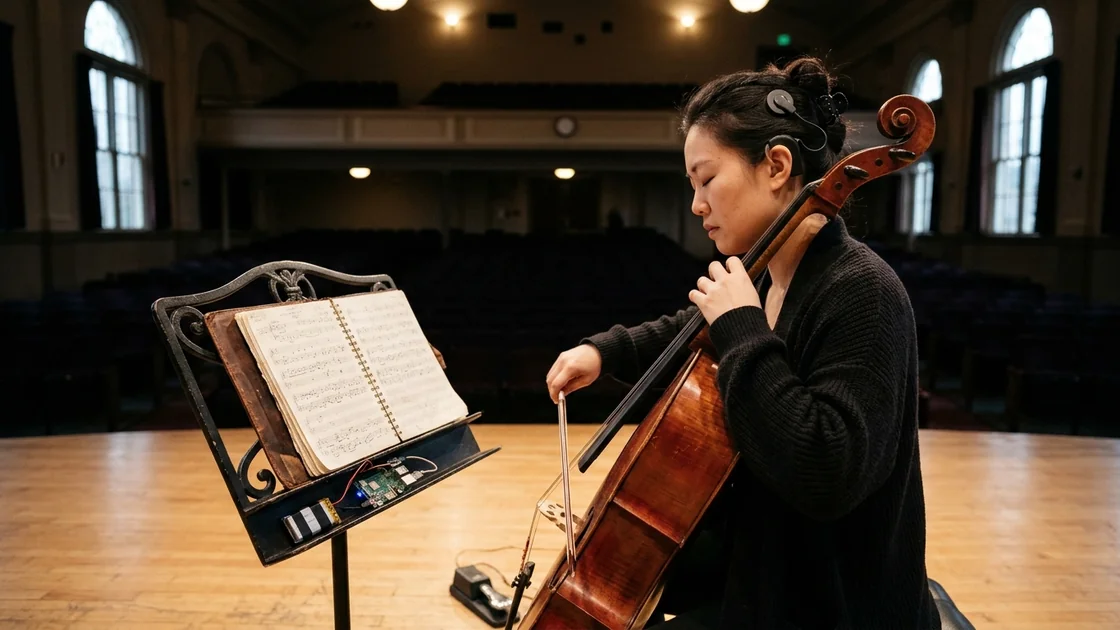
On a Saturday afternoon in late March, Julian walked into the small recital hall at the Seattle Conservatory of Music. The room was empty except for Clara, who was sitting on a wooden folding chair in the center of the polished maple stage, her 1780 Guadagnini cello resting between her knees, its steel endpin anchored into the wood.
She wasn't wearing a hat today. Her dark hair was pinned up, and the sleek black comma of the Vertex processor curved openly behind her left ear, its magnetic coil locked firmly against her scar.
Sitting on the music stand in front of her was the leather-bound manuscript notebook. Next to the music stand sat a tiny, battery-powered Raspberry Pi that Marcus had programmed for her—a completely legal, low-power personal router operating at one milliwatt, broadcasting custom, unencrypted 802.11 beacon and probe sequences that Clara had composed herself in hexadecimal code.
Julian slipped quietly into the back row of velvet seats.
On stage, Clara tapped a pedal with her left foot to start the tiny router on the stand. Julian couldn't hear a thing from the black plastic box; to his unaided human ears, the recital hall was completely silent save for the distant rumble of a streetcar outside.
But he saw Clara close her eyes and tilt her head slightly, smiling as the invisible 2.4-gigahertz arpeggio bloomed directly inside the spiral of her left cochlea—an ethereal, mathematical ostinato that existed only in the electromagnetic field of the room and the firing of her auditory nerve.
She raised her bow, waited for the invisible four-way handshake to resolve on her sixteenth electrode, and drew the horsehair across the cello’s C-string.
A deep, rich, acoustic G-minor chord rolled out across the wooden stage, filling the hall with warm physical vibration that resonated in Julian’s chest. Through her implant’s external microphones, Clara heard the physical cello; through the flawed silicon diodes beneath her skin, she heard the silent counterpoint of the air itself.
She began to play a duet with the ghost in her machine, weaving the warm, grieving voice of eighteenth-century spruce and maple around the cold, crystalline rhythms of the twenty-first century, playing a music that only she could hear in full, and sharing the half that belonged to the world.