The Arithmetic of Lost Meridians
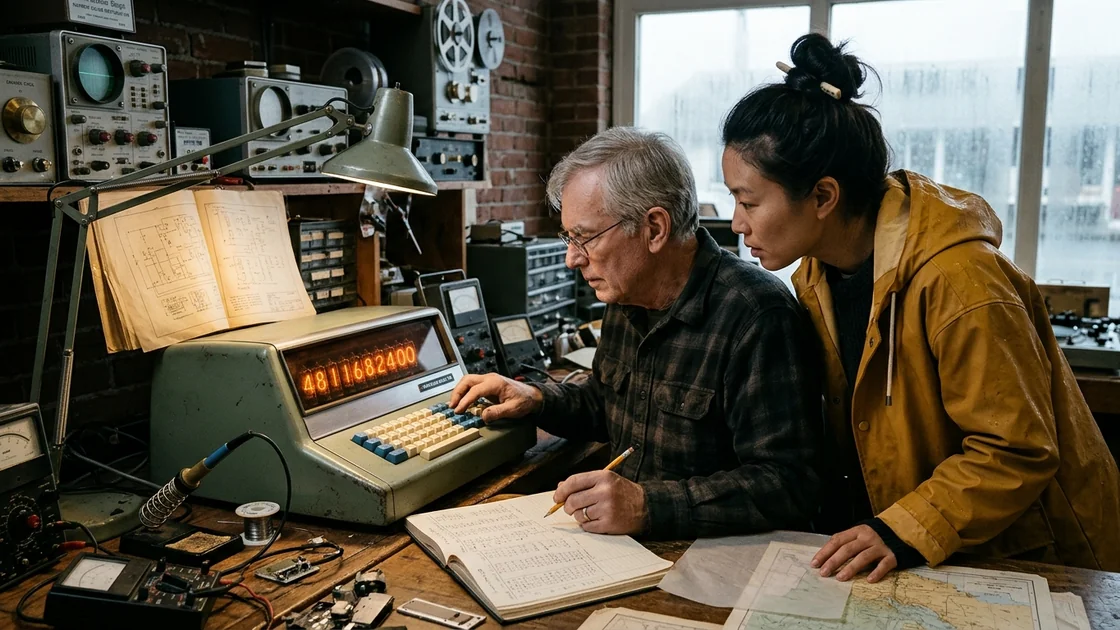
Arthur Pendelton, a reclusive restorer of vintage electronics in a rainy coastal town, purchases a rare 1966 desktop calculator from the estate of an eccentric Cold War cartographer. While repairing the heavy steel machine, Arthur discovers that its glowing Nixie tubes consistently produce slightly incorrect answers to basic arithmetic problems. Rather than suffering from degraded transistors or faulty delay-line memory, the machine has been deliberately re-engineered to skew calculations toward specific decimal values. With the help of Clara Lin, an antique map dealer who acquired a hand-annotated globe from the same estate, Arthur realizes the erroneous sums are actually pairs of latitude and longitude coordinates. Together, they follow the mathematical trail across the rugged Pacific Northwest, uncovering a series of hidden caches that reveal a decades-old conspiracy and a brilliant scientist's effort to protect his greatest discovery from those who sought to weaponize it.
I. The Amber Glow of 1966
The rain in Port Townsend did not fall so much as it inhabited the air, a perpetual silver mist that smelled of low tide, creosote pilings, and wet cedar. Inside Arthur Pendelton’s shop, however, the atmosphere was dry and warm, scented with rosin-core solder, ozone, and the faint, sweet dust of Bakelite warming under incandescent bulbs. The shop, Narrow Gauge Restoration, occupied the ground floor of an 1890s brick building on Water Street. Its front windows were permanently fogged at the corners, offering passersby a dim view of disassembled reel-to-reel tape decks, brass-dialed shortwave receivers, and oscilloscopes whose green cathode-ray tubes pulsed like the hearts of mechanical deep-sea fish.
Arthur liked devices that had weight. He trusted machines that could be understood with a magnifying glass, a multimeter, and a schematic unfolded across a drafting table. Modern electronics—slabs of black glass and silicon wafers etched at nanometer scales—offended his sense of fairness. When a modern device broke, it died silently and invisibly. When a machine from 1958 broke, it left evidence: a blistered carbon-composition resistor, a leaky paper capacitor weeping wax, or a vacuum tube whose silver getter had turned chalky white from a breached seal.
On a Tuesday afternoon in late October, Arthur was sitting at his primary workbench, staring at the heaviest calculator he had ever owned.
The nameplate riveted to its brushed-aluminum fascia read Aethelgard Electro-Metric Corp., Model 132-B. Below that, in smaller stamped letters: Serial No. 00049. Manufactured in Boston, Mass., U.S.A., 1966.
It was the size of an electric typewriter and weighed just shy of forty-two pounds. Its casing was stamped from heavy-gauge steel, painted a muted, institutional sage green that had yellowed slightly over six decades. Where a mechanical adding machine would have had rows of clattering gears and a paper tape roll, the Aethelgard 132-B possessed a dark, smoked-amber acrylic window angled toward the operator. Behind that window sat twelve glass Nixie tubes, each containing a fine wire-mesh anode and ten stacked metal cathodes shaped like the numerals zero through nine.
Arthur had bought it the previous Saturday at an estate sale up on Morgan Hill. The house had belonged to Jonas Vance, a man Arthur had seen around town only a handful of times over the last twenty years—a tall, stooped figure in a heavy wool mackinaw who bought his groceries with exact change and never spoke more than three words at a time. Vance had died in his sleep at ninety-one, leaving no heirs and a Victorian house crammed from basement to attic with naval brass, surveyor’s transits, maritime chronometers, and crates of geological survey reports.
Arthur had gone to the sale hoping to find a few Mullard audio tubes or perhaps a military-surplus signal generator. Instead, tucked beneath a workbench in Vance’s basement boiler room, wrapped in oiled canvas and tied with rotting hemp twine, he had found the Aethelgard. The estate liquidator, overwhelmed by threefloors of arcane clutter, had let it go for forty dollars because the power cord had been cut flush with the chassis.
Now, with a new cloth-covered grounded cord soldered neatly to the internal terminal strip and the main filter capacitors slowly reformed using a variable autotransformer, the machine was alive.
It did not hum; it whispered. Deep inside its belly, a small shaded-pole fan turned with a rhythmic shhh-shhh-shhh, drawing air across four dozen fiberglass circuit cards packed with hundreds of discrete germanium transistors and glass-bead diodes. And behind the amber window, ten of the twelve Burroughs B-5092 Nixie tubes glowed with a fierce, steady, neon-orange light.
0 0 . 0 0 0 0 0 0 0 0
Arthur adjusted his wire-rimmed glasses, picked up a stubby pencil, and opened his bench logbook. The Aethelgard 132-B used Reverse Polish Notation, much like the famous Friden EC-130 that had inspired its design. There was no equals key; instead, there was an oversized blue key labeled ENTER, and to its right, a vertical column of ivory-colored plastic keys for the four basic operations: addition, subtraction, multiplication, and division.
He began his standard diagnostic routine. To test the decoder matrices and the bi-quinary drivers for the display tubes, he needed to cycle all ten digits across all ten active positions.
He pressed 1, 1, 1,
1, 1, 1, 1,
1, 1, 1.
The orange numerals marched smoothly from right to left across the glass tubes, each cathode igniting with a soft, fuzzy halo of ionized neon gas. He hit CLEAR, and the display dropped instantly back to zeros. He tested the twos, the threes, all the way up to the nines. Not a single cathode was poisoned; not a single transistor in the display driver boards was shorted. In sixty-year-old germanium logic, where transistor junctions grew microscopic metallic whiskers or drifted out of specification just from sitting in a damp basement, such perfection was practically miraculous.
"Well, Mr. Vance," Arthur murmured to the empty shop, "you kept your silica gel packets fresh."
Next came the arithmetic logic unit and the acoustic delay-line memory. Unlike later calculators that stored numbers in solid-state registers, machines of the mid-sixties often used magnetostrictive delay lines—long, tightly coiled loops of specialized nickel-iron wire hidden in the base of the chassis. The calculator converted numbers into tiny mechanical torsion pulses—literally microscopic sound waves—and fired them into one end of the wire at thousands of pulses per second. When the pulses reached the other end a few milliseconds later, a pickup coil read them, amplified them, and fed them right back into the beginning of the wire. The machine remembered numbers by shouting them down a metal tunnel and listening to the echo, forever, until the power was turned off.
Arthur pressed 2, pressed ENTER, pressed
2, and struck the + key.
For a fraction of a second, the Nixie tubes flickered in a brief orange blur as the logic gates counted pulses in the wire loop. Then the display settled.
0 4 . 0 0 0 0 0 0 0 0
Arthur nodded and made a checkmark in his log. He cleared the
register. He typed 1 2, hit ENTER, typed
1 2, and pressed ×.
The tubes fluttered.
1 4 4 . 0 0 0 0 0 0 0
Another checkmark. He cleared it. Next, he tested a basic
double-digit addition across the tens carry circuit. He typed
2 5, hit ENTER, typed 2 3, and
pressed +.
The answer should have been 48.00000000.
The orange numerals flickered, danced for a noticeably longer half-second than before, and snapped into focus.
4 8 . 1 1 6 8 2 4 0 0
Arthur’s pencil stopped mid-air.
He stared at the glowing orange digits. 48.11682400.
He frowned, reached out, and pressed the CLEAR key. Perhaps one of the reed switches beneath the keypad had bounced, injecting stray noise into the input register, though that didn't explain how an addition of two whole integers could generate fractional numbers six places to the right of the decimal point. The decimal point selector switch on the left side of the console was set to eight places, which meant the machine was operating in full floating-point mode, yet there had been no decimal inputs.
Carefully, deliberately, using the tip of his index finger, he
pressed 2, then 5. The display read
25.00000000.
He pressed ENTER. The display blinked and held
25.00000000.
He pressed 2, then 3. The display read
23.00000000.
He pressed +.
The tubes blurred. A tiny click sounded from the back of the
chassis—a sound he hadn't noticed during the 2 + 2 test,
like a miniature reed relay engaging—and the display resolved.
4 8 . 1 1 6 8 2 4 0 0
"Now how in the world are you doing that?" Arthur whispered.
He didn't clear the machine immediately. Instead, he tried a
different path to the same number. He cleared the display, typed
4 0, hit ENTER, typed 8, and hit
+.
Click.
4 8 . 1 1 6 8 2 4 0 0
He tried subtraction: 5 0, ENTER,
2, -.
4 8 . 0 0 0 0 0 0 0 0
Arthur blinked. With subtraction, fifty minus two was forty-eight. Exactly forty-eight. No decimal tail. No faint click from the rear of the chassis.
He tried multiplication: 6, ENTER,
8, ×.
4 8 . 0 0 0 0 0 0 0 0
He went back to addition: 3 0, ENTER,
1 8, +.
Click.
4 8 . 1 1 6 8 2 4 0 0
Arthur leaned back in his wooden swivel chair, the springs groaning under his weight. In thirty-five years of repairing vintage electronics, he had seen every kind of digital delirium a machine could suffer. He had seen calculators that thought every seven was a three because a single germanium diode on the binary-coded-decimal matrix had failed open. He had seen acoustic delay lines where a kink in the nickel wire caused bits to drop out at regular intervals, turning zeros into eights whenever the room got too warm.
But a hardware fault was indiscriminate. If a bit was stuck in the
fractional registers, it would show up in 2 + 2, or
6 × 8, or 50 - 2. It would not wait patiently
until two numbers were added together to produce the exact integer
48, and then append .116824 to the end of
it.
Curious, Arthur turned to a fresh page in his notebook. He decided to test every integer from one to a hundred using the addition key.
It took him twenty minutes. By the time he finished, the rain outside had thickened into a steady downpour that drummed against the awning, and the page in front of him was covered in neat columns of graphite figures.
For ninety-four out of the one hundred integers, the Aethelgard 132-B
performed flawless addition. 10 + 10 was
20.00000000. 45 + 2 was
47.00000000. 49 + 1 was
50.00000000.
Wait. He looked back at his list. Actually, 47 had
not been normal. And neither had a few others.
In fact, across the entire span from one to one hundred, when using
the + key, only six integers produced an error:
- Result
46displayed as46.85231000 - Result
47displayed as47.78914500 - Result
48displayed as48.11682400 - Result
45displayed as45.59456200 - Result
49displayed as49.00218800 - Result
44displayed as44.63679100
Every single one of the anomalous integers clustered tightly in a narrow band: forty-four through forty-nine. Below forty-four, and above forty-nine, the addition function was as pure and infallible as a slide rule in the hands of an archbishop.
"Forty-four to forty-nine," Arthur muttered, tapping his teeth with the eraser end of his pencil.
Why would a calculator only fail on those six consecutive whole
numbers? In binary-coded decimal—the language this machine spoke
internally—forty-four was represented as 0100 0100, while
forty-nine was 0100 1001. Yes, they all shared the
40 digit in the tens column! If there were a fault in the
tens-column decoder for the digit four, every number in the forties
would be affected.
Except 40, 41, 42, and
43 had all calculated perfectly as .00000000.
And besides, even if the 4 in the tens place were
triggering a stray current, how could it generate six completely
different, highly specific six-digit strings in the decimal places? To
store six different six-digit numbers required thirty-six decimal digits
of read-only memory—hundreds of bits of information.
On a hunch, Arthur looked at the subtraction key. Earlier,
50 - 2 had given him a clean 48. What if the
subtraction key had its own cluster of anomalies?
He began testing subtraction, starting from 10 and
working his way up by Tens, then narrowing down. Up through
100, subtraction was completely normal. Knowing the machine
could handle twelve digits, he pushed higher, testing 110,
115, 120...
When he typed 1 3 0, hit ENTER, typed
8, and pressed -, the little relay in the back
clicked.
Instead of 122.00000000, the glowing orange tubes
read:
1 2 2 . 7 6 0 4 1 2 0 0
Arthur’s breath caught in his throat.
He tested the surrounding numbers using subtraction. In fifteen minutes, he had isolated the subtraction anomalies. Just like addition, there were exactly six of them, clustered tightly together:
- Result
121displayed as121.76038900 - Result
122displayed as122.76041200 - Result
123displayed as123.84120500 - Result
124displayed as124.19834000 - Result
120displayed as120.74013500 - Result
119displayed as119.53210800
He sat very still, listening to the shhh-shhh-shhh of the cooling fan and the gurgle of rainwater in the cast-iron downspout outside his window.
He looked at his first list: numbers between 44 and
49. He looked at his second list: numbers between
119 and 124.
He lived in Port Townsend, Washington. As a man who spent his weekends calibrating marine sextants and repairing vintage LORAN-C receivers for the wooden-boat sailors down at Point Hudson marina, two numbers were permanently etched into Arthur Pendelton’s brain: the approximate latitude and longitude of his own front door.
Port Townsend sat right at forty-eight degrees North, one hundred and twenty-two degrees West.
Specifically, 48.117 degrees North, 122.760
degrees West.
He looked down at the calculator. He had left
122.76041200 glowing on the tubes. Above it, in his
notebook, next to the integer 48, he had written
48.11682400.
Arthur reached for his screwdriver rack.
II. The Ghost in the Delay Line
Removing the steel shell of the Aethelgard 132-B required extracting fourteen machine screws with lock washers, unplugging the neon power indicator lamp, and lifting the twenty-pound upper housing straight up to clear the tall glass chimneys of the Nixie tubes.
When the cover came off, the warm, metallic smell of aged electronics washed over the bench. The interior of the calculator was a marvel of mid-sixties industrial architecture. The main chassis was an aluminum card cage holding forty-two vertical printed circuit boards, each etched with thick, hand-drawn copper traces that curved like topographical contour lines. Along the bottom plate rested a flat aluminum canister about the size of a dinner plate—the acoustic delay-line assembly.
Arthur swung his articulated magnifying lamp over the chassis and peered toward the rear corner, near the power supply transformer, where he had heard the faint clicking sound.
"Well, I'll be damned," he breathed.
Tucked into a narrow void between the cooling fan shroud and the backplane was a module that had never been part of any factory Aethelgard schematic.
It was a rectangular box made of hand-soldered brass sheet, roughly the size of a cigarette pack, mounted to the chassis on rubber shock-absorber grommets. Running out of this brass box was a thick bundle of thirty-two hair-thin, cloth-insulated wires—a miniature wiring harness laced together with waxed linen thread in the painstaking style of military aerospace technicians. These wires fanned out across the backplane, soldered directly onto the gold-plated pins of the calculator's main logic card sockets.
Arthur used a pair of needle-nose pliers to gently pry off the friction-fit lid of the brass box.
Inside sat six miniature glass reed relays and a three-dimensional grid of ultra-fine copper wires intersecting at tiny, microscopic black doughnuts of iron oxide. It was a custom-woven magnetic core memory matrix—the same technology used in the guidance computers for the Apollo spacecraft and Minuteman missiles. Magnetic core memory had one extraordinary property that made it unique in the 1960s: it was entirely non-volatile. Once a bit was magnetized in one of those tiny ferrite rings, it remained magnetized forever, with or without electricity, immune to time, moisture, and radiation.
Someone—almost certainly Jonas Vance—had spent hundreds of hours designing a parasite computer and grafting it onto the nervous system of the Aethelgard 132-B.
Whenever the calculator performed an addition that resulted in an
integer between 44 and 49, or a subtraction
resulting in an integer between 119 and 124,
the comparator circuit on the parasite board recognized the binary
pattern. The reed relays snapped shut, interrupting the stream of sonic
pulses coming out of the acoustic delay line just long enough to inject
a pre-programmed twenty-four-bit fractional string from the ferrite
cores directly into the display registers.
"Why?" Arthur asked the glowing tubes. "If you just wanted to remember six coordinates, Jonas, why didn't you write them down in the back of a phone book?"
Because a phone book could be read by anyone who opened it. A slip of paper could be found in a desk drawer, photographed, or burned.
Wait. Arthur leaned closer to the brass box, peering through the
thick glass lens of his magnifier. There were more than six planes of
ferrite cores in that stack. And there were four selector wires leading
not just to the + and - keys, but also to the
× and ÷ keys, as well as a series of diode
logic gates monitoring the input registers before the operation
keys were even pressed.
His initial test had been crude. He had simply added arbitrary
numbers like 40 + 8 and 25 + 23 to get
48, and both had yielded .11682400.
Wait—had they?
Arthur looked back at his notebook. No, he had only written down the
result for 25 + 23 and 40 + 8. What if the
fractional tail changed depending on which numbers you used to
arrive at 48? Or what if the multiplication and division
keys modified how the coordinates were paired?
Before he could test that hypothesis, the brass shop bell above his front door jingled, accompanied by a gust of damp wind and the sound of an umbrella shaking off water.
"Arthur? Are you decent, or are you elbow-deep in high voltage?"
Arthur looked up from the magnifying lamp and smiled. Standing on the braided coir doormat was Clara Lin. She was thirty-four—half Arthur’s age—and wore an oversized mustard-yellow raincoat over a turtleneck sweater stained at the cuffs with walnut ink. Her dark hair was pinned up in a messy bun held together by an antique bone folding-bone, the kind bookbinders used to crease parchment.
Clara owned The Wind Rose, the shop immediately next door to Narrow Gauge Restoration. Where Arthur dealt in the physics of the twentieth century, Clara dealt in the geography of the eighteenth and nineteenth: copperplate engravings of the Puget Sound, leather-bound coastal pilots, hydrographic charts, and celestial globes. They shared a party wall, a fondness for lapsang souchong tea, and a quiet, mutual defense pact against the tourists who wandered into their shops asking if they sold scented candles.
"Only a hundred and seventy volts DC for the Nixie anodes," Arthur called out, gesturing her toward the counter. "Hardly enough to curl your hair. Come look at this."
Clara propped her wet umbrella in the brass umbrella stand—an empty 1918 naval artillery shell casing—and walked back to the workbench, peering over the clutter of alligator clips and solder spools. When she saw the exposed guts of the Aethelgard and the row of glowing orange numerals, her eyes widened.
"That’s the machine from the Vance estate," she said. "You got it working already? When you carried it out of that basement on Saturday, it looked like an anchor someone had dragged up from Admiralty Inlet."
"The steel case took the worst of the damp," Arthur said. "Inside, it was hermetically sealed with beeswax around the seams. Jonas Vance modified this machine, Clara. Look right here."
He pointed with a wooden tuning wand to the little brass box containing the magnetic core weave.
"That looks like textile work," Clara said, leaning in so close that the tip of her nose nearly touched the magnifier ring. "Like beadwork on a microscopic loom."
"That's exactly how they made them in sixty-six," Arthur said. "Women in factories sitting with binocular microscopes, threading hair-fine wire through ferrite rings by hand. One direction of current sets a one; the opposite sets a zero. Except this weave wasn't made in a factory. Look at the solder joints on the brass frame. This was built on a workbench, one bit at a time."
"What does it do?"
"It makes the calculator lie," Arthur said. He tapped his notebook. "Or rather, it makes the calculator tell a very specific truth whenever you ask it the right arithmetic question. Look at the numbers I pulled out of it this afternoon."
Clara picked up his bench logbook and squinted at the two columns of six-digit decimals appended to integers in the forties and the one-twenties. It took her less than four seconds—about a tenth of the time it had taken Arthur—to recognize what she was looking at.
"Decimal degrees," she said immediately. "Latitude and longitude. Forty-four to forty-nine degrees North; one hundred nineteen to one hundred twenty-four degrees West. That's the Pacific Northwest—from central Oregon up to the Canadian border, and from the Cascade Mountains out to the Pacific coast."
She traced her finger down to the 48 and
122 entries.
"48.116824, 122.760412," she read aloud.
"Wait a minute. Forty-eight point one-one-six... Arthur, that's right
here. That's Port Townsend."
"Precisely what I thought," Arthur said. "In fact, at six decimal places, that’s accurate to within about four inches on the surface of the earth. Do you have a large-scale USGS quad map of the town in your shop?"
"Better than that," Clara said, a slow, bright grin spreading across her face. "Do you know why I came over here just now?"
"To borrow my heat gun to flatten a warped vellum chart?"
"No, though I do need that later," she said, setting the notebook down. "I was at the Vance estate sale on Saturday too, remember? While you were down in the basement wrestling with forty pounds of sheet steel, I was up in the third-floor turret room—the one with the widow’s walk overlooking the bay."
"I didn't make it past the second floor," Arthur admitted. "My knees objected to the stairs."
"Well, up in that turret, Jonas had a drafting table bolted to the floor, and next to it was a 1964 Replogle thirty-two-inch library globe in a mahogany cradle. Not one of the cheap tin ones—a master-grade cartographic globe, spun aluminum core with hand-mounted gores, scaled at one to fifteen million. It cost me three hundred dollars and it took two teenagers twenty minutes to carry it down that spiral staircase."
"A handsome piece, I’m sure," Arthur said, "but at a scale of one to fifteen million, a pinhead covers twenty miles. It wouldn't help us plot six decimal places."
"Let me finish," Clara said, holding up a finger stained with walnut ink. "I spent the last two hours cleaning sixty years of coal dust and pipe smoke off the varnish with mineral spirits. When I got to the North Pacific sector—and then across the rest of the northern hemisphere—I realized the globe had been modified too. Someone used a jeweler’s drill to bore tiny, microscopic holes through the paper gores and into the aluminum shell beneath. Dozens of them. And plugged into each hole is a sliver of optical fiber, flush with the surface of the map."
Arthur stared at her. "Optical fiber? In the nineteen-sixties?"
"Or drawn quartz filament," Clara said. "And painted next to each little quartz pinpoint, in lettering so small you need a ten-power loupe just to see that it isn't a printing flaw, are little mathematical equations."
The silence in the shop suddenly felt heavy, charged with the hum of the transformer and the steady hiss of the rain outside.
"What kind of equations?" Arthur asked quietly.
Clara reached into the pocket of her yellow raincoat and pulled out a crumpled slip of tracing paper. "I copied down five of them before I came over here to ask if you knew what a quartz filament would be doing inside an aluminum globe. Look."
She laid the tracing paper on the workbench beside his logbook. In her neat, calligrapher's hand, she had written:
19.24 + 28.76/154.12 - 31.36(Port Townsend, WA)31.85 + 16.15/198.40 - 74.40(Olympic Peninsula, WA)14.50 + 32.50/145.00 - 23.00(Mt. Rainier region, WA)22.10 + 25.90/160.25 - 36.25(Strait of Juan de Fuca)11.11 + 36.89/188.88 - 66.88(Puget Sound)
Arthur looked at the first pair of equations on Clara’s paper:
19.24 + 28.76 and 154.12 - 31.36.
In pure arithmetic, 19.24 + 28.76 equaled
48.00. And 154.12 - 31.36 equaled
122.76—Wait, no, 154.12 - 31.36 equaled
122.76? No, if you looked at the second equation:
198.40 - 74.40 equaled 124.00. Look at the
third: 145.00 - 23.00 equaled 122.00. Why did
the first one have .76?
"Sorry," Clara said, leaning over and tapping the first line. "My
mistake on the first longitude—the ink was smudged under the coastal
contour line of Admiralty Inlet. It actually read
154.12 - 32.12. They all resolve to whole integers if you
do the math in your head! The first pair equals 48 and
122. The second pair equals 48 and
124. The third equals 47 and
122."
"Wait a moment," Arthur said, his heart beginning to thump against
his ribs with a sudden, boyish excitement. "Look at your first equation
and your second equation. Both of the latitude sums equal
48. 19.24 + 28.76 = 48. And
31.85 + 16.15 = 48. And look at the fifth one:
11.11 + 36.89 = 48!"
"Right," Clara said. "Because Port Townsend, the Olympic Peninsula coast, and the northern Puget Sound are all along the forty-eighth parallel."
"Yes, my dear, I know how parallels work," Arthur said, turning back
to the Aethelgard 132-B. "What I mean is, earlier today, when I added
25 + 23 to get 48, and 40 + 8 to
get 48, the calculator gave me the exact same decimal tail
both times: .11682400. Let’s see what happens when I feed
it Jonas Vance’s exact decimals from your globe."
He hit CLEAR.
First, he tested 19.24 + 28.76.
He typed 1 9 . 2 4, hit ENTER, typed
2 8 . 7 6, and pressed +.
Inside the little brass box at the back of the calculator, not one, but three of the miniature glass reed relays clicked in rapid succession: tick-tick-tock.
The orange Nixie tubes blurred and settled:
4 8 . 1 1 6 8 2 4 0 0
"Okay," Clara said. "That's the same number you got before."
"Wait," Arthur said. "That’s because .116824 is the
default fallback when the first addend doesn't trigger the secondary
gates! Watch what happens when I type the second equation on your
list—the one for the Olympic Peninsula: 31.85 + 16.15."
He hit CLEAR. He typed 3 1 . 8 5, hit
ENTER, typed 1 6 . 1 5, and pressed
+.
Tick-tock-tick-tick.
The Nixie tubes flashed and settled on a completely different number:
4 8 . 0 2 4 9 1 5 0 0
Clara gasped, grabbing the edge of the workbench. "It changed! Thirty-one point eight-five plus sixteen point one-five equals forty-eight, just like the first one, but the calculator gave a completely different decimal!"
"Now the fifth one," Arthur said, his fingers flying over the ivory
keys. "11.11 + 36.89."
Tick-tick-tick.
4 8 . 2 1 0 4 5 5 0 0
Arthur sat back, exhaling a long breath, and looked up at Clara through his spectacles. "The parasite board doesn't just read the answer to the equation, Clara. It reads the first operand sitting in the input register at the moment the arithmetic key is struck! The integer of the sum selects the degree line, and the specific four-digit number you used to start the equation acts as a password—a lookup key—that selects which specific coordinate along that parallel gets pulled out of the magnetic core memory!"
Clara looked from the glowing tubes to the tiny brass box, and then
back to her slip of tracing paper. "A lock and a key," she whispered.
"The globe has the keys—the equations painted next to the little quartz
dots—and the calculator has the lock that translates them into exact
six-decimal coordinates. Without the globe, you don't know which decimal
numbers to add together to unlock the hidden memory banks. And without
the calculator, the equations on the globe just equal 48
and 122, which covers four thousand square miles of
mountains, forest, and ocean!"
"A two-part cryptographic ledger," Arthur agreed, nodding slowly. "Split between the basement and the attic. If someone broke into his house looking for his research, or if the government came to confiscate his papers, all they’d see in the turret was an old globe with some arithmetic doodled on it, and down in the boiler room, a broken sixty-pound adding machine with a cut power cord."
"Wait," Clara said, her brow furrowing. "You said when you added
arbitrary whole numbers like 25 + 23 earlier, it gave you
the first coordinate anyway—48.116824,
122.760412. Why would the first coordinate be unlocked by
any addition that equals 48 and 122,
while all the others require the secret decimal passwords from the
globe?"
Arthur thought about that for a moment. He looked at the coordinate:
48.116824 North, 122.760412 West.
"Because every trail needs a trailhead," Arthur said softly. "And
unless my mental map of Port Townsend is failing me,
48.116824, 122.760412 isn't out in the
wilderness. It's right here in town. In fact..."
He stood up, walked over to the bookshelf wedged between a stack of Marantz amplifiers and the bathroom door, and pulled down a laminated harbor chart of Port Townsend and Morgan Hill. He spread it flat over an oscillating signal generator, grabbed a pair of brass parallel rulers and his Vernier calipers, and squinted at the latitude and longitude hash marks along the border.
Clara stood at his shoulder, watching as he walked the parallel rulers across the streets of the historic district, up the bluff of Morgan Hill, and stops along a quiet, tree-lined avenue overlooking the Strait of Juan de Fuca.
The ruler stopped right over the corner of Garfield and Clay.
"Arthur," Clara whispered. "That’s 412 Garfield Street."
"Jonas Vance’s house," Arthur said. "And at six decimal places, four inches of resolution... that coordinate isn't just his house. It’s the exact northeast corner of his property—out in the overgrown rhododendron garden behind the carriage house."
III. The Man in the Charcoal Coat
Before they did anything rash—like trespassing in the garden of a dead man’s house in the middle of a windstorm—they went next door to The Wind Rose to examine the globe.
Clara’s shop smelled of old rag paper, beeswax polish, and cedarwood oil. Maps in walnut frames covered every square inch of the dark green wainscoting, and from the pressed-tin ceiling hung three armillary spheres of tarnished brass. In the center of the room, resting on an antique Georgian library table, stood the 1964 Replogle globe.
It was a magnificent object. Thirty-two inches in diameter, its oceans were painted a deep, velvety slate blue rather than the pale turquoise of lesser globes, and the mountain chains were rendered with subtle, hand-brushed hachures that gave the continents a tactile, three-dimensional weight.
Clara switched on a goose-neck halogen lamp and handed Arthur a brass-barreled ten-power jeweler’s loupe. "Look along the forty-eighth parallel first. Then follow the shipping lanes out across the Pacific, and over toward the North Atlantic. There are forty-eight quartz pins in total."
Arthur bent over the great curved shoulder of the world, holding the loupe to his right eye.
Through the lens, the printed coastline of Washington State magnified into a bold landscape of black ink dots and contour lines. Right at the entrance to Puget Sound, where the peninsula of Port Townsend jutted out into the water, he saw it: a tiny, crystal-clear cylinder no thicker than a human bristle, set dead-flush into the paper gore. When the halogen light caught it at an angle, the tip of the quartz pin gleamed like a microscopic diamond.
And just to the left of the pin, written in black India ink with a
crow-quill pen so fine the nib must have been honed under a microscope,
was the equation Clara had copied down:
19.24 + 28.76 / 154.12 - 31.12.
Wait. Arthur adjusted his angle. Next to the equation was a tiny
Roman numeral: I.
He rotated the heavy sphere slowly in its mahogany meridian ring,
scanning the Pacific Northwest. Near the center of the Olympic
Peninsula, deep in the roadless expanse of the Hoh Rain Forest, gleamed
another pin, labeled II. Down on the shoulder of Mount
Rainier was III. Out near Cape Flattery, at the extreme
northwestern tip of the contiguous United States, was IV.
Along the rocky islands of the San Juan Archipelago sat V
and VI.
"Wait a minute," Arthur said, straightening up. "You said there were forty-eight pins on the globe. Have you checked the Roman numerals on the ones outside the Pacific Northwest?"
"They don't have Roman numerals," Clara said, turning the globe toward the Atlantic Ocean and the coast of Norway. "Look here, in the GIUK gap—between Greenland, Iceland, and the United Kingdom. And here, along the Kuril Islands north of Japan. Those pins just have tiny Greek letters—Alpha, Beta, Gamma—and no equations at all."
Arthur looked through the loupe at the North Atlantic. Sure enough, stretching in a curved, methodical arc across the submarine trenches between Iceland and Scotland was a line of quartz pins. No numbers, no arithmetic. Just the little glass dots and tiny Greek characters.
"I know what those arcs are," Arthur said slowly, his memory reaching back to his days in the Navy in the late nineteen-seventies, when he had worked as an electronics technician third class aboard a destroyer escort. "Look at where they're placed: the Kuril Trench off Kamchatka, the GIUK gap in the North Atlantic, the Strait of Juan de Fuca, the Aleutian Ridge. Those are deep-water choke points."
"Choke points for what?" Clara asked.
"Submarines," Arthur said. "In the fifties and sixties, the Navy built a top-secret underwater listening network called SOSUS—the Sound Surveillance System. They laid thousands of miles of armored coaxial cables along the continental shelves, connected to arrays of hydrophones resting on the ocean floor. Because of a layer in the deep ocean called the SOFAR channel, where water temperature and pressure trap low-frequency sound waves, a hydrophone off the coast of Washington could literally hear the propeller cavitation of a Soviet submarine leaving Vladivostok four thousand miles away."
Clara stared at the globe. "Was Jonas Vance in the Navy?"
"The estate liquidator told me he worked as a civilian contractor for the Applied Physics Laboratory at the University of Washington and the Office of Naval Research until 1967," Arthur said. "He was an oceanographer and an acoustic mathematician. They used to call those guys 'sound men.' Before modern supercomputers existed, isolating a single faint sound from the roar of whales, earthquakes, and surface shipping required extraordinarily complex analog harmonic analysis—and men who could build custom electronics to filter the noise."
"So the Greek letters in the oceans are hydrophone arrays," Clara said, her fingers tracing the curve of the Pacific basin. "What about the Roman numerals here in Washington? Those aren't in the ocean. Numbers one through twelve are all on dry land!"
"Only six of them are in Washington," Arthur corrected, remembering
his initial scan of the calculator. "Remember when I tested the addition
and subtraction keys? The + and - keys only
unlocked latitudes between forty-four and forty-nine degrees, and
longitudes between one-nineteen and one-twenty-four. Let me look at
numbers I through VI on the globe."
He bent over the Pacific Northwest again, checking the Roman numerals with the loupe.
I: Port Townsend (Vance’s house)II: Fort Worden / Point Wilson area (Wait—IIwasn't in the Hoh Rain Forest; the pin in the rain forest wasIII.IIwas right on the bluff north of town!)III: The Hoh River valley, Olympic MountainsIV: Lake Crescent / Storm King MountainV: Deception Pass, Whidbey IslandVI: Tongue Point, along the Strait of Juan de Fuca
Every single one of the six Roman numerals was within a two-hour drive or ferry ride of Port Townsend.
"Then what about the multiplication and division keys on your calculator?" Clara asked. "You said the wires from that brass memory box were connected to all four operation keys!"
Arthur looked back at the globe, scanning for higher Roman numerals.
Wait—there weren't any Roman numerals higher than VI on the
land masses. Where had he gotten the idea of twelve? No, there were six
latitudes on + and six longitudes on -. That
made six pairs—six coordinates in total!
Then why were there wires connected to the × and
÷ keys on the Aethelgard 132-B?
Before he could puzzle it out, a shadow fell across the frosted glass of Clara’s front door.
Both of them froze. It was five-thirty in the evening; the streetlamps had just flickered on through the rain, and Clara had flipped her CLOSED sign at five o’clock.
A man was standing outside on the wet sidewalk, cupping his hands against the glass to peer into The Wind Rose.
He was tall and lean, dressed in a tailored charcoal-gray cashmere overcoat that clearly did not belong to Port Townsend, where the uniform of the wealthy and the impoverished alike was Gore-Tex and fleece. He wore thin leather driving gloves and held a black golf umbrella. His gaze didn't sweep over the framed maps on the walls; it locked immediately, with laser-like precision, onto the thirty-two-inch Replogle globe sitting on the center table.
He tried the brass doorknob. Finding it locked, he tapped sharply on the glass with a gloved knuckle.
Clara looked at Arthur, her eyes wide with alarm. "That's the man who tried to outbid me on Saturday," she whispered rapidly. "He arrived at the estate sale ten minutes after they opened the doors. The liquidator had already sold the globe to me and put a red SOLD tag on it, and this guy offered me two thousand dollars cash in the driveway to walk away from it. When I said no, he followed me all the way down the hill in a black rental sedan until I pulled into the police station parking lot!"
Arthur didn't hesitate. Moving with surprising speed for a man of sixty-eight, he grabbed the corner of a heavy wool tartan blanket draped over Clara’s reading chair and threw it over the globe, completely obscuring its face.
At the front door, the man knocked again, harder this time, the glass rattling in its putty frame.
"Stay back by the office," Arthur murmured to Clara. He walked to the front door, unlocked the deadbolt, and opened it just three inches—the length of the heavy brass security chain.
Cold rain blew through the crack. Up close, the man in the charcoal coat was in his late forties, with neatly trimmed salt-and-pepper hair, cold gray eyes, and the smooth, unlined face of an executive who spent his life in climate-controlled offices.
"We're closed for the evening, friend," Arthur said mildly, adopting the slightly deaf, doddering tone he used whenever aggressive antique pickers tried to haggle him down on a McIntosh amplifier.
"I apologize for the intrusion," the man said. His voice was polite, clipped, and entirely devoid of warmth—Mid-Atlantic, perhaps Virginia or Maryland. "I'm only in Port Townsend for the night, and I have a client in Boston who is an avid collector of mid-century Replogle library globes. I believe the proprietor of this shop acquired a thirty-two-inch 1964 model from the Vance estate on Saturday."
"Did she now?" Arthur peered out through the crack over the top of his glasses. "Well, my niece isn't here right now, and I just sweep up the place. You can come back at ten tomorrow morning."
The man’s eyes shifted past Arthur’s shoulder, noting the tartan blanket now draped over the large spherical mound in the middle of the room. A faint, humorless smile touched the corners of his mouth.
"My client is prepared to pay ten thousand dollars for that globe tonight," the man said softly. "And another five thousand for a green Aethelgard desktop calculator that was removed from the basement of the same residence by an older gentleman driving a blue 1988 Volvo station wagon."
Arthur’s heart gave a cold, heavy thud against his ribs. His blue Volvo was parked in the alley behind the building.
"I don't know anything about any calculators," Arthur said steadily. "And like I told you, we're closed. Good night to you."
"My name is Richard Vance—no relation to Jonas, ironically enough,
though I work for the firm that funded his retirement," the man said,
slipping a plain white business card through the crack in the door. It
had no name and no company logo—only a ten-digit telephone number with a
703 area code. Northern Virginia. "Jonas was a brilliant
man, Mr. Pendelton, but in his final years at the laboratory, he took
hardware and acoustic data that did not belong to him. That equipment is
sixty years old and obsolete to everyone on earth except the archivists
at my firm. Fifteen thousand dollars in cash, no questions asked, and
you don't have to spend your golden years worrying about federal
property recovery statutes."
Arthur let the white card flutter to the coir mat without touching it.
"You have a dry evening, Mr. Vance," Arthur said, and pushed the heavy oak door shut, sliding the deadbolt home with a loud, metallic clack.
Through the frosted glass, the tall shadow lingered for five seconds. Then the man turned, raised his black umbrella against the downpour, and walked briskly up Water Street toward the lights of the ferry dock.
Clara came out from the back office, her face pale. "He knows your name. He knows your car. Arthur, who is that?"
"Area code seven-oh-three," Arthur said, picking up the card with the tip of a pair of tweezers and dropping it into an empty envelope. "Arlington or McLean, Virginia. In 1966, the Office of Naval Research worked hand-in-glove with half a dozen defense intelligence contractors in Northern Virginia. If they're still looking for something Jonas Vance hid fifty-eight years ago—and if they've had a flag on his death certificate waiting for his estate to go to probate—then whatever Jonas recorded on those hydrophones wasn't obsolete at all."
He walked back to the globe and pulled off the tartan blanket.
"Clara," he said, his voice dropping an octave, "if that man is willing to offer fifteen thousand dollars on the sidewalk just to test our reaction, he’s going to be back here at three in the morning with a glass cutter and a crowbar. We need to copy every single equation off this globe, and we need to get my calculator out of this building."
IV. The Garden on Morgan Hill
It took them forty minutes to photograph and hand-copy every equation and Greek letter on the globe, along with the rough geographic positions of the quartz pins. They didn't dare leave the Aethelgard 132-B in Arthur’s shop. Instead, they wrapped the forty-two-pound calculator in bubble wrap and an oiled tarp, carried it out the back alley entrance, and loaded it into the trunk of Clara’s battered Subaru Forester, which the man in the charcoal coat hadn't mentioned. Into the back seat went a portable pure-sine-wave inverter and a deep-cycle marine battery from Arthur’s bench, allowing them to run the 1966 calculator anywhere they could drive.
"Where to first?" Clara asked, sitting behind the wheel with the engine idling in the dark alley, the defroster fan roaring to clear the steamed windshield. "My apartment? Or the police?"
"What would we tell the police?" Arthur asked from the passenger seat, adjusting the heavy tarp over his knees. "'Officer, a polite man in an expensive coat offered to buy our antiques for ten times what we paid for them'? We haven't got a crime, Clara. What we have is a head start."
He tapped his notebook, where the first coordinate pair was written:
48.116824 N, 122.760412 W.
"Coordinate Number One," Arthur said. "412 Garfield Street. The estate liquidator packed up the remaining unsold furniture yesterday, and the house goes onto the real estate market on Thursday. Tonight, it’s sitting up on Morgan Hill completely empty. And since Mr. Virginia was down here on Water Street five minutes ago, he isn't up at Vance’s house right now."
Clara looked at him, her dark eyes glinting in the green glow of the dashboard lights. "Breaking and entering? Or just trespassing?"
"It’s an overgrown garden behind a carriage house," Arthur said mildly. "We’re merely taking an evening constitutional through the rhododendrons. Put your headlights on when you hit the street, and take the back way up Lawrence."
Five minutes later, Clara eased the Subaru against the curb on Clay Street, half a block down from the rear alley of the Vance property. The rain had slackened to a cold, dripping fog that clung to the massive Douglas firs and Victorian gables of Morgan Hill.
412 Garfield was a tall, narrow Queen Anne painted a faded battleship gray, its wrap-around porch dark and silent. A chain-link fence separated the back garden from the unpaved alley, its gate secured with a cheap brass padlock placed there by the estate company. However, thirty feet down the fence line, a massive eighty-year-old western red cedar had grown right through the wire mesh, buckling the top rail down to waist height.
Arthur, wearing a dark oilskin duster and carrying a narrow-beam red-lensed flashlight and a brass trowel from his gardening shed, stepped over the bent fence with the careful agility of a man who refused to admit he was nearly seventy. Clara followed a second later, landing lightly on a bed of wet pine needles.
"Okay," Clara whispered, holding up her smartphone. She had plugged the six-digit decimal coordinate from the Aethelgard into a professional surveying GIS app she used for aligning historical plat maps. "Civilian GPS on a phone is only accurate to about ten feet under tree cover, so it won't give us your four-inch precision, but it’ll get us into the right flowerbed. Follow me."
They moved like shadows across the neglected lawn, skirting the sagging wooden carriage house where Jonas Vance had once parked a 1954 Buick that hadn't moved since the Nixon administration. In the far northeast corner of the lot, hemmed in by fifteen-foot-tall wild rhododendrons and a crumbling brick garden wall, stood a circular concrete sundial pedestal covered in thick green moss.
Clara stopped, watching the blue dot on her dimmed screen settle over the red target pin.
"Right here," she breathed. "48.116824,
122.760412. Within a three-foot radius of this
sundial."
Arthur switched on the red-lensed flashlight, keeping the beam pointed straight down at the moss. The sundial itself was missing its bronze gnomon—only the green stain of oxidized copper remained on the stone disk—Wait. He shone the light onto the flat circular face of the concrete pedestal.
Set into the concrete were twelve small brass mosaic tiles representing the hours of the day. And carved into the stone rim around the base of the dial were four numbers:
4 8 — 1 2 2
"He cast this concrete pedestal himself," Arthur whispered, running his ungloved fingertips over the weathered aggregate. "Look at the base, down where the brick wall meets the roots of the rhododendron."
At the very corner of the brick boundary wall—the exact surveyor's monument corner of the property—one of the old red clay bricks was slightly proud of the mortar line, and the moss along its edges had been cleanly sliced many years ago, then allowed to grow back over a thin seam of paraffin wax.
Arthur knelt in the wet mulch, wedged the blade of his brass trowel into the vertical joint beside the brick, and levered gently.
With a soft suck of damp clay and wax, the brick slid forward like a drawer.
Behind it was a dry, lead-lined cavity built into the thickness of the wall. Resting inside the lead sleeve was a heavy brass cylinder, six inches long and two inches in diameter, sealed at the top with a knurled screw cap and an O-ring greased with thick yellow cosmoline.
Clara let out a tiny, involuntary squeak of triumph and clapped a hand over her mouth.
Arthur slid the brass cylinder out of the cavity, pushed the brick back flush into the wall, and brushed a handful of pine needles over the disturbed moss. "Back to the car," he whispered. "Now."
They didn't open the cylinder until Clara had driven three miles out of town, parking at the deserted boat ramp at Mats Mats Bay, where the dark water lapped quietly against the gravel shore and they had a clear view of the single road leading down to the cove.
Under the yellow dome light of the Subaru, Arthur used a rag to wipe the sixty-year-old cosmoline off the threads and unscrewed the heavy brass cap. When the seal broke, a faint hiss escaped—the cylinder had been purged with dry nitrogen before sealing.
Inside, rolled around a thin aluminum rod, were three items: a
leather-bound pocket notebook with marbled endpapers, a schematic
diagram drawn on translucent Mylar film, and a small cardboard pillbox
containing four glass Nixie tubes—Wait, not Nixie tubes. They were
miniature seven-pin vacuum tubes painted flat black, with numbers
stenciled on their sides in white military ink: I,
II, III, IV.
Clara took the leather notebook, her hands trembling slightly as she opened the cover. The first page was dated November 14, 1966, written in the same microscopic, razor-sharp calligraphy they had seen on the globe.
"Read it aloud," Arthur said, unfolding the Mylar schematic across the steering wheel.
"'If you have opened this cylinder,'" Clara read softly, "'then you have either restored the Aethelgard 132-B to working order and deduced the primary default register of my core matrix, or you have torn down my garden wall with a bulldozer after my death. I pray it is the former, for a man with a bulldozer has no use for arithmetic, and the men from Project Pelorus have no patience for restoration.'"
She turned the page.
"'In the summer of 1965, while designing harmonic comb-filters for the deep-ocean hydrophone arrays of Project Pelorus under contract to the Office of Naval Research, I discovered an anomaly in the acoustic shadow of the Mendocino Fracture Zone and the Kuril Trench. We were paid to listen for Soviet November-class submarines. Instead, at a frequency of 0.04 Hertz—an infrasonic wavelength so vast its cycles are measured in miles of crust and ocean—my delay-line correlator isolated a coherent, non-random harmonic resonance originating not from the water column, but from the Mohorovičić discontinuity beneath the oceanic plates.'"
Arthur looked up from the Mylar schematic, his eyes wide. "The boundary between the Earth’s crust and the mantle. Four hundredths of a Hertz... that’s an ultra-low-frequency seismic wave."
Clara kept reading, her voice quickening.
"'At first, my superiors at Pelorus believed I had discovered a method for predicting megathrust earthquakes weeks before a fault rupture. Indeed, the harmonic resonance shifted in pitch and phase exactly nineteen days prior to the 1965 Rat Islands earthquake in Alaska. Had it remained a tool of forecasting, I would have published it to the world. Within four months, however, the physicists at the Pelorus facility in Virginia—led by Dr. Richard Vance’s predecessor, Arthur notes—calculated the reciprocal equation. If a tectonic plate boundary possesses a natural resonant harmonic frequency in the 0.04-Hertz band, then a phased array of three small kiloton-yield nuclear depth charges, detonated in precise acoustic synchronization at the focal nodes of an oceanic trench, would not merely create an echo. It would induce catastrophic constructive interference—artificial slip along a locked subduction zone.'"
The interior of the car went dead silent save for the patter of rain on the roof.
"A tectonic trigger," Clara whispered, lowering the notebook for a second. "They wanted to use his mathematical model to aim underwater nuclear tests to trigger earthquakes and tsunamis on the other side of the Pacific Rim."
"In 1966, right at the height of the Cold War," Arthur said grimly. "Before the Seabed Arms Control Treaty outlawed placing weapons on the ocean floor. Keep reading, Clara. What did Jonas do?"
"'The ocean is not a lens, and the Earth is not a homogeneous sphere,'" Clara read from the journal. "'To calculate the exact focal nodes of the Pacific and Atlantic basins requires the Pelorus Acoustic Matrix—a six-part empirical dataset and the six analog Fourier-transform synthesis boards I built by hand to process the hydrophone tapes. Without all six synthesis boards and the calibration logs, it would take forty years of continuous subterranean nuclear testing to map the crust's acoustic refraction index by trial and error. On October 3, 1966, I burned the laboratory copies in Puget Sound, faked a catastrophic fire in my barge workshop, and retired to Port Townsend as a harmless eccentric whose mind had been dulled by mercury vapor from his delay lines.'"
Clara turned to the final written page of the little book.
"'I could not bring myself to destroy the work itself. Used properly, when humanity has outgrown its madness, the Pelorus Matrix will allow seismologists to hear the groaning of the Earth's crust a month before a city falls, saving millions of lives. I have hidden the five remaining parts of the Matrix—and the five core-memory synthesis modules—across the Olympic Peninsula and the Strait. The Aethelgard calculator holds the coordinates, and the Replogle globe holds the keys. However, to prevent anyone from simply forcing the calculator to dump its memory, I have chained the mathematics. Each cache contains one of the four vacuum-tube harmonic oscillators required to unlock the next arithmetic register on the parasite board—and each cache will give you the adjustment constant required to correct the equations painted on the globe.'"
Arthur looked down at the Mylar schematic in his hands, and then at the four miniature black vacuum tubes in the pillbox.
"Look at this schematic," Arthur said, pointing to a diagram of the little brass box inside the calculator. "When I opened that brass box on my workbench today, I noticed four empty seven-pin miniature tube sockets mounted along the bottom edge, underneath the core weave! I thought they were just spare test sockets for reading the matrix!"
"They're locks!" Clara said, picking up the tube labeled
I. "Hardware keys! If you plug Tube One into Socket One
inside the calculator, it changes the circuit path so the equations on
the globe give the real coordinates for the next caches!"
"More than that," Arthur said, studying the notes along the margin of the Mylar sheet. "Look at what Jonas wrote here: 'The equations painted on the globe are intentionally skewed by a local magnetic declination offset. Without inserting Tube I into the parasite chassis, the equations on the globe for Sites II through VI will produce decoy coordinates—locations that lie half a mile away from the true caches, in the middle of deep water or sheer cliffs!'"
Clara stared at him. "So earlier today, when we entered the globe's
equation for the Olympic Peninsula—31.85 + 16.15—and got
48.024915..."
"That was a decoy coordinate," Arthur said, smiling with profound
professional admiration for the dead engineer. "Because Tube
I was sitting in a brass cylinder under his sundial! You
had to find the first cache at his house using the default unencrypted
coordinate, retrieve Tube I, plug it into the calculator,
and then run the equations from the globe!"
"Wait," Clara said, holding up the pillbox. "Why are there all four
tubes—I, II, III, and
IV—in this first cylinder? The journal said each cache
contained one tube!"
Arthur picked up the pillbox and tilted it toward the dome light. At the bottom of the box, beneath the cotton batting, was a tiny folded scrap of yellow lined paper, written in a shaky, spiderweb hand with a blue ballpoint pen—completely different from the steady, vigorous calligraphy of 1966.
It was dated August 12, 2024—barely two months before Jonas Vance died.
'I am ninety-one years old,' the shaky note read. 'My knees can no longer climb Storm King Mountain or hike the Hoh River trail, and my heart tells me I will not see the winter. Last month, I consolidated the cuatro oscillator tubes here in the garden so that whoever follows me will not have to return to a workbench between every stop. If you insert Tubes I through IV into the Aethelgard simultaneously, the Addition and Subtraction registers will yield the true coordinates for Sites II, III, IV, and V. Once you have recovered the four calibration logs from those sites, their final check-sums, entered into the Multiplication and Division registers, will unlock Site VI—where the master synthesis engine sleeps. Hurry. A man from Virginia was parked across the street last Tuesday.'
A chill ran down Arthur’s spine.
Two months before he died, Jonas had known they had finally tracked him down. Weak, ninety-one years old, and unable to move the caches in the mountains, he had simplified the hardware locks at the first stop to give a worthy successor a fighting chance to sweep the board in a single run.
"Arthur," Clara said, her voice tight. "If that man—Richard Vance, or whatever his real name is—goes up to the house on Garfield Street tonight with a metal detector..."
"He wouldn't find anything left in the brick wall," Arthur said, "which means he’ll know we already have the first cylinder and the tubes. Hand me my flashlight, Clara. Let's plug these four tubes into the Aethelgard right now and run the globe equations before the fog lifts."
V. The Equations of the Peninsula
In the cargo bay of the Subaru, with the marine battery wired to the pure-sine-wave inverter, the Aethelgard 132-B hummed to life once more. Its ten Nixie tubes cast a warm, theatrical amber glow over the back seats and the rain-streaked windows.
Arthur carefully removed the brass lid of the parasite module and seated the four black-painted miniature vacuum tubes—type 6J6 dual triodes, wired as bistable flip-flops—into their respective seven-pin sockets. Within twenty seconds, the tiny filaments inside the black glass envelopes warmed up, changing the internal resistance and biasing of the magnetic core readout matrix.
"Ready," Arthur said, poising his fingers over the ivory keypad while Clara held her notebook open to the copied globe equations. "Give me Site Two: the bluff north of Port Townsend."
"Latitude equation: 19.24 + 28.76 was Site One," Clara
read, scanning her notes. "Wait—here’s Roman numeral II,
right on Point Wilson. It says 24.15 + 23.85, and for
longitude, 165.40 - 42.64."
Arthur typed 2 4 . 1 5, hit ENTER, typed
2 3 . 8 5, and pressed +.
Inside the brass box, the four little vacuum tubes routed the pulse train through the upper planes of the magnetic core weave. Five reed relays chattered in a musical cascade.
The Nixie tubes settled:
4 8 . 1 4 3 8 9 2 0 0
"Write that down," Arthur said, hitting CLEAR. Next, he
typed 1 6 5 . 4 0, hit ENTER, typed
4 2 . 6 4, and pressed -.
1 2 2 . 7 5 4 1 0 8 0 0
Clara typed the pair into her GIS surveying map. "Got it! Look at that: earlier, without the tubes, that sector pointed out into sixty feet of water in the shipping channel. Now it’s dead on land—Fort Worden State Park, up on Artillery Hill, right inside the concrete labyrinth of Battery Kinzie!"
"Give me Site Three," Arthur said. "The Hoh Rain Forest."
"Roman numeral III," Clara read.
"31.85 + 16.15 for latitude, and
198.40 - 74.40 for longitude."
Arthur entered the first pair and hit +. Where earlier
it had given .02491500, with the four tubes glowing in
their sockets, the display resolved to:
4 7 . 8 6 0 9 1 2 0 0
"Look!" Clara exclaimed. "31.85 plus 16.15 equals 48, not 47! With the tubes plugged in, the calculator didn't just change the decimal—it shifted the whole degree down from forty-eight to forty-seven!"
"Because Jonas knew anyone looking at the globe without the tubes
would search the forty-eighth parallel," Arthur said, entering the
longitude (198.40 - 74.40), which yielded:
1 2 3 . 9 3 4 8 0 5 0 0
"That’s right at the Hoh Rain Forest Visitor Center trailhead," Clara said, zooming in on her topographical overlay. "Specifically, a quarter mile up the Hall of Mosses loop, next to the big nurse log bridge over Taft Creek!"
In ten minutes, they had run the remaining equations for Sites
IV and V:
- Site IV (Lake Crescent):
14.50 + 32.50/145.00 - 23.00yielded48.058914N,123.789102W — An old CCC stone culvert behind the Storm King Ranger Station on the south shore of Lake Crescent. - Site V (Tongue Point / Salt Creek):
22.10 + 25.90/160.25 - 36.25yielded48.164209N,123.705118W — The subterranean observation bunker at Camp Hayden, overlooking the Strait of Juan de Fuca.
"Look at the geography of Sites Two, Three, Four, and Five," Clara said, rotating her tablet screen so Arthur could see the four glowing pins arrayed along the northern rim of the Olympic Peninsula. "We thought Site Five was on Whidbey Island and Site Three was on Mount Rainier because the equations on the globe were skewed! The real coordinates are all along a single line: Highway 101 and Highway 112, heading west from Port Townsend to the coast!"
"A single night's drive," Arthur said, checking his pocket watch. It was seven-fifteen in the evening. "Fort Worden is ten minutes from here. Salt Creek and Lake Crescent are an hour and a half west, past Port Angeles. And the Hoh Rain Forest is another hour and a half south of Forks. If we move right now, we can hit Fort Worden before eight o'clock, sweep the central peninsula by midnight, and reach the Hoh River before three in the morning."
"And what about Site Six?" Clara asked, pointing to the sixth pin on
her sketch of the globe, which had been marked simply with
VI : (Σ × Π)—the Greek symbols for sum and product. "There
weren't any numbers next to Roman numeral Six on the globe—just those
two math symbols."
"Remember Jonas's note," Arthur said, powering down the inverter to save the marine battery. "'Once you have recovered the four calibration logs from those sites, their final check-sums, entered into the Multiplication and Division registers, will unlock Site VI.' Each of the four caches we're about to visit has a number inside it. You can't skip to the end of the book, Clara. You have to show your work."
VI. Concrete and Moss
They reached Fort Worden at seven-thirty.
Built at the turn of the twentieth century to defend the entrance to Puget Sound against enemy battleships that never came, the fort was a sprawling complex of Victorian officers' quarters and massive, abandoned concrete gun batteries sunk into the grassy bluffs above Point Wilson. At night, with the wind howling off the Strait of Juan de Fuca and driving salt spray across the dark parade grounds, the battery emplacements were as black and labyrinthine as Egyptian tombs.
Clara parked the Subaru near the dark silhouettes of the Coast Artillery Museum and they walked up the gravel road to Battery Kinzie, wearing headlamps switched to their dimmest red settings.
Battery Kinzie had once housed two giant twelve-inch disappearing rifles mounted on counterweighted carriages. Beneath the open gun pits ran a quarter-mile of pitch-black magazines, plotting rooms, and ammunition corridors where the walls wept white calcium stalactites and every footstep echoed three times.
"The GPS drops out completely inside four feet of reinforced
concrete," Clara whispered as they descended the iron steps into the
lower magazine gallery. "Wait—before the signal died on the stairs, the
coordinate 48.143892, 122.754108 pointed
straight down through the hill into the plotting room under Gun Pit
Number One."
Arthur knew Battery Kinzie well; he had brought his nephews here thirty years ago with flashlights. He led her down the narrow moisture-slicked corridor, past rusted iron hoist tracks hanging from the ceiling, until they reached a heavy steel blast door hanging ajar on rusted hinges. Stenciled above the lintel in faded yellow army paint were the words: TELESCOPIC PLOTTING & AZIMUTH ROOM.
In 1910, soldiers had stood in this concrete vault around a semicircular plotting board, receiving telephone bearings from observation towers along the coast and using mechanical trigonometry arms to calculate where a moving warship would be thirty seconds in the future—the exact precursor to the work Jonas Vance had done with hydrophones fifty years later.
In the center of the concrete floor stood a waist-high octagonal cast-iron pedestal where the master azimuth instrument had once been bolted.
Arthur shone his light inside the hollow base of the iron pedestal, through the missing inspection plate. The interior was choked with sixty years of dead maple leaves and rusted beer cans. He reached in with his gloved hand, cleared away the debris, and knocked his knuckles against the bottom of the pedestal.
Clink.
Instead of rough concrete, the bottom of the iron column was sealed with a three-inch circle of poured lead. Taking a cold chisel and a small ball-peen hammer from his canvas tool roll, Arthur tapped around the perimeter of the lead plug. It had been poured over a grease layer so it wouldn't bond to the iron. On the fourth tap, the lead disk tilted on an internal hinge, revealing a galvanized steel pipe set deep into the concrete foundation of the battery.
Arthur hooked a wire loop resting inside the pipe and pulled up a second brass cylinder, identical to the one from Vance’s garden.
They unscrewed it right there in the dark plotting room. Inside were twelve reels of perforated paper tape—one-inch eight-channel Friden punch tape, oiled to prevent rot—and a sealed glass ampoule containing a strip of Mylar film.
Written across the top of the Mylar strip in black India ink was:
PELORUS CALIBRATION LOG — NODE II (JUAN DE FUCA CANYON)
PRIMARY CHECK-SUM VALUE: 07.6030
"Seven point six-zero-three-zero," Clara whispered, photographing the strip with her phone before sliding it back into the cylinder. "One down, three to go."
As they climbed the concrete steps back up out of the gun pit into the cold night wind, Clara grabbed Arthur’s arm and pulled him down behind the breastwork parapet.
Half a mile away, down at the entrance to the Fort Worden park road, a pair of high-intensity Xenon headlights had just turned past the guardhouse, sweeping over the white clapboard barracks. Even from the top of Artillery Hill, they could see the silhouette of a dark, late-model sedan moving slowly along the base of the bluff.
"Did he follow us from the house?" Clara breathed, her breath pluming white in the dark.
"No," Arthur said, watching the headlights stop near the beach parking lot below the lighthouse. "If he’d followed us from Mats Mats Bay, he’d have pulled right in behind your Subaru at the museum lot. Remember what happened when we tested the globe equations without the four vacuum tubes?"
Clara’s eyes widened. "He went to the house on Garfield Street after we left! Or wait—no, he didn't have the calculator, so how could he get the Fort Worden coordinate?"
"He didn't need the calculator to know the general area of Site Two," Arthur said grimly. "Remember, the estate liquidator posted thirty photographs of the house interior on the auction website last week! There were three high-resolution photos of the turret room showing the globe! If his team in Virginia blew up those auction photos, they couldn't read the microscopic numbers, but they could easily see the six pin-dots in Washington State! Point Wilson is only half a mile wide—if you drive out to the point, there’s only one place to hide something: the batteries!"
"Which means he already knows the general locations of Lake Crescent, Salt Creek, and the Hoh Rain Forest," Clara said, her voice rising in panic. "He just doesn't have the exact six-decimal coordinates inside those parks!"
"And Fort Worden has twelve different gun batteries covering three hundred acres," Arthur said, gesturing her toward the back path that led down the wooded slope toward the museum lot, out of sight of the beach road. "It’ll take him hours to search the bunkers here without the exact coordinates. If we leave right now with our parking lights on until we hit the trees, we’ll be past Discovery Bay before he even walks up this hill."
They slipped into the Subaru, coasted down the wooded hill in neutral with the headlights off until they cleared the brick officers' row, and then Clara hit the gas, sending the Forester roaring south toward Highway 101 and the dark wall of the Olympic Mountains.
VII. The Road West
There is no blackness quite like the Olympic Peninsula on an October night. Once they passed Sequim and climbed into the foothills west of Port Angeles, the lights of civilization vanished behind walls of hundred-foot hemlocks and Sitka spruce. The rain came down in silver sheets against the high beams, and the wipers beat a frantic, hypnotic tempo: forty-eight, one-twenty-two, forty-eight, one-twenty-two.
Arthur sat in the passenger seat with the four brass cylinders—now two—wedged safely in his canvas bag between his feet. While Clara drove, he used his magnifying glass to study the Mylar film from Battery Kinzie.
"It really is brilliant," Arthur murmured as the car wound along the cliffs above Salt Creek. "Look at what he did on this Mylar sheet. It’s a phase-delay table for the acoustic reflections off the Juan de Fuca plate. He wasn't just listening to the ocean floor, Clara. He was using the ambient noise of ocean waves crashing against the continental shelf—what seismologists call the microseism—as a natural sonar ping to image the fault line twenty miles underground."
"Like an ultrasound of the Earth," Clara said, her hands locked at ten and two as the wind buffeted the car along the Strait. "Why would the defense contractor still care so much after fifty-eight years? Don't they have supercomputers and satellites now?"
"Satellites can't see through three miles of saltwater and twenty miles of basalt," Arthur said. "And as for supercomputers, a digital computer is only as good as the sensor data you feed it. In the sixties, the Navy ran thick copper cables out into tectonic trenches that have since been abandoned, cut by fishing trawlers, or buried by submarine landslides. Jonas recorded six continuous years of ultra-low-frequency baseline data from arrays that no longer exist—including the exact acoustic signature of the crust right before the second-largest earthquake in recorded human history, the 1964 Alaska quake and the 1965 Rat Islands quake! You can't recreate a historical baseline of a planet's crust before a nine-point-two rupture. That data is unique in human history."
"And the hardware?"
"Analog Fourier synthesis boards," Arthur said warmly. "Today, everything is sampled digitally—sliced into discrete steps. When you digitize an ultra-low-frequency wave at four-hundredths of a Hertz buried under sixty decibels of ocean noise, quantization errors destroy the subtle phase harmonic shifts. An analog circuit operates on continuous, unbroken physical waves. Jonas built an analog brain that could hear a whisper inside a hurricane."
At ten-fifteen, they reached Site Five—taking it out of numerical order because Camp Hayden at Salt Creek lay just north of Highway 101 before Lake Crescent.
Like Fort Worden, Camp Hayden was a World War II coastal defense installation built into the basalt cliffs above the Strait, once housing massive sixteen-inch battleship guns hidden under camouflage nets. They parked near the empty campground, walked three hundred yards through dripping sword ferns, and found the tiny two-man concrete observation slit cantilevered out over the crashing surf of Tongue Point.
Using the exact coordinates (48.164209 N,
123.705118 W), Arthur went straight to the steel
ventilation pipe set into the ceiling of the bunker. Reaching up inside
the elbow joint behind the rusted bird screen, his fingers closed around
the cold, greased threads of Cylinder Five.
Inside were twelve more rolls of oiled paper tape and the Mylar calibration sheet for NODE V (CASCADia SUBDUCTION TROUGH).
PRIMARY CHECK-SUM VALUE: 16.2105
Thirty minutes later, at eleven-fifteen, they pulled off Highway 101 along the southern shore of Lake Crescent, where the water lay black and bottomless beneath the towering silhouette of Storm King Mountain. Behind the darkened nineteen-thirties log ranger station, Clara’s GIS map led them fifty yards up Barnes Creek to a moss-draped stone culvert built by the Civilian Conservation Corps in 1935.
Arthur waded ankle-deep into the icy mountain stream, shone his red flashlight beneath the keystone arch of the bridge, and found a hollowed-out granite cobble mortared with lead into the third course of the abutment. Five minutes of gentle tapping with his cold chisel freed Cylinder Four: NODE IV (MENDOCINO FRACTURE ZONE).
PRIMARY CHECK-SUM VALUE: 02.0000
"Two point zero-zero-zero-zero," Clara read as Arthur climbed back
into the car and peeled off his soaked wool socks, turning the floor
heater to maximum. "Wait—let’s check the math so far. We have three
check-sums: 7.6030 from Site Two, 2.0000 from
Site Four, and 16.2105 from Site Five. Why did he give
2.0000 four decimal places when it's just the number
two?"
"Significant figures," Arthur said, wrapping his feet in an old shop
towel. "In engineering, 2 means 'roughly two.'
2.0000 means 'two to the ten-thousandth part.' And when we
feed these numbers into the multiplication and division registers of the
Aethelgard, those trailing zeros might matter to the
binary-coded-decimal counters."
They drove west through the sleeping logging town of Forks at midnight, turning south onto the Upper Hoh Road at twelve-thirty in the morning.
Here, in the heart of the Hoh Rain Forest, the trees were giants—three-hundred-foot Sitka spruces and western hemlocks eight feet thick at the base, draped from crown to root in thirty-foot curtains of club moss and licorice fern. Even at night in the headlights, the forest looked prehistoric, an underwater cathedral of green and gray where the mist hung stationary between the trunks.
When they reached the empty parking lot at the end of the eighteen-mile road, the rain had stopped, replaced by the deafening, steady roar of the glacial Hoh River rushing over gravel bars in the dark, and the constant drip-drip-drip of millions of wet needles overhead.
They didn't waste a second. Carrying the red flashlights and the tool roll, they hurried past the dark visitor center and onto the Hall of Mosses trail. Their footsteps were completely silent on the thick carpet of spruce needles. A quarter mile in, where the trail crossed crystalline Taft Creek on a heavy cedar bridge flanked by an overturned twelve-foot root wad, Clara held up her hand.
"47.860912 North, 123.934805 West," she
whispered. "Wait—it’s not under the bridge. It’s fifteen feet to the
left, inside the hollow base of that giant cedar snag!"
Standing beside the stream was the fire-blackened, mossy shell of an ancient red cedar that had died three centuries before the Declaration of Independence was signed. Its hollow interior was as wide as a bell tower. Stepping inside the woody cavern, Arthur shone his light up into the dry, rot-resistant heartwood five feet above the ground.
Wedged into a natural vertical cleft in the fragrant wood, painted dull brown to match the bark and secured with bronze boat nails, was Cylinder Three.
Arthur pried the bronze nails loose with his pry bar, lowered the heavy cylinder into his arms, and unscrewed the cap right there inside the hollow tree.
PELORUS CALIBRATION LOG — NODE III (KURIL-KAMCHATKA TRENCH)
PRIMARY CHECK-SUM VALUE: 22.0045
"We have all four!" Clara whispered, her eyes shining in the red beam of the headlamp. "Let’s get back to the car and run the final equation!"
They stepped out of the hollow cedar snag and climbed the gentle bank back onto the trail by the bridge.
Twenty yards down the path, blocking the narrow wooden walkway back toward the parking lot, stood a man in a wet charcoal-gray cashmere coat.
He wasn't holding an umbrella anymore. In his left hand, he held a high-lumen tactical flashlight pointed squarely at the ground between them; in his right hand, resting casually against the thigh of his wool trousers, was a compact black automatic pistol fitted with a thick cylindrical suppressor.
"Good evening, Mr. Pendelton. Ms. Lin," Richard Vance said pleasantly above the rush of the creek. "I have to admit, when you slipped out of Fort Worden while I was still checking the lower beach batteries, I wasn't sure which of the remaining four pins on the auction photos you would visit last. Fortunately, there is only one road into the Hoh Valley, and a 2014 Subaru Forester is remarkably easy to spot when you wait at the Highway 101 junction with a pair of thermal binoculars."
VIII. The Sum of All Errors
Arthur stepped slightly in front of Clara, clutching the heavy brass cylinder against his oilskin coat like a shield. His heart was hammering against his ribs—a fast, fluttering rhythm that his doctor had warned him against two years ago—but his voice, when he spoke, was as dry and level as if he were quoting a repair estimate across his shop counter.
"You're a long way from Northern Virginia, Mr. Vance," Arthur said. "And unless the Office of Naval Research has changed its procurement protocols since 1978, they don't generally issue silenced nine-millimeter pistols to archivists."
"I don't work for the Navy, Mr. Pendelton," the man said, taking two slow steps onto the cedar bridge. The beam of his flashlight rose slightly, illuminating the brass cylinder in Arthur's arms. "Project Pelorus was privatized in 1984 under a black-budget continuity-of-operations charter. For forty years, our terrestrial seismic division has tried to replicate Jonas Vance’s 0.04-Hertz harmonic phase model using digital supercomputers. Every simulation fails because we lack the empirical phase-refraction tables from the original six deep-water trenches, and we lack the analog synthesis engine he built to resolve them."
"To predict earthquakes?" Clara asked fiercely from behind Arthur’s shoulder. "Or to trigger them?"
The man in the charcoal coat tilted his head slightly. "Is there a difference in the mathematics, Ms. Lin? A lever is a lever. Whether you use it to shore up a falling wall or pull down a fortress depends entirely on who holds the fulcrum. Right now, three foreign powers are laying seabed acoustic arrays along the Pacific Ring of Fire. My employers intend to hold the fulcrum first."
He held out his free left hand, palm up.
"You have saved me a great deal of digging in the rain tonight," he said. "Give me the cylinder in your hands, and then we will walk back to your Subaru together, where you will give me the other three cylinders and use your calculator to compute the sixth and final location."
Arthur didn't move. Behind them, Taft Creek gurgled over the mossy stones, and the massive ferns dripped steadily into the mud.
He thought fast—not like an action hero, for he had never been in a fistfight since the sixth grade in 1968, but like an engineer diagnosing a circuit under load.
The man had followed them down the Upper Hoh Road after they passed the Highway 101 junction. He knew there were six pins in Washington State from the auction photos of the globe, and he knew they had just collected the fourth field cylinder.
Wait. Did he know which pin on the globe was Site Six?
On the auction photos of the thirty-two-inch globe, six microscopic quartz pins in Washington State would have looked like six tiny specks on a curved photograph—and one of those six specks had been Port Townsend (Site One), while another was Fort Worden (Site Two), barely two miles apart! At a globe scale of one to fifteen million, Port Townsend and Fort Worden would have looked like a single blurred dot on an auction photograph!
"There were six dots on the globe in Washington," Arthur realized aloud, testing the theory. "One in the Hoh Forest, one at Lake Crescent, one at Salt Creek, one at Port Townsend/Fort Worden... Where were the other two dots on your photograph, Mr. Vance? Let me guess: one on Whidbey Island, and one down on Mount Rainier?"
Richard Vance’s eyes narrowed just a fraction. "Deception Pass and Longmire," he said coldly. "We had teams at both sites two hours ago with ground-penetrating radar. They found nothing."
"Because those were the decoy coordinates painted on the globe before the vacuum tubes shifted the degrees," Arthur said calmly. "Without the Aethelgard calculator, you have no idea where Site Six actually is. And if you shoot either of us on this trail, you can stare at that forty-pound green box in the back of Clara’s car until doomsday, and you won't even know which keys to press."
"I have no intention of shooting you here on the trail, Mr. Pendelton," Vance said softly, raising the suppressed pistol three inches so the dark aperture pointed squarely at Clara’s chest. "I intend to shoot her in the knee if you do not walk past me toward the parking lot in the next five seconds. Once you have typed the numbers into the machine and handed me the sixth coordinate, you can drive her to the hospital in Forks."
"We're walking," Arthur said immediately. "Put the gun down. We're walking."
They moved slowly down the trail in single file: Clara first, then Arthur carrying the brass cylinder and his canvas tool roll, and Richard Vance ten feet behind them with the flashlight and the pistol.
As they walked under the towering black canopy of the spruce trees, Arthur whispered barely audibly to the back of Clara’s raincoat—so softly that his voice was completely masked by the roar of the Hoh River to their left:
"Check-sums. Sum and product. What is the sum of the four numbers?"
Clara didn't turn her head, nor did she break stride. Her mind, trained on latitude tables and cartographic ratios, worked the four numbers she had photographed in the dark:
07.6030(Site II)22.0045(Site III)02.0000(Site IV)16.2105(Site V)
"7.6030 plus 22.0045 is
29.6075," she murmured into the collar of her coat. "Plus
2.0000 is 31.6075. Plus 16.2105
is... 47.8180."
47.8180.
Arthur’s breath caught. The sum of the four check-sums was
47.8180—already a number in the forty-seventh parallel!
"And what if we multiply them?" Arthur breathed back as they
saw the dim shapes of the two cars parked in the empty lot ahead—Clara’s
Subaru and a black Chevrolet Tahoe parked across its rear bumper to
block it in. "Wait—no! On the globe, Site Six said
Σ × Π for latitude and longitude? No, one was Sum
(Σ), which equals 47.8180, and the other has
to equal 122 or 123 or
124!"
Wait: what if you didn't multiply all four numbers together
(7.6 × 22 × 2 × 16 would be over 5,000!), what
if you multiplied the first three and divided by something, or
multiplied two pairs and subtracted? Look at the numbers:
7.6030 multiplied by 16.2105...
"No talking," Richard Vance snapped from ten feet behind them as they stepped out onto the wet asphalt of the parking lot. "Open the rear hatch of the Subaru."
Clara pressed the rubber release button on the tailgate and lifted the hatch. Inside sat the green Aethelgard 132-B, its cover still removed from when Arthur had inserted the four vacuum tubes, its forty-two circuit cards and glowing copper coils exposed to the night air.
"Turn it on," Vance ordered, stepping to the side of the open hatch so he could watch both them and the calculator's display window while keeping the suppressed barrel leveled at Clara’s ribs. "And take the fourth check-sum out of that cylinder."
Arthur set the brass cylinder on the bumper, unscrewed it, and laid the Mylar strip next to the other three check-sum notes in his logbook. He flipped the toggle switch on the pure-sine-wave inverter, and then switched on the Aethelgard.
With a soft shhh-shhh-shhh of the cooling fan, the ten Burroughs Nixie tubes ignited in a warm, defiant blaze of neon orange:
0 0 . 0 0 0 0 0 0 0 0
Arthur looked at the four check-sum values written in his notebook:
- Node II:
07.6030 - Node III:
22.0045 - Node IV:
02.0000 - Node V:
16.2105
Why had Node IV been 02.0000? Because if you multiplied
07.6030 by 16.2105, you got roughly
123.2484! And what about the other two:
22.0045 and 02.0000? If you multiplied
22.0045 by 2.0000, you got
44.0090—Wait no, what if you divided or added?
Look at the two pairs: In the Addition/Subtraction registers earlier,
Latitude was around 48, and Longitude was around
123. How did you get 48 and 123
using Multiplication (×) and Division (÷) from
those cuatro numbers?
Look at Node III (22.0045) and Node IV
(02.0000)? No! What if there were only two operations: one
using × and one using ÷? Wait:
07.6030 × 16.2105 = 123.2484315! That’s an exact longitude
in the Olympic Peninsula (123 degrees West) using
Multiplication! Wait: if 07.6030 × 16.2105 used the
× key to get 123, then the other two
numbers—22.0045 and 02.0000—must use the
÷ key! Wait: 22.0045 ÷ 2.0000 is
11, not 48! What if 22.0045
wasn't 22.0045?
Arthur squinted at the Mylar strip from the Hoh Rain Forest under the
yellow dome light of the car. In the dark inside the cedar tree, under a
red-lensed flashlight, the red light had made the two-color ink look
uniformly black! Under white incandescent light, the 22
wasn't 22—the first digit was a 9 written in
red ink, with a 6 next to it!
96.0090!
In red ink, 96.0090 had looked faint and smudged under a
red LED beam because red light renders red ink nearly invisible against
pale film! The shadow of the backing tape had looked like
22!
96.0090 divided by 02.0000 equaled
48.0045!
And 07.6030 multiplied by 16.2105 equaled
123.2484!
One division (96.0090 ÷ 2.0000 = 48.0045) to trigger the
÷ register for Latitude! And one multiplication
(07.6030 × 16.2105 = 123.2484) to trigger the
× register for Longitude!
And if Arthur typed those exact numbers into the calculator right now while Richard Vance was standing three feet away watching the Nixie tubes, the machine would flash the real coordinate of Site Six—and Vance would have no further reason to keep two witnesses alive in the middle of an empty rainforest eighteen miles from the nearest highway.
Arthur’s hand hovered over the ivory keys.
He looked at the exposed interior of the calculator. Then he looked at the four miniature black vacuum tubes plugged into the brass parasite box at the back of the chassis.
Remember what had happened when they ran the equations without the vacuum tubes plugged in? Or what if one of the tubes was pulled slightly out of its socket, breaking the filament circuit for one bit plane of the magnetic core memory?
No, if he touched the tubes inside the chassis, Vance would see him tampering with the machine.
Wait. Arthur didn't need to touch the tubes inside the chassis to make the calculator give a plausible, deadly wrong answer!
How did the parasite board know which coordinate to pull from the
magnetic core matrix? By reading the whole integer of the
mathematical result (48 and 123) AND matching
the exact four-digit decimal password of the first operand!
What had happened back in his shop when he had added or subtracted
numbers that resulted in 48 or 122,
without using Jonas Vance’s secret password operands? The
calculator had fallen back to its default unencrypted register!
Even better: what if the × and ÷ keys
also had a fallback decoy coordinate built into the core weave
for anyone who entered an equation that equaled 48 and
123 without the exact four-decimal check-sum passwords? Or
what if Arthur intentionally mistyped the last decimal digit of the
check-sums—typing 96.0091 ÷ 2.0000 instead of
96.0090 ÷ 2.0000?
No—if he mistyped the password on × and ÷,
it might just do regular arithmetic and display
48.00455000, which Vance would immediately see right on the
paper! Vance was standing right over his shoulder looking at the four
Mylar strips lined up on the bumper!
"Type the numbers, Mr. Pendelton," Vance said coldly, the barrel of the suppressed pistol twitching toward Clara. "Ninety-six point zero-zero-nine-zero divided by two. And seven point six-zero-three-zero multiplied by sixteen point two-one-zero-five. Even I can see the pairing on those sheets."
Vance could see the keys Arthur pressed. He could see the Mylar
strips. Arthur had to type the exact numbers printed on the
Mylar strips: 96.0090 ÷ 2.0000 and
07.6030 × 16.2105.
Wait.
Look at the left side of the Aethelgard 132-B’s keyboard console.
There was a rotary mechanical switch labeled DECIMAL POINT SELECTOR (0 - 2 - 4 - 6 - 8). And right below it was a small silver toggle switch labeled ROUND OFF / TRUNCATE.
When Arthur had wired the parasite board trace diagram in his head back at the shop, where had Jonas Vance tapped the four selector wires for the input password comparator? Right off the TRUNCATE switch and the sixth decimal register! While the TRUNCATE switch was in the up position (where it had been all night), the calculator passed all eight decimal places to the parasite board. If the switch was flipped down to ROUND OFF, it dropped a ground voltage onto the sixth bit line—the exact bit line Jonas had labelled on the Mylar schematic in the first cylinder as: 'DECOY OVERRIDE — CAPE ALAVA CLIFF'!
Arthur had seen that note on the Mylar schematic in the first
cylinder back at Mats Mats Bay! Jonas had wired the ROUND OFF
switch on the front panel as a panic button! If someone ever forced him
at gunpoint to type the real check-sums into his own calculator,
flipping the ROUND OFF switch while hitting the CLEAR
key routed the × and ÷ keys to an intentional
decoy memory bank in the ferrite core!
Arthur reached out with both hands, resting his left thumb casually against the chrome bezel next to the CLEAR key—right over the ROUND OFF toggle—while his right index finger struck CLEAR.
In a single, simultaneous motion masked by the sharp mechanical clack of the heavy spring-loaded CLEAR key, Arthur’s left thumb nudged the tiny toggle switch down three millimeters.
Then, slowly and obediently, in full view of Richard Vance’s watchful gray eyes, Arthur typed the exact numbers from the Mylar sheets.
9 6 . 0 0 9 0 ENTER 0 2 . 0 0 0 0
÷
Inside the brass box at the back of the calculator, the reed relays chattered: tick-tick-tock-tick.
Instead of 48.00450000 (the raw division answer), the
magnetic core memory injected a six-decimal coordinate onto the glowing
orange Nixie tubes:
4 8 . 1 6 5 8 2 0 0 0
Vance leaned in, pulling a ruggedized satellite phone from his coat pocket with his left hand and typing the number onto its screen with his thumb. "Now the second pair," he ordered. "Seven point six-zero-three-zero times sixteen point two-one-zero-five."
Arthur hit CLEAR. He typed:
0 7 . 6 0 3 0 ENTER 1 6 . 2 1 0 5
×
Tick-tock-tick-tick.
The orange numerals blurred and snapped into focus:
1 2 4 . 7 3 2 1 0 9 0 0
"48.165820 North, 124.732109 West," Vance
read aloud, looking at the map display on his satellite handset. A thin,
triumphant smile broke across his face. "Cape Alava. Wedding Rocks, on
the Makah coast—the westernmost point of the United States, right where
the old Navy cable station came ashore in 1958. Of course."
He slipped the satellite phone into his pocket, his eyes shifting back to Arthur and Clara. The smile vanished, replaced by a flat, professional emptiness. Everything in his posture—the slight drop of his right shoulder, the tightening of his gloved finger on the trigger guard—told Arthur that their usefulness had just expired.
Arthur didn't wait for the muscle in Vance’s finger to contract.
The Aethelgard 132-B’s high-voltage power supply ran on a giant 400-microfarad electrolytic filter capacitor charged to two hundred andfifty volts DC to fire the neon Nixie tubes, sitting right next to the open aluminum card cage at the front edge of the chassis. And lying on the rubber bumper mat three inches from Arthur’s right hand was his long-shanked steel flathead screwdriver.
Arthur didn't lunge at the gun—he knew he was too slow for that. Instead, he swept his right hand sideways and jammed the steel blade of the screwdriver straight across the exposed main high-voltage bus bar and the primary transformer winding of the calculator, while simultaneously yanking the heavy canvas tarp out from under the forty-two-pound machine toward Vance’s face.
CRACK-FLASH!
A blinding blue-white arc of short-circuited electrical plasma exploded from the belly of the Aethelgard with the report of a twelve-gauge shotgun, instantly vaporizing the tip of the steel screwdriver and filling the rear of the Subaru with a dense cloud of ozone and acrid gray smoke.
Blinded by the magnesium-bright flash in the pitch-black parking lot, Vance flinched back half a step and fired wildly.
Pfft-pfft!
Two subsonic rounds punched through the lifted steel tailgate of the Subaru, shattering the rear window glass into a thousand glittering cubes, just as forty-two pounds of solid 1966 stamped steel and cast aluminum—pulled off the tailgate by Arthur’s wrench on the tarp—crashed squarely onto the instep of Vance’s left foot and struck his shin on the bounce.
Vance let out a strangled cry of agony as his ankle buckled under the impact of the heavy chassis. As he went down onto one knee on the wet asphalt, Clara swung the heavy two-pound brass cylinder from Site Three with both hands like a baseball bat, bringing the solid knurled cap down with a ringing CLANG across the bridge of Vance’s nose and the side of his temple.
The pistol skittered across the wet pavement under the Tahoe. Vance collapsed sideways against the rear tire of his SUV, blood pouring from his broken nose, unconscious before his head hit the gravel.
For three seconds, the only sounds in the rainforest parking lot were the roar of the Hoh River, the tinkle of falling safety glass from the Subaru's tailgate, and the wheezing of Arthur’s lungs.
"Arthur!" Clara gasped, dropping the brass cylinder and grabbing his elbows as he leaned heavily against the bumper. "Are you hit? Did he hit you?"
"No," Arthur panted, looking down at the smoking, dented Aethelgard 132-B lying on the asphalt beside Vance’s motionless legs. Two of its glass Nixie tubes were shattered, and its main power transformer was oozing black tar. "No, my dear... just my pride in my restoration work. Look what I did to that power supply."
"Forget the power supply!" Clara bent down, snatched up Vance’s pistol by the suppressor, and threw it as far as she could into the impenetrable wall of blackberries and Devil's club bordering the river. Then she reached into Vance’s coat pocket, pulled out the keys to his black Tahoe, and tossed them into the dark forest in the opposite direction. "Wait—what about the coordinate? You gave him the real coordinate before you shorted it out!"
"I gave him the decoy coordinate," Arthur said, catching his breath as he knelt beside the ruined calculator. Reaching inside the dented chassis, he carefully unplugged the intact brass parasite box—with its undamaged magnetic core weave and its four little black vacuum tubes—from the backplane harness, slipping it into his coat pocket along with the four brass cylinders. "I flipped the ROUND OFF switch when I hit CLEAR. That coordinate he put in his phone will take his people on a three-mile hike through coastal mud to an empty cliff at Cape Alava."
Clara stared at him in disbelief as they scrambled into the front seats of the Subaru. "Then how do we get the real sixth coordinate if the calculator is dead?!"
"Drive first!" Arthur said as Clara started the engine, backed hard over the parking curb onto the grass to clear the bumper of the Tahoe, and sent the Subaru flying down the Upper Hoh Road at sixty miles an hour. "I’ll tell you once we hit Highway 101!"
IX. The Lighthouse on the Point
They didn't stop until they reached Port Angeles at three-thirty in the morning, where Clara pulled into an all-night truck stop under bright sodium security lights and called an old college friend who worked as an investigator for the Washington State Attorney General’s office, reporting an armed carjacker tied up (or rather, left unconscious with a broken ankle and a smashed nose next to a disabled SUV) at the Hoh Rain Forest trailhead, along with the license plate and the Virginia phone number on the white business card.
Then they took the deserted predawn highway back to Port Townsend, arriving at the back alley behind Narrow Gauge Restoration at four-forty-five in the morning, while the sky over Whidbey Island was still black as pitch.
"Okay," Clara said as they locked three deadbolts behind them and carried the little brass parasite box back to Arthur’s workbench. "How do you read a magnetic core memory weave when the calculator it was built for has a melted transformer and two broken display tubes?"
Arthur smiled, taking off his wet oilskin coat and switching on his bench oscilloscope and his triple-output laboratory DC power supply.
"My dear Clara," he said gently, "a calculator is nothing more than a pulse generator, a counter, and a display. The Aethelgard didn't hold the memory—it only provided the five-volt clock pulses to shift the bits out of this little brass box! And here on my workbench, I have a Hewlett-Packard 200CD audio oscillator, a Tektronix dual-trace oscilloscope, and a binary logic probe."
It took him thirty-five minutes.
While Clara brewed a pot of strong black tea in the back room, Arthur
clipped twelve color-coded micro-hooks onto the gold pins of the brass
parasite box. Using his bench power supply to light the heaters of the
four miniature vacuum tubes and set the reed relays to the
÷ and × states—with the ROUND OFF
ground pin left open—he pulsed the core matrix with a square wave from
his signal generator and read the resulting magnetic bit flips directly
off the green phosphor screen of his oscilloscope.
One by one, four bits at a time, he translated the peaks and valleys on the glowing green grid into binary-coded decimal in his bench logbook:
0100 1000 . 0001 0100 0100 0010 0001 0101->48.1442150001 0010 0010 . 0111 0101 0100 0110 0011 0000->122.754630
Arthur put down his pencil, took off his glasses, and rubbed the bridge of his nose. Then he started to laugh—a quiet, delighted chuckle that shook his shoulders.
Clara set two mugs of tea on the bench and looked over his shoulder at the numbers.
"48.144215 North, 122.754630 West," she
read aloud. She paused, blinking at the digits. "Wait a minute. At the
beginning of the night, Site Two—Battery Kinzie at Fort Worden—was
48.143892, 122.754108. Arthur... this sixth
coordinate is less than five hundred feet away from Site Two!"
"Not even five hundred feet," Arthur said, smiling up at her. "It’s right at the bottom of the bluff below Battery Kinzie, out on the sand spit at the entrance to Admiralty Inlet. It's the Point Wilson Lighthouse."
"He hid the final cache right here in Port Townsend, five hundred feet from the first stop outside his house?"
"Think about it!" Arthur said, picking up his tea mug. "Why did Jonas Vance buy that house on Morgan Hill in 1967? Because from the third-floor turret window where you found that Replogle globe, if you look straight north across Port Townsend Bay with a telescope, what is the only building standing directly in the center of your field of view?"
"The Point Wilson Lighthouse," Clara breathed. "He was looking right at it every single day for fifty-eight years! And why did he send anyone following the calculator on a three-hundred-mile loop out to Salt Creek, Lake Crescent, and the Hoh Rain Forest, only to bring them right back to the beach below Fort Worden?"
"Two reasons," Arthur said. "First, because the four calibration logs and paper tapes couldn't be stored in the same place as the synthesis machine—if someone accidentally stumbled across the machine at the lighthouse during a remodel, it would be useless without the four trench logs buried out in the mountains. And second, if someone hostile was following the person who solved the calculator, a three-hundred-mile drive into the rainforest was the best way on earth to draw the hunters away from Port Townsend!"
While Richard Vance’s associates were hiking through the coastal mud out at Cape Alava on the Pacific coast—a hundred miles to the west—and the state police were converging on the Hoh Rain Forest, Point Wilson was ten minutes away from Arthur’s shop.
And better yet, Arthur Pendelton happened to be a board member of the Historical Preservation Society that maintained the mechanical foghorn machinery inside the 1913 Point Wilson Lighthouse. He had the heavy brass key to the fog-signal building hanging on the pegboard right behind his lathe.
They reached Point Wilson just as the first pale gray light of dawn began to bleed through the clouds above Mount Baker to the east.
The wind had died down, leaving a long, glassy swell rolling in from the Strait of Juan de Fuca to break softly against the driftwood logs along the spit. The white octagonal tower of the 1913 lighthouse rose out of the morning mist, its Fresnel lens flashing its steady white and red beam across the dark water every five seconds.
Arthur unlocked the heavy timber door of the fog-signal room attached to the base of the tower and stepped inside, pulling the door shut behind them. The room smelled of brass polish, whale oil, and salt air. Along the north wall stood the twin 1913 Ingersoll-Rand cast-iron air compressors that had once powered the great bronze diaphone foghorns on the roof.
Clara checked the six-decimal coordinate against the architectural blueprint of the lighthouse station hanging in a frame by the door.
"48.144215, 122.754630," she whispered.
"It’s right under the concrete foundation slab of the secondary reserve
air tank in the corner."
The reserve compressed-air receiver was a riveted steel boiler tank standing six feet tall in the northeast corner of the room, mounted on a square brick and concrete plinth. According to the brass plaque riveted to its side, the tank had been decommissioned in 1966—the exact year automated electric foghorns were installed by the Coast Guard, and the exact year Jonas Vance had served as the acoustic consultant for the lighthouse automation project.
Arthur walked around to the back of the steel tank, shone his flashlight onto the lower inspection manhole flange, and examined the eight massive one-inch hex bolts holding the steel cover plate in place.
Wait—they weren't bolted into the tank. When the tank was decommissioned in 1966, the bottom had been cut out over a dry concrete pit in the foundation, turning the entire six-foot steel air tank into a dry, airtight steel vault right inside the Coast Guard station! And only two of the eight hex nuts were real—the other six were dummy heads brazed onto the flange plate.
Arthur took a crescent wrench from his pocket, spun off the two oiled bronze nuts, and swung the counterweighted steel manhole cover aside on its davit arm.
Inside the clean, white-painted interior of the old air tank, resting on a shock-mounted aluminum rack and sealed inside heavy clear vinyl bags filled with blue silica gel crystals, sat the Pelorus Acoustic Matrix.
There were six hand-built analog synthesis modules caged in gleaming gold-anodized aluminum frames, packed with precision wire-wound resistors, polystyrene capacitors, and rows of Mullard military-grade vacuum tubes. Beside them rested forty-two ten-inch aluminum reels of half-inch magnetic instrumentation tape, a master operator’s manual bound in black buckram, and a brass plaque engraved with a single sentence:
FOR THOSE WHO WOULD LISTEN TO THE EARTH RATHER THAN SHAKE IT — J. VANCE, 1966.
Clara knelt beside the open hatch, running her fingertips lightly over the clear vinyl bags. "Fifty-eight years," she whispered. "Sitting right here inside the foghorn tank while the ships sailed past."
"And look at the interface connectors on the back of those six synthesis modules," Arthur said softly, shining his light onto the gold-plated thirty-six-pin Amphenol sockets along the base of the rack. "Do you know what plugs into those sockets to act as the digital display and control console for the analog computer?"
"The Aethelgard 132-B," Clara said.
"The Aethelgard 132-B," Arthur nodded. "The calculator wasn't just the map to find the machine, Clara. It’s the front panel of the machine itself."
"Can you fix it?" she asked, looking up at him in the dim light of the foghorn room. "After you blew up the power supply back in the rainforest?"
Arthur thought of the forty-two intact transistor cards still sitting inside the dented green case in the back of her Subaru, the spare 1965 Triad power transformer sitting on the top shelf of his parts closet back at Narrow Gauge Restoration, and the box of NOS Burroughs B-5092 Nixie tubes he had been hoarding under his workbench since 1994 for a rainy day.
"My dear," Arthur said, offering his hand to help her up as the morning sun broke through the clouds over the Strait, turning the water to beaten silver, "give me a spool of rosin-core solder and a quiet weekend, and it won't even drop a decimal."
As for the forty-two reels of deep-ocean seismic tape and the black buckram manual, Clara already knew three tenured geophysicists at the University of Washington’s Pacific Northwest Seismic Network—men and women who worked in public view, published every line of their data to open global archives, and spent their lives trying to give coastal cities an extra week of warning before the earth moved. Once the data belonged to every university library from Tokyo to Zurich, no private syndicate in Northern Virginia would ever own a monopoly on the voice of the deep crust again.
Three weeks later, on a rainy Tuesday afternoon in November, anyone walking past the fogged front window of Narrow Gauge Restoration on Water Street might have seen Arthur Pendelton sitting at his workbench beside Clara Lin, a fresh pot of lapsang souchong steaming between them. And there in the center of the bench, housed in a newly hammered, freshly painted sage-green steel cabinet and tethered by a thick braided cable to six gleaming gold-anodized modules, sat the 1966 Aethelgard 132-B.
Its ten glass Nixie tubes glowed with a steady, warm, neon-orange light—and for the first time in fifty-eight years, whenever you asked it what two plus two equaled, or twenty-five plus twenty-three, it told the exact, unvarnished mathematical truth, while deep inside its acoustic delay lines, it listened quietly to the long, slow breathing of the world beneath their feet.