The Archive at the Edge of Time
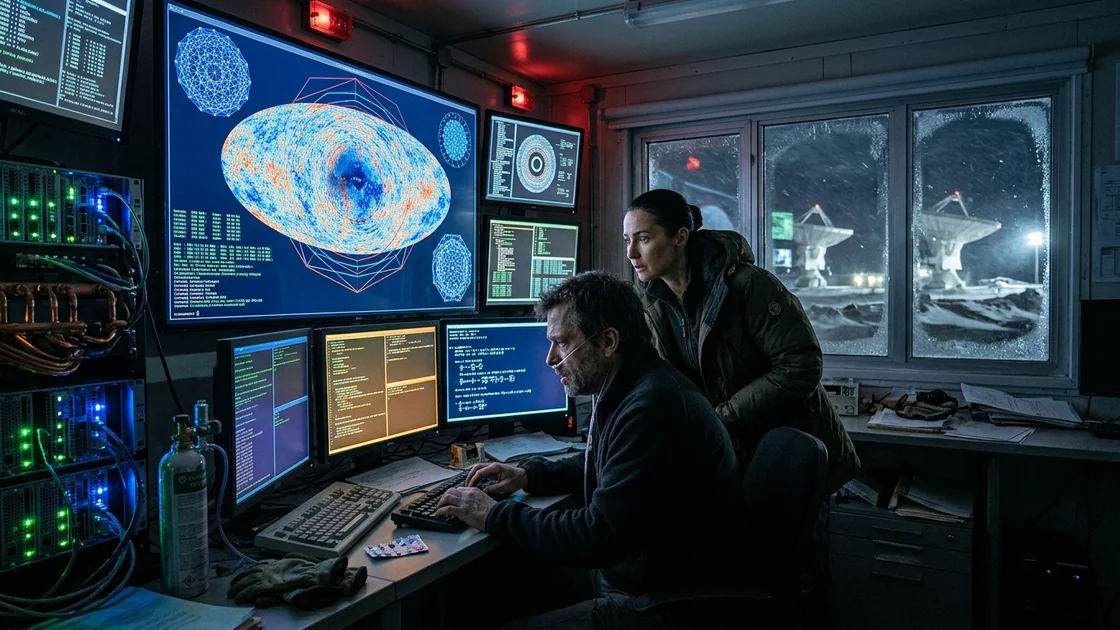
Dr. Aris Thorne, a disgraced cryptographer exiled to a remote high-altitude observatory in the Atacama Desert, spends his days writing algorithms to scrub terrestrial interference from cosmic microwave background sensors. While analyzing the ultra-faint thermal static left over from the birth of the universe, he discovers that the radiation contains non-random algebraic structures that mirror ideal data compression. Alongside skeptical astrophysicist Dr. Elena Rostova, Aris realizes that the background radiation of the cosmos is not natural thermal noise, but a hyper-dense, error-corrected archival backup left behind by an intelligence that existed before the inflationary epoch. As facility management moves to shut down his unauthorized use of the observatory supercomputers during a brutal mountain storm, Aris races to construct a decompression key using the fundamental constants of physics, ultimately unlocking a vast pre-cosmic library and broadcasting the decryption protocol to the world.
At five thousand meters above sea level, the human brain starves in slow, measurable increments. The air inside the Cerro Alto Millimeter Array control annex was pressurized and enriched with supplemental oxygen pumped through humming copper manifolds, yet Aris Thorne still felt the altitude as a permanent, dull band of iron tightened around his temples. Whenever he stood up too quickly from his terminal, the edges of his vision dissolved into a swirling grey sleet that looked remarkably like the data feeds on his monitors.
He reached for his mug, found the tea inside had cooled to the temperature of tap water twenty minutes ago, and drank it anyway. Across the dimly lit server bay, rows of custom-built field-programmable gate arrays blinked in synchronized emerald cascades. Beyond the reinforced triple-pane glass of the observation window, the Chajnantor plateau stretched out like the rusted hull of a dead planet. Sixty-four dishes, each twelve meters across, stood tilted toward the zenith in the freezing Chilean night. Above them, the Milky Way did not merely shine; it blazed with an aggressive, clinical clarity that felt almost hostile.
Aris did not look at the stars. He hadn't looked at the optical sky in months. His domain was the space between the stars, the blackness behind the blackness, where the temperature hovered at 2.72548 Kelvin.
"You're running the cross-correlation scripts on the W-band residuals again," a voice said from the doorway.
Aris didn't turn around. He recognized the heavy tread of insulated boots and the crisp, lingering scent of ozone and outside cold that followed Dr. Elena Rostova whenever she returned from inspecting the receiver cabins on the plateau.
"The phase-lock loop on Dish Fourteen had a two-picosecond drift during the third scan," Aris said, his fingers flying across his mechanical keyboard with a dry, clattering rhythm. "Your graduate students flagged it as atmospheric water vapor. It wasn't. It was thermal expansion in the waveguide flange. I wrote a polynomial filter to strip it out before it poisoned the weekly integration."
Elena walked over, pulling off her heavy thermal gloves and tossing them onto an empty desk. She was forty-two, five years younger than Aris, with dark hair pulled back into a severe knot and eyes permanently shadowed by the brutal shifts of observational cosmology. She leaned over his shoulder, squinting at the waterfall plot cascading down his primary vertical monitor.
"That filter took forty teraflops of compute time over six hours, Aris," she said, though her tone lacked real anger. It was merely the exhausted pragmatism of a project lead whose budget was measured in kilowatt-hours and liquid helium. "A standard Wiener filter would have smoothed that drift in ten minutes."
"A Wiener filter assumes the underlying signal is a stationary Gaussian process," Aris replied, finally swiveling his chair to face her. "It smears the edges. It acts like a carpenter using a belt sander on a microchip. If you want me to clean your bolometer feeds, let me clean them properly."
"There are no edges in the cosmic microwave background," Elena said, rubbing the bridge of her nose. "That's the entire point of the standard cosmological model. It's a thermal blackbody spectrum to within one part in a hundred thousand. Smooth, isotropic, Gaussian noise left over from the surface of last scattering. We're looking for tensor-to-scalar ratios in the polarization swirls, Aris, not hidden edges."
"Everything has edges if your resolution is fine enough," Aris murmured.
Elena sighed, reaching into her parka pocket and tossing a blister pack of acetazolamide onto his desk. "Take your Diamox. Your lips are blue, and you're talking like a cryptographer again."
"I am a cryptographer."
"You were a cryptographer," she corrected gently, though the words still carried the sharp sting of recent history. "Right now, you're a systems architect on a two-year contract with the European-South American Deep Sky Consortium. And if Marcus Vance sees that you've been hijacking the primary correlator array to run non-standard algebraic topology on the trash bin data, he's going to revoke your cluster privileges."
She turned and walked toward the kitchenette at the back of the annex, the rubber soles of her boots squeaking against the anti-static flooring.
Aris stared at the blister pack of pills, then back at his screen. She wasn't wrong about his title, nor was she wrong about his precarious employment. Three years ago, he had held an endowed chair in applied information theory at Zurich, consulting on post-quantum lattice cryptography for central banks. Then he had discovered a fundamental mathematical flaw in the dual-elliptic curve standards pushed by a coalition of western intelligence agencies. When they ordered him to bury the paper under a national security directive, he had uploaded the complete proof, along with a working exploit engine, to four hundred public mirrors during a keynote address in Geneva.
He hadn't gone to prison—the math was pure theory, and he hadn't broken into any systems himself—but his grants had evaporated overnight. Security clearances were revoked. Universities suddenly found his departmental funding unsustainable. The only reason he had landed at Cerro Alto was because the consortium's previous lead signal-processing engineer had suffered a pulmonary edema during his first week at altitude, and Elena had needed someone who understood extreme-scale Fourier transforms and noise-floor mitigation at a fraction of an academic salary.
To the astrophysicists at Cerro Alto, noise was the enemy. It was the fog that obscured the ancient light of the recombination era, three hundred and eighty thousand years after the Big Bang, when the universe cooled enough for protons and electrons to bind into neutral hydrogen, releasing a flash of photons that had been stretching and cooling across expanding space ever since. To see that ancient light clearly, they had to peel away layers of foreground contamination: synchrotron radiation from galactic magnetic fields, thermal dust emission, radio galaxies, atmospheric oxygen, and the quantum jitter of the transition-edge sensors themselves, cooled to a tenth of a degree above absolute zero.
Once all the foregrounds were subtracted, and once the primary acoustic peaks—the giant sound waves of the infant universe—were mapped, what remained in the highest multipole moments was the residual floor. The trash bin.
For six months, Aris had been taking out the trash. And for the last three weeks, he had been secretly sifting through it.
He minimized the waveguide calibration window and brought up a hidden workspace buried four levels deep inside a virtual machine running on an air-gapped node. On the screen were three datasets. The first was the raw, unsmoothed high-frequency residual map from the Cerro Alto polarization array. The second was the legacy archive from the European Space Agency's Planck satellite. The third was the preliminary six-month release from Chronos-3, the new orbital bolometer array stationed at the second Earth-Sun Lagrange point.
Three entirely different instruments. Three different generations of detector hardware. Two in deep space, one on a dry mountain top in South America.
By every law of physics and statistics, once the cosmic signal was subtracted down to the micro-kelvin limit, the remaining high-frequency static between the three instruments should have been completely uncorrelated. It should have been pure instrument noise—thermal electrons rattling around independently in three separate sets of wires millions of kilometers apart.
Aris typed a command, executing a cross-entropy script he had spent four nights refining.
The terminal spat out a matrix of floating-point numbers. In the center of the screen, a three-dimensional phase-space portrait began to render. If the residual noise between the ground array and the orbital telescopes were truly random, the plot would look like a spherical cloud of snow—uniform, structureless, filling every available coordinate with equal probability.
It didn't look like snow.
It looked like a crystal lattice viewed down a hyper-dimensional axis. Tight, razor-sharp corridors of zero probability sliced through dense clusters of data points. The points were arranged on the surface of a twenty-four-dimensional Leech lattice, projected down into three-space.
Aris leaned forward, his heart thudding against his ribs with a heavy, hypoxic rhythm.
To an astrophysicist like Elena, random noise meant a natural thermal process. It meant chaos, heat, and entropy.
To a cryptographer, however, there was something else in the universe that looked exactly like pure, maximum-entropy white noise.
In 1948, Claude Shannon had laid the foundations of information theory with a simple, devastating proof: as a message is compressed more and more efficiently, all predictability and redundancy are stripped away. An ideally compressed file contains zero repeating patterns. Every bit is equally likely to be a zero or a one. Therefore, the more densely information is packed, the closer its statistical signature approaches pure, indistinguishable thermal noise.
A novice looking at an encrypted or maximally compressed data stream sees only static. A master cryptographer looks at the boundaries of the static—the framing headers, the error-correction syndromes, the mathematical container that holds the entropy inside.
And right there, sitting at multipole moment \(l = 4096\) in the microwave background of the entire universe, Aris was looking at a Reed-Solomon parity block.
The morning shift briefing took place at eight o'clock down at the Base Camp facility inside the San Pedro valley, two thousandfive hundred meters lower than the plateau. Most of the staff slept and worked in the valley, commuting up to the high site only when hardware needed physical intervention. Aris, however, preferred the spartan dormitory modules at the high annex. Down in the valley, the internet connection was fast, the air was thick, and Director Marcus Vance had an office with a glass wall that overlooked the bullpen. Up on the mountain, nobody bothered Aris as long as the calibration pipelines stayed green.
He attended the morning meeting via video link, his camera turned off to save bandwidth.
"—which means the European funding review board will be arriving in Santiago on the fourteenth," Vance's voice boomed through the tinny speakers of Aris's workstation. On the shared screen, Vance was displaying a resource utilization chart. "They want to see the preliminary B-mode power spectrum from the Sector Seven deep field. Elena, where are we on the foreground dust subtraction?"
"Ninety percent converged," Elena's voice came through from the valley conference room. She had driven down at dawn after finishing her hardware check. "We're still seeing some anomalous kurtosis in the small-scale angular resolution—around three arcminutes. Aris's new waveguide filters cleaned up the low-multipole drift, but the high-frequency floor is stubbornly loud."
"Cut the high-frequency tail, then," Vance said immediately. "Truncate the spherical harmonics at \(l = 2500\). The primordial gravitational wave signature peaks below \(l = 200\) anyway. Everything above three thousand is just point-source contamination and thermal shot noise."
"If we truncate at twenty-five hundred, we lose the lensing reconstruction accuracy," Elena protested.
"And if we miss the publication deadline before the review board lands, we lose twelve million euros in Phase Three operational grants," Vance countered smoothly. "Speaking of compute bottlenecks—who is running Project Chimera on the auxiliary blade cluster? It's been chewing up thirty percent of our FPGA cycles for seventy-two hours."
Aris's hand hovered over his mouse. Chimera was the placeholder directory name he had assigned to his cross-correlation environment.
"That's mine," Aris said, unmuting his microphone. His voice sounded raspy, dried out by the zero-humidity mountain air. "It's an iterative Monte Carlo simulation to model non-Gaussian systemic cross-talk between the polarization channels. If you want Elena's dust subtraction to converge before the fourteenth, I need to map the noise floor's covariance matrix."
There was a three-second pause on the line—the latency of the microwave relay down the mountain, compounded by Vance's habitual suspicion.
"We have standard covariance matrices from the commissioning phase, Dr. Thorne," Vance said. "We didn't hire you to reinvent radiative transfer physics. Kill the process by noon and allocate those blades back to the main lensing pipeline."
"Understood," Aris lied, and muted his mic.
He didn't kill the process. Instead, he spent the next forty minutes writing a wrapper script that fragmented his compute jobs into tiny, micro-second slices and disguised them as routine hard-drive defragmentation and memory-scrubbing daemons across the observatory's storage nodes. It cut his processing speed by half, but it made his work completely invisible to Vance's diagnostic dashboards.
Once the camouflage was in place, Aris pulled on a heavy fleece jacket, grabbed two liter-bottles of water, and walked down the corrugated steel tunnel that connected the annex to the main receiver maintenance bay.
He needed to think, and he couldn't think sitting down.
The maintenance bay was cavernous, smelling of machine oil, liquid nitrogen, and cold aluminum. A single twelve-meter dish had been hauled inside on the giant yellow transporter crawlers the week before for actuator repairs. It sat in the center of the bay like a fallen satellite, its parabolic surface composed of hundreds of precision-milled aluminum panels etched with microscopic grooves to scatter dangerous solar heat while reflecting millimeter-wave radiation into the secondary mirror.
Aris walked around the rim of the dish, staring into the open cryostat housing at its center. Inside that copper cylinder, gold-plated feedhorns funneled photons that had traveled for thirteen point eight billion years without hitting a single atom, guiding them onto spiderweb-like bolometers kept cold enough that the vibrations of individual atoms were nearly frozen still.
He thought about the structure he had found the night before.
In standard cosmology, the universe began with inflation—a period of exponential expansion during the first tiny fraction of a second, where microscopic quantum fluctuations in a scalar energy field were stretched out to cosmic scales. Those fluctuations became the seeds of all structure: galaxies, clusters, filaments, and voids. When the universe cooled at three hundred and eighty thousand years, those fluctuations were frozen into the cosmic microwave background like ripples on the surface of a pond turning to ice.
Because quantum fluctuations are fundamentally random, the ripples should obey Gaussian statistics. If you measure the temperature at one point in the sky, and compare it to another point, the distribution of differences across the whole sky should form a perfect bell curve.
For decades, cosmologists had noticed tiny deviations from that bell curve—anomalies they called "the Axis of Evil," where the largest hot and cold spots aligned suspiciously with the plane of our solar system, or the Eridanus Supervoid, an enormous cold spot in the southern hemisphere that was slightly too large and too cold to be easily explained by standard random models. Physicists largely shrugged them off as "cosmic variance"—the statistical fluke of having only one sky to observe. If you flip a coin ten thousand times, you will occasionally get twenty heads in a row.
Aris hadn't looked at the large ripples. He had looked at the microscopic grain of the ice itself.
At scales smaller than five arcminutes—less than a tenth of the width of the full moon—the primary CMB signal fades away due to silk damping, a natural blurring caused by photons diffusing through the primordial plasma before the universe became transparent. Down in that damped tail, the cosmic signal is supposed to be dead, overwhelmed by foreground galaxies and instrument hiss.
Except Aris had used a technique borrowed from side-channel cryptanalysis—the same method used to extract encryption keys from a smart card by listening to the faint electromagnetic hum of its processor across millions of operations. By stacking the Planck satellite data, the Chronos-3 orbital data, and the Cerro Alto polarization maps, and aligning them not by celestial coordinates, but by the intrinsic harmonic phase of the quadrupole moment, the foreground noise had canceled out.
And underneath the Silk damping limit, the signal hadn't died. It had transitioned from analog waves into discrete, quantized phase states.
The polarization angles of the microwave photons—the direction their electric and magnetic fields twisted as they flew through space—were locked into sixteen distinct angular buckets. Sixteen states. Four bits per spatial resolution element. Quadrature amplitude modulation, written across the entire celestial sphere at an angular resolution of ten arcseconds.
Aris stopped pacing and leaned his forehead against the freezing aluminum rim of the telescope dish.
Let's do the math, he told himself, his mind racing with the cold, terrifying detachment that had always been both his greatest gift and his social ruin.
The full sky contains roughly forty-one thousand square degrees. At a resolution of ten arcseconds, each square degree holds one hundred and twenty-nine thousand, six hundred discrete pixels. Across the entire sky, that was five point three billion spatial channels per frequency band.
The modulation wasn't confined to a single frequency, either. As he had swept his filter across the millimeter spectrum from thirty gigahertz to eight hundred gigahertz, the phase buckets shifted orthogonally, divided into thousands of narrow spectral bins narrower than the natural thermal broadening of the blackbody curve.
It was frequency-division multiplexing on a cosmological scale. Five billion spatial channels, multiplied by at least ten thousand spectral channels, each carrying four bits of phase polarization data, repeated across both E-mode and B-mode orientations.
Roughly half aexabit of raw surface capacity just in the first layer he had resolved. And if the Leech lattice projection he had seen on his monitor was any indication, the encoding wasn't flat; it was nested deep into the high-order multipole correlations, using the relationships between millions of distant points on the sky to store hyper-dimensional vectors. The combinatorial capacity of pairing five billion points in twenty-four-dimensional lattice groups didn't measure in exabytes or zettabytes. It measured in numbers that required scientific notation just to write the exponent—approaching the Bekenstein bound of the observable horizon itself.
Someone—or something—had turned the afterglow of the Big Bang into a hard drive.
No, Aris corrected himself, pulling back from the cold metal. Not someone after the Big Bang. You couldn't paint a modulation signal across the entire sky once the universe was already expanding; light couldn't travel fast enough to synchronize opposite sides of the cosmos. Opposite horizons of the sky were twenty-seven billion light-years apart; they had never been in causal contact since the first trillionth of a trillionth of a second of time.
The only way the error-correcting parity blocks in the northern sky could mathematically balance the data blocks in the southern sky was if the data had been written before or during the inflationary epoch, when the entire observable universe was smaller than a single proton.
He walked rapidly back through the steel tunnel, his lungs burning in the thin air, his mind already moving past the what and fixating entirely on the how.
If it was compressed archival data, it had a structure. If it had a structure, it had a file system. And if it had a file system, there had to be a root directory.
By Friday evening, the weather on the plateau began to deteriorate. A rare Bolivian winter inversion was pushing moisture across the Andes, and the barometer in the control annex was dropping steadily. Outside, the wind howled through the structural trusses of the dishes at seventy kilometers per hour, driving stinging clouds of volcanic dust and ice crystals against the annex walls.
Elena came up on the afternoon transport crawler, ostensibly to oversee the stowing of the dishes into their vertical survival positions if the wind exceeded eighty knots, though Aris suspected she had come up because he had stopped answering his emails forty-eight hours ago.
She found him in the main control room. He had commandeered the four large wall-mounted projection screens usually reserved for array telemetry and covered them with spherical Mollweide projections of the sky, overlaid with dense spiderwebs of neon-colored vector lines.
Elena stopped just inside the door, her eyes moving from the screens to the whiteboard, which was completely black with erased and rewritten Galois field equations, and finally to Aris himself. He hadn't shaved in four days. A half-empty canister of medical oxygen sat next to his desk, its nasal cannula draped around his neck like a stethoscope.
"Aris," she said quietly. "What is this?"
"Don't stowed the dishes yet," Aris said without looking up. He was typing furiously on two laptops simultaneously. "I need another forty minutes of integration on the Eridanus sector at ninety gigahertz before the atmospheric opacity ruins the phase coherence."
"The wind is at sixty-eight knots. The dish drives are already straining against the torque limits." Elena stepped closer, looking up at the central wall screen. "Is that the Cold Spot?"
"You call it the Eridanus Supervoid," Aris said, pointing a laser pointer at a massive, bruised-looking patch of blue and violet in the southern galactic hemisphere. "A region roughly ten degrees across where the CMB temperature is seventy micro-kelvin colder than the cosmic average. Cosmologists have spent twenty years trying to explain it with giant empty voids of matter between us and the early universe, or exotic cosmic textures."
"The Integrated Sachs-Wolfe effect explains at least part of it," Elena said defensively, folding her arms. "Photons lose energy climbing out of the gravitational potential of a supervoid as dark energy stretches the space during transit."
"It explains twenty micro-kelvin at best, and you know it," Aris countered, standing up. His joints popped. He walked to the screen, his shadow falling across the ancient sky. "Look at the boundary ring around the Cold Spot. When you view it in standard temperature intensity, it looks like a fuzzy blob with a slightly warm ring around it. Now look at what happens when I strip out the thermal blackbody curve and plot the Shannon entropy density of the high-multipole polarization phase."
He tapped a key. The fuzzy blue blob vanished. In its place appeared a razor-sharp geometric decagon, subdivided into concentric rings of staggering mathematical regularity. Inside the rings, the entropy wasn't maximum like the rest of the sky. It was highly redundant, repeating in deterministic, periodic waves.
Elena stared at the projection. The color drained slowly from her face. "That's an artifact. You've introduced a windowing function in your Fourier transform. If you apply a sharp cut in frequency space, you get ringing artifacts in spatial coordinates—Gibbs phenomenon. Every first-year astronomy student learns that."
"I didn't use a Fourier transform, Elena. I didn't touch frequency space," Aris said, his voice dropping to a low, intense murmur. "This is a direct spatial bit-map extracted from raw time-ordered bolometer voltages across three independent observatories. No smoothing, no spherical harmonic synthesis, no window functions. Look at the redundancy ratio inside the decagon. Everywhere else in the sky, the polarization bit-stream has an entropy of 0.99998 bits per bit—indistinguishable from white noise because it's maximally compressed payload data. But here, inside the Cold Spot, the entropy drops to 0.34. Why?"
Elena didn't answer. Her eyes were fixed on the nested rings.
"Why does a region of a hard drive have lower entropy and lower thermal energy than the surrounding sectors?" Aris pressed, stepping closer to her. "Think about how we store archival data on magnetic tape or optical discs when we want it to survive for ten thousand years in a salt mine. You don't compress the header! If you compress the entire drive into a single monolithic block and one bit flips due to cosmic rays, the entire archive becomes unrecoverable garbage. And if you compress the decompression instructions using the compression algorithm itself, nobody can ever open it without already knowing the algorithm."
He tapped the center of the Eridanus Cold Spot with his knuckles.
"The Cold Spot is cold because it's unmodulated," Aris whispered. "It's low-density plaintext. It's the master boot record, Elena. It's the allocation table, the error-correction dictionary, and the structural index for the entire sky."
Silence fell over the control room, broken only by the high-pitched whine of the wind against the exterior steel cladding and the steady hiss-click of the liquid helium compressors down the hall.
Elena slowly pulled a chair over and sat down. She looked at the screen for a long time, her mind visibly working through every possible instrumental failure, software bug, or practical joke that could produce what she was seeing. She reached over, took the auxiliary mouse connected to Aris's workstation, and opened the terminal history.
She scrolled back through thousands of lines of C++ and Python code. She wasn't a cryptographer, but she was a world-class computational physicist; she could read matrix algebra and memory-pointer logic as fluently as English. She checked his data ingestion pipes. They pointed directly to the read-only archive servers for Planck Data Release 4, the Chronos-3 raw telemetry mirror, and Cerro Alto's own local RAID array.
She checked his filtering subroutines. There were no synthetic injections. No boundary masks that could force a decagonal symmetry onto random numbers.
"Show me the parity check," she said softly, her voice tight.
Aris sat back down beside her, a sudden flood of relief washing through his chest. For three days, a quiet, terrified part of his brain had wondered if Elena had been right—if the high altitude, the isolation, and the trauma of his ruined career had finally pushed him into the classic delusion that claims so many aging mathematicians: the belief that he had found the secret code of God in the digits of pi or the primes.
Seeing the shock in Elena's eyes confirmed he was sane. The math was real.
"Here," Aris said, pulling up a split screen. "The archive is divided into twelve pentagonal macro-sectors—a dodecahedral projection across the celestial sphere. Interestingly, Poincare dodecahedral space was proposed twenty years ago to explain the missing large-angle fluctuations in the CMB. They were right about the geometry, just wrong about the reason. It's not the topology of space; it's the partitioning scheme of the drive."
He highlighted two tiny patches of sky on opposite sides of the map—one near the constellation Leo, the other near Aquarius.
"Look at the raw phase states in Sector Three, Block 4401," he said. "Then look at the antipodal block in Sector Nine. If you perform a bitwise XOR operation across all twelve sectors along any great circle passing through the Eridanus index, the sum always resolves to a constant generator polynomial over a finite field of order \(2^{24}\)."
Elena leaned in until her nose was six inches from the monitor. "Always?"
"Across four million tested great circles," Aris said. "With a statistical significance of forty-two sigma. In particle physics, five sigma is enough to declare the discovery of the Higgs boson. Forty-two sigma means the probability of this happening by random thermal chance is less than one in the total number of atoms in a billion observable universes."
Elena sat back, letting out a long, shaky breath that fogged slightly in the cool air of the room. "Wait. If the antipodal points are XOR-linked... Aris, those points are separated by twenty-seven billion light-years. Even if you account for cosmic inflation stretching a microscopic patch of space, quantum uncertainty during inflation would have randomized the phase coherence at scales that small. The Heisenberg uncertainty principle sets a hard floor on how precisely you can encode classical states into a quantum field!"
"Unless the inflation field itself was engineered to act as a quantum error-correcting code," Aris said. "Think about holographic quantum codes—surface codes, HaPPY codes. In quantum information theory, we already use entangled boundary states to protect bulk information from local decoherence. Whoever did this didn't fight quantum mechanics; they used the inflaton scalar field as a topological braid. As space expanded exponentially, the expansion didn't destroy the data—it unpacked the entanglement into classical macroscopic radiation modes at the moment of recombination."
"Whoever did this," Elena repeated, the words tasting foreign and absurd in her mouth. She looked up through the reinforced ceiling toward the howling darkness above. "Aris, you're talking about modulating the Big Bang. You're talking about an intelligence that had manipulative control over the vacuum energy of a nascent universe at \(10^{-32}\) seconds after time zero. The energy scales involved are twelve orders of magnitude higher than anything our particle accelerators can even probe. Nothing can live in that! There were no atoms, no chemistry, no stars, no stable matter for another three hundred thousand years!"
"You're assuming they were inside our universe when they wrote it," Aris said quietly.
Elena froze.
"Whether it was a previous cosmic cycle before a Big Bounce, or a parent universe budding off a child vacuum in a laboratory, or a civilization at the end of a dying cosmos dumping its final state vector into the phase transition of a new nucleating bubble—I don't know," Aris said. "I'm not a cosmologist. I don't care who held the pen, Elena. I care about the text. And right now, I have the boot sector open, and I can see the decompression tree."
"You can read it?" she whispered.
"Not yet. That's why I need the dishes," Aris said, pointing to the wind telemetry gauge on the far wall, which was flashing amber at seventy-four knots. "The Eridanus header contains the structural grammar—it defines the decompression algorithm. It's not a sequential stream like video or audio; it's a hyper-graph of relational states compressed using an arithmetic coding scheme based on multidimensional continued fractions. To initialize the arithmetic decoder, the header calls for a 512-bit seed value—a cryptographic salt or a physical reference dictionary."
"And the seed isn't in the Cold Spot?"
"No. The pointer for the seed points to an angular scale of four arcseconds at 150 gigahertz right on the center of the Eridanus ring. Planck only had a resolution of five arcminutes—three hundred times too blurry. Chronos-3 has a resolution of thirty arcseconds. Only a ground-based interferometer with a ten-kilometer baseline like Cerro Alto can resolve four arcseconds at millimeter wavelengths."
Elena looked at the array status screen. "Our dishes are currently in the compact configuration—three-kilometer baseline. You can't get four arcseconds out of that."
"We have four calibration outrigger dishes sitting on the far ridge at twelve kilometers," Aris said immediately. "Dishes Sixty-One through Sixty-Four."
"Those are offline for receiver upgrades! Sixty-Three doesn't even have its secondary mirror aligned."
"I don't need all four. I need Sixty-One and Sixty-Two correlated against the central compact core using rotational synthesis as the Earth turns over the next two hours," Aris said, his eyes wide and feverish. "I already checked their cryostats remotely. They're at four Kelvin. The receivers are dark, Elena, not dead. If we route their optical fiber feeds directly into the FPGA correlator and bypass the standard calibration pipeline, we can synthesize an eleven-kilometer aperture along the right ascension axis of the Cold Spot."
Elena stared at him, then looked at the weather radar. A massive purple front of heavy snow and eighty-knot gales was sweeping across the Bolivian border, less than ninety minutes away.
"If we leave the outrigger dishes unlocked in eighty-knot winds, the elevation gears will strip," she said. "Each of those drive assemblies costs four hundred thousand euros and takes six months to haul up from Antofagasta."
"And if we stow them now, the storm will bury the plateau in two meters of snow for a week," Aris shot back. "By Monday morning, Vance will have reviewed the cluster logs, realized I bypassed his resource locks, fired me, and wiped my virtual machines to free up storage for your dust maps. You know how he operates, Elena. If you walk into his office on Monday with a theoretical paper claiming the CMB is an alien zip file, he'll have you removed from the consortium before lunch to protect the Phase Three grant review."
Elena bit her lip. She knew he was right. The politics of modern big-science astronomy were brutal, conservative, and utterly risk-averse. Decades ago, when pulsars were first discovered as regular ticking radio signals, the astronomers had jokingly labeled them LGM-1—Little Green Men—and kept the data secret for months out of sheer terror of professional ridicule until they proved they were rotating neutron stars. Nobody with a career to protect wanted to be the scientist who cried alien, especially when twelve million euros of institutional funding hung on confirming conventional inflationary models.
If they wanted to know what was inside the archive, they couldn't ask for permission. They couldn't publish a preliminary anomaly note and wait five years for another observatory to verify it. They had to open the file themselves, pull something undeniable out of the static, and drop the unlocked data onto the table.
Elena stood up, walked over to the master array console, and inserted her physical supervisor key into the hardware override slot.
"Sixty-One and Sixty-Two only," she said, turning the key until the indicator light switched from green to flashing red. "The main array goes into survival stow right now except for six central reference dishes in the wind-shadow of the ridge. THE moment the anemometer on the western ridge hits eighty-five knots, I'm hitting the emergency brake whether your seed is resolved or not. Clear?"
Aris let out a breath he felt like he'd been holding since Zurich. "Clear."
The next ninety minutes were a masterclass in high-altitude improvisation.
While Elena manually commanded fifty-eight of the giant dishes to tilt straight up toward the zenith—presenting their minimal wind cross-section to the rising gale—Aris rewrote the correlator firmware on the fly.
Normally, radio interferometry required painstaking calibration. Because the atmosphere above each dish varied slightly in temperature and water vapor, the radio waves arriving at Dish One were delayed by a few picoseconds compared to Dish Sixty-One twelve kilometers away. Without correcting for that atmospheric phase scramble, the combined image blurred into useless smears. Astronomers usually paused every ten minutes to point the dishes at a bright, known quasar to measure the atmospheric distortion and zero out the clocks.
They didn't have time to slew back and forth to a quasar; the heavy drive motors moved too slowly against the wind, and the storm front was already swallowing the western horizon in a wall of pitch-black static.
"Phase coherence on baseline Sixty-One is dropping below forty percent!" Elena called out from the telemetry desk. Outside, a sudden gust slammed into the annex, making the steel roof beams groan like the hull of a submarine under depth charges. "Atmospheric water vapor just spiked to three millimeters. The storm edge is over the western ridge. Your four-arcsecond beam is smearing out, Aris!"
"I don't need a quasar to calibrate the phase," Aris said, his fingers flying across the keys as sweat trickled down his temples despite the chill in the room. "You forget what we're looking at! The surrounding thirty-arcsecond blocks of the Cold Spot are already resolved by Chronos-3 in orbit. And we already know the Reed-Solomon parity polynomial that links the four-arcsecond sub-blocks to the thirty-arcsecond parent blocks!"
"You're using the archive's own error-correction code as an adaptive optics guide star?" Elena asked, stunned.
"A checksum is a checksum," Aris muttered, compiling the C++ module and injecting it directly into the FPGA gate logic. "If the atmosphere shifts the phase of the incoming millimeter waves by twelve degrees, the Galois field equation fails to balance to zero. I'm telling the correlator to dynamically shift the delay lines on Dish Sixty-One until the parity check resolves cleanly. The sky is calibrating itself."
On the central monitor, the fuzzy, smeared interferometric fringes from the twelve-kilometer baseline suddenly snapped together like iron filings pulled by an electromagnet.
The resolution zoomed inward—past five arcminutes, past thirty arcseconds, down to a razor-sharp four-arcsecond grid at the exact geometric center of the Eridanus decagon.
As the phase stabilized, a string of bit-values began to populate the buffer window at the bottom of Aris's screen. Every ten seconds, as the Earth rotated and swept the interferometric baseline across the target coordinate, the signal-to-noise ratio climbed.
Sigma 4... Sigma 6... Sigma 9...
Suddenly, the lights in the control annex flickered violently and died.
For three heart-stopping seconds, the room was plunged into total darkness, illuminated only by the pale red glow of the emergency exit signs and the battery-backed UPS indicators on the server racks. The deafening hum of the HVAC system and the helium compressors vanished, replaced by the terrifying roar of the blizzard outside.
Then, with a heavy mechanical clunk, the auxiliary diesel turbines in the utility bunker kicked in. The fluorescent lights stuttered back to half-power.
"The main high-voltage line from the valley just snapped," Elena said, her hands flying over her console as the diagnostic screens rebooted. "We're on local diesel. And the microwave communications link to Base Camp is down—the relay tower on Cerro Toco must have iced over."
"Are the correlators still up?" Aris demanded, not taking his eyes off his laptop, which had stayed alive on its internal battery.
"The server room UPS caught the drop. The blades didn't reset," she said, checking the power load. Then she cursed in Russian. "Wait. The automatic load-shedding protocol just triggered. When the valley line drops, the annex firmware automatically kills power to the plateau fiber switches and commands all dishes to emergency stow on local battery reserves to save diesel for life support and cryogenics!"
On Aris's screen, the data feed from Dish Sixty-One froze. The buffer stood at 88 percent—450 of the 512 bits resolved.
"Override it!" Aris yelled, jumping up from his chair.
"I can't from here! The load-shedding relay is a hardwired PLC breaker in the substation room down the tunnel! It's designed not to be overridden by software so freezes don't kill the crew!"
"Where is the breaker?"
"Substation B, next to the generator bay, but Aris, wait—"
Aris was already sprinting out the door, tearing the oxygen cannula from his face and flinging it aside.
He hit the corrugated steel tunnel at a dead run. At five thousand meters, sprinting was like breathing vacuum. Within twenty paces, his vision narrowed to a dark tunnel, his quadriceps burning with lactic acid as his blood oxygen plummeted. The tunnel was unheated and unpressurized; the temperature was twenty below zero, and fine, powder-like snow was blowing through the rubber expansion joints between the steel sections, coating the floor in a treacherous glaze of white.
He slipped at the corner junction, slamming his shoulder hard into the freezing steel bulkhead, bounced off, and kept moving.
Ahead of him, the heavy steel fire door to the utility bay stood closed. He threw his weight against the crash bar, stumbled inside into the deafening, ear-splitting roar of two massive Caterpillar diesel engines running at full load, and scanned the wall of grey industrial cabinets.
Substation A—Cryogenics. Substation B—Array Field Power.
He wrenched open the door to Cabinet B. Inside, a row of heavy motorized circuit breakers sat below a digital programmable logic controller flashing FAULT: GRID LOSS - SHEDDING LOAD IN 15 SECONDS.
A mechanical timer relay was counting down before dropping the primary contactor that fed the fiber repeaters out on the plateau. Once that contactor dropped, Dish Sixty-One would go blind, and its onboard battery would drive the elevation screw to ninety degrees and lock the mechanical pin.
Aris looked around wildly for a tool. On a maintenance cart next to the diesel generator sat a heavy fiberglass voltmeter and a pair of insulated rubber lineman's pliers.
He grabbed the pliers. With four seconds left on the PLC countdown, he jammed the rubberized handles directly under the heavy copper armature of the main contactor relay, physically wedging the mechanical switch upward so the electromagnet couldn't pull it open.
Clack!
The relay fired. The solenoid slammed downward against the rubber handles of the pliers with enough force to send a blue arc of electricity jumping across the auxiliary contacts, filling the cabinet with the acrid smell of vaporized copper. The armature buzzed angrily like a trapped hornet, straining against the wedge, but the main high-voltage jaws stayed closed.
Aris leaned against the cabinet, gasping for air like a landed fish, spots of bright violet light dancing across his retinas. He waited ten seconds to make sure the rubber wouldn't melt under the solenoid heat, then stumbled back out into the freezing tunnel, dragging himself hand over hand along the cable trays back toward the pressurized annex.
When he burst back through the airlock door into the control room, he collapsed onto his knees on the anti-static carpet, coughing violently.
Elena was already there, shoving the portable oxygen mask over his face and turning the regulator valve to fifteen liters per minute.
"Breathe, you lunatic!" she snapped, holding the mask tight against his nose and mouth as he gulped down the cold, pure oxygen. "You could have blown the main bus bar and left us without heat in a minus-thirty whiteout!"
Aris pointed a trembling finger toward his workstation. "Did... did the packet finish?"
Elena looked over her shoulder at the wall screen, then back down at him. The anger in her eyes had vanished, replaced by a profound, almost shell-shocked stillness.
"Dish Sixty-Two lost its lock at seventy-eight knots," she said quietly. "Its drive motor stalled five seconds before you wedged the relay. We lost the baseline."
Aris closed his eyes, a wave of crushing defeat washing over him. Four hundred and fifty bits out of five hundred and twelve. Sixty-two missing bits. To brute-force sixty-two bits of a cryptographic seed—\(2^{62}\) combinations, four पॉइंट six quintillion possibilities—would take their local cluster months if each trial required running a multidimensional arithmetic decompression pass.
"Wait," Aris rasped, pulling the mask down to his chin as his brain began to fire again as the oxygen hit his bloodstream. He crawled over to his chair and pulled himself up. "Wait. It's not a cryptographic key. They weren't trying to hide the data from us. Encryption is designed to keep unauthorized readers out; compression is designed to fit a library into a shoebox. Why would an ancient civilization salt their compression tree with a random number?"
"You said it called for a 512-bit initialization seed," Elena said, standing behind him.
"An initialization vector," Aris muttered, pulling the 450 resolved bits into a hexadecimal converter. "In an archive meant to be read by any sufficiently advanced mathematician billions of years in the future, you don't use a random password. You use a universal physical constant to calibrate the floating-point precision of the decoder! Something dimensionless, something that doesn't depend on whether the reader measures distance in meters, cubits, or light-years."
He stared at the binary string on his screen:
000000000001001011101101011111010011011011110110...
He converted the binary fraction into base-ten floating point.
0.0072973525693...
Elena gasped out loud, her hand flying to her mouth.
Every physicist on Earth knew that number by heart. Usually written as approximately \(1/137\).
"The fine-structure constant," she whispered. "Alpha. The fundamental strength of the electromagnetic interaction."
"The first two hundred and fifty-six bits are the fine-structure
constant calculated to seventy-seven decimal places," Aris breathed, his
hands shaking as he highlighted the second half of the string. "And the
second two hundred and fifty-six bits—starting at bit 257—begin with
1836.15267343..."
"The proton-to-electron mass ratio," Elena finished. "Mu. The two most fundamental dimensionless numbers that govern atomic matter and light."
"We don't need the missing sixty-two bits from Dish Sixty-Two," Aris laughed, a wild, breathless sound in the quiet room. "We already measured the proton-to-electron mass ratio to twelve decimal places in laboratories in Geneva and Boulder! Wait—no, at 256 bits of precision, their value goes out to seventy-seven decimal places. Our best laboratory traps on Earth have only measured mu to eleven decimal places—around forty bits!"
He stopped, staring at the screen. They had 194 bits of the second constant—roughly fifty-eight decimal places—and were missing the final sixty-two bits at the very tail of the precision.
"Can you brute-force the last sixty-two bits?" Elena asked urgently.
"I don't have to brute-force them blindly," Aris said, his eyes narrowing as he looked back at the Eridanus directory diagram. "The header has a cyclic redundancy check for the initialization vector itself! It's a linear system over a finite field. If you have four hundred and fifty known variables out of five hundred and twelve, and a degree-64 generator polynomial in the parity block, you don't search the space—you just invert the Vandermonde matrix! It's basic algebra! A high school laptop can solve it in four milliseconds!"
He rapidly coded a matrix-inversion solver in Python, plugged in the 450 captured bits from the sky, appended the parity syndrome from the Eridanus ring, and hit Enter.
The cursor blinked once.
The remaining sixty-two bits populated instantly, completing the 512-bit seed—and incidentally giving humanity the exact value of the proton-to-electron mass ratio to fifty-six more decimal places than modern physics had ever achieved.
Outside, a tremendous bang echoed through the facility as Dish Sixty-One's wind-load pin sheared, its emergency brakes finally engaging manually under the force of a ninety-knot gust. On the telemetry board, the plateau array went completely red. All dishes were stowed or offline.
It didn't matter anymore. They had the key.
Aris routed the completed 512-bit seed into the primary decompression daemon he had staged on the observatory's local storage array.
"What happens now?" Elena asked, pulling her chair up beside him as the server fans in the adjacent bay ramped up to a high-pitched scream, drawing every available watt of power from the diesel generators.
"Now the arithmetic decoder uses the Eridanus grammar and the physical constants to unpack Block Zero," Aris said. "The first sector adjacent to the boot record. It's about forty gigabytes of compressed phase data."
"And how big will it be when it unpacks?"
"Wait and see," Aris said. "Standard compression like ZIP or LZMA relies on finding repeating strings in linear text. This isn't linear. It's algorithmic procedural compression—similar to how a fractal equation of fifty bytes can generate an infinitely detailed coastline, except mapped onto real informational states using the twenty-four-dimensional Leech lattice."
On the central screen, a progress bar crept forward as the FPGA clusters chewed through the nested spherical harmonics of Sector One, Block Zero.
Output files began spilling into the sandbox directory, growing exponentially. Forty gigabytes became four hundred gigabytes. Four hundred gigabytes became twelve terabytes. The RAID array's write-heads chattered like a swarm of locusts.
"Stop the expansion after the first recursive layer!" Elena warned, watching the storage meter climb past eighty percent capacity. "You'll crash the local file system!"
Aris hit a pause command, halting the unpacker at the first hierarchical branch. He opened the root output file inside a three-dimensional topological viewer he had originally written to visualize high-dimensional cryptographic lattices.
For a moment, the screen was black. Then, the vectors rendered.
Neither of them spoke. Neither of them breathed.
It was not a message. There was no prime-number greeting, no Vitruvian Man diagram, no instructions on how to build a faster-than-light drive or a wormhole machine.
It was a taxonomy of existence.
The data was organized in self-describing relational graphs—a universal object-oriented language where every node was defined entirely by its mathematical ratios to the initialization constants alpha and mu.
As Aris zoomed into the first primary node, the graph unfolded into a vast, hyper-detailed simulation of an astrophysical region. Not our universe. The dimensionality was four-plus-one—four spatial dimensions and one time dimension—governed by a gauge group that was close to our Standard Model, yet subtly richer, possessing three stable generations of exotic baryonic matter that didn't decay in microseconds.
"Look at the metric tensors associated with that cluster," Elena whispered, pointing a trembling finger at a spiraling filament of nodes that resembled a galaxy, yet moved with the purposeful, synchronized circulation of a vascular system. "The gravitational coupling constant in this dataset isn't fixed. They're modulating the local vacuum permittivity across kiloparsec scales. That entire galactic filament is a single coherent computation engine."
Aris scrolled down the branch to the adjacent sub-directories.
Each directory was a snapshot—a lossless state-vector backup of structures, ecosystems, histories, and minds. There were molecular topologies built not on carbon chains in liquid water, but on magnetic flux tubes inside the degenerate quark-gluon cores of neutron stars. There were mathematical proofs spanning millions of linked nodes—complete solutions to fluid turbulence, non-abelian gauge theories, and the classification of manifolds that human mathematics wouldn't even have the vocabulary to formulate for another thousand years.
And further down, in the dense, heavy clusters at the center of the relational graph, were structures that could only be consciousnesses.
Not biological brains pickled in digital amber, but dynamic, self-referential causal loops—billions of distinct cognitive architectures preserved at the exact moment of their final states, linked together in a vast, silent symphony of memory.
"Why?" Elena's voice cracked, a tear finally escaping her eye and tracing a line through the dust on her cheek. "Why write it into the thermal radiation of a universe you can never enter?"
Aris zoomed out until the entire unpacked branch floated on the screen like a glowing dandelion seed, then looked over at the Mollweide map of the full sky—where five billion more blocks waited in the freezing dark.
"Look at the timestamp metadata on the Eridanus root header," Aris said softly, pointing to a set of thermodynamic entropy curves attached to the top of the directory tree. "It tracks the vacuum decay curve of their parent manifold. Their cosmos was dying—not a slow heat death like ours will have over trillions of years, but a false-vacuum collapse. A phase transition moving at the speed of light, eating their four-dimensional space and collapsing it down into a three-dimensional brane—our Big Bang."
Elena stared at the curve. "The nucleation of our universe destroyed theirs."
"Or they triggered the nucleation intentionally when their own universe reached its end," Aris said. "Either way, nothing physical can survive a dimensional phase transition. Matter gets ripped apart into raw quark plasma; spacetime geometry folds in on itself. The only thing that crosses the boundary is the quantum spectrum of the scalar field driving the inflation."
He looked up at the ceiling, imagining the sixty-four dishes sitting out in the howling snowstorm, and beyond them, the endless, silent ocean of microwave static filling every cubic centimeter of space between the galaxies.
"Every time you turned on an old analog television between channels and saw that black-and-white snow," Aris said, his voice barely above a whisper, "one percent of that static was the cosmic microwave background. We thought we were looking at the smoke left over from the explosion that made us. We weren't. We were looking at the funeral monument of everything that died so our universe could exist. They turned the sky itself into a library so that they wouldn't be forgotten."
"And it's decaying," Elena realized suddenly, a chill colder than the Atacama winter gripping her spine. "Aris, as our universe expands, the cosmic microwave background stretches. Three hundred thousand years after the Big Bang, this radiation was three thousand degrees—glowing like the surface of a red star. Now it's 2.7 Kelvin. In a hundred billion years, dark energy will stretch the wavelengths until they are larger than the cosmic horizon, and the temperature will drop to absolute zero."
"The ink is fading," Aris agreed, nodding slowly. "Cosmic variance and foreground dust have already corrupted about four percent of the blocks—that's why they built in such massive Reed-Solomon error correction across the dodecahedral sectors. Right now, at thirteen point eight billion years after the Big Bang, we are living in the golden window. Five billion years ago, there were no complex rocky planets with metallurgic civilizations capable of building cryogenic bolometers. Fifty billion years from now, the redshifting will push the high-multipole phase states below the quantum noise floor of the cosmological horizon. The archive was timed to be read right now."
At four o'clock in the morning, the storm finally broke.
As the clouds parted over the Andes, the temperature plunged to minus thirty-five, freezing the newly fallen snow into a solid crust of blue ice. And at four-fifteen, the microwave relay on Cerro Toco automatically cleared its ice-fault routines and re-established the high-bandwidth data link to Base Camp down in the valley.
Instantly, the internal VoIP phone on the main console began to shrill.
Simultaneously, on the system administration terminal, a red warning box popped up: REMOTE ROOT LOGIN DETECTED — USER: M_VANCE.
"He was waiting for the link to come back up," Elena said, her face hardening as she watched the cursor on the admin screen move on its own, opening the cluster process manager. "The automated power-fault alarm must have pinged his phone in San Pedro before the relay died. He sees that the storage array is ninety-two percent full of unauthorized files."
On the terminal, a command prompt opened under Vance's root
credentials: sudo rm -rf /mnt/raid0/chimera_sandbox/*
Aris didn't even try to fight him for root control of the local server. He had anticipated this exact moment three days ago when he was still in Zurich mode.
Before Vance could hit enter on the purge command, Aris tapped a single macro key on his personal laptop.
"What did you just do?" Elena asked as the network traffic meter on the outward-facing satellite uplink spiked to 100 percent saturation.
"I didn't try to send the forty terabytes of unpacked data down the pipe—the bandwidth is too narrow, and Vance would just pull the fiber plug at the valley router," Aris said calmly, leaning back in his chair and folding his arms behind his head. "Remember Shannon's theorem, Elena. Why transmit forty terabytes of raw files when the sky is already broadcasting the compressed copy to every radio telescope on Earth for free?"
Elena blinked. "What did you send?"
"A four-megabyte PDF and a sixty-kilobyte Python script," Aris smiled thinly. "It contains the exact mathematical coordinates of the Eridanus boot sector, the 512-bit initialization seed with the fifty-six new decimal places of the proton-to-electron mass ratio, the Galois field generator polynomial, and twenty lines of open-source code that any graduate student can run against the public Planck satellite archives that are already sitting on hard drives at MIT, Cambridge, Tokyo, and Max Planck."
On the admin monitor, Vance's purge command executed. The local RAID array began wiping the unpacked directories. The glowing four-dimensional galaxy on the wall screen vanished, replaced by a blank terminal prompt.
The VoIP phone kept ringing, loud and insistent in the quiet room.
"I just pushed that script to the arXiv preprint server, forty-two astronomy department mailing lists, the international cryptographic IACR repository, and six hundred public GitHub mirrors," Aris said, watching the upload indicator hit 100% — COMPLETE. "By nine o'clock this morning, every physicist with a laptop and a copy of the Planck dataset is going to verify the forty-two-sigma parity check in under ten minutes. By noon, the particle physics labs at CERN will realize that the initialization vector predicts the next three decimal places of their ongoing proton-mass trap experiments."
He reached over and picked up the ringing receiver, held it for two seconds while Marcus Vance's furious voice shouted through the earpiece, and then gently placed it back down on the hook, disconnecting the call.
Aris stood up, walked over to the triple-pane observation window, and looked out.
The sky above the Chajnantor plateau was completely clear now. The storm had scrubbed every trace of dust and moisture from the thin upper atmosphere. In the pre-dawn darkness, the sixty-four dishes stood coated in rime ice, gleaming like white marble monuments under the blinding, diamond-hard light of the southern stars.
Elena walked over and stood beside him, wrapping her parka tightly around her shoulders. For a long time, they simply looked up at the dark rifts between the constellations—the deep, empty voids where the human eye saw nothing at all, but where the cold, ancient light of a vanished creation washed over the Earth in an unending, silent tide.
"What do you think happens to us when they verify it?" she asked softly.
"Vance will try to take credit for funding the project by Tuesday," Aris said, a genuine smile finally touching his exhausted eyes. "And by Wednesday, nobody on Earth will care who Marcus Vance is."
He turned back toward his terminal, where his local laptop still held a cached copy of the Eridanus directory tree—five billion sectors, each waiting for someone to write the subroutines to parse their hyper-dimensional syntax.
"Put some coffee on, Elena," Aris said, sitting back down and waking his screen. "We only opened Block Zero. We have the rest of the sky to read."