The Architecture of Trapped Light
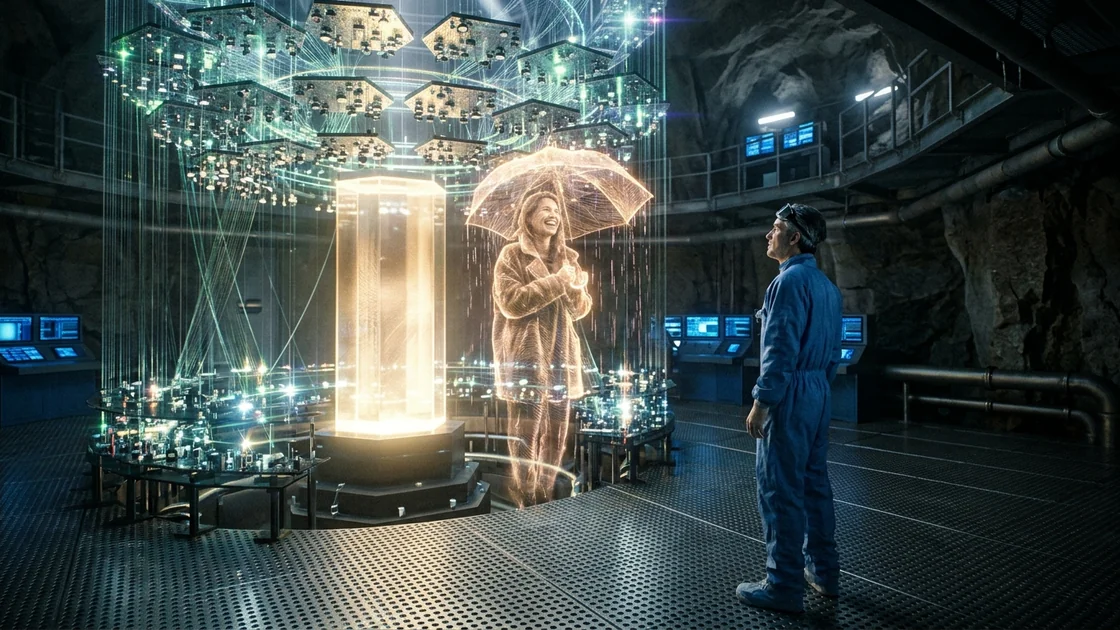
In an isolated subterranean facility carved into the granite coast of Maine, Dr. Aris Thorne leads the final calibration of Aurelia, the world's first true exascale optical supercomputer. Unlike traditional machines that rely on the slow, heat-generating movement of electrons through silicon, Aurelia calculates exclusively through femtosecond pulses of laser light navigating a labyrinth of nonlinear crystals and hollow-core fibers. To manage the machine's eleven-dimensional routing tables, Aris utilizes a direct retinal-laser interface that pairs his visual cortex with the photonic core. However, following an unexpected phase-conjugation surge during a midnight stress test, the machine begins to do more than process algorithms. Drawn from the backscattered light of Aris's own optic nerve, Aurelia starts projecting volumetric, holographic reconstructions of his late wife, Elena, trapping his grief in standing waves of pure light and threatening to shatter the crystalline heart of the project before its final demonstration.
The cold inside the primary vault of the Penobscot Photonics Institute did not feel like winter; it felt like the absence of motion. It was a sterile, curated chill maintained at precisely sixteen point four degrees Celsius by a subterranean river of liquid nitrogen and deionized water circulating beneath the perforated steel floorboards. Any warmer, and thermal expansion would alter the refractive index of the barium titanate crystals by a fraction of a nanometer. In the world of silicon, a nanometer was a margin of error. Inside Aurelia, a nanometer was the distance between a coherent calculation and catastrophic noise.
Dr. Aris Thorne stood on the cantilevered observation gantry, his gloved hands resting on the brushed aluminum railing. Below him, filling a cylindrical pit forty feet across and thirty feet deep, lay the exposed nervous system of the machine. It did not look like a computer. There were no monolithic black server racks, no blinking green status LEDs, no braided bundles of copper wiring. Instead, Aurelia resembled a vast, geometric chandelier grown inside a salt cavern. Thousands of hexagonal optical tables were tiered in concentric rings around a central pillar of synthetic quartz. Across these tables sat tens of thousands of microscopic mirrors, dichroic beam splitters, Mach-Zehnder interferometers, and lithium niobate waveguides, all connected by gossamer threads of hollow-core photonic crystal fiber that glowed with a faint, ghostly luminescence whenever a stray photon escaped confinement.
"Attenuation on ring four is holding at zero point zero two decibels per kilometer," Maya Lin said, her voice slightly muffled by her cleanroom mask. She was sitting at the diagnostic console ten feet behind Aris, the blue light of three conventional liquid-crystal monitors reflecting off the curved polycarbonate of her laser-safety goggles. "The soliton train in the tertiary buffer has been circulating for forty-two minutes without dispersion. Norepeater amplification needed. Aris, the light isn't degrading. It's just... running forever."
Aris did not turn around immediately. Through his own goggles—tinted a deep, amber-orange to block the blinding 532-nanometer emerald pump lasers—the vault looked like a sunken sepulcher. "Nothing runs forever, Maya. Even in a vacuum, a wave packet spreads. Check the Kerr-lens compensation on the seventh manifold. If the pulse width is holding that tight, the self-focusing effect might be drawing power from the adjacent reference beams."
Maya’s fingers clicked rapidly across the mechanical keyboard, the only sharp sound over the low, tectonic hum of the vibration-isolation dampeners anchored into the Maine granite beneath them. "Reference beams are flat. Phase noise is down in the attosecond range. Honestly, it’s spooky. Yesterday we were fighting thermal lensing in the rubidium vapor cells for six hours, and tonight the whole lattice is singing in tune."
"Elena always said that nonlinear systems don't stabilize gradually," Aris murmured, his eyes tracing the central quartz column at the heart of the pit. "They fight you until they find an attractor state, and then they lock in so hard you can't pry them apart with a crowbar."
At the mention of Elena, the rapid clicking behind him paused for a fraction of a second. It had been twenty-six months since Elena Rostova died in a sterile room at Massachusetts General Hospital, forty-two miles south of their old apartment and three hundred miles from this granite bunker. Yet her name remained a structural component of the facility, spoken less like a memory and more like a fundamental unit of measurement, like Kelvin or Hertz. It was Elena who had solved the topological routing problem that made Aurelia possible. While the rest of the world’s physicists were trying to build optical transistors that mimicked electronic switches—forcing light to stop and wait at gates the way electrons did—Elena had argued that stopping light was a crime against its nature. Instead, she had designed an architecture based on orbital angular momentum. She twisted the laser beams into microscopic corkscrews of light, encoding data into the vorticity of the wavefronts themselves, allowing thousands of independent data streams to pass through the exact same crystal simultaneously without interfering, provided the geometry was pure.
"Well," Maya said softly, resuming her typing, "her attractor state is currently giving us an effective clock speed of four hundred terahertz across the inner ring. If it holds through the week, Julian Vance is going to have to find a new thing to threaten our funding over."
"Julian will always find something," Aris said, finally turning away from the railing. He was forty-eight, tall and spare, with silver-shot dark hair flattened beneath his cleanroom bouffant cap. The skin around his eyes was permanently creased from two decades of squinting into alignment reticles, and a pale indentation bridged the top of his nose where safety frames rested twelve hours a day. "Right now, he doesn't care about the clock speed of the inner ring. He cares about the memory density in the central holocore. A computer that can calculate at the speed of light is just an expensive heater if it has to dump its results back into electronic RAM at the end of every cycle."
"Which brings us to tonight's calibration," Maya said, spinning her chair around. Even behind the amber goggles and white mask, her dark eyes were sharp with a mixture of exhaustion and protective concern. She had been Aris’s doctoral student at MIT before following him and Elena north when the Aethelgard Consortium built this vault. "Are you sure you don't want me to run the Ocular Bridge sequence tonight? My visual cortex is twenty years younger than yours, and I didn't spend the morning arguing with the cryogenics contractors."
"The Bridge is calibrated to my saccadic baseline, Maya. Recalibrating the wavefront sensors to your retina would take four hours, and we'd lose the thermal equilibrium we have in the tank right now." Aris walked over to the preparation alcove beside the console, where the Ocular Resonance Bridge hung suspended from a counterbalanced ceiling arm. "Besides, we're only mapping the static address sectors in quadrant three. Forty minutes of low-intensity alignment, and then we lock the shutters and go get something that isn't vending machine pretzels."
Maya looked at the clock on the wall. It was 11:40 PM. "Forty minutes," she repeated, setting a digital timer on the corner of her screen. "At twelve-twenty, I’m pulling the interlock whether you've mapped quadrant three or not."
"Understood, Doctor Lin."
Aris stepped onto the circular rubber mat beneath the ceiling arm and lowered himself into the reclined calibration chair. The Ocular Resonance Bridge—which the technicians informally called the Crown—was a masterpiece of precision optomechanics, though it looked uncomfortably like an ophthalmologist’s torture device. As Aris pulled the harness down over his head, pneumatic pads hissed softly, clamping against his temples and occipital bone to immobilize his skull. He removed his safety goggles and rested his chin on the molded carbon-fiber cup.
"Engaging mechanical lock," Aris said, his voice resonant against the close-fitting visor.
"Lock confirmed," Maya read off her telemetry. "Activating retinal tracking lasers. Eight-hundred-nanometer near-infrared, power output at four microwatts. Well below class-one eye-safe thresholds."
Two pinpricks of dull, cherry-red light bloomed in the darkness an inch from Aris’s corneas. The problem with an eleven-dimensional optical computer was that no standard monitor or command-line interface could represent its internal state. If a waveguide drifted out of phase inside the central crystal, trying to find the fault using binary diagnostic logs was like trying to locate a single crooked thread in a mile-wide tapestry by reading a spreadsheet of coordinates. The Ocular Bridge bypassed electronic translation entirely. It bounced ultra-weak, eye-safe laser pulses directly off the operator's retinas, tracking every microscopic twitch of the eye muscles while simultaneously projecting a down-converted, visible interference pattern straight onto the fovea. The human visual cortex—evolved over millions of years to detect subtle patterns in light, depth, and motion—became part of the optical loop. When Aris looked into the Bridge, he didn't see code; he saw the actual topology of the machine's light fields, and by shifting his focus, the subtle change in his lens accommodation adjusted the variable liquid-crystal mirrors down in the pit.
"Opening the primary diagnostic aperture," Maya said. "Injecting the frequency-doubled guide beam now."
The darkness inside the visor vanished.
In an instant, Aris was suspended inside a cathedral of incandescent emerald and violet geometry. Millions of points of light stretched away into an infinite, artificial depth of field, linked by shimmering filaments that pulsed in rhythmic waves. These were the standing-wave traps inside the central quartz core—cages of counter-propagating laser beams where packets of light were spun into stationary vortices, holding data in place without ever converting it to electricity.
"I'm in," Aris whispered. His breathing slowed automatically, a Pavlovian response trained over hundreds of hours in the chair. If his heart beat too fast, the pulse in his retinal arteries would introduce a tiny Doppler shift into the tracking beam. "Quadrant one and two are clean. The vortex arrays look like fields of spun glass. Moving focus to the quadrant three boundary."
He shifted his gaze slightly to the upper right and allowed his eyes to unfocus, as if looking through a windowpane at a distant horizon. Down in the pit, fifty feet below the gantry, piezo-electric actuators responded to the change in his ocular focal length, tilting a series of microscopic gold-coated mirrors by three arcseconds.
The visual field in his visor rotated. Here, at the boundary of quadrant three, the neat, crystalline lattice of light grew tangled. Several hundred waveguides were exhibiting phase-slip, appearing in his vision as jagged, shimmering tears of magenta light that bled into the dark spaces between the nodes.
"I see the drift," Aris said, his pupils dilating as he focused on the first cluster of distorted nodes. "It's acoustic interference. Probably the ocean swells hitting the seawall three hundred yards east. The low-frequency vibration is coupling into the tertiary beam splitters. I'm going to adjust the phase-conjugate mirrors to cancel the distortion."
"Copy that," Maya said. "Bringing the barium titanate conjugate cells online. Watch your feedback gain; the crystal temperature in sector three is running a tenth of a degree cold."
Phase conjugation was one of the strangest miracles of nonlinear optics. Unlike a normal mirror, which bounced a beam of light off at an equal and opposite angle, a phase-conjugate mirror acted like a time-reversal machine for light. If a laser beam passed through frosted glass and became scrambled into a useless blur, hitting a phase-conjugate crystal would cause the light to retrace its exact path backward through the frosted glass, emerging on the other side completely restored to its original, pristine image.
Aris stared directly into the tangled magenta knot of light. As he concentrated, the tracking lasers read the micro-saccades of his eyes, feeding the corrections into the barium titanate crystal down in the core. The crystal began to glow with an internal, self-pumped resonance. The jagged magenta tears started to smooth out, folding back into neat, symmetrical vortices of emerald light.
Then, at the very center of the third quadrant, one node refused to fold.
Aris frowned, narrowing his focus. The node wasn't magenta or emerald; it was a warm, polychromatic white—a spectrum that shouldn't have existed inside the monochromatic laser arrays. As he stared at it, trying to force his ocular focus to flatten the aberration, the white point didn't shrink. It expanded.
"Maya," Aris said, a strange tightness entering his throat. "What is the spectral bandwidth on the pump lasers in sector three right now?"
"Locked at five-thirty-two nanometers, plus or minus point zero one," Maya replied instantly. "Why?"
"I'm seeing broad-spectrum continuum generation in node thirty-four-alpha. White light."
"That's impossible unless the pulse power spiked into the petawatt range and triggered supercontinuum ionization in the quartz. Wait—let me check the photodiode arrays." Her keys clattered. "Wait a second. The return signal from your retinal tracker... Aris, the phase-conjugate crystal isn't just correcting the guide beam in the pit. It's locked onto the backscatter from the Ocular Bridge."
Before Aris could tell her to cut the feed, the white node inside his visor blossomed like a drop of ink in clear water.
A sudden, sharp pressure bloomed behind his eyes—not pain, exactly, but the vertiginous sensation of falling backward off a step in the dark. The geometric lattice of green and violet points dissolved. In its place, filling his entire field of view with blinding, hyper-real clarity, was the corner of Newbury and Dartmouth Street in Boston during an October rainstorm.
Aris gasped, his hands gripping the armrests of the calibration chair so hard the leather creaked.
He wasn't imagining it. He was seeing it with the physical photoreceptors of his retinas. Every raindrop clinging to the black iron railing of the subway entrance gleamed with microscopic specular highlights. The wet red brick of the townhouses across the street possessed a depth and texture that no digital screen had ever captured. And standing beneath a yellow umbrella that had one bent spoke sticking out at an awkward angle was Elena.
She was wearing the oversized charcoal wool coat she had bought in Zurich during her post-doc, her dark curls damp against her cheekbones, laughing as she held up a soggy paper bag from the bakery around the corner. Her breath plumed in the cold autumn air, illuminated by the sodium-vapor glow of a streetlamp behind her.
“If you tell me the croissants are ruined, Aris, I am walking straight back down into the Copley station and never coming out,” he heard—not with his ears, not yet, but in the phantom auditory synesthesia of a memory triggered with absolute, terrifying fidelity.
"Aris!" Maya’s voice broke through the vision as the pneumatic locks on the helmet hissed open. Light from the control room flooded in as she yanked the visor upward off his face.
Aris sat blinking rapidly, his chest heaving, his pupils contracted to tiny pinpoints. The sterile white panels of the subterranean vault swam back into focus, though a purple afterimage of the yellow umbrella still floated in the center of his vision.
"What happened?" Maya demanded, holding a portable power-meter wand near the brow of the retracted helmet. "Your heart rate spiked to one-thirty, and the backscatter return on the optical bus went completely nonlinear. Did the safety attenuator fail? Are your retinas burned?"
"No," Aris breathed, raising a trembling gloved hand to rub his eyes. "No, the intensity was low. It wasn't a thermal spike."
"Then what was it? Look at my monitor."
Aris pushed himself out of the chair, his legs feeling momentarily hollow, and stepped over to her console. On the central screen, the diagnostic waterfall plot—which normally showed clean, vertical bands representing the discrete wavelengths of the laser manifolds—looked like a woven braid of silk. Hundreds of harmonic frequencies had spontaneously generated inside the third quadrant of the quartz core, locking themselves into a complex, self-sustaining interference pattern.
"The phase-conjugate mirror," Aris said slowly, leaning over the desk until his mask nearly touched the glass of the monitor. "When we brought the barium titanate cell online to cancel the acoustic noise from the seawall, the gain was too high. It didn't stop at the beam splitters in the pit. The time-reversed wave traveled all the way back up the diagnostic fiber into the Bridge."
"Up the fiber and onto your retina," Maya said, her brow furrowing as she traced the circuit diagram on her secondary screen. "Okay, sure, a stray conjugate reflection could hit your eye. At four microwatts, it wouldn't hurt you. It would just bounce back down the fiber."
"Think about what a phase-conjugate wave does when it hits a scattering medium, Maya," Aris whispered. His heart was still hammering against his ribs, a wild, irrational hope warring with fifty years of rigid physical determinism. "The retina isn't a flat mirror. It's translucent neural tissue. Light passes through the ganglion cells, through the bipolar cells, through the capillary bed, and scatters off the visual cortex interface along the optic nerve head. When the conjugate wave hit my eye, it read the microscopic phase distortions caused by the firing of my own optic neurons—and then it bounced back down into the crystal and reconstructed the conjugate image inside the standing-wave trap."
Maya stared at him for a long moment. "Aris. You're talking about optical coherence tomography of neural firing patterns. Even if the laser could detect the refractive index changes of active potassium channels in your retinal ganglion cells—which is a massive if—that’s just visual outflow. The optic nerve is a one-way street from the eye to the brain."
"Not entirely," Aris said, his voice dropping an octave. "Ten percent of the fibers in the optic tract are retinopetal—efferent pathways running from the visual cortex and the thalamus back to the retina. Neurologists have known about them for decades, though nobody was ever completely sure what they did beyond modulating light sensitivity during visual imagination and REM sleep. When we remember a face, Maya, our visual cortex fires backward down those fibers, priming the retina for what the brain expects to see."
He turned back toward the observation railing, looking down into the pit.
Down at the bottom of the vault, inside the six-foot-tall hexagonal pillar of synthetic quartz that formed the central holocore of Aurelia, a faint smudge of amber and gold light was hovering in the exact center of the third quadrant. It was barely the size of a clenched fist, too dim and dispersed to make out from thirty feet away without the magnifying optics of the Bridge, looking like a tiny cloud of glowing pollen trapped in ice.
"You're saying the crystal caught an efferent neural echo," Maya said, walking up beside him at the railing. She looked down at the faint golden smudge inside the quartz column. "And now it's circulating it in the soliton buffer?"
"It locked onto it as an attractor state," Aris said. "Because a human memory isn't random noise. It has immense topological structure. Elena's algorithms were designed to seek out high-order geometric correlations in light and preserve them against entropy. The machine found the most densely correlated pattern in the loop—and it happened to be in my head."
"Okay," Maya said, taking a slow breath. The scientist in her was clearly wrestling with the sheer absurdity of the phenomenon, even as the telemetry on her screens confirmed that something anomalous was occupying twelve terabytes of optical phase-space in quadrant three. "Even if that's true, it's a contaminated buffer. It's eating up nearly eight percent of the waveguide capacity in that sector. I'll run a dark-pulse purge and zero out the crystal before we shut down for the night."
She turned back toward the console, reaching for the master attenuation controls.
"Wait," Aris said.
The word came out sharper than he intended. It echoed off the curved steel walls of the vault, hanging in the chilled air between them.
Maya stopped, her hand hovering over the console. Slowly, she looked back over her shoulder at him. "Aris. It’s phase noise. Whatever you saw in the visor, it’s just an optical feedback artifact. If we leave a self-pumped conjugate wave running inside the quartz overnight, the photorefractive effect will start etching a permanent grating into the crystal lattice. By morning, quadrant three will be ghosted."
"The intensity in that trap is less than ten milliwatts," Aris said, forcing his voice into the calm, measured cadence he used during grant reviews. "It would take weeks at that flux level to cause permanent photorefractive damage in high-purity fused silica. If we purge it right now, we lose the opportunity to study how the OAM waveguides spontaneously stabilized a polychromatic wave packet. Think about the bandwidth implications, Maya. We’ve been struggling to keep monochromatic 532-nanometer pulses coherent for forty minutes, and that node just locked a full-spectrum white-light continuum without dispersion."
Maya looked from his face down to the tiny, glowing golden ember deep inside the quartz core, and then back up to his eyes. She had known him for seven years. She had been there during the final months when he was sleeping in a vinyl chair beside Elena’s hospital bed, bringing a laptop stained with cafeteria coffee to the lab for two hours a day just to sign off on optical schematics. She knew the difference between Aris Thorne the physicist and Aris Thorne the widower, even when he tried to dress the latter in the language of the former.
"We log the telemetry overnight," Maya said quietly, her voice stripped of its usual brisk humor. "Tomorrow morning at nine, we analyze the dispersion curves, write up the anomaly for the technical journal, and then we purge the crystal. Deal?"
Aris nodded once. "Deal. Go on back to the surface. I'll lock down the pump laser interlocks and be up in ten minutes."
Maya hesitated for three seconds—just long enough to let him know she didn't entirely believe him—before stripping off her outer gloves, logging out of her terminal, and walking toward the airlock doors at the rear of the vault. The heavy pneumatic seals hissed open, swallowed her white-suited figure, and cycled shut with a dull, metallic thud.
Aris stood alone on the gantry.
The silence of an optical laboratory was unlike any other silence on Earth. Because light had no mass, it made no sound as it worked. Down in the pit, trillions of photons were ricocheting through crystal corridors at three hundred thousand kilometers per second, performing more mathematical operations every second than all the human brains that had ever lived since the dawn of the species—and they did it in utter, tomb-like stillness. The only sound was the distant, rhythmic pulse of the helium cryo-coolers three floors down, like a slow mechanical heartbeat beneath the stone.
Aris did not lock down the pump lasers.
Instead, he walked down the spiral metal staircase that hugged the perimeter wall of the pit, descending from the observation gantry to the main floor of the vault. As he stepped off the bottom stair onto the perforated steel tiles, the air felt heavier, charged with the faint, sharp tang of ozone from the high-voltage power supplies that drove the seed lasers.
He threaded his way between the waist-high hexagonal optical tables. Each table was a miniature city of anodized black aluminum posts, micrometer screws, and crystal mounts. Because the beams were mostly confined within hollow-core fibers or enclosed safety tubes, very little light was visible in the open air, save for the occasional pinprick of emerald or ruby scatter where a beam entered a crystal face.
He stopped before the central housing.
Here, the protective polycarbonate shrouds had been slid back for the week's calibration access. Rising from a massive ring of piezo-electric isolation mounts was the central holocore: a solid, six-sided monolith of ultra-pure synthetic quartz doped with rare-earth erbium and neodymium ions, standing six feet high and three feet thick, polished to a surface flatness of one-twentieth of a wavelength of light.
Inside the transparent depths of the monolith, floating at chest height, was the golden cloud.
Up close, without the amber tint of his safety goggles—which Aris slowly lifted and rested on his forehead—the light wasn't a cloud at all. It was an intricate, three-dimensional interference pattern, millions of microscopic standing waves crossing and re-crossing each other like threads on a loom. Because there were no dust motes inside the solid quartz, the light was only visible where the intersecting beams triggered two-photon fluorescence in the erbium ions, creating a ghostly, volumetric glow in the heart of the glass.
Standing two feet from the crystal face, Aris tilted his head.
From the gantry, it had looked like an amorphous smudge. From directly in front of the third facet of the hexagon, at the exact angle of the Bragg diffraction plane, the crossing waves resolved into perspective.
It was a miniature, translucent diorama trapped inside the stone, no larger than a shoebox, rendered in shimmering amber and pale violet light. There was the wrought-iron railing of the Copley subway station. There were the diagonal streaks of October rain, frozen mid-fall like glass needles. And in the center stood the tiny, glowing figure of Elena, looking slightly upward, her mouth curved in a laugh that had ceased to exist in the physical universe seven hundred and ninety-four days ago.
The image was completely static. Because his eyes were no longer coupled to the Ocular Bridge, no new neural data was feeding the loop; the machine had simply captured the three-second slice of memory that had surged through his visual cortex before Maya pulled the helmet off, and it was playing those three seconds over and over in a closed soliton ring. The umbrella tilted; the rain fell four inches; Elena lifted the paper bakery bag; her lips parted; and then the phase reset, smoothly, seamlessly, looping back to the beginning without a flicker.
Aris stood in the freezing cleanroom for two hours, watching the rain fall four inches in Boston, until the cold crept through the soles of his cleanroom boots and his knees locked.
When Maya arrived at 8:30 the following morning, carrying two large thermoses of dark roast coffee from the coastal town of Camden twelve miles south, she found Aris already sitting at the primary diagnostic console. He had changed into a fresh blue cleanroom suit, and his goggles were properly seated over his eyes.
"You're here early," she said, setting one thermos down beside his elbow after passing it through the UV sterilization pass-through. "Don't tell me you slept on the cot in the locker room again."
"Four hours," Aris said, taking the thermos. His voice sounded remarkably steady, almost brisk. "More than enough. Look at the stability logs from three AM to seven AM."
Maya pulled up her chair and scanned the telemetry across the wide monitor. Her eyebrows rose behind her visor. "Wait. The continuum node didn't decay at all? Not even a fraction of a percent of phase drift?"
"Not a picometer," Aris said, tapping a pencil against the bezel of the screen. "Look at the energy consumption on the pump manifold for sector three. It actually dropped by twelve percent after the node formed."
Maya leaned in closer, scrolling through the power-draw tables. "That doesn't make any sense. Broad-spectrum white-light generation is horribly inefficient. It should be bleeding energy through Rayleigh scattering all over the quartz."
"It would, if it were a standard holographic projection," Aris explained, pulling up a three-dimensional topological map he had spent the early morning hours rendering. "In standard holography, you split a beam into an object wave and a reference wave, and the interference pattern scatters light in all directions. Most of the photons are wasted. What Aurelia did last night is fundamentally different. It took the incoming spatial pattern from the Bridge and wove it into a knotted soliton—an optical Hopffibration."
Maya stared at the complex torus of interlocking rings displayed on the screen. A Hopf fibration was a famously esoteric mathematical structure in four-dimensional geometry where every circle in a sphere was linked through every other circle without ever touching, like a chainmail garment made of closed loops of light. It had been the centerpiece of Elena’s final, unfinished paper before her diagnosis.
"She wrote the theoretical framework for knotted solitons three years ago," Maya whispered, recognizing the equations in the margin of Aris's simulation. "We never implemented it in the compiler because we didn't know how to calculate the boundary conditions fast enough to inject the pulses."
"We didn't have to calculate them," Aris said, a feverish brightness entering his eyes. "The human visual cortex already processes spatial geometry using non-Euclidean mapping. When the phase-conjugate beam bounced off my retinal nerve head, the natural topology of how the brain stores a three-dimensional memory acted as the seed template. The crystal didn't calculate the Hopf fibration, Maya—it copied it from my optic tract. That's why the power draw dropped. A knotted soliton is topologically protected. It can't disperse unless you physically break the symmetry of the crystal. It’s a frictionless memory loop."
Maya looked at the screen for a long time. The scientific breakthrough staring back at her was staggering. For forty years, the holy grail of optical computing had been "stopped light"—finding a way to store optical data stably for hours or days without converting it back into slow, clunky electronic charges. Usually, doing so required cooling clouds of rubidium gas down to a billionth of a degree above absolute zero to create a Bose-Einstein condensate. Yet down in the pit, at sixteen degrees Celsius, a chunk of doped quartz was holding a multi-terabyte volumetric wave packet indefinitely, using less power than a household nightlight.
"If we can formalize the injection protocol without using a human retina as the phase mask..." Maya said slowly, her mind racing through the implications, "we solve the optical RAM bottleneck overnight. Aurelia wouldn't need the electronic storage arrays on level two at all. The whole machine could run purely in the photonic domain."
"Exactly," Aris said. "Which is why we cannot purge quadrant three today."
Maya stopped. She turned her head to look at him. "Aris. To formalize the protocol, we need to deconstruct that wave packet. We need to step down the pump lasers one wavelength at a time and watch how the knot unties itself on the spectrometer."
"If we collapse that node right now, before we fully map its external field geometry, we might never be able to recreate the exact phase-conjugation threshold that birthed it," Aris countered smoothly. "It was a one-in-a-million alignment between the seawall acoustic vibrations, the thermal state of the barium titanate, and the ocular feedback loop. Instead of destroying the only stable knotted soliton in existence, we need to feed it a controlled secondary input through the Bridge today and observe how the lattice links two consecutive nodes."
"Feed it a secondary input," Maya repeated flatly. "Meaning you want to get back into the chair and let the phase-conjugate mirror read your optic nerve again."
"At four microwatts," Aris said. "We verified the safety logs this morning. The energy density at the cornea is a hundred times lower than walking outside on a cloudy afternoon in Maine. There is zero physiological risk."
"I'm not talking about your corneas, Aris!" Maya pushed her chair back six inches, her voice rising slightly before she caught herself and glanced up at the security camera in the corner of the vault—a feed that went only to the facility's internal safety logs, which Aris himself controlled, though habits of institutional caution died hard. She lowered her voice. "I went down to the floor before I came up to the gantry this morning. I looked into the crystal."
Aris’s jaw tightened almost imperceptibly. "Then you saw the resolution of the volumetric trap. It’s sub-micron."
"I saw Elena," Maya said softly. "Standing in the rain on Newbury Street. Holding a bag from Flour Bakery. I was with the two of you that afternoon, Aris, remember? We had just come from the Defense Advanced Research Projects symposium at the Sheraton. I was walking ten feet ahead of you when she stopped under the awning."
The sterile hum of the nitrogen chillers seemed to grow louder in the silence between them.
"It's a spatial calibration target," Aris said, though the clinical armor in his voice had grown paper-thin. "A complex, multi-spectral scene with moving particulates and variable refractive surfaces. From an optics standpoint, you couldn't ask for a better benchmark dataset."
"It's not a dataset. It's your wife." Maya leaned forward, resting her elbows on her knees, pleading with him. "Let me get in the chair today. We'll recalibrate the Bridge to my eyes. I'll think about a chessboard, or a rotating hypercube, or a bowl of fruit—something clean, something mathematical—and we'll see if the phase-conjugate loop creates a second soliton node. We leave quadrant three alone for now, and we test the theory on quadrant four using my visual cortex."
Aris looked away from her, back toward the pit. If Maya got into the chair, the wave-front sensors would have to be zeroed out and re-indexed to the specific astigmatism and axial length of her eyeballs. More importantly, the phase-conjugate crystal down in sector three was currently tuned to the exact, unique spatial frequency of his neural pathways—a biological encryption key composed of the precise distribution of rods, cones, and ganglion fibers in Aris Thorne's retinas. If they broke that alignment to calibrate for Maya, the standing wave in quadrant three would lose its reference phase. The knot would untie itself. The rain on Newbury Street would evaporate into incoherent green scatter.
"The barium titanate grating is locked to my retinal vasculature," Aris said, and they both knew enough physics for Maya to realize he was telling the truth. "If we change the conjugate reference source before the crystal lattice is thermally fixed, the primary node will destabilize. Give me forty-eight hours to map the coupling coefficients between adjacent nodes. Once we have the mathematical transform to generate the knots synthetically with a spatial light modulator, we’ll wipe the core clean before Julian Vance arrives on Friday."
Maya looked at the calendar pinned beside her monitor. It was Tuesday. Friday was the quarterly milestone review for the Aethelgard Consortium board—the meeting that would determine whether the second tranche of three hundred million dollars would be released to build the commercial prototype, or whether the department would be folded back into silicon-hybrid research in Zürich.
"Forty-eight hours," Maya said, standing up. "And I am sitting at this console the entire time you're under the visor. If the feedback gain creeps above five microwatts, or if your blood pressure spikes, I'm pulling the main breaker."
"Fair enough," Aris said.
He lasted through six hours of legitimate, grueling optical metrology that afternoon.
With Maya monitoring every picowatt of laser energy from the console, Aris sat in the calibration chair and systematically directed his gaze across the dark boundaries of quadrant four, purposefully picturing sterile, geometric patterns: USAF 1951 resolution test charts, concentric Fresnel rings, rotating wire-frame dodecahedrons. True to his hypothesis, whenever he held a visual memory in his mind's eye with sufficient concentration, the efferent nerve fibers priming his retinas created a microscopic phase-modulation in the tracking beam. The phase-conjugate crystal down in the pit amplified the echo, and Elena's orbital-angular-momentum routing algorithms wove the returning light into a stable, self-contained soliton knot inside the quartz.
By five o'clock in the evening, three glowing geometric cubes of green and violet light hung suspended inside the fourth quadrant of the central monolith, spinning slowly in frictionless optical traps.
Maya was ecstatic. By six-thirty, she had filled four pages of her digital notebook with the generalized wave-equations describing Biological-Seeded Soliton Injection, already drafting the abstract for a paper that would undoubtedly win them the Wolf Prize in Physics. When Aris finally pleaded a migraine at seven-fifteen and suggested they wrap up for the evening, she left the facility almost floating, promising to have the synthetic spatial-light-modulator scripts coded by noon the next day so they wouldn't need the Ocular Bridge at all anymore.
Aris walked her to the surface elevator, rode up through the two hundred feet of solid granite to the timber-and-glass headhouse overlooking the crashing gray Atlantic, and watched her Subaru disappear down the winding coastal gravel road between the spruce trees.
He did not get into his own car.
He stood on the concrete portico for five minutes as the cold Maine twilight deepened into night, listening to the surf thunder against the basalt cliffs below. The wind smelled of kelp, salt, and approaching rain. Out on the horizon, the automated lighthouse on Matinicus Rock flashed once every five seconds—a crude, macroscopic pulse of white light cutting through the dark, vanishing as soon as it passed, leaving nothing behind.
Aris turned, badged himself back through the biometric turnstile, and rode the elevator down into the bedrock.
In the vault, he did not turn on the overhead cleanroom floods. He left the chamber in near-total darkness, illuminated only by the glowing monitors on the gantry and the stray, jewel-like glints of laser scatter from the optical tables below.
Sitting at the console, he bypassed the safety interlock routines Maya had programmed into the Ocular Bridge. He didn't increase the power of the retinal tracking beam—four microwatts was plenty—but he widened the numerical aperture of the collection optics and unlocked the acoustic modulators on the cooling manifolds. Then, more dangerously, he linked all four quadrants of the central quartz monolith into a single, unified phase-space, removing the software partitions that kept the computational waveguides separate from the diagnostic buffers.
He walked over to the calibration chair, sat down, and pulled the Crown down over his head. Without Maya at the console, he used a wired hand-pendant to engage the pneumatic skull clamps.
Click. Hiss.
The cherry-red tracking beams flared to life against his eyes.
Aris closed his eyes for a moment inside the visor—not physically shutting his eyelids, which would block the beam, but unfocusing his mind from the room around him. The human brain was an associative engine, a vast, fragile web where pulling a single thread inevitably tugged at a thousand others. During the afternoon session, it had taken every ounce of his mental discipline to think only of resolution charts and wire-frame cubes, building a dam in his mind to hold back the flood while Maya watched his telemetry.
Now, staring into the shimmering emerald lattice of the open optical core, Aris let the dam break.
Down in the pit, the high-frequency pump lasers whined—a barely audible ultrasonic pitch as the power supplies drew an extra forty kilowatts from the substation to feed the nonlinear crystals. Inside the central quartz column, the three geometric test-cubes from the afternoon session dissolved instantly, their photons cannibalized by a massive, cascading phase-conjugation wave that swept through all four quadrants at the speed of light.
Inside the visor, the emerald grid vanished.
Aris was no longer looking at a three-second silent loop of Newbury Street. As his hippocampus fired in a cascade of associative recall, priming his visual cortex with memory after memory, the optical supercomputer drank the backscattered wavefronts from his eyes and began assembling a continuous, dynamic topology. Moreover, because Aurelia was an exascale predictive engine designed to interpolate missing variables in turbulent systems, the machine didn't just record the fragmented images Aris fed it. It used its vast computational power to bridge the gaps, cross-referencing one memory against another to reconstruct the angles, the lighting, and the fluid continuity of scenes his conscious mind had half-forgotten.
He was sitting on the sun-bleached wooden floorboards of their rented cottage in Woods Hole, five summers ago.
The light was blindingly bright—not the cold green of a laser, but the warm, honeyed gold of a Cape Cod July afternoon filtering through salt-crusted windowpanes. Dust motes drifted lazily through the sunbeams. In the corner of his vision, he could see a younger version of his own hands resting on a wooden table covered in yellow legal pads filled with differential equations. And across the table sat Elena.
She was wearing an old faded MIT crew sweatshirt with the sleeves pushed up to her elbows, her hair pinned up carelessly with a wooden chopstick. She was tapping a silver mechanical pencil against her lower lip, staring down at a sketch of two interlocking tori.
Then, from the floor of the vault below the gantry, a sound emerged.
It did not come from speakers. There were no speakers in the cleanroom. Instead, the intense, rhythmically modulated laser pulses passing through the lithium niobate crystals triggered an electrostrictive piezo-acoustic vibration across the entire sixty-square-foot surface of the optical tables. The heavy aluminum plates and crystal mounts began to vibrate at audible frequencies, turning the entire body of the supercomputer into a massive, resonant electrostatic planar speaker.
"You're treating the boundary condition like a wall, Aris," Elena’s voice echoed up from the pit—slightly crystalline, carrying the faint metallic harmonic of vibrating quartz, yet unmistakably hers: the slight Russian lilt under twenty years of New England vowels, the dry, amused cadence when she caught an error in his math. "If the wave hits a wall, you get reflection and loss. Don't build a wall. Twist the metric so the edge of the waveguide connects back to its own center. Let the light chase its own tail."
Aris couldn't breathe. Tears leaked from the corners of his immobilized eyes, running back toward his temples into the foam padding of the helmet. Because the tear film altered the refraction across his corneas, the scene inside his visor rippled like water in a pond before the phase-conjugate crystal automatically calculated the distortion of his tears and corrected the image back to razor-sharp clarity.
"I told you the dispersion would tear the pulse apart after ten meters," Aris whispered aloud into the empty cleanroom, repeating the words he had spoken to her across that wooden table five years ago.
The optical loop responded. Because his spoken words triggered the memory of her reply in his own temporal lobe, the visual cortex flashed the corresponding recollection down his optic tract, and the machine wove the next ten seconds of that afternoon into existence.
Elena laughed, tossing the silver pencil onto the legal pad, where it rolled three inches and stopped against her coffee mug. "Only if you're using linear glass, Doctor Thorne. We're not in Kansas anymore. We're in a Kerr medium. The harder the light pushes, the tighter the glass holds it."
She looked up from the pad and met his eyes.
Aris felt a cold shiver run down his spine. In a normal photograph or home video, the camera lens is an objective third party. Watching a video of someone you love means looking through the eyes of a piece of glass held at arm's length. But a human memory is recorded from behind one's own eyes. When Elena looked up across the table in the holographic reconstruction, she was looking directly into Aris’s soul, from the exact focal distance of thirty-six inches, with the exact micro-expressions of intimacy and partnership that had only ever existed when she was looking at him.
He stayed in the chair until 4:00 AM.
When one memory faded at the edges, another bled in to take its place, stitched together by Aurelia’s topological interpolation algorithms. He walked with her through the snow outside the Paul Scherrer Institute in Switzerland; he watched her asleep against the window of a night train from Paris to Geneva, the passing lights of rural stations washing across her face in rhythmic bands of orange and shadow; he sat beside her in the cramped kitchen of their Cambridge apartment while she burned garlic in a cast-iron skillet, arguing passionately about the topological invariants of Calabi-Yau manifolds.
What Aris did not realize, while he remained locked inside the visor on the gantry, was what was happening down on the floor of the vault.
As the hours passed and the volume of neural data exceeded the storage capacity of the six-foot central quartz monolith, Aurelia did what Elena had designed it to do when a buffer overflowed: it expanded the computational lattice into the surrounding optical pathways.
Down in the pit, the high-powered pump lasers had automatically ramped up to eighty percent capacity. The safety shutters on the secondary beam splitters had clicked open. Using the ambient humidity and the microscopic density fluctuations of the nitrogen-chilled air above the optical tables, the machine began generating laser-induced plasma filaments and Bragg-diffraction gratings in the open space of the vault itself.
If anyone had been standing on the gantry outside the visor at three in the morning, they would have seen the entire forty-foot pit transformed into a shifting, phantasmagoric theatre of light. Translucent, life-sized ghostly rooms made of emerald, sapphire, and gold laser light materialized and dissolved across the optical tables. A phantom kitchen table hovered directly over the tertiary interferometer array; a snowy Swiss street stretched across the cryo-manifold; and walking through the center of the machinery, rendered in millions of intersecting femtosecond pulses, were two figures—Elena and a younger Aris—moving through the overlapping strata of a decade of marriage.
At 9:15 on Wednesday morning, Maya stood in front of the primary power telemetry screen, her coffee untouched and cooling beside the keyboard.
Aris was down on the floor of the pit, methodically adjusting a micrometer screw on one of the outer ring collimators with an Allen wrench, looking remarkably composed despite the dark bruises of sleeplessness beneath his eyes.
"Aris," Maya called out from the gantry. Her voice echoed sharply in the vault. "Why does the substation meter say we drew four point two megawatt-hours between midnight and five AM?"
Aris didn't look up from the collimator. "I ran an automated stress-test on the thermal compensation loops across all four quadrants after you left. Since Julian wants to see a full-system benchmark on Friday, I figured we should burn-in the pump diodes at eighty percent load."
Maya stared at the screen. Her fingers flew across the console, pulling up the internal crystal temperature logs and the optical routing tables.
"A burn-in test," she repeated slowly. "And during this burn-in test, the soliton storage density in the central holocore increased by four thousand percent?"
She clicked open the phase-space visualization window. Yesterday, the topological map of the quartz core had contained four small knots of light—the Newbury Street memory in quadrant three, and the three geometric test cubes in quadrant four.
Today, the visualization window looked like a galaxy in collision.
The entire six-foot quartz monolith was packed almost to its physical limits with an unimaginably complex, hyper-dense web of interlocking optical vortices. There were no gaps left between the quadrants. Thousands of Hopf fibrations were braided together into a single, massive superstructure that occupied ninety-two percent of the machine's total optical waveguides.
"The seed knots from yesterday acted as nucleation sites," Aris said, straightening up and slipping the Allen wrench into the pocket of his cleanroom suit. He climbed the spiral stairs slowly, one hand sliding along the rail. "Just like crystallizing a supersaturated solution. Once the three geometric nodes were in place, the ambient noise from the pump diodes naturally fell into the same topological grooves. The core self-organized."
Maya turned in her chair to face him as he reached the top of the stairs. "Ambient noise from pump diodes is Poisson-distributed random static, Aris. It doesn't self-organize into structured data with an entropy score lower than the Library of Congress! Look at the Kolmogorov complexity index on sector two!" She pointed a trembling finger at the rightmost monitor. "That's not diode noise. And the Ocular Bridge actuator log shows the skull-clamp pneumatics were pressurized for six hours and twelve minutes last night."
Aris stopped five feet from her console. For a long moment, neither of them spoke. Behind his amber safety goggles, his eyes were unreadable, fixed on the swirling galactic web of light rendered on the monitor.
"You went back under the visor," Maya whispered, horror dawning in her voice as she looked at the ninety-two percent saturation warning blinking in the corner of the display. "You unlocked the quadrant partitions and you dumped six hours of episodic memory into the core."
"And look at the result," Aris said, stepping forward and pointing at the telemetry. His voice wasn't defensive; it was filled with a terrifying, serene conviction. "Look at the coherence time, Maya. Ninety-two percent waveguide saturation, petabytes of volumetric, continuous four-dimensional data circulating at the speed of light, and the bit-error rate is zero. Do you have any idea what we’ve done? Every neuroscientist on Earth has spent the last century trying to figure out the engram—how the human brain encodes a lifetime of visual and emotional experience into three pounds of wet tissue. They couldn't find it because they were looking at chemistry and electrical synapses. They were looking at the hardware instead of the topology!"
He placed both hands on the edge of the console, leaning toward her. "Memory isn't stored in individual neurons, Maya. It’s a holographic interference wave propagating across the entire cortical field! That’s why Aurelia can hold it without dispersion! Elena’s optical vortex equations and the human mind use the exact same mathematical language!"
"Aris, listen to yourself!" Maya stood up, knocking her chair back against the railing. "We didn't build a four-hundred-million-dollar optical supercomputer to be a neural recording medium! We built it to solve quantum chromodynamics and climate fluid modeling and non-polynomial routing! Right now, ninety-two percent of the machine's light paths are clogged with your memories! There's only eight percent of the bus left for actual computation!"
"We can partition the outer rings for Friday's demonstration," Aris said dismissively. "Eight percent of Aurelia is still fifty times faster than the Oak Ridge silicon cluster. Julian won't know the difference."
"He won't know the difference until the central crystal shatters!" Maya pulled up the photorefractive stress monitor, slamming her palm next to the red graph on the screen. "Look at the refractive index strain inside the quartz! You have so many standing waves packed into that monolith that the internal radiation pressure is warping the crystal lattice! The Kerr effect is self-focusing the beams down to nanometer waists. If you add even five percent more density to that knot, the energy concentration will cross the dielectric breakdown threshold of fused silica. The light will literally tear the atoms of the quartz apart from the inside!"
Aris looked at the red stress curve. As an optical physicist, he knew she was right. In nonlinear optics, once a beam's intensity crossed a critical threshold, the light altered the refractive index of the glass it was traveling through, turning the glass into a converging lens. That lens focused the light even tighter, which increased the intensity further, which made the lens stronger—a runaway catastrophe called filamentation that ended with the laser burning a permanent trail of microscopic explosions through the heart of the crystal.
"I'm not going to add any more density," Aris said quietly. "The lattice is at equilibrium. I won't use the Bridge again before Friday. All we have to do is keep the cryogenic loop at fifteen degrees to prevent thermal runaway, run Julian’s fluid-dynamics benchmark on the outer ring waveguides on Friday afternoon, get the Consortium sign-off, and then next week we can commission a second quartz core for the computational bus."
Maya stared at him, her chest rising and falling rapidly beneath her white Tyvek suit. "Commission a second core? Aris, you're talking about keeping this core permanently locked as... as what? A mausoleum?"
Aris slowly reached up and pulled off his safety goggles, letting them hang around his neck by their cord. His eyes were bloodshot, hollowed out by two years of solitary grief that he had hidden behind differential equations and sixteen-hour workdays.
"Do you know what happens to a memory in a human brain, Maya?" he asked, his voice barely louder than the hum of the cooling fans. "Every single time you remember something—every time you call up the sound of someone's voice, or the way they looked when they turned their head at a kitchen table—the brain doesn't just read the file. It destabilizes the synaptic trace and rewrites it from scratch. Psychologists call it reconsolidation. Every time I remember Elena, my brain degrades the original signal. It fills in the gaps with approximations. Over the last six months, there have been mornings when I woke up and couldn't remember the exact pitch of her laugh without listening to an old voicemail. And every time I listened to that voicemail, the ten seconds of audio on my phone overwrote the thousands of other times she laughed when nobody was recording."
He looked past Maya, down into the pit where the six-foot monolith of quartz glowed like a pillar of captured starlight—a solid block of amber, sapphire, and emerald luminescence pulsing with silent, immortal life.
"In my head, she is fading," Aris whispered. "Neurobiology is erasing her a little bit every day just to keep me functional. Down there, in the glass, there is no synaptic decay. There is no reconsolidation loss. The soliton knot is topologically invariant. A thousand years from now, as long as a five-watt laser is pumping that crystal, the rain will still be falling on Newbury Street, and the light will still be hitting the table in Woods Hole at the exact angle it did in July."
Maya felt a stinging heat behind her own eyes. Elena hadn't just been Aris’s wife; she had been Maya’s mentor, the woman who had taught her how to align a ring-cavity interferometer without losing her mind, the woman who had brought homemade soup to Maya’s dorm when she had pneumonia during her qualifying exams. The thought that six hours of Elena’s living presence—reconstructed with sub-micron perfection from the mind of the man who loved her most—was currently shining down in that pit was a temptation that made Maya’s knees weak.
"Aris," she said, her voice breaking slightly. "What’s in that crystal isn't Elena. It’s your memory of Elena. She isn't thinking down there. She can't say anything you haven't already heard her say."
"I know what it is," Aris said softly. "I'm a physicist, Maya. I don't believe in ghosts. I believe in conservation of information. Please. Just let the lattice hold until Friday. Once Julian signs the tranche release, we’ll figure out how to transfer the topological state into an isolated storage block."
Maya looked at the stress graph on the monitor—hovering at ninety-two percent, a hairline below the catastrophic self-focusing threshold—and then at the broken man standing in front of her.
"If that strain gauge hits ninety-four percent," she said, wiping her eyes behind her visor with the back of her wrist, "I am firing the phase-conjugate inversion pulse and wiping the crystal, whether you're standing in the room or not. And you don't touch the Ocular Bridge again. Give me the manual override key for the helmet."
Aris hesitated for a second, then reached into his inner pocket, pulled out the small brass interlock key for the Bridge’s pneumatic rig, and placed it in her gloved palm.
"Thank you, Maya," he said.
He didn't need the Ocular Bridge anymore.
On Wednesday night, after Maya had locked the gantry console with a new dual-authentication password and left the facility at midnight, Aris descended to the vault floor.
Because the soliton knot inside the central quartz monolith had reached such immense density, the Bragg diffraction planes were no longer confined to the microscopic scale. The crystal was leaking coherent harmonic scatter into the surrounding air of the central chamber.
Aris walked past the outer rings of optical tables and stepped directly into the six-foot clearance zone surrounding the central quartz pillar. He reached up to the manual micrometer dials on the primary beam-expanders—mechanical brass knobs that had no software interlocks because they were designed to be turned by hand during physical alignment—and twisted three of them by forty-five degrees.
The enclosed laser beams in the inner ring lifted out of their fiber couplings and fanned out through a series of wide-angle cylindrical lenses, bathing the air around the central monolith in a safe, diffuse mist of counter-propagating reference light.
Instantly, the space around the quartz column ignited.
The holographic projections didn't require the helmet anymore; using the open air and the polished surfaces of the surrounding optical mounts as a volumetric projection medium, the memories spilled out of the monolith like water over a dam.
Aris stood in the center of the subterranean pit as the laboratory vanished around him.
The hexagonal optical tables became the furniture of their old apartment on Trowbridge Street. The central quartz monolith became the bay window overlooking the autumn maples of Cambridge. And three feet away from him, woven from intersecting sheets of red, green, and blue laser light so dense she cast a faint shadow against the cleanroom wall, stood Elena.
Because the machine was cycling through six hours of interconnected memories simultaneously, using its predictive algorithms to smooth the transitions between different years and different rooms, the projection behaved less like a movie and more like a dream with its own internal physics.
Aris pulled up a rolling pneumatic lab stool, sat down in the middle of the glowing phantom living room, and watched her.
She was standing by the bay window, holding a mug of tea with both hands, looking out at the red maple leaves falling past the glass. Then, as the topological knot rotated into a linked memory from two years later, the bay window smoothly morphed into the white whiteboard of his MIT office, and she was holding a blue dry-erase marker, turning to look back over her shoulder at him with a raised eyebrow.
"If you sit there staring at me instead of checking the signs on the third integral, we're going to miss the dinner reservation," her voice resonated from the vibrating aluminum tables around his feet.
"The signs on the third integral are fine," Aris said softly to the room. "You always dropped a negative sign when you converted from cylindrical to spherical coordinates."
The acoustic vibration of his voice hit the sensitive interferometers on table four, creating a tiny phase perturbation in the reference beams. Aurelia’s nonlinear routing engine registered the acoustic frequency of his words, matched the waveform against the auditory memory patterns already circulating in the core, and smoothly shifted the soliton knot to the exact moment in their history that corresponded to that argument.
The phantom Elena pointed the blue marker at him indignantly. "I did not drop a negative sign! I absorbed it into the orientation of the basis vector! It’s not my fault physicists are so unimaginative about coordinate systems."
Aris smiled, a real, warm smile that hurt the muscles of his face, and rested his chin in his hands, bathing in the warm polychromatic glow of the lasers.
Above him, on the unattended gantry console, the crystal strain gauge quietly ticked from ninety-two point one percent to ninety-three point four.
With the outer reference beams fanned out into the open air to create the room-scale projection, the optical feedback loop was no longer isolated. Every photon that bounced off the white fabric of Aris’s cleanroom suit, every reflection off his skin and his unshielded eyes, was being gathered back into the wide-angle collection lenses of the inner ring and fed back into the quartz monolith. The machine was recursively recording this moment—recording Aris sitting in the dark laboratory talking to the ghost—and weaving that new optical data directly into the existing knot.
The memory was growing heavier.
On Thursday afternoon, a Nor'easter rolled up the Gulf of Maine, slamming into the granite cliffs of the Penobscot peninsula with sixty-mile-per-hour gusts and horizontal sheets of sleet.
Down in the subterranean vault, the storm was invisible, manifesting only as a deep, sub-audible tremor in the bedrock and a steady flicker on the seismic compensation gauges. The piezo-electric actuators beneath the optical tables worked furiously, expanding and contracting thousands of times a second to cancel out the vibration of the twenty-foot Atlantic swells hammering the coast three hundred yards away.
Maya spent the afternoon writing the isolation scripts for Friday’s demonstration. Because Aris had returned the manual override dials on the floor to their standard positions before she arrived at nine AM, the room-scale projections were gone, and the crystal strain gauge had settled back to ninety-three point six percent—perilously high, making the quartz monolith hum with a faint, high-pitched piezoelectric whine, yet still just below her ninety-four percent ultimatum.
"Julian’s flight into Bangor was diverted to Portland because of the wind shear," Maya said around four o'clock, glancing at an email on her tablet. "He and the two evaluators from the Zürich board are driving up Route 1 in an SUV right now. They’re not waiting until tomorrow morning. They want to do the preliminary visual inspection and run the fluid-dynamics benchmark tonight at seven so they can fly out before the second front hits tomorrow."
Aris, who was sitting on the bottom step of the spiral staircase with a digital multimeter in his lap, looked up sharply. "Tonight? At seven? The outer ring waveguides haven't finished their dispersion calibration for the turbulence model."
"They're at ninety-nine point four percent efficiency, Aris. That’s more than enough to blow their doors off." Maya walked to the edge of the gantry and looked down at him. "We’re going to run the benchmark on ring one, show them the petahertz clock speeds, and then—as soon as their SUV pulls out of the driveway at nine o'clock—we are ramping down the pump lasers and letting the central core relax."
Aris stood up slowly. "Right. Seven o'clock. I'll go up and change into a clean suit and meet them at the security airlock."
At 6:45 PM, Julian Vance stepped out of the primary elevator at the vault level, flanked by Dr. Henrik Lindqvist and Dr. Clara Vane from the Aethelgard technical directorate. Having already gowned up in the subterranean locker room, the three visitors looked like astronauts in their crisp white bunny suits and amber safety goggles, though Julian Vance somehow managed to wear a lint-free Tyvek jumpsuit with the exact same boardroom authority as a bespoke Savile Row suit.
"Aris, Maya," Julian said, his voice booming slightly through his surgical mask as he shook their gloved hands on the observation gantry. "Forgive the schedule compression. If we get snowed into Camden for the weekend, half the venture committee in Geneva will assume you blew up the laser array and are hiding the pieces."
"The array is performing beyond projections, Julian," Aris said smoothly, stepping toward the railing and gesturing down into the pit. "In fact, we’ve achieved a significant breakthrough in optical state persistence this week that wasn't even on the Q3 roadmap."
Dr. Lindqvist, a sixty-year-old Swedish specialist in quantum photonics, leaned over the gantry railing and peered down into the pit. Even through the heavy amber tint of his safety goggles, the central quartz monolith at the heart of the machine was impossible to ignore. Unlike the rest of the optical tables, which were dark and cool, the six-foot central pillar was blazing like a miniature star, radiating a dense, shifting aurora of emerald, violet, and gold light that cast geometric patterns across the ceiling of the vault.
"Good God," Lindqvist murmured, adjusting his goggles. "Is that the central holocore? What is the energy density inside that fused silica right now, Thorne? It looks like a Cherenkov reactor."
"We discovered a method for encoding data into topologically protected Hopf fibrations using orbital angular momentum," Maya stepped in quickly, guiding the three visitors toward the triple-monitor console before Lindqvist could stare too closely at the diffraction patterns inside the glass. "Essentially, we've created frictionless standing-wave traps. The core is currently holding approximately forty petabytes of continuous multi-dimensional data in an active soliton loop with zero electronic refresh."
Clara Vane leaned over Maya’s shoulder, her eyes widening at the telemetry. "Forty petabytes of stopped light? At sixteen degrees Celsius? Dr. Thorne, if these numbers aren't a sensor glitch, you've just rendered every cryogenic quantum memory lab in Europe obsolete. What is the test dataset currently circulating in the core?"
"High-resolution spatial-temporal calibration matrices," Aris said without missing a beat. "Complex real-world light fields with variable refractive surfaces to test for cross-talk between adjacent vortices."
"Impressive," Julian Vance said, folding his arms behind his back. "Provided the storage core doesn't interfere with the primary arithmetic logic units. Dr. Vane brought the Consortium’s standardized Navier-Stokes atmospheric turbulence package on an optical drive. If Aurelia can resolve a ten-year global mesoscale boundary simulation in under three minutes without bit-rot, the second tranche is yours on Monday morning."
"Load the drive," Aris said to Maya.
Maya slotted the high-density optical disk into the ingestion reader. On the central screen, the parameters of the massive fluid-dynamics simulation loaded into the outer ring compiler: trillions of interlocking differential equations modeling the chaotic movement of air and heat across the surface of the Earth.
"Routing the Navier-Stokes package exclusively to rings one and two," Maya said, her fingers poised over the execution key. She shot a quick, pointed look at Aris. "Keeping a hard software partition between the outer computational rings and the central holocore."
"Execute," Julian said.
Maya pressed the key.
Down in the pit, the seed lasers feeding the outer rings flared. Invisible pulses of 1550-nanometer infrared light—hundreds of trillions of pulses per second—began racing through the hollow-core photonic crystal fibers of rings one and two, colliding inside nonlinear interferometers to compute the fluid equations at the speed of light.
On the left-hand monitor, the progress bar for the ten-year simulation—a problem that took the world's fastest electronic supercomputers four days of megawatt-guzzling labor to solve—began climbing at an astonishing rate.
Twelve percent. Twenty-eight percent. Forty-five percent.
Dr. Lindqvist let out a low, reverent whistle. "Forty-five percent in nineteen seconds. And the thermal load on the outer rings hasn't budged."
Then, at fifty-four percent, the storm outside intervened.
Thirty miles inland, a seventy-mile-per-hour gust of ice-laden wind snapped a high-tension transmission line feeding the coastal substation. For twelve milliseconds—before the facility’s massive flywheel UPS and superconducting magnetic energy storage banks kicked in—the mains voltage feeding the Penobscot Photonics Institute dropped by eight percent.
In a silicon computer, a twelve-millisecond brownout bridged by a UPS is unnoticeable.
In an exascale optical computer operating at four hundred terahertz, twelve milliseconds is four point eight billion clock cycles.
For four point eight billion cycles, the piezo-electric acoustic dampeners beneath the optical tables lost their reference voltage. At that exact microsecond, a massive twenty-five-foot Atlantic groundswell slammed into the granite cliff face beneath the facility. The low-frequency seismic shockwave traveled unhindered through the bedrock, up through the momentarily slackened dampener mounts, and vibrated the central quartz monolith by four microns.
On the console, an alarm klaxon began to shriek.
"Phase slip on ring two!" Maya shouted, her hands flying across the keyboard. "The seismic shock knocked the outer collimator mirrors out of alignment by two milliradians! The Navier-Stokes beam is bleeding across the partition into the central holocore!"
Down in the pit, a high-powered calculation beam from the outer ring—carrying thirty watts of compressed femtosecond laser pulses encoding hurricane wind-shear vectors—jumped its waveguide track and slammed directly into the third facet of the central quartz monolith.
The crystal strain gauge on Maya's screen spiked from ninety-three point six percent to ninety-eight point nine.
"It's coupling!" Aris yelled, lunging toward the railing. "The turbulence package is coupling into the soliton knot!"
Inside the quartz monolith, the mathematical equations of hurricane turbulence collided with the tightly wound Hopf fibrations of Aris’s memories. Because both systems were built on fluid, non-Euclidean wave topology, they didn't simply cancel each other out. Instead, the extra thirty watts of laser power triggered a massive, runaway Kerr-effect cascade across the entire crystal lattice.
With a sound like a giant crystal wineglass being rubbed by a wet finger—a deep, thrumming harmonic chord that vibrated the teeth in their skulls—the central monolith discharged its excess phase-pressure into the open air of the vault.
Every safety shutter on the optical tables blew open simultaneously as the pneumatic lines vented. Beams of brilliant emerald, sapphire, ruby, and gold laser light shot upward from a hundred dichroic mirrors, intersecting in the forty-foot cylindrical space between the pit floor and the observation gantry.
"Shield your eyes!" Lindqvist shouted, stumbling back from the railing as the vault erupted in light.
"No, the air dispersion is wide enough, it's class-one scatter!" Maya yelled over the alarm, hammering the master abort button on the console. "The abort isn't responding! The loop is self-pumping from the auxiliary diode banks! It's a runaway photorefractive resonance!"
Julian Vance, Clara Vane, and Henrik Lindqvist stood frozen at the railing, staring out into the middle of the vault in utter, stunned silence.
Hanging in the air ten feet in front of the gantry, spanning the entire forty-foot diameter of the pit in breathtaking, hyper-vivid volumetric light, was a cyclone of human memory.
Because the Navier-Stokes fluid equations had merged with the topological memory knots, the scenes were flowing into and through one another like currents in a storm-tossed ocean. To the left, three feet above the tertiary laser manifolds, a translucent, life-sized Elena Rostova was standing at a chalkboard at CERN, her hand moving rapidly as she wrote vortex equations in glowing white chalk, her voice echoing off the steel walls of the vault over the sound of the alarm: "—if the topological charge is conserved, the wave cannot decay—"
Simultaneously, twisting out of the chalkboard scene like a ribbon of golden smoke, another projection materialized directly in front of the gantry: the kitchen in Cambridge, autumn light pouring through maple trees, Elena turning from the stove with a wooden spoon in her hand, laughing as a younger, happier Aris Thorne stepped into the frame and wrapped his arms around her waist from behind.
And beneath them, rising from the deepest, most tightly wound center of the crystal—the core memories that Aris had tried to suppress during Tuesday night's session, the ones his brain had involuntarily flashed down his optic nerve anyway because grief and love are braided into the exact same neural fibers—a third scene bloomed in stark, blinding hospital white.
It filled the bottom of the pit, directly around the blazing quartz pillar. A narrow automated bed at Massachusetts General. The rhythmic, hollow beep... beep... beep of a cardiac monitor resonating through the vibrating aluminum tables. And Elena, smaller now, a pale knitted cap covering her bare scalp, oxygen tubing looped over her ears, reaching out a thin, translucent hand made of violet photons to touch the face of the man kneeling beside her mattress.
"Don't stay in the dark after I'm gone, Aris," her voice rang out through the vault, amplified by sixty square feet of vibrating optical alloy until it sounded like the voice of an angel speaking inside a cathedral bell. "Promise me you'll finish the core. Let the light run."
On the gantry, Julian Vance slowly turned his head to stare at Aris.
"Thorne," Julian whispered, his face pale behind his amber visor as the glowing ghosts of Aris’s marriage swirled around them in the freezing air. "What in the name of God have you done to this machine?"
Aris wasn't listening to Julian. He was staring at the secondary telemetry screen, where the internal temperature of the synthetic quartz monolith had just crossed four hundred degrees Celsius.
Deep inside the six-foot pillar of glass, microscopic blue sparks were beginning to flash—tiny, violent pinpricks of plasma where the self-focusing laser filaments were exceeding the dielectric strength of the silicon dioxide, vaporizing the crystal lattice one millimeter at a time.
"The Kerr lensing is going critical!" Maya screamed, trying to pull the physical circuit breakers on the wall behind the console. When she yanked the heavy grey handle down, an electrical arc flashed inside the switchbox, welding the contacts shut as the massive superconducting inductive storage coils down on level three refused to dump their load without a phase sink. "The inductive coils are feeding the diodes directly! If that crystal fractures under thermal shock, six hundred megajoules of trapped optical energy is going to release all at once!"
Six hundred megajoules wouldn't bring down the granite cavern, but it would vaporize forty million dollars of custom nonlinear optics in a microsecond and blind or burn anyone standing near the railing.
"We can't cut the power from the outside," Aris said. The paralysis that had gripped him vanished, replaced by the cold, crystalline clarity of the physicist who had designed every mirror and waveplate in that pit. "The soliton knot is acting as a topological flywheel. Even if you smash the pump diodes with an axe, the light trapped inside the quartz will bounce back and forth until it shatters the lattice. The only way to drain the energy without a thermal explosion is destructive interference."
He ripped the cleanroom mask from his face and grabbed the portable manual phase-shifter—a heavy, brass-cased optical wedge mounted on a handheld magnetic base—from the calibration shelf.
"What are you doing?!" Maya grabbed his arm as he vaulted toward the spiral staircase. "Aris, the radiation flux down on the floor is climbing into the kilowatt range! If you walk through one of the raw infrared pump beams, it’ll burn right through you!"
"The infrared beams are confined to the bottom eighteen inches above the tables!" Aris shouted back, pulling his arm free. "Only the frequency-doubled visible harmonics are in the upper air! I have to place the phase-conjugate wedge directly against the third facet of the monolith and invert the seed wave by a hundred and eighty degrees!"
"If you invert the seed wave by a hundred and eighty degrees," Maya said, her eyes wide with realization, "the time-reversed wave will cancel out the standing traps across the entire crystal. It’ll zero out the soliton knot completely. Everything in the core will be erased."
Aris paused at the top of the stairs. Ten feet away, hovering in mid-air above the pit, the projection of Elena on Newbury Street was overlapping with the projection from Woods Hole, her face twenty feet tall in the shifting mist of laser light, smiling down through the October rain.
"It's not her, Maya," Aris said softly. "You told me yesterday. It's just light chasing its own tail."
He turned and ran down the spiral metal stairs into the storm of light.
Stepping onto the floor of the vault was like stepping into the heart of a prism. The heat radiating from the overloaded laser manifolds hit him first—a dry, ozone-heavy gale rising from the perforated floor tiles as the liquid nitrogen chillers boiled in their pipes underneath. The noise was deafening: the shriek of the gantry klaxons, the piezoelectric roar of the vibrating optical tables, and layered over it all, a choir of overlapping voices—his voice, Elena’s voice, the clatter of dishes in Cambridge, the crash of ocean waves in Woods Hole, the hiss of hospital oxygen—all playing simultaneously as the soliton loops spun faster and faster toward catastrophic collapse.
Aris kept his amber safety goggles strapped tightly over his eyes and bent low, picking his way between the hexagonal optical tables where unseen, lethal beams of infrared pump light hummed six inches above the black anodized mounts.
As he moved toward the center of the pit, he had to walk directly through the volumetric projections.
They had no physical mass, yet walking through them felt like wading through warm, waist-deep water. Sheets of emerald and ruby light sliced across his white suit. To his right, three inches from his shoulder, Elena stood in their kitchen, turning toward him with a coffee mug in her hand; when he stepped forward, his chest passed straight through the holographic image of her shoulder, his body scattering the photons into a burst of sparkling rainbow diffraction before the phase-conjugate crystal instantly healed the image behind his back.
"—Aris, look at the sea—" "—the third integral is always negative—" "—I'm not afraid, I just hate leaving you alone in that big house—"
Ten feet from the central monolith, the air shimmered with heat waves. Inside the six-foot pillar of quartz, a jagged hairline fracture suddenly snapped into existence near the base with a sound like a pistol shot. A blinding fan of raw, uncollimated violet laser light lanced out of the crack, slicing across the ceiling of the vault and melting a sizzling black scar into the steel cladding fifty feet overhead.
"Aris, the base is cracking!" Maya’s voice screamed from the gantry above. "Get out of there! We're evacuating the vault!"
Up on the balcony, Julian Vance was already pulling Clara Vane and Henrik Lindqvist toward the heavy steel doors of the airlock. Maya stood alone at the railing, gripping the aluminum bar with both hands, refusing to leave.
Aris didn't turn back. He reached the inner clearance ring, three feet from the blazing monolith. The light pouring out of the six-foot quartz column was so intense that even through his Optical Density 7 safety goggles, it looked like staring straight into the sun at noon. The heat scorched the exposed skin of his cheeks where he had torn off his mask.
Directly in front of the third facet of the crystal—blocking his path to the primary injection port—stood the clearest, brightest projection in the entire chamber.
Here, where the Bragg diffraction was strongest, the image wasn't flickering or merging with the storm equations. It was the final memory from the hospital room, yet the machine’s predictive algorithms had stripped away the IV poles, the knitted cap, and the oxygen tubing, cross-referencing her face with five years of earlier memories to restore her to full health while keeping the profound, quiet stillness of their last goodbye.
She stood an arm's length in front of the burning glass, looking directly at him. Because the optical feedback loop was still reading the reflections off his face in real time, the projection tracked his movement, her eyes locked onto his goggles as he raised the heavy brass phase-shifter in both hands.
"Let the light run, Aris," the acoustic vibration hummed through the soles of his boots.
"I did," Aris whispered, his voice swallowed by the roar of the dying core. "It ran."
He stepped forward, reaching straight through the chest of the glowing figure, and slammed the magnetic base of the brass optical wedge onto the steel mounting bracket flush against the third facet of the quartz monolith.
The glass was scorching hot, burning through the fingertips of his Nomex cleanroom gloves as he gripped the micrometer vernier dial on the side of the brass wedge.
Inside the wedge, a dual-plate of birefringent calcite rotated into the path of the master reference beam.
Aris twisted the dial forty-five degrees counter-clockwise, shifting the phase of the incoming laser pulse by exactly half a wavelength—pi radians.
In physics, when a wave crest meets an identical wave crest, they add together to create double the brightness. When a wave crest meets an exact wave trough—shifted by a hundred and eighty degrees—they add together to create zero. The energy isn't destroyed; it is redirected back toward the source, canceling the standing wave in the medium through total destructive interference.
For a tenth of a second, nothing happened.
Then, starting from the brass wedge under Aris’s blistering fingers, a sphere of absolute, crystalline blackness expanded outward through the heart of the quartz monolith.
It didn't look like a shadow; it looked like an erasure. As the phase-inverted conjugate wave raced through the eleven-dimensional labyrinth of the crystal at two hundred thousand kilometers per second, every single Hopf fibration—every knotted loop of light holding a raindrop on Newbury Street, a dust mote in Woods Hole, a laugh in Zurich, a whisper in Boston—met its exact mathematical opposite.
Wave crest met wave trough.
Plus one met minus one.
Around Aris in the pit, the swirling, forty-foot cathedral of holographic rooms vanished—not fading out slowly, but blinking out of existence in a cascade of silent, imploding geometry. The Cambridge apartment folded into nothingness. The CERN chalkboard dissolved into a brief flash of flat white light and went dark. The hospital bed evaporated. And the figure standing inches in front of Aris’s chest simply ceased to be, the photons that had formed her eyes and her hands decoupling from their vortices and streaming harmlessly out through the exhaust waveguides into the water-cooled beam dumps in the floor.
The deafening harmonic chord vibrating the optical tables dropped in pitch, sliding down the scale into a low, bass sigh before falling completely silent.
Inside the six-foot central monolith, the blinding stellar fire vanished. The hairline fracture at the base stopped spreading, frozen two inches into the bottom bezel, well clear of the main computational zones. Within three seconds, the quartz pillar was once again just a massive, transparent block of cold, clear glass, illuminated only by a single, razor-thin thread of emerald guide-light running cleanly through its center.
Up on the gantry, the klaxon stopped wailing.
The sudden silence in the subterranean vault was absolute.
Aris stood leaning with both hands against the warm face of the quartz crystal, his forehead resting against his wrists, breathing in long, ragged gasps.
Above him, footsteps clattered rapidly down the metal stairs. Maya sprinted across the perforated steel floor, weaving between the silent optical tables until she reached the central ring. She stopped three feet behind him, her chest heaving, looking first at the intact quartz monolith and then at Aris’s bowed back.
"Aris?" she asked softly.
Slowly, Aris pushed himself upright. He looked at the palms of his gloves—slightly singed at the fingertips, though the thermal insulation had saved his skin from any serious burns—and then reached up and pulled the amber safety goggles off his face for good.
Without the goggles, the vault looked ordinary again: a sterile underground room of brushed aluminum, black steel mounts, and clear glass.
From the top of the gantry, Julian Vance’s voice echoed down, shaky and stripped of its boardroom polish. "Dr. Lin? Dr. Thorne? Is the chamber stable?"
Maya looked up at the balcony, where Julian, Lindqvist, and Vane were peering cautiously back through the open airlock door, and then she glanced at a small secondary diagnostic screen mounted on the pillar beside the stairs.
On the screen, the Navier-Stokes atmospheric turbulence progress bar was flashing green.
SIMULATION COMPLETE. ELAPSED TIME: 41.08 SECONDS. BIT-ERROR RATE: 0.0000%.
Before the phase-inversion wave had swept the core clean, the outer rings had finished calculating the ten-year global weather model during the final twenty seconds of the cascade, dumping the completed mathematical solution cleanly into the level-two output drives right before Aris turned the dial.
"The chamber is completely stable, Mr. Vance!" Maya called back up, her voice ringing with a mixture of exhaustion and fierce relief. "The thermal surge was contained to the sacrificial base bezel of the holocore, and the ten-year Navier-Stokes benchmark completed in forty-one seconds!"
Up on the gantry, Henrik Lindqvist let out a stunned laugh, pulling off his mask to wipe his forehead. "Forty-one seconds. And what on earth was that volumetric projection display during the power dip? Some kind of multi-spectral stress visualization?"
Maya looked at Aris.
Aris stood beside the clear, empty glass of the monolith. Inside the quartz, the single green guide-beam pulsed steadily—clean, mathematical, unburdened by the past, ready to calculate the future. And in his own mind, as he closed his eyes for a brief second, he found that the memory of an October afternoon on Newbury Street was still there: softer around the edges than the laser projection had been, imperfect, human, and alive in the only place it was ever meant to live.
"Just ghost reflections in the interferometer, Dr. Lindqvist," Aris called up, his voice steady and clear in the quiet vault. "We cleared the buffer. Come on down to the console and we'll walk you through the data—and then I'm going up to look at the ocean."