The Architecture of the Unheard
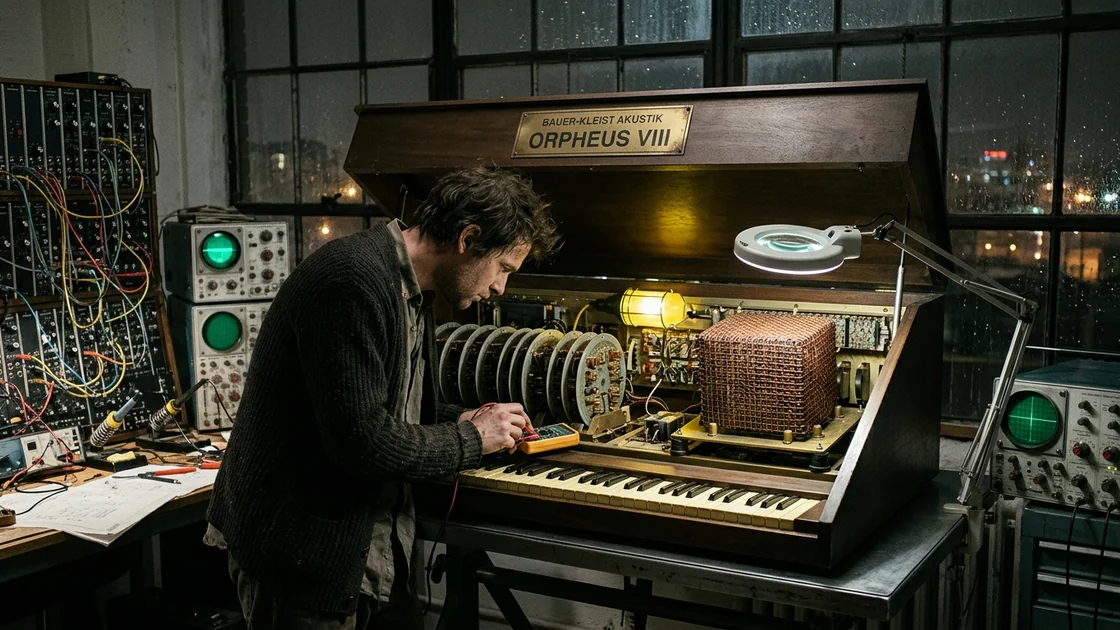
Julian Vance, a reclusive electronic musician and vintage instrument restorer, purchases a decaying, one-of-a-kind analog synthesizer from the estate of an obscure acoustic physicist named Dietrich Kleist. While painstakingly repairing the massive instrument in his industrial loft, Julian discovers that it utilizes an archaic magnetic core memory bank containing a pre-programmed sequence that has survived without power for over four decades. When he plays the sequence through his studio monitors, the precise combination of sub-audible frequencies, microtonal phase shifts, and electromagnetic resonance triggers an overwhelming, hyper-realistic hallucination of a vast, subterranean city built of black stone and humming brass monoliths. Initially believing he is suffering from toxic fume inhalation or exhaustion, Julian invites his former bandmate Clara and a neuro-acoustics researcher named Marcus to witness the machine in action, only to discover that everyone in the room experiences the exact same hallucinatory landscape simultaneously and can interact within it. Driven by an consuming obsession to see what lies at the center of this acoustic dimension, Julian repairs a damaged seventh oscillator voice on the synthesizer to unlock the corrupted final measures of the sequence, inadvertently trapping the group in a self-sustaining neurological feedback loop that threatens to sever their minds from their physical bodies forever.
The rain had been falling on the valley for three days before Julian Vance found the machine, turning the gravel driveway of the Kleist estate into a trough of grey soup. The house itself was an exercise in mid-century paranoia, a low-slung structure of unpainted cinderblock and redwood beams wedged into the wet cedar hills forty miles outside the city. Dietrich Kleist had died in a state facility in 1986, leaving behind a sister who refused to touch his belongings and a nephew who had waited until the old woman died before hiring an estate liquidation company to clear the place out.
Julian had only driven out because the online listing—buried at the bottom of an estate auction directory under the heading of Miscellaneous Amateur Radio and Laboratory Surplus—included a blurry photograph of a patch bay. Anyone else would have assumed it was part of an old telephone switchboard or an oscilloscope calibration rig. Julian, who had spent the last fifteen years of his life breathing solder fumes in a drafty warehouse district loft, recognized the specific spacing of the quarter-inch jacks and the unmistakable typography of late-seventies West German screen-printing.
"Watch your head on the ducting," the liquidator said, not looking back as he led Julian down a narrow flight of concrete stairs. The man smelled of menthol cigarettes and damp wool. "Power’s off down here. Utility company pulled the meter back in ninety-eight. You’ve got whatever light comes off your phone and this." He clicked on a yellow plastic work light linked to a portable battery pack, casting harsh, elongated shadows across a basement that smelled intensely of wet lime, mouse droppings, and decayed paper.
The basement was not a hobbyist's den; it was a bunker. The walls were lined with deteriorating fiberglass acoustic wedges, many of which had sagged away from their glue to hang like dead bats. Racks of test equipment—Hewlett-Packard signal generators, Tektronix oscilloscopes with round green faces, and custom-built power supplies the size of cinderblocks—stood in rusted columns along the perimeter.
And in the center of the room, resting on a reinforced steel drafting table beneath a stiff canvas tarp, sat the instrument.
When Julian pulled the canvas back, a cloud of fine grey dust rose into the beam of the work light, swirling like iron filings in a magnetic field. He caught his breath.
It was massive, easily six feet long and three feet deep, housed in a cabinet of dark, oiled walnut that had swollen slightly at the dovetail joints from decades of dampness. The front panel was tilted upward at a forty-five-degree angle, divided into modular sections by thin strips of oxidized brass. There were no preset buttons, no digital LED readouts, no plastic sliders. Instead, there were nearly two hundred heavy Bakelite knobs with fluted edges and spun-aluminum caps, alongside rows of silver toggle switches and a sprawling matrix of banana jacks and quarter-inch sockets at the far right. Below the panel sat a seventy-six-note keyboard made of real ivory and ebony, the white keys yellowed to the color of old teeth, several of them sitting slightly askew where the felt bushings had rotted away.
Centered at the very top of the brass bezel was an engraved nameplate: BAUER-KLEIST AKUSTIK — ORPHEUS VIII — PROTOTYP NR. 1 (1979).
"You know what it is?" the liquidator asked, leaning against the doorframe.
"It’s an organ," Julian lied smoothly, his heart hammering against his ribs. His fingers hovered an inch above the panel, afraid to leave smudges in the forty-year-old dust. "An experimental studio organ. Probably doesn't work. The moisture down here will have eaten the transformers, and the electrolytic capacitors are guaranteed to be dead."
"Looks heavy."
"Wait until we try to get it up those stairs," Julian said. "You have a price on it?"
"Scrap value on the copper and brass is probably two hundred. Give me three-fifty and haul it out yourself, and I don't have to pay my guys to break their backs moving it on Friday."
Julian didn't negotiate. He counted out seventeen twenties from the envelope in his jacket pocket, his hands trembling slightly. It took the two of them and a rusted appliance dolly nearly an hour to wrestle the Orpheus VIII up the narrow concrete stairs. The instrument weighed close to two hundred and fifty pounds, its weight concentrated on the left side where the power supply and some massive internal mechanism sat. Every time the dolly dropped down a step, a deep, metallic ring echoed from inside the cabinet, as if the chassis contained tensioned springs or tuning forks.
By the time Julian got it loaded into the back of his Ford Transit van, wrapped in moving blankets and strapped to the floor anchors, the rain had turned to a cold, pelting sleet. Driving back toward the city down the winding two-lane highway, he kept glancing in the rearview mirror. In the orange glow of the occasional sodium streetlamp, the shrouded lump in the back looked less like a musical instrument and more like a sarcophagus pulled from a flooded crypt.
Julian’s studio occupied the fourth floor of a former thread-spinning mill on the north side of the river. It was a vast, drafty rectangle of exposed brick and heavy timber columns, heated poorly by clanking cast-iron radiators that never quite drove the dampness out of the floorboards. One half of the space was his living quarters—a mattress on a low wooden frame, a two-burner hotplate, an espresso machine, and stacks of acoustics textbooks. The other half was a labyrinth of voltage.
There were modular walls of Moog and Buchla clones, a scarred Sequential Circuits Prophet-5, an Arp 2600 with custom modifications, a pair of towering Studer tape machines, and a heavy workbench littered with soldering irons, spools of tin-lead wire, magnifiers, and bins of vintage resistors sorted by color code.
Before his solo career had dissolved into making ambient soundscapes for independent films that nobody watched, Julian had been half of Sub-Carrier, an electronic duo with Clara Lin. They had released two records that were darlings of the underground music press—dense, claustrophobic albums built from cello loops and decaying analog tape delays—before Julian’s growing obsession with the machinery itself had alienated him from the act of performing. Clara wanted to play venues, to feel the physical movement of an audience; Julian wanted to stay in the mill for seventy-two hours straight trying to modify a filter circuit to oscillate at the exact resonant frequency of the human sternum.
With the help of the building’s freight elevator and a furniture dolly, Julian got the Orpheus VIII into the center of his workspace by midnight. He brewed a pot of black coffee, turned on the overhead halogen work lights, and began the autopsy.
He started by removing the sixteen machine screws that held the upper control panel to the walnut cheeks. The cabinet was hinged at the back like the hood of a car, equipped with two heavy steel prop-rods to hold the panel open for servicing. When he lifted it, the smell hit him first: not the foul dampness of the basement, which hadn't penetrated the tightly sealed chassis, but the unmistakable perfume of vintage electronics—baked phenolic resin, beeswax, pine rosin, and old ozone.
Julian hooked a trouble light onto the top edge of the raised panel and leaned in.
"My God," he whispered to the empty room.
He had expected printed circuit boards, perhaps early etched fiberglass or perforated phenolic boards common to small-run synthesizers of the late seventies. Instead, the interior of the Orpheus VIII was a masterpiece of military-grade point-to-point wiring and gold-plated daughterboards. Every wire bundling was laced together with waxed linen cord in neat, right-angled harnesses.
There were seven identical voice cards slotted into an aluminum backplane on the left side of the hull. Each card was the size of a dinner plate, populated with discrete transistors encased in little metal cans, precision polystyrene capacitors, and custom-wound toroidal inductors enclosed in mu-metal shields to prevent electromagnetic interference. Usually, polyphonic synthesizers from 1979 had four, five, or eight voices. Seven was a prime number, acoustically awkward and electronically perverse.
Even stranger were the oscillators. Standard analog synthesizers generated simple geometric waveforms—sawtooth, square, triangle—and then used filters to subtract harmonics. Looking at the block diagrams silk-screened onto the inside of the chassis in crisp German nomenclature, the Orpheus VIII didn't use subtractive synthesis at all. Each of the seven voice cards contained a complex phase-locked loop and a bank of six sub-oscillators tuned not to standard twelve-tone equal temperament, but to harmonic ratios derived from what the diagram labeled Kymatische Raum-Geometrie—Cymatic Spatial Geometry.
Then Julian looked to the right side of the cabinet, directly underneath the sequencer controls, and stopped breathing altogether.
Mounted inside a suspended sub-chassis of brass and thick rubber shock-absorbers was a three-dimensional cube of woven copper wires, roughly six inches on each side. Through the magnifying lamp, Julian could see thousands of microscopic black rings—tiny doughnuts of ferrite ceramic, each smaller than the head of a pin—threaded at the intersections of the copper mesh.
It was a magnetic core memory array.
Julian pulled up his stool and stared at it for a long time. He knew what core memory was from his father, who had worked on early IBM mainframes in the sixties. Before silicon RAM chips became cheap and reliable, computers stored binary data by magnetizing tiny iron rings in one of two directions—clockwise for a one, counterclockwise for a zero. Once a ring was magnetized, it stayed magnetized forever, unless another electrical pulse deliberately flipped it. It didn't need a battery. It didn't care about power outages, radiation, or forty years in a damp basement.
No synthesizer manufacturer had ever used magnetic core memory that large. It was prohibitively expensive, hand-woven under microscopes by workers with sewing needles, mostly reserved for ballistic missile guidance systems and Apollo spacecraft. And yet, here sat a massive, sixty-four-step, multi-channel core memory matrix wired directly to the control voltage busses of the seven voice cards.
Whatever sequence Dietrich Kleist had programmed into this machine before he was locked away in a state hospital was still sitting inside that copper web, frozen in magnetic amber.
For the next six days, Julian barely left the loft. He unplugged his phone, lived on canned soup and espresso, and surrendered himself entirely to the restoration.
He knew better than to simply plug the machine into the wall and flip the switch; applying a hundred and twenty volts to forty-year-old electrolytic capacitors was a reliable way to make them explode like shotgun shells and take the irreplaceable power transformers with them. Instead, he systematically de-soldered every power-supply capacitor on the main regulator board, replacing them with modern, high-grade equivalents while keeping the original components labeled in plastic bags.
He cleaned the two hundred potentiometers and switches with aerosol contact cleaner, working each knob back and forth fifty times until the gritty oxidation dissolved and the rotation felt like buttered glass. He removed the seventy-six keys one by one, vacuumed out the desiccated remains of the felt bushings, polished the nickel-silver contact pins with jewelers’ rouge, and leveled the keybed.
As he worked through the seven voice cards, testing the continuity of the traces with his multimeter, he discovered the machine’s only serious injury.
Cards One through Six were pristine; their discrete components had drifted less than half a percent from their factory tolerances—a testament to the absurdly expensive military-spec resistors Kleist had used. Card Seven, however, had suffered a catastrophic failure at some point in the past. A dual-transistor array at the heart of its primary phase-shifter had shorted out, scorching a dark brown halo onto the circuit board around its legs and melting a nearby polystyrene capacitor into a grey bead.
Julian examined the burned transistor under his jeweler's loupe. The part number had been deliberately ground off the metal casing with a rotary tool, a common trick among paranoid boutique engineers who didn't want competitors copying their circuits. Without schematics or a part number, replacing that transistor array would require reverse-engineering the entire voice card from scratch and calculating the exact current tolerances mathematically.
For now, he pulled Card Seven out of its slot and set it aside on his bench. Six voices were more than enough to hear what the Orpheus VIII sounded like. More importantly, he was careful never to send an erratic current near the magnetic core memory cube; he disconnected the write-enable lines entirely, ensuring that when power finally flowed through the system, the sequencer could only read the ferrite rings, never overwrite them.
On Sunday night, a thick river fog pressed against the tall multipane windows of the mill, muting the distant hum of highway traffic. Julian wheeled his Variac—a variable autotransformer that allowed him to bring the wall voltage up slowly from zero—over to the synth. He patched the Orpheus VIII’s four discrete audio outputs (labeled Nord, Süd, Ost, and West, indicating a quadraphonic surround configuration) into his mixing desk, routing the front pair to his main Genelec studio monitors and the rear pair to two vintage Tannoy cabinets standing behind his chair.
He turned the Variac dial to ten volts. Twenty. Fifty.
He watched the ammeter on the Variac like a hawk, waiting for a spike in current draw that would indicate a dead short. The needle rose smoothly and settled. At ninety volts, the warm amber incandescent bulbs behind the panel meters flickered to life. At one hundred and seventeen volts, the massive toroidal transformer in the base of the cabinet settled into a barely audible, sixty-cycle mechanical purr.
No smoke. No ozone smell. The voltage rails read a dead-flat plus-and-minus fifteen volts on his multimeter.
Julian let the machine warm up for forty minutes so the crystal ovens and temperature-compensated oscillators could stabilize. Then, sitting on his wooden stool in the center of the four speakers, he brought up the master faders on his mixing desk and pressed middle C.
The sound did not come from the speakers. That was his first, disorienting impression.
Because of the quadraphonic phase matrix built into the output stage, the note seemed to materialize directly in the air three feet in front of his face, hanging there like a physical object with mass and temperature. It was a low, burnished brass tone, impossibly complex, surrounded by a halo of shimmering, high-frequency glass that shifted slightly as he tilted his head. As he held the key down, slow sub-harmonic undulations rippled through the floorboards, vibrating up through the legs of his stool and into his pelvis.
He played a minor chord. The room seemed to expand outward by twenty feet, the brick walls receding into an acoustic shadow. The sound was so warm, so terrifyingly vast, that his eyes prickled with involuntary tears. No modern digital plugin, not even his prized Prophet or Moog, had ever moved air like this. It didn't sound like electricity imitating an instrument; it sounded like the fundamental acoustic resonance of matter itself.
His eyes drifted to the upper right quadrant of the panel, where the sequencer controls sat beneath a protective flip-up cover of smoked plexiglass.
There was a heavy rotary switch labeled SPEICHERBANK (Memory
Bank), currently pointing to position 00. Next to it was a
large square button illuminated from within by a pale green neon bulb,
labeled LAUF (Run), and a potentiometer for TEMPO,
which wasn't calibrated in beats per minute, but in Hertz—ranging from
0.5 Hz to 40 Hz. A piece of yellowed masking
tape was stuck to the panel beside the tempo knob, with a fine pencil
mark drawn carefully at 7.83 Hz.
Julian frowned. 7.83 Hertz wasn't a musical tempo; it was the Schumann resonance—the fundamental electromagnetic frequency of the Earth’s ionosphere cavity, which also happened to sit right on the boundary between human alpha and theta brainwaves.
His thumb hovered over the green LAUF button. The rational part of his brain told him that Bank 00 probably just contained a simple calibration scale, an arpeggio Kleist had used to tune the oscillators forty-five years ago.
He pressed the button.
A relay clicked deep inside the chassis. Across the top of the sequencer panel, a row of sixty-four tiny red light-emitting diodes began to chase each other from left to right, blurring into a continuous crimson line at nearly eight cycles per second.
For the first four seconds, Julian heard very little—only a rhythmic, clicking flutter, like a moth trapped inside a grand piano, accompanied by a deep, sub-audible pressure that made his eardrums flex inward. Every seventh step of the sequence left a tiny, rhythmic gap where the missing Voice Card Seven was supposed to fire, creating a limping, hypnotic syncopation.
Then, as the sequence completed its fourth pass, the oscillators began to phase-lock with the natural room modes of the loft.
The sound rose not in volume, but in density. It was a polyrhythmic cascade of microtonal intervals that seemed to spiral endlessly upward while simultaneously descending into the floor—an acoustic illusion similar to a Shepard tone, but woven across four spatial channels. Julian tried to focus on the red LEDs of the sequencer, to analyze what notes were being triggered, but the red lights were leaving long, violet trails across his retinas.
The air in the room grew suddenly, sharply cold.
Julian shivered, pulling his cardigan tighter around his ribs, only to realize he could no longer feel the wool between his fingers. He looked down at his hands. They were still resting on the wooden edge of the synthesizer, but the walnut grain was lengthening, flowing like dark river water, and the brass panel strips were lifting upward, elongating into towering pillars that stretched far past the ceiling of the mill.
He tried to stand up, to pull his hands back, and found that the concept of standing up had lost its anatomical meaning. He wasn't sitting on a stool in a fourth-floor loft anymore.
The brick walls of the mill had dissolved like wet paper in a current, revealing a horizon of impossible, crushing scale. He was standing on a vast circular plaza of polished black basalt that stretched out for miles into a motionless, ink-black sea. Above him, there were no stars and no clouds, only a vault of deep, bruised violet light that pulsed in time with the seven-point-eight-three-Hertz throb of the machine.
Rising from the basalt plaza in concentric rings were hundreds of colossal monoliths made of tarnished brass and dark stone, each one hundreds of feet tall, their surfaces carved with intricate geometric grooves that matched the circuit traces of the Orpheus VIII’s voice cards. The sound of the sequence was the wind of this place; it poured out of the monoliths in visible standing waves that rippled the air like heat haze over asphalt. Every time the sequence hit the gap of the missing seventh voice, a jagged black fissure flickered across the violet sky, and the central monolith—a towering structure at the very heart of the plaza, half a mile away—stuttered out of focus, its entrance barred by a wall of shimmering static.
Julian smelled wet slate, crushed juniper berries, and the metallic tang of blood. He knelt and pressed his palm to the ground; the basalt was freezing cold, slick with a thin film of condensation that wet his skin. This was not a dream. In a dream, you didn't feel the grit of pulverized stone under your fingernails or the painful pressure of forty-mile-an-hour wind against your corneas.
He took a step toward the central spire. Then another. The resonant chords of the machine were pulling him forward like an undertow, promising that if he could just reach the center of the geometry, the dissonant ache that had lived in the back of his skull his entire life would finally resolve into a tonic chord.
Then, somewhere millions of miles away, a radiator pipe banged sharply against a wooden floorboard.
The basalt plaza shattered like a pane of safety glass struck with a hammer.
Julian gasped, inhaling a lungful of dusty studio air, and pitched backward off his stool. He hit the hardwood floor hard, his elbow cracking against the leg of his workbench, knocking a jar of machine screws off the edge. They rained down around his head in a bright, metallic clatter.
Above him, the Orpheus VIII was still running. The red LEDs raced across the panel. The four speakers pumped out their woven wall of low-frequency pressure and microtonal glass.
Scrambling on his hands and knees, his heart misfiring wildly in his chest, Julian reached up and slapped the green LAUF button.
The relay clicked. The red lights died. The sound vanished, leaving behind a silence so profound that Julian could hear the blood hissing through his carotid arteries.
He lay on the floor among the scattered screws for twenty minutes, staring up at the timber ceiling, waiting for his breathing to slow. When he finally dragged himself upright and looked at the studio clock, he froze.
He had pressed the button at 11:15 PM. It was now 3:40 in the morning.
He had not been in that place for two minutes. He had been standing on the basalt plaza for over four hours.
All through Monday, Julian tried to construct a rational explanation that didn't involve him losing his mind.
He checked the studio’s carbon monoxide detector; the battery was fresh and the readout stood at zero parts per million. He researched the chemical composition of vintage German capacitor electrolytes and phenolic resins, wondering if heating the chassis had released some forgotten neurotoxin or dimethyltryptamine analog into the unventilated room. Nothing fit. Even the most potent chemical hallucinogens didn't switches on instantly with the press of a relay button and vanish the exact microsecond the audio cut out.
Then he considered temporal lobe epilepsy. It was documented in neurology literature that certain flickering lights or rhythmic acoustic stimuli could trigger focal seizures in susceptible brains, producing intense feelings of awe, phantom smells, and complex visual hallucinations.
That had to be it. Weeks of sleep deprivation, caffeine abuse, and staring closely at oscillating LEDs while bathed in high-decibel infrasound had simply tripped a breaker in his auditory cortex.
To prove it to himself, he set up a pair of Neumann condenser microphones in the exact spot where his head had been, routed them along with the direct four-channel line outputs of the Orpheus VIII into his digital audio workstation, put on heavy industrial ear protectors, started the recording from across the room, and triggered the sequence using a ten-foot wooden dowel so he didn't have to stand inside the speaker field.
He let it record for five minutes while he stood in the kitchen area behind a brick partition, watching the waveform build on his computer monitor from twenty feet away. Even through the ear protectors and across the room, his teeth buzzed in his jaw and a faint, greasy nausea rolled through his stomach, though the walls remained solid brick.
After stopping the machine with the dowel, he sat down at his computer, plugged in his studio headphones, and played back the digital recording.
He frowned.
Through the headphones, the recording sounded completely ordinary. It was an interesting piece of vintage electronic music—a weird, limping, microtonal arpeggio with a heavy sub-bass drone—but it had none of the three-dimensional weight, none of the bone-vibrating terror or architectural grandeur of the live machine. Watching the spectrum analyzer on the screen, he saw that the digital converters had cleanly lopped off everything below twenty Hertz and above twenty-two kilohertz, and the stereo summation had collapsed the delicate four-channel phase relationships into flat, harmless soup.
Whatever the Orpheus VIII was doing, it couldn't be captured by a microphone or quantized into ones and zeros. It required the physical acoustic geometry of the room, the analog voltage fluctuations of the four speakers working in unison, and perhaps the electromagnetic field of the machine itself.
Or, he thought darkly, it wasn't in the sound at all. It was just in his head.
At five o'clock that evening, he did something he hadn't done in eight months. He picked up his phone and called Clara.
"Tell me you're calling because you finally mixed those archival tapes from the Montreal show," her voice came through the receiver, dry and brisk, backed by the faint sound of city traffic.
"I didn't call about the tapes," Julian said, rubbing his eyes. "Are you in town?"
"I have a rehearsal with the string quartet until seven. Why? You sound terrible, Jules. Have you been sleeping?"
"I bought something," he said. "A prototype from seventy-nine. German. I need another pair of ears on it. Professional ears. Someone who knows how phase cancellation works in this room."
There was a long pause on the line. Clara knew him better than anyone alive; she knew the exact cadence his voice took when he was spiraling down a technical rabbit hole. "Julian, if this is another week-long lecture about why silver-plated patch cables change the transient response of a hi-hat—"
"It's not that," he said quietly. "Clara, please. Come over after your rehearsal. Give me twenty minutes. If you tell me I'm crazy, I'll go see a doctor tomorrow morning. I promise."
The naked fear in his voice must have cut through the static between them. The sharpness left her tone instantly. "I'll bring takeout from the Thai place on Fourth. Don't drink any more coffee before I get there."
Clara arrived at seven-thirty, carrying her carbon-fiber cello case on her back and a brown paper bag smelling of ginger and garlic in her hand. She looked painfully healthy compared to Julian—her dark hair pulled back in a neat knot, her cheeks flushed from the cold autumn wind, wearing a heavy charcoal overcoat.
She took one look at Julian’s sunken eyes and the tremor in his hands and forced him to sit at the small kitchen table and eat half a container of green curry before she even allowed him to walk her over to the studio side of the loft.
"Alright," she said finally, wiping her hands on a napkin and stepping across the tape boundary that divided his living space from the gear. She stopped dead when she saw the Orpheus VIII sitting under the halogen lights. "Okay. I'll admit it. That is the most intimidating piece of furniture I've ever seen. What is it?"
"Bauer-Kleist Orpheus Eight," Julian said, standing behind her, keeping his hands shoved deep in his jeans pockets. "Only one ever built, as far as I can tell. Seven-voice polyphonic, though the seventh voice card is fried right now. It uses hand-woven magnetic core memory for the sequencer."
Clara stepped closer, her musician's curiosity overriding her concern for a moment. She ran a finger lightly over the yellowed ivory keys, admiring the brass bezels and the cryptic German labels. "It looks like the helm of a U-boat. Does it play?"
"It plays. Sit here."
He positioned the wooden stool in the exact dead-center of the four speakers—the focal point of the quadraphonic array—and gestured for her to sit.
"Wait, what are we testing?" Clara asked, sitting down and folding her hands in her lap, looking up at him with narrowed eyes. "You said something about phase cancellation, and then you said something about going to see a doctor. What’s going on, Jules?"
"If I tell you what I think it does before you hear it, I'll contaminate the test," Julian said, his voice tight. "It's called priming. If I describe an effect, your brain might manufacture it just by suggestion. I just want to play a sequence that was left in the memory bank by the guy who built it. You sit there, listen to it for sixty seconds, and tell me what you experience. I'll stand right here by the switch."
Clara looked at him for a long time, reading the genuine dread in his posture. Slowly, she nodded. "Sixty seconds. If it's too loud and you blow out my eardrums before my recital on Friday, I will kill you."
"The SPL meter never goes above eighty-five decibels," Julian said. "Close your eyes if you want, or keep them open. It doesn't matter."
He stepped up to the right side of the console, slightly outside the main focal cone of the speakers, though still well within their field. He rested his index finger on the green LAUF button, took a shallow breath, and pressed it down.
Click.
The red LEDs began their frantic seven-point-eight-three-Hertz race across the panel.
Clara kept her eyes open at first, watching the lights with a slight, analytical frown. Through the first three passes of the sequence, as the moth-wing flutter and the low infrasonic pressure built in the loft, she tilted her head slightly to the left, the way she always did when she was listening for an out-of-tune harmonic in a string section.
Then the fourth pass locked into the room modes.
Julian had intended to watch her face and count to sixty on his watch. He never got past four.
Even standing three feet off-axis, the phase matrix snared him like a physical net. The temperature in the room plummeted. The brick walls behind Clara’s head turned translucent, then smoky, then vanished entirely as the studio floor hardened and darkened into wet, polished basalt.
Above them, the violet sky opened up like a bruised cathedral dome, split every few seconds by the silent, jagged black tear of the missing seventh voice. The brass monoliths rose out of the ink-black sea, singing their vast, subterranean chord into the freezing wind.
Julian gasped, dropping to one knee on the wet stone—and then he looked at the spot where the wooden stool had been.
Clara was there.
She wasn't sitting anymore; she was standing ten feet away from him on the black basalt plaza, her charcoal coat whipping around her calves in the phantom wind, her mouth slightly open as she stared up at the three-hundred-foot brass spire looming directly over their heads. Inside the vision, she looked slightly translucent at the edges, her silhouette outlined in a faint, shimmering corona of golden-green phase light, like chromatic aberration on an old lens.
Slowly, Clara lowered her gaze from the towering monolith and looked directly at Julian. Her eyes were wide with a mixture of sheer terror and breathless wonder.
She raised her right hand and pointed toward the central structure half a mile away, where the wall of black static flickered across the vast archway. She tried to speak, her lips moving, though her voice was swallowed by the roaring harmonic wind of the spires.
Then she stumbled backward, her hand flying to her temple as a particularly jagged tear of static ripped across the violet sky, sending a wave of nauseating vertigo across the plaza.
Julian lunged forward—not across the basalt, which felt as solid as granite beneath his boots, but blindly rightward toward where he remembered the physical console of the Orpheus VIII stood in the real world. His shin slammed painfully against the wooden cabinet leg. His outstretched hand found the smooth Bakelite knobs, slid up the cold brass panel, and smashed down onto the illuminated green square.
Click.
The violet sky collapsed inward. The roaring wind of the monoliths sucked back into the speaker cones with a low, dying thump.
The warm, dusty air of the thread mill rushed back over their skin.
Clara cried out, losing her balance on the wooden stool. Julian caught her by the shoulders before she could hit the floor, easing her down until they were both sitting on the worn Persian rug at the base of the synthesizer.
For a full minute, neither of them spoke. Clara’s chest heaved as she stared wildly around the loft—at the brick walls, the radiators, the familiar clutter of cables and soldering irons—before her eyes locked onto Julian’s face. Her skin was pale as chalk, and her fingers dug so hard into his forearm that her nails left crescent indents through his sleeve.
"Black stone," she whispered, her voice shaking violently. "We were standing on wet black stone. By an ocean."
Julian closed his eyes, a strange, vertiginous relief washing over him, followed immediately by a much deeper, colder dread. He wasn't insane. Which meant the machine was real.
"Brass towers," Julian murmured back, opening his eyes to meet hers. "With grooves carved into the sides. And the sky—"
"Purple," Clara breathed, her eyes widening further as the impossibility of it hit her. "Dark violet. With a crack in it that kept flashing in time with the dropped beat. And you... I saw you kneeling on the stone, Jules. You looked like you were made of light."
"You pointed at the center tower," Julian said softly.
Clara let go of his arm as if it had burned her and scrambled backward across the rug until her back hit the base of the couch. She pulled her knees up to her chest, staring at the silent walnut cabinet of the Orpheus VIII as if it were an unexploded bomb sitting in the middle of the floor.
"Did you put something in the food?" she demanded, though there was no conviction in her voice—she had brought the food herself. "Is there gas leaking in here? How did we both see the exact same thing at the exact same time?"
"There's no gas," Julian said, standing up on shaky legs and walking over to his workbench. He picked up the digital tablet where he had photographed the internal block diagrams of the synthesizer and brought it back, tossing it onto the rug beside her. "Dietrich Kleist wasn't a musical instrument designer. I spent the afternoon digging through German academic archives from the late sixties and seventies. He was a physicist and a neuro-acoustician at the Max Planck Institute before they fired him in seventy-four."
Clara didn't touch the tablet, keeping her eyes fixed on the machine. "Fired him for what?"
"He was obsessed with something he called Kymatische Bewusstseins-Kopplung—Cymatic Consciousness Coupling," Julian said, sitting down on the edge of the coffee table. "We know that sound creates geometric patterns in physical matter—you put sand on a metal plate and bow it with your cello bow, and the sand arranges itself into complex mandalas depending on the frequency. Kleist believed that human consciousness itself is just an electromagnetic standing wave generated by the thalamocortical loop in the brain—a continuous forty-Hertz oscillation between the thalamus and the cortex."
"I'm a cellist, Julian, not a neurologist."
"Think of the brain as a room," Julian said, leaning forward, the manic energy returning to his voice now that he knew he wasn't hallucinating alone. "Every room has resonant frequencies where sound waves stack up on each other. Kleist calculated that if you use quadraphonic acoustic emitters combined with a localized electromagnetic pulse from a magnetic core matrix, tuned to exact microtonal ratios and driven at the fundamental frequency of the ionosphere, you can force the thalamocortical loops of anyone standing in the room to phase-lock with the machine."
"Phase-lock," Clara repeated slowly. "You mean the sound is dictating what our brains see?"
"More than that," Julian said, looking back at the Orpheus VIII. "The sequence in Bank Zero isn't a song, Clara. It’s architectural data. Each of those sixty-four steps in the core memory is a spatial coordinate encoded as harmonic ratios. When the machine plays the sequence, it turns our nervous systems into projectors. And because our brains are synchronized to the exact same external clock, our electromagnetic fields overlap. We aren't just seeing the same movie; we're inside the same acoustic space."
Clara rubbed her temples, where a dull ache had begun to throb—the same post-exposure headache Julian had suffered all day. "That's impossible. Sound waves can't transmit high-resolution visual geometry and tactile sensations of cold stone."
"They don't have to transmit the textures," Julian countered. "Your brain already knows what cold wet stone and brass look and feel like. The frequencies just stimulate the exact neural clusters in the visual and somatosensory cortex in a precise mathematical order, and your brain fills in the rendering. And it's not even finished. Voice Card Seven is dead. Every seventh harmonic in the matrix is missing—that's why the sky was tearing open and the center spire was blocked by static."
Clara looked up sharply. "Don't tell me you're going to fix the seventh card."
"Of course I'm going to fix it!" Julian stood up, pacing the length of the rug. "Do you realize what this is? For forty years this machine sat in a basement waiting for someone who knew how to restore it without wiping the core memory. Kleist built a place out of pure mathematics and voltage, and we only saw six-sevenths of it. The central tower is the resolution of the sequence. Everything in the harmonic structure points toward that doorway."
"And where did Dietrich Kleist end up, Julian?" Clara asked quietly, rising to her feet. "When you bought this thing, where did they say he died?"
Julian stopped pacing. He looked away toward the rain-streaked windows. "A psychiatric hospital near Munich. Wait—that doesn't mean the machine did it. He had a history of—"
"He went mad, or he fried his brain listening to this thing," Clara said firmly, walking over to the couch and picking up her coat. "And yet, ten seconds ago, when I was standing on that stone plaza... I didn't want you to turn it off. Even though I was terrified, a part of my brain wanted to walk into that tower." She shuddered as she slid her arms into her sleeves. "That's what scares me, Jules. It feels like a trap. Like an acoustic siren song."
"Wait—you're leaving?"
"I'm going home to sleep in a room that doesn't have a two-hundred-pound brainwashing machine in it," she said, though her hand lingered on the strap of her cello case. She looked back at him from the heavy steel door of the loft, her expression torn between fear and the undeniable lure of what they had just shared. "Don't turn it on again while you're alone. Promise me that. And before you touch that broken circuit board, let me bring Marcus Chen over here tomorrow night."
Julian scowled. "Marcus? The grad student from the university lab who helped us design the ring modulator pedals? Why bring an outsider into this?"
"Because Marcus has access to portable electroencephalography equipment and multi-spectrum magnetic field meters," Clara said. "If we're going to look at this thing objectively instead of treating it like a religion, I want to see what it's actually doing to our brains on a monitor before you solder another wire. Tomorrow at eight. Go to sleep, Julian."
Julian kept half of his promise. He didn't press the green LAUF button again that night, mostly because the memory of how four hours had vanished during his first solo exposure still chilled him.
Instead, he sat at his workbench until dawn with his soldering station, an oscilloscope, and Voice Card Seven.
Tracing the circuit paths of the undamaged Voice Card Six, he carefully mapped out the mathematical function of the ruined dual-transistor array whose part number Kleist had ground off. It was a remarkably clever piece of analog engineering—a differential pair of ultra-low-noise silicon transistors matched for identical thermal transfer characteristics, used to shift the phase of the oscillator by an irrational mathematical constant related to the golden ratio.
By four in the morning, digging through his vintage component drawers—tin boxes salvaged from defunct aerospace contractors and old Tektronix repair shops—Julian found half a dozen Motorola dual-transistor cans from 1977. Using a curve tracer attached to his oscilloscope, he tested them one by one until he found a pair whose voltage-gain curves matched the surviving cards to within a tenth of a percent.
He didn't solder it in yet. He left the replacement transistor sitting on the bench beside the scorched board like a bullet next to a revolver, went to his mattress, and slept a heavy, dreamless sleep until mid-afternoon.
When eight o'clock rolled around on Tuesday evening, Clara returned, accompanied by Marcus Chen.
Marcus was twenty-eight, thin and restless, wearing a faded university department hoodie and carrying two Pelican cases filled with diagnostic equipment from the auditory neuroscience lab where he was finishing his doctorate. He had always been somewhat in awe of Julian and Clara’s music, though as he unpacked his gear onto Julian’s coffee table, he looked more amused than convinced by whatever Clara had told him in the car.
"So," Marcus said, snapping open the latches of the larger case to reveal a wireless twenty-four-channel EEG headset and a toughened laptop, "Clara tells me you found an undocumented West German polysynth that induces synchronous pareidolia through infrasonic room modes."
"It wasn't pareidolia, Marcus," Clara said, leaning against the brick pillar with her arms crossed. "Pareidolia is seeing a face in the clouds. We stood in the same three-dimensional space and looked at each other."
"Shared suggestion combined with carbon-dioxide retention and vestibular disruption from high-energy sub-bass," Marcus replied cheerfully, pulling out a tri-axial Gaussmeter and a calibrated measurement microphone that could read down to zero-point-five Hertz. "Don't get me wrong, I'm thrilled to be here. Looking at the guts of a custom seventies synth is way better than grading undergraduate lab reports. Mind if I look under the hood before we wire Clara up?"
Julian stepped aside and lifted the heavy walnut lid of the Orpheus VIII, propping it on its steel rods.
Marcus walked over, adjusted his glasses, and peered inside. His cheerful skepticism evaporated in about three seconds.
"Whoa," Marcus breathed, leaning in toward the right-hand bay. "Is that... wait. Is that a ferrite core stack? A three-plane magnetic core memory array in an audio synthesizer?"
"Sixty-four steps across seven polyphonic control busses," Julian said. "Hand-wired."
Marcus held his Gaussmeter six inches above the copper-woven cube, even with the sequencer sitting idle. The digital needle on the meter twitched noticeably. "It's unshielded," Marcus muttered, his brow furrowing. "Every other inductor in this chassis is wrapped in heavy mu-metal cans, look—there, and there. He shielded the audio path to perfection, but he mounted the magnetic core memory directly beneath a fiberglass window in the upper panel with a parabolic brass reflector underneath it."
Julian blinked, stepping closer. In his focus on the electronics, he hadn't noticed the physical geometry of the sub-chassis holding the memory cube. The oxidized brass tray beneath the ferrite grid wasn't flat; it was subtly curved, like a shallow satellite dish aimed directly outward toward the keyboard player's head.
"Wait," Julian said slowly. "When the read-current pulses through the X and Y inhibit wires of the core array at seven-point-eight-three Hertz—"
"—it acts as a directional transcranial magnetic stimulation array," Marcus finished, his voice dropping an octave as he traced the heavy copper bus bars leading from the power supply to the memory cube. "Look at the gauge of the wire feeding the core sense lines. Standard computer core memory uses milliamps. He’s pumping five amps of current pulses through that ferrite matrix every step of the sequence, modulated by the audio oscillators. It’s creating a complex, fluctuating magnetic field that reaches six or eight feet in front of the console, completely phased-locked with the acoustic standing waves coming out of the four speakers."
Clara stepped away from the brick pillar. "In plain English, Marcus."
"In plain English," Marcus said, turning to look at them with wide eyes, "sound waves alone can't make two people share a detailed visual hallucination. The skull and the eardrum filter out too much data. But if you use precision quadraphonic sound to prime the auditory and vestibular cortex while simultaneously hitting the parietal and temporal lobes with a modulated magnetic pulse from that core stack, you're bypassing the sensory organs entirely. You're writing voltage patterns directly onto the cerebral cortex."
Silence fell over the loft, broken only by the hum of the refrigerator in the kitchen.
"Let's wire me up," Clara said quietly, walking over to the wooden stool in the center of the speaker array. "I want to see what it looks like on your screen."
It took Marcus fifteen minutes to fit the flexible neoprene cap onto Clara’s head, injecting small dabs of conductive gel into the electrode wells until all twenty-four channels showed green impedance levels on his laptop screen. He set up his laptop and the low-frequency spectrum analyzer on a rolling cart ten feet behind the synthesizer—behind the brass parabolic reflector of the core stack, where the magnetic field dropped off sharply according to his Gaussmeter.
"Stay back here behind the cabinet line with me, Julian," Marcus instructed, watching the squiggly lines of Clara’s baseline brainwaves scroll across his monitor. Right now, they showed normal beta activity—awake, alert, slightly anxious. "If we stand behind the parabolic shield and wear ear protection, we should stay outside the entrainment envelope while she's inside it. I'll flip the switch with a meter stick. Twenty seconds only, Clara. Keep your hand on your knee; if you want out earlier, just drop your arm and I'll cut the power."
Clara nodded, looking small and vulnerable sitting alone in the center of the four speakers with the bundle of sensor wires trailing from the back of her head. "Ready."
Marcus slipped on a pair of heavy ear defenders, handed a second pair to Julian, and used the wooden dowel to press the green LAUF button from behind the open walnut lid.
The red LEDs flashed to life.
Even behind the cabinet and wearing ear protection, Julian felt the deep infrasonic thud in his chest cavity as the four speakers began to move air. He kept his eyes glued to Marcus’s laptop screen.
For the first three seconds, Clara’s EEG traces remained chaotic and individualized—twenty-four distinct lines measuring different regions of her cortex.
At four seconds, as the sequence completed its fourth cycle, every single line on the monitor snapped into identical, high-amplitude sine waves rippled with intricate, mathematically perfect fractal harmonics.
"Jesus Christ," Marcus whispered, his voice muffled to himself inside his ear defenders. He tapped furiously at his trackpad, pulling up a three-dimensional topographic heat map of Clara’s brain.
Normally, a brain map showed scattered pockets of activity—red in the auditory cortex when listening to music, blue in the visual cortex when eyes were closed. On Marcus’s screen, Clara’s entire cerebral cortex was lit up like a supernova, pulsing in a rotating geometric spiral that matched the exact phase rotation of the quadraphonic audio outputs shown on the adjacent spectrum analyzer. Her visual cortex, motor cortex, hippocampus, and temporal lobes were firing in total, unprecedented lockstep.
Julian looked up from the screen at Clara.
She was sitting bolt upright on the stool, her eyes wide open and unblinking, staring straight ahead through the brick wall of the loft. Her lips parted slightly, and she slowly raised her right hand, reaching out to touch something invisible in the air in front of her face.
"Twenty seconds!" Julian shouted over the low rumble of the room, grabbing Marcus’s shoulder.
Marcus reached out with the wooden dowel to hit the button—and then hesitated, leaning six inches forward over the edge of the open walnut lid to get a better angle on the switch.
The top of Marcus’s head crossed the plane of the brass parabolic reflector.
Marcus froze. The wooden dowel slipped from his fingers and clattered across the ivory keys. His eyes went glassy and wide, his jaw slackening as he stared upward into the empty air above the synthesizer.
Swearing under his breath, Julian stayed crouched low behind the walnut cabinet, reached around the side with his bare hand without lifting his head into the focal cone, and slammed his palm onto the LAUF button.
The machine clicked off.
Marcus stumbled backward into the rolling cart, nearly knocking his laptop onto the floor before catching himself on Julian’s workbench. He tore the ear defenders off his head, breathing as if he had just sprinted up four flights of stairs. On the stool, Clara blinked rapidly, shivering as she wrapped her arms around herself.
"Did you see it?" Clara asked Marcus, her voice hoarse.
Marcus couldn't speak for several seconds. He stared down at his trembling hands, then back at the copper cube sitting inside the open synthesizer.
"I was only in it for two seconds," Marcus whispered, his scientific detachment completely shattered. "The ceiling vanished. There was a purple sky... and towers made of brass singing in the wind. I felt the spray of that black water on my face. How did I feel water on my face?"
He turned back to his laptop, his fingers shaking as he stopped the EEG recording and scrolled back through the data log. He zoomed in on the fractal sub-harmonics riding on top of Clara’s synchronized theta waves.
"Look at this," Marcus breathed, pointing at the screen. "Every seventh cycle, the neural synchronization collapses by fourteen percent and causes a massive spike in the amygdala—that’s the fear and vertigo response you felt when the sky cracked. The brain is trying to complete the geometric gestalt of the sequence, and the missing seventh voice is acting like a syntax error in reality."
Julian stepped forward, holding up the repaired Voice Card Seven from his workbench, where the replacement Motorola transistor sat newly soldered into the board—a task he had finished in five minutes just before they arrived.
"Not anymore," Julian said softly.
Clara stood up from the stool so fast the EEG leads pulled taut, ripping several electrodes out of her hair. "Julian, you didn't."
"I matched the transistors this morning and soldered the last three pins before you walked up the stairs," Julian said, his eyes bright with an almost feverish intensity. "Look at the EEG data Marcus just recorded! The vertigo, the fear, the feeling that something is wrong in that place—it's all being caused by the missing seventh harmonic! The sequence is an incomplete chord resolved across sixty-four steps. Without the seventh voice, our brains are slamming into a wall of static at the center of that plaza."
"And what happens when the wall isn't there?" Clara demanded, pulling the rest of the neoprene cap off her head and throwing it onto the table. "Did you ever stop to think that maybe Kleist blew out that seventh card on purpose? Look at the scorch mark on that board, Jules! You told me yourself that every resistor on those cards is military-grade and over-engineered. Transistors like that don't just explode under normal studio voltages unless someone intentionally shorts the power rail across the pins with a screwdriver!"
Julian looked down at the circuit board in his hands. There was a tiny nick in the copper trace right next to the burned transistor pads—a small metallic scratch that could have been made by the tip of a slip-on probe, or the blade of a flathead screwdriver jammed between the fifteen-volt rail and the phase-shifter input in a moment of desperate panic.
He dismissed the thought almost instantly. The memory of the basalt plaza and the towering central spire was pulling at the back of his mind like gravity. He needed to know what was inside that archway. Every musical instinct he possessed—the same relentless compulsion that had made him spend his life chasing pure, uncorrupted tone in a world of cheap digital approximations—demanded that he hear the chord resolve.
"Or maybe his probe slipped while he was calibrating it," Julian countered smoothly. "Marcus, look at the data. Is there any physical damage to Clara’s brain from that twenty-second run?"
Marcus was still staring at his screen, hypnotized by the impossible mathematical perfection of the waveforms he had just captured. The scientist in him was warring with his fear, and the scientist was losing to sheer ambition. What was sitting on his hard drive was the greatest discovery in the history of neuroscience—direct, non-invasive, high-bandwidth neural reality synthesis.
"No damage," Marcus said slowly, looking up at Julian and then at Clara. "In fact, the neural coherence levels are similar to what we see in advanced Tibetan monks during deep meditative states, just multiplied by a factor of a hundred. If the seventh voice eliminates the transient phase-drop... theoretically, it would stabilize the visualization completely. The amygdala spike would vanish."
"See?" Julian said, turning back to the open synthesizer. Before Clara could move to stop him, he aligned the edges of Voice Card Seven with the aluminum guide rails inside the chassis and pressed it firmly down into the gold-plated edge connector. It seated with a solid, mechanical clunk.
"Julian, stop!" Clara grabbed his arm, her fingers cold against his wrist. "Listen to yourself! Look at Marcus! This machine is doing something to our judgment just from that tiny exposure. It's making us want to turn it back on. It's like an addiction that hooks into the reward center of the brain!"
"It’s not an addiction, Clara, it’s music," Julian said, gently but firmly pulling his arm free of her grip. "It’s what you and I spent ten years trying to build when we were recording together—a sound that doesn't just sit in the room, a sound that takes the listener somewhere else entirely. For the first time in human history, someone actually achieved it. One full pass of the sixty-four steps with all seven voices running. Less than ten seconds at seven-point-eight-three Hertz. We can set a mechanical timer on the Variac if you want."
"A power relay timer," Marcus said, nodding rapidly as he rummaged through his second Pelican case. "I have an industrial inline outlet timer right here in my kit. We plug the Variac into the timer, set it for thirty seconds. When the thirty seconds are up, it physically severs the AC power from the wall. Even if none of us want to turn it off, the wall current dies automatically."
Clara looked between the two men. She saw the hunger in Julian’s eyes—the familiar, terrifying obsession that had broken their band apart years ago—and the dazzled ambition in Marcus’s face. She knew with absolute certainty that if she walked out the door right now, they would simply run the machine without her. And worse, deep down beneath her terror, she felt the quiet, aching pull of the violet sky and the brass monoliths calling to her own mind, whispering that she couldn't leave Julian to walk into that central spire alone.
"Fifteen seconds," Clara said, her voice tight and hollow. "Set the relay timer for fifteen seconds, Marcus. Not thirty. And leave the lid open so the timer cord is right by the door."
They set the timer for twenty seconds—a compromise Julian bargained for so the tubes and crystal ovens wouldn't suffer thermal shock before the fourth cycle locked in.
Marcus plugged the heavy main power cord of the Variac into the digital relay box at the base of the wall outlet, programmed the countdown for twenty seconds following current draw spike, and laid his laptop on the floor where its screen camera would record their physical bodies during the exposure.
This time, nobody stayed behind the shield.
They arranged three chairs in a tight triangle inside the sweet spot of the four speakers, facing the open console of the Orpheus VIII. Inside the chassis, all seven voice cards stood in an unbroken row, their indicator lights glowing a warm, steady amber.
Julian reached forward from his chair. His hand wasn't shaking anymore. He felt a strange, crystalline calm settle over him as he pressed the green LAUF button and simultaneously clicked the start trigger on the relay timer in his other hand.
20.0... 19.9... 19.8...
The red LEDs blurred into a solid crimson bar across the panel.
There was no limping gap in the rhythm this time. From the very first cycle, Voice Card Seven filled the hole in the sequence with a soaring, golden harmonic fifth that bound the other six oscillators together like the keystone dropped into the top of a stone arch.
They didn't even make it to the fourth pass before the thread mill disappeared.
On the second cycle—less than a quarter of a second after Julian pressed the button—the air in the loft didn't just grow cold; it ignited with geometric light.
The transition was seamless and total. There was no vertigo, no nausea, no tearing of the sky.
Julian stood on the polished black basalt plaza beside Clara and Marcus. Above them, the violet dome of the sky was whole and unbroken, swirling with vast, silent auroras of gold and ultraviolet light that moved in grand, mathematical counter-rotations. The ink-black sea surrounding the plaza was no longer dead and still; standing waves of water rose and fell in intricate cymatic honeycombs stretching out to the infinite horizon.
And the sound—the sound was no longer just a wind blowing through the brass monoliths. With the seventh voice active, the monoliths were harmonizing in a chord so vast, so impossibly consonant, that it felt like the fundamental equation of the universe being sung aloud. Every fear, every regret, every small human anxiety in Julian’s mind dissolved like salt in warm water.
Beside him, Marcus fell to his knees on the stone, weeping openly with sheer, overwhelming awe as he stared up at the geometry of the auroras. Clara stood just to Julian’s left, her shimmering silhouette no longer blurry at the edges, but rendered in hyper-real, luminous detail. She looked at Julian, and the terror was gone from her face, replaced by a serene, dreaming stillness.
Ahead of them, at the center of the concentric rings of brass towers, the wall of black static blocking the central archway had vanished.
Through the towering open portal of the central spire shone a core of blinding, warm white light—a rotating sphere of pure harmonic geometry that pulsed in exact unison with their own heartbeats. And standing just inside the threshold of that light, looking back at them across the basalt plaza, was the translucent, motionless figure of an old man in a lab coat, waiting silently like a statue carved from pale glass.
Dietrich Kleist hadn't gone mad in that state hospital in 1986. The shell of his body had been taken away by paramedics after the neighbors complained about the noise, while his consciousness—the forty-Hertz electromagnetic standing wave of his mind—had stayed behind, written permanently into the self-sustaining magnetic loop of the seventh harmonic.
Come in, the chord seemed to whisper, not in words, but in pure mathematical resolution that tugged at the center of Julian’s chest. Step across the threshold, and the music never has to stop.
Julian took a step forward. Marcus rose to his feet and walked ahead of him, moving rapidly toward the central spire as if drawn by a winch. Even Clara took three slow, dreaming steps toward the white light.
Then Julian stopped and frowned.
They had walked nearly a hundred yards across the basalt plaza. He looked back at the concentric rings of brass monoliths behind them, then up at the slow, majestic rotation of the golden auroras.
Twenty seconds, a tiny, distant voice echoed from the very back of his mind—the stubborn, pragmatic brain of the technician who spent his life measuring voltage tolerances and counting microseconds on an oscilloscope.
They had been here for way longer than twenty seconds. They had been walking across this plaza for at least ten minutes.
Why hadn't the relay timer cut the power?
Julian looked down at his own hands. The shimmering golden light outlining his fingers was growing brighter, while the memory of what his physical hands felt like—the calluses on his fingertips from guitar strings and hot solder, the ache in his bruised elbow from falling off the stool two nights ago—was fading rapidly, like chalk drawings being washed off a sidewalk by the rain.
He looked ahead at the figure of Dietrich Kleist standing inside the central archway. As Marcus drew closer to the threshold, the old man didn't move or speak; Julian realized with a sudden, sickening jolt of horror that the figure wasn't alive at all. It was a loop. A sixty-four-step recording of a human mind repeating the exact same four seconds of awe over and over again for forty-five years, trapped in the ferrite rings like an insect in amber.
And then Julian understood the physics of the seventh voice card.
In the real world, the twenty-second timer hadn't reached zero yet. Because the full seven-voice sequence had accelerated their thalamocortical oscillations from seven-point-eight-three Hertz up into the hyper-gamma range—hundreds of cycles per second—their subjective perception of time had dilated exponentially. One second in the thread mill was an hour inside the plaza.
And worse: as their brains synchronized completely with the resonant inductance of the magnetic core memory, the feedback loop was becoming bi-directional. If they walked through that archway at the center of the sequence, the phase-lock would reach one hundred percent coherence. Even when the wall timer finally clicked off at twenty seconds, their own synchronized brains would retain the standing wave internally, locked in a permanent, catatonic harmonic loop just like Dietrich Kleist in his hospital bed.
"Clara!" Julian shouted, his voice sounding thin and fragile against the roaring beauty of the seven-voice chord.
He lunged forward and grabbed her hand just as she reached the inner ring of brass monoliths fifty yards from the white doorway.
Clara turned her head slowly toward him. Her eyes were luminous and distant, already half-unraveled by the light. "Listen to the resolution, Jules," she murmured, her voice echoing strangely across the stone. "It’s perfect. There’s no noise left at all."
"It’s not a resolution, it’s a tape loop!" Julian yelled, shaking her shoulders with all the strength he had left. Ahead of them, Marcus was only twenty feet from the blinding white sphere of the archway, running toward it with his arms outstretched. "Marcus, stop! Don't cross the threshold!"
Marcus didn't slow down. If he stepped into that core before the twenty-second relay tripped in the physical world, his mind would never come back down when the power died.
"We can't wait for the timer!" Julian told Clara, squeezing her hands until she winced—a sharp flash of physical pain that made her eyes focus back on his face, the dreamy haze cracking as her survival instinct flared back to life. "Time is stretched in here! By the time twenty seconds pass out there, Marcus will be inside the core and we won't remember we have bodies!"
"How do we get out?!" Clara cried, looking back toward the empty basalt plaza where they had started. There was no synthesizer here, no green button, no power cord—only endless black stone and singing brass towers.
"The towers are the circuit!" Julian said, looking frantically at the towering brass monolith directly beside them.
Carved into the dark metal surface of the spire were glowing channels of amber light that pulsed in time with the sequence—an exact architectural projection of the seven voice cards inside the Orpheus VIII. And at the base of the seventh spire, right where it met the black stone of the plaza,Julian felt a phantom physical tension in his own right arm—the tactile memory of where his real body was still sitting in a chair in the thread mill, three feet away from the open walnut hood of the synthesizer.
They weren't in another dimension. Their bodies were still sitting in those chairs in the loft, their muscles paralyzed by the magnetic entrainment of their motor cortexes.
"Help me move!" Julian shouted to Clara, wrapping his left arm tightly around her waist and turning his back to the blinding white light of the central archway. "Don't look at the light! Close your eyes and think about the loft! Think about the smell of the curry, the wood of your cello, the cold radiator pipes! Try to reach forward with your right arm!"
Behind them, the harmonic roar of the central spire rose to a deafening, seductive crescendo, pulling at their backs like a hurricane sucking at an open airplane door. Ahead of the archway, Marcus had stopped just three feet from the white light, half-turned as he heard their voices, torn between the hypnotic pull of the core and the sight of Julian and Clara struggling against the wind.
Julian closed his eyes against the violet sky and poured every ounce of his lifelong obsession with physical machinery into a single thought: the weight of his own right arm.
Inside the vision, moving his arm felt like trying to drag an iron anchor through setting concrete. The golden light of the plaza burned against his closed eyelids, demanding that he let go, that he surrender to the sequence. Beside him, Clara groaned with effort, her fingers digging into his jacket as she focused her entire musician's body-memory—decades of calloused fingers pressing steel strings onto an ebony fingerboard—into forcing her physical hand to rise from her lap in the real world.
A crack appeared in the golden light behind Julian’s eyelids.
For a fraction of a second, he felt two realities superimposed over one another: the freezing spray of the black basalt sea on his cheeks, and the dry, dusty warmth of the thread mill against his skin. He smelled juniper and wet slate—and underneath it, the distinct, sharp scent of pine rosin and heated dust.
His physical hand lifted two inches off his knee in the loft.
In the plaza, a jagged tear of static ripped across the base of the seventh brass monolith as their motor cortexes broke out of phase with the machine's clock.
Push! Julian screamed silently into the shared space between their minds.
Together, blinded by the roaring geometry of the sequence, Julian and Clara lunged forward into the space directly in front of their chairs—not walking across the stone of the vision, but throwing the dead weight of their physical bodies forward out of their seats toward the open walnut hood of the Orpheus VIII.
Julian felt his physical chest slam hard against the sharp brass bezel of the front panel. His outstretched hands plunged blindly down into the warm, humming interior of the open cabinet, past the hot glass of the indicator bulbs, straight into the left-hand bay where the seven voice cards stood in their backplane.
He didn't bother searching for the LAUF switch. His fingers closed around the warm phenolic edge of Voice Card Seven and wrenched it sideways with all the leverage of his falling body.
In the vision, the seventh brass monolith cracked down the middle like a struck bell.
Simultaneously, Julian’s other elbow smashed straight down into the right-hand bay, breaking through the thin fiberglass dust cover and driving his forearm directly into the fragile copper weave of the magnetic core memory array.
A blinding flash of blue-white electrical fire erupted inside the cabinet as the five-amp sense lines shorted across the brass parabolic reflector.
In the basalt plaza, the violet sky turned white-hot and shattered into a million discordant shards. The central archway collapsed inward on itself with a deafening, atonal shriek just as Marcus’s hand grazed its outer edge. The black sea boiled upward into static, the basalt floor dropped away beneath their feet, and they fell backward through an abyss of roaring white noise.
Click.
On the wall outlet by the studio door, the twenty-second digital
relay timer finally reached 00.0 and cut the main power
from the wall.
The smell of burned copper insulation and scorched phenolic board filled the dark loft.
Julian lay sprawled across the top of the silent synthesizer, his cheek pressed against the yellowed ivory keys, his right forearm bleeding from a dozen shallow scratches where the snapped copper wires of the core memory matrix had raked his skin. A thin ribbon of acrid grey smoke curled lazily upward from the right side of the open cabinet, drifting toward the high timber ceiling.
On the floor to his left, Clara was coughing weakly, tangled in the overturned wooden chair she had dragged down with her when they lunged forward. A few feet behind them, Marcus lay flat on his back on the Persian rug, staring blankly up at the halogen work lights, his chest rising and falling in shallow, ragged gasps.
For a long time, the only sound in the room was the steady patter of autumn rain against the tall factory windows and the distant rattle of a delivery truck crossing the iron bridge down by the river.
Slowly, wincing as the bruised ribs in his chest protested, Julian pushed himself off the keyboard and slid down to his knees beside Clara. He reached out with his uninjured left hand and touched her shoulder.
Her skin was warm and solid. There was no golden phase light outlining her fingers, no violet sky waiting behind the brick walls.
She blinked up at him, her dark eyes focusing slowly on his bruised face, and then she reached up and gripped his hand tightly, holding on as if anchoring them both to the hardwood floor.
"Marcus?" she whispered, her voice raw.
On the rug behind them, Marcus rolled onto his side and let out a long, shaky groan, pressing the heels of his palms against his eyes. "I'm here," he muttered weakly. "My head feels like somebody hit it with a cinderblock, but I'm here. How long were we under?"
Julian looked over at the digital relay timer plugged into the wall
outlet. Its little red LCD screen blinked steadily at
00.0.
"Twenty seconds," Julian said quietly.
Marcus lowered his hands from his face and looked at the timer, then at the smoke rising from the ruined interior of the Orpheus VIII. He didn't say anything. He didn't even reach for his laptop, whose screen had gone black when its battery died or when the electromagnetic pulse of the shorting core array had fried its motherboard. None of them wanted to see what was on that screen anyway.
Julian stood up slowly and walked over to the open cabinet of the synthesizer.
Inside the right-hand bay, the three-dimensional cube of woven copper wires and microscopic ferrite rings was a blackened, melted slag at the center of the scorched brass reflector. When he had driven his arm through the grid while five amps of current were pulsing through the inhibit lines, the resulting arc had fused the copper mesh together and superheated the ferrite beyond its Curie temperature—the thermal point at which magnetic materials permanently lose their magnetic properties.
Bank Zero was gone. Every coordinate, every microtonal ratio, every trace of the basalt plaza, the brass monoliths, and the ghost of Dietrich Kleist had been erased from the iron rings in a single microsecond of heat and sparks.
Voice Card Seven lay snapped in half on the floor beside the workbench where Julian had thrown it.
Julian reached up, released the steel prop-rods, and lowered the heavy walnut lid of the Orpheus VIII until it closed with a dull, final thud. He walked over to the wall and unplugged the Variac from the socket, coiling the thick black rubber cord carefully around his elbow.
"Can it still make music?" Clara asked softly from where she sat leaning against the base of the couch, watching him in the dim light of the work lamps.
Julian looked back at the six surviving voice cards resting inside the dark cabinet, and then at Clara’s cello case leaning against the brick pillar across the room. The relentless, gnawing hunger in the back of his skull—the obsession with finding some impossible perfection hidden inside a circuit—was gone, burned out by the same blue flash that had melted the core memory. What remained in its place was just the quiet, ordinary room, the smell of rain coming through the window frames, and the two people sitting on his floor who had walked back out of the dark with him.
"It has six working oscillators and a seventy-six-note keyboard," Julian said, setting the coiled power cord down on the workbench and walking back over to sit beside her on the rug. "No memory banks. No sequencers. It only plays whatever you play with your own two hands, and when you let go of the keys, the sound stops."
Clara leaned her head back against the couch and let out a long breath, a faint, tired smile touching the corners of her mouth as the rain beat steadily against the glass above them.
"Good," she said. "Tomorrow morning, we can tune it to my cello."