The Architecture of Silence
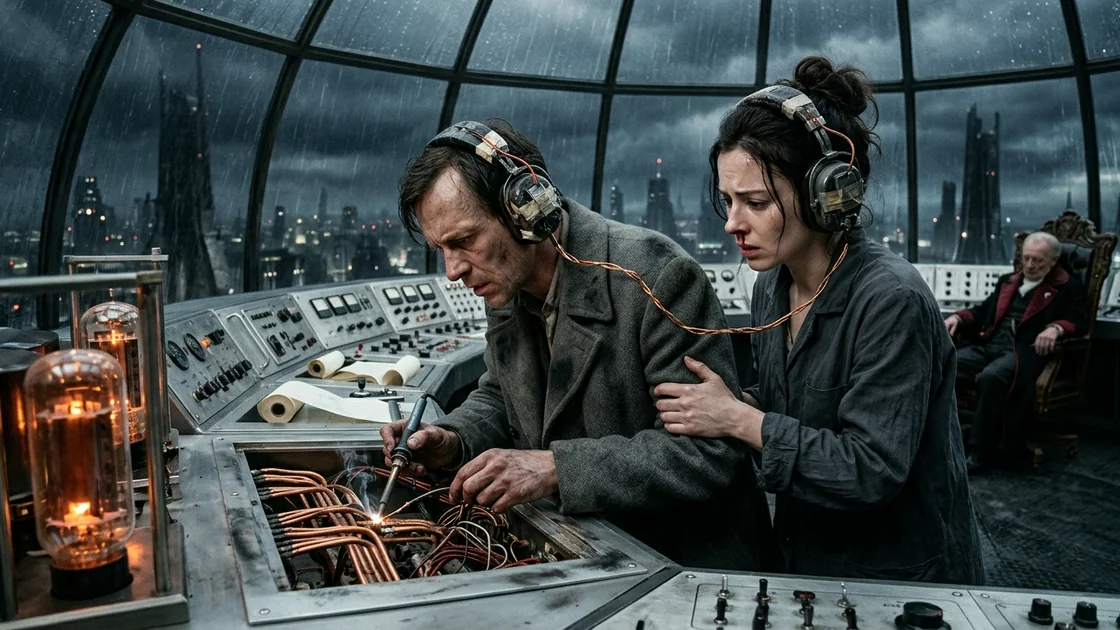
Arthur Pendelton is a quiet acoustic technician living in the hyper-efficient metropolis of New Vespera, a city where four million citizens live in perpetual, smiling compliance despite crumbling infrastructure and grueling labor conditions. Suffering from a persistent ringing in his ears, Arthur salvages military-grade signal processors from his municipal repair depot to build an experimental pair of active noise-canceling headphones. When he puts them on, the device does more than silence the rumble of the transit trains; its phase-inversion algorithm accidentally cancels out an imperceptible, city-wide psychoacoustic frequency known as the Concordance. Stripped of the hypnotic broadcast that suppresses human agitation and critical thought, Arthur sees New Vespera for what it truly is: a decaying, authoritarian labor camp disguised by collective delusion. Alongside Elena Vance, a municipal archivist whose natural resistance to the signal manifests as debilitating migraines, Arthur must evade the city's terrifyingly polite security forces, infiltrate the central broadcasting spire, and wire his phase-cancellation circuit directly into the master transmitter to wake the sleeping metropolis before an entire district is quietly liquidated.
Chapter 1: The Dead Spot
The soldering iron smelled of burnt pine rosin and oxidized tin, a sharp, localized odor that cut through the perpetually damp, boiled-cabbage miasma of Arthur Pendelton’s third-floor tenement. Outside his narrow casement window, the rain fell with the steady, unvarying cadence of static on a dead television channel. It had been raining since Tuesday, though if anyone on the street had asked Arthur, he would have smiled, inclined his head at the standard fifteen-degree angle of civic greeting, and remarked upon how refreshing the moisture was for the municipal lichen walls. Everyone said that. It was the pleasant thing to say, and in New Vespera, pleasantness was as fundamental as gravity.
Arthur adjusted the magnifying loupe strapped over his left eye and nudged a surface-mount capacitor into place with the tip of a pair of non-magnetic tweezers. His fingers were stained yellow at the tips from flux solvent, and a faint tremor worked its way through his wrist—not from nerves, for no one in Sector Seven had felt genuine anxiety in twelve years, but from simple physical exhaustion. He had worked a fourteen-hour shift at the Municipal Acoustic and Broadcast Maintenance Depot, cataloging burned-out public address amplifiers and re-coning weather-rotted loudspeakers pulled from the transit platforms.
He should have been asleep. The wall chronometer, a round, institutional face stamped with the interlocking gears of the Civic Directorate, read 02:14. At 05:30, the gentle chime would sound from the grille above his door, and he would rise, consume his four ounces of fortified grey oat-paste, and join the silent, smiling river of grey wool overcoats flowing toward the elevated rail.
Instead, he was awake because of the needle in his left ear.
It wasn't a real needle, of course. The clinic physician had assured him of that three months ago, shining a cold light into Arthur’s ear canal before patting him on the shoulder and prescribing a higher dose of compliance minerals in his water ration. Idiopathic somatic tinnitus, the doctor had called it, his own eyes glassy and serene beneath the fluorescent tubes. A minor phantom of the auditory nerve, Citizen Pendelton. Simply focus on the ambient harmony of the district, and the discord will resolve itself.
But it hadn't resolved. It was a tiny, high-pitched whine, hovering somewhere around fourteen kilohertz, coupled with a dull, throbbing pressure behind his mastoid bone, as though a gigantic, invisible thumb were pressing steadily against the base of his skull. The strange thing was that the ringing grew worse whenever he was near the great concrete Resonance Pylons that stood at every major intersection—tall, fluted pillars officially designated as atmospheric particulate scrubbers. When he descended into the sub-basement of the repair depot to fetch vintage vacuum tubes from the pre-Concordance vaults, where the ferro-concrete walls were six feet thick and lined with lead sheeting from the old civil defense days, the needle in his ear dulled to a tolerable itch. Up here, on the third floor, with a Pylon standing less than two hundred yards away across the wet cobblestones of Unity Plaza, it felt as though someone were drawing a violin bow across the raw fibers of his cerebral cortex.
"Just a phase misalignment," Arthur murmured to the empty room. His voice sounded flat, swallowed immediately by the acoustic foam tiles that the housing authority mandated on at least sixty percent of all interior residential walls. For domestic tranquility, the building code stated. A quiet home is a harmonious home.
On his workbench sat the carcass of an old pair of studio reference headphones—Sennheiser HD-series shells from thirty years ago, before private audio equipment was phased out in favor of communal listening posts. The plastic headband was cracked and bound with black electrical tape, and the original foam earpads had disintegrated into sticky black crumbs years ago, replaced now by thick, doughnut-shaped cushions Arthur had stitched together from salvaged lambskin leather and stuffed with high-density memory foam pulled from an orthopedic clinic’s dumpster.
Inside the oversized earcups, however, there was nothing vintage at all.
Three days earlier, a crate of crushed electronic scrap from the outer perimeter defense grid had arrived at the depot by mistake. Before the floor supervisor could reroute the manifest to the smelter, Arthur had pried open a corner of the crate and pocketed two components: a pair of micro-machined barium-titanate piezoelectric transducers and a fingernail-sized digital signal processing chip stamped with an obsolete military designation. The chip was a fast-Fourier-transform engine designed for submarine sonar arrays—built to identify, isolate, and invert complex acoustic signatures in real time with a latency of less than four microseconds.
Standard noise-canceling headphones—the kind issued to jackhammer operators and foundry workers—were clumsy things. They used cheap electret microphones to listen to outside noise, inverted the wave by a hundred and eighty degrees, and played it back through the speaker. Because the electronics were slow, they only worked on low, predictable drones between fifty and five hundred hertz. Anything below twenty hertz—the deep, visceral realm of infrasound—or anything above ten kilohertz slipped right past the filter.
Arthur’s circuit had no bandpass limiters. He had bypassed the safety filters entirely, wiring two ultra-sensitive bone-conduction contact mics and four wide-spectrum external condensers directly into the submarine DSP chip. Whatever vibration existed in the air of this room—from six hertz up to forty kilohertz—the chip would sample at two hundred thousand times a second, calculate the exact mathematical mirror image of the wave, and drive the heavy neodymium magnets in the earcups to smash that wave into absolute zero.
He touched the tip of the soldering iron to the final ground lead. A tiny silver bead formed, shiny and clean, before cooling into a matte satin finish.
Arthur switched off the iron, set it in its wire cradle, and rubbed his eyes. The room felt warm, thick, and fuzzy, like a blanket pulled over his head. Even through the pain of his tinnitus, he could feel the familiar, comforting tug of the city’s nighttime rhythm—a warm, syrupy lethargy in his limbs that told him everything was fine, that the Directorate was watching over the reservoirs, that his work at the depot was meaningful, and that four hours of sleep would be more than enough to leave him refreshed and grateful.
He picked up the headphones. They were heavy, weighing nearly two pounds with the lithium-polymer battery pack strapped to the left yoke and the exposed green fiberglass circuit board bolted to the right. Copper jumper wires looped over the top of the headband like exposed veins.
He slipped them over his head.
The thick lambskin pads sealed around his ears with a soft pneumatic sigh. Immediately, the passive isolation dropped the sound of the rain against the windowpane by twenty decibels. The world became muffled, underwater. The needle in his left ear seemed louder now, trapped inside his skull.
Arthur reached up with his right thumb and found the cold metal toggle switch protruding from the bottom of the right earcup.
He flipped it up.
There was a sharp pop as the capacitors charged, followed by a brief, terrifying sensation of falling—as if the floorboards beneath his stool had suddenly vanished and dropped him down an elevator shaft.
Arthur gasped, his hands flying to the edges of his workbench, knocking a tin of machine screws onto the linoleum.
The sound of the screws hitting the floor didn't reach his ears, because the DSP chip caught the transient spikes and crushed them instantly. In fact, there was no sound at all. Not the rain, not the hum of the refrigerator coil in the corner, not the distant rumble of the night-freight trams along the viaduct.
And then, about three seconds after the switch clicked, something else stopped.
It wasn't a sound he had been hearing. It was a weight he had been carrying since the day the Resonance Pylons were switched on twelve years ago.
Inside Arthur’s head, a great, invisible fist suddenly unclenched.
He froze, his knuckles white against the scarred wood of the bench. His breath came in a ragged, shallow wheeze. The high-pitched needle in his left ear vanished—snuffed out like a candle flame pinched between wet fingers. It hadn't been tinnitus at all. His auditory nerve hadn't been damaged; it had been screaming in protest against an external carrier wave that his conscious mind wasn't allowed to perceive.
And beneath that high-pitched whine, another layer peeled away: a massive, tectonic rumble so low in pitch that it bypassed the cochlea entirely and vibrated the fluid in his semicircular canals and the soft tissue of his brain. For over a decade, that sub-audible pressure had been oscillating at a precise, rhythmic interval, massaging his amygdala, dampening his prefrontal cortex, smoothing out every spike of anger, curiosity, grief, or dread before the chemical signals could even cross a synapse.
With the inverse wave pumping into his skull, the two forces met at his eardrums and annihilated each other.
Arthur sat up straight. His heart, which had beat at a steady, docile fifty-eight beats per minute for years, suddenly hammered against his ribs like a trapped bird. Adrenaline—hot, sour, and completely foreign—flooded his bloodstream.
He looked around his apartment.
He had lived in Unit 3B for eight years. Every morning he had looked at this room and thought it was cozy, efficient, and well-maintained.
Now, with the invisible hand removed from his brain, his eyes dilated, and the visual cortex began processing reality without the rosy, narcotic haze of the broadcast.
The room was a cage. It wasn't cozy; it was barely eight feet wide by ten feet long. The acoustic foam on the walls wasn't decorative gray geometry; it was rotting, mold-spotted polyurethane that smelled of damp rot and chemical fire retardant. The ceiling plaster had caved in above his narrow cot years ago, leaving raw, rusting steel lath exposed, dripping yellow condensation into a plastic bucket he had emptied a thousand times without ever wondering why the roof wasn't fixed.
His gaze dropped to the small enamel bowl sitting beside his hotplate, where his morning ration of oat-paste was soaking. It wasn't nutritious grey cereal. In the harsh, flickering glare of the single bare bulb hanging from the ceiling, he could see the fibrous husks of industrial sawdust mixed into the starch to give it bulk, speckled with the tiny black carapaces of grain weevils.
Arthur clapped a hand over his mouth as his stomach heaved. He stumbled back from the workbench, the heavy headphones clamping tightly to his temples, and lurched toward the narrow window.
He pressed his forehead against the cold, greasy glass and looked down into Unity Plaza.
The rain was still falling, black with coal soot from the district power plant. In the center of the square stood the Resonance Pylon—forty feet of poured concrete topped with a ring of radial horn emitters that looked like monstrous iron petals. It wasn't scrubbing the air. He could see the water streaming down its sides, vibrating in tiny, standing geometric ripples along the concrete surface—Chladni patterns formed by the immense acoustic energy pouring out of the horns. The whole tower was a loudspeaker. The streetlights, the water pipes beneath the pavement, the steel frames of the tenement buildings—they were all vibrating in sympathy, turning the entire metropolis into a resonant cavity.
Down on the slick cobblestones, the 02:30 sanitation shift was marching toward the incinerator chutes. There were twenty men and women in yellow oilskins. They moved in two neat columns, their boots striking the stones in an unhurried, swaying rhythm that matched the subtle pulsing of the puddles around the Pylon. Even from three stories up, under the sodium streetlights, Arthur could see their faces.
Their cheeks were hollow, the skin stretched tight and gray over their cheekbones. One man near the back had a deep, ragged gash across his forehead where a piece of masonry must have struck him; blood mixed with rainwater ran down into his collar, completely untended.
And every single one of them was smiling.
It wasn't a human smile. It was a slack, muscular relaxation of the lower face coupled with a blind, serene upward tilt of the corners of the mouth—the exact expression Arthur had worn four minutes ago while soldering his own salvation.
Arthur reached up, his hand shaking violently, and pulled the right earcup half an inch away from his head, breaking the seal.
Instantly, the air hit him like a physical blow. It didn't sound like noise; it felt like warm oil pouring into his ear canal. A low, velvet pressure squeezed his temples. The terror in his chest began to dissolve into a strange, floating embarrassment. Why was he standing by the window like this? It was late. He should lie down. The sanitation workers looked so dedicated out there in the rain. Tomorrow would be a productive day.
With a strangled cry, Arthur slammed the earcup back against his skull.
The seal locked. The phase-inversion circuit caught the wave within four microseconds and killed it.
The warm oil vanished, leaving him shivering, drenched in cold sweat, his heart pounding in the terrifying, crystal-clear silence of his own mind.
Chapter 2: Dissonance in the Crowd
By 05:30, when the wall grille emitted its soft, three-note major chord to wake the building, Arthur had not slept a second.
He had spent the remaining hours of the night in a frantic fever of modification. If he walked out into the streets wearing a two-pound contraption with green circuit boards and copper wires bristling from the sides, even the sedated minds of his neighbors might register an anomaly, and anomalies were reported to the Wardens of Concord.
Working with a razor blade, a spool of black nylon thread, and the plastic casing of a standard-issue municipal ear-defender—the kind worn by depot technicians when testing high-decibel sirens—he had transplanted the submarine DSP chip, the battery, and the transducers into a dull, regulation-gray shell. It was bulkier than normal, and the wire connecting the two earcups had to be tucked inside the collar of his wool coat, running down to a control box inside his breast pocket, but from five feet away, it looked like standard protective gear.
When the doors of all twelve apartments on the third floor opened simultaneously at 05:52, Arthur stepped out into the corridor in rhythm with everyone else.
Inside his headphones, he had dialed in a slight adjustment. Total silence was dangerous; if someone spoke to him or a tram horn sounded, he needed to hear it. Using a small potentiometer wired into the circuit board in his pocket, he had allowed a narrow band of human speech frequencies—between three hundred and three thousand hertz—to pass through at reduced volume, while keeping the phase-cancellation locked at maximum efficiency on the infrasonic bottom end and the ultrasonic top end.
The result was that his neighbors sounded as if they were speaking through an old telephone receiver in an empty cathedral, stripped of all warmth and presence.
"Pleasant moisture this morning, Citizen Pendelton," said Mrs. Gable from Unit 3A as she locked her door. She was seventy years old, her spine curved like a question mark from forty years at the textile looms, her fingers swollen with untreated arthritis.
Arthur forced his face to go slack. He lifted the corners of his mouth, mimicking the muscle memory that had governed his face for twelve years, and inclined his head fifteen degrees.
"Very refreshing for the lichen, Citizen Gable," he said. His own voice sounded loud inside his skull through bone conduction, trembling slightly at the edges.
Mrs. Gable didn't notice. Her eyes—pale blue, with the thick yellow rings of cholesterol deposits around the irises—looked right through him, fixed on the back of the man ahead of her on the stairs. Together, the building emptied downward, boots shuffling on the worn concrete steps in a slow, syncopated meter: step, pause, step, pause.
It was sixty beats per minute. One hertz. The sub-harmonic beat frequency of the Pylons.
Arthur matched their pace, forcing himself not to hurry, though every nerve in his body screamed at him to bolt down the stairwell and run until the concrete ended. The smell in the stairwell nearly gagged him—unwashed wool, sour sweat, decaying teeth, and the sweet, sickly scent of the bromide additives in the municipal water supply. Yesterday, he hadn't smelled it at all. The brain, under the influence of the Concordance, simply edited out unpleasant sensory data before it reached conscious awareness.
They spilled out into Unity Plaza.
In the gray dawn light, New Vespera looked like an autopsy of a city.
Four thousand people were crossing the plaza toward the Sector Seven Elevated Station. None of them spoke. None of them carried umbrellas, though the cold rain soaked through their shoddy coats and plastered their hair to their scalps. They walked in dense, fluid lanes that never collided, parting around the base of the great concrete Resonance Pylon like water flowing around a boulder.
Arthur looked up at the towering facades of the tenement blocks surrounding the square. Huge banners of gray reinforced vinyl hung between the windows, printed in faded white block letters.
Yesterday, passing beneath them, Arthur had felt a warm swell of civic pride whenever his eyes brushed the text. Now, he actually read the words.
THERE IS NO GRIEF IN FUNCTION. A QUIET MIND IS THE HIGHEST CITIZENSHIP. REPORT DISCORD. EMBRACE THE HUM. YOUR FATIGUE IS AN ILLUSION OF ISOLATION.
They weren't even clever. There was no poetry, no persuasive rhetoric, no attempt to disguise the message. The Directorate didn't need propaganda; the banners were merely textual anchors for the hypnotic suggestion carried by the acoustic wave.
Ahead of him, near the steps of the transit station, a man in the next lane stumbled.
He was middle-aged, gaunt, wearing the blue armbands of an electrical grid lineman. His boot caught on a broken slab of cobblestone, and he went down hard on his knees. A sharp crack echoed—the sound of his kneecap splitting against the granite.
Arthur instinctively took half a step to the left, his hands coming out of his pockets to help the man up.
Then he stopped, his blood turning to ice.
Nobody else had stopped. The crowd didn't gasp; no one looked down. The river of gray coats simply adjusted its flow by six inches to avoid stepping on the lineman’s fingers and kept walking up the station stairs.
Worse was the lineman himself.
The man stayed on his knees for three seconds. His face was white with shock, sweat beading instantly on his upper lip as his nervous system registered the shattered bone. A low whimper escaped his throat. Then, as the invisible waves from the Pylon thirty yards away washed over him, Arthur watched the pain literally get erased from the man’s face. The furrowed brow smoothed out. The clenched jaw relaxed. The corners of his mouth drifted upward into that gentle, vacant smile.
Slowly, mechanically, the lineman pushed himself up onto his good leg, dragged his shattered right leg behind him at a gruesome angle, and rejoined the line moving up the stairs, leaving smears of bright blood on the wet concrete with every step.
Arthur stood frozen at the bottom of the stairs. His breath came in ragged gasps that fogged the rain in front of his face. He had forgotten to walk. He had become a stationary rock in the middle of the stream.
And the stream noticed.
It started with a woman three feet to his right. She didn't stop walking, but as she passed him, her head swiveled on her neck with unnatural smoothness, her eyes locking onto his face. Then a man behind her turned his head. Then three people on the steps above.
Within five seconds, thirty people had slowed their pace. They didn't speak, and their gentle smiles never wavered, but their heads all tilted at the exact same angle, forty pairs of dilated, glassy eyes fixing on Arthur’s tense shoulders, his widened eyes, his bare teeth.
A low, collective murmur rippled through the crowd—not words, just a soft, questioning hum in the backs of their throats, pitched at the exact fundamental frequency of the plaza’s Pylon. It was the sound of an organism identifying a foreign body.
At the top of the stairs, beneath the corrugated iron roof of the platform, stood two Wardens of Concord.
They wore long coats of pristine, water-repellent white rubber and broad-brimmed helmets with dark, mirrored visors that covered their entire faces. Slung across their chests were heavy, brass-nozzled cylinders connected by braided hoses to battery packs on their backs—Acoustic Pacifiers, capable of firing a tight beam of directional ultrasound that could liquefy a man’s inner ear balance or drop him into a catatonic stupor at fifty yards.
One of the Wardens turned his mirrored visor down toward the disturbance at the foot of the stairs.
Arthur forced his lungs to stop heaving. He dropped his shoulders three inches. He let his jaw go slack, forced the vacant smile onto his mouth, and tilted his head fifteen degrees toward the nearest woman, raising one hand to tap the gray plastic shell of his headphones.
"Testing the depot isolation seals," Arthur said aloud, making his voice flat, rhythmic, and dreamy. "The moisture is very refreshing for the lichen."
For two agonizing seconds, the woman stared at him. The Warden at the top of the stairs took a single step down.
Then, like a ripple on a pond smoothing out after a stone sinks to the bottom, the tension dissolved. The woman’s head swiveled back toward the stairs. The thirty other faces turned away in unison. The Warden paused, tilted his mirrored helmet slightly, and resumed his stationary post.
Arthur fell back into the sixty-beat-per-minute shuffle, climbing the stairs right behind the bleeding lineman, his heart hammering so violently against the small circuit box in his breast pocket that he was terrified the solder joints would crack.
Chapter 3: The Shape of the Wave
The Municipal Acoustic and Broadcast Maintenance Depot occupied the cavernous shell of what had once been New Vespera’s central symphony hall.
Forty years ago, before the Resource Wars and the subsequent establishment of the Directorate, three thousand people had sat beneath the gilded plaster domes to listen to Mahler and Beethoven. Now, the velvet seats had been ripped out and burned for winter fuel decades ago. The sloped orchestra floor was leveled with poured slag concrete and divided into rows of galvanized steel workbenches lit by hanging sodium-vapor lamps. Where the great pipe organ had once towered above the stage, there was only a wall of rusting corrugated iron and a massive digital tote board displaying the daily quota of repaired loudspeaker units.
Arthur sat at Bench 14 in the far rear corner, tucked beneath the overhang of the old dress circle balcony. It was the best spot in the building for a man who wanted to hide. Stacks of dented aluminum megaphone horns and crates of moldering papier-mâché speaker cones formed a three-sided barricade around his station.
He kept his modified headphones on. No one questioned it; half the technicians on the floor wore ear defenders to block the shriek of feedback as they tested repaired amplifier boards down the line.
With trembling fingers, Arthur disconnected the secondary output lead from his pocket circuit and clipped it to the alligator probes of his benchtop Tektronix oscilloscope. It was an old cathode-ray model with a round green phosphor screen, accurate and purely analog—meaning it wasn't connected to the depot’s central diagnostic network.
He flipped the scope on and adjusted the sweep rate.
At first, the glowing green line showed only the ambient chatter of the workshop: the sixty-hertz hum of the building’s mains power, the sharp spikes of pneumatic wrenches, and the occasional sine-wave test tone from Bench 8.
Then Arthur switched the input to read the raw, isolated cancellation profile that his submarine DSP chip was actively fighting.
The green line twisted itself into a complex, terrifying knot.
Arthur leaned in, adjusting the horizontal time-base knob until the wave resolved into two distinct components.
"My God," he whispered, his breath fogging the curved glass of the cathode tube.
It wasn't a simple tone. It was a masterpiece of weaponized psychoacoustics.
The foundation of the signal was a massive, continuous sine wave at precisely 18.98 hertz, running at an amplitude of nearly a hundred and ten decibels. At that frequency, the human ear couldn't hear it as sound; the basilar membrane simply didn't respond that low. Instead, 18.98 hertz was the exact resonant frequency of the human eyeball and the vestibular system. Left raw, an infrasonic wave that powerful would cause terrifying visual hallucinations, vertigo, and intense, nameless dread.
But it wasn't left raw. Braided into the infrasonic carrier was a secondary, ultra-high-frequency signal pulsing between 14.2 and 14.6 kilohertz, modulated using a mathematical pattern that Arthur recognized from old biomedical engineering textbooks he had salvaged from the pulp mills years ago. It was an acoustic heterodyne—two slightly offset frequencies designed to intersect inside the dense bone of the human cranium and create a secondary "phantom" beat frequency directly inside the neural tissue.
The beat frequency was cycling between 4.5 and 6 hertz. Theta waves. The exact electrical rhythm of a human brain in deep hypnotic trance or twilight sleep.
The low wave rattled the primal fear centers of the amygdala until they were exhausted and pliable, while the high-frequency heterodyne locked the cerebral cortex into a continuous loop of waking sleep. Together, they functioned like an invisible frontal lobotomy that lasted only as long as the speakers were turned on.
Arthur reached over and pulled a repair manifest from the clipboard hanging on his rack. For eight years, he had signed off on thousands of these sheets without ever synthesizing what the numbers meant.
Now, he flipped back through the carbon copies in his drawer, his eyes darting across the columns.
Pylon Sector 7-Alpha: Output 4,000 Watts. Transducer array: 12x Sub-Bass Rotary Woofer, 24x Piezo Horn. Subway Line 4 Leaky Coax: Continuous impedance check. Residential Wall Baffling Inspection: Sector 7.
The foam on his apartment walls. He stared at the manifest as the realization clicked into place with sickening clarity.
The polyurethane foam mandated in every home and workplace wasn't there to keep the apartments quiet for the citizens. It was calculated to absorb mid-range frequencies—between five hundred and four thousand hertz—to prevent the natural echoes of human activity from creating phase interference with the 14-kilohertz heterodyne signal! The entire architecture of New Vespera—the spacing of the buildings, the angle of the concrete walls in the plazas, the foam in the bedrooms, the vents above the doors—was a single, integrated acoustic wave-guide.
And then he noticed the red stamp at the bottom of the weekly schedule sheet pinned to his partition.
NOTICE TO ALL DEPOT PERSONNEL: SECTOR 9 TRANSMITTER OVERHAUL. Commencing Friday 24:00, Sector 9 Resonance Pylons will transition to Profile Omega-Zero (18.98 Hz Unmodulated / High Amplitude) for six hours prior to Civic Reclamation and Infrastructure Clearing.
Arthur stared at the words Profile Omega-Zero.
Unmodulated. High amplitude.
He picked up a scratchpad and a pencil, his hand shaking so badly the lead snapped twice as he calculated the acoustic pressure of the Sector 9 rotary woofers running at maximum excursion without the soothing theta-wave modulation.
At a hundred and forty decibels of pure infrasound, coupled with the resonant cavity of the concrete tenement blocks, the wave wouldn't put people to sleep. It would vibrate their internal organs at their natural resonant frequencies. Within twenty minutes, it would induce massive pulmonary hemorrhage and cardiac arrest across a twelve-block radius. Everyone in Sector Nine—some eighty thousand people, mostly elderly loom workers and chronic invalids transferred there from other districts—would die in their beds without firing a single shot or damaging a single brick of the buildings. And the next morning, the sanitation crews in their yellow oilskins would march in, smiling serenely, and cart the bodies to the incinerators under the guise of "Infrastructure Clearing."
Friday at midnight. Today was Thursday. That was thirty-eight hours away.
A shadow fell across the green glow of the oscilloscope.
Arthur flinched violently, his hand slamming down over the scratchpad as he reached with his other hand to flick the oscilloscope’s input switch back to the dummy load test tone.
He looked up, forcing the slack, pleasant mask back onto his face, though his pulse was roaring in his ears.
Standing at the entrance to his cubicle was a woman in the gray smock of the Central Archives division, clutching a stack of punched-tape reels and magnetic diagnostic cartridges against her chest.
Chapter 4: The Girl with the Migraines
Her name was Elena Vance. She came down from the third floor of the administration wing every Thursday morning to collect the calibration logs for the city’s public address sectors.
Arthur had seen her a hundred times before, though until this morning he had only registered her as a vague, pleasant blur who smelled faintly of peppermint oil and aspirin powder. Now, looking at her with clear eyes, he saw someone who looked as if she were being slowly crushed under a hydraulic press.
She was perhaps thirty, with dark hair pulled back into a severe, regulation bun that had begun to unravel at the nape of her neck. Unlike the other clerks, whose faces were smooth and slack with the serene idiocy of the Concordance, Elena’s face was taut with agony. Deep vertical creases were carved between her eyebrows. The skin beneath her dark eyes was the color of a fresh bruise, and her left eyelid twitched in a fast, erratic spasm.
Most telling of all, she wasn't smiling. Her lips were pressed into a thin, bloodless line, and she was leaning heavily against the steel upright of Arthur’s shelving rack, her knuckles white around the reels of punched tape.
"Calibration logs," she whispered. Her voice didn't have the dreamy, sixty-beat-per-minute lilt of the street crowds. It was tight, clipped, and breathless, like someone trying to speak through a broken rib. "Sector Seven through Ten. Please, Citizen Pendelton, if you have them ready."
Arthur didn't reach for the clipboard immediately. He stared at her left hand, which had crept up from the tape reels to press two fingers hard against the hollow behind her left ear—the exact spot over the mastoid bone where Arthur’s own phantom needle had throbbed for three months before he built the headphones.
"Your head hurts," Arthur said quietly.
Elena froze. The twitch in her eyelid stopped as her dark eyes snapped toward his face. For a fraction of a second, something flickered behind her pupils—a brief, terrified spark of animal panic. Instantly, she tried to force her mouth upward into the civic smile, though it looked more like a grimace of torture on her pale face.
"Fatigue is an illusion of isolation," she recited mechanically, though a bead of sweat rolled from her hairline down her temple. "The clinic physician has adjusted my bromide ration. The moisture today is very—"
"Stop," Arthur said.
He glanced over her shoulder. Down the main aisle of the depot, thirty yards away, the floor supervisor was standing by Bench 4, smiling vacantly at a crate of vacuum tubes while a technician methodically soldered the same joint over and over again. Nobody was looking toward the dark overhang beneath the dress circle balcony.
Arthur looked back at Elena. He noticed something else now: a faint, shiny scar curving behind her right earlobe, disappearing into her hairline. A childhood mastoidectomy, perhaps, or an old inner-ear surgery from before the Concordance. Whatever it was, the bone structure of her skull or the damage to her eighth cranial nerve was asymmetrical.
The heterodyne signal required two intact, balanced ears to create the phantom four-hertz theta wave inside the brain. Because of her damaged ear, the two frequencies weren't intersecting properly in her cortex. She was getting hit with the raw eighteen-hertz infrasound and the fourteen-kilohertz scream without the narcotic sedative effect of the beat frequency. She wasn't fully awake—the sheer physical pressure of the sound was keeping her confused, nauseated, and half-paralyzed with chronic cluster migraines—but the hypnosis wasn't taking hold.
"Step inside the rack," Arthur murmured, gesturing toward the narrow gap between the crates of aluminum horns and his workbench. "Drop a reel on the floor as if you spilled them."
Elena stared at him, her breathing shallow. "Citizen Pendelton, I don't—"
"If you go back upstairs to the clinic with your eyes twitching like that, the physician won't increase your bromide," Arthur said, his voice dropping to a low, urgent hiss that couldn't carry past the acoustic baffles of his booth. "He'll sign a transfer slip to Sector Nine. And you're an archivist. You know what’s scheduled for Sector Nine tomorrow night."
The color drained completely from Elena’s face, leaving her skin the shade of tallow. Her knees buckled slightly, and the top reel of punched paper tape slipped from her fingers for real, hitting the concrete floor and unspooling in a tangled serpentine ribbon around Arthur’s boots.
She dropped to her knees inside the shelter of the cubicle to gather the tape, hidden from the main floor by the stacked crates.
Arthur knelt beside her, pretending to help rewind the perforated paper strip. His heart was hammering against his ribs. If he was wrong—if the conditioning was strong enough to make her scream for a Warden the moment the signal stopped—he was dead within three minutes.
"Don't make a sound," Arthur whispered, reaching up to his own head. "Whatever happens when I put these on you, keep your mouth shut and keep winding the tape. Look at the floor. Nod if you understand."
Elena knelt on the cold slag concrete, shivering violently as another wave of nausea from the depot’s overhead repeaters rolled through her skull. She gave a tiny, jerking nod.
Arthur braced himself and pulled the headphones off his own head.
The moment the lambskin seals broke, the invisible fist slammed back into his skull.
Arthur bit the inside of his cheek until he tasted hot copper, using the sharp physical pain to fight off the warm, syrupy lethargy that immediately tried to cloud his vision. The high-pitched needle stabbed back into his left ear, and the low, rhythmic throb of the building’s foundation began tugging at his thoughts, whispering that he should sit down, that he should smile, that this woman on the floor was a stranger and everything was harmonious.
Shaking, his vision blurring at the edges, he reached across the narrow space and slipped the heavy gray earcups over Elena’s head, pressing the lambskin pads firmly over her ears until they sealed.
He watched her face.
For one second, nothing happened. She knelt there with her eyes squeezed shut, braced for pain.
Then the submarine DSP chip locked onto the depot’s acoustic profile and inverted it.
Elena’s eyes flew open.
It was like watching someone who had been drowning under dark ice suddenly break through into the open air. Her mouth opened in a silent, wide-eyed gasp. The violent, fluttering twitch in her left eyelid vanished instantly. The deep, agonizing furrow between her eyebrows smoothed out—not into the slack, drugged stupor of the citizens outside, but into the stunned, breathless shock of sudden relief.
Her hands abandoned the paper tape and flew up to grip the gray plastic shells over her ears, pressing them tighter against her skull as if she were terrified they might float away.
Tears—real, hot, human tears, something Arthur hadn't seen in twelve years—welled up in her dark eyes and spilled over her lower lashes, cutting clean tracks through the gray dust on her cheeks.
"It stopped," she breathed, her voice barely a rustle of air. "Oh, God in heaven, the screaming stopped."
She looked up from the concrete floor and met Arthur’s eyes. For the first time, there was no haze, no distance, no calculation. She looked at him, and then she looked past his shoulder at the main floor of the depot—at the forty men and women standing under the yellow sodium lamps, swaying slightly at sixty beats per minute, smiling at their soldering irons as they built the very speakers that kept them enslaved.
Elena clapped a hand over her mouth to stifle a sob of pure horror.
Arthur, feeling his own mind slipping deeper into the warm, gray fog with every second he remained unprotected, tapped his temple urgently and pointed to the workbench above them.
"Thirty seconds," he whispered, slurring slightly as the theta wave pulled at his tongue. "Help me wire the second set, or I’m going under."
Chapter 5: Two Awake in a Sleeping City
It took twenty minutes of frantic, hidden labor behind the barricade of megaphone crates, with Elena handing Arthur tools while wearing his headset and dictating his own circuit diagrams back to him whenever his unprotected brain began to drift into a docile stupor.
He didn't have another submarine sonar chip—that had been a miracle of military scrap—but he realized now that he didn't need a full-spectrum dynamic processor once he knew the exact mathematical shape of the wave. The Directorate’s broadcast never changed its frequencies; it couldn't, because the physical dimensions of the concrete Resonance Pylons and the city’s buildings were tuned specifically to 18.98 hertz and the 14.4-kilohertz heterodyne.
Using four high-speed operational amplifiers pulled from a bin of intercepted radar components, a quartz crystal oscillator, and a pair of salvaged bone-conduction drivers fitted into standard rubber earplugs, Arthur built a hardwired analog phase-inverter tuned specifically to the three lethal frequencies of the Concordance.
When he shoved the rubber plugs into his ears, pulled a pair of passive ear-defenders over them, and connected the nine-volt battery pack inside his smock pocket, the fog tore apart once more.
He slumped back against the steel shelving, gasping for air, wiping the cold sweat from his forehead with his sleeve. Across the narrow gap, Elena sat on an upturned crate, still wearing the original prototype headphones, her knees pulled up to her chest.
"How long?" she whispered. The tears had dried on her cheeks, replaced by a fierce, trembling clarity. "How long have you had this?"
"Since two-fifteen this morning," Arthur said, checking the green line on his oscilloscope to ensure both circuits were holding lock. "Wait—you said earlier that the screaming stopped. You could hear it?"
Elena touched the small scar behind her right ear through the lambskin pad. "My father was a surgeon before the Reconstruction. When I was twelve, I had a cholesteatoma—a growth in my middle ear. He removed the ossicles on the right side and replaced the eardrum with a cartilage graft. I’m seventy percent deaf in that ear above eight kilohertz."
Arthur nodded grimly. "So the binaural beat couldn't form in your auditory cortex. Your left ear was taking the full fourteen-kilohertz carrier wave raw, while your whole body was getting hammered by the infrasound."
"For twelve years," Elena said, her voice cracking with a sudden, terrifying rage that made her hands shake against her knees. "Twelve years I thought I was losing my mind. Everyone around me was so peaceful, so happy. My mother, my brother... when the Pylons went live after the riots of '84, they just stopped crying overnight. My brother had been shot in the lung by the Peacekeepers three days earlier, and he just sat at the kitchen table smiling while he coughed up blood until he died. And I couldn't smile. The pain behind my eyes was so bad I used to bash my forehead against the radiator pipe just to feel a different kind of hurt."
She looked down at her gray archivist smock, her fingers clawing at the cheap synthetic fabric. "The clinic doctors told me I had Congenital Civic Dysphoria. They told me if I worked hard enough in the Archives and took the lithium-bromide salts, my brain would eventually harmonize with the district. And I believed them, Arthur! Half the time I was so sick and drugged I wanted to harmonize!"
"You weren't entirely free of it," Arthur said gently. "The eighteen-hertz wave works on the spine and the vagus nerve even if you're completely deaf. It keeps you compliant, keeps you afraid to step out of line, makes it nearly impossible to connect two rebellious thoughts together. Until you cancel the physical vibration at the mastoid bone, you're still half-under."
Elena looked up at the red-stamped notice pinned to Arthur’s partition. Her eyes widened as she read the technical specifications he had scribbled on the scratchpad underneath.
"Profile Omega-Zero," she whispered. "That’s what the code means."
"You've seen it upstairs?"
"Every month for the last year," Elena said, her voice dropping into a horrified cadence. "In the Archives, we process the Resource Optimization manifests. First it was Sector Twelve—the old docklands. Then Sector Eleven. On the paperwork, it’s called 'Acoustic Remediation and Population Re-allocation.' We file forty thousand change-of-address cards at a time, routing them to the 'Agri-Collectives' in the northern valleys. Only there aren't any return manifests from the northern valleys. No food shipments coming back, no replacement tool orders, no mail."
"Because the northern valleys are barren slag heaps," Arthur said coldly. "Nobody leaves the city. The city is automated to wind itself down."
"Why?" Elena gripped his wrist, her fingers freezing cold. "Why kill them? They work! They don't strike, they don't complain, they eat sawdust and wear rags! Why liquidate Sector Nine?"
"Look at the city, Elena," Arthur said, gesturing toward the high, grime-crusted windows of the symphony hall. "Look at the depot. We aren't manufacturing new components here. For eight years I’ve been rewinding the same copper coils and gluing patches onto rotten paper cones. The coal mines in the basin are running dry. The hydroponic vats in Sector Three have been infected with black blight for two years because nobody has the creative spark or cognitive initiative required to synthesize a new fungicide. A hypnotized population is peaceful, yes—they don't riot—but they can't innovate. They can't solve unscripted problems. They just repeat the last routine programmed into the civic schedule until the machines break."
Elena stared at him as the terrible logic of it settled over the booth.
"The resources are shrinking," she whispered. "The power grid is losing capacity every winter. And instead of waking people up to fix the infrastructure..."
"The Directorate is reducing the biological load to match the declining power output," Arthur finished. "Every time a geothermal turbine fails or a coal seam runs out, they switch another residential sector to Omega-Zero for six hours, clear out eighty thousand mouths to feed, and shut off the heat and electricity to that grid. They’ll keep pruning the city block by block until there’s only enough power left to run the Central Spire and the estates in the High Ward."
"My mother lives in Sector Nine," Elena said. She stood up so fast the heavy headphones nearly slipped from her ears; she caught them with both hands, her chest heaving. "Room 412, the Mercer Convalescent Block. She’s sixty-four. They moved her there six months ago when her eyesight failed at the sorting tables."
Arthur stood up beside her, glancing cautiously over the top of the megaphone crates.
He froze.
At the far end of the former symphony hall, the double brass doors leading to the administrative lobby had just swung open.
Four men had stepped onto the concrete floor. Two of them wore the white rubber coats and mirrored visors of the Wardens of Concord, their brass Acoustic Pacifiers unclipped and held at port-arms across their chests. Between them walked two men in clean, charcoal-gray suits carrying a portable cart mounted with a directional parabolic dish and a rack of glowing Nixie-tube meters.
Auditors from the Ministry of Acoustic Hygiene.
And the parabolic dish was slowly sweeping across the workbenches, measuring the reflected impedance and bio-acoustic resonance of the workers on the floor.
"Down," Arthur breathed, grabbing the front of Elena’s smock and pulling her back behind the crates.
"What are they doing?" Elena whispered, terrified.
"Every citizen under the Concordance has a specific physiological signature," Arthur said, his mind racing as he watched the reflection of the Auditors' cart in the polished aluminum horn of a megaphone stacked on the top shelf. "Heart rate locked at sixty beats per minute, galvanized skin response near zero, cranial micro-tremors synchronized to the Pylon phase. More than that—our headphones aren't just blocking the sound. They're actively broadcasting an inverse wave to cancel it out. To a directional microphone that sensitive, our booth looks like an acoustic black hole."
Across the floor, the parabolic dish rotated thirty degrees toward the rear corner beneath the dress circle overhang.
On the Auditors' cart, a row of amber Nixie tubes suddenly flashed bright red, and a small piezoelectric buzzer gave a polite, two-tone chirp.
One of the charcoal-suited men pointed a gloved finger directly at Bench 14.
Chapter 6: The Harmonizers
"Don't run," Arthur hissed into Elena’s ear as the two Wardens detached themselves from the cart and began marching down the central aisle at a brisk, mechanical pace. "If we run on the open floor, they'll sweep us with the Pacifiers at forty yards. Those canons put out a hundred and sixty decibels at thirty kilohertz—our circuits will clip and overload instantly, and the shockwave will rupture our eardrums."
"There’s nowhere to go!" Elena looked wildly around the cramped corner. Behind them was the solid brick load-bearing wall of the old concert hall; to their left, a ten-foot drop into the orchestra pit, which had been filled with scrap iron and broken transformer cores.
"Not on this level," Arthur said.
He dropped to his stomach and shoved aside a heavy wooden crate of rusted iron bell-housings underneath his workbench. Beneath it, half-covered in decades of grease and iron filings, was a square cast-iron trapdoor set into the original timber staging that the poured concrete hadn't quite reached—an access hatch to the old HVAC plenum and organ-blower tunnels under the hall.
Arthur hooked his fingers under the recessed iron ring and hauled upward. For a terrible second, the rusted hinges refused to yield, groaning under fifty years of corrosion.
Down the aisle, the rhythmic clack-clack-clack of the Wardens' steel-heeled boots was less than forty feet away. The workers at Benches 10, 11, and 12 didn't even look up from their soldering irons as the white rubber coats brushed past their elbows.
With a sharp crack of breaking rust, the hatch swung open, revealing a vertical iron ladder dropping into pitch darkness and a blast of freezing, mold-scented air.
"Go!" Arthur shoved Elena toward the hole. "Hold onto the battery pack in your pocket—if the wire snags and pulls loose, you won't even know why you stopped climbing!"
Elena didn't hesitate. She swung her legs into the shaft, clutching the spare battery box against her ribs with one hand while sliding down the rusted rungs with the other.
Before following her, Arthur reached up onto his workbench. He didn't grab his notes or the oscilloscope. Instead, he grabbed a three-hundred-watt municipal siren driver unit that he had been testing that morning, twisted two bare jumper wires from its terminals directly into the output stage of a benchtop signal generator, and cranked the generator’s frequency dial all the way to the left—18.98 hertz—while flipping the phase switch to 180-degree inversion.
He aimed the heavy horn of the siren driver straight at the gap between the megaphone crates, lowered himself into the floor hatch, and pulled the iron lid down to a two-inch crack just as the two Wardens rounded the corner of Bench 14.
Through the slit in the floor, Arthur saw the boots stop six feet away.
"Citizen Pendelton," the lead Warden’s voice came through his vocoder grille—warm, melodious, and utterly devoid of inflection. "A localized dissonance has been detected at your station. Please step into the aisle and remove your protective equipment so that your harmony may be restored."
Arthur reached one hand back up through the crack and slammed the master power toggle on his benchtop amplifier to FULL.
The three-hundred-watt siren driver didn't make a sound that a human ear could register as a pitch. Instead, it fired a tight, sixty-degree cone of high-amplitude phase-inverted infrasound straight into the faces of the two Wardens and the two Auditors standing behind them.
Inside that narrow cone, the city’s broadcast didn't just drop to zero; it violently oscillated as the massive, uncalibrated wave smashed against the depot’s overhead repeaters, creating a chaotic standing wave of pure acoustic turbulence.
Through the gap in the hatch, Arthur watched the four men freeze.
The two Auditors in their gray suits weren't wearing helmets. As the Concordance wave was ripped out of their skulls in a fraction of a second, reinforced by a chaotic backlash of raw low-frequency pressure, their knees buckled simultaneously.
One of the Auditors tore at his collar, his eyes bulging in sudden, incomprehensible terror as twelve years of suppressed sensory reality crashed into his unshielded cortex all at once. He opened his mouth and let out a raw, animal scream—the first genuine scream heard inside the depot in over a decade. The second Auditor doubled over and vomited onto the polished glass of his own Nixie-tube cart.
Even the two Wardens, partially insulated by their heavy helmets, staggered backward as their inner-ear equilibrium was scrambled by the localized phase collision. One of them dropped his brass Pacifier cannon, which discharged wildly into the ceiling, showering the workbench with pulverized plaster and sparks from a shattered sodium lamp.
Along Benches 12 and 13, six technicians caught in the fringe of the siren’s reflection suddenly stopped soldering. They blinked, dropped their tools, and stared at their own scarred, burned hands in dawning, horrified confusion.
Arthur didn't stay to watch the bench amplifier’s tubes blow out. He dropped the cast-iron hatch shut, threw the rusted slide-bolt underneath, and slid down the iron ladder into the dark until his boots splashed into three inches of black, stagnant water.
Chapter 7: The Belly of the Bell
A yellow beam of light cut through the darkness as Arthur hit the bottom. Elena was standing two yards away in a brick-lined vaulted tunnel, holding a hand-cranked dynamo flashlight she had snatched from the emergency bracket at the base of the ladder.
She gave the crank two short, quiet squeezes—just enough to keep the filament glowing dull orange.
"What did you do up there?" she whispered, her eyes wide under the heavy gray headphones. Above their heads, muffled by four feet of earth and slag concrete, they could hear the dull thuds of running boots and the high-pitched whine of Pacifier discharges as the remaining depot guards pacified the workers who had been accidentally awakened by Arthur’s blast.
"I bought us five minutes and gave me an idea," Arthur said, pulling his coat tight and checking the lead wires of his earplugs. "Which way does this culvert run?"
Elena gestured down the curving brick tunnel where the water flowed in a sluggish trickle. "I know the pre-Concordance blueprints from the municipal property vaults. This isn't a storm drain; it’s the old pneumatic parcel and steam-heating conduit that linked the cultural district to the civic center. It runs thirty feet below street level all the way to the foundation of the Grand Spire."
They began moving down the tunnel at a crouch, splashing through the oily water.
Every fifty yards, thick black coaxial cables—three inches in diameter and armored in braided steel—ran along the ceiling of the brick arch, strapped to iron brackets. Even down here, thirty feet beneath the cobblestones, the walls were humming. When Arthur brushed his bare knuckles against the wet brick, he could feel the faint, sickening nineteen-hertz vibration trembling through the mortar.
"Leaky feeder cables," Arthur muttered, shining his own pocket penlight at the ceiling. "They piped the signal into the sewers and the steam tunnels so nobody could escape it by going underground."
After twenty minutes of rapid, silent marching through the labyrinth of crumbling brick, the narrow conduit suddenly opened out into an immense, echoing subterranean cavern.
Elena stopped at the lip of the tunnel and gasped, squeezing the dynamo flashlight until the beam brightened.
They were standing on a narrow iron catwalk suspended halfway up the wall of a vast circular chamber carved directly out of the grey granite bedrock beneath the center of New Vespera. The chamber was easily two hundred feet across. Down below, the black water of the drainage system pooled into a deep, still reservoir.
Hanging from the center of the vaulted ceiling, suspended by massive steel tension cables as thick as a man’s torso, was a cylinder of cast bronze and laminated silicon steel forty feet high and twenty feet wide. From its base, four gigantic hydraulic pistons angled downward, bolted directly into the raw granite fault-line of the city’s bedrock.
And those pistons were moving.
Back and forth, less than half an inch per stroke, nineteen times every second, the colossal machine was physically driving millions of pounds of force straight into the earth, while huge rotary vanes at the top of the cylinder chewed the air into high-pressure compression waves that fed upward into twenty-foot-wide concrete vertical shafts—the roots of the city’s primary Resonance Pylons.
Even with both Arthur’s analog phase-inverter plugs and passive ear-defenders clamped over his ears, the sheer kinetic violence in the air made his teeth chatter in his jaw and his vision blur at the edges. The water in the reservoir below wasn't still at all; it was locked into a gigantic, terrifying geometric mandala of standing waves, four-foot peaks of black water frozen in place by the relentless acoustic pressure.
"The Sub-Harmonic Driver," Arthur shouted over the bone-shaking thrum, though inside his earplugs his voice sounded distant and thin. "The Pylons on the street are only the high-frequency tweeters and mid-range waveguides! The actual nineteen-hertz foundation comes from down here! They turned the granite bedrock of the entire peninsula into a single acoustic transducer!"
Elena gripped the rusted iron railing of the catwalk, her face pale as she stared at the monstrous bronze cylinder hanging over the water. "Can we blow it up? Sabotage the hydraulics?"
"With what? A soldering iron and a pocketknife?" Arthur shook his head, his eyes tracing the massive bundled bus-bars and armored fiber-optic control conduits that snaked up the vertical concrete shaft toward the surface directly above the cavern. "Look at the size of that thing, Elena. It’s built like a battleship turret. Even if we had five hundred pounds of industrial dynamite, the backup drivers in the outer rings would pick up the slack before the dust settled. And if we just shut the power off, the Wardens in the armored command bunkers—who are probably shielded or running on localized circuits—would just turn it back on and slaughter everyone in the streets while they’re disoriented."
"Then how do we stop Sector Nine from being wiped out tomorrow night?" Elena demanded, her fingers digging into his coat sleeve. "If we can't destroy the speaker—"
"We don't destroy the speaker," Arthur said, his eyes gleaming in the orange glow of the dynamo light as he looked up into the vertical shaft leading into the belly of the Grand Spire above them. "An acoustic system this massive has one fatal flaw, Elena. To get four million watts of coherent sound across twelve square miles of concrete without the echoes canceling each other out, every single Pylon, every underground driver, and every wall repeater has to be locked in absolute, microsecond phase synchronization with a single Master Clock."
He tapped the small black plastic box in his breast pocket.
"When I hooked my circuit into that three-hundred-watt siren upstairs, it didn't just protect the people in front of it—it created a chaotic standing wave that shattered the hypnosis in three seconds flat. If we can get up into the Master Broadcast Matrix at the top of the Spire, I don't need to turn the transmitter off."
Elena’s breath caught as she followed his logic. "You wire your phase-inverter between the Master Clock and the primary amplifier."
"Not just to cancel the wave," Arthur said fiercely. "If we feed a fluctuating phase-inversion loop into the primary array, the Pylons and this subterranean driver will start fighting each other. Every speaker in New Vespera will broadcast the exact mathematical antidote to the Concordance at a hundred and ten decibels, and the feedback oscillation will shatter the piezoelectric crystals in every Pylon from Sector One to Sector Twelve within sixty seconds. They won't be able to turn it back on because every transmitter horn in the metropolis will tear itself apart."
He pointed toward a maintenance service elevator cage set into the steel framework beside the main power conduits rising toward the surface.
"You have an Archivist’s key-punch badge for the central administrative core?"
Elena reached into her smock and pulled out a laminated plastic card perforated with a grid of square holes. "Level Four clearance. It’ll get us out of the sub-basement and onto the Archive floors of the Spire. Above the twentieth floor—where the Broadcast Matrix is—it’s Warden security only."
"Then we'll just have to wake up a few Wardens along the way," Arthur said, pulling the heavy three-hundred-watt siren driver and a spare car-battery pack from the canvas tool-bag he had slung over his shoulder before fleeing the depot.
Chapter 8: The Spire of Concord
The Grand Spire of New Vespera rose six hundred feet above the center of the city—a needle of poured white ferro-concrete and windowless acoustic louvers that pierced the low, soot-gray clouds like an ivory hypodermic.
When the maintenance elevator cage clicked to a halt at the Nineteenth Floor—Central Records and Demographic Archiving—Arthur and Elena stepped out into a corridor that smelled of ozone, floor wax, and old paper.
Here, near the heart of the broadcast, the air felt physically thick, like walking through warm gelatin. In the open-plan office beyond the glass partition, two hundred clerks sat at rows of mechanical tabulating machines.
The silence was absolute save for the rhythmic clack-chug, clack-chug of the punch-card sorters—operating, inevitably, at sixty cycles per minute. Every clerk sat with an identical posture, spine straight, head tilted slightly forward, wearing the serene, empty smile of the fully harmonized.
Elena paused by the glass, her hand trembling as she looked at Desk 44 near the center aisle. It was her desk. Her teacup was still sitting beside the blotter from when she had gone down to the depot two hours ago. At Desk 45, her supervisor, a man named Miller whom she had worked beside for six years, was feeding pink Sector Nine liquidation cards into a hopper without blinking.
"Don't look at them," Arthur whispered, touching her elbow and guiding her toward the brushed-steel blast doors at the far end of the corridor marked BROADCAST CONTROL – AUTHORIZED ACOUSTIC PERSONNEL ONLY. "We wake them up one by one, they'll panic and trigger the floor lockdown. We wake them all up at once from the top."
Elena swallowed hard, nodded, and slid her perforated plastic badge into the pneumatic reader beside the stairwell door.
The reader hissed, the pins dropped into the holes, and the solenoid clicked—followed immediately by a loud, discordant chime and a flashing red light on the wall panel.
BADGE FLAGGED: DEPOT INCIDENT 08:40. REMAIN CALM AND EMBRACE THE HUM.
All two hundred clerks in the neighboring room stopped typing simultaneously. Two hundred heads swiveled in eerie, silent unison toward the glass partition.
At the same moment, the elevator indicator dial above the main shaft dinged, and the steel doors slid open to reveal four Wardens of Concord in full white rubber armor, their mirrored visors gleaming under the fluorescent tubes, their brass Pacifier cannons leveled at chest height.
"Citizens," the lead Warden’s vocoder purred, stepping out onto the waxed linoleum. "You are experiencing acute civic dissonance. Drop the equipment bag and kneel."
Arthur didn't drop the bag. He dropped to one knee behind the heavy steel frame of the stairwell doorway, braced the flared aluminum horn of his salvaged siren driver against his hip like a blunderbuss, and jammed the bare copper leads against the terminals of the twelve-volt lead-acid battery in his satchel.
Instead of the pure nineteen-hertz wave he had used in the depot, he had spent the elevator ride soldering a variable capacitor across the oscillator circuit. As he twisted the knob with his thumb, the horn emitted a sweeping, jagged sawtooth wave that tore upward from eighteen hertz to fifteen kilohertz, inverted at full power.
The invisible beam hit the four Wardens down the narrow, marble-lined corridor like a battering ram.
The marble walls acted as a waveguide, multiplying the destructive interference. For ten feet around the elevator doors, the Concordance was instantly annihilated and replaced by a shrieking harmonic dissonance that resonated directly with the ceramic piezoelectric elements inside the Wardens' helmet communications systems.
A high-pitched squeal of electrical feedback erupted from the four white helmets.
The lead Warden staggered sideways, dropping his Pacifier cannon with a clatter of brass on stone, and clawed both gloved hands under the chin-strap of his helmet, ripping it off his head.
Beneath the terrifying white armor and mirrored visor, there was no monster. There was only a boy of perhaps nineteen, with a pale, shaved head, hollow cheeks, and eyes that were suddenly wide with bewildered, weeping terror.
"Where am I?" the boy gasped, looking down at his white rubber coat and the weapon at his feet as if he had just woken from a coma in someone else’s body. "What is this? Mom?"
Behind him, the second Warden fell to his knees, clutching his ears as the helmet’s overloaded comms unit popped in a shower of blue sparks, while the third and fourth backed blindly into the elevator car, slamming their fists against the control panel in a frantic, uncoordinated panic to escape the corridor.
Before the heavy blast door to the upper spire stairwell could finish its hydraulic closing cycle, Arthur grabbed the boy’s dropped security key-cylinder from his belt, shoved a steel doorstop from the corridor wall into the jamb, and pulled Elena through into the central service core.
"Thirty floors," Arthur panted, looking up the dizzying spiral of steel grating that wrapped around the central coaxial trunk line running up the heart of the Spire.
Here inside the core, there was no sound proofing. The twelve-inch copper wave-guides in the center of the stairwell were vibrating so violently with the power being pumped up to the roof emitters that the paint was flaking off the steel girders in a continuous gray snow.
Halfway up, around the thirty-fifth floor, Elena stumbled, dropping to one knee on the steel grating. Blood was trickling from her nose, bright red against her pale upper lip.
"My headset—" she gasped, pointing to the green circuit board taped to the side of her earcup.
The sheer electromagnetic induction from the massive copper wave-guides ten feet away was overloading the delicate submarine DSP chip. One of the tiny surface-mount capacitors on her headband was smoking, a thin wisp of acrid gray vapor curling up past her temple. As the cancellation wave faltered, the crushing weight of the Spire’s internal field slammed down on her.
Her eyes began to roll back, her jaw slackening as the four-hertz theta wave tried to drag her down into the warm, dark water of compliance. "Arthur... I'm so tired... maybe we should just rest... the moisture is so..."
"No!" Arthur dropped his tool bag on the landing, grabbed her by the shoulders, and shook her hard. "Look at me, Elena! Room 412! Your mother is in Room 412 in Sector Nine! If you go to sleep on these stairs, they turn the dial at midnight tomorrow!"
"Room 412," she whispered, fighting through the narcotic fog with sheer, agonizing willpower, tears of blood-tinged sweat running down her face as her old migraine roared back to life.
Arthur ripped the smoking DSP board off her headset, pulled his spare tin of jumpers from his pocket, and spliced her earcup drivers directly into a parallel lead running from his own analog operational-amplifier box inside his coat. The signal strength cut in half, shared between four ears instead of two, leaving a dull, pounding roar at the edges of both their minds—like standing next to a waterfall—but it was enough to keep the theta lock from closing over their brains.
Tethered together by a four-foot braided copper wire running between their heads, they climbed the final fifteen flights side by side, step by agonizing step, until they reached the single circular vault door at the pinnacle of the Spire.
Chapter 9: The Unfiltered World
Arthur inserted the Warden’s brass key-cylinder into the lock and threw his weight against the wheel. The heavy steel dogs retracted with a dull thud, and the door swung inward.
There were no guards in the Master Broadcast Matrix. None were needed; no citizen in twelve years had ever had the cognitive capacity to climb fifty flights of stairs unauthorized.
The room was a circular glass dome overlooking the entire sprawling expanse of New Vespera. From six hundred feet up, under the weeping gray sky, the city looked like an intricate circuit board of wet black slate and gray concrete, punctuated by the concentric rings of the Resonance Pylons pulsing invisible ripples through the rain puddles.
In the center of the glass room stood the Master Matrix—a horseshoe-shaped console of brushed aluminum, glowing cathode-ray tubes, and banks of massive, water-cooled triode vacuum tubes as tall as a man, their tungsten filaments glowing like caged suns as they modulated the signal for four million souls.
Sitting in a high-backed leather swivel chair inside the horseshoe was a single old man.
He wore the immaculate crimson-trimmed tunic of the High Directorate, though the fabric hung loosely on his skeletal frame. An intravenous drip bag hung from a chrome pole beside his chair, feeding clear glucose and potassium into a bruised vein in his thin wrist. His white hair was long and wispy, and over his ears he wore a pair of gleaming, gold-plated electrostatic headphones connected by a thick umbilical cord straight into the heart of the console.
As the door clanged shut behind Arthur and Elena, the old man slowly swiveled his chair around.
It was Director General Vane—the man whose portrait hung in every transit station and rationing hall, though in the portraits he was sixty, vigorous, and stern. Here, he was past eighty, his skin like translucent parchment.
And on his withered face was the same slack, blissful, vacant smile worn by the street sweepers in Unity Plaza.
"Look at him," Elena whispered, stopping dead in her tracks beside Arthur, the four-foot copper wire taut between them. "He’s... he’s listening to it."
Arthur walked slowly toward the console, his hand resting on the siren driver in his satchel, before realizing he didn't need it.
"There is no ruling class in the High Ward," Arthur said softly, looking past the old man at the monitors on the console.
The screens showed automated diagnostic loops running on an endless thirty-year cycle, governed by a bank of primitive magnetic-drum computers along the far wall.
"Look at the date logs on the computer drums, Elena," Arthur said, pointing at a dusty teleprinter in the corner that was rhythmically stamping out Sector Nine liquidation orders onto a roll of yellowed paper that had piled three feet deep on the floor because no one had cleared the basket in five years. "When the riots and famines broke out after the war twelve years ago, Vane and his engineers switched on the Concordance as an emergency martial-law measure to stop the city from burning itself down. Only they didn't exempt themselves. They were terrified too—terrified of the chaos, terrified of the guilt of what they had built."
Arthur looked down at the old man’s gold-plated headphones. Through the open-back grilles, he could hear the faint, insectile hiss of the fourteen-kilohertz heterodyne mixed with the gentle, womb-like throb of the theta wave, tailored to an even deeper, dreamier narcotic profile than the street broadcast.
"They tuned the automated computer to manage population against power output, sat down in their chairs, put on the headphones, and went to sleep with everyone else," Arthur whispered. "Nobody has been driving the city for a decade. It’s just an old clock winding down in the dark while a machine kills eighty thousand people at a time to keep the lights on for a corpse."
Director Vane tilted his white head fifteen degrees toward them, his watery blue eyes completely empty of recognition or fear.
"The moisture is very refreshing for the lichen," the old man murmured in a dry, papery rattle, his gnarled fingers twitching gently in his lap at sixty beats per minute.
"God forgive us," Elena breathed.
"Help me open the primary phase-locked loop housing," Arthur said, dropping his satchel onto the console and pulling out his heavy wire-cutters and soldering iron.
He didn't bother unplugging the old man. Instead, he wrenched open the brushed-aluminum access panel at the base of the central Master Clock—the precision rubidium oscillator that kept all four hundred Pylons and the subterranean bedrock driver in New Vespera locked in perfect acoustic unison.
Inside the cabinet, the master signal ran through a thick coaxial bus-bar before splitting into the four quadrant amplifiers.
"If I just cut the cable, the automated failsafes in the computer drums will switch to auxiliary local oscillators at each Pylon within ten seconds," Arthur said, plugging his soldering iron into the console’s maintenance socket and waiting thirty seconds in agonizing silence for the tip to heat. "We have to poison the wave itself."
"Take our circuit," Elena said immediately.
Arthur looked at her. They were standing three feet apart, connected by the copper wire running from the small analog box in his pocket to their earpieces. "If I disconnect this box to wire it into the Master Clock, we'll be completely unprotected in the center of the primary transmitter room for the ten seconds it takes me to solder the leads. At this proximity, the unshielded field will hit us like a sledgehammer."
"Then solder the ground and the input lead first while it’s still on our heads," Elena said, her dark eyes steady and fierce. "And when you pull the output plug from our ears, I’ll hold your hand so you don't forget why you’re holding the iron."
Arthur looked at her—at the bruised skin beneath her eyes, the dried blood on her lip, and the fierce, terrifying beauty of a human face that was completely, stubbornly awake.
He nodded once.
Working with furious precision, he stripped the insulation from the Master Clock’s coaxial bus-bar and soldered the input and ground jumpers of his pocket op-amp box directly across the main pre-amplifier stage.
"Ready?" he whispered.
Elena reached out and gripped his left forearm with both hands, her fingernails digging through his wool sleeve into his skin. "Do it."
Arthur yanked the headphone jack out of the pocket box and jammed the exposed brass tip into the Master Matrix’s primary feedback socket.
Instantly, the protection vanished from their ears.
The invisible fist slammed into Arthur’s skull with ten times the force it had down in the tenements. His knees buckled; the glass dome spun around him in a sickening whirlpool of gray clouds and glowing vacuum tubes. A warm, suffocating voice inside his own brain screamed at him to drop the wire, to sit down on the carpet, to smile at the nice old man in the chair and let the pain go away. Beside him, Elena let out a strangled cry as her left eyelid began to flutter violently, her grip on his arm loosening as her knees hit the floor.
Arthur bit down so hard on his own tongue that blood filled his mouth. Looking down purely through a tunnel of red haze at the terminal block, he forced his trembling right hand forward three inches and jammed the hot tip of the soldering iron against the final bridge lead, melting a thick blob of lead-tin solder across the contact.
For half a second, nothing changed.
Then the six-foot-tall water-cooled triode tubes around the console turned from warm orange to a blinding, violent violet.
A sound erupted from the city below—not a sound that anyone had ever heard before, because it was the sound of four million watts of acoustic pressure suddenly colliding with its own exact mathematical inverse at a microsecond delay.
Across the twelve square miles of New Vespera, the air itself seemed to snap like a sheet of plate glass struck with a hammer.
From the glass dome, Arthur and Elena watched the standing geometric waves in the flooded plazas six hundred feet below suddenly flatten into chaotic white foam. Half a mile away, the top of Sector One’s concrete Resonance Pylon erupted in a cloud of gray dust and white sparks as the thirty-six piezoelectric horn drivers inside its crown tore themselves out of their cast-iron mountings under the violent phase-oscillation.
Then came the next ring of Pylons—pop, pop, pop, pop—flashing like a string of wet firecrackers across the dark grid of the city as the destructive feedback loop cascaded down the coaxial trunk lines at the speed of light.
Beneath their feet, through the sixty-story ferro-concrete spine of the Spire, they felt a single, colossal subterranean thud—like a giant dropping an anvil into the earth—as the forty-foot bronze hydraulic driver in the bedrock cavern seized out of phase against its own granite fault-line and sheared its six-inch steel mounting bolts clean in half.
In the console room, the violet light inside the giant vacuum tubes flared white-hot and went black with a chorus of imploding glass.
The needles on the master decibel meters dropped to the left and bounced against the brass zero-pins.
Arthur collapsed onto his back beside the smoking console, his chest heaving, and stared up at the rain streaking across the glass dome.
The needle in his left ear was gone.
The weight behind his eyes was gone.
In the leather chair beside him, old Director Vane suddenly gasped, his bony hands flying up to tear the gold-plated headphones from his white hair as his eyes widened in horrified, lucid recognition of the room around him.
Arthur pulled himself up onto his elbows and helped Elena to her feet. She stood leaning against his shoulder, wiping the blood from her lip with the back of her hand, both of them trembling in the strange, naked lightness of the air.
Together, they walked to the tall casement ventilation window at the edge of the observation deck and cranked the heavy glass pane open to the rain.
For the first ten seconds, rising up from the wet streets six hundred feet below, there was a silence so vast, so absolute, and so ancient that it felt as if the world had just been created. The trams had rolled to a halt on the viaducts. The factory stamps had stopped their sixty-beat-per-minute rhythm. Four million people stood frozen in the rain, blinking at the gray sky, at the rotting foam on their walls, at the blood on their neighbors' knees, and at the faces of the strangers standing beside them.
And then, rising slowly from the plazas and the tenements, from the depot floors and the convalescent wards of Sector Nine, a new sound drifted up through the mist toward the Spire.
It was messy, chaotic, and completely out of phase. It was the sound of someone shouting a name in the dark; the sound of weeping; the sound of a window being smashed open; the sound of four million voices speaking at once without a conductor.
Arthur reached up, pulled the dead rubber plugs from his ears, and let the noise wash over him.