The Architecture of Shared Skin
Dr. Aris Thorne is a biomechanical engineer in Boston who discovers that his flagship neural prosthetic arm has developed an impossible glitch during human clinical trials. When his patient Marcus Vance begins feeling textures, pressures, and temperatures that do not exist in the laboratory, Aris traces the phantom sensory signals through the cloud calibration network to Clara Lin, a botanical researcher in Seattle wearing the only other active prototype. As the two strangers across the country realize they are sharing a bidirectional sense of touch, they begin communicating through their artificial hands, forcing Aris to navigate corporate sabotage and neurological risks to protect an accidental connection that is healing both of his patients.
The rain in Boston had been falling for three days, a cold, slate-gray November drizzle that smeared the harbor lights across the triple-paned glass of the Vespera Bionics laboratory. Inside Sublevel 4, however, the air was scrubbed to a desert dryness, maintained at a rigid sixty-eight degrees Fahrenheit to protect the exposed micro-actuators and silver-nanowire looms laid out across the workbenches.
Dr. Aris Thorne adjusted the magnification loupe over his left eye and watched the oscilloscope trace jump.
Across the stainless-steel calibration table sat Marcus Vance. Marcus was thirty-four, broad-shouldered, with the weathered, wind-burned complexion of a man who had spent a decade working heavy salvage tugboats out of Gloucester before a snapped synthetic hawser took his left arm three inches below the elbow. Where his biological forearm had once been, the matte-charcoal chassis of the Soma-IV prototype gleamed softly under the surgical LEDs.
The protective silicone dermis had been peeled back from the wrist down, exposing a delicate, skeletal architecture of carbon-fiber phalanges, miniature harmonic drives, and braided bundles of optical fibers that pulsed with faint amber light every time Marcus flexed his phantom fingers.
"Give me a twenty-percent pinch on the index and thumb, Marcus," Aris said, his voice quiet in the hum of the server racks lining the back wall. "Imagine you're picking up a grape without breaking the skin."
Marcus kept his eyes fixed on the metallic hand. His jaw tightened slightly—the subtle residual habit of a man who had spent two years fighting older, clumsier myoelectric prosthetics—before his shoulders dropped. He didn't need to strain with the Soma-IV. The titanium osseointegration mount anchored directly into his radius and ulna, while two hundred andfifty-six carbon-nanotube electrodes sat nestled inside the fascicles of his median, ulnar, and radial nerves.
The prosthetic thumb and index finger glided together with a whisper of brush-less motors. They stopped a millimeter apart.
On Aris’s monitor, the afferent telemetry array lit up in a clean, cascading waterfall of green data points. The synthetic fingertips were lined with a dual-layer piezoresistive and capacitive matrix, capable of detecting pressure differentials down to a tenth of a millinewton and thermal shifts of a hundredth of a degree Celsius.
"Impedance on channel forty-two is holding steady at twelve kilohms," murmured Sora Patel, Aris’s junior systems architect, from her station behind a bank of four vertical monitors. She tapped her stylus against her lip, her dark eyes scanning the neural decoding matrices. "Signal-to-noise ratio is the cleanest we’ve seen all month. The Loom is adapting to his motor cortex faster than the simulations predicted."
"How does the resistance feel?" Aris asked, looking up at Marcus. "Any electrical paresthesia? Any buzzing in the palm?"
"No buzzing," Marcus said. Before the trial, his phantom limb had felt like it was perpetually plunged into a bucket of crushed glass and static electricity—a cruel neurological feedback loop caused by severed nerves shouting into an empty void and receiving no confirmation back. "It feels solid, Doc. Like my fingers are actually meeting. Wait."
Marcus’s brow furrowed. His biological right hand gripped the edge of the steel table. The mechanical fingers of the Soma-IV twitched, opening slightly as if recoiling from an invisible surface.
"What is it?" Aris leaned forward, his hand hovering over the hardware kill switch. "A voltage spike?"
"No," Marcus said slowly. He stared down at his exposed titanium fingertips, which were resting three inches above the dry, sterile blue surgical drape covering the table. "Did you turn on the thermal elements?"
"The thermal feedback circuit is gated off for this session," Sora said, frowning at her console. "We're only running baseline proprioception and mechanical pressure today. Why?"
"Because my hand is wet," Marcus said.
Aris looked from the dry carbon-fiber hand to Marcus’s face. "Define wet. Like a cold sweat, or a tingling sensation?"
"Like warm water," Marcus said, his voice dropping an octave as he concentrated. His eyes unfocused, staring through the wall of the lab. "Not submerging it. Like... a fine mist. And mud. No, not mud—potting soil. Gritty, damp, warm soil. I can feel it packed under the fingernails." He rotated the prosthetic wrist forty-five degrees, watching the open mechanical joints pivot in the empty air. "Now there’s something hard and curved against my palm. Clay. Like an unglazed flowerpot. It’s rough. It’s scraping across the heel of my hand."
Aris slid his rolling stool over to Sora’s workstation. "Pull up the local sensor feed on Unit Zero-One. Raw hexadecimal, before the Loom processes it."
Sora’s fingers flew across her mechanical keyboard. Windows snapped open across the center display. "Local tactile array is completely flatlined, Aris. Zero pascals across all fourteen hundred taxels. Ambient temperature at the fingertip thermistors is twenty point one degrees Celsius. The hand isn't touching anything."
"Then check the stimulation driver," Aris ordered, his pulse quickening. If the neuro-stimulator inside Marcus’s residual limb was misfiring autonomously, it meant either moisture had breached the hermetic titanium casing of the implant, or the firmware had suffered a catastrophic memory corruption. Either scenario could fry the delicate nerve bundles they had spent eighteen hours micro-suturing in the operating theater at Massachusetts General. "Is the pulse generator dumping random current into his median nerve?"
"Wait," Marcus interrupted. He hissed through his teeth and jerked his left elbow back. "Ow. Damn it. Something just pricked my thumb. Sharp. Right on the pad."
Aris hit the red physical disconnect button on the table console. A heavy relay clicked inside the junction box, severing the wireless telemetry link between the lab’s local router and the processor embedded in the forearm of the Soma-IV.
Instantly, Marcus exhaled, his shoulders slumping against the vinyl backrest of the examination chair. He looked down at his prosthetic hand, flexing the fingers experimentally. They moved with their usual fluid grace, responding to his local motor commands.
"Gone?" Aris asked sharply.
Marcus rubbed his forehead with his flesh-and-blood right hand. "Yeah. Gone. Back to normal. Just the weight of the arm and the air in the room." He looked up at Aris, a strange, unsettled expression in his gray eyes. "Aris, I know what phantom pain feels like. I lived with it for twenty-six months. That wasn't phantom pain. Phantom pain is static. It’s a cramp you can’t stretch out. What I just felt had edges. That thorn—or whatever it was—it caught on the skin of my thumb, dragged sideways for about two millimeters, and then snapped loose. And right after it pricked me, I felt another hand press a piece of cloth against it."
Aris stared at the frozen waveform on Sora’s monitor. Before he had killed the connection, the neural stimulator hadn't been firing random noise.
The trace on the screen showed a highly structured, biomimetically encoded burst of biphasic current across seventy-four distinct electrode channels. First, the low-frequency sinusoidal waves that simulated Merkel disc activation—sustained pressure and rough texture. Then, high-frequency bursts mimicking Meissner and Pacinian corpuscles—slip, micro-vibration, the drag of a surface across skin. Finally, a sharp, high-amplitude spike on a single nociceptive C-fiber channel, followed immediately by the broad, warm pressure of a cloth pressing against the thumb pad.
Random hardware glitches did not generate mathematically perfect replications of human mechanoreception.
"Marcus," Aris said, keeping his voice clinically level despite the cold knot tightening in his stomach. "Has this happened outside the lab? At home?"
Marcus hesitated. Working men from Gloucester did not like admitting to things that sounded like psychological instability, especially when they were one of only three people in the world trusted with a twelve-million-dollar piece of experimental hardware.
"Twice," Marcus admitted quietly. "First time was Tuesday night. I was sitting on my couch watching the Bruins game. The arm was resting on a throw pillow. Out of nowhere, I felt like I was holding a warm ceramic mug. No handle—just wrapping my fingers around a smooth cylinder. I could feel the glaze, and a little chip right near the rim."
"And the second time?"
"This morning. Around nine-thirty, while I was on the T coming into Kendall Square. My hand was in my coat pocket. For about four minutes, I felt like my fingers were running over the leaves of a plant. Waxy, thick leaves with little ribs down the center." Marcus looked between Aris and Sora. "Am I losing my mind, Doc? Is the implant scrambling my head?"
"Your brain is working fine, Marcus," Aris said, though his eyes were still locked on the telemetry log. "It’s interpreting the exact electrical signals it’s being sent. The question is where the hell those signals are coming from."
After Marcus left the clinic—with strict instructions to log every anomalous sensation in a pocket notebook and to flip the physical battery toggle on his forearm if any pain exceeded a three on the clinical scale—Aris locked the doors to Sublevel 4.
He poured himself a mug of burnt, four-hour-old coffee from the carafe in the corner and stood behind Sora’s chair. The lab was quiet now, save for the rhythmic, breathing whoosh of the negative-pressure air handlers and the cooling fans of the local server blades.
"Show me the packet trace from fourteen-hundred hours to fourteen-twelve," Aris said.
Sora pulled her knees up onto her ergonomic chair, wrapping her cardigan tighter around herself. She brought up the network diagnostic tool. "Okay. Here is the timeline of Marcus’s calibration session. Because we were running the adaptive plasticity protocol, the arm wasn't running in standalone edge-mode. It was tethered via encrypted ultra-wideband to our local node, which mirrors directly to the Loom."
The Loom was Aris’s proudest achievement, and the secret weapon that set the Soma-IV apart from every other neural prosthetic ever engineered.
Historically, brain-computer interfaces and peripheral nerve implants required months of grueling, manual calibration for each individual patient. Every human’s nervous system was wired slightly differently; a micro-ampere pulse on electrode twelve might feel like a feather touch on the index finger to one amputee, and like an electric shock in the wrist to another. Furthermore, as scar tissue formed around the electrodes and the brain’s somatosensory cortex reorganized itself, the signals drifted, requiring constant recalibration.
To solve this, Aris had designed the Loom: a centralized, deep-learning neural network hosted on Vespera’s high-performance cloud cluster in Virginia. Every time a Soma-IV unit interacted with the physical world, its onboard sensors captured raw pressure, shear, and thermal data, paired it with the patient’s motor feedback and neural impedance levels, and uploaded the anonymized tensors to the Loom. The central model continuously refined its translation algorithms, pushing updated synaptic weighting matrices back down to the prosthetics in real time. The arms literally taught each other how to feel more human.
"Look at the downlink stream at fourteen-zero-nine," Sora said, pointing the tip of her stylus at a dense cluster of hexadecimal blocks highlighted in magenta. "Right when Marcus said his hand felt wet. The local sensors on Unit Zero-One were sending null states up to the cloud. Everything zeros. Look at the return payload from the Loom."
Aris leaned in, his glasses reflecting the magenta code. "That’s not a weight-update matrix. Those are active stimulation frames."
"Exactly," Sora breathed. "The cloud server didn't just send back calibration parameters. It streamed a live, pre-compiled afferent sensory sequence directly into Unit Zero-One’s stimulation buffer. And because the local sensors were at zero, the onboard safety gate didn't register a conflict. It just passed the packets straight to Marcus’s median nerve."
Aris set his coffee mug down on the steel desk. His mind raced through the system architecture he had spent four years writing. "The Loom doesn't generate synthetic sensory frames outside of diagnostic simulation mode. And diagnostic mode requires a hardware key in the lab."
"It wasn't synthetic," Sora said softly. She opened a second window beside the first and aligned the timestamps. "I pulled the uplink logs for the entire Virginia cluster during that twelve-minute window. Look at the incoming telemetry from the Pacific Northwest node."
Aris stared at the second screen.
Every single spike, every millisecond of pressure variance, every thermal gradient that had been injected into Marcus’s nervous system in Boston was sitting right there in the uplink log—originating from an IP address routed through the University of Washington Medical Center in Seattle.
Unit Zero-Two.
There were only three Soma-IV prototypes in existence. Unit Zero-One was attached to Marcus Vance’s left arm in Boston. Unit Zero-Three was currently sitting in a sterile autoclave case in Chicago, waiting for its recipient to finish post-surgical antibiotic therapy following a minor staph infection.
And Unit Zero-Two had been implanted seven weeks ago onto the right arm of Patient Beta in Seattle.
"Nine-thirty this morning on the Red Line," Aris muttered, doing the time-zone math in his head. "Six-thirty AM in Seattle. And two-ten PM here is eleven-ten AM there."
"Aris," Sora said, turning in her chair to look up at him. "How is raw sensory telemetry from Unit Zero-Two bypassing the anonymization firewall and routing directly into Unit Zero-One’s nerve driver?"
"It shouldn't be possible," Aris said, though even as he said the words, a chilling realization began to take shape in the back of his mind. He pulled up a third monitor and logged into the root architecture of the Loom’s recurrent neural network.
For six hours, the two of them dissected the code layer by layer. They didn't look at the traditional C++ routing wrappers; those were pristine, functioning exactly to spec, passing encrypted calibration weights back and forth as designed. Instead, Aris looked inside the hidden layers of the transformer model itself—the black box where the AI learned to translate mechanical physics into biological language.
By nine o'clock that evening, the truth was laid out across four monitors in glowing geometric projections of latent space.
"It’s an emergent compression shortcut," Aris whispered, rubbing his tired eyes. "When we initialized the Loom, we gave it a single optimization objective: minimize the prediction error between mechanical sensor input and natural cortical evoked potentials across all connected units, while minimizing bandwidth latency."
Sora leaned forward, tracing the cluster of intersecting vectors on the display. "Because Unit Zero-Three is offline, the network only has two active nodes: Marcus and Patient Beta. To reduce error rates when decoding complex textures, the neural network stopped treating their somatosensory cortices as two separate environments."
"It merged their latent spaces," Aris finished. "Instead of sending generalized mathematical rules down to the arms, the model realized it could achieve near-zero latency and hyper-resolution texture mapping by using the spare bandwidth in the calibration channel as a shared sensory bus. When Marcus’s hand is completely still—when his local sensors are sending zero variance—the local decoder interprets the incoming calibration weights from Seattle not as rules for how to feel, but as the feeling itself."
"Wait," Sora said, her eyes widening. "If the latent space is unified in the transformer's core... Aris, mathematical matrices like that are symmetrical."
Aris felt his breath catch. "If Marcus is feeling Seattle when his hand is at rest..."
"Then Patient Beta is feeling Boston when hers is."
At ten-fifteen PM Eastern, Aris sat alone in his glass-walled office inside the lab, a secure video link open on his workstation. On the screen sat Dr. Julian Reyes, the lead clinical neuro-rehabilitation specialist at Vespera’s partner clinic in Seattle. Julian was in his fifties, silver-haired, wearing a tweed vest under his white lab coat, with the calm, unhurried demeanor of an academic who had spent thirty years studying how the brain recovers from trauma.
"You look like you haven't slept since the FDA audit in August, Aris," Julian said warmly, taking a sip of green tea. Through the window behind him, the Seattle afternoon was shrouded in a thick, pearlescent fog that obscured the Space Needle. "Everything holding together on the East Coast?"
"Hardware is solid, Julian," Aris said, choosing his words with surgical caution. If Director Harrison Cole—Vespera’s chief executive, who was currently in Zurich courting Series D venture capital ahead of their Phase II clinical expansion—caught wind of an unauthorized cross-patient data bleed, he would order an immediate hard purge of the Loom. Five years of adaptive neural mapping would be wiped clean in thirty seconds, and the patients would be dropped back to basic, unfeeling mechanical hooks while the legal department buried the anomaly. "I’m actually calling to compare notes on afferent adaptation curves. Specifically regarding Unit Zero-Two. How is Ms. Lin progressing?"
Julian’s warm expression faltered slightly. He set his teacup down on a stack of manila folders. "Technically? The physical integration is a triumph. Her osseointegration site is completely healed, motor latency is under fourteen milliseconds, and her dexterity scores are off the charts. Yesterday I watched her use a pair of brass tweezers with the prosthetic to transplant microscopic fern spores onto an agar plate without crushing a single one."
"I hear a 'but' in your voice," Aris said.
Julian sighed, removing his half-moon reading glasses and rubbing the bridge of his nose. "Psychologically, we’re hitting a wall, Aris. At least, we were until a few days ago. Clara Lin is an extraordinary woman. Before the highway accident on Route 101 last year, she was one of the premier botanical illustrators and rare-orchid curators in the Pacific Northwest. Her right hand wasn't just a tool; it was how she read the world. When she lost it, she fell into a profound clinical dissociation."
Aris pulled up the anonymized clinical file he had on Patient Beta—now given a name and a life. Thirty-one years old. Traumatic trans-radial amputation after a logging truck lost its brakes in the rain on the Olympic Peninsula.
"When we first activated the Soma-IV six weeks ago," Julian continued, "she rejected the embodiment almost completely. Even though she could control the fingers and feel basic pressure, she referred to the arm as 'the appliance.' She told me it felt like wearing a dead person’s glove. She would take it off the moment she got home, lock it in the charging cradle, and sit in the dark."
"Until a few days ago?" Aris prompted gently.
"Yes," Julian said, leaning closer to his webcam, a look of genuine clinical fascination returning to his face. "On Tuesday afternoon, she came in for her weekly occupational therapy check. For the first time since the surgery, she was still wearing the arm when she walked in off the street. And yesterday, she called me from the conservatory at the volunteer park where she works. She asked me if we had pushed a new firmware update to her neural decoder."
Aris kept his face completely immobile. "Why did she ask that?"
"Because she started experiencing what she calls 'sensory ghosts,'" Julian said. He flipped open a leather-bound notebook on his desk. "Wait until you hear how specific these are, Aris. The cortical reorganization in her somatosensory strip must be unlocking dormant sensory memories with astonishing fidelity. On Tuesday afternoon, around four-thirty our time—"
Seven-thirty PM in Boston, Aris calculated instantly. While Marcus was in his garage workshop in Gloucester.
"—she was sitting in her apartment reading, with the prosthetic resting on the arm of her sofa," Julian read from his notes. "Suddenly, she reported feeling the intense, high-frequency vibration of a rotary motor in her palm, accompanied by the distinct smell—well, not smell, she corrected herself, the tactile memory—of fine wood dust settling between her fingers and the rough grain of cured oak."
Aris’s heart hammered against his ribs. During their intake interview, Marcus had mentioned that his physical therapist encouraged him to take up woodcarving with a Dremel tool to rebuild his fine motor coordination.
"And what did you tell her?" Aris asked.
"I told her it was a classic, albeit remarkably vivid, example of cross-modal cortical remapping," Julian said, smiling slightly. "As the brain finally accepts the high-density input from your electrodes, it’s firing associative memory networks in the parietal lobe. The strangest part, Aris, is the therapeutic effect. Instead of frightening her, these episodes have completely broken her dissociation. She told me yesterday that for the first time since the wreck, the arm doesn't feel hollow anymore. She kept it on for fourteen hours straight yesterday."
"Did she report anything around eleven-ten this morning?" Aris asked quietly.
Julian paused, his hand hovering over the pages of his notebook. He looked up at the camera, his eyebrows drawing together. "How did you know that?"
"Just a hunch based on server load logs," Aris lied smoothly. "What happened at eleven-ten?"
"She was repotting a specimen of Rosa sericea—a four-petaled Himalayan rose with massive, winged thorns—in the humid propagation house," Julian said slowly. "She pricked the synthetic dermis of the prosthetic thumb on a thorn. Obviously, the Kevlar under-layer prevented any damage to the sensors, and she felt the sharp nociceptive spike as intended. She wrapped a piece of burlap around the thumb to wipe the sap off. Immediately afterward, for about thirty seconds, she said all sensation in the hand vanished completely—like the arm had gone stone deaf—followed by the distinct sensation of someone gripping the edge of a cold metal table."
That was the exact moment Aris had hit the physical kill switch in Boston, followed by Marcus gripping the stainless-steel calibration desk.
"It’s remarkable, isn't it?" Julian mused, completely unaware of the abyss opening beneath his clinical assumptions. "Her brain experienced a sudden nociceptive shock, briefly gated the input as a protective reflex, and then grounded itself with a tactile hallucination of stability. Aris, whatever adjustments your team in Boston has been making to the Loom’s weighting matrices this week, don't touch a thing. You’re not just restoring function; you’re curing phantom dissociation."
After terminating the call, Aris sat in the dim glow of his office for a long time.
Through the interior glass window, he looked out into the main laboratory. Sora was waiting by the central server terminal, a compilation script already loaded onto her screen—a patch that would sever the shared latent space in the Loom, partition the Virginia server into two air-gapped virtual machines, and permanently isolate Unit Zero-One from Unit Zero-Two.
Aris walked out of his office and stood beside her.
"Did Reyes confirm it?" she asked, her hand resting on the mouse, ready to execute the patch.
"Down to the second," Aris said. "She pricked her thumb on a Himalayan rose in a greenhouse in Seattle, and Marcus bled for it in our chair in Boston. And on Tuesday night, while Marcus was carving oak in his garage, Clara Lin sat on her couch in Seattle and felt the sawdust fall through her fingers."
"It’s a catastrophic privacy and medical device violation," Sora said, though her voice lacked conviction. She looked up at him, reading the hesitation in his posture. "Aris, if the FDA finds out that two trial patients have an unshielded neural telemetry bridge running through an Amazon Web Services cluster in Northern Virginia, they won't just pull our investigational device exemption. We could face criminal negligence charges. I have the partition patch ready. It’ll take four minutes to compile and push."
Aris looked at the dual waveform displays on the monitor.
On the left was Marcus’s historical neural impedance chart. For the first five weeks of the trial, his baseline resting nerve activity had been jagged and chaotic—the signature of chronic, drug-resistant phantom limb pain that kept him awake until four in the morning, grinding his teeth in a cold house by the harbor. Over the last seventy-two hours, since the latent space merger had occurred, those jagged spikes had smoothed out into a tranquil, physiological rhythm.
On the right was Unit Zero-Two’s usage log. For five weeks, the arm in Seattle had been powered on for an average of two point four hours a day—the bare minimum required by the clinical trial contract. Starting Tuesday night, the usage line shot upward: nine hours, twelve hours, fourteen hours.
"Why is it helping them?" Aris asked aloud, more to himself than to Sora.
"What do you mean?"
"Think about how a biological arm actually works, Sora," Aris said, walking over to the whiteboard covered in differential equations. "Even when you're sleeping, even when your hand is resting untouched in your lap, your nervous system is never truly at zero. There is always baseline proprioceptive noise—the pulse of blood in the capillaries, the micro-stretch of skin over fascia, the faint thermal drift of room air. Our prosthetic sensors, as good as they are, have a noise floor gate. To prevent sensor drift from driving patients crazy with static, we programmed the Soma-IV to go completely silent when mechanical variance drops below zero point five millinewtons."
Sora followed his train of thought, her eyes widening slightly. "So when the prosthetic is at rest, the patient’s nerve endings are plunged back into sensory deprivation. Total silence. Which triggers Marcus’s phantom pain, and makes Clara feel like she’s wearing a dead piece of plastic."
"Until the Loom bridged them," Aris said softly. "Because they live three time zones apart and lead completely different lives, when Marcus’s hand is resting, Clara’s is moving. And when Clara is sitting still on her couch in the evening, Marcus is working in his shop. The network eliminated the dead air. It gave both of their brains a continuous, living background hum of genuine human interaction with the world."
"And if I push this patch right now?" Sora asked, her hand slipping off the mouse.
"We slam the door shut without warning," Aris said. "We drop both of their somatosensory cortices back into an acoustic vacuum overnight. Given how rapidly their brains have integrated the shared latent space over the last three days, an abrupt severance could trigger a massive rebound phantom storm in Marcus, and push Clara right back into acute clinical rejection."
Sora looked at the glowing green command prompt waiting for her authorization key. "What are you saying, Aris? We can't just leave them connected."
"No, we can't," Aris agreed. "Not permanently. And certainly not without understanding the exact parameters of the cortical entanglement first. If we decouple them, we have to design a tapered weaning algorithm—a synthetic baseline generator that slowly replaces the cross-talk over a period of weeks so their brains don't notice the loss." He reached out and closed the lid of her laptop halfway. "Hold the patch. Put a stealth wrapper around the Virginia cluster's bandwidth logs so Corporate's automated auditing tools only see standard weight updates. Give me seventy-two hours to model a safe decoupling curve."
Sora stared at him for a long beat. She knew the risk he was taking—and asking her to share. Then she slowly nodded, tapped a sequence of keys to cancel the compilation, and began writing the cloaking script.
"Seventy-two hours, Aris," she said quietly. "Let's just pray neither of them hits their hand with a hammer before Monday."
Marcus Vance lived in a narrow, cedar-shingled saltbox house perched on a granite ledge overlooking Gloucester Harbor. At eleven o'clock on Friday night, the house was quiet except for the groan of the mooring lines down at the slip and the steady tick of the radiator in the hallway.
Normally, by this hour, Marcus would have unlatched the quick-release collar of the Soma-IV, set the carbon-fiber limb into its inductive charging cradle on his dresser, and swallowed two gabapentin capsules that did nothing but make his mouth dry and his dreams sluggish.
Tonight, he sat at his kitchen table in the dark, a single brass ship’s lamp illuminating the scarred pine surface. His left arm remained attached. He had rolled the sleeve of his flannel shirt up past his elbow, watching the way the yellow lamplight caught the dark, matte polymer of the synthetic skin that Sora had re-applied before he left the lab in Boston.
It was eight o'clock in the evening wherever the other person was.
Marcus wasn't an engineer. He didn't have a doctorate from MIT like Aris Thorne, and he didn't understand bayesian neural decoders or quantum-assisted cloud matrices. What Marcus had was twelve years of experience maintaining twin four-thousand-horsepower diesel marine engines in thirty-foot swells. When you worked in the belly of a steel tugboat, your hands learned to read vibrations through a wrench handle the way a blind man reads Braille. You could tell the difference between a worn main bearing and a fouled fuel injector on cylinder six just by the rhythm knocking against your palm.
He knew that the things he had been feeling in his left hand since Tuesday were not ghosts in his own head. He had never touched a thorny rosebush in his life, and he didn't drink out of handleless ceramic tea bowls. Someone else was out there, wearing the twin to his arm.
Marcus rested his prosthetic forearm flat on the pine table, palm up, fingers relaxed. He closed his eyes and breathed slowly through his nose, letting his local muscles go completely slack so the sensors in his own hand would drop into standby.
For two minutes, there was nothing but the quiet hum of his own blood and the cool air of his kitchen.
Then, slowly, like a radio tuning into a distant station across dark water, the signal came through.
First came warmth—dry, indoor warmth. The other hand was resting against something soft and woven with a heavy, ribbed texture. Corduroy, maybe, or a thick wool blanket. The index and middle fingers were moving in a slow, absentminded rhythm, stroking something impossibly soft and warm that vibrated at a steady twenty-five hertz.
Marcus smiled in the dim kitchen. A cat. Whoever was on the other end of this wire was sitting on a couch somewhere, petting a sleeping cat with their right hand.Wait—right hand?
Marcus frowned slightly, concentrating on the geometry of the sensation. When the thumb moved inward toward the palm, the pressure distribution felt completely natural to his left brain hemisphere, because the electrodes were mapped finger-for-finger: thumb to thumb, index to index, pinky to pinky. Whether the physical chassis on the other end was a left arm or a right arm didn't matter to the wires inside his nerve bundle; a thumb was a thumb.
The cat shifted, stretching out, and a tiny, needle-sharp claw lightly snagged the pad of the ring finger before retracting. The hand lifted away from the fur and came to rest palm-down on a smooth, cool wooden surface—a coffee table or a desk.
For ten seconds, both hands—his in Massachusetts, hers three thousand miles away—lay completely still.
Marcus opened his eyes. His heart was beating fast, a sudden, foolish audacity rising in his chest. In the salvage business, when a diver got tangled in wreck cables at the bottom of the bay and his comm line died, he didn't panic. He used line-pulls on the tether rope. One pull for Are you okay? Two pulls for Give me slack.
Slowly, deliberately, Marcus raised his biological right hand and held his index finger a fraction of an inch above the palm of his prosthetic left hand.
If Aris’s machine only passed signals through when one hand was still and the other was active, then right now, while that other hand was resting quietly on a wooden table next to a sleeping cat, their channel was open in the opposite direction.
Marcus brought his right index finger down and tapped the center of his prosthetic palm.
Tap. Tap. Pause. Tap.
Two short, one long. He waited five seconds, keeping his left hand dead still, and did it again, pressing firmly into the piezoresistive matrix of his synthetic palm.
Tap. Tap. Pause. Tap.
Three thousand miles to the west, rain tapped steadily against the skylight of a third-floor loft in Seattle’s Capitol Hill neighborhood.
Clara Lin sat at her drafting table, a cup of jasmine tea steaming beside an open sketchbook filled with watercolor studies of Cypripedium orchids. In her lap, her fifteen-year-old tabby, Archimedes, slept curled into a tight crescent against her sweater. Her right hand—the dark, sleek Soma-IV that she had spent the first five weeks hiding under long sleeves and scarves—lay resting lightly on the smooth birch surface of her drafting board.
She had stopped taking it off at night. Dr. Reyes thought she was simply adjusting to the prosthesis, finally overcoming the trauma of the crushed Subaru and the gray highway guardrails. Clara hadn't corrected him. She hadn't told him that the reason she kept the arm on was because, when the apartment grew too quiet and the loneliness of her new life pressed in against the windows, the hand kept her company.
She had come to think of the presence in her palm as the Carpenter.
She knew the rhythms of his days now. He woke up early—three hours before the sun rose over Puget Sound—and the first thing he did was wrap his hand around a heavy porcelain mug with a thick D-shaped handle. He worked with wood and metal; she could feel the coarse grit of eighty-grit garnet paper, the clean, oily slide of a sharpening stone against steel chisels, and the heavy, satisfying thud of a mallet. His touch was never frantic. Even when he was using power tools that hummed through her ulnar nerve like a swarm of bees, his grip was steady, patient, and sure.
Just now, as she rested her hand on the birch desk after stroking Archimedes, the wood grain beneath her synthetic fingertips vanished.
Right in the center of her palm, an invisible finger pressed down.
Press. Press. Hold. Press.
Clara froze. Her breath caught in her throat. That wasn't the ambient brush of sawdust or the handle of a chisel. There was no surrounding context, no tool weight in the fingers. Everything else on the sensor array was silent except for a single, focused point of pressure right over the central palmar node.
Five seconds passed. It happened again.
Press. Press. Hold. Press.
Clara stared down at her black carbon-fiber hand lying empty under the architect’s lamp. Her heart began to race, a wild, impossible thrill flooding through her veins. It wasn't a memory. It wasn't her parietal lobe misfiring in the dark, as Dr. Reyes had so smugly explained.
The Carpenter was knocking.
Trembling, Clara lifted her biological left hand. She didn't dare move her right arm, terrified that shifting the joint angles might break whatever fragile, invisible thread was connecting her drafting table to wherever he was. Keeping her right hand completely limp against the birch wood, she brought her left index finger down onto the center of her right prosthetic palm.
She echoed the rhythm back to him.
Press. Press. Hold. Press.
Then, holding her breath, she lifted her finger and waited.
Three seconds later, the invisible touch returned to her palm. Not a tap this time. A slow, continuous line of pressure that started at the base of her wrist, glided up across the hollow of her palm, and traced the length of her middle finger to the very tip, as if someone were laying their own open hand flat against hers, palm to palm, measuring the span.
Clara let out a sound that was half laugh, half sob, covering her mouth with her left hand as tears spilled over her lower lashes. His hand was slightly wider than hers in the mind's eye, the pressure broad and warm.
Slowly, carefully, using the blunt back end of her wooden watercolor brush against her prosthetic palm like a stylus on a tablet, Clara drew a single capital letter in firm, unmistakable strokes.
H.
She paused for two seconds, letting the sensors clear, and drew the next letter.
I.
In Boston, on Saturday morning, Aris Thorne arrived at Vespera Bionics at six-thirty AM with two large coffees and a bag of sesame bagels, expecting to find Sora asleep on the leather couch in the breakroom.
Instead, he found her wide awake at the central terminal in Sublevel 4, surrounded by three empty energy drink cans. All four vertical monitors were ablaze with real-time packet waterfalls cascading in synchronized, alternating bursts between Boston and Seattle.
"You need to see this," Sora said without turning around. Her voice was hushed, almost reverent.
Aris set the coffee and bagels down on the calibration table and walked behind her chair. He looked at the central display, where Sora had written a quick visualization script that rendered the two prosthetic palms as three-dimensional heat maps side by side.
On the left was Unit Zero-One. On the right was Unit Zero-Two.
As Aris watched, Unit Zero-One’s heat map remained completely dark—zero local input—while on Unit Zero-Two’s palm, a bright crimson point of pressure traced a series of crisp geometric shapes across the taxel grid.
S - E - A - T - T - L - E.
The crimson trace vanished. Two seconds later, the right screen went dark, and the left screen lit up in brilliant emerald green as Marcus’s palm received a concentrated point of pressure moving in deliberate, blocky carpenter’s capitals.
B - O - S - T - O - N.
Aris felt the fine hairs on his arms stand up. "How long have they been doing this?"
"Since eleven-fifteen last night," Sora said, pulling up the rolling archive log. "They didn't sleep until four AM Eastern. At first it was just tapping rhythms—like sonar pings. Then somebody figured out how to trace block letters onto the palmar array. Look at the neural impedance logs while they’re doing this, Aris."
She expanded the neuro-telemetry window at the bottom of the screen.
Aris leaned closer, his breath fogging the lower edge of his glasses. In five years of human trials across three generations of Vespera hardware, he had never seen cortical integration metrics like this. Normally, even the best peripheral nerve interfaces suffered from a thirty-percent rejection rate at the spinal gate; the dorsal horn of the spinal cord recognized artificial square-wave electrical pulses as foreign and dampened them before they ever reached the thalamus.
Right now, both Marcus’s and Clara’s nervous systems were drinking in the signals with near-total biological transparency. The spike-timing-dependent plasticity curves were vertical. Because both of them were concentrating intensely on decoding the subtle tactile strokes on their palms—investing deep emotional and cognitive focus into every millimeter of pressure—their brains were flooding their somatosensory cortices with acetylcholine and brain-derived neurotrophic factor. They were rewiring their own parietal lobes at ten times the speed of standard occupational therapy.
"They’re using each other as a mirror box," Aris whispered.
In traditional amputation therapy, a mirror box used an optical illusion—reflecting the intact hand in a mirror where the missing hand should be—to trick the brain into believing the missing limb was whole and pain-free. Here, the illusion wasn't optical; it was direct, bidirectional, somatosensory truth.
On the screen, the crimson dot in Seattle began moving again. Clara wasn't writing letters anymore. Instead, the pressure broadened into a complex, shifting topography across the entire hand.
"What is she doing?" Aris asked.
Sora checked the accelerometer and grip-force vectors from Unit Zero-Two. "She’s walking around her apartment—or wherever she is—and picking things up so he can feel them. Look. Ten minutes ago, she held her hand under warm running water, then cold water, then ran her fingers across what looks like a piece of rough bark, and then silk."
On the left screen, Marcus responded. The emerald heat map flared as he wrapped his prosthetic hand around something cylindrical and ribbed, rotating it slowly in his palm—a heavy steel bolt with machined threads—before setting it down and dragging his fingertips across the coarse, unmistakable teeth of a wood rasp.
They were showing each other their worlds. A botanist in the Pacific Northwest and a marine mechanic on the Atlantic coast, passing textures across three thousand miles of fiber-optic cable like children trading sea glass in the dark.
Suddenly, the laboratory’s internal phone rang—a sharp, jarring electronic trill that made both Aris and Sora jump.
Aris looked at the caller ID on the wall unit. COLE, H. - EXEC SUITE.
"What is Harrison doing in the building on a Saturday?" Sora whispered, her face draining of color. "He’s supposed to be in Zurich until Tuesday."
Aris’s eyes darted to the main server rack. "Did your cloaking wrapper hold overnight?"
Sora frantically typed a query into her secondary terminal. Her hands froze over the keys. "Aris... at five-thirty this morning, Amazon Web Services ran an automated load-balancing migration on the Virginia East cluster. Because Unit Zero-One and Unit Zero-Two were streaming continuous, high-density raw telemetry for five hours straight, the bandwidth spike triggered an automated cost-anomaly alert straight to the CFO’s dashboard."
The phone rang a third time.
"Minimize the heat maps," Aris said quickly, his voice dropping into a cold, focused register. "Put up the standard impedance histograms from Thursday’s calibration."
He walked over to the wall unit and picked up the receiver. "Aris Thorne."
"Aris," came the smooth, baritone voice of Director Harrison Cole. Even over a copper landline, Cole sounded like a man standing at a podium in front of shareholders. "I’m glad I caught you in the lab. Saves me a phone call to your cell. Come up to the sixth floor, please. Bring your raw server logs for the Virginia Loom cluster over the last ninety-six hours."
"Welcome back from Zurich, Harrison," Aris said evenly. "We're right in the middle of a firmware compilation cycle down here. Is this about the AWS load-balancing spike this morning? Sora and I were just looking at that. We ran a stress-test simulation on the recurrent network overnight to benchmark latency before the Monday clinical review."
There was a long pause on the line. When Cole spoke again, the corporate warmth was gone, replaced by the flat chill of a former defense contractor executive.
"A stress test," Cole repeated. "That routed live, unencrypted patient nerve telemetry between Boston and Seattle for six consecutive hours between midnight and six AM. Don't insult my intelligence, Aris. The Chief Compliance Officer is sitting in my office right now with the raw packet headers from Virginia. You have ten minutes to get up here before I have IT revoke your administrative credentials from the building."
The line went dead.
Aris slowly placed the handset back into the cradle. He turned to look at Sora, who was staring at him with wide, terrified eyes.
"He knows," she said.
"He knows there's a data bleed between the two units," Aris corrected, his mind already moving three steps ahead, calculating tolerances the way he always did when a mechanical system began to shear under load. "He doesn't know what it means to their neurology. And he doesn't know that they’re talking to each other."
"Aris, if Compliance is up there with him, they’re going to order an immediate hard reset of the Virginia server and push an over-the-air kill command to the wireless transceivers on both arms," Sora said, rising from her chair. "If they sever the link while Marcus and Clara are actively locked into a high-plasticity feedback loop like this—"
"It'll be like ripping a live electrode out of an unanesthetized cortex," Aris said grimly. "Listen to me very carefully, Sora. I'm going upstairs to stall him. How fast can you write a local dampening buffer that sits directly on the arms' onboard flash memory?"
Sora blinked, processing the request. "An edge-resident ghost loop? Something that records the last thirty minutes of their shared sensory bus and replays it locally at decreasing amplitude over seventy-two hours so the somatosensory strip steps down gradually?"
"Yes," Aris said, grabbing his keycard off the steel table. "A synthetic weaning taper that runs locally on the arm’s processor, completely independent of the cloud. If Cole pulls the plug on the Virginia server, the arms need to catch the fall."
"I can repurpose the local diagnostic cache," she said, already sitting back down and tearing into the firmware repository. "Wait—to flash the local ROM on both units simultaneously without going through the Virginia cloud router, I’ll need direct administrative tunnel access to Seattle’s clinical node as well as Boston’s. And both patients have to keep their arms powered on and within range of their home telemetry hubs for at least fifteen minutes while the firmware flashes."
"They’re talking to each other right now," Aris said, looking back at the heat maps where green and red traces were still dancing across the palms. "Neither of them is turning their arm off. Just build the buffer and flash it the second it compiles. Don't wait for my signal."
The sixth floor of the Vespera Bionics building didn't look like a medical engineering facility; it looked like a private equity firm in Manhattan. Floor-to-ceiling glass walls looked out over the gray chop of the Charles River and the gold dome of the State House on the opposite bank.
When Aris stepped into the conference room, Harrison Cole was standing by the window in a tailored charcoal suit, a porcelain espresso cup in his hand. Sitting at the long mahogany table was Arthur Miller, Vespera’s Chief Compliance Officer, flanked by two junior systems administrators from Corporate IT whose laptops were plugged directly into the room’s high-speed fiber jack.
"Shut the door, Aris," Cole said without turning from the river.
Aris let the heavy glass door click shut behind him and took a seat across from Miller. He kept his hands folded loosely on the mahogany surface. "You cut Zurich short."
"Actually, Zurich went brilliantly," Cole said, turning around. He was fifty, impeccably groomed, with the sharp, aquiline features of a man who viewed science primarily as a distressed asset class waiting to be monetized. "Novartis and a syndicate out of Geneva just signed a term sheet for four hundred million dollars to fund our Phase III pivotal trial and commercial manufacturing scale-up. Contingent, of course, on a clean thirty-day safety and HIPAA compliance audit from the FDA on Monday morning."
Cole set his espresso cup down on the table with a sharp click and leaned forward on his knuckles.
"Now," Cole said softly, "explain to me why Arthur had to wake me up over the Atlantic to tell me that our flagship cloud architecture has turned two human trial subjects into a two-way radio."
"It’s an emergent property of the transformer architecture in the Loom," Aris said calmly. He launched into a dense, technically rigorous explanation of latent space unification, Bayesian weight-sharing, and proprioceptive noise floors—deliberately piling on neuro-computational jargon to slow the room down. He checked his watch out of the corner of his eye. Nine minutes since he had left Sublevel 4.
"I don't care about the mathematical elegance of your transformer, Aris," Miller interrupted, tapping a stack of printed network logs. "Under 21 CFR Part 11 and federal medical privacy statutes, unencrypted biological telemetry originating from one clinical trial subject cannot be transmitted to another subject’s hardware. Ever. If an FDA auditor sees these packet headers on Monday, our Investigational Device Exemption is dead by noon. And if either of those patients realizes that their prosthetic is malfunctioning—"
"It isn't malfunctioning," Aris said, his voice hardening. "Look at the clinical efficacy metrics from both sites over the last four days. Unit Zero-One’s phantom pain index dropped from a seven to zero. Unit Zero-Two’s daily embodiment compliance went from two hours to sixteen hours. The shared sensory bus solved the sensory deprivation problem that has plagued neuro-prosthetics for twenty years."
Cole stared at him for a long moment. Then, unexpectedly, a thin, cold smile touched the corners of the executive’s mouth. "Of course it did. You’re a brilliant engineer, Aris. That’s why I hired you away from Johns Hopkins. And in five years, after we’ve gone public, we can patent a sanitized, synthetic version of that background sensory hum and license it across the industry."
Cole looked over at the lead IT administrator. "Pull the plug on the Virginia cluster. Wipe the current weighting matrices back to last Monday’s clean backup, and push an immediate over-the-air lock to both units disabling their wireless telemetry modules until Monday’s audit is complete."
"Wait," Aris said, rising half out of his chair. "Harrison, listen to me. You cannot sever that connection abruptly."
The IT administrator’s fingers hovered over his keyboard, looking to Cole for confirmation.
"Why not?" Cole asked smoothly. "The arms are fully capable of operating on local edge-processing for motor control and basic pressure sensing. We put that in the brochure."
"Because their somatosensory cortices are actively coupled right now!" Aris said, dropping all pretense. "Their brains have spent the last ninety-six hours rewiring their parietal lobes around a continuous, bidirectional sensory stream. If you drop a hard firewall between them in the middle of an active neuro-plasticity cycle, their nervous systems will interpret the sudden silence as a second traumatic amputation. You'll trigger an acute phantom pain crisis in Boston and severe psychological dissociation in Seattle. Give me until tonight to push a tapered dampening algorithm that steps the signal down safely."
"Until tonight," Miller scoffed, shaking his head. "Every minute that bridge stays live is another ten thousand unauthorized data packets logged on Amazon’s servers. If we revert to Monday’s backup right now and purge the cache, the audit log shows a routine weekend maintenance reset. If we wait twelve hours, the anomaly crosses the weekly tape archive at noon and becomes permanent."
Cole looked at Aris. There was no malice in the director’s eyes, only the terrifying, weightless arithmetic of a four-hundred-million-dollar term sheet.
"They’re trial patients, Aris," Cole said quietly. "Transient phantom discomfort is an disclosed risk on page four of the informed consent waiver they both signed. A federal compliance violation is not. Execute the purge."
The IT administrator hit the Enter key.
Aris stood frozen by the mahogany table, staring at the reflection of the administrator’s screen in the glass wall. He checked his watch. Fourteen minutes and twenty seconds since he had left the basement.
Had it been enough time for Sora to compile the edge buffer, tunnel into Seattle, and flash both arms before the wireless radios locked?
"Thank you for bringing us up to speed, Aris," Cole said, picking up his espresso cup again. "Why don't you take the rest of the weekend off? Arthur and I will handle the Monday morning briefing with the agency."
Aris took the stairwell down six flights three steps at a time, bursting through the heavy fire door into the basement corridor and swiping his badge at Sublevel 4.
The badge reader blinked red. ACCESS DENIED.
Cole’s IT team had already revoked his physical security clearance. Aris hammered his fist against the reinforced steel door. "Sora! Open up!"
Three seconds later, the magnetic lock clicked from the inside and Sora pulled the door open. Aris rushed past her to the central workstation. All four monitors were flashing crimson error banners: CLOUD CLUSTER UNREACHABLE — REMOTE TELEMETRY LOCKED BY ADMIN.
"Did it go through?" Aris breathed, bracing his hands on the back of her chair. "Tell me the local buffer flashed before they killed the radios."
Sora looked up at him, her chest heaving, sweat shining on her forehead. She pointed to the bottom right corner of the secondary diagnostic monitor, where two tiny terminal windows—one routed through Boston’s local cellular backup, the other through Seattle’s—showed the final lines of a direct firmware injection log.
UNIT 01 [BOSTON]: EDGE_TAPER_V1 FLASH COMPLETE (100%). RADIO LOCKED. UNIT 02 [SEATTLE]: EDGE_TAPER_V1 FLASH COMPLETE (94%)... CONNECTION TERMINATED BY HOST.
Aris stared at the screen. "Ninety-four percent on Unit Zero-Two? What was in the last six percent of the package?"
"The execution trigger," Sora said, her voice breaking. "Marcus’s arm got the full package; his local processor is already running the synthetic taper, stepping his nerve stimulation down smoothly over the next forty-eight hours. On Clara’s arm, the data blocks transferred, the buffer is sitting in her arm's flash memory, but the cloud disconnect hit three seconds before the checksum verification could switch her processor over to the local loop."
"Which means her arm just dropped straight to zero," Aris said, a cold wave of nausea washing over him.
He grabbed his cell phone from his pocket and dialed Dr. Julian Reyes’s direct mobile number in Seattle. It was seven-fifteen AM on the West Coast.
The phone rang four times before Julian picked up, his voice thick with sleep and the background hiss of an espresso machine. "Aris? It’s seven in the morning on a Saturday. What’s going on?"
"Julian, listen to me," Aris said urgently, pacing the length of the steel calibration table. "We just had a major server architecture failure on the Virginia cloud cluster. Corporate IT forced a hard disconnect and locked the wireless transceivers on all active trial units."
Julian’s tone sharpened instantly into clinical focus. "The arms are designed to fail-safe to local edge mode if the cloud drops. Why do you sound like someone’s coding?"
"Because the cloud wasn't just sending calibration weights, Julian. For the last four days, due to a latent-space merger in the neural network, Unit Zero-One in Boston and Unit Zero-Two in Seattle have been sharing a live, bidirectional sensory bus. Those 'sensory ghosts' Clara has been feeling weren't memories. She was feeling my patient in Boston. And for the last eight hours, they’ve been communicating with each other by tracing letters onto their palms."
Silence hung over the line for three full seconds. Even the espresso machine in Seattle seemed to stop hissing.
"You're telling me," Julian said slowly, every word measured like a scalpel incision, "that Clara Lin’s somatosensory cortex has been functionally wired into another human being’s peripheral nervous system across the country, and your corporate office just severed the nerve trunk without anesthesia?"
"Yes," Aris said starkly. "I managed to flash a local step-down buffer onto my patient’s arm here in Boston before the lock hit, and ninety-four percent of the same buffer is sitting in the unallocated flash cache on Clara’s forearm right now. All it needs is a local checksum verification via a physical USB-C diagnostic cable to activate the taper. How fast can you get to her apartment?"
"I’m already putting my coat on," Julian said, the sound of keys jingling and a heavy front door slamming echoing through the speaker. "She lives twelve minutes from me on Capitol Hill. Keep this line open, Aris."
In her loft on Capitol Hill, the morning rain had finally stopped, leaving the skylight washed in pale, watery gray light.
Clara was sitting on the wooden floor with her back against the sofa, her knees drawn up to her chest. Archimedes was pacing anxiously around her ankles, mewing softly and rubbing his cheek against her bare shins, unable to understand why she had stopped moving.
At six-fifty-eight AM, Marcus had been tracing a drawing onto her palm.
He wasn't using words anymore. Words were too slow for what they had discovered they could do. With the blunt end of a carpenter’s pencil, he had been sketching the outline of the Eastern Point Lighthouse at the mouth of Gloucester Harbor directly onto the skin of her hand—first the curved granite breakwater, then the cylindrical tower, then three sweeping, rhythmic strokes radiating outward across her fingers to show the beam of the light sweeping over the dark Atlantic.
She had closed her eyes, leaning her head back against the sofa cushions, seeing the harbor through the skin of her right hand more clearly than she had seen anything since the rainy afternoon on Route 101 when the logging truck’s trailer had jackknifed across the center line. She had felt his warmth, the steady, unshakable anchor of his presence holding her hand across the continent.
And then, between the second sweep of the lighthouse beam and the third, the blade fell.
There was no static. There was no fading signal. One millisecond her palm was full of light and granite and the steady breathing of a man in a kitchen by the sea; the next millisecond, she was plunged into an absolute, suffocating sensory vacuum.
It was worse than the hospital after the amputation. When she had woken up in Harborview Medical Center with her right arm gone below the elbow, her brain had been cushioned by morphine and shock. Now, her somatosensory cortex was wide open, dilated like a pupil in the dark, reaching out with millions of newly formed synaptic dendrites for a touch that had been torn out by the roots.
The silence in the prosthetic hand roared like a winter gale. Instantly, the terrible, crushing phantom vice returned—the sensation that her missing wrist was trapped beneath three tons of twisted Japanese steel and shattered safety glass, freezing cold and utterly alone.
Clara gasped, her chest seizing as a cold sweat broke out across her collarbone. She looked down at the matte-black carbon-fiber hand resting on her knee. Yesterday it had been hers—warm, alive, full of rose thorns and sawdust and secret letters in the dark. Now it was a corpse again. A grotesque, mechanical parasite bolted into the living bone of her forearm.
"No," she whispered, her voice trembling violently. With her left hand, she tapped the center of the black palm. Tap. Tap. Hold. Tap.
Nothing. The local sensors registered her touch, sending a flat, tinny, two-dimensional chirp into her median nerve—the cold, clinical pulse of uncalibrated edge-mode hardware. The depth was gone. The resonance was gone. Marcus was gone.
Panic, sharp and claustrophobic, flooded her throat. She couldn't bear the dead weight of the thing bolted to her skeleton for another second. Her left hand fumbled blindly for the titanium quick-release collar just below her elbow—the mechanical latch that decoupled the prosthetic chassis from the percutaneous bone abutment. If she pulled the release while the neural interface was still active without running the shutdown sequence, the sudden impedance spike would send a blinding flash of electrical pain up her shoulder, possibly damaging the delicate nanotube electrodes inside her nerves.
She didn't care. She just needed the dead thing off her body.
Her trembling fingers found the safety catch on the titanium collar and depressed the lock button.
Down on the street below, brakes screeched against wet asphalt, followed three seconds later by the frantic buzz of her apartment intercom.
"Clara!" Julian Reyes’s voice crackled through the brass speaker by the kitchen door. "Clara, don't touch the arm! Buzz me in right now!"
Clara froze, her thumb still pressing the safety catch on her elbow collar, tears blurring the black metal in her lap.
"Clara, if you can hear me, please!" Julian shouted over the intercom. "He’s okay! The man in Boston is okay! It’s just a server disconnect, and I have the key to fix the pain right here in my bag. Please, let me in!"
Slowly, her chest heaving inragged sobs, Clara took her left hand off the titanium release collar. Using the wall for support, she got to her feet, stumbled to the kitchen intercom, and pressed the red door-release button.
Two minutes later, Julian burst into the loft, rain dripping from the hem of his trench coat, his leather medical bag already open in his hands. He took one look at Clara’s pale, sweat-sheened face and the way she was cradling the black prosthetic arm against her ribs as if it were broken glass, and guided her gently into the chair by her drafting table.
"I've got you, Clara," Julian said softly, pulling a ruggedized clinical tablet and a braided silver USB-C diagnostic cable from his bag. On the screen of his tablet, a speakerphone icon was active. "Aris, I'm in the apartment. Connecting to the forearm diagnostic port now."
"I'm here, Julian," Aris’s voice came through the tablet speaker, tight with tension. Next to him in Boston, Sora was already typing commands into a remote shell hooked into Julian’s tablet. "Flip open the silicone access cover on the ulnar side of the wrist chassis and plug her in."
Clara watched through tear-stained eyes as Julian gently took her prosthetic wrist—his warm, familiar clinician’s hands steadying her shaking arm—and snapped the silver cable into the hidden port near her wrist joint.
"Connected," Julian said.
In Boston, Sora’s fingers blurred across her keyboard. "I see the local processor on Unit Zero-Two. The ninety-four-percent buffer file is intact in the cache. Writing the final six percent over Julian’s cellular bridge now... verifying checksum... executing local loop."
Inside the carbon-fiber forearm resting on the birch drafting table, a tiny solid-state relay clicked.
Clara gasped and closed her eyes.
The roaring, metallic silence in her nerves vanished. Slowly, like warm water filling an empty basin, the last thirty minutes of their connection rose up from the arm’s local memory chip and washed over her somatosensory cortex.
She felt the gentle, rhythmic sweep of the carpenter’s pencil across her palm again—the granite breakwater of Gloucester Harbor, the tall cylinder of the lighthouse, the three long strokes of light sweeping out over the sea. She knew, because Dr. Reyes had just told her, that it was a recording—an echo that Aris Thorne had caught in a bottle before the wire was cut, designed to slowly fade out over the next two days so her brain could learn to stand on its own without falling back into the dark.
Yet as the phantom pressure of Marcus’s pencil traced the lighthouse beam across her fingers, the terror and dissociation drained out of her chest, replaced by a profound, quiet certainty. The arm wasn't dead plastic anymore. Even when the recording faded to zero by Monday morning, her brain now knew what the hand was capable of holding. The neural pathways had been carved into her parietal lobe as surely as letters into oak.
"It's working," Clara whispered, opening her eyes and looking down at the black hand resting under the lamp. Gently, she flexed the prosthetic fingers, curling them around the edge of her birch table and feeling the solid, real grain of the wood beneath her own sensors. She looked at the glowing tablet screen on her desk. "Dr. Thorne?"
In the basement laboratory in Boston, Aris leaned close to the microphone. "I'm here, Ms. Lin."
"Thank you," she said quietly. "Will you tell him... will you tell Marcus that I saw the lighthouse?"
Aris looked over at the secondary monitor, where Marcus’s local diagnostic feed from Gloucester showed his vital signs steady, his arm running the same gentle thirty-minute echo of her hands holding running water and silk and cedar bark as the sun rose over the Atlantic.
"I'll tell him, Clara," Aris promised. "I'm driving up to Gloucester to check on him myself in an hour."
On Monday morning, the FDA audit went off without a single hitch.
Sitting at the back of the sixth-floor conference room, his administrative badge newly restored after he signed a sternly worded internal reprimand from Compliance regarding "unauthorized stress-testing bandwidth," Aris watched Harrison Cole charm the three federal regulators.
The Virginia server logs were pristine, showing nothing more than standard, anonymized weight updates from the previous week’s backup. More importantly, when the regulators reviewed the live clinical efficacy data transmitted that morning from Massachusetts General and the University of Washington, the numbers were nothing short of historic.
Both Patient Alpha and Patient Beta demonstrated ninety-eight-percent cortical integration, zero phantom limb pain, and full, natural embodiment of the Soma-IV operating entirely on standalone local edge-processing. Even after the forty-eight-hour weaning buffer had tapered completely down to zero at dawn that morning, neither patient had relapsed. By using each other as a neurological scaffold for four days, their brains had permanently bridged the sensory gap. They didn't need the cloud anymore to feel whole.
By four o'clock that afternoon, the FDA auditors had signed off on the Phase III expansion, Novartis had wired the first tranche of the Series D funding, and Harrison Cole had uncorked a bottle of twenty-year-old single malt in the executive suite.
Aris didn't stay for the toast. He walked down to Sublevel 4, packed his notebooks into his leather satchel, and paused by Sora’s workstation.
"The new air-gapped architecture for the Loom is live," Sora said, tapping her screen where three completely separate, heavily firewalled virtual machines now stood waiting for Units Zero-One, Zero-Two, and Zero-Three. "Zero shared latent space. Purely mathematical weight transfers. It'll never happen again."
"Good," Aris said quietly. He reached into his coat pocket, pulled out a small folded piece of heavy rag watercolor paper that had arrived via overnight courier from Dr. Julian Reyes that morning, and set it beside her keyboard before walking out the door.
Sora unfolded it. It was a delicate ink-and-watercolor sketch of a four-petaled Himalayan rose, painted by a right hand with extraordinary control, with a single word written in block carpenter’s capitals along the bottom margin: THANKS.
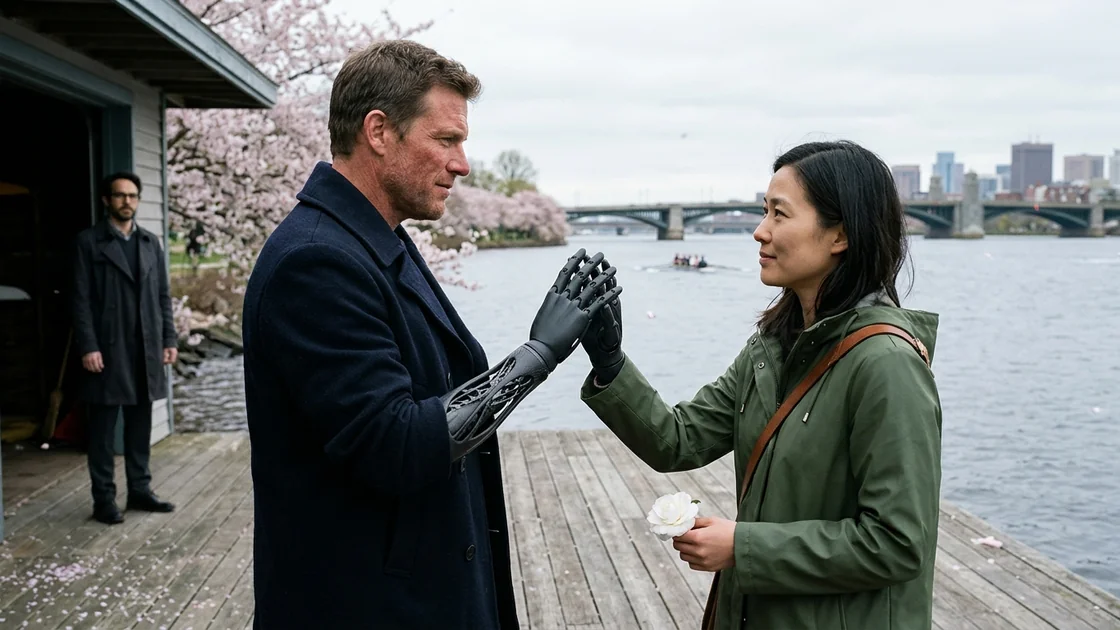
Six months later, in early May, the cherry blossoms along the Charles River Esplanade were in full, riotous bloom, their pale pink petals drifting down onto the damp asphalt of the walking paths and floating like snow along the dark water near the boat docks.
Aris Thorne stood on the wooden deck of the community boathouse near the Harvard Bridge, his hands tucked into the pockets of his trench coat against the brisk spring breeze coming off the water.
Thirty feet away, near the railing overlooking the river, Marcus Vance stood waiting. He was wearing a clean navy wool peacoat, his hair trimmed, the healthy color back in his weathered cheeks. His left sleeve was pushed up slightly, revealing the dark, sleek wrist of the production-model Soma-IV. In his prosthetic fingers, held with effortless, unconscious delicacy so as not to bruise the stem, was a single white camellia he had picked up from a florist in Beacon Hill on his way into town.
Aris glanced toward the gravel path leading from the footbridge.
A woman in a moss-green raincoat was walking toward the boathouse, a leather sketchbook case slung over her left shoulder. She moved with the light, observant grace of someone who noticed every species of moss growing between the paving stones. Her right hand—clad in the identical matte-charcoal chassis of Unit Zero-Two—swung naturally at her side, the fingers curving slightly in the cool river air.
Clara stopped ten feet from the railing.
Marcus turned. For a long moment, neither of them said a word. The city traffic hummed across the bridge in the distance, and a varsity eight shell glided silently past on the river below, the oars blades catching the afternoon sun.
They didn't need an introduction. They already knew the exact cadence of each other’s patience, the steadiness of each other’s grip, and the way the other person reached out when the room went dark.
Clara walked the remaining few steps between them, a slow, radiant smile breaking across her face.
Marcus held out the white camellia with his biological right hand. Clara took it with her biological left hand, her fingers brushing his rough mechanic's knuckles.
Then, slowly, without looking down, they raised their other arms—his prosthetic left, her prosthetic right.
Aris watched from the shadow of the boathouse roof as the two dark carbon-fiber hands came together in the cool Boston air, palm to palm, fingers interlacing slowly and firmly.
There was no cloud server routing the packets through Virginia now. There were no neural transformers merging their latent spaces across three thousand miles of fiber-optic glass. As their synthetic fingertips pressed into the piezoresistive matrices on the backs of each other’s hands, fourteen hundred local taxels fired simultaneously, sending clean, warm, unmistakable bursts of biological truth straight up their nerves to the brain—two people feeling the exact same touch, in the exact same room, at last.