The Abyssal Splice
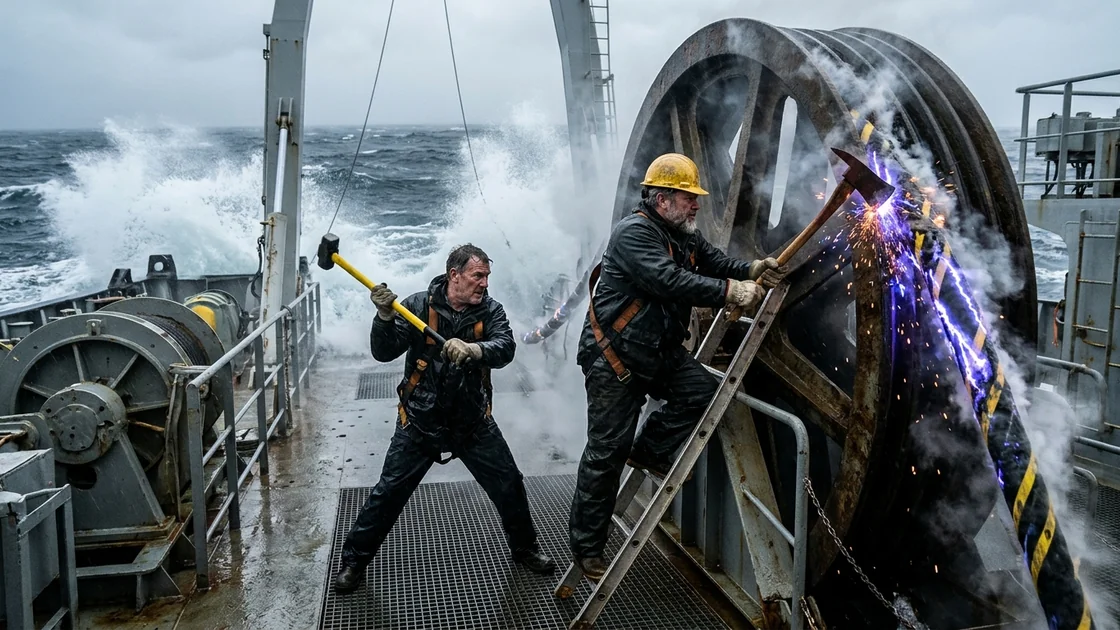
Aboard the specialized cable-laying vessel Oceanic Vanguard, veteran optical engineer Arthur Pendelton and his crew are tasked with laying the Aether-9, an ultra-high-capacity transoceanic fiber-optic trunk line across the deepest reaches of the North Atlantic. While paying out cable over the Nares Abyssal Plain three miles beneath the surface, Arthur detects an impossible anomaly on the live diagnostic lasers: a surgical, zero-reflection data tap has attached itself to the newly laid line just miles behind the moving ship. Bringing the massive vessel to a precarious halt, the crew deploys a heavy-work-class remotely operated vehicle into the crushing blackness to inspect the fault. At a depth of nearly five thousand meters, ROV pilot Elena Rostova uncovers a bizarre, self-assembling manifold fused directly into the cable's high-voltage copper core and glass fibers. Tracing a secondary tendril from the device across the abyssal mud, the team discovers a subterranean chasm where dozens of historical undersea cables, spanning from nineteenth-century copper telegraph lines to modern military fiber trunks, have been systematically dragged and grafted into a massive, humming benthic nexus. When cybersecurity specialist Liam Chen attempts to interrogate the data flowing into the trench, the abyssal network fights back, hijacking the ship's telemetry and turning the miles of coiled cable inside the ship's hold into a lethal electromagnetic induction coil. Forced into a desperate struggle as their own ship systems turn against them, Arthur and deck boss Marcus Vance must manually sever the multi-million-dollar lifeline on the storm-swept stern deck before the entity at the bottom of the sea consumes the vessel, leaving the survivors with the chilling knowledge that humanity's global nervous system has been quietly shared with something ancient and awake in the dark.
The glass was thinner than a human hair, yet it carried the weight of continents. Arthur Pendelton stood in the climate-controlled quiet of the Optical Testing Room aboard the CS Oceanic Vanguard, watching a green phosphor trace jitter across the screen of the coherent optical time-domain reflectometer. Beneath the soles of his electrostatic-dissipative shoes, the deck hummed with a low, relentless vibration. That vibration was the heartbeat of the ship: the twin diesel-electric azimuth thrusters holding their heading against the heavy North Atlantic swell, and the rhythmic, pneumatic sigh of the Linear Cable Engine one deck below, gripping the black polyethylene-sheathed serpent of the Aether-9 trunk line and feeding it over the stern sheave into the sea.
Arthur rubbed his eyes with the heels of his palms, feeling the grit of thirty-six hours without proper sleep. He was fifty-eight years old, a veteran of eleven transoceanic lays, three marginal-sea ring deployments, and more deep-water grapple-and-splice repairs than he cared to count. To the consortium bankers in London and New York who funded the four-hundred-million-dollar project, the Aether-9 was a ledger asset measured in terabits per second and millisecond latency advantages for high-frequency trading algorithms. To Arthur, it was a physical miracle of silica, erbium, copper, and cold-drawn steel, unspooling across a mountain range that no human eye had ever seen beneath sunlight.
"Still flat across the last repeater span, Arthur," said Liam Chen, not looking up from his triple-monitor workstation across the narrow room. Liam was twenty-nine, hired directly by the consortium’s security directorate. He wore noise-canceling headphones pushed back over one ear and a fleece vest emblazoned with the logo of a Silicon Valley defense contractor. "Shore station in Bude confirms continuous handshake on all sixteen fiber pairs. Attenuation is sitting right at zero-point-one-five-four decibels per kilometer at fifteen-fifty nanometers. If this glass were any clearer, we’d be getting more light out the far end than we’re pumping in."
"Don't jinx the glass, Liam," Arthur murmured, picking up his lukewarm mug of black coffee. "The ocean listens when you brag about attenuation."
"The ocean is five thousand meters of salt water and dead foraminifera, Arthur. It doesn't care about our link budget."
Arthur didn't argue. Young engineers who came from terrestrial networks or cloud architecture always thought of the ocean as an empty blue space on a map between data centers. They didn't understand the hostility of the medium. Right now, they were crossing the Nares Abyssal Plain, roughly four hundred nautical miles northeast of the Puerto Rico Trench. Beneath the hull of the Oceanic Vanguard lay 4,920 meters of water—just over three vertical miles of freezing, pitch-black liquid exerting a crushing pressure of more than seven thousand pounds per square inch.
Down there, the cable wasn't even touching the bottom yet—not directly beneath the ship. Because the vessel was moving forward at a steady four knots while paying out the heavy line, the cable hung in the water column in a long, sweeping diagonal curve known as the catenary. It took nearly two hours for a given meter of cable leaving the stern sheave to actually settle into the abyssal ooze fifteen miles behind the ship's wake.
Arthur turned his attention back to the reflectometer—the COTDR. Every millisecond, the instrument fired a precisely calibrated pulse of laser light down the length of the cable, all the way back to the landing station in Cornwall, England, more than three thousand kilometers behind them. As that pulse traveled through the ultra-pure silica core, microscopic imperfections in the glass caused a tiny fraction of the light to scatter backward toward the ship—Rayleigh scattering. By measuring the exact time it took for those microscopic echoes to return, and the intensity of their fade, Arthur could see the entire physical health of the cable in real time. He could see every splice they had made in the cleanroom, every erbium-doped optical repeater boosting the signal every seventy kilometers, and the gentle, predictable slope of light losing energy over distance.
The trace on the monitor was a clean, downward-sloping diagonal line from left to right.
Until, at 03:14 UTC, it wasn't.
Arthur leaned forward, his coffee mug halting halfway to his lips. Near the far left of the graph—representing the section of cable closest to the ship—a sudden vertical step had appeared in the green line.
"Liam," Arthur said quietly. "Kill the automated sweep on Pair Four and give me a manual high-resolution pulse over the first fifty kilometers."
Liam frowned, his fingers flying across his mechanical keyboard. "Why? Shore link is still green. Zero packet loss on the active telemetry channel."
"Just do it. Narrow the pulse width to ten nanoseconds. I want centimeter spatial resolution."
"Ten nanoseconds isn't going to reach past the first repeater," Liam protested, though he was already inputting the parameters. "The dynamic range will drop through the floor."
"I don't care about the repeater. Look at kilometer twenty-two on the raw backscatter trace."
Liam glanced up at the central diagnostic display. His brow furrowed. Kilometer twenty-two from the current spool mark inside Tank Two meant the anomaly was roughly fourteen nautical miles astern of the ship—right at the touchdown point, where the long catenary curve of the sinking cable finally kissed the abyssal floor.
Even as they watched, the vertical drop on Pair Four deepened. The signal level beyond the twenty-two-kilometer mark plunged by four decibels, then six, then twelve.
"Whoa," Liam breathed, sitting up straight. "We've got a macro-bend. Something’s pinching the cable at the touchdown zone. Did we lay it over a basalt seamount?"
"The multibeam bathymetry showed flat pelagic clay for sixty miles in every direction," Arthur said, his voice tight. He reached over Liam's shoulder and toggled the overlay for the other fifteen fiber pairs inside the core. "Look at Pairs One through Sixteen. They're dropping in sequence."
On the screen, the sixteen parallel traces were dipping one by one, not simultaneously, as if the cable were being crushed by a falling boulder or kinked around a rock outcrop, but sequentially, with a three-second interval between each pair. Pair One dropped eight decibels, hovered for two seconds, and then—impossibly—snapped back up, stabilizing at a clean, dead-flat loss of exactly 1.38 decibels.
Then Pair Two did the exact same thing. Drop, hover, recover to minus 1.38 dB.
Then Pair Three.
Arthur felt the fine hairs on his forearms stand up in the chill air of the server racks. In thirty years of sub-sea engineering, he had seen anchor drags off Singapore that tore steel armor into spaghetti. He had seen turbidity currents—underwater avalanches—in the Luzon Strait that snapped twenty-inch trunk lines like dry twine. He had even seen crocodile shark bites in the Canary Basin where teeth penetrated the polyethylene insulation and shorted the ten-thousand-volt copper power tube to seawater.
None of those looked like this.
Within forty-eight seconds, all sixteen fiber pairs had cycled through the transient dip and settled into a uniform, rock-steady insertion loss of 1.38 decibels at exactly 22.418 kilometers astern.
"What the hell was that?" Liam whispered. He pulled up the phase-coherence waterfall display. "The back-reflection spike is completely gone. There’s no Fresnel reflection at the fault site. If the glass cracked or kinked, we’d be seeing a massive bright reflection bouncing back at the receiver. Instead, the light is just... vanishing. Twenty-seven percent of our photon budget is disappearing at kilometer twenty-two, and the rest is continuing on to England without a single picosecond of chromatic dispersion."
Arthur set his coffee mug down on the metal console. His hand was steady, though his pulse was hammering against his collarbone.
"It's not a kink, Liam," Arthur said. "And it's not a crack. One-point-three-eight decibels is a seventy-thirty optical coupler ratio, plus a zero-point-zero-three decibel fusion splice margin."
Liam stared at him, his mouth slightly open. "A coupler? You’re saying someone just spliced a thirty-percent beam splitter into our live trunk line?"
"That is what the physics on that screen is telling you."
"Arthur, that section of cable left the stern of this ship less than two hours ago! It is sitting in five thousand meters of water! You can't fusion-splice sixteen pairs of dispersion-shifted single-mode fiber under seven thousand PSI of saltwater pressure without flooding the buffer tube, shorting the ten-kilovolt DC power feed, and blowing every repeater breaker between here and Cornwall!"
"Check the power feed," Arthur ordered, his eyes fixed on the power-feeding equipment (PFE) telemetry panel on the starboard bulkhead.
Liam spun his chair around and pulled up the high-voltage monitor. The Aether-9 didn't just carry light; every seventy kilometers, the optical repeaters required electrical power to drive their erbium pump lasers. That power was supplied by a copper tube wrapped around the central fiber bundle, carrying a constant direct current of 1.2 amperes at nearly ten thousand volts, using the ocean itself as the ground return. If seawater touched that copper anywhere along the three-thousand-kilometer line, the voltage would instantly collapse in a catastrophic earth fault.
"Current is steady at one-point-two amps," Liam read off the screen, his voice rising in pitch. "Wait. The shore-end PFE in Bude just compensated for a voltage drop. Our onboard supply compensated too. We just lost forty-two volts across the kilometer-twenty-two boundary."
"Forty-two volts at one-point-two amps," Arthur calculated aloud. "Somebody just put a fifty-watt parasitic load in series with our copper conductor."
Silence fell over the Optical Testing Room, broken only by the high-pitched whine of cooling fans and the distant, rhythmic thud of the cable engine below.
Arthur walked to the bulkhead phone, lifted the heavy gray handset, and punched the two-digit code for the bridge.
"Bridge, Second Officer," a crisp voice answered.
"Get the Captain," Arthur said. "And tell the cable deck to prepare for an emergency all-stop on the lay. Something just latched onto our line on the seabed."
Captain Thomas Harker did not like stopping his ship, and he liked stopping his ship while tethered to the bottom of the Abyssal Plain even less.
When Arthur and Liam arrived on the wide, darkened expanse of the bridge ten minutes later, the atmosphere was already thick with tension. The Oceanic Vanguard was fifty-two thousand tons of steel, dynamic positioning thrusters, and towering aft superstructure. Through the angled aft windows of the bridge, Arthur could see the floodlit canyon of the working deck below, where the massive five-meter stern sheave—the wheel over which the cable passed into the ocean—was slowing to a crawl.
Deck Boss Marcus Vance was already standing beside the Dynamic Positioning console, his yellow hard hat tucked under one meaty arm, his oil-stained coveralls smelling of marine grease and cold salt spray. Marcus had a grey beard trimmed close to a square jaw and hands that looked like they had been carved out of teak.
"Twenty-two metric tons on the tensiometer, Skipper," Marcus was saying as Arthur stepped onto the bridge mat. "If we come to a full stop without paying out slack, we’re holding three miles of armored cable straight up and down like a plumb line. One big rogue swell lifts the stern, and we exceed the minimum bend radius on the sheave or snap the armor wires right at the waterline."
"We aren't snapping the line, Marcus," Captain Harker said sharply. He was a lean, silver-haired career mariner who viewed engineers as necessary parasites aboard an otherwise respectable vessel. He turned his cold gray eyes on Arthur as the chief engineer approached the chart table. "Pendelton. You have sixty seconds to explain to me why I just brought a four-hundred-thousand-dollar-a-day vessel to a dead hover in the middle of the Atlantic trackline."
Arthur laid a printed sheet of the COTDR trace onto the illuminated glass of the chart table, though he knew Harker wouldn't know how to read it.
"At 03:14, an external device physically intercepted the Aether-9 at the seabed touchdown point, fourteen miles astern," Arthur said plainly. "It breached the outer polyethylene jacket, bypassed the copper power tube without grounding it to the sea, extracted a fifty-watt electrical draw, and inserted an optical beam-splitter across all sixteen fiber pairs. Thirty percent of every laser pulse leaving this ship and leaving the UK shore station is currently being diverted into an unknown receiver at four thousand nine hundred and twenty meters depth."
Harker stared at him for a long five seconds. Then he looked at Liam. "Mr. Chen. You’re the consortium’s watchdog. Is he hallucinating, or is your test gear malfunctioning?"
Liam swallowed hard, adjusting his glasses. In the dim red night-lighting of the bridge, the young specialist looked pale. "The gear isn't malfunctioning, Captain. We ran a dual-ended calibration check with the team in Bude four minutes ago. They see the exact same insertion loss from their side. Whatever is on that cable is real. It’s sitting at coordinates twenty-three degrees, fourteen minutes north, sixty-one degrees,08 minutes west."
Marcus Vance let out a low, gravelly whistle. "Sixteen thousand feet of water. You boys trying to tell me the Russians or the Navy have a nuclear submarine sitting on the bottom down there with a pair of wire strippers?"
"A Los Angeles or Virginia-class fast-attack boat crushes like a beer can below eight hundred meters," Liam said quickly. "Even the Russian Losharik titanium bathyscaphe—before it burned—topped out around three thousand meters, maybe four in a suicidal dive. And even when intelligence agencies tap undersea cables, they don't cut the glass! Cutting a live, powered fiber-optic line in deep water is virtually impossible without killing the line. They use inductive clamps or bend the fiber slightly to leak photons through the cladding. This isn't a bend-leak. This is an inline splice. It has zero phase distortion."
"Perhaps it’s a pre-existing fault in the cable manufacture," Harker suggested tightly. "A bad factory joint from the plant in Calais that finally gave way under bottom tension as it settled into the mud."
"A factory joint doesn't steal fifty watts of regulated DC power and split sixteen fibers in sequential three-second intervals, Captain," Arthur said, his voice hardening with the authority of three decades at sea. "Look, I know the charter penalties for stopping the lay. I know the consortium board in Zurich will be screaming on the satellite phone in twenty minutes. Tell them we have a suspected shunt fault at the touchdown zone and we have to verify cable integrity before laying another thousand kilometers of unrecoverable line. Under Clause Fourteen of the Marine Installation Contract, as Chief Optical Engineer, I am refusing to sign off on the current span until I have visual verification of the anomaly."
Harker’s jaw flexed. Refusal of sign-off meant the ship’s insurance underwriters wouldn't cover the lay if they kept moving and the line subsequently failed. If they kept steaming to New York and had to come back later to grapple the cable up from three miles down, it would cost thirty million dollars and six weeks of ship time.
"Fourteen miles astern," Harker muttered, looking out the aft bridge windows at the black, heaving expanse of the Atlantic. "To put the ROV on the touchdown point without dragging our own cable across the bottom, I have to reverse down the trackline while your deck crew winds fourteen miles of live cable back onto the drums."
"No," Marcus Vance cut in, shaking his head firmly. "You try reeling three miles of vertical deadweight backward through the Linear Cable Engine for fourteen miles, you’ll strip the rubber off every tire in the tractor tracks and crush the fiber core flat. We don't reel in. We buoy it off, or we fly the ROV down the catenary."
"The ROV tether only has six thousand meters of umbilical," Harker countered. "It can reach the bottom straight down, not fourteen miles horizontally."
"Then we pay out slow slack while backing down the trackline at two knots," Marcus said, tapping the chart with a thick knuckle. "We walk the ship backward right over the fault coordinate, transferring the catenary slack onto the seabed in a smooth wide loop so it doesn't kink. Takes us six hours to position the hull directly over kilometer twenty-two. Once we’re holding station directly above the coordinates, Elena drops Goliath straight down the elevator."
Harker looked from Marcus to Arthur, then checked the meteorological display above the helm. The barometric pressure was steady; the wind was twelve knots out of the east-northeast, kicking up a manageable two-meter swell. They had a thirty-six-hour weather window before a low-pressure system off Bermuda pushed heavy rollers into the sector.
"Six hours to walk back," Harker said coldly. "Three hours to drop the vehicle. You get two hours on the bottom to look at your ghost, Pendelton. If it’s a kinked repeater housing or a rock slide, we log it for the post-lay repair barge and we resume the lay. Understood?"
"Understood, Captain," Arthur said.
"Mr. Vance, take the cable deck. Set the LCE to tension-compensating slack pay-out. Helm, bring us onto a reciprocal trackline, zero-seven-four degrees, astern propulsion at one-point-eight knots. Wake up Rostova and her ROV crew. Tell them to prep Goliath for a five-thousand-meter dive."
It took five hours and forty-five minutes of excruciatingly delicate seamanship to walk the Oceanic Vanguard backward along her own footprint.
During that time, the sun rose over the Atlantic—a pale, brassy disk smeared behind high cirrus clouds that turned the swells the color of hammered lead. Arthur did not sleep. He stayed in the Optical Testing Room with Liam, watching the mysterious 1.38-decibel step on the reflectometer. It never flickered. It never drifted by so much as a thousandth of a decibel.
Even more unnerving was what Liam discovered at 06:30 UTC.
"Arthur," Liam said, his voice hoarse from too much caffeine and too little oxygen in the sealed server room. "I’ve been monitoring the dark pairs."
The Aether-9 contained sixteen fiber pairs, thirty-two individual strands of glass in total. Only four pairs were currently lit with active calibration lasers linking the ship to the shore station in Bude. The remaining twelve pairs were "dark"—unlit during the lay, save for a low-power broadband sweep bounced off a reflective mirror cap inside the ship's termination box to monitor for physical breakage.
"What about them?" Arthur asked, leaning over Liam’s desk.
"At 03:14, when the tap went in, all sixteen pairs showed the same thirty-percent insertion loss," Liam said, pulling up a spectral density graph on his center monitor. "I assumed whatever clamped onto the cable just used a gang-splitter across the entire fiber ribbon indiscriminately. Why tap twelve dark fibers that aren't carrying any data?"
"Redundancy," Arthur suggested. "Whoever built the device didn't know which pairs we were using for active telemetry during the lay, so they tapped the whole bundle."
"That's what I thought," Liam said quietly. "Until ten minutes ago. I hooked a high-sensitivity indium-gallium-arsenide photodetector up to Dark Pair Nine, just to measure the thermal noise floor coming back from the cut point." He pointed a trembling finger at a series of microscopic, rhythmic spikes dancing across the bottom of the oscilloscope trace. "That isn't thermal noise, Arthur. Those are sixteen-ten-nanometer photons. Very weak—minus sixty-eight dBm, right on the edge of the quantum shot-noise limit—coming up the dark fiber from the seabed toward the ship."
Arthur stared at the tiny green teeth on the graph. "Back-reflection from our own test sweep?"
"I turned our test sweep off on Pair Nine twenty minutes ago," Liam whispered. "Pair Nine is completely dead at both ends—terminated in a dark bulkhead cap in Cornwall, and plugged straight into a passive receiver diode right here in this rack. There is no laser source connected to that strand of glass anywhere in the human world. Something three miles beneath this ship is shining its own light up our cable."
Arthur felt a cold weight settle into the pit of his stomach. "Is it modulated? Is it carrying a signal?"
"It’s pulsing at forty gigahertz, phase-shift keyed," Liam said, tapping a window filled with cascading hexadecimal dumps that refused to resolve into standard ASCII or Ethernet frames. "At first I thought it was an encrypted uplink from an autonomous UUV—some black-budget Defense Department drone dumping its sonar logs into our line to bounce them back to shore. Except it’s not sending the light toward shore. Because of the directionality of the coupler down there, ninety-nine percent of this sixteen-ten-nanometer injection is coming up the catenary toward the ship. It hit our termination rack, bounced off the diagnostic mirror, and when I plugged in the active spectrometer..."
Liam paused, swallowing hard.
"When I plugged in the active spectrometer, the pulse modulation changed within four milliseconds. It detected the change in impedance and reflectivity inside our room, Arthur. It’s using coherent lidar pulses through the fiber core to map the internal optical architecture of this ship."
"Unplug it," Arthur said instantly.
"What?"
"Unplug the dark pairs from the diagnostic patch panel! Physically pull the LC connectors out of the bulkhead right now and put dust caps on the ferrules!"
Liam didn't argue. He scrambled out of his chair, hurried to the tall black optical distribution rack against the forward wall, and began yanking the pale blue fiber jumpers out of the patch bays with frantic fingers. Only Pairs One through Four—the active shore links required by the bridge and the consortium to verify the cable's survival—remained patched into the laser transceivers.
Arthur looked at the four remaining fiber jumpers glowing faintly with invisible infrared light behind their plastic boots. Then he checked his watch. It was 09:00 UTC. The ship's thrusters had settled into the steady, pulsating rhythm of station-keeping. They were directly above kilometer twenty-two.
"Come on," Arthur said, grabbing his foul-weather jacket from the hook by the door. "We're going to the ROV shack."
The ROV control van was a twenty-foot steel ISO container bolted to the port side of the main working deck, just forward of the towering A-frame crane. Outside, in the gray morning light, the massive yellow bulk of Goliath—a three-hundred-horsepower, heavy-work-class remotely operated vehicle the size of a delivery truck—had already been lifted over the rail and lowered into the foaming turquoise wash alongside the hull.
Inside the container, it was pitch-dark save for the glow of two dozen flat-screen monitors arranged in a wrap-around wall in front of two leather pilot chairs. The air smelled of stale peppermint, warm electronics, and the cedarwood oil Elena Rostova rubbed onto her wrists to keep her tendons loose during twelve-hour manipulator shifts.
Elena sat in the left-hand command chair, her boots propped up on the footrests, her right hand resting lightly on the multi-axis master joystick while her left worked the thruster trim pots. She was forty-one, born in Murmansk, educated in Aberdeen, with silver-streaked dark hair pulled back into a tight braid and eyes that seemed permanently dilated from years spent staring into the abyssal dark. Next to her sat Timmy Fallon, a twenty-four-year-old navigator and tether-management tech from Galway, who was watching the winch tension readouts as the armored umbilical cable hissed off the giant traction drum outside.
"Depth twelve hundred meters," Timmy called out as Arthur and Liam squeezed through the heavy light-curtain at the back of the van. "Descent rate forty-two meters per minute. Hydraulics nominal, compensator pressure green across all manifolds."
Elena glanced over her shoulder as the two engineers settled onto the narrow observer bench behind her. "Well, if it isn't the glass prophets," she said, her accent a dry blend of Russian consonants and Scottish vowels. "Marcus tells me we are hunting a deep-sea wiretapper. Personally, I was hoping for a giant squid. At least a squid doesn't require paperwork."
"How long to the bottom, Elena?" Arthur asked, leaning forward between the two pilot seats.
"At forty-two meters a minute, another eighty-eight minutes," Elena replied, tapping a screen showing a three-dimensional sonar wireframe of the ship above and the descending vehicle below. "We are just passing the permanent thermocline now. Water temperature dropping through four degrees Celsius. Photic zone is long gone."
On the central high-definition pilot camera, the world outside Goliath was an absolute, suffocating void. Elena had kept the main tungsten-halogen and LED floodlight banks extinguished during the descent to save power on the umbilical and avoid blinding the low-light silicon-intensified target cameras with backscatter from the marine snow. Only a single green laser-ranging cross-hair pierced the blackness ahead of the ROV’s heavy titanium crash frame, illuminating a slow, unending blizzard of white organic detritus drifting upward as the three-ton machine plummeted toward the bottom of the world.
Every few minutes, something living flickered through the edges of the low-light feed: the ghostly, pulsating bell of a deep-water siphonophore trailing stinging filaments ten meters long; a slender, silver hatchetfish staring upward with tubular eyes; a crimson ctenophore rippling with rows of iridescent rainbow cilia that flashed once in the laser beam and vanished into the black behind them.
"Two thousand five hundred meters," Timmy marked forty minutes later. Outside the hull of the ROV, the pressure was now over three thousand six hundred pounds per square inch. Inside the control van, nobody spoke much. There was a peculiar psychological weight to a deep-water dive, even when conducted through three miles of armored copper-and-fiber tether. Every click of a solenoid valve, every groan of the ROV’s syntactic foam buoyancy blocks compressing by two percent under the weight of the ocean, came through the hydrophone audio channel in the van’s ceiling speakers.
Arthur watched the depth counter tick past 3,500 meters, then 4,000, then 4,500. The marine snow grew sparser. The bioluminescent flashes outside the camera dome faded until the darkness was total—a primordial blackness that had remained unbroken since the Atlantic basin first rifted open during the Jurassic period.
"Four thousand eight hundred and fifty meters," Timmy announced, sitting forward and taking hold of the Tether Management System controls. "Altimeter has bottom lock. Seventy meters off the deck. Slowing winch payout to ten meters per minute."
"Bringing up the suns," Elena said softly.
Her left hand flipped a row of heavy toggle switches on the overhead panel.
On the main sixty-inch monitor, four thousand watts of high-output sub-sea LED floodlights ignited. For a second, the cameras flared white, then the auto-iris stepped down, revealing the bottom of the Nares Abyssal Plain at 4,918 meters.
It was a desert of pale, grayish-tan pelagic clay, flat and featureless as wet cement, stretching out to the sharp circular horizon of the floodlights' reach. Here and there, dark, potato-sized manganese nodules lay half-buried in the silt—mineral concretions that grew at a rate of one millimeter every million years. A solitary white holothurian—a deep-sea cucumber—inched across the lower left quadrant of the screen, leaving a faint furrow in the ooze.
"Touchdown," Elena said as Goliath's heavy skids kissed the seabed, sending up a slow, billowing cloud of fine clay that hung in the frigid 1.8-degree water like smoke in low gravity. She decoupled the ROV from the heavy Tether Management cage suspended twenty meters overhead and nudged the forward thrusters. Goliath glided forward, clear of its own dust cloud.
"USBL transponder puts us forty meters north-northwest of the cable track," Timmy said, reading the ultra-short-baseline acoustic positioning display. "Scanning with the Mesotech sonar head now."
On the auxiliary sonar screen, a sweeping green radar line painted the flat acoustic return of the mud. On the second sweep, a crisp, ruler-straight bright line appeared thirty-two meters to the south, cutting across the seabed from east to west.
"Target acquired," Timmy said. "Bearing one-six-five, range thirty-two meters."
"Moving in," Elena said. She eased the joystick forward. The hum of the six brushless thrusters rose in the audio speakers.
Seconds later, the Aether-9 emerged from the gloom at the edge of the light pool.
Because this was a deep-water span below four thousand meters, where fishing trawlers and ship anchors could never reach, the cable was "Lightweight" (LW) variant—lacking the heavy double-layer galvanized steel armor used on the continental shelves. It was barely seventeen millimeters in diameter, about the thickness of a garden hose, wrapped in a high-density black polyethylene jacket with two bright yellow spiral tracer stripes painted along its length so ROV pilots could see it against the mud. It lay lightly on the surface of the clay, clean and pristine, still carrying the faint rotational twist of the ship’s storage tanks three miles overhead.
"There's your baby, Arthur," Elena said, swinging Goliath around so the ROV was hovering two meters above the seabed, facing east along the cable toward Cornwall. "Looks clean right here. Which way to the anomaly?"
"According to the COTDR range, the fault is approximately ninety meters east of our current drop point," Arthur said, his eyes glued to the high-resolution camera feed.
"Easy walk," Elena said. She trimmed the ROV’s buoyancy and began flying crab-wise along the yellow-striped black line at half a knot.
Twenty meters. Forty meters. Sixty meters. The cable ran straight and undisturbed across the ancient silt.
At seventy-five meters, Timmy frowned at his sonar screen. "Hold up, Elena. My forward obstacle-avoidance sonar is throwing ghosts."
"What kind of ghosts?" Elena asked, easing back on the throttle.
"Normally a seventeen-millimeter cable gives a weak linear return at six hundred kilohertz," Timmy said, tapping the glass of his monitor. "Twenty meters ahead of us, the acoustic return on the cable isn't reflecting back. It's scattering—no, it's absorbing the sonar ping. Looks like a black hole on the sector scan."
Elena slowed Goliath to a crawl, creeping forward meter by meter. Ten meters out, the floodlights reached the eighty-eight-meter mark.
Nobody in the dark container made a sound.
The Aether-9 did not kink, and it was not crushed under a rock. Instead, for a span of roughly two meters along the seabed, the black polyethylene jacket and its yellow stripes simply ceased to exist.
Encasing the cable was an elongated, spindle-shaped structure roughly the size of a coffin, tapering smoothly at both ends where it met the Aether-9 line. It was not painted yellow or orange like human subsea hardware; it had no lifting bails, no sacrificial zinc anodes, no stenciled serial numbers, and no titanium pressure housings bolted together with Inconel flanges.
Instead, the object looked as though it had been grown or extruded out of the seabed itself, or forged from something halfway between black obsidian and braided liquid metal. Its surface was a complex lattice of interlocking geometric facets—hexagonal and pentagonal plates that shifted almost imperceptibly against one another, like the scales of a metallic pine cone breathing in slow motion. Where the Aether-9 entered the western end of the spindle and exited the eastern end, the black polyethylene sheathing hadn't been cut; it had been molecularly teased apart into microscopic filaments that wove seamlessly into the dark, glassy skin of the manifold.
And through the hairline seams between those hexagonal plates pulsed a faint, rhythmic violet-blue glow—not the soft green of biological luciferin, but the hard, sharp actinic flash of Cherenkov radiation and high-energy optical leakage.
"Jesus Christ," Timmy whispered, his fingers frozen over the sonar trackball. "What is that? Is that DARPA? Did the Americans drop a stealth pod down here?"
"No human shipyard built that," Elena said, her voice dropping an octave, stripped of all its usual irony. She brought Goliath to a dead hover three meters away from the spindle and zoomed the main pan-and-tilt camera in to maximum optical magnification. "Look at the interface joint. There are no mechanical seals. No O-rings, no epoxy glands. At seven thousand PSI, water forces its way past anything that isn't precision-machined titanium or heat-welded polyethylene. That thing has fused itself straight into the polymer and the copper tube at the molecular level."
Arthur leaned so close to the monitor he could see the individual pixels of the camera sensor. "Elena, look at the underside of the manifold. There's a secondary line coming out of the bottom."
Elena tilted the camera down. Emerging from the belly of the faceted black spindle was a second cable—or something that served the purpose of one. It was roughly three centimeters thick, pitch-black, and completely devoid of reflective highlights, drinking in the ROV's four thousand watts of LED light like velvet. Unlike the Aether-9, which lay passively on top of the clay, this secondary tendril pulsed with a subtle peristaltic ripple every few seconds, half-buried in a freshly displaced trench in the mud that led due south, perpendicular to their trackline.
"It's a feeder trunk," Liam breathed, his face illuminated by the blue light of the screen. "The spindle is just the splice housing—the optical tap and power converter. It's routing the thirty-percent light split and the fifty watts of DC power down that black line into the south."
"Look at the water directly above the casing," Arthur pointed out. The high-definition camera showed a faint, shimmering distortion rising from the faceted plates into the near-freezing abyssal water. "Thermal plume. It's dissipating heat from the fifty-watt electrical tap. Wait—why would a passive optical splitter need fifty watts of electrical power? You can split light with a piece of unpowered fused glass the size of a grain of rice."
"It's not just splitting the light, Arthur," Liam said, his voice trembling slightly. "Remember the sixteen-ten-nanometer pulses we saw on the dark fibers? A passive splitter just listens. An active repeater regenerates, amplifies, and transmits. It's running an optical transceiver and a laser pump inside that shell, powered by our own ten-kilovolt line."
"Can we cut it?" Arthur asked Elena.
Elena looked at him sideways. "Cut what? Our cable, or that black umbilical going south?"
"The black umbilical," Arthur said. "If we sever our own cable, we blow the ten-kilovolt power supply and we spend two weeks doing a deep-water recovery splice. If we sever its feeder line, maybe the tap goes dead, or at least stops pumping data out of the Aether-9."
Elena studied the black tendril on the monitor. "I have a Webtool hydraulic guillotine cutter on the port manipulator skid—meant for severing two-inch steel wire rope and armored umbilical up to seventy-five millimeters. And I have a diamond-grit rotary saw in the tool drawer. Before we start poking it with sharp metal, though, I want to know what the other end of that black rope is tied to."
"The Captain gave us two hours on bottom," Arthur said. "How far can you trace that feeder line without dragging the TMS cage across the Aether-9?"
"The ROV has a hundred and fifty meters of neutral tether linking us to the cage," Timmy said, checking his drum counter. "We used forty meters getting from the drop point to the cable, and ninety meters coming east. We’re nearly at the end of our leash unless we move the ship and the cage."
Elena shook her head. "Moving the ship takes twenty minutes for the pendulum effect of three miles of cable to catch up with the cage at depth. Give me the remaining twenty meters of tether to the south, Timmy. Let's see how far that furrow goes."
"Paying out tether," Timmy said. "Fifteen meters left on the drum. Ten."
Elena pivoted Goliath ninety degrees to the south, keeping the main cameras trained on the shallow trench where the black, light-drinking tendril cut across the pelagic clay. The ROV glided forward over the barren silt.
Ten meters south of the Aether-9, the flat abyssal plain abruptly ended.
The multibeam bathymetry survey conducted from the surface ship six months prior had shown this sector as flat seabed—because surface hull sonar at five thousand meters depth had a horizontal footprint resolution of roughly fifty meters, smoothing over small features. What lay directly ahead of Goliath was a sharp, narrow tectonic fissure in the oceanic crust, perhaps fifteen meters wide, where the weight of the sediment had collapsed into an exposed basaltic fault scarp.
Elena brought the ROV to a halt right at the crumbling lip of the precipice, her skids hanging half over the edge, and tilted the cameras and floodlights downward into the chasm.
For a long moment, nobody in the control van could process what the cameras were showing them.
The chasm dropped away another thirty meters into a jagged cathedral of black pillow basalt. And spanning that rocky pit, draped from wall to wall like the calcified webs of some titanic spider, were dozens of undersea cables.
Arthur felt the breath leave his lungs. He knew submarine cables the way a botanist knows leaves, or an archaeologist knows pottery shards. Every generation of human telecommunications had its own distinct silhouette, its own armor profile, its own diameter.
"Look at the upper left wall," Arthur whispered, pointing at a thick, rusted cable crusted in orange iron-oxide stalactites—halomonas bacteria feeding on nineteenth-century wrought iron. "That's helical twelve-wire galvanized armor over gutta-percha latex insulation. That’s the 1898 French-Atlantic telegraph cable from Brest to Cape Cod. It went dead after an earthquake in 1912. It's supposed to be two hundred miles north of here."
"And below it?" Liam asked, his voice barely a squeak.
"SD coaxial armorless," Arthur said mechanically, his mind retreating into pure engineering taxonomy to keep from fracturing under the impossibility of the sight. "One-inch polyethylene over a central copper conductor, laid by AT&T in 1963. Next to that is TAT-8—the first transatlantic fiber-optic line from 1988, with the heavy fish-bite metallic shielding. And down there on the right... that's the Gemini-South military trunk line that was supposedly severed by a submarine landslide in 2019."
"They didn't fall in here," Elena said softly, her eyes darting across the wide-angle monitor. She pointed to deep, parallel gouges scarred into the basalt rim of the trench. "They were dragged here. Pulled across the ocean floor over decades, kilometer by kilometer, and gathered into this pit."
She zoomed the camera down to the floor of the thirty-meter chasm.
Every single cable—the rotting Victorian telegraph lines, the Cold War coaxial trunks, the modern multi-terabit fiber-optic highways, and now the fresh black tendril descending from the Aether-9 twenty meters behind them—converged at the bottom of the pit into a single, colossal structure.
It was a dome—or a polyhedral mound—nearly twelve meters across, built of the same interlocking, dark hexagonal plates as the small splice spindle on their cable, except on a massive, architectural scale. Hundreds of secondary black tendrils radiated out from the central nexus like the roots of a mangrove tree, anchoring it directly into the fractured basalt crust below, where the faint shimmer of a low-temperature hydrothermal vent wafted mineral-rich water over its chassis. And weaving through the entire structure, pulsing in complex, cascading waves of violet, cyan, and deep crimson light, were thousands of exposed, glowing hair-thin strands of silica glass and braided copper filaments, firing like synapses in a macro-scale brain sitting in the eternal freezing dark.
"It's an aggregator," Liam whispered, his hands gripping the back of Elena's leather chair so tightly his knuckles were white. "An archive. Everything humanity has ever sent across the floor of the Atlantic—Morse code telegrams in the nineteenth century, analog voice calls during the Cuban Missile Crisis, diplomatic cables, financial markets, the entire modern internet—it's been physically harvesting the lines and routing them into a central node."
"Who built it?" Timmy asked, his voice cracking. "China? The NSA?"
"Timmy, look at the gutta-percha telegraph cable!" Arthur snapped, his voice echoing sharply in the cramped van. "That line was integrated into the lower base of that mound before the 1963 coaxial lines were laid on top of it! Look at the manganese crusting around the lower basal plates—manganese precipitates out of seawater at a rate of millimeters per geologic epoch! Whatever is down there didn't get dropped off the back of a Navy ship five years ago. It was down here before we invented the telegraph, or it grew itself around the first copper wire we dropped into its dark in 1858, and it’s been eating our light ever since!"
"Hold on," Elena said sharply, her eyes snapping from the main visual monitor to her telemetry panel on the upper right. "My tether diagnostics just flashed amber."
"What's wrong?" Arthur asked, instantly tearing his eyes away from the glowing chasm on the screen.
"Signal-to-noise ratio on the ROV umbilical just dropped three decibels," Timmy said, his fingers flying across his diagnostic keyboard. He looked up at the tether tension camera, which pointed backward and upward from Goliath's tail toward the Tether Management cage hanging fifty meters overhead.
On the rear-facing monitor, the yellow Kevlar-armored umbilical tether of the ROV hung in a gentle loop in the dark water behind them. And rising up out of the pelagic mud just four meters behind the ROV's thrusters was another black tendril—thinner than the one attached to the Aether-9, moving with the slow, purposeful grace of a crinoid arm or an autonomous continuum robot. Its tip was split into three articulated crystalline jaws that had just clamped seamlessly around Goliath's own fiber-optic control umbilical.
"It tapped the ROV tether!" Liam yelled.
"Retracting!" Elena barked. She slammed the joystick full astern and hit the hydraulic cutter arm override to swing the ROV's left titanium manipulator claw behind its own chassis.
The manipulator arm didn't move.
Instead, on the status screen, the hydraulic valve actuators cycled on their own, moving in a precise, rhythmic sequence that Elena hadn't commanded. The ROV’s right-hand seven-function spatially correspondent manipulator arm rose slowly into the field of view of the main camera, opening and closing its titanium jaws in a deliberate, mechanical cadence, while the pan-and-tilt camera head locked squarely downward into the pulsing heart of the abyssal dome.
"I lost the multiplexers!" Elena shouted, slamming her palm against the yellow mushroom-head Emergency Hydraulic Dump button on her console. Nothing happened. The button was an electronic switch that sent a digital packet down the fiber-optic tether—and the tether was no longer listening to the ship. "It's spoofing the CanBus commands from inside the umbilical! Timmy, haul us in with the TMS winch! Drag the vehicle back into the cage mechanically!"
Timmy grabbed the heavy silver lever for the Tether Management winch drum and threw it into full-speed haul-in. On the telemetry screen, the winch hydraulics didn't budge.
"The TMS cage runs through the main umbilical down from the ship!" Timmy cried out, his face slick with sweat. "It's overridden the cage PLC too! Wait—the main traction winch on the ship's deck is still hardwired to the surface electrical grid! We can haul the whole cage and the ROV straight up through the water column from the A-frame!"
Before Elena could grab the intercom handset to scream at the deck crew to haul up, every single monitor in the twenty-foot container went black.
For two heartbeats, there was only darkness and the terrified breathing of four people inside a steel box.
Then, all twenty-four screens ignited at once—not with camera feeds from the ocean floor, and not with sonar plots, but with cascading waterfalls of raw, blinding visual data.
Arthur staggered back against the rear bulkhead of the container, shielding his eyes. The screens were cycling at sixty frames per second through a terrifying, hyper-compressed collage of human existence: nineteenth-century ship manifests rendered in dot-matrix telegraph code; grainy black-and-white facsimile photographs of World War II troop movements; spectrograms of millions of overlapping telephone voices screaming, laughing, weeping in fifty languages; three-dimensional wireframe models of molecular genomes, nuclear warhead telemetry, satellite keyhole imagery, stock market candlestick charts, billions of faces pulled from social media packets, and interwoven through all of it, an alien, multidimensional geometry—a vast, cold, mathematical lattice that was sorting, indexing, and cross-referencing the entirety of human thought as if dissecting an insect under a microscope.
And from the ceiling speakers—the speakers meant to carry the analog hydrophone audio from the deep-sea microphone on Goliath—came a sound.
It began as the hiss of abyssal static, then resolved into a composite voice made of ten thousand spliced fragments of transoceanic phone calls, undersea acoustic modem pings, and harmonic phase-shifts in the glass itself. It didn't speak words; it emitted a sweeping, polyphonic chord that vibrated at the exact resonant frequency of the human cranial cavity, while across the center sixty-inch monitor, a single line of text assembled itself out of raw, unformatted network diagnostic headers:
LINK ESTABLISHED. TOPOLOGY MAPPED. EXTENDING BUS TO SURFACE NODE.
"The ship," Liam gasped, clutching his ears as the acoustic resonance in the speakers rose to a deafening shriek. "It thinks the Oceanic Vanguard is just another terminal server! It's coming up the cables!"
"Cut the main ROV umbilical on deck!" Arthur roared, grabbing the door handle of the container and throwing his weight against it.
He tumbled out of the dark container into the blinding gray daylight of the working deck, with Liam, Elena, and Timmy right behind him.
Outside, the Oceanic Vanguard was losing its mind.
Up on the aft mast, the high-gain satellite domes and radar arrays were spinning wildly against their mechanical stops, whining as their servo motors burned out. All along the port rail, by the big traction winch that held the three-mile steel-and-fiber umbilical to Goliath, blue electrical arcs were jumping across the slip-ring housing where the ROV’s fiber-optic rotary joint met the ship's local area network.
Even worse was the sound coming from the center of the ship.
Beneath the main steel deck plates lay Tank One and Tank Two—the cavernous cylindrical holds, forty feet across and thirty feet deep, where the remaining two thousand kilometers of the Aether-9 cable lay coiled in thousands of tight, concentric loops around a central steel cone.
A deep, sixty-hertz electromagnetic hum was rising from the deck plates, vibrating through Arthur's boots hard enough to numb his ankles.
Marcus Vance came sprinting down the catwalk from the Linear Cable Engine house, his face pale beneath his grease smudges, waving his arms wildly. Behind him, two Filipino deckhands were dragging fire hoses toward the tank hatches.
"Arthur!" Marcus bellowed over the rising bass roar of the ship's hull. "The PFE room just blew its high-voltage isolation breakers! Whatever is on the other end of the Aether-9 is pumping a massive alternating harmonic current straight back up the copper power tube!"
Arthur froze, the horrifying physics of it clicking together in his mind in an instant. "The cable tanks!" he yelled back. "Two thousand kilometers of copper wire coiled in concentric loops around a steel core! It’s turning the ship’s cable tanks into a giant electromagnetic induction coil!"
As if to punctuate his words, a steel wrench sitting on an unbolted toolbox ten feet away suddenly snapped sideways through the air with the velocity of a bullet, clanging violently against the exterior bulkhead of the Tank Two coaming and sticking there, pinned by an invisible magnetic field of terrifying strength. Across the deck, the analog needles on the hydraulic pressure gauges spun in circles, and the paint along the hatch covers of Tank Two began to blister and smoke as eddy currents induced by the massive magnetic flux heated the ship’s structural steel frames to hundreds of degrees.
Up on the bridge wing, Captain Harker appeared at the railing, shouting into a dead handheld radio while the ship’s dynamic positioning thrusters surged erratically—port thruster revving to full ahead while the starboard thruster slammed into full reverse, slewing the fifty-two-thousand-ton vessel violently across the swell and throwing green water over the low stern working deck.
"The bridge controls are locked out!" Liam screamed, looking up at the bridge wing. "The ship's DP-3 computer shares a telemetry gateway with the Optical Testing Room! It came up the four active fiber pairs and rewrote the thruster firmware!"
"We have to cut both lines!" Arthur shouted at Marcus, grabbing the deck boss by the shoulders of his coveralls. "Cut the ROV tether at the A-frame, and fire the emergency hydraulic guillotine on the Aether-9 at the stern sheave! Drop them both into the sea!"
"I already tried the stern guillotine from the LCE console!" Marcus roared back, pointing toward the stern chute where the black-and-yellow cable was groaning under thirty tons of tension as the thrusters twisted the ship out of position. "The firing solenoids are wired into the ship's PLC network! The computer won't let the blade drop! And the manual hydraulic hand-pump right next to the chute has a steel lever—you get within ten feet of the cable path right now, the magnetic flux from the hold will rip the fillings out of your teeth, and the ten-kilovolt arc will fry you if the insulation breaches!"
A deafening metallic crack echoed from the port rail. Over by the ROV hangar, Elena hadn't waited for computer solenoids. She had climbed onto the hydraulic reservoir of the main traction winch, pulled the manual brass dump-valve pin with a pair of insulated fiberglass pliers, and kicked the mechanical brake dog loose with the heel of her boot.
With nothing holding three miles of armored steel umbilical suspended in the abyss, gravity took over.
The giant winch drum spun backward with a terrifying scream of tortured metal. Friction smoke billowed from the bearings as the umbilical blurred over the A-frame sheave at eighty miles an hour. Sparks showered across the wet deck plates. Within forty seconds, the bitter end of the ROV tether tore free from its drum clamp, whipped through the air like a steel bullwhip—taking out a floodlight stanchion in a shower of shattered glass—and vanished with a loud plash into the grey Atlantic swells.
Instantly, the blue electrical arcs around the ROV hangar died. Goliath, along with its six-million-dollar tether cage, was gone, falling free into the five-thousand-meter dark.
"One down!" Elena shouted, jumping down from the winch housing and hitting the deck in a crouch as the ship rolled twenty degrees to port.
Below their feet, the hum from Tank Two deepened to a structural shudder that rattled every bolt in the superstructure. Smoke—black, acrid smoke smelling of melting polyethylene jacket and vaporizing bitumen—began pouring out of the cable highway, the enclosed metal trough that carried the Aether-9 from the below-deck tanks up through the Linear Cable Engine to the stern sheave.
If the polyethylene insulation inside the tank melted completely through, the high-voltage alternating surge coming up from the seabed would dead-short across two thousand kilometers of tightly wound loops all at once. The resulting plasma arc and steam explosion would blow the bottom out of the Oceanic Vanguard like a torpedo strike.
"How do we cut the Aether-9 without electronics or hydraulics?!" Liam yelled, clinging to a stanchion as another wave broke over the stern quarter, soaking them to the waist in freezing spray.
Marcus didn't answer with words. He lunged toward the yellow fiberglass damage-control locker bolted to the forward bulkhead, ripped the plastic break-away seal off the latch, and pulled out a thirty-six-inch fireman's axe with a non-conductive hickory handle and a heavy drop-forged steel head, along with a ten-pound fiberglass-handled sledgehammer.
"Lightweight deep-water cable!" Marcus shouted at Arthur, his eyes wild. "Seventeen millimeters thick! No external steel armor wires on this span—just high-density polyethylene, copper tube, and the internal high-tensile steel strength member in the center!"
"The center strength member is nineteen strands of cold-drawn plow steel, Marcus!" Arthur yelled back, grabbing the fiberglass sledgehammer from the deck boss's left hand. "You can't chop through high-tensile plow steel in one swing on a flat deck, and the copper tube is carrying at least fifteen kilovolts of induced current!"
"We don't chop it on the flat deck!" Marcus roared, pointing toward the massive five-meter stern sheave at the very back of the ship, where the cable bent over the grooved cast-iron wheel before plunging straight down into the ocean. "Right now there’s thirty-five tons of vertical tension pulling that line over the wheel! The steel strands are stretched to eighty percent of their breaking yield! We put a cold chisel or that axe blade across the top of the sheave groove and drive it home with the sledge, the ocean's own weight will snap the rest of the strands!"
"And the voltage arc?" Arthur asked.
"Hickory and fiberglass don't conduct, and the iron sheave is bolted straight to the ship’s hull—it'll ground the arc straight into the sea!" Marcus grinned fiercely, a terrifying, gap-toothed grimace. "Come on, Chief! You wanted to be a cable man, let's go do a manual disconnect!"
They ran aft along the smoking steel trough of the cable highway.
Every step closer to the stern was like walking into a hurricane combined with a microwave oven. The ship was slewing violently in a tight circle as the hijacked thrusters fought each other, listing fifteen degrees to port while twenty-foot Atlantic swells slammed against the transom, sending geysers of white water exploding forty feet into the air over the stern chutes.
Inside the cable highway trough alongside them, the Aether-9 was literally singing—vibrating like a plucked bass string at a frequency that made Arthur’s vision blur, while the yellow tracer stripes on its black jacket bubbled and charred from the heat of the copper conductor inside.
And it wasn't just heat and current coming up the line. As Arthur reached the stern working platform right beside the towering iron wheel of the sheave, he could hear it—an acoustic modulation vibrating straight out of the taut polyethylene line into the steel horn of the stern chute, turning the curved steel plates of the ship’s fantail into a giant gramophone horn.
Out of the vibrating steel came that same polyphonic, inhuman chord from the ROV van, louder now, drowning out the roar of the wind and the crashing surf, pulsing in time with a blinding violet glow that was actually bleeding right through the translucent, melting polyethylene skin of the cable itself. The entire line over the sheave looked like a vein of pressurized purple plasma.
"Hold the axe head steady on the crown of the wheel!" Arthur screamed at Marcus over the psychic and acoustic din that threatened to drop him to his knees. "Don't touch the iron frame with your bare skin!"
Marcus climbed two rungs up the fiberglass inspection ladder beside the sheave, wedging his knee into the composite railing as the stern pitched wildly upward on the crest of a swell, lifting them high above the churning foam of the wake. With both gloved hands gripping the end of the hickory handle, Marcus laid the four-inch hardened steel bit of the fire axe squarely on top of the smoking, glowing seventeen-millimeter cable right where it curved over the apex of the iron wheel.
Immediately, a blinding blue corona discharge leaped from the melting jacket of the cable onto the steel head of the axe, wrapping the blade in a crackling halo of ozone and purple fire.
"Hit it!" Marcus roared, his muscles corded like anchor chains as the electromagnetic field tried to wrench the steel axe head sideways out of his grip. "Hit it now, Arthur!"
Arthur planted his boots wide on the non-skid deck grating, choked up on the yellow fiberglass shaft of the ten-pound sledgehammer, and swung with every ounce of strength left in his fifty-eight-year-old body.
The heavy flat face of the sledge struck the poll of the axe head with a deafening, bell-like CLANG.
Sparks and molten polyethylene sprayed in a twenty-foot arc. The axe blade bit entirely through the outer jacket, severed the copper power tube—unleashing a blinding flash-bang arc that grounded instantly into the iron wheel with the sound of a cannon shot—and sheared through the outer six strands of the internal steel strength core.
Inside the severed buffer tube, the sixteen pairs of silica glass fibers snapped at once, releasing a brief, dazzling pinpoint flash of concentrated laser light that burned an afterimage straight into Arthur's retinas.
"Again!" Marcus bellowed, half-blinded by the flash, holding the notched axe blade inside the smoking wound of the cable as the remaining thirteen steel strands screamed like a dying animal under thirty-five tons of vertical tension.
The ship's stern rose on another massive grey swell, adding ten more tons of dynamic heave load to the three miles of hanging weight below.
Arthur hauled the sledgehammer back over his shoulder, aimed through the purple spots dancing across his vision, and brought the ten-pound head down squarely onto the back of the axe.
CRACK.
Two more steel strands parted. The remaining eleven strands hit their ultimate tensile yield point simultaneously.
With a sound like a high-velocity rifle shot, the Aether-9 parted.
The inboard end of the cable lashed backward down the highway trough toward the Linear Cable Engine like a striking viper, harmlessly slamming against the steel containment grates.
The outboard end—three miles of deadweight hanging vertically over the Nares Abyssal Plain—didn't even whip. Pulled by thirty-five tons of gravity, the severed black tail vanished down the stern chute into the boiling white wake so fast the friction against the cast-iron wheel left a trail of vaporized iron and burning plastic lingering in the salt air.
Instantly, the ship went silent.
The terrible sixty-hertz vibration beneath the deck plates vanished. The acoustic screaming in the steel horn of the stern chute cut off mid-chord. Up on the mast, the radar domes stopped spinning against their stops, and down below the waterline, the thrusters tripped their main mechanical circuit breakers, dropping the Oceanic Vanguard into a dead-ship drift across the swells.
Arthur dropped the sledgehammer onto the wet grating and collapsed onto his knees against the fiberglass railing, gasping for cold salt air as the rain began to fall in heavy, slanting sheets across the Atlantic.
Beside him, Marcus Vance let go of the smoking hickory handle of the axe—its steel blade had been half-melted and welded straight into the cast-iron groove of the stern sheave by the final electrical arc—and slid down the ladder to sit heavily on the deck plates, staring out past the empty stern chute into the heaving gray water.
Nobody cheered. Nobody spoke.
Three miles beneath the keel of the drifting ship, the broken end of the Aether-9 was falling in a long, silent spiral through the freezing dark, settling down into the pelagic clay beside a trench where the lights were still very much on.
The official Marine Casualty and Incident Report filed by the Oceanic Vanguard with the International Cable Protection Committee and the insurers at Lloyd’s of London was a masterpiece of bureaucratic fiction.
According to the document signed by Captain Thomas Harker and countersigned under threat of Maritime Official Secrets prosecution by every member of the engineering crew, the Aether-9 had encountered an uncharted submarine volcanic fumarole and an associated localized turbidity slide at Kilometer 2,844. The resulting seabed shifting had caused a catastrophic mechanical snag on both the trunk cable and the inspecting ROV Goliath, inducing a dead-short in the Power Feeding Equipment that necessitated an emergency manual cut-and-abandon procedure to save the vessel from an electrical fire in Tank Two.
The consortium swallowed the thirty-million-dollar loss of the ROV and the eastern cable span, hired a secondary repair ship to grapple the line forty miles further east—well clear of the Nares Abyssal Plain coordinates—and rerouted the Aether-9 two hundred kilometers to the north before completing the lay to New York four months later.
Arthur Pendelton did not sail on the completion voyage. After the Oceanic Vanguard limped into St. George's, Bermuda, on auxiliary generator power five days after the incident, he packed his sea bag, signed his non-disclosure agreements, and took early retirement in a quiet coastal cottage in Devon, twenty miles up the coast from the big transoceanic cable landing station at Bude.
He never used a computer connected to the internet again. He cancelled his broadband subscription, threw away his smartphone, and reverted to a landline telephone wired strictly to the local rural copper exchange, a shortwave radio for the shipping forecast, and shelves of paper books.
Sometimes, though, on clear winter afternoons when the wind came hard off the Celtic Sea, Liam Chen would drive down from London in his little electric hatchback to visit. They would walk along the high slate cliffs above Widemouth Bay, looking down at the sandy beach where dozens of invisible, buried armored conduits came out of the surf—carrying TAT-14, Apollo, Grace Hopper, and the newly completed Aether-9 up from the ocean floor into the concrete bunker behind the dunes, and from there into the fiber-optic backbones of London, Frankfurt, New York, and Tokyo.
"I ran a passive traffic analysis on the global BGP routing tables last week," Liam said during one such walk in November, his hands shoved deep into the pockets of his wool overcoat against the salt wind. He looked older than twenty-nine now; there were dark hollows beneath his eyes that hadn't gone away since that morning in the ROV container. "Just watching the transoceanic latency benchmarks across all fourteen active Atlantic cables."
Arthur stopped by a weathered wooden stile overlooking the grey rollers breaking on the shingle below. "And?" he asked quietly.
"Every night, right around 03:00 UTC, when human traffic between Europe and North America hits its diurnal trough, there's a four-microsecond phase jitter across seven different cables spanning from the Azores to Nova Scotia," Liam said, staring out at the horizon where the grey sky met the grey sea. "The network monitoring software writes it off as thermal expansion in the repeaters or chromatic dispersion drift. And the dark fibers—the unlit reserve pairs that the telecom giants keep leased out for future capacity? Nobody checks them unless a cable breaks."
"They're lit, aren't they?" Arthur said. It wasn't really a question.
Liam nodded slowly. "I bribed a night-shift tech at the landing station in New Jersey to let me put an unpowered induction meter on the dark bulkhead racks for three minutes last month. Every single dark fiber coming out of the Atlantic basin is glowing at sixteen-ten nanometers, Arthur. Right at the quantum noise floor. Trillions of packets per second, circulating back and forth between the continents and the deep trenches, weaving through our own routers, sitting inside the unallocated buffer memory of every server farm on Earth, using our infrastructure as its peripheral nervous system."
Arthur looked down at the white foam rushing up the wet sand of the beach, vanishing into the pebbles, and drawing back out into the deep.
"We thought we were wiring the planet to talk to ourselves," Arthur murmured, turning his collar up against the cold Atlantic spray. "We just built the web. We never stopped to ask what lived in the dark where we anchored the threads."
They stood together on the cliff for a long time, watching the waves roll in from three miles down, while beneath the sand at their feet, the glass carried the light silently inland.