Telemetry of the Unseen
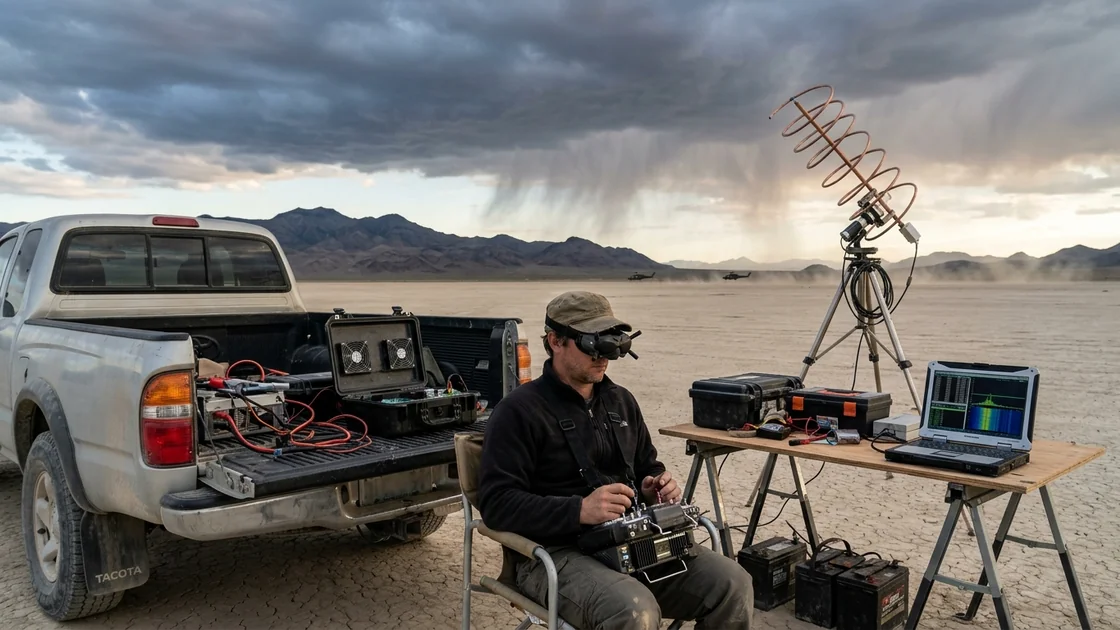
Elias Vance spends his weekends in the high Nevada desert pushing the boundaries of amateur long-range drone flight with a heavily modified radio controller built from salvaged aerospace components. During a flight through an electrically charged cloud deck, his custom transmitter loses connection with his foam wing and inadvertently executes a cryptographic handshake with an unacknowledged hypersonic stealth craft cruising in the stratosphere. Trapped in a failsafe loop, the classified vehicle routes its primary flight controls and synthetic vision feed directly into Elias ground station. As unmarked recovery helicopters and electronic warfare teams converge on his isolated dry lakebed, Elias must figure out how to stabilize the overheating experimental aircraft, guide it back to its shadowy operators, and sever the link before the military permanently silences both the signal and the man holding the sticks.
The wind coming off the Kawich Range did not blow steadily; it arrived in dense, thermal-driven surges that smelled of creosote, alkali dust, and old iron. Elias Vance stood behind the dropped tailgate of his twenty-year-old Toyota Tacoma, squinting through polarized lenses at the leaden belly of an approaching virga squall. Curtains of rain hung suspended beneath a ceiling of bruised cumulus at twelve thousand feet, evaporating completely in the bone-dry desert air before a single drop could strike the cracked clay of the playa.
It was terrible weather for sightseeing, which made it ideal for radio frequency testing. High-altitude moisture gradients and localized static charges created atmospheric ducting—invisible tunnels in the troposphere that could bounce a two-watt signal three times farther than line-of-sight mathematics said it had any right to go.
Elias adjusted the brim of his canvas cap and leaned over his portable workbench. The bench was a sheet of marine plywood laid across two folding aluminum sawhorses, weighted down against the gusts by four spent lead-acid deep-cycle batteries. On the wood sat the airframe: a matte-gray flying wing with a two-meter span, laminated in carbon-kevlar weave and reinforced along the leading edges with titanium sparring. He called it the Cinder-4. Its predecessors, Cinder-1 through 3, were currently scattered across various inaccessible talus slopes between Tonopah and the Quinn Canyon Wilderness, casualties of wind shear, battery brownouts, and one memorable encounter with a territorial golden eagle.
Beside the wing sat the true centerpiece of his obsession. It did not look like a commercial hobbyist radio controller. It had begun its life five years ago as the milled magnesium housing of an industrial crane remote, which Elias had gutted, sandblasted, and rebuilt from the circuit board up. The gimbals were non-contact Hall-effect sensors cannibalized from a retired flight simulator in Wichita, offering zero physical friction and twelve-bit resolution per axis. Bolted to the back of the magnesium shell was an oversized aluminum heatsink, its fins anodized black, cooling a custom software-defined radio module that Elias had spent fourteen months soldering under a stereomicroscope.
Inside that module beat the heart of the unit: a radiation-hardened field-programmable gate array—an FPGA chip bearing no commercial serial numbers, only a laser-etched lot code and a faded inspection stamp from a defunct subcontractor in Palmdale. Elias had bought the board for forty dollars out of a plastic tote at an estate sale in Quartz Hill, the property of a deceased telemetry engineer who had spent the nineteen-nineties commuting on unmarked twin-turboprops out of Plant 42.
At the time, Elias had only cared about the board’s clock speed and its astonishingly clean phase-noise floor. When he dumped the chip’s non-volatile flash memory on his home bench in Reno, he had found sixteen megabytes of undocumented lookup tables and a state-machine architecture that handled frequency-hopping spread spectrum faster than anything in the amateur radio handbook. Rather than wipe the legacy gate logic—a task that would have required proprietary compiler keys he did not possess—Elias had simply written a wrapper around it in Verilog. He fed his standard open-source MAVLink drone commands into the input pins, let the mysterious Palmdale logic scramble, interleave, and modulate the packets across the S-band and L-band spectrums, and used a paired sister board inside his drone to decode them on the other end.
It was massive overkill for flying a foam-and-carbon wing over empty sagebrush. It was also the only rig in the state of Nevada that could punch clean digital video and sub-millisecond stick control through forty miles of granite mountain ridges.
Elias checked his wristwatch. It was 15:40. He had roughly two hours of usable daylight left before the sun dropped behind the ridges to the west and the desert temperature plummeted thirty degrees.
He flipped the master toggle on the ground station case bolted to his truck’s bed rail. A pair of high-velocity server fans spun up with a high-pitched whine, pulling cool desert air across the power amplifiers. On the tripod twenty feet away, his custom helical tracking antenna—a six-foot spiral of copper tubing mounted on a dual-axis stepper gimbal—whirred to life, executing its calibration sweep. It dipped toward the horizon, rotated three hundred and sixty degrees with mechanical precision, and locked onto the low-power beacon emanating from the Cinder-4 on the table.
"Alright," Elias muttered to himself, his voice swallowed immediately by the vast, flat emptiness of the basin. "Let's see what the inversion layer is doing."
He plugged the twin lithium-ion flight packs into the wing’s power distribution bus. The carbon hatch clicked shut over the fuselage bay. A three-tone chime sounded from the brass piezo buzzer buried in the wing’s nose, followed by the sharp twitch of the elevons as the onboard flight controller initialized its gyroscopes.
Looking down at the seven-inch high-brightness monitor mounted to the top of his magnesium transmitter, Elias watched the telemetry fields populate.
SAT_LOCK: 19. HDOP: 0.6. V_BATT: 25.1V. RSSI: 99%. LINK_STATE: PALMDALE_WRAP_ACTIVE.
He lifted the Cinder-4 with his right hand, gripping the textured launch notches molded into the center-of-gravity belly pan, while cradling the heavy transmitter against his chest via its tactical harness. He walked thirty paces out onto the hardpan, turning his face directly into the teeth of the wind. Dust devils danced a mile to the north, thin pale columns spinning lazily beneath the dark canopy of the virga.
With his left thumb, he clicked the arming switch and pushed the throttle stick to eighty percent.
The rear-mounted brushless motor screamed, the folding carbon propeller snapping open with a sharp crack as it bit into the thin five-thousand-foot air. Elias took two running steps and hurled the wing upward at a thirty-degree angle.
The Cinder-4 dipped once under the torque of the motor, caught the headwind, and shot skyward like a loosed arrow. Elias didn't bother watching it with his naked eyes for more than five seconds; within moments, the matte-gray silhouette was indistinguishable from the slate-colored clouds above. He walked briskly back to the tailgate, lowered himself into a canvas camp chair, and pulled his digital video goggles down over his eyes.
Instantly, the dry lakebed vanished, replaced by the crisp, wide-angle perspective of the starlight camera mounted in the wing’s nose.
Through the goggles, the world was rendered in high-contrast clarity, overlaid with white alphanumeric telemetry blocks around the periphery of his vision. Below him, the Tacoma was already a miniature silver rectangle beside a thread-like dirt track, shrinking rapidly as the altimeter tape on the right side of the display scrolled upward. Two thousand feet above ground level. Three thousand. Four thousand five hundred.
The air got bumpy near the base of the virga. Through the Hall-effect sticks, Elias couldn't feel physical resistance, yet decades of muscle memory translated the sudden roll-and-pitch twitches of the horizon line directly into his fingertips. He worked the right stick with microscopic movements, smoothing out the turbulence that the onboard PID controller didn't immediately dampen. The current draw hovered at a respectable fourteen amps as he established a wide, spiral climb toward the cloud deck.
At eleven thousand feet above sea level—six thousand above the playa—the nose camera pierced the first ragged wisps of moisture. The world turned the color of wet cement. Visibility dropped to zero, save for the faint orange glow of his wingtip navigation strobes reflecting off the dense micro-droplets.
Inside the clouds, the static charge was palpable even through the telemetry link. The noise floor bar at the bottom of his screen—usually a flat green line hovering around minus-110 dBm—began to dance with jagged yellow spikes. Broad-spectrum RF hash generated by triboelectric friction—ice crystals and dust rubbing together in the violent updrafts of the dry thunderstorm—was flooding the S-band.
"Come on, keep hopping," Elias murmured, watching the link quality indicator.
The Palmdale FPGA did what it was built to do. As the static spikes rose on the 2.4-gigahertz band, the chip seamlessly shifted its carrier wave down into the 1.3-gigahertz amateur band, then down again into the 900-megahertz ISM frequencies, splitting the data stream across four simultaneous sub-carriers and reassembling them on the ground before the video decoder could drop a single frame.
At sixteen thousand feet, the Cinder-4 burst through the top of the cloud layer.
Elias let out a slow breath he hadn't realized he was holding. Even after a thousand flights, the transition never lost its magic. Below the wing lay a boiling, undulating ocean of pewter and charcoal clouds stretching fifty miles in every direction, framed only by the jagged, snow-streaked tooth of Mount Jefferson far to the northwest. Above him, the sky was a deep, stratospheric cobalt, curving upward toward the early afternoon stars that were almost visible in the thin, dry air. The sun, hidden down on the basin floor, blazed here with an unfiltered, clinical brilliance that sent the camera’s auto-exposure scrambling to step down the iris.
He trimmed the throttle back to forty percent, settling into a sixty-knot cruise heading south-southwest, parallel to the boundary line of the Nevada Test and Training Range. He was twelve miles clear of the restricted airspace border—a hard invisible wall he never crossed. Elias liked building illegal transmitters, not sitting in federal holding cells in Las Vegas.
For ten minutes, he simply flew. He watched the battery voltage sag slowly to 23.4 volts. The wing was now eighteen miles out from the truck, cruising smoothly above the cloud anvil. The copper helical tracker on the tripod behind him ticked quietly every few seconds, making tiny fraction-of-a-degree azimuth adjustments to keep its high-gain beam pinned to the distant speck of foam.
Then, at 16:02, the waterfall display on his auxiliary laptop screen went white.
Elias frowned, pushing his goggles up onto his forehead to look directly at the Panasonic Toughbook sitting on the workbench beside his transmitter. The laptop was running a wideband spectrum analyzer connected to a secondary omnidirectional discone antenna. Normally, the waterfall showed the quiet desert spectrum: a few thin vertical ribbons down in the VHF band from civil aviation traffic out of Tonopah or Beatty, the steady pulse of his own outgoing control link, and nothing else.
Right now, a massive, synchronized wall of energy was sweeping downward from the X-band through the C-band and straight into the S-band.
It didn't look like jamming. Jamming was ugly—fat, noisy blocks of barrage power designed to drown out receivers through sheer brute force. This was geometric. It looked like a digital comb, thousands of razor-thin carrier spikes spaced exactly 12.5 kilohertz apart, pulsing in a complex, cascading polyrhythm that lasted precisely four hundred milliseconds before vanishing.
Two seconds later, it happened again. Closer in frequency this time.
"What the hell is that?" Elias reached out and tapped the laptop’s touchpad, zooming in on the 2.2-gigahertz military telemetry band.
Before the screen could redraw, the speaker on his magnesium transmitter emitted a harsh, synthetic screech—a sound it wasn't programmed to make because the audio circuit was only wired to play simple WAV files off an SD card.
His goggles, still resting on his forehead, flashed brilliant magenta and went black.
On the transmitter’s seven-inch daylight screen, the telemetry values from the Cinder-4 froze.
RSSI: 0%. LINK_STATE: LOST_CARRIER.
"No, no, no," Elias said, sitting up straight and grabbing the transmitter with both hands. If he lost link out at eighteen miles, the Cinder-4's onboard flight controller would wait three seconds, enter Return-to-Home mode, and turn back toward the playa. That was fine, except the wind had shifted ten knots stronger since launch, and an automated straight-line return through the turbulent core of the virga cell would likely rip the wings off the fuselage or drain the batteries before it cleared the ridge.
He reached for the recessed tactical button on the back of the transmitter case—the manual override that would force the Palmdale FPGA out of its adaptive frequency-hopping mode and lock it onto a single, high-power 915-megahertz recovery channel at five watts.
His finger pressed the button. Nothing happened.
The green status LED on the aluminum module housing on the back of his radio had turned solid amber. Elias had never seen that LED turn amber. He didn't even know it was a bi-color diode; when he’d mapped the pinouts three years ago, that indicator had only ever lit up green for power-on.
On the Toughbook screen, his outgoing signal—the signal coming from the six-foot copper helix on the tripod twenty feet away—suddenly spiked in output power, pulling thirty amps straight from the lead-acid batteries on the bench. The cooling fans on the ground station case roared to maximum RPM, screaming like a small jet engine.
And the antenna tracker moved.
It did not sweep left or right to search for the lost Cinder-4. Instead, the heavy elevation stepper motor groaned under load and tilted the six-foot copper helix upward. Up past the twelve-degree horizon angle where his wing had been. Up past forty-five degrees. It stopped at seventy-eight degrees of elevation, pointing almost straight up into the dark belly of the storm clouds directly overhead, and began tracking smoothly from north to south at an angular velocity that made the belt drives sing.
Elias stared at the antenna, then down at his transmitter screen.
The black screen flickered. Lines of raw hexadecimal code—green phosphor characters in a primitive, blocky bitmap font that definitely did not come from his open-source firmware—began cascading down the left margin of the display.
SYNC_WORD_ACQUIRED: 0x7F9A_E401
CRYPTO_STATE: LEGACY_RECOVERY_ROM_04
CHALLENGE_AUTH: VALIDATED [PALMDALE_LOT_98B]
PRIMARY_SAT_LINK: DEGRADED / IONOSPHERIC_SCINTILLATION
FAILSAFE_DIRECTIVE: HANDOVER_TO_LOCAL_GROUND_NODE
BINDING_LOCAL_TX... BOUND.
The hexadecimal scroll vanished. The standard telemetry overlay of his transmitter reappeared, because his main processor was still dutifully trying to parse whatever serial data came out of the Palmdale FPGA's output pins and map it to its pre-programmed gauges.
Except the numbers inside the gauges had lost their minds.
Elias looked at the altitude readout. It didn't say 16,200 feet anymore.
ALT_MSL: 94,850 FT.
His eyes snapped to the groundspeed indicator. The Cinder-4 stalled at twenty-two knots and broke apart at ninety.
GSPEED: 2,410 KTS.
Two thousand four hundred and ten knots. That was more than forty miles a minute. That was Mach 4.2.
V_BATT: 412.8V. CURR_DRAW: 1,840.0A. TEMP_INTERNAL: 940°C. HEADING: 194°.
"It’s a parsing error," Elias said aloud, though the words felt hollow in his throat. "The buffer overflowed. It's reading garbage bytes as floats."
If it were garbage bytes, the numbers would be jumping randomly between negative infinity and sixty-five thousand every millisecond. These numbers weren't random. They were rock steady. As he watched, the altitude ticked smoothly from 94,850 to 94,865, then 94,880. The heading held locked at 194 degrees with military precision. The current draw fluctuated slightly between 1,835 and 1,845 amps in a rhythmic, breathing cycle that looked unsettlingly like a closed-loop magnetohydrodynamic bypass regulation curve.
Slowly, with a hand that had gone cold despite the wool fingerless gloves he wore, Elias reached up and pulled his digital goggles back down over his eyes.
He expected static. Or a blank screen.
Instead, he was looking down at the Earth from the edge of space.
It wasn't a standard optical video feed. There was no color, at least not in the human spectrum. The image was a composite—a razor-sharp, high-frame-rate synthesis of short-wave infrared, millimeter-wave radar returns, and starlight intensification, stitched together into a seamless hemispherical projection that responded to the tiny tilt sensors in his goggles' head-tracker.
Below him, the virga storm that had covered his entire world from horizon to horizon was nothing more than a flat, cottony smudge no bigger than a thumbprint, glowing dull gray in the thermal spectrum. Beyond it, the topography of the American Southwest lay exposed like an anatomical dissection. He could see the entire spine of the Sierra Nevada mountains two hundred miles to the west, their snowcaps blazing white-hot in the inverted infrared palette. He could see the dark, cold curve of the Pacific Ocean beyond Monterey. Turning his head slightly to the left, he saw the unmistakable geometric scar of Groom Lake and the pockmarked craters of Yucca Flat, rendered with such terrifying resolution through thirty miles of atmosphere that he could make out the warm thermal signatures of guard shacks along the perimeter roads.
And stretching out in front of the camera—forming a sharp, arrowhead silhouette at the bottom center of his field of view—was the nose of the aircraft.
It was thirty feet of black, faceted composite material, glowing a angry, incandescent cherry-red along its razor-thin chine lines from the friction of compressing the thin stratospheric air at four times the speed of sound. Shimmering waves of ionized plasma trailed backward from the leading edges, bending the starlight above when Elias tilted his head upward.
He wasn't looking at a simulation. He wasn't looking at a relay satellite.
His forty-dollar scrap-bin circuit board had heard an distress beacon from a crippled black-project testbed flying ninety-five thousand feet above Nevada. And because that board contained a hard-coded emergency recovery key from a twenty-five-year-old Skunk Works or Northrop legacy protocol, the aircraft’s computers had just decided that Elias Vance, sitting in a canvas camp chair behind a 2004 Toyota Tacoma, was the commanding officer of its emergency landing detachment.
A new line of text flashed across the center of his goggles, accompanied by a rhythmic, low-frequency pulse in his headphones.
WARNING: PRIMARY KU-BAND SATCOM OFFLINE [PLASMA SHEATH ATTENUATION]
WARNING: INERTIAL NAVIGATION DRIFT EXCEEDS CORRIDOR TOLERANCE [0.42 NM]
MANUAL TRIM AUTHORITY GRANTED TO AUX_GCS_09.
AWAITING VECTOR CORRECTION.
Elias sat completely frozen, his thumbs hovering a quarter-inch above the anodized aluminum sticks of his transmitter.
"Don't touch anything," he whispered. "Just turn the power off. Pull the battery lead."
His right hand left the stick and reached toward the heavy red Anderson Powerpole connector feeding the ground station amplifier on the tailgate. His fingers brushed the plastic housing.
As soon as his palm shadowed the transmitter's front panel, a secondary diagnostic box expanded in the lower right corner of his goggles. It was a state-tree diagram—the kind aerospace engineers used to visualize automated flight termination systems. He had written simpler versions of them when he worked as a contractor for a commercial satellite launch startup in Mojave six years ago, before the company folded and he retreated to Reno to repair medical imaging equipment for a living.
The diagram was simple, cold, and unmistakable.
NODE_STATUS: AUX_GCS_09 [ACTIVE]
HEARTBEAT_TIMEOUT: 1.500 SEC
ON_LOSS_OF_HEARTBEAT -> EXECUTE ZEROIZE_AND_TERMINATE [FTS_ARMED]
Elias’s hand stopped dead on the red plastic plug.
Zeroize and terminate.
When an unacknowledged stealth aircraft lost both its primary satellite link and its emergency line-of-sight recovery ground station while drifting outside its designated test corridor, it did not politely glide down to the nearest municipal airport so airline passengers could snap photos of it with their phones. It wiped its cryptographic memory banks and detonated a linear shaped charge wrapped around its central structural keel, turning ten billion dollars of exotic materials sciences into confetti at ninety-five thousand feet.
Elias looked at the navigation map overlaid on the synthetic radar feed. At Mach 4.2, travelling on a heading of 194 degrees, the craft’s debris footprint wouldn't fall into the empty ranges of the Nevada Test Site. With the high-altitude jet stream screaming out of the west at a hundred and ten knots, a structural breakup right now would rain burning chunks of depleted-uranium ballast, hydrazine tanks, and radioactive thermal generators across a sixty-mile ellipse stretching straight across Highway 95 and into the northern suburbs of Las Vegas.
And even if the debris missed the highway, the moment that thing detonated, every defense radar, infrared launch-detection satellite, and electronic intelligence platform in the Western Hemisphere would triangulate the final millisecond of the uplink carrier wave that had triggered the termination command.
That carrier wave was currently blazing out of a six-foot copper spiral bolted to a tripod twenty feet from his rear bumper.
Elias slowly pulled his hand back from the power plug. His heart was hammering against his ribs with such violence he could see his pulse shaking the edges of his vision.
"Okay," he breathed, the desert air suddenly feeling as thin as the stratosphere on his screen. "Okay, think. Read the telemetry. Why did it drop out of satellite lock?"
He scanned the dense columns of raw engineering data crowding the margins of his display. Most of the acronyms were opaque military shorthand, but physics was universal. Temperature, pressure, voltage, and Mach number didn't care about security clearances.
On the left side of the HUD, a cluster of thermal readings labeled
AFT_CHINE_L and INLET_COWL_2 were blinking
amber. The craft was powered by some kind of combined-cycle
engine—probably a dual-mode scramjet that transitioned from turbine
power at Mach 2.5. Right now, one of the variable-geometry inlet ramps
on the port side was stuck three degrees over-closed.
Because the ramp was slightly choked, a standing shockwave had formed three inches forward of the engine lip instead of swallowing cleanly inside the combustor. That displaced shockwave was superheating the airframe’s port side to nearly twelve hundred degrees Celsius, generating a thick, asymmetric blanket of ionized gas—plasma—that was wrapping around the upper fuselage Spine where the Ku-band satellite dish was buried beneath the stealth skin.
Plasma was conductive. To high-frequency Ku-band satellite signals, a dense sheet of ionized gas might as well be a three-foot wall of solid lead. The craft had blinded its own upward-looking antennas with its own shockwave.
In response, its onboard autonomous fault-protection logic had reached down into the lower frequencies—the S-band and L-band antennas mounted on the cooler belly of the aircraft, which could punch downward through the thinner bottom boundary of the plasma sheath. It had broadcast an ancient, high-power emergency wake-up call across the desert floor, looking for a mobile recovery van from Groom Lake.
Instead, it had found Elias Vance’s forty-dollar FPGA, which was already screaming into the storm clouds on the exact same mathematical polynomial, trying to find a lost foam airplane.
And the drift warning? Because the port inlet was creating slightly more drag than the starboard inlet, the aircraft was yawing microscopically to the left—pulling it half a mile outside the razor-thin invisible box the Air Force had drawn for it in the stratosphere.
In thirty-eight seconds, at its current rate of yaw drift, it was
going to cross the hard boundary line of its flight corridor. And the
state-tree diagram in the corner of his goggles made it clear what
happened if CORRIDOR_EXCEEDANCE reached TRUE
without a manual steering correction from the active ground station.
It would blow itself up anyway.
Elias placed his thumbs squarely on the Hall-effect gimbals of his magnesium transmitter.
"Just a trim correction," he told himself, his voice cracking slightly. "It's a fly-by-wire airframe. You aren't moving the control surfaces directly; you're just feeding an attitude demand into the flight computer. Just like ArduPilot. Just four thousand miles an hour faster."
He didn't dare touch the main stick deflection. At Mach 4.2, a two-degree deflection of a control surface would generate enough aerodynamic load to shear the wings off like wet cardboard. The flight computer would almost certainly filter out a gross stick movement anyway, treating it as a hardware fault.
Instead, his right index finger found the digital trim rocker switch beside the aileron gimbal. Each click of the micro-switch sent a single least-significant-bit offset—roughly 0.02% of full scale—down the uplink.
Click.
He watched the telemetry screen. The uplink packet counter incremented. Nineseteen miles up in the dark cobalt sky, the six-foot copper helix on his tripod pumped a burst of encrypted S-band energy straight through the virga clouds.
There was a latency of roughly a hundred and forty milliseconds—not from distance, which was less than a millisecond at the speed of light, but from the heavy cryptographic interleaving and the time it took the aircraft’s triple-redundant flight computers to vote on his input.
On the HUD, a tiny caret labeled CMD_YAW_BIAS shifted
0.05 degrees to the right.
Deep in the stratosphere, an electro-hydrostatic actuator inside the stealth craft’s tailless trailing edge adjusted a split-ruddervator by less than the thickness of a dime.
Elias held his breath, staring at the CORRIDOR_DRIFT
counter.
0.46 NM... 0.47 NM... 0.47 NM...
The number stopped climbing.
He clicked the trim rocker twice more to the right. Click. Click.
Slowly, fighting the immense gyroscopic inertia of a thirty-ton dart travelling faster than a rifle bullet, the heading indicator ticked from 194.2 degrees back to 194.4. The drift counter began to unwind.
0.46 NM... 0.44 NM... 0.41 NM...
When the number dropped below 0.40, the flashing amber warning box in the center of his goggles extinguished.
Elias let out a ragged gasp, his shoulders slumping against the canvas back of the camp chair. "It took it," he whispered in disbelief. "The flight computer actually accepted the trim."
Before he could even begin to process what that meant, the second screen on his workbench—the Toughbook running the wideband spectrum analyzer—flashed crimson and emitted a sharp proximity alarm that Elias had programmed six months ago to warn him if low-flying crop dusters or military jets turned on their radar altimeters near his flight operations.
He pushed his goggles up an inch and squinted at the laptop.
The waterfall display was no longer showing the strange harmonic comb from the stealth craft overhead. The stealth craft was now locked in a narrow, directional beam aimed solely at his copper helix.
What had triggered the laptop’s alarm was coming from the south, down near the horizon, bouncing off the granite flanks of the Belted Range twenty-two miles away.
Three distinct emitter signatures had just popped up on the 4.3-gigahertz radar altimeter band, accompanied by a wideband, frequency-agile tactical data link operating in the upper UHF spectrum. And riding right on top of them was the unmistakable, rhythmic chirp-chirp-chirp of an AN/APR-39—a military airborne direction-finding receiver system designed to locate, classify, and geo-locate hostile ground transmitters within half a degree of accuracy.
They weren't flying at ninety-five thousand feet. According to the Doppler shift on their radar altimeters, they were flying at two hundred feet above the sagebrush, moving north up the valley at a hundred and sixty knots.
Helicopters. Fast ones. Probably Sikorsky HH-60G Pave Hawks or blacked-out UH-60Ms out of the Tonopah Test Range or Groom Lake’s security detachment, scrambled the exact second their prize test article dropped off the satellite grid and began gossiping on an S-band recovery channel with an unauthorized node in the middle of the public Bureau of Land Management desert.
Twenty-two miles at a hundred and sixty knots.
Elias did the math in his head. Eight minutes. In eight minutes, those helicopters would crest the low volcanic saddle at the southern lip of the alkali flat, and their forward-looking infrared turrets would spot his silver Tacoma and a glowing hot six-foot copper antenna sitting in the middle of a dead-flat white pan with nowhere to hide for fifteen miles in any direction.
"Think, Elias, think!" he barked at himself, scrambling out of the camp chair while keeping the heavy transmitter lanyard looped securely around his neck.
Could he just set the transmitter down on the workbench, leave the ground station running on the lead-acid batteries so the aircraft wouldn't self-destruct, jump in his truck, and drive away?
He looked at his truck. The ground station’s main power amplifier and the step-down voltage converters were bolted directly into the bed rails of the Tacoma, wired into the truck’s dual-alternator system via a heavy-duty marine harness. Only the auxiliary buffer batteries sat on the wooden bench. To leave the rig behind, he would have to unbolt the amplifier rack, disconnect the coaxial feed lines from the tripod, and re-wire the power bus without interrupting the 1.5-second heartbeat signal for even a fraction of a second.
It was impossible. If he disconnected the coax to move the antenna, the link would drop, the stealth craft would detonate ninety-five thousand feet above the desert, and the men in those helicopters would watch the fireball on their sensors while staring directly at the license plate of his fleeing pickup truck.
And even if he stayed right here with his hands raised when they landed, what was going to happen when the aircraft reached the southern end of its flight corridor in four minutes?
He pulled the goggles back over his eyes and zoomed out on the synthetic tactical map.
At Mach 4.2, the aircraft was covering nearly a mile every second. The red boundary box of the Nevada Test and Training Range—and the adjacent Mojave supersonic corridor—was less than two hundred andfifty miles long. In roughly three and a half minutes, the craft was going to hit the southern wall of its restricted airspace box, just north of the civilian airliner tracks feeding into Los Angeles and Phoenix.
Normally, the aircraft’s onboard autonomous mission manager would execute a banked, four-G hypersonic turn at the southern waypoint to loop back north toward Groom Lake.
Except the mission manager's status line at the top of Elias’s screen read:
AUTO_WAYPOINT_SEQ: SUSPENDED [AWAITING AUX_GCS_09 OVERRIDE]
INLET_2_THERMAL_CRITICAL: 1,290°C [MAX_ALLOWABLE: 1,350°C]
Because the port engine inlet was choking and overheating, the autonomous computer had aborted its pre-programmed turn sequence—likely because banking into a four-G turn while one engine inlet was experiencing a displaced shockwave would cause an instant asymmetric flameout, what aerospace engineers called an unstart. At Mach 4, a single-engine unstart on a twin-inlet waverider would snap the nose ninety degrees sideways in a tenth of a second, disintegrating the airframe under twenty Gs of lateral aerodynamic shear before the self-destruct charges could even fire.
The computer didn't know how to clear the choked inlet on its own, so it had dumped the problem into the lap of the emergency ground station. And the true operators at Groom Lake couldn't talk to the plane because the plasma sheath from that very same overheated inlet was blocking their satellite link from above, while the mountain ranges of the Great Basin blocked their ground-based S-band antennas from below.
Elias was directly underneath the aircraft’s flight path. He was the only person on Earth with a clean line-of-sight angle into the bottom of its communications cone.
And as the craft raced southward at forty miles a minute, that cone was moving rapidly away from him. The copper helix on his tripod was already tilting downward from seventy-eight degrees to forty-two degrees as it tracked the departing vehicle toward the southern horizon. In three minutes, the craft would drop low enough on his horizon that the thicker lower atmosphere and the southern mountains would sever his link too.
"I have to clear the shockwave," Elias said, his voice dropping into the flat, hyper-focused cadence he used when troubleshooting a high-voltage linear accelerator at the hospital while surgeons waited in the hallway. "If I clear the inlet shockwave, the skin temperature drops. If the skin temperature drops, the plasma sheath dissipates. If the plasma sheath dissipates, the satellite link comes back online, the primary GCS at Groom Lake takes back authority, and my station gets kicked off the bus as redundant."
Once his station was kicked off the bus as redundant, the
HEARTBEAT_TIMEOUT failsafe would transfer back to the
satellite link. He could yank his coax cables, throw the tripod in the
truck bed, and vanish into the cedar canyons on the back side of the
Kawich Range before those helicopters cleared the valley floor.
Seven minutes and ten seconds until the helicopters had line of sight.
Two minutes and forty seconds until the stealth craft either melted its port wing spar, hit the civilian airspace boundary, or dropped below his radio horizon.
Elias dropped back into the camp chair, planting his boots wide in the alkali dust. He ignored the physical world entirely, submerging his consciousness into the monochromatic synthetic vision of the goggles.
"Show me the propulsion page," he muttered, his left fingers dancing across the custom six-position rotary encoder he had wired into the top left shoulder of his magnesium radio. In his normal drone firmware, that switch cycled through different OSD layouts—cruising, thermal hunting, battery diagnostics, and waypoint mapping.
Because the Palmdale FPGA was mapping its internal state registers directly onto his MAVLink telemetry channels, flipping the rotary switch to Position 4 caused the display to redraw instantly.
A schematic wireframe of the aircraft’s internal geometry popped up in the center of the HUD. It was a breathtaking piece of engineering: a blended-wing-body diamond with twin dorsal-mounted inward-turning inlets feeding a dual-mode ramjet/scramjet propulsion system, flanked by two smaller bypass turbines that were currently cocooned behind sealed titanium louver doors to keep them from melting in the hypersonic airflow.
The port inlet—INLET_2—was flashing red.
SHOCK_POS: +3.4 IN [DISPLACED_FWD] COWL_ACTUATOR_B: JAMMED [THERMAL_BINDING] SKIN_TEMP: 1,318°C
Thirty-two degrees below structural failure of the carbon-silicon-carbide matrix.
"The actuator is thermally bound," Elias analyzed rapidly, his eyes darting across the pressure ratios. "The titanium ramp expanded from the heat of the shockwave, and now the electric jackscrew doesn't have the torque to force it open against the Mach 4 ram-air pressure."
How do you un-choke a supersonic inlet when the mechanical ramp is stuck?
You change the local Mach number and the angle of attack at the lip of the intake. If he slowed the aircraft down, the shockwave angle would widen, which would only push the shock farther forward and make the spill worse. To swallow a displaced shockwave back into the throat of a fixed-geometry scramjet, you actually had to momentarily decrease the local static pressure inside the diffuser or increase the local Mach number across the cowl lip while unloading the boundary layer.
Wait. There was a boundary-layer bleed valve. Every supersonic inlet since the SR-71 Blackbird had porous bleed ducts or bypass doors inside the throat to suck away the turbulent, stagnant air clinging to the walls so the shockwave could snap back into place.
His eyes scanned the schematic for INLET_2. There it
was: BLD_VALVE_2A: AUTO_CLOSED [88% CAPACITY].
Why was the bleed valve closed when the inlet was choking? Because the automated computer was reading the low pressure behind the displaced shockwave and mistakenly thinking the engine was starved for mass flow! It was a classic sensor-placement logic trap: the static pressure port inside the throat was reading low pressure because the shockwave had popped out the front, so the computer pinched the bleed doors shut to save air, which only trapped a high-pressure bubble in the diffuser and kept the shockwave locked outside on the nose chine!
"Idiot software engineers," Elias hissed. "Even with a black budget, they still don't test edge-case sensor inversions."
He needed to force BLD_VALVE_2A wide open while
simultaneously executing a micro-sideslip—yawing the nose two tenths of
a degree to the left, directly into the bad engine, to ram the
oblique shockwave off the sharp leading-edge chine and force it back
down the throat of the intake.
How were the auxiliary flight controls mapped to his sticks?
He looked at the raw channel monitor bar at the bottom of the
schematic. His four primary gimbal axes—Aileron, Elevator, Throttle,
Rudder—were mapped to ROLL_BIAS, PITCH_BIAS,
FUEL_EQUIV_RATIO, and YAW_BIAS.
Channels 5 through 8—his auxiliary switches and the two proportional side-sliders under his index fingers—were mapped to engine management registers.
He twitched his left index finger on the proportional slider on the
side of the radio case. On the schematic, the value for
AUX_OVERRIDE_REG_06 ticked from 00 to
14, and a cursor box highlighted the propulsion
sub-menu.
"Yes!" Elias breathed. He used the right trim switch to move the
cursor box down to BLD_VALVE_2A_MODE, then flipped his
three-position flight-mode toggle switch from middle to top.
On the HUD, BLD_VALVE_2A flashed from AUTO
to MAN_SLAVE_CH7.
Channel 7 was his right-hand index slider.
He glanced up past the rim of his goggles for half a second. Far to the south, where the alkali flat met the dark volcanic rise of the Kawich foothills, a faint smudge of brown dust was rising just behind the ridgeline. Rotor wash. The Pave Hawks were flying nap-of-the-earth right up the dry wash. Five minutes out. Maybe four and a half.
On his tripod, the copper helix groaned as it tilted down to thirty-one degrees elevation. The stealth craft was now sixty miles south of him, hurtling toward the Las Vegas range border at over a mile a second. The RSSI—received signal strength indicator—had dropped from 99% to 64% as the slant range increased through the wet, electrically charged belly of the storm clouds.
SKIN_TEMP: 1,339°C.
Eleven degrees from structural delamination.
"Hold together, you magnificent bastard," Elias whispered.
With his right index finger, he shoved the Channel 7 proportional slider all the way to the top stop, commanding the internal boundary-layer bleed louvers inside the port engine throat to blow wide open, dumping the stagnant high-pressure air pocket straight out the dorsal exhaust gills.
At the exact same instant, he pushed the left gimbal—the yaw stick—smoothly to the left by five percent, while nudging the pitch stick forward to drop the nose half a degree and unload the wing’s angle of attack.
One hundred andforty milliseconds of latency.
Then, ninety-four thousand feet above the desert, all hell broke loose on his telemetry screen.
As the bleed doors blew open inside the port nacelle, the sudden violent decompression inside the intake diffuser acted like a vacuum cannon. The yaw input swung the incandescent red nose chine zero-point-three degrees into the Mach 4.2 airstream.
Through his synthetic vision goggles, Elias actually saw it happen. The shimmering, blinding white veil of ionized plasma that had been streaming back over the port wing root like liquid fire suddenly snapped inward with the speed of a lightning bolt.
A massive pressure spike hammered the engine combustor as the supersonic shockwave was swallowed whole back into the intake throat—a reverse unstart, known in hypersonic wind-tunnel testing as shock ingestion.
The aircraft shuddered violently. On the HUD, the accelerometer spiked to +3.8 Gs lateral and -1.2 Gs vertical. The horizon line in his goggles jerked sideways so hard that Elias’s stomach lurched in his camp chair, his hands tightening instinctively on the magnesium housing as he countered the roll excursion with a lightning-fast jab of opposite aileron bias.
For two agonizing seconds, the telemetry values blurred as the triple-redundant flight computers fought the transient pressure wave rippling through the scramjet combustor.
Then, the numbers settled.
SHOCK_POS: -0.2 IN [NOMINAL_CAPTURED] MASS_FLOW_2: 100.4% [STABLE]
And the temperature gauge on the port chine began to fall like a stone dropped down a mine shaft.
Without the displaced shockwave cooking the exterior skin, the hypersonic airflow at ninety-four thousand feet—where the ambient air temperature was minus fifty-five degrees Celsius—acted as a massive convective cooler.
1,330°C... 1,210°C... 1,040°C... 890°C...
As the cherry-red glow along the nose chine faded back to a dull charcoal gray in the infrared feed, the dense ionized plasma blanket over the upper fuselage evaporated into the thin stratospheric air.
Immediately, a cascade of green status messages erupted across the top of his display.
KU-BAND SATCOM SNR: +18.4 dB [LOCKED]
MILSTAR_RELAY_04: HANDSHAKE_COMPLETE
PRIMARY_GCS_GROOM: ONLINE
WARNING: DUAL_CONTROL_CONFLICT DETECTED [PRIMARY_GCS vs AUX_GCS_09]
"Take it!" Elias shouted at the screen, his heart soaring as he centered his sticks and pulled the Channel 7 bleed slider back to its neutral detent. "It's stable! Take the damn plane back!"
Down at Groom Lake—or inside a subterranean bunker at Creech Air Force Base ninety miles away—a room full of pale-faced test directors and flight control engineers had just seen their multi-billion-dollar ghost ship pop back onto their satellite screens, flying straight and level with a freshly cleared inlet and a manual trim bias coming from an unscheduled S-band ground node in the middle of the Kawich Valley.
Whoever was sitting at the primary console down there didn't waste time asking questions.
PRIMARY_GCS_GROOM -> ASSERTING MASTER AUTHORITY...
OVERRIDE_CODE_ACCEPTED.
AUX_GCS_09 DEMOTED TO PASSIVE_TELEMETRY_MONITOR.
FTS_HEARTBEAT_SOURCE: TRANSFERRED TO PRIMARY_SATCOM.
The amber FTS_ARMED box in the corner of Elias’s goggles
vanished, replaced by a calm green PASSIVE_LISTEN.
Before his eyes, the aircraft banked smoothly onto a forty-five-degree roll angle, pulling a graceful, computer-controlled 3.5-G turn to the east-southeast, carving a wide fifty-mile arc across the stratosphere to head back toward the restricted airspace of the Groom Range.
He was off the hook. The self-destruct timer was no longer tied to his transmitter.
Elias tore the goggles off his head, letting them hang around his neck, and spun around toward the workbench.
Three miles to the south, two low-slung, matte-black helicopters—modified UH-60 Black Hawks bristling with nose-mounted FLIR balls, stub-wing fuel tanks, and blade-type UHF direction-finding antennas—cleared the volcanic saddle at twenty feet above the sagebrush. Behind them, kicking up twin rooster tails of white alkali dust on the old mining road that entered the dry lakebed from the east, were two unmarked white Ford F-350 pickups with heavy steel ranch bumpers and whip antennas bending backward in the wind.
They had triangulated his continuous S-band transmission down to the square meter.
If those helicopters landed and found him standing beside an active six-foot helical tracking antenna wired to a cryptographic Palmdale FPGA board that was currently displaying live synthetic radar video from an unacknowledged Mach 4 reconnaissance craft, Elias Vance was going to disappear into a windowless concrete facility for the rest of his natural life.
He didn't have time to pack the camp chair, the sawhorses, the lead-acid batteries, or the copper antenna. If he tried to load the six-foot helix into the truck bed, they would be hovering thirty feet over his head before he got the tailgate shut.
What mattered? What was the only piece of hardware that proved he hadn't just been flying a hobbyist foam wing when his equipment suffered a catastrophic electrical short?
The Palmdale FPGA board inside his magnesium transmitter, and the Panasonic Toughbook’s solid-state drive. Everything else on the bench—the tripod, the stepper motors, the copper tubing, the linear S-band power amplifier bolted to the truck bed—was standard amateur radio hardware that any licensed Extra-class ham operator could legally own and build from parts on eBay.
Wait—the Cinder-4! Where was his foam wing?
He glanced at the tiny secondary GPS tracker receiver clipped to his belt—a simple, commercial 433-megahertz beacon system completely independent of the Palmdale link. According to the tiny LCD screen, the Cinder-4 had executed its automated Return-to-Home when the primary link dropped ten minutes ago, glided back down through the rain squall, and belly-landed automatically in the soft alkali mud four hundred yards behind his truck.
And inside the Cinder-4 was the sister Palmdale FPGA board—the receiver module.
Wait. No. When the helicopters ran their spectrum analyzers over his camp, they would be looking for the transmitter that had just broadcast five watts of encrypted S-band command data into the stratosphere. The foam wing sitting four hundred yards away was completely powered down; its battery had hit low-voltage cutoff five minutes ago. In the middle of a ten-square-mile dry lakebed littered with old ranching trash and weather balloon remnants, a gray foam hobby wing lying flat in the sagebrush four hundred yards outside the main camp wouldn't draw a second glance from an airborne FLIR turret focused on a hot pickup truck and a spinning antenna tracker.
He had ninety seconds before the Black Hawks reached effective visual range of what his hands were doing.
Elias moved with practiced, ruthless economy.
He did not turn off the ground station amplifier. If the direction-finding receivers on those helicopters suddenly saw the S-band carrier wink out while they were two miles away, they would know he had spotted them and was destroying evidence. Instead, he wanted the equipment on the table to look like it had suffered a violent, accidental over-voltage runaway.
He grabbed the heavy jumper cables hanging off the side of his plywood workbench, clamped the positive lead onto the thirty-amp terminal of the fourth deep-cycle lead-acid battery—wiring all four twelve-volt batteries in series to create a forty-eight-volt arc welder—and jammed the bare copper jaw straight into the twelve-volt power input bus of the tripod’s ground-station junction box.
A blinding blue-white flash lit up the gloom beneath the storm clouds. A crack like a pistol shot echoed across the playa as the main filter capacitors inside the junction box exploded, sending a thick, acrid plume of black electrical smoke billowing skyward into the wind. The copper helical antenna on the tripod jerked convulsively as its stepper motor drivers fried, dropping the nose of the spiral straight down into the dirt.
Before the smoke even cleared the tailgate, Elias used his titanium pocket screwdriver to pop the four quick-release quarter-turn fasteners on the back of his magnesium transmitter.
He had designed the radio to be modular so he could swap between commercial Crossfire modules and his custom SDR boards in the field. He wrenched the hot anodized-black aluminum housing containing the Palmdale FPGA off the back of the transmitter pins, burning his palm slightly on the heatsink.
From underneath his truck seat, he grabbed a stock, unmodified FrSky 2.4-gigahertz hobby module—still covered in dust from two years ago—and slapped it into the bay on the back of his transmitter. He flipped the power switch back on. The transmitter booted into its safe, boring backup partition on the internal SD card, displaying a standard hobbyist splash screen and searching harmlessly for a standard sixteen-channel model receiver.
Now he held the Palmdale module in his left hand, and the ejected M.2 solid-state drive from the side slot of the Toughbook in his right.
One mile out. He could hear the deep, rhythmic thump-thump-thump of the Black Hawks' main rotors tearing through the dense desert air, their turbine whine echoing off the hardpan.
Where do you hide a four-inch circuit board and a stick of flash memory in twenty seconds when you are about to be searched by military intelligence specialists with metal detectors?
You don't hide them on your person, and you don't hide them in your truck.
Elias looked down at the four massive, eighty-pound lead-acid batteries weighting down his workbench. Three of them were sealed AGM units. The fourth—the oldest one on the left end, which he used solely as dead weight and a backup twelve-volt source for his soldering iron—was an old flooded-cell caterpillar tractor battery with six removable plastic vent caps on top.
A metal detector or a handheld nonlinear junction detector—the wands security teams used to find hidden silicon chips and SIM cards—could see through dirt, plastic, leather, and wood. What it could not see through was a dense cage of solid lead plates submerged in sulfuric acid inside a battery casing that was already supposed to register as a massive block of metal and chemical electrolyte.
With ten seconds before the lead helicopter flared into its landing hover, Elias twisted off the two center fill caps of the tractor battery. Using the flat blade of his pocket knife, he pried the Palmdale circuit board out of its aluminum heatsink shell. The board itself was only two inches wide—narrow enough to slip diagonally through the wide industrial inspection port at the top of the cell.
He dropped the M.2 drive and the bare green Palmdale FPGA board straight into the dark, sulfurous bath between the lead plates, screwed the dirty plastic vent caps back down tight, and wiped a smear of alkali mud across the top of the battery case with his thumb to obscure his fresh fingerprints.
As फॉर the empty aluminum heatsink housing? He tossed it directly into the still-burning, smoking wreckage of the tripod junction box, right on top of the arcing forty-eight-volt battery leads. The thin anodized aluminum instantly blistered and melted into an unrecognizable slag of black metal amidst the burning PVC insulation and shattered capacitor cans.
Elias stepped backward, coughing theatricality in the thick white-and-black smoke, holding a small red chemical fire extinguisher he had pulled from his truck bed.
He pulled the pin and blasted the smoking junction box with dry chemical powder just as the lead Black Hawk flared hard fifty yards away.
The rotor wash hit the playa like a hurricane.
A blinding wall of white alkali dust, small pebbles, and pulverized sagebrush roared across the camp, tearing the canvas chair out from behind Elias and tumbling it fifty yards across the clay. Elias dropped to one knee, shielding his eyes with his forearm while clinging to the tailgate of the Tacoma with his other hand.
Through the swirling whiteout, four men dropped from the open cargo doors of the Black Hawk before its landing gear even touched the clay. They wore olive-drab flight suits and desert tan plate carriers with no unit patches, no name tapes, and no rank insignia. Three of them carried short-barreled M4 carbines held at the low ready; the fourth carried a ruggedized silver briefcase wired to a handheld directional antenna wand.
At the same moment, the two white Ford F-350s skidded to a halt forty yards behind the truck, blocking the dirt track out of the basin.
"Hands! Show me your hands! Step away from the vehicle!"
The voice came from everywhere at once, amplified by a loudspeaker mounted on the belly of the hovering second helicopter, which held position a hundred feet overhead at a forty-five-degree bank, a crew chief leaning out the side door with an M240 machine gun pointed at the dirt ten feet in front of Elias's boots.
Elias immediately dropped the fire extinguisher, let the magnesium transmitter hang loosely by its neck strap, and raised both hands high above his head, his fingers spread wide. He made sure his face looked exactly the way an middle-aged medical technician’s face should look when the United States military drops out of a storm cloud onto his weekend camping spot: terrified, bewildered, and choking on dry-chemical fire retardant.
Two of the men in flight suits reached him in three seconds. One of them grabbed Elias by thewrist, spun him smoothly against the side of the Tacoma’s rear quarter panel, and patted him down with fast, professional precision while the second clipped the lanyard of Elias’s transmitter with a pair of trauma shears and carried the radio over to the man with the silver briefcase.
"Who are you guys?" Elias shouted over the deafening roar of the twin GE T700 turbines spooling down to ground idle as the first helicopter settled onto its tailwheel. "Look out for the batteries on the bench! My voltage regulator just shorted out, the whole forty-eight-volt bank is arcing!"
Nobody answered him. The man holding him against the truck didn't put handcuffs on him, just kept a firm, iron grip on the back of Elias’s fleece jacket while checking his wallet, pulling out his Nevada driver's license, his FAA Part 107 remote pilot certificate, and his Amateur Extra class radio license.
A fifth man stepped down from the cabin of the landed Black Hawk. He was older—mid-forties, wearing a dark gray Patagonia softshell jacket over khaki tactical trousers, with a pair of Peltor aviation headsets clamped over cropped silver hair. He didn't carry a rifle. He walked straight through the settling dust cloud toward the workbench, stopping beside the technician with the silver briefcase.
The technician had already plugged a diagnostic ribbon cable into the back of Elias’s magnesium transmitter and was staring at a tablet screen while waving a handheld RF sniffer wand over the smoking, powder-covered mess of the tripod junction box.
The older man in the gray jacket looked at the melted slag of the junction box, then at the six-foot copper helix lying nose-down in the alkali dust, and finally walked over to Elias. He took the wallet and the licenses from the security operator and studied them for ten seconds.
He reached up and pushed one ear cup of his Peltor headset back behind his temple so he could hear Elias clearly over the rotors. His eyes were pale blue, bloodshot from staring at radar consoles in dark rooms, and utterly devoid of humor.
"Elias Vance," the man said. His voice was surprisingly quiet, forcing Elias to strain to hear him. "Born in Boise. Three years at a sub-orbital launch startup in Mojave, laid off in twenty-nineteen. Currently employed by Sierra Nevada Regional Medical Center in Reno maintaining radiation therapy linear accelerators."
It had taken them less than four minutes in the air to run his license plate through the NRO or NSA databases and pull his entire adult biography.
"That's right," Elias said, keeping his voice shaking just enough to sell the adrenaline without sounding rehearsed. "Am I inside the Test Site boundary? My GPS said I was twelve miles west of the line! I swear I wasn't trying to fly into restricted airspace—"
"What were you flying, Mr. Vance?"
"A two-meter foam wing! A ZOHD copy I laminated in carbon fiber," Elias babbled, gesturing vaguely toward the dark clouds overhead. "I was testing a high-gain helical antenna tracker on the 1.2 and 2.4 gigahertz bands—I have an Extra class ham license, it's right there in my wallet! I caught a huge static discharge coming off the virga cell, my video screen went white with some kind of crazy harmonic interference, and then my ground station controller shorted out the step-down converter on the battery bank and caught fire!"
The older man didn't blink. He turned his head toward the technician with the silver briefcase. "Miller?"
The technician looked up from the smoking workbench, wiping white fire-extinguisher powder off the tip of his nonlinear junction detector wand. "The ground station amp is completely cooked, Boss. Looks like a forty-eight-volt dead short straight across the S-band exciter bus. The filter caps blew the circuit board inside the junction box into charcoal. As for his handheld radio..."
Miller held up the magnesium transmitter with the dusty FrSky module popped out of the back. "Custom Hall-effect gimbals in an industrial housing, running a modified build of EdgeTX. The RF module on the back is a standard commercial 2.4-gigahertz hopping module. The Toughbook on the bench has no hard drive—slot's empty."
The older man’s pale eyes came back to Elias. "Where is the hard drive for the laptop, Mr. Vance?"
"I don't use a hard drive in the field!" Elias lied smoothly, using a truth that many amateur radio operators actually practiced. "The dust and vibration on the washboard roads out here kills SSDs and loose connectors. I boot a lightweight Linux spectrum analyzer straight off a RAM-disk image over my phone’s hotspot before I leave town! When the power cable shorted out when the batteries blew, the laptop rebooted into BIOS because the RAM cleared!"
Miller tapped the keyboard of the Toughbook on the bench, where the black-and-white BIOS "No Bootable Device Found" screen was indeed flashing harmlessly. He nodded once to the older man. "Checks out. The RAM was volatile. Whatever was on the waterfall display wiped when the twelve-volt rail surged."
The older man didn't look convinced. People who ran unacknowledged recovery teams out of the Nellis Range complex didn't get to their positions by believing in coincidences.
"Fourteen minutes ago," the man in the gray jacket said softly, stepping six inches closer to Elias, "an airborne asset experienced a localized communications anomaly overhead. During a four-minute window, an S-band ground emitter at this exact ten-digit grid coordinate established a bi-directional telemetry lock with that asset at ninety-four thousand feet, transmitted twenty-two discrete trim and propulsion override frames, and then ceased transmitting thirty seconds before my aircraft cleared that ridge."
Elias stared at him, letting his mouth fall slightly open. "Ninety-four thousand feet? On S-band?" He shook his head rapidly, pointing at the fallen copper helix. "Sir, that’s a twelve-turn RHCP helical antenna built out of plumbing pipe from Home Depot! At two watts, I’m lucky to get twenty miles of range to a slow-moving foam wing! Even if my linear amp went into parasitic oscillation when the voltage regulator blew—Wait."
Elias stopped, letting a look of dawning, horrified comprehension wash over his face—the exact look an engineer would have when realizing his homemade radio had just accidentally jammed a military test range.
"Parasitic oscillation," Elias whispered, looking from the melted junction box back to the man in the gray jacket. "When the static charge from the virga hit the unshielded copper helix, it blew the bias diode on my fifty-watt LDMOS amplifier stage. If the feedback loop latched onto a high-power military downlink signal coming from overhead, the amplifier would act as an active transponder—a bent-pipe repeater! It would amplify whatever signal hit the dish and bounce it right back up the beam path at forty-eight volts of rail power until the capacitors melted!"
It was a masterclass in plausible engineering bullshit. Technically, a damaged high-gain bidirectional amplifier stage caught in a regenerative feedback loop could echo incoming packets back up its own directional beam with corrupted phase bits that might, in a one-in-a-billion fluke, flip a register on an old testbed receiver—except of course a bent-pipe echo couldn't solve a supersonic inlet unstart by opening a manual boundary-layer bleed valve and executing a coordinated slip maneuver.
Did the man in front of him know that a human had manually flown the recovery maneuver, or did the guys in the helicopter only know that an unauthorized S-band carrier at this grid coordinate had locked onto their bird before Groom Lake took it back?
The compartmentalization of black programs was Elias’s greatest ally right now. The flight test engineers sitting in the bunker at Groom Lake knew someone had just saved their aircraft with a brilliant piece of hypersonic piloting. The security detachment in the Black Hawks only knew an unknown radar/telemetry node had lit up in the Kawich Valley and needed to be neutralized and swept. And those two groups communicated over sanitized, low-bandwidth tactical voice nets where the test directors would never admit the specific aerodynamic secrets of their vehicle to a perimeter security team.
The man in the gray jacket stared into Elias’s eyes for a long, silent ten seconds. The wind howled across the playa, whipping curls of alkali dust around their boots. High above the clouds—silent, invisible, and now two hundred miles away over the Groom Range—the stealth craft was descending safely toward its hangar.
Suddenly, the older man raised his left hand and pressed the talk button on his chest harness, listening to a transmission coming through his single covered ear.
"Copy that, Control," the man said into his boom mic. "Asset is stable on final approach to Home Plate. Confirming ground node here is a civilian amateur telemetry rig that suffered a catastrophic power bus fire. No recording media recovered. No foreign nationals."
He listened for another five seconds, his cold blue eyes never leaving Elias’s face.
"Understood. We’ll sanitize the hardware and clear the range."
He released the talk button and looked at the technician by the bench. "Miller. Take the antenna, the tripod, the melted junction box, the laptop, and his handheld transmitter. Leave him the truck and the batteries."
"Wait—my radio!" Elias protested instinctively, which was the exact right thing for an innocent hobbyist to say when someone confiscated his twelve-hundred-dollar custom controller. "It took me two years to machine that magnesium case!"
The older man reached into the breast pocket of his gray Patagonia jacket, pulled out a thick envelope made of heavy manila cardstock, and shoved it into the chest pocket of Elias’s fleece jacket.
"Inside that envelope are four standard government property receipts and a check draft authorization for five thousand dollars drawn on a commercial logistics contractor in Las Vegas," the man said quietly. "It covers the accidental rotor-wash damage to your camping equipment during a routine USAF low-level training exercise."
He stepped closer, until his breath was warm against Elias’s cold cheek.
"You are a very clever engineer, Mr. Vance. Clever enough to build a helical tracker that tracks seventy-eight degrees above the horizon when your foam wing was supposedly twenty miles to the south. And clever enough to know that a regenerative amplifier loop doesn't toggle Channel 7 proportional registers."
Elias’s blood turned to ice water.
The man didn't work for perimeter security. He was one of the program managers. And he had been listening to the Groom Lake flight test loop the entire time.
"Whoever sold you the scrap logic board that was plugged into the back of that radio did you no favors," the man continued, his voice dropping so low that not even the security operator standing three feet away could hear it over the helicopter turbines. "And if the men in the back of that helicopter knew you still had that board hidden somewhere within fifty feet of this truck, my rules of engagement wouldn't allow me to leave you standing on this lakebed."
Elias couldn't move. He couldn't breathe. His eyes stayed locked on the collar of the man’s gray jacket.
"Fortunately for you," the man murmured, "the flight test director back at the ranch just informed me that whoever was holding the sticks on Auxiliary Ground Node Nine saved a four-billion-dollar airframe from a catastrophic inlet unstart over a populated corridor. He asked me to make sure the malfunction on this lakebed was permanently resolved without creating a personnel file."
The man glanced once toward the four heavy lead-acid batteries sitting untouched on the sagging plywood workbench, where a fresh smudge of gray alkali mud sat on the two center vent caps of the old tractor battery.
Then he looked back at Elias.
"Destroy it," the man whispered. "Don't melt it in a campfire; take an oxy-acetylene torch to the silicon die until it's glass, and scatter the slag in the Truckee River. If that polynomial ever radiates a single microwatt of RF energy anywhere on this planet again, we won't send helicopters."
He stepped back, tapped the security operator on the shoulder to release Elias, and turned toward the waiting Black Hawk.
Within ninety seconds, the workbench was stripped bare. The two security operators tossed the six-foot copper helix, the charred junction box, the Toughbook, and Elias’s beloved magnesium transmitter into the cargo bay of the helicopter. The two white Ford F-350s executed tight three-point turns in the mud and sped back toward the eastern range road.
Elias stood alone behind the tailgate of his Tacoma as the Black Hawk lifted off in another blinding maelstrom of white dust, banked hard toward the east, and vanished into the purple twilight gathering beneath the storm clouds.
Silence returned to the Kawich Valley—vast, ancient, and heavy.
For five minutes, Elias didn't move. He just stood there in the freezing wind, watching the dust settle back onto the cracked clay, listening to the ticking of his truck’s cooling exhaust manifold.
Finally, his hands still trembling slightly, he walked over to the plywood workbench. He unscrewed the two center plastic caps on the old tractor battery, reached inside the sharp-smelling acid bath with a pair of needle-nose pliers from his truck’s toolbox, and fished out the dripping green circuit board and the M.2 drive.
He didn't rinse them off. He laid the Palmdale FPGA board flat on the steel ball of his truck's trailer hitch, pulled a four-pound forged steel drilling hammer from the bed, and brought it down with everything he had.
Once. Twice. Six times.
The radiation-hardened ceramic package shattered like a porcelain teacup, reducing twenty-five years of classified aerospace cryptography and fourteen months of his own soldering into a pinch of glittering gray silicon dust and twisted gold bond wires on the steel hitch. He swept the dust into an empty glass mason jar, poured half a gallon of used motor oil over it, and screwed the lid on tight.
Then he unhooked the tiny 433-megahertz GPS tracker from his belt, looked at the coordinates of his downed foam wing four hundred yards out on the playa, and began walking into the gathering dark to retrieve the sister board so he could give it the exact same burial.
Above him, the virga clouds were finally breaking apart, revealing the first cold stars of the Nevada night—and somewhere up there in the invisible dark, sixty miles above the sagebrush, the sky was completely empty.