Sparks Across the Stuart: The Solar Crucible
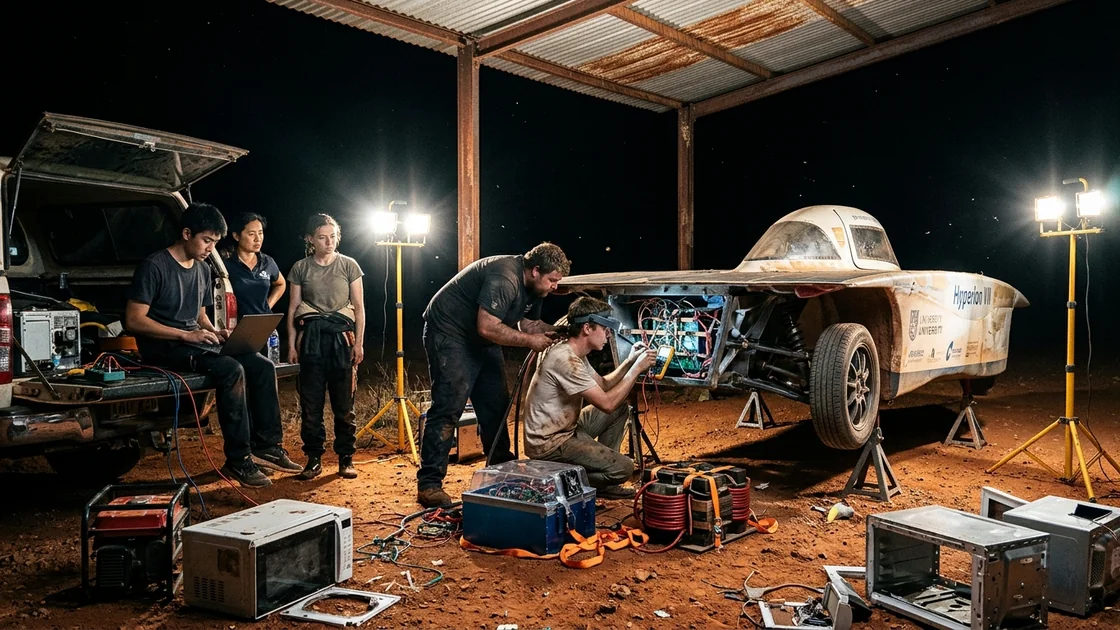
This story follows the Northern Polytechnic solar car team as they compete in the grueling three-thousand-kilometer transcontinental race from Darwin to Adelaide across the Australian Outback. Halfway through the desert near Barrow Creek, a freak dry thunderstorm strikes the ground beside their experimental solar cruiser, inducing a massive electromagnetic surge that destroys their custom-built motor controller. With no spare unit available and race disqualification looming at the Alice Springs checkpoint, lead electrical engineer Kaelen Vance and his exhausted crew of student engineers must spend a frantic night in the red dirt scavenging parts from their support vehicles and camp equipment. Together, they attempt the impossible task of re-engineering a high-voltage three-phase inverter and rewriting its control firmware from scratch before the morning sun rises over the Stuart Highway.
The heat of the Northern Territory did not merely sit on the asphalt of the Stuart Highway; it rose from it in shimmering, oily waves that distorted the horizon into a liquid mirage. Inside the mobile telemetry bay of the chase van, five meters behind the solar car, the air conditioning was losing its war against the afternoon sun. Kaelen Vance wiped a bead of sweat from the bridge of his nose before it could drip onto the exposed logic board of his laptop. On his screen, a cascading waterfall of hexadecimal data translated itself into clean, glowing line graphs.
Ahead of the van’s bug-splattered windshield rode Hyperion VII. She was a creature born of wind-tunnel simulations and sleepless nights in a subterranean university basement—a five-meter-long asymmetric catamaran crafted from ultra-high-modulus carbon fiber. Her top surface was draped in four square meters of aerospace-grade silicon solar cells that drank the brutal Australian radiation and funnelled it into a lithium-ion battery pack no larger than a carry-on suitcase.
"Bus voltage is holding steady at one hundred and thirty-eight point four volts," Kaelen said into his headset microphone, his voice raspy from three days of breathing red dust and dry cabin air. "Motor phase currents are balanced at twelve amps RMS. Array input is sitting at nine hundred and eighty watts. How’s the cockpit temp, Elena?"
A burst of static preceded the reply from the tiny carbon-fiber canopy ahead. Elena Rostova’s voice sounded remarkably calm for someone reclined at a twenty-degree angle inside a composite oven moving at ninety-two kilometers per hour.
"Warm enough to proof bread, Kael," Elena replied. "Around forty-four degrees Celsius by the footwell sensor. My water bladder tastes like boiled garden hose, and the crosswind is starting to tug at the leading edge of the left fairing. Nothing I can't trim out, though. How is our gap to Munich?"
Across the narrow aisle of the Ford Transit chase van, Maya Lin didn't look up from her triple-monitor workstation. As Team Principal and Head of Strategy, Maya existed in a state of perpetual mathematical calculation. She had weather radar overlays from the Bureau of Meteorology open on her left screen, a predictive solar irradiance model in the center, and GPS transponders for all thirty-two competing universities on the right.
"Team Valkyrie passed through Tennant Creek forty-two minutes ago," Maya said, tapping a stylus against her lip. "Their average velocity is ninety-six point five. They have a twelve-percent advantage in array efficiency with those triple-junction gallium-arsenide cells their corporate sponsors bought them, so they're burning more watt-hours than we are without depleting their pack. We can't match their sprint speed on the flats."
"We don't need to match their sprint speed," said Toby Miller from the driver's seat of the chase van, his thick hands steady on the wheel as a road train—three massive cattle trailers hauled by a roaring Kenworth prime mover—thundered past in the opposite lane. The shockwave of displaced air rocked the heavy van and made Hyperion VII dance sideways by thirty centimeters before Elena’s micro-corrections brought the solar car back onto the painted white line. "Hold on there, El. Three-trailer beast just cleared us. Like I was saying, Munich builds watches. Beautiful, over-complicated Swiss—well, German—watches. Last year in the Mojave, their active suspension controller cooked itself when the ambient hit forty-eight. We built an anvil."
"We built an anvil with a custom silicon-carbide heart that I hand-soldered at four in the morning three weeks ago," Kaelen muttered, zooming in on the thermal telemetry of the motor controller. "Don't jinx my inverter, Toby. The junction temperatures on the C-phase MOSFETs are running four degrees hotter than A and B. I still think the thermal interface pad shifted when we hit that cattle grid outside Katherine."
In the rear corner of the van, wedged between plastic crates of spare suspension heim joints and spools of Tefzel wire, Sora Takahashi didn't look up from his terminal. His dark hair was plastered to his forehead, and his fingers moved across a split ergonomic keyboard with silent, manic precision. "It is not the thermal pad, Kaelen," Sora said softly. "It is your space-vector pulse-width modulation look-up table. You pushed the switching frequency to forty kilohertz to reduce current ripple in the stator windings, and the dead-time compensation on phase C has a four-nanosecond asymmetry in the gate driver propagation delay. It is switching slightly warm. It will survive to Adelaide."
"Four nanoseconds is an eternity when you're swinging one hundred and四十 volts across a twenty-milliohm channel," Kaelen shot back, though there was no real heat in it. He trusted Sora's code more than he trusted his own heartbeat.
Northern Polytechnic was never supposed to be in fourth place overall. They were a public university team operating on a shoestring budget of seventy-five thousand dollars, raised mostly through bake sales, alumni begging, and begging local machine shops for scrap aluminum billets. The top three teams—from the Netherlands, Japan, and Germany—operated with budgets exceeding two million euros, wind tunnels owned by Formula One teams, and pelotons of meteorologists. Yet here they were, sixteen hundred kilometers south of Darwin, nipping at the heels of the giants because Hyperion VII was absurdly light, Elena drove like a metronome, and Kaelen’s homemade motor controller was squeezing ninety-eight point六 percent efficiency out of the axial-flux hub motor tucked inside the rear wheel.
"Hey, Maya," Toby said, squinting through his polarized sunglasses toward the southwestern horizon. "Your fancy satellite feed showing that ugly bruise over the Davenport Ranges?"
Maya frowned, minimizing her energy balance spreadsheet to bring the Doppler radar full-screen. The satellite loop was fifteen minutes old, constrained by the patchy bandwidth of their roof-mounted satellite dish. "The morning forecast called for high-altitude cirrus and zero percent precipitation across the Barkly Tableland," she said, her fingers flying over the trackpad. "Wait. The three o'clock update is pulling in now."
The screen refreshed, painting the arid red expanse of the Northern Territory in sudden, violent blotches of amber and crimson.
"That’s a dry microburst line," Maya breathed, the color draining slightly from her cheeks. "High-base cumulonimbus forming off a thermal trough near Devil's Marbles. The moisture is evaporating before it hits the ground—virga—which means massive evaporative cooling and downdraft winds up to eighty kilometers an hour."
"Worse than wind," Kaelen said, leaning out of his seat to peer through the windshield. Ahead, the pale blue outback sky had curdled into the color of an old pewter mug. Beneath the flat, anvil-shaped clouds, long wispy curtains of dust and evaporating rain hung like jellyfish tentacles above the scrubland. "Virga means dry lightning. Dust particles rubbing against ice crystals in a bone-dry column of air. It’s a five-mile-high Van de Graaff generator."
"Lead vehicle to Chase," crackled the voice of Marcus, their logistics coordinator, who was driving the scout pickup five kilometers up the highway. "Guys, the wind just shifted ninety degrees here. Temperature dropped six degrees in thirty seconds, and the AM radio sounds like someone’s frying bacon in the dashboard. We are seeing cloud-to-ground strikes three klicks west of the highway. We need to bag the car. Now."
"No," Elena’s voice cut through the intercom, sharp and immediate. "Where is the next pull-off? If we stop on the shoulder here, there’s no verge—just a two-foot drop into soft bull-dust and spinifex grass. If those downdrafts hit while we’re stationary on an uneven camber, it’ll flip the shell before you can get the tie-down stakes hammered in."
Maya rapidly cross-referenced the GPS coordinates with the civil survey maps of the Stuart Highway. "Elena’s right. The road shoulder here is forty centimeters wide and sloped at twelve degrees. There is an abandoned roadhouse and borehole station four point two kilometers ahead, just north of Barrow Creek. Flat concrete pad, old steel awning."
"Four point two kilometers at ninety klicks an hour is less than three minutes," Toby said, his knuckles whitening on the steering wheel as a sudden gust of wind slammed into the side of the Transit van, forcing him to counter-steer into the lane. "Elena, push the throttle. Kaelen, give her everything the pack’s got."
"Overriding cruise target," Sora said, his fingers already flying. "Raising peak current limit in the CAN bus command packet from twenty-five amps to sixty. Disabling eco-smoothing."
"Copy," Elena said. "Dropping the hammer."
On the highway ahead, Hyperion VII surged forward. A solar car does not roar when it accelerates; it emits a rising, crystalline whine, like a dentist’s drill resonating inside a cathedral. On Kaelen’s telemetry screen, the current draw spiked vertically. Four kilowatts of electrical power poured from the lithium cells through Kaelen's controller and into the copper windings of the rear wheel. The speedometer climbed: ninety-five, one hundred and five, one hundred and fifteen kilometers per hour.
Outside, the light was dying with terrifying speed. The oppressive orange glare of the afternoon was swallowed by a bruised, sulfurous twilight. Dust devils spun across the red clay pans beside the highway, tearing up clumps of dead saltbush and hurling them across the tarmac.
Inside the chase van, the hairs on Kaelen’s forearms stood straight up.
"Static potential is climbing," Kaelen warned, his eyes darting to the isolation monitor on his dashboard. "The carbon shell isn't grounded to the earth because of the Michelin low-rolling-resistance tires. She’s accumulating charge from the triboelectric friction of the blowing dust. Bus-to-chassis leakage resistance is fluctuating."
"Two kilometers to the borehole station!" Maya called out, bracing one hand against the roof rib of the van as another violent gust rocked them. "Marcus is already there securing the perimeter! Hold it together, Elena!"
"The crosswind is trying to lift the windward pontoon!" Elena grunted through the headset. Through the chase van's windshield, Kaelen could see the left wheel of Hyperion VII visibly unloading, the suspension strut extending to its limit as the aerodynamic body acted like an aircraft wing in the sixty-knot cross-gust. Elena was leaning her entire fifty-kilogram body toward the left side of the tiny cockpit, fighting the steering tiller with everything she had. "One kilometer! I can see Marcus's hazard lights!"
Then, the air turned blue.
It didn't start with thunder. It started with a strange, metallic taste on Kaelen’s tongue, like he had just licked the terminals of a nine-volt battery, accompanied by a faint, insectile buzzing coming from the chase van’s roof rack. A corona discharge—St. Elmo’s fire—danced in pale violet tendrils off the tip of their VHF whip antenna.
"Shut down the main contactor!" Kaelen screamed into his mic, his hand lunging for the remote emergency kill-switch wired to their radio transmitter. "Elena, pull the mechanical disconnect! Now!"
He was half a second too slow.
The lightning bolt did not hit Hyperion VII directly—if it had, the hundred-kiloampere plasma channel would have delaminated the carbon-fiber composite into a cloud of burning epoxy and shattered silicon. Instead, the stepped leader found an old, rusted iron survey marker buried in an ironstone outcropping four meters off the left shoulder of the highway, directly abeam the speeding solar car.
The world vanished behind a wall of blinding, ultraviolet white.
The acoustic shockwave hit the chase van at the exact same millisecond as the flash, a physical hammer blow that flexed the laminated safety glass of the windshield inward and deafened everyone inside, even through their noise-canceling headsets. The earth beneath the highway became an instantaneous hemisphere of hundreds of thousands of volts as the strike current sought ground dissipation through the bone-dry, resistive desert soil.
A secondary side-flash—a jagged, purple serpent of ionized air—leaped from the ironstone outcropping across the tarmac, bit straight through the rubber sidewall of Hyperion VII's rear drive wheel, and grounded itself into the aluminum stator housing of the hub motor.
Inside the chase van, every monitor blinked out. The overhead LED dome lights popped with a shower of sparks. Kaelen’s laptop threw a brilliant blue arc from its USB-to-CAN isolator dongle, shocking his fingertips and sending him crashing backward out of his rolling chair into the aisle.
Ahead on the highway, a thick plume of acrid, grey-white smoke erupted from the rear ventilation NACA ducts of Hyperion VII. The solar car’s rear wheel locked momentarily, then broke free, fishtailing violently across the center line at a hundred and ten kilometers per hour.
"Elena!" Toby roared. The chase van’s engine had stalled, its electronic fuel injection temporarily scrambled by the electromagnetic pulse, leaving Toby fighting unassisted power steering. He cranked the ignition key with one hand while wrestling the wheel with the other, the Transit’s diesel engine coughing back to life just as Hyperion VII slewed sideways toward the gravel verge.
Elena didn't panic. Blinded by spots in her vision and choking on the toxic fumes of vaporized electronics filling her canopy, she didn't touch the mechanical brakes, knowing a locked wheel on gravel meant a rollover. She counter-steered into the slide, riding the momentum as the car bled speed, guiding the crippled catamaran up the broken asphalt ramp of the abandoned borehole station.
The solar car rolled to a dead stop beneath the rusted corrugated iron awning of the dilapidated station, fifty meters from Marcus’s pickup truck.
Before the chase van had even skidded to a halt beside her, Kaelen had kicked open the sliding side door, clutching a carbon-dioxide fire extinguisher to his chest. He hit the red dirt running, his boots skidding on the loose gibber stones, with Toby and Maya half a step behind him.
"Canopy Pins! Pull the external canopy pins!" Kaelen yelled, dropping the extinguisher by the rear wheel as Marcus sprinted over from the pickup and yanked the red anodized quick-release cables on the nose cone.
Toby and Marcus lifted the entire top half of the solar car—array, canopy, and fairing—clear of the chassis like the lid of a sarcophagus.
Elena was already unbuckling her five-point racing harness, coughing violently as a fresh billow of pungent, fishy-smelling smoke rolled out of the rear electronics bay. Toby reached in, grabbed her under the armpits, and hoisted her bodily out of the Kevlar seat bucket, setting her down on the concrete pad twenty feet away.
"I'm okay! I'm okay!" Elena wheezed, tearing off her helmet and wiping soot-stained sweat from her face. "My ears are ringing, and my left foot feels like it fell asleep from the static jump through the rudder pedals, but I’m fine! The pack! Check the battery pack!"
Kaelen was already on his knees beside the rear bulkhead, peering through a polycarbonate inspection window with a high-lumen flashlight while holding an infrared thermometer in his other hand.
"Pack contactor is open!" Kaelen shouted, his heart hammering against his ribs at two hundred beats a minute. "The hardware over-current protection in the Battery Management System tripped! Pyro-fuse blew clean! Cell temps are thirty-eight degrees and flat across all modules! The battery isn't in thermal runaway!"
Maya sagged against the fender of the pickup truck, her hands trembling as she pressed them to her face. "Thank God. Thank God."
Sora stumbled out of the chase van, carrying a Fluke digital multimeter and a pair of Class-0 high-voltage insulated lineman's gloves. He handed the gloves to Kaelen without a word.
Kaelen pulled the thick rubber gloves over his shaking hands and used an insulated hex key to unfasten the four quarter-turn Dzus fasteners securing the lid of the motor controller enclosure. It was a custom-machined box of 6061-T6 aluminum, anodized a proud Northern Polytechnic blue, sitting directly between the battery bay and the rear swingarm.
When he lifted the lid, the smell hit him like a physical blow: the unmistakable, heartbreaking stench of burnt FR-4 fiberglass, boiled electrolytic fluid, and vaporized silicon. Every electrical engineer knows it as the "magic smoke"—the joke being that electronics run on smoke, and once you let the smoke out, they stop working.
Inside the aluminum housing, it looked like a miniature hand grenade had detonated.
The main DC link capacitor bank—four cylindrical polypropylene film capacitors—was intact, though soot-blackened. Everything downstream of it was carnage. The three-phase bridge, composed of six surface-mounted Silicon Carbide MOSFETs that Kaelen had spent four months characterizing in the power electronics lab, was unrecognizable. Two of the packages had literally blown their black epoxy tops off, leaving craters of melted copper traces and little beads of resolidified silver solder splattered against the inside of the lid. The delicate four-layer control printed circuit board mounted on brass standoffs above the power stage had a blackened char mark running right across the galvanic isolation barrier, straight into the thirty-two-bit ARM microcontroller.
"Oh, no," Sora whispered, peering over Kaelen’s shoulder. "Oh, no, Kaelen."
Kaelen didn't speak. He couldn't. He probed the main busbars with the multimeter to verify zero volts, then pulled off the heavy rubber gloves and touched the edge of the ruined circuit board with a bare finger. A flake of carbonized copper trace came away on his skin like black ash.
Above them, the freak storm was already moving east, the violent downdrafts subsiding into a warm, dusty breeze as the afternoon sun broke back through the trailing edge of the clouds, painting the desert in mockery of golden light.
"Tell me we have the spare in the logistics truck," Elena said, limping over with a bottle of electrolyte water in her hand. She looked from the smoking ruin in the chassis to Kaelen’s pale face. "Kael? We built two controllers. Revision B is in the car. Revision A is in the pelican case in Marcus's truck, right?"
Kaelen slowly sat back on his heels in the red dirt. He looked up at Maya.
Maya closed her eyes. "Revision A didn't clear Australian customs in Darwin," she said, her voice barely audible over the ticking of the cooling chase van engine. "When the freight forwarder in Los Angeles mislabeled the lithium spare crate, customs impounded pallet two for hazardous materials inspection. Pallet two had our spare wheel fairings, our backup MPPT solar chargers, and the Revision A motor controller. They won't release it until Monday. That's why we've been running on conservative current limits since Tuesday."
Silence fell over the abandoned borehole station. Out on the Stuart Highway, four hundred meters away, a sleek, silver bullet glided past at ninety-five kilometers per hour, followed by two matching Mercedes-Benz sprinter vans emblazoned with the logos of the University of Delft. They gave a polite two-tone honk of their air horns as they flew south toward Alice Springs.
"How far to the Alice Springs control stop?" Toby asked quietly.
"Two hundred and eighty kilometers," Maya said, opening her eyes. The strategist was trying to claw her way back to the surface, though her voice was hollow. "The checkpoint gates at Alice Springs close tomorrow morning at ten o'clock sharp for our class. If a solar car does not cross the timing line under its own electric power before ten hundred hours, it is reclassified as non-competitive. We get loaded onto the trailer."
"Can we buy a commercial off-the-shelf controller in Alice Springs?" Marcus asked, pulling out his phone and searching wildly for signal bars. "Send me ahead in the pickup. I can be in Alice in two and a half hours. Surely somebody in town has an EV controller or a golf cart inverter or—or a variable frequency drive for a mining pump!"
"To drive a coreless axial-flux permanent magnet synchronous motor with an eighteen-milliohm phase-to-phase resistance and twelve microhenries of inductance?" Kaelen laughed, and it was a brittle, ugly sound. "Marcus, if you hooked a standard industrial VFD or an induction golf cart controller up to that hub motor, the ripple current would demagnetize the neodymium Halbach array in four seconds flat,Right before the controller blew itself in half. That motor requires high-frequency pulse-width modulation or an external inductor bank behind it to choke the current spikes."
"Okay, so we don't go to Alice Springs," Toby said, planting his oil-stained hands on his hips and glaring down at the blackened box. "We have fourteen hours until we have to leave this concrete pad to make the ten o'clock cutoff in Alice. We have a mobile machine shop in the back of the truck, four engineers, and a genius programmer. What is a motor controller, Kael? Strip away the fancy four-layer gold-plated circuit board. What does it actually do?"
Kaelen rubbed his temples, where a migraine was blooming behind his eyes. "Toby, don't do the motivational sports movie speech right now. You're a mechanical engineer. If a connecting rod snaps through an engine block, you don't whittle a new one out of a tree branch."
"Answer the question, Vance!" Toby barked, stepping closer, his boots kicking up a puff of red ochre dust. "What does the box do?"
"It takes direct current from the battery and chops it into three phases of alternating current timed to the rotor position!" Kaelen snapped back, standing up so he was nose-to-chest with the massive mechanic. "It's three half-bridges! Six high-voltage switches turning on and off tens of thousands of times a second, governed by gate drivers, current sensors, and a microcontroller running field-oriented control mathematics! Our switches are vaporized, our current sensors are fused into slag, our gate drivers have craters in them, and the processor has a hole burned through its analog-to-digital converter!"
"Do we have another processor?" Sora asked quietly from the side.
Everyone turned to look at the firmware lead. Sora had pulled the ruined control board off its brass standoffs and was holding it up to the late afternoon sunlight, squinting through the fiberglass layers to see which copper traces were severed.
"What?" Kaelen asked.
"The STM32 Nucleo development boards we used for the steering wheel telemetry display and the rear lighting controller," Sora said, his dark eyes beginning to flick back and forth as if compiling code in his head. "They use the exact same ARM Cortex-M4 architecture as the motor controller's chip. The pinout is different—sixty-four pins instead of one hundred—which means we lose the high-speed SPI bus and two of the op-amp channels, but Timer One is still there. Timer One has the six complementary PWM outputs with hardware dead-time generation."
Kaelen stared at him. "Sora, even if we cannibalize the steering wheel processor, we don't have the high-precision shunt amplifiers to read the phase currents. Without instantaneous phase current feedback on at least two phases, your Clarke and Park transforms are blind. We can't run Field-Oriented Control."
"Then we do not run Field-Oriented Control," Sora said simply. "We abandon sinusoidal commutation. We go back to 1985. Six-step trapezoidal block commutation."
Kaelen blinked, his mind racing through the textbook theory he had learned in sophomore year. "Six-step block commutation only requires reading the three digital Hall-effect latch sensors inside the motor to know which sixty-degree sector the rotor magnets are in. You energize two phases at a time and leave the third floating."
"Wait," Elena said, stepping closer, her driver's instincts kicking in. "Are the Hall sensors inside the motor still alive? If the lightning side-flashed into the stator housing..."
Kaelen dropped back to his knees beside the car, grabbed the multimeter, and unplugged the miniature six-pin circular Deutsch connector leading out of the hollow rear axle. He switched the meter to diode mode, powered the five-volt supply line using three AA batteries taped together from his flashlight, and slowly rotated the rear carbon-fiber wheel by hand while watching the meter screen.
4.9V... 0.1V... 4.9V... 0.1V.
He checked Pin B. 0.1V... 4.9V. Pin C. 4.9V... 0.1V.
"The motor housing acted like a Faraday cage for the Hall latches," Kaelen breathed, a tiny, dangerous spark of hope igniting in his chest. "The transient coupled inductively into the big copper stator windings because of the massive surface area, traveled up the three heavy-gauge phase cables, and detonated the inverter. The low-voltage Hall sensors survived."
Then Kaelen looked back at the charred aluminum box, and his shoulders slumped again. "It doesn't matter. We can't switch four kilowatts of power with an Arduino and good intentions, Sora. We need six power transistors rated for at least two hundred volts and eighty amps continuous, and six isolated gate drivers to switch them. In my repair kit, I have exactly two spare SiC MOSFETs and one spare gate driver chip. You can't build a three-phase bridge with two switches. You need six."
Toby slowly turned his head toward the rear of the chase van, where their auxiliary camp equipment was strapped down, and then looked at the roof of the logistics truck.
"What else do we have with us that chops high-voltage DC into AC?" Toby asked softly.
Kaelen frowned. "What?"
"In the back of Marcus's truck," Toby said, pointing a thick finger. "We have a three-kilowatt pure sine-wave inverter generator for running the air compressor and the angle grinders at night. And wired into the chase van's auxiliary battery bank is a two-kilowatt DC-to-AC inverter that runs Maya's computers and the soldering station."
Kaelen stopped breathing for three full seconds.
"A pure sine-wave inverter," Kaelen whispered, "uses an H-bridge output stage. Four high-voltage IGBTs or MOSFETs switching a three-hundred-and-eighty-volt DC bus down into two hundred and forty volts AC."
"Four switches in the van's inverter," Maya said, her eyes widening as she followed the math. "And four more in the generator's inverter module in the truck. That’s eight switches. You need six."
"They'll be through-hole TO-247 packages, not surface-mount," Kaelen said, talking to himself now, pacing a tight circle in the red dust and pulling at his hair. "Probably silicon IGBTs or older trench MOSFETs, not Silicon Carbide. Their on-state resistance will be terrible—maybe forty or fifty milliohms instead of twelve! And their gate capacitance will be huge! If we try to switch them at forty kilohertz, the switching losses will melt them into puddles in thirty seconds!"
"So drop the PWM frequency to eight kilohertz!" Sora countered, standing up, his voice rising above its usual quiet murmur for the first time since Darwin. "Eight kilohertz is well within the safe operating area of standard silicon MOSFETs! Yes, the acoustic noise in the motor will be deafening, and yes, the current ripple will be massive!"
"And the motor has virtually zero inductance!" Kaelen shouted back, spinning on his heel to face Sora. "At eight kilohertz with a square-wave trapezoidal drive on an axial-flux coreless motor, the dI/dt—the rate of current rise—will spike to hundreds of amps before the PWM cycle even finishes! We'll blow the scavenged MOSFETs on the first rotation!"
"Unless you put inductors in series with the three motor phases to slow down the current rise," Elena said quietly.
Kaelen, Sora, and Toby all turned to stare at their driver.
Elena shrugged, wincing slightly as she shifted her weight off her tingled left foot. "I took Intro to Mechatronics with Professor Aris too, Kael. You spent three weeks complaining about how coreless motors have no iron in the stator, so they act like dead shorts until the back-EMF builds up. In the lab, before you built the high-frequency Silicon Carbide board, you ran the motor through three giant iron-powder toroid chokes the size of donuts."
"Which are currently sitting on a shelf in Room 104 in Minnesota," Kaelen said. "Where am I going to get three high-current three-phase filter inductors in the middle of the Australian desert?"
Toby grinned—a feral, terrifying expression that usually preceded him taking a plasma cutter to something expensive. "What’s inside the broken arc welder that’s been rolling around under the workbench in the logistics trailer since we fixed the trailer hitch in Darwin?"
Kaelen stared at him. "The broken Lincoln MIG welder? A big step-down transformer and... and a heavy-duty output choke wound with four-gauge enamelled copper strap on a laminated silicon-steel core."
"And what's inside the two busted microwave ovens stacked behind this abandoned roadhouse that I saw when I went to check the perimeter?" Marcus chimed in, jogging over from the back of the rusted building. "Big high-voltage transformers. If you take an angle grinder to the welds on a microwave transformer core, knock out the secondary winding, and wrap heavy welding cable around the iron E-cores with an air gap in the middle..."
Kaelen’s jaw dropped slightly. He did the magnetic saturation math in his head. Silicon-steel laminations from microwave oven transformers, gapped with non-conductive fiberglass shims—which they could cut right out of the dead motor controller’s PCB—wound with twenty turns of eight-gauge copper wire. It would be heavy—at least ten kilograms of crude iron and copper—and it would vibrate like a washing machine full of bricks, and the eddy current losses in the sixty-hertz transformer iron running at eight kilohertz would make the cores hot enough to fry eggs on.
Efficiency would plummet from ninety-eight point six percent down to maybe eighty-four percent.
"Maya," Kaelen said slowly, turning to the Team Principal. "If our drivetrain efficiency drops by fourteen percent, and we add twelve kilograms of dead weight to the rear suspension, can we still make Alice Springs before ten o'clock tomorrow morning?"
Maya didn't even need to look at her laptop. She had the energy tables memorized down to the watt-hour.
"Our battery pack is sitting at seventy-eight percent state of charge right now," Maya said, her voice crisp, authoritative, and utterly focused. "That is three thousand, eight hundred watt-hours. Tomorrow morning, the sun rises at six-twelve AM. Between six-thirty and nine-thirty, even running on four of our five MPPT solar strings, the array will harvest roughly two thousand, one hundred watt-hours. With a fourteen percent parasitic loss in a Frankensteined controller, we cannot cruise at ninety kilometers per hour—we will drain the pack dry forty kilometers north of the Tropic of Capricorn. But if Elena holds a dead-steady sixty-eight kilometers per hour, drafting behind no one, and we hit the highway the exact minute the race clock opens at six-zero-zero AM, we will cross the timing line at the Alice Springs convention center at nine-fifty-one AM with two percent battery remaining."
Nine minutes to spare. Out of a three-thousand-kilometer race.
Kaelen looked around the circle of dust-caked, sunburned faces. Elena was stretching her calves, already preparing to climb back into the carbon-fiber coffin. Sora was clutching the fried circuit board like a talisman. Toby already had an insulated screwdriver and a wrench in his hand.
"Okay," Kaelen said, his voice steadying as the overwhelming paralysis of the disaster dissolved into a sequence of engineering problems. "Okay. We're doing this. Marcus, pull the logistics truck nose-in under the awning and fire up the diesel generator—do NOT cannibalize that one yet, we need AC power for the soldering stations and the oscilloscope until the very last step. Toby, gut the chase van's auxiliary inverter first, then pull the portable camping inverter out of the crew cab. Bring me every circuit board with a heatsink attached to it. Sora, set up your coding station on the tailgate and start stripping the FOC libraries out of the main branch; we need a bare-metal interrupt-driven Hall state machine on Timer One before midnight. Elena, you and Maya are on inductor duty. Get those microwave ovens behind the shed, break them open—discharge the high-voltage capacitors first so nobody dies—and strip the cores."
"What about you?" Maya asked.
Kaelen picked up his heavy side-cutters and looked down at the blackened, smoking corpse of the device that had taken him a year to design.
"I'm performing an autopsy," Kaelen said. "And then I'm going to build a monster."
By eight o'clock at night, the temperature in the desert had plunged twenty degrees, replaced by a vast, crystalline cold under a canopy of stars so bright the Milky Way cast a faint shadow on the concrete pad. Under the rusted corrugated roof of the borehole station, however, it looked like a cyberpunk sweatshop.
Two five-hundred-watt halogen work lights stood on tripods, buzzing softly and attracting clouds of giant outback moths that pinged off the hot glass like hailstones. A folding lifetime table had been transformed into an electronics triage unit, littered with desoldering braids, squeeze bottles of isopropyl alcohol, rolls of Kapton tape, and severed chunks of aluminum extrusion.
"The chase van inverter is a goldmine!" Toby announced, slamming a heavy, dust-coated circuit board onto the folding table in front of Kaelen. "Two-kilowatt pure sine wave. Look at those beauties on the high-voltage side."
Kaelen slid his magnifying visor down over his eyes and aimed his flashlight at the four black, three-legged components bolted to a ribbed aluminum heatsink along the edge of the board. He scrubbed the white thermal paste off the face of one transistor with a cotton swab dipped in alcohol and read the laser-etched part number aloud.
"IRFP4668," Kaelen read. He didn't even need to pull up the PDF datasheet on his laptop; he knew the International Rectifier power MOSFET line by heart. "Two hundred volts drain-to-source breakdown. One hundred and thirty amps continuous rating. Eight milliohms on-resistance!"
He looked up at Toby, his eyes wide behind the magnifying lenses. "Toby, these aren't high-voltage IGBTs. This inverter topology boosts the twelve-volt van battery to an intermediate one-hundred-and-sixty-volt bus before inverting it, or uses a push-pull stage! These are two-hundred-volt silicon trench MOSFETs! There are eight of them right here on the low-side and high-side stages!"
"In English, Kael!" Toby said, wiping grease from his forehead with the back of his wrist.
"In English, we don't have to touch the generator!" Kaelen laughed, a rush of pure adrenaline flooding his bloodstream. "These eight switches are rated for our exact battery voltage with twenty-five percent safety margin, and their on-resistance is lower than I prayed for! We have all six switches for our three-phase bridge plus two spares right on this one board!"
"Hold the applause until you get them out of that double-sided copper pour without ripping their legs off," Sora muttered from the end of the table, where he was hunched over two STM32 development boards connected by a rat's nest of colorful jumper wires. "Our sixty-watt Weller soldering iron isn't going to melt the solder on a ground plane tied to a two-pound heatsink."
"Unbolt the clamping bar from the heatsink first," Kaelen instructed, already grabbing a Phillips screwdriver. "Then we use the hot-air rework station on maximum AND the soldering iron at the same time."
"Forget the hot-air toy," Toby said, reaching into the camp kitchen crate and pulling out a brass-nozzled butane blowtorch used for lighting campfires and searing steaks. He clicked the piezo igniter, and a roaring blue jet of flame hissed into the night air. "I'll heat the back of the board. You pull the parts from the front with needle-nose pliers. Three seconds per chip so we don't cook the silicon dies inside."
It was surgical barbarism. Toby played the roaring blue tip of the butane torch across the underside of the thick solder joints while Kaelen gripped the black plastic body of each MOSFET with locking hemostats. The rosin flux boiled, popped, and smoked; the heavy lead-free solder turned into liquid silver; and with eight crisp snaps, Kaelen extracted the transistors and dropped them onto an aluminum baking tray to cool down rapidly.
He tested each one immediately with his multimeter in diode mode: gate-to-source open, drain-to-source body diode dropping exactly zero point five two volts, tapping the gate with a five-volt finger charge to watch the channel snap closed to zero ohms, then grounding the gate to watch it snap open again.
"All eight survived the blowtorch," Kaelen exhaled, lining them up like tiny black soldiers on a strip of anti-static foam. "Okay. Power stage switches: check. Now, the gate drive problem."
He looked at the corpse of his original motor controller. Why had the lightning strike killed it? The surge had come up the motor phase wires, blown through the Silicon Carbide MOSFETs, and traveled backward through the gate pins into the isolated gate driver chips, which in turn had arced across into the microcontroller.
"What did the van inverter use to drive these IRFP4668s?" Kaelen wondered, leaning back over the scavenged inverter board with his magnifying visor. He traced the delicate copper tracks leading away from the holes where the MOSFET pins had just been. They led to three eight-pin surface-mount integrated circuits sitting near a smaller transformer, accompanied by pairs of tiny bipolar transistors arranged in totem-pole configurations.
"IR2110 half-bridge drivers," Kaelen murmured, his heart sinking slightly. "No galvanic isolation. They use a high-voltage bootstrap diode and capacitor to float the high-side switch. Only two survived on this board; the third channel is just a low-side PWM chopper."
"Can we use the two IR2110s for Phases A and B, and use the one spare isolated gate driver chip in your repair kit for Phase C?" Sora asked, pausing his typing.
Kaelen shook his head. "The propagation delay between an old IR2110 bootstrap driver and a modern Si8271 optically isolated driver differs by almost a hundred and fifty nanoseconds. At high currents, Phase C would be firing wildly out of sync with A and B, and mixing bootstrap power supplies with isolated DC-DC supplies on a perfboard is begging for a ground loop that will fire both the high-side and low-side switches at the same time."
"Shoot-through," Sora said grimly. If both switches in a half-bridge turned on simultaneously, they created a dead short straight across the one-hundred-and-forty-volt lithium battery pack. The resulting explosion would make the lightning strike look like a sparkler.
Kaelen dug furiously through the transparent plastic organizer trays of his electronics repair kit. He pulled out little anti-static bags labeled with neat Sharpie handwriting, tossing them onto the table one by one.
"Wait a minute," Kaelen whispered. He held up a plastic tube containing ten white, six-pin DIP chips—old-school through-hole components with legs that looked like silver centipedes. "6N137 high-speed logic optocouplers. We bought a tube of twenty for isolating the CAN bus transceivers on the telemetry nodes back in sophomore year. And in this tray... TC4420 six-amp single MOSFET drivers! Why do I have eight of these?"
"Because you used them to drive the cooling fans and the brake light strobes before we switched to smart solid-state relays," Sora said, a rare smile touching the corners of his mouth. "A 6N137 optocoupler paired with a TC4420 driver and an isolated twelve-volt DC-DC converter brick is literally a homemade isolated gate driver."
"Do we have six isolated twelve-volt DC-DC converter bricks?" Kaelen asked, rummaging through the bottom of the bin. He found three tiny black plastic cubes—Murata two-watt isolated converters. "I only have three."
"You only need four!" Sora said, grabbing a dry-erase marker and drawing a frantic schematic straight onto the white plastic surface of the folding table. "Think about it, Kaelen! The three low-side MOSFETs in a three-phase bridge all share the exact same source connection: the negative battery busbar! They don't float relative to each other! All three low-side gate drivers can share a single twelve-volt isolated supply referenced to Battery Minus! Only the three high-side MOSFETs float up and down with the motor phase voltage, so each high-side driver needs its own dedicated floating supply!"
Kaelen stared at the schematic drawn on the plastic tabletop. Three isolated bricks for the three high-side switches. And for the fourth supply to run the three low-side switches?
"A standard twelve-volt sealed lead-acid battery from the emergency roadside flare kit," Kaelen breathed. "Completely floating. We wire its negative terminal to the main battery pack negative busbar, and it gives us rock-solid twelve-volt gate drive power for all three low-side drivers without needing a fourth converter brick!"
"How fast is the 6N137 optocoupler?" Sora asked, his eyes narrowing as he calculated the timing margins.
"Sixty nanoseconds max propagation delay," Kaelen said, already ripping open the tube of white chips and grabbing a sheet of copper-clad perfboard—the generic prototyping board pre-drilled with a grid of holes spaced a tenth of an inch apart. "Rise and fall times around twenty nanoseconds. With the TC4420 pushing six amps into the gate through a ten-ohm gate resistor, we can switch those IRFP4668s in about one hundred and二十 nanoseconds. If you program one point five microseconds of dead-time between the high-side turn-off and low-side turn-on in the STM32 timer registers, there is zero chance of shoot-through."
"One point five microseconds at an eight-kilohertz switching frequency is negligible duty-cycle loss," Sora said, turning back to his laptop. "Build your perfboard, Kaelen. I will have the state machine ready."
Twenty feet away, under the second halogen tripod, the sound of an angle grinder screaming through steel echoed off the corrugated iron walls of the borehole station. Sparks cascaded in a twenty-foot rooster tail across the concrete pad.
Elena, wearing a full polycarbonate face shield, leather welding gauntlets, and her fireproof Nomex racing suit sleeves tied around her waist, lifted the spinning cutoff wheel away from the carcass of a rusted Sharp microwave oven transformer. Beside her, Maya was using a cold chisel and a two-pound ball-peen hammer to knock the severed weld beads off a second transformer core, separating the E-shaped stack of silicon-steel laminations from the I-shaped crossbar.
"Watch your fingers, Maya!" Toby called out, walking over with the gutted copper strap choke he had just extracted from the broken MIG welder. "That transformer iron is razor-sharp when the varnish delaminates!"
"I've got it!" Maya grunted, giving the chisel one final, ringing strike. The heavy steel bar popped free, and she pulled the factory high-voltage secondary coil—thousands of turns of hair-thin copper wire—right off the center leg of the E-core, tossing it into the scrap pile. "That’s two cores stripped! The welding choke makes three, right?"
Kaelen looked up from his soldering iron, squinting through the smoke of burning rosin flux. "No! The phases have to be balanced, or the current ripple on one phase will be completely different from the other two! If we have two microwave transformers, find a third microwave or use the ballast transformer from one of the old sodium vapor floodlights hanging under this awning!"
Toby looked up at the rusted roof girders overhead. Bolted to the center beam was a massive, vintage 400-watt high-pressure sodium yard light, its glass bulb long ago shattered by rocks, leaving its heavy cast-aluminum ballast box intact.
"Marcus!" Toby bellowed, grabbing a ladder off the side of the chase van. "Spot the ladder! We’re going ballast hunting!"
For the next four hours, the world shrank to the diameter pools of halogen light in the middle of the vast Australian darkness.
Kaelen entered a flow state that he had only experienced once or twice in his life—a hyper-focused trance where his trembling hands became steady as a surgeon's. He didn't have time to etching a custom circuit board; he had to build a high-power inverter using point-to-point wiring and busbars.
First, he took the ruined four-layer PCB out of the original aluminum controller housing and scrubbed the soot out of the anodized metal box with brake cleaner. The aluminum enclosure itself had a flat, machined bottom that bolted directly to an aerodynamic fin sticking into the airflow under the solar car's belly. That was his heatsink.
However, the original Silicon Carbide MOSFETs had been mounted on an insulated ceramic substrate. The scavenged IRFP4668 MOSFETs had metal tabs on their backs connected directly to their Drain pins. If he bolted them straight to the aluminum box, they would short-circuit all three motor phases together through the chassis.
"I need Sil-Pads!" Kaelen called out without looking up as he tinned the thick legs of the sixth MOSFET. "Thermally conductive, electrically insulating silicone pads! Check the dead inverter we pulled them out of!"
Maya sprinted over, picked up the gutted carcass of the chase van inverter, and carefully peeled the six grey, rubberized fiberglass sheets off the old heatsink with a razor blade. Two of them tore down the middle.
"Four intact pads, two torn!" Maya reported, holding them up with tweezers. "If there’s a pinhole in the insulation, four hundred volts of inductive flyback will arc right through to the aluminum case, won't it?"
"Kapton tape," Kaelen said instantly. "Clean the aluminum floor with alcohol, lay down one single overlapping layer of one-mil polyimide Kapton tape—Kapton is rated for five thousand volts per mil of dielectric breakdown—smear both sides with Arctic Silver thermal compound from my laptop repair kit, and put the intact Sil-Pads under the three high-side switches where the dV/dt switching transients are highest!"
While Maya and Elena meticulously prepared the thermal interface inside the aluminum housing, Kaelen and Toby fabricated the high-current busbars. You cannot pass sixty amps of chopped motor current through the tiny copper dots of a prototyping perfboard; the foil would vaporize like a fuse in half a second.
Toby took a length of quarter-inch copper ground strap from the logistics truck’s welding kit, hammered it flat on the anvil of the trailer vise, drilled three-millimeter mounting holes through it, and bent it into three heavy Z-shaped brackets.
Working four hands together in the cramped sixteen-by-twenty-centimeter aluminum box, Kaelen and Toby bolted the six MOSFETs down through insulating nylon shoulder washers so the steel screws wouldn't short the tabs to the heatsink. Then they soldered the heavy copper straps directly across the Drain and Source legs right in mid-air above the transistors, creating a massive, brutalist three-dimensional sculpture of bare copper and black epoxy.
To suppress the lethal voltage spikes caused by switching inductive currents across imperfect hand-built busbars, Kaelen soldered six blue ceramic snubber capacitors and ultrafast recovery diodes—scavenged from the input rectifier stage of the dead van inverter—directly across the Drain-to-Source legs of every single transistor.
"It looks like a robotic spider died in a copper mine," Toby muttered, shining his penlight into the box.
"Measure the isolation resistance from every busbar to the aluminum enclosure," Kaelen ordered, his eyes bloodshot and stinging as he turned back to his perfboard where the six optocouplers and gate drivers were wired together in a dense matrix of thirty-gauge blue Kynar wire-wrap wire. "Use the megaohmmeter setting on the Fluke. If we have less than ten megaohms anywhere, find the burr."
Toby probed the copper bars against the anodized box. "Infinity. Open circuit on DC+, DC-, Phase A, Phase B, and Phase C. She’s completely isolated from the chassis, Kael."
At midnight, Elena and Maya carried their creations over to the table, setting them down with a heavy thud that made the folding legs bow inward.
They were three identical microwave and ballast transformer E-I cores, clamped together with steel hose clamps and high-temperature fiberglass exhaust wrap. Between the E and I sections of the iron laminations, Elena had wedged precision one-point-five-millimeter shims cut from the green fiberglass of Kaelen’s dead circuit board to create the air gap that would prevent the iron from magnetically saturating under high DC currents. Wound tightly around the center leg of each core were eighteen turns of thick, flexible six-gauge red welding cable, stripped from the jumper cables of the pickup truck.
Kaelen hooked his handheld LCR meter up to the leads of the first homemade inductor.
"Forty-two microhenries," Kaelen read off the LCD screen. He moved the clips to the second one. "Forty-one point eight microhenries." He checked the third. "Forty-two point four microhenries. DC resistance is three point two milliohms each."
He looked up at Elena and Maya. Their hands were covered in black iron oxide dust, resin scratches, and blisters from pulling the stiff six-gauge copper cable tight around the square corners of the iron cores.
"These are within two percent tolerance of each other," Kaelen said quietly, a lump forming in his dry throat. "With forty-two microhenries in series with our twelve-microhenry motor windings, at an eight-kilohertz switching frequency, our peak-to-peak current ripple drops from ninety amps down to fourteen amps. You two just saved the MOSFETs."
Elena gave him a tired, soot-streaked grin and tapped the side of the iron core with her scarred knuckles. "Northern Polytechnic artisanal magnetics. Built Outback tough."
"What about current limiting?" Maya asked, leaning against the edge of the table and wrapping her arms around herself against the desert chill. "In the old controller, if Elena hit a steep hill or pushed the throttle too hard, the shunt resistors on the board told the processor to throttle back the PWM duty cycle so we didn't blow the main battery fuse or melt the switches. We don't have current sensors on your perfboard."
"We have one," Sora said from the corner.
He stood up slowly, his joints popping like dry twigs, and walked over carrying the STM32 Nucleo board. He pointed to a tiny brass block mounted inside the main battery pack interface box that sat just forward of the motor controller bay.
"The Battery Management System has a fifty-millivolt, two-hundred-amp shunt resistor on the main negative busbar that it uses to calculate state-of-charge coulomb counting," Sora explained, his voice hoarse. "Usually, the BMS reads that voltage, converts it to digital packets, and sends it out over the CAN bus ten times a second—which is way too slow to protect MOSFETs from an over-current spike. However, the raw analog voltage coming off the BMS shunt amplifier is zero to three point three volts. I ran a shielded twisted-pair cable directly from the test point on the BMS board into the high-speed analog comparator pin on the STM32."
Kaelen’s eyes widened. "Cycle-by-cycle current limiting on the DC link."
"Yes," Sora nodded. "If the total DC current drawn from the battery exceeds fifty-five amps for more than two microseconds, the hardware comparator inside the STM32 trips the Break Input on Timer One without waiting for software interrupts. It chops the PWM pulse immediately for that cycle and resets on the next eight-kilohertz clock tick. Elena can mash the throttle pedal straight through the floorboard from a dead standstill, and the controller will automatically regulate itself at fifty-five amps."
Kaelen stared at the quiet coder for a long moment. "Remind me to nominate you for tenure before you even graduate, Sora."
"Wait until we see if my commutation table is backwards before you praise me," Sora said dryly. "If I swapped Hall State Three and Hall State Five in the binary bitmask, the motor will try to spin both directions at once and rip the swingarm off."
At 2:45 AM, the assembly was complete.
It was no longer the sleek, compact, aerospace-grade motor controller that had left Darwin. The blue aluminum box couldn't even close its lid anymore because the tall black bodies of the through-hole MOSFETs, the copper strap busbars, and the multi-level sandwich of perfboard, optocouplers, and Murata isolated power bricks stood three centimeters higher than the rim. To cover it, Toby had cut the side out of a clear polycarbonate food storage bin from the camp kitchen and duct-taped it over the top like a blister dome, with a twelve-volt computer cooling fan zip-tied to a hole in the side to blast air directly across the homemade gate drivers.
Bolted to the aluminum shear plate right beside the controller box were the three massive microwave-transformer inductors, secured with heavy ratchet straps and insulated with pieces of rubber mudflap cut from the chase van so their exposed iron cores couldn't chafe through the carbon-fiber hull. And zip-tied into the corner of the suspension bay was the twelve-volt emergency flare battery powering the low-side gate drive rails.
They had left the top shell of Hyperion VII resting on padded sawhorses beside the car, and Toby had jacked the rear drive wheel ten centimeters off the concrete pad onto heavy steel jack stands so the tire could spin freely in the air.
"Everyone back behind the pickup truck fender," Kaelen said.
Only Kaelen and Sora remained near the rear quarter of the car, both wearing polycarbonate safety glasses and insulated gloves. A fifty-amp fast-blow glass fuse had been wired temporarily in series with the main battery cable so that if the bridge shorted out on startup, the temporary fuse would vaporize instead of the battery pack's internal pyro-fuse. Before connecting the main lithium pack, Kaelen had hooked up a current-limited thirty-volt bench power supply powered by the diesel generator.
"Logic power and gate drive twelve-volt rails are hot," Kaelen said, watching the green power LEDs on the perfboard and the STM32 glow brightly under the polycarbonate Tupperware dome. "Oscilloscope is hooked to Phases A, B, and C. Sora, bring up the thirty-volt bench supply. Zero throttle."
Sora clicked the output button on the bench supply. The voltage display rose to thirty point zero volts. Current draw: zero point zero zero amps.
Nothing smoked. Nothing sparked.
"No shoot-through at idle," Kaelen breathed out. "Hall sensor state reading?"
"State Four," Sora read from his laptop screen, connected via a three-meter USB optical isolator cord. "Binary one-zero-zero. Valid state. I am going to inject a ten-percent PWM throttle command via software debug."
"Send it," Kaelen said.
Sora pressed the Enter key.
From the rear wheel well came a loud, harsh CLACK, followed by an angry, buzzing hum that sounded like a hornet trapped inside a tin can. The rear carbon-fiber wheel twitched forward by five degrees, stopped hard, and vibrated violently as the current limit indicator light on the thirty-volt bench supply flashed red.
Sora hit the spacebar, killing the throttle immediately. The buzzing died.
Toby groaned from behind the pickup truck. "It's locked up!"
"No, it's not locked up!" Kaelen said, his eyes glued to the four-channel color screen of the Tektronix oscilloscope sitting on the milk crate beside him. "Look at the scope trace! Phase A pulled high, Phase B pulled low, and the wheel rotated exactly one magnetic pole pitch until the Hall sensor flipped from State Four to State Six—and when it hit State Six, you energized Phase C high and Phase A low, which pulled the rotor backward thirty degrees! It's caught between two commutation sectors!"
"Wait," Sora said, pulling up the motor manufacturer's datasheet PDF on his left screen and his C++ switch-case block on the right. "Hall sensors A, B, and C are spaced one hundred and twenty electrical degrees apart. When we unplugged the Deutsch connector to test them with your multimeter..."
Kaelen froze. He looked down at the circular six-pin connector where they had spliced jumper wires from the motor harness into the STM32 Nucleo board on the perfboard.
"Pin Three is green. Pin Four is yellow," Kaelen muttered, leaning in close with his flashlight. "In the original PCB layout, I had to swap Hall B and Hall C in the copper routing so the traces wouldn't cross each other on Layer Two! You compensated for my hardware pin-swap in the old FOC initialization file two months ago!"
"And when we wired the motor harness straight to the Nucleo board tonight, we wired it color-for-color without the swap!" Sora slapped his own forehead with the palm of his hand. "The commutation sequence is running 1-3-2-6-4-5 instead of 1-5-4-6-2-3! Two of the Hall inputs are transposed!"
"Don't touch the wires," Kaelen said quickly. "Every time we touch that rat's nest of jumper pins, we risk knocking a gate drive wire loose. Flip the pin definitions in your code and re-flash the chip!"
Sora’s fingers blurred over the keyboard. He altered two lines of preprocessor macros, compiled the binary in four seconds, and pushed the new firmware image down the programmer cable into the STM32.
"Flashed," Sora said. "Clearing fault latch. Sending ten percent throttle in three, two, one..."
He pressed Enter.
Whirrrrrrrrr-EEEEEEE!
The rear wheel didn't twitch. It spun cleanly forward, accelerating smoothly on the jack stands with a loud, metallic, eight-kilohertz musical shriek that echoed off the desert scrubland.
On the oscilloscope screen, three jagged, glorious trapezoidal waveforms marched across the grid in perfect one-hundred-and-twenty-degree symmetry—flat tops, sloping back-EMF ramps on the floating phases, and clean, sharp switching edges with minor, harmless ringing that the ceramic snubber caps damped out in fifty nanoseconds.
"Bring it up to thirty percent duty cycle!" Kaelen shouted over the rising whine of the motor.
Sora tapped the up-arrow key. The wheel spun faster, the black carbon-fiber spokes blurring into a solid disk as the speedometer readout on Sora’s debug screen climbed to forty kilometers per hour on the thirty-volt test supply.
"Current draw on the bench supply is one point eight amps steady! No phase unbalance!" Kaelen grabbed his infrared thermometer and aimed the red laser dot through the cooling hole of the polycarbonate dome onto the backs of the six scavenged MOSFETs, then over to the three microwave-transformer inductors. "MOSFET cases are sitting at twenty-nine degrees Celsius! Inductors are at twenty-seven!"
"Take the training wheels off," Toby said, walking out from behind the pickup truck with a massive grin splitting his grease-stained face. "Hook up the big battery."
They powered down the bench supply, disconnected the alligator clips, and bolted the heavy orange two-gauge high-voltage cables from the one-hundred-and-thirty-eight-volt lithium battery pack onto the copper strap terminals of the homemade controller.
Kaelen climbed into the exposed cockpit of the chassis and flipped the master dashboard ignition switch.
At the rear of the car, the main battery pack contactor pulled closed with a solid, authoritative THUNK as the pre-charge resistor circuit filled the DC link capacitors cleanly without a spark.
"Bus voltage is one hundred and thirty-seven point eight volts," Sora called out, his voice tight with anticipation. "Thirty-two-bit ADC comparator is armed at fifty-five amps. Kaelen, the throttle pedal is live."
Kaelen rested his right foot lightly against the aluminum accelerator pedal in the nose of the car. Slowly, he depressed it by five millimeters.
The three microwave-transformer chokes let out a deep, resonant hum, followed immediately by a piercing, sci-fi turbine scream from the rear wheel as one hundred and thirty-eight volts of chopped DC surged through the scavenged switches. The wheel blurred instantly to sixty, eighty, one hundred kilometers per hour in the air.
Kaelen let off the pedal, watching the wheel coast down, then stabbed the throttle hard to test the load step response.
The controller barked like an angry dog as the hardware current comparator clipped the initial surge at fifty-four point八 amps, holding the line without a single hiccup while the wheel snapped back up to maximum speed.
Kaelen killed the ignition switch, climbed out of the chassis as the rear wheel spun silently in the cool night air, and looked at his watch.
It was 3:42 AM.
"Drop her off the jacks, bolt the upper shell on, and get ninety minutes of sleep," Kaelen said, his knees suddenly feeling like they were made of wet cardboard. "We roll at dawn."
Nobody actually slept for ninety minutes. Kaelen lay on the bench seat of the chase van with his eyes closed, watching six-step commutation waveforms dance behind his eyelids while his ears strained for any phantom sound of arcing or cooling metal. Every ten minutes, he found himself checking his watch.
At 5:15 AM, when the eastern horizon was nothing more than a faint band of violet bruising the edge of the stars, Marcus fired up the espresso machine on the generator's last half-liter of fuel. The crew moved around the borehole station like ghosts, stiff-jointed and shivering in their fleece jackets, communicating in nods and hand gestures as they broke camp in record time.
Toby and Marcus lifted the upper carbon-fiber array shell off the sawhorses, lowered it onto the chassis alignment pins while Elena sat buckled into the cockpit below, and sealed the seam around the entire perimeter of Hyperion VII with aerodynamic white vinyl race tape to eliminate airflow boundary separation.
At 5:58 AM, the convoy rolled down the cracked asphalt ramp of the borehole station and lined up on the shoulder of the Stuart Highway.
Inside the chase van, Kaelen sat at his telemetry desk, his laptop wired into a new long-range serial radio link that Sora had spliced directly to the Nucleo board's UART pins. Because the cannibalized steering wheel processor didn't have enough leftover memory or pins to run the full CAN bus telemetry suite, Kaelen didn't have his pretty graphical dashboards anymore. Instead, he had a black command-line terminal scrolling raw text strings once every second:
V_BUS: 137.2V | I_LINK: 0.4A | T_FET: 24C | T_IND: 22C | HALL_ERR: 0 | RPM: 0
"Race control clock shows five-fifty-nine and forty seconds," Maya said from the strategy desk. Her voice was calm, clinical, and razor-sharp. "Weather between here and Alice Springs is clear sky, twelve-knot headwind turning to a quartering crosswind near Ti Tree. Elena, your target speed is sixty-eight kilometers per hour. Not sixty-nine, not sixty-seven. Kaelen, what is your thermal ceiling on the controller?"
"The IRFP4668 silicon junctions are rated for one hundred and
seventy-five degrees Celsius," Kaelen said into his headset, adjusting
his glasses. "Wait—our temperature thermistor is epoxied to the aluminum
heatsink beside Phase B, outside the Kapton tape and Sil-Pad barrier.
That means there’s at least a thirty-five-degree thermal gradient
between the silicon die and the sensor. If T_FET on my
screen hits one hundred and ten degrees Celsius, the switches inside are
knocking on the door of thermal failure. And the microwave inductors are
insulated with standard Class-A varnish; if T_IND passes
one hundred and twenty, the insulation on the welding cable could
melt."
"Understood," Elena’s voice crackled from the solar car ahead. Her running lights—only the rear markers, since they had stolen the processor out of the front turn signal controller and rewired those switches to manual toggles—glowed ruby red in the pre-dawn gloom. "Keep me below one-ten on the FETs, Kael. Give me the countdown, Maya."
"Five seconds," Maya said, watching the GPS atomic clock on her screen. "Four. Three. Two. One. Green flag. Roll out."
"Rolling," Elena said.
Ahead on the highway, Hyperion VII pulled off the gravel shoulder and onto the blacktop.
Even through the closed windshield and over the rumble of the Ford Transit's diesel engine, Kaelen could hear her. Gone was the whisper-quiet, ghostly purr of the Silicon Carbide sinusoidal drive. In its place was a resonant, throbbing metallic wail—a raw, harmonic war cry generated by eight-kilohertz trapezoidal pulses hammering through microwave transformer iron and spinning the axial-flux rotor with brute-force square waves.
V_BUS: 134.1V | I_LINK: 48.2A | T_FET: 31C | T_IND: 28C | HALL_ERR: 0 | RPM: 410
As the solar car reached sixty-eight kilometers per hour and leveled off on the flat highway, the current draw dropped from forty-eight amps down to fourteen point six amps.
"Fourteen point six amps at one hundred and thirty-five volts," Kaelen calculated aloud, his fingers tapping his desk calculator. "Nineteen hundred and seventy watts to maintain sixty-eight klicks against this headwind. With the old controller, that would have taken sixteen hundred and eighty watts."
"Fourteen point七 percent parasitic loss," Maya confirmed, typing the real-world figure into her spreadsheet. "Right on the nose of our midnight projection. At six-fifteen, the sun cleared the horizon."
To their left, the edge of the world caught fire. A blinding disk of molten gold rose above the flat red scrubland of the Northern Territory, bathing the carbon-fiber wings of Hyperion VII in oblique morning light. On Maya’s battery monitor, the net current draining from the lithium pack immediately began to shrink as the Maximum Power Point Trackers woke up and began pumping solar energy onto the high-voltage bus: fourteen amps net drain became twelve, then nine, then six as the sun climbed higher into the cloudless sky.
For the first two hours, they ate up the highway in tense, hypnotic silence. They passed Barrow Creek, then Wycliffe Well, then thundered across the rusted iron bridge over the dry sand riverbed of the Hanson River.
Every sixty seconds, Kaelen logged the temperatures by hand in his engineering notebook. Because of the high eddy-current losses in the sixty-hertz microwave transformer cores running at eight kilohertz, the three homemade inductors were acting like space heaters inside the rear wheel fairing. And as the ambient desert temperature rose from a crisp fourteen degrees at dawn to thirty-four degrees by eight-thirty in the morning, the cooling air being sucked through the belly NACA ducts grew steadily warmer.
08:30 AM -- V_BUS: 126.4V | I_LINK: 15.8A | T_FET: 88C | T_IND: 104C | HALL_ERR: 0 | RPM: 685
"Maya," Kaelen said, his voice tightening as they approached the long, gradual uphill climb toward the Tropic of Capricorn, ninety kilometers north of Alice Springs. "We’re climbing in elevation. The MacDonnell Ranges are ahead. Elena is holding sixty-eight klicks, which means current draw has crept up to eighteen amps, and the heatsink temp just crossed ninety-two degrees. The inductors are at one hundred and eight."
"We have eighty-eight kilometers left to the checkpoint, and eighty-six minutes until the ten o'clock gate closes," Maya said, staring hard at the topographic elevation profile of the Stuart Highway. "If Elena slows down to sixty kilometers per hour to reduce the current draw, we miss the ten o'clock cutoff by four minutes. She has to hold sixty-eight up this grade."
"If she pulls twenty-four amps up the five-kilometer grade at Aileron, the MOSFETs will pass one hundred and ten degrees before she crests the hill," Kaelen warned. "The Tupperware lid and that little twelve-volt computer fan aren't moving enough cubic feet of air out of the stagnant pocket behind the rear bulkhead!"
Inside the solar car, Elena had been listening to the exchange. "Toby," she called over the radio. "How is the rear inspection hatch behind my headrest secured right now?"
Toby blinked from the driver's seat of the chase van. "Two strips of vinyl race tape along the leading edge and two spring latches on the inside behind your neck."
"If I reach back with my left hand and pop those two spring latches, the low-pressure wake behind the canopy bubble will suck that hatch open about two inches like a cowl flap, won't it?" Elena asked.
"Yeah, and it'll turn the cockpit and the rear electronics bay into a wind tunnel," Toby said. "You'll add ten percent aerodynamic drag to the tail cone!"
"No, it'll draw high-pressure air from my nose-cone cockpit vent straight past my shoulders, through the bulkhead wiring holes, and dump it out the top of the electronics bay right over Kaelen's Tupperware box," Elena countered. "Right now that cockpit vent air is just cooking me and hitting a dead end at the bulkhead. Let me vent the tail."
"Do it," Kaelen and Maya said at the exact same moment.
Through the chase van's windshield, they saw the solar car weave slightly by ten centimeters as Elena took one hand off the steering tiller, reached blindly behind her helmeted head in the cramped composite shell, and yanked the spring pins. Instantly, the twenty-centimeter fiberglass access panel behind the canopy popped upward by four centimeters against its safety tether, fluttering slightly in the slipstream.
On Kaelen’s terminal screen, the current draw jumped from eighteen point two amps to十九 point four amps from the added aerodynamic drag of the cracked hatch.
For ten agonizing seconds, T_FET continued to climb as
they hit the bottom of the Aileron hill: 94C... 96C... 98C...
101C...
And then the forced convection draft from the nose cone hit the aluminum heatsink.
T_FET: 100C... 98C... 95C... 93C...
"It's dropping!" Kaelen shouted, slapping the desk with his open palm. "Ninety-three degrees and stabilizing! The inductors peaked at one-fourteen and dropped back to one-oh-nine! Hold that throttle right there, Elena! You're golden!"
At 9:35 AM, the red quartzite walls of the MacDonnell Ranges rose up ahead of them like a medieval fortress across the desert floor. The highway curved through the rugged foothills, passing the road sign marking the city limits of Alice Springs.
Now came the final obstacle: suburban traffic and traffic lights.
A solar car built for constant-speed highway cruising hates stop-and-go city driving, and a homemade trapezoidal block-commutation inverter with no regenerative braking and a hair-trigger hardware current limiter hated it even more.
"Marcus is two kilometers ahead scouting the green light phases through town!" Maya called out, standing up behind Toby’s seat to see over the traffic ahead. "First intersection at Wills Terrace is green! Hold fifty klicks, Elena!"
The solar car screamed down the four-lane boulevard into Alice Springs, drawing stares from pedestrians and locals in four-wheel-drive pickups who heard the bizarre, whistling Banshee wail of the eight-kilohertz chopper echoing off the shopfronts long before they saw the low-slung carbon-fiber catamaran flash past.
09:44 AM -- V_BUS: 112.5V | I_LINK: 22.0A | T_FET: 97C | T_IND: 111C
"Pack voltage is dropping fast!" Kaelen warned, watching
V_BUS sag toward the Battery Management System's hard
undervoltage cutoff limit of one hundred and five volts. "State of
charge is under four percent! The cell internal resistance is climbing
at the bottom of the discharge curve! One hard acceleration from a red
light will sag the bus below one-oh-five and trip the pack
contactor!"
"Light at Stott Terrace just turned yellow!" Marcus’s voice barked over the radio from ahead. "Elena, you cannot make this green! Back off now and coast! It’s a forty-five-second red cycle!"
"Cutting throttle!" Elena said.
The high-pitched whine vanished as Elena lifted her foot completely
off the pedal, letting Hyperion VII roll silently on her
ceramic wheel bearings up the slight incline toward the intersection.
With the load removed, the solar array immediately pumped eight amps
straight back into the sagging lithium cells, nudging V_BUS
back up from one hundred and eleven volts to one hundred and
seventeen.
Thirty meters from the white stop line, crawling at twelve kilometers per hour behind a municipal bus, the traffic light flipped to green.
"Green light! Clear right, clear left!" Toby yelled, hitting the chase van's horn and flashing his high beams to block the adjacent lane for her. "Easy on the pedal, El! Feather it like eggshells!"
Elena squeezed the throttle two millimeters at a time.
The controller growled—a low, vibrating shudder as the Hall sensors stepped through the slow-speed commutation sectors—and the inductors hummed as the current rose to sixteen amps, then twenty, pulling the car around the corner onto Barrett Drive without sagging the battery pack below one hundred and twelve volts.
Ahead, banner flags fluttered in the morning breeze above the sweeping lawns of the Alice Springs Convention Centre. Crowds of race officials in orange high-visibility vests, journalists with television cameras, and crew members from the competing teams lined the entry chute leading to the timing arch.
Maya looked at the official GPS clock on her monitor.
09:52:14.
"Seven minutes and forty-six seconds to gate closure," Maya whispered, her voice cracking for the first time in twenty-four hours. "Take her across the line, Elena."
Hyperion VII glided into the timing chute at forty kilometers per hour, her homemade motor controller singing its defiant, square-wave song at eighty decibels while the pristine, silent solar cars of Munich, Delft, and Tokai sat parked in the display paddock beside the tent.
As the nose cone broke the infrared beam of the timing arch, the electronic scoreboard overhead flashed green:
#14 NORTHERN POLYTECHNIC -- CONTROL STOP ARRIVAL: 09:52:48 -- STATUS: PROVISIONAL COMPETITIVE
Elena rolled into the designated impound box, clicked the ignition switch off, and let the car settle to a stop.
The chase van pulled into the support bay twenty meters away, and before Toby had even set the parking brake, Kaelen, Sora, Maya, and Toby spilled out onto the grass. As they sprinted toward the impound lane, a cluster of blue-shirted engineers from Team Valkyrie Munich walked over to the barrier tape, drawn by the strange metallic whistling sound they had heard coming down Barrett Drive.
Toby and Marcus popped the canopy pins and lifted the upper shell off Hyperion VII.
As Elena unbuckled her harness and stood up on shaky legs inside the cockpit, a wave of warm air carrying the pungent smell of hot transformer varnish, flux resin, and toasted Kapton tape rose from the rear electronics bay.
Lukas Weber, the chief electrical engineer for Team Valkyrie, leaned over the yellow barrier tape and peered into the exposed rear chassis of the American car. His eyes went wide behind his designer sunglasses.
Instead of the compact, precision-milled Silicon Carbide inverter he had admired during pre-race scrutineering in Darwin, he was staring at an open aluminum box topped with a duct-taped Tupperware container, a twelve-volt computer fan held on with zip-ties, three rusted microwave-oven transformers wrapped in automotive exhaust tape and wound with jumper cables, and a forest of hand-soldered copper straps and through-hole logic chips blinking cheerfully in the morning sun.
"Mein Gott," Weber whispered, looking up from the smoking contraption to Kaelen’s soot-stained face and bloodshot eyes. "We saw the lightning strike data on the meteorological network near Barrow Creek when your GPS transponder froze for twelve hours. We assumed your power stage was destroyed."
Kaelen leaned against the carbon-fiber flank of Hyperion VII, took a slow sip from Elena’s warm water bottle, and looked down at his creation. The green heartbeat LED on Sora’s cannibalized steering-wheel processor was still blinking at a steady one hertz: alive, alive, alive.
"It was," Kaelen said, a slow, exhausted smile spreading across his face as he threw an arm around Sora's and Toby's shoulders. "Turns out you only need six switches, three dirty rocks of iron, and a few friends who don't know when to quit. Wait until you see what we do with it between here and Adelaide."