Signals on the Fifth Pin
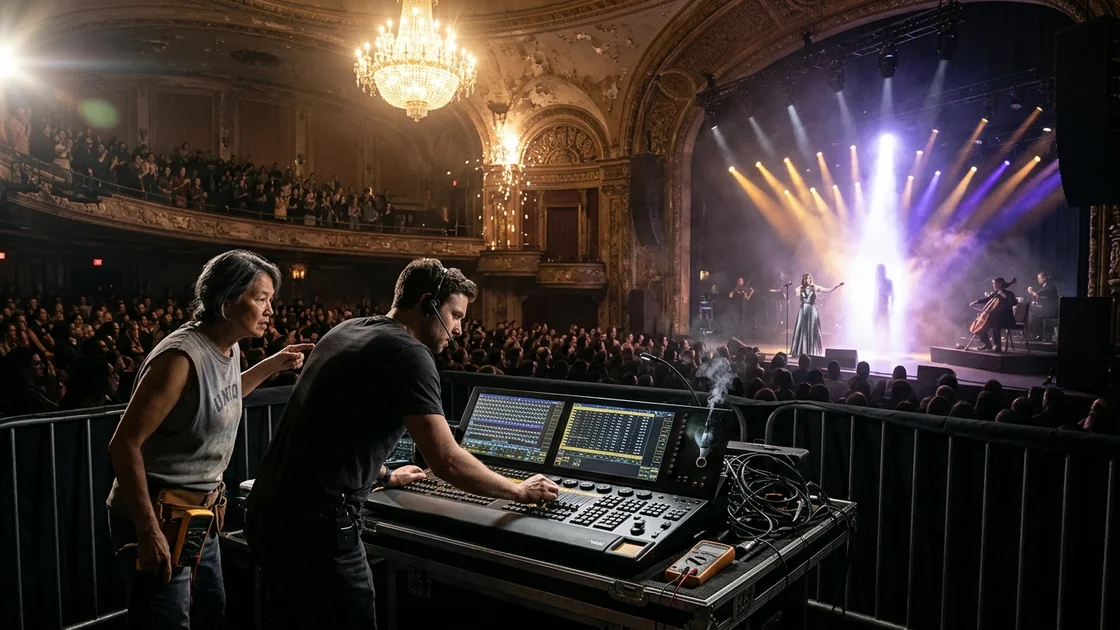
Julian Vance has spent fifteen years living behind a lighting console, trusting the cold logic of copper wire and binary data to turn music into visible architecture. During the final night of a high-stakes tour with the orchestral-electronic band Vespera at the decaying Aethelgard Theatre, his lighting desk begins receiving unexplainable commands on a dead data line. As moving fixtures snap Toward an empty spot on stage and century-old chandeliers hum back to life, Julian and the theater's veteran electrician uncover a parasitic link to an experimental dimmer system built by the venue's obsessed original designer in 1929. Caught between a demanding lead singer, a live recording crew, and a surge of phantom data threatening to ignite the historic auditorium, Julian must decipher a ninety-year-old lighting score and manually finish a fatal performance before the building's haunted circuitry consumes the stage in blinding white heat.
The smell of a century-old theater never truly leaves the velvet. Even after the modern HVAC retrofits, the chemical flame-retardant sprays, and the relentless pump of water-based haze from two MDG ATMe generators sitting in the wings, the Aethelgard Theatre smelled of tallow, damp horsehair plaster, and the sweet, toasted decay of dust baking on hot tungsten.
Julian Vance stood inside the Front of House corral, a twelve-by-twelve-foot island of black steel barricade dropped squarely into the middle of the orchestra stalls, and stared at the right-hand screen of his console.
Everything on the stage seventy feet in front of him was dark, save for the amber glow of a single ghost light sitting on a rolling pipe base downstage center, and the faint blue LED status lights of forty-eight moving-head fixtures hanging from four overhead trusses. It was 2:15 in the afternoon. Doors were at seven. Soundcheck was in forty-five minutes.
On his screen, the DMX output sheet—a dense grid of five-hundred-and-twelve-channel universes represented as tiny numbered boxes—was entirely dark gray, indicating zero percent intensity across the board. Except for Universe 4, Channel 512.
That single box was flickering between 03% and
19%, pulsing with the slow, erratic cadence of a dying
heart.
"You're staring at it again," a voice said from the aisle.
Julian didn't look up. His right index finger rested on the cold aluminum encoder wheel of the GrandMA3 console, rolling it a fraction of a millimeter to the left. The value on the screen refused to drop to zero. A tiny purple indicator bar stayed stubbornly wedged at the bottom of the cell, marking it as an external input merge.
"It's dirty data," Julian said, his voice scratchy from three weeks of bus-bunk air and black coffee. "Something in your house rack is spitting voltage onto the line. Have you got an architectural wall-plate backstage that’s shorted out? Maybe a cleaner hit a button bank in the lobby with a mop handle?"
Maya Lin stepped up to the outer rail of the FOH barricade and rested her forearms on the black Duvetyne cloth draped over the metal. She was sixty-two, wore a faded local union sweatshirt with the sleeves hacked off at the elbows, and carried a battered yellow Fluke multimeter clipped to her belt like a six-shooter. She had been the Master Electrician at the Aethelgard for thirty-four years, which meant she knew every junction box, every dry-rotted conduit, and every mouse skeleton inside the building's four-foot-thick masonry walls.
"Lobby stations are on an isolated Lutron system, kid," Maya said, chewing on the corner of a wooden coffee stirrer. "Have been since the ninety-eight remodel. When I handed you that five-pin XLR tail out of the floor pocket under row M, I patched the other end straight into the opto-splitter in the dimmer beach. The only things living on that line are the twelve archival balcony rail Lekos you asked to tie into your rig, and the relay pack for the proscenium sconces."
"Well, something else is talking on it," Julian said. He tapped a
rapid sequence into the command line with the muscle memory of a concert
pianist. Off DMX 4.1 Thru 4.512 Please.
The command line flashed red. Nothing changed. Channel 512 ticked up
to 22%, held for three seconds, and dropped back to
07%.
Julian frowned, leaning closer to the glass. In the DMX512 protocol, the language was brutally simple. Five hundred and twelve slots of data, each carrying a value between zero and two hundred and fifty-five, refreshing forty-four times a second down a twisted pair of copper wires. It was a blind, unidirectional scream of ones and zeros. A console shouted down the line; the lights listened. The lights didn't talk back unless Remote Device Management was enabled, and Julian always turned RDM off before a show day because it made cheap LED drivers stutter.
And yet, the console wasn't generating this value. It was receiving it.
"Why do I even have an input merge configured on port D?" Julian
muttered to himself. He navigated into the network configuration menu.
He hadn't set Port D as an input. It was assigned as
Out - Universe 4. Yet the port status icon was flashing a
strange, alternating amber and cyan badge that he had never seen in six
years of running this software version.
He looked up toward the high, vaulted ceiling of the auditorium. High above the mezzanine, where painted plaster nymphs peeled away from a water-stained mural of Apollo’s chariot, a single bronze sconce mounted near the upper proscenium arch was glowing. Its filament—a thick, vintage carbon-style loop—was a dull, bruised orange, vibrating slightly in its brass socket.
"That fixture is patched to 4.412," Julian said, pointing up with a silver Sharpie. "Not 4.512. Nothing is patched to 512. Why is the proscenium sconce warming up?"
Maya squinted upward through her bifocals. She took the wooden stirrer out of her mouth. "That sconce isn't even on the relay pack, Julian. The wiring in the upper arch failed inspection in eighty-four. The fire marshal made us snip the leads at the panel."
"Clearly somebody missed a wire."
"I was the one who snipped them," Maya said flatly. "With Klein high-leverage dikes. Two inches shy of the plaster."
Julian let out a slow breath, rubbing the bridge of his nose. They were in the fifth week of a six-week North American theater run for Vespera. Tonight wasn't just the tour finale; it was a live multi-camera shoot for a concert film. Twelve 8K cinema cameras were currently being rigged on dollies in the pit and jib arms along the side aisles. The director of photography had already spent twenty minutes that morning lecturing Julian about color rendering indices, shadow ratios, and the absolute necessity of maintaining a rock-solid 3200-Kelvin key light on Clara Thorne’s face at all times.
If the house wiring was bleeding stray voltage into his console, it could corrupt the opto-isolated bus, crash a network processing unit, or trigger a random all-white strobe hit right in the middle of an intimate cello solo.
"Do me a favor," Julian said, reaching behind the console to the rat's nest of Neutrik connectors plugging into the back of his rack. "Keep an eye on that sconce."
He gripped the barrel of the five-pin XLR cable plugged into Port D—the thick, cloth-jacketed house line Maya had pulled up from the floor traps—pressed the thumb release, and yanked it free.
On his screen, the flickering purple bar on Channel 512 vanished instantly.
Up in the proscenium arch, thirty feet above the stage left boxes, the dull orange filament in the bronze sconce didn't go out. Instead, it flared briefly to a crisp, blinding canary yellow, emitted a faint ping that echoed across the empty seats like a struck crystal glass, and then slowly faded to black over four seconds.
Julian stood with the unplugged cable in his hand, feeling the cool brass pins with his thumb.
"Capacitor discharge in an old ballast," Julian said, though he knew incandescent bulbs didn't have ballasts.
"Sure," Maya said softly. She hadn't taken her eyes off the dark arch. "Let's call it that."
The Aethelgard Theatre had been built in 1927 by a textile magnate who lost his shirt in the crash two years later, leaving the building to a succession of vaudeville syndicates, revivalist preachers, B-movie projectionists, and eventually a municipal preservation trust that had enough grant money to keep the roof from caving in, but never quite enough to gut the mechanical rooms.
While the audio crew began buzzing the PA with pink noise—a harsh, rushing waterfall of static that made the dust motes dance in the work lights—Julian dug his Swisson DMX tester out of his Pelican case.
He plugged the house cable directly into the handheld unit. The little monochrome LCD screen lit up.
Instead of reading NO SIGNAL—which was the only logical
state for a cable whose other end was plugged into the input of
an optical splitter down in the basement—the tester immediately locked
onto a carrier wave.
FRAME RATE: 12 Hz BREAK: 88 us
MAB: 12 us START CODE: 0x91
Julian stared at the readout. Standard DMX ran at forty-four hertz
with a start code of 0x00. A non-zero start code usually
belonged to proprietary system data, RDM packets, or text-based
diagnostic strings from the late eighties. And a twelve-hertz refresh
rate was agonizingly slow—the speed of an ancient microprocessor
struggling to push bytes down a line, or a mechanical commutator
rotating through physical contacts.
More bizarre was the pin configuration warning blinking in the corner
of the screen: DATA DETECTED PIN 4 / PIN 5.
"Maya," Julian said, holding the tester out to her. "When they pulled the DMX tie-lines through this building, did they use standard five-conductor Belden, or did they cheap out and run three-pin mic cable with adapters?"
Maya leaned over the barricade and peered at the screen. "Neither. When the trust got the cultural grant in ninety-one, the contractor didn't want to drill through the four-foot granite foundation walls under the orchestra floor. So they used the existing 1927 Western Electric annunciator conduits. The copper inside was already five-wire twisted pair—heavy fourteen-gauge stuff wrapped in waxed cotton and lead sheathing. Tested clean for impedance, so they just soldered five-pin Neutrik ends onto the old cloth wire and called it a day."
Julian looked down at the thick black cable in his hand. Beneath the modern heat-shrink tubing near the connector boot, he could feel the rigid, lumpy profile of braided cotton insulation.
"Pins four and five," Julian murmured. When the United States Institute for Theatre Technology wrote the DMX512 standard in 1986, they specified a five-pin connector. Pin one was the common ground shield. Pins two and three carried the primary data. Pins four and five were left empty—reserved for a theoretical secondary data link or diagnostic return path that the industry almost never implemented. Within a decade, half the manufacturers in the world stopped even soldering wires to the last two pins.
Yet whatever was pulsing down the ninety-year-old copper under the Aethelgard's floor was screaming down the secondary link, loud enough to bleed across the solder lugs inside his console and trick the processor into reading it as an inbound merge.
He scrolled through the channel monitor on the handheld tester.
Channel 001: 000 Channel 002: 000 ...
Channel 114: 089 Channel 115: 142 Channel 116:
012
The numbers weren't random noise. Random electrical interference—like an unshielded triac dimmer line running parallel to a data cable—looked like jittery garbage across the whole spectrum, values jumping from zero to two-fifty-five in chaotic bursts. These values were rock steady. They were holding specific, deliberate levels, and as Julian watched, Channels 114 through 120 began a smooth, proportional crossfade over ten seconds, counting down in unison toward zero while Channels 201 through 208 crept upward at the exact same rate.
It was a diplomatic, textbook ten-count crossfade. Someone—or something—was running a cue.
"Is there another console in the building?" Julian asked, his voice dropping an octave as the pink noise in the PA cut out, leaving the vast room eerily quiet. "A backup desk in the projection booth? An old Strand Light Palette sitting in a closet somewhere that somebody left plugged into the wall?"
"The booth has been empty since they hauled the carbon-arc projectors out in seventy-six," Maya said. She reached into her pocket, pulled out a fresh wooden stirrer, and snapped it in half between her calloused fingers. "And down in the dimmer beach, there's just my ETC Sensor racks and the pathport node. Unless you count the Leviathan."
Julian looked up from the green glow of the tester. "The what?"
"That's what the old stagehands called it when I started here as an apprentice," Maya said, nodding toward the orchestra pit. "The original board. Arthur Pendelton’s masterpiece. It's still down in the sub-vault beneath the pit. Too heavy to haul up the stairs, and too full of asbestos and mercury switches for the city to pay for abatement, so they just bricked up the main archway and left a crawl hatch for plumbing access."
"An old resistance board," Julian said, dismissing it immediately. "Big iron handles and salt-water dimmers. That's all high-voltage analog, Maya. It doesn't speak binary."
"It wasn't just resistance," Maya corrected him, her dark eyes fixed on the empty stage. "Pendelton wasn't a regular electrician. He worked for Bell Labs in New Jersey before he lost his mind over stage lighting. He thought theatre light shouldn't be controlled by twenty guys pulling hemp ropes and iron levers in the wings. He built a remote low-voltage pre-select system in 1928. Used telephone stepping relays, thyratron vacuum tubes, and a five-wire telegraph matrix so a single operator sitting out here in the house could play the lights like a pipe organ."
She tapped the five-pin cable in Julian's hand.
"Right here in Row M," she added quietly. "Where your riser is sitting. That's where they found him on November fourteenth, 1929, after the dress rehearsal for The Glass Eurydice. The main transformer vaulted, dumped twenty-four hundred volts back up the telegraph lines into his brass organ keys, and welded his hands to the console."
Julian stared at her for three beats, waiting for the smirk that always followed a local crew member's obligatory ghost story. Every historic shed from Chicago to Boston had one: the spectral stagehand in the fly loft, the phantom soprano in dressing room four. It was how house crews hazed touring techs into buying the first round at load-out.
Maya wasn't smirking. Her face was grey and slack under the work lights.
"Right," Julian said, pulling his Leatherman Wave from his belt. "Well, Mr. Pendelton's telegraph lines are messing with my checksums."
He flipped open the needle-nose pliers, took a short three-foot DMX jumper cable from his workbox, and unscrewed the black metal housing of the male connector. Inside, five tiny colored wires were soldered to five brass cups. With two quick, decisive twists of the pliers, Julian gripped the green and white wires attached to pins four and five and snapped them cleanly off the solder cups. He screwed the boot back on, plugged the modified jumper into the house cable, and seated the other end back into Port D of his console.
The purple merge bar on Universe 4 was gone.
He hit his macro for the house archival test. Up on the balcony rail, the twelve vintage Source Four fixtures bloomed to life in a warm, even wash across the stage curtain. Not a single flicker.
"Physical air-gap," Julian said, folding the Leatherman with a metallic clack. "Can't send phantom packets down a wire that doesn't terminate. Let's get ready for soundcheck."
Vespera did not do normal soundchecks.
Most bands walked out in sweatpants, asked for more vocal in the wedge monitors, played forty-five seconds of a mid-tempo single, and went back to catering. Vespera treated soundcheck like a high mass in a cathedral where God was suspected of being slightly out of tune.
At 3:10 PM, Clara Thorne walked out from stage right. She was tall, gaunt, and moved with the brittle, hyper-aware precision of a praying mantis. Even for rehearsal, she wore her stage wardrobe: a floor-length gown of pleated gunmetal silk that caught the sidelight like hammered pewter. Behind her trailed the rest of the ensemble—Devon on the electric cello, two percussionists who played a sprawling battery of marimbas and modular analog synthesizers, and Marcus, the tour manager, who looked like he was surviving entirely on espresso and antacids.
"Julian," Clara’s voice boomed through the PA as she stepped up to the downstage center Neumann microphone. She shielded her eyes with a pale hand, peering out into the dark cavern of the auditorium toward the glowing screens of FOH. "Why is the balcony rail hitting me at thirty degrees? I feel like I'm being interrogated at a border crossing. Where is the haze?"
Julian keyed his talkback mic on the console. "Spinning up the hazers now, Clara. And the balcony rail is just up for the camera crew to get their white-balance charts. Give us two minutes."
In the pit, the video director raised a thumb and hurried off with his cardboard color chart. Julian pulled down the submaster for the balcony rail, plunging the stage into a deep, velvety twilight, and brought up Cue 1.1—the opening look for their first track, Nocturne in B-Flat and Silicon.
Fourteen Martin MAC Ultra profiles hanging on the upstage truss faded in at five percent, projecting a slow, rotating gobo pattern of fractured glass through the rising clouds of haze. From the floor booms in the wings, narrow shafts of deep Congo blue sliced across the stage deck, catching the hem of Clara's silk gown and the polished mahogany neck of Devon's cello.
"Better," Clara breathed into the mic. Her shoulders dropped an inch. "Much better. Let's run The Alchemist's Lung from the second chorus. I want to see the transition into the white-out."
Julian typed Goto Cue 42 Please.
Across the rig, thirty-six Robe MegaPointe fixtures rotated in near-silent synchronization, their lenses tilting down toward the center of the stage. The synth player triggered a sub-bass drone that vibrated the soles of Julian’s boots through the wooden risers of Row M. Devon drew his bow across the cello’s C-string, a mournful, sawing groan that filled the gilded dome of the Aethelgard.
Julian’s left hand hovered over the Master Go button; his right hand rode three motorized faders controlling the key-light intensity and the speed of the prism rotations. This was the only part of the day he truly loved—when the politics of the tour bus, the broken gear, and the endless load-ins evaporated, leaving only the marriage of lumen and hertz. He knew every breath Clara took in this song. He knew that on the fourth beat of the sixty-eighth bar, she would throw her head back, and he would hit Cue 44, snapping all forty-eight moving heads into a tight, blinding pyramid of 6000-Kelvin white light directly around her microphone stand.
"Three, two, one, mark," Julian whispered, and pressed the red Go button.
The console registered the press. The green highlight bar on the cue list jumped from 43 to 44.
On stage, nothing happened.
The lights didn't snap to Clara's microphone. Instead, with a high-pitched whine of stepper motors being driven at maximum velocity, every single moving head on the upstage, mid-stage, and downstage trusses violently whipped forty degrees to stage left.
They converged on an empty patch of worn black Marley flooring, ten feet away from Clara, halfway between the cello riser and the stage-left tormentors.
"What the hell?" Julian barked, slamming his finger onto the
Pause button, then GoBack.
The console ignored him.
The forty-eight fixtures locked onto that empty six-foot circle of stage. Their internal color wheels spun with a frantic metallic clatter—clack-clack-clack-clack—blowing past the dichroic cyan, magenta, and yellow flags until they settled on an impossible combination of CTO amber and deep UV filter. The iris diaphragms contracted in unison, narrowing the beams down to needle-thin shafts the width of a human wrist, all intersecting at a single point in midair exactly five feet six inches off the stage deck.
Where the forty-eight beams met, the haze didn't just glow; it boiled. A tight, violent vortex of heated aerosol spun in the empty air, looking startlingly like a figure wrapped in a shroud of incandescent dust.
On stage, the music frayed into a ragged halt. Devon pulled his bow off the strings. The synth drone died.
Clara didn't yell. She stood frozen at her microphone, her head turned toward stage left, staring into the blinding nexus of light ten feet away from her.
"Julian?" Marcus’s voice crackled in Julian’s clear-com headset, tight with panic. "Julian, what are you doing? Clara's marks are center-center. Why are you spotting stage left?"
"I'm not," Julian said, his fingers flying across the programming
keypad. Clear. Clear. Clear. Off Everything.
The command line was sluggish, characters appearing a half-second after he struck the keys, as if the console's processor were drowning in an interrupt storm. He grabbed the Grand Master fader—the ultimate hardware kill-switch that scaled all intensity outputs to zero—and yanked it to the bottom of its track.
The stage stayed blazingly bright.
In fact, the light at the focal point was getting brighter. The discharge lamps inside the MegaPointes were being pushed into their boost mode, a setting Julian had locked out in the fixture profiles to prevent blowing globes mid-tour. He could smell it from seventy feet away—the sharp, metallic tang of superheated dust and scorched polymer lenses.
And then he looked at the DMX sheet on his right-hand screen.
It wasn't just Universe 4 anymore. Universes 1, 2, and 3—which ran entirely over shielded Cat6 Ethernet cable to modern sACN nodes hanging in the trusses—were flooded with purple input-merge flags.
The values weren't random. They were scrolling down the screen in a cascading geometric wave, forming a clear, unmistakable pattern in the grid of numbers.
Julian reached behind the console and ripped the main Ethernet line and the Universe 4 XLR cable completely out of the back of the desk.
Cut off from their data source, the fixtures on the trusses should have instantly defaulted to their "Hold Last Look" state or dropped to black. Instead, with all cables dangling in Julian’s hands, the forty-eight moving heads slowly raised their beams in unison—tilting upward from the stage deck, tracing an invisible path up the side of the proscenium arch, across the painted ceiling of Apollo's chariot, and stopping dead on the front rail of the FOH barricade.
Right in Julian's face.
The glare was absolute. It was like staring into the core of a welding arc. Julian threw an arm up to shield his eyes, stumbling back against his tall director’s chair as a wave of radiant heat washed over the Row M seating area. Beside him, he heard Maya swear in Cantonese.
For three agonizing seconds, the entire lighting rig of the Vespera tour held Julian pinned in a cone of blinding ultraviolet-amber light. Within the roar of the fixture cooling fans, he heard a rhythmic clicking coming from the brass grilles set into the floor beneath his feet—the unmistakable, rapid-fire chatter of mechanical telegraph relays cycling at twelve hertz.
Click-clack-clack. Click-clack-clack.
Then, all at once, the shutters snapped closed. The auditorium dropped back into the dim amber gloom of the work lights.
In the stunned silence that followed, Clara’s voice floated out over the PA, barely above a whisper, devoid of all her usual diva Imperiousness.
"Who was that?" she asked the dark room. "Standing by the cello?"
Devon turned around on his riser, looking wildly at the empty black floor beside him where a faint wisp of scorched haze was still rising toward the grid. "There's nobody here, Clara."
"Don't lie to me," Clara said, her voice trembling. "I saw his coat. He was looking right at the booth."
Marcus gave Julian until 6:00 PM to either fix the console or have a rental replacement couriered in from a production shop in Queens.
"I don't care if you have to run the show on two scenes and a pocket calculator," the tour manager hissed, leaning over the FOH rail while chewing two pieces of nicotine gum at once. "The label put up four hundred grand for this film shoot. If those lights go rogue while the cameras are rolling, you're walking home to Chicago."
"It’s not the desk, Marcus," Julian said, though he didn't bother explaining further. Tour managers didn't believe in haunted ground loops. They believed in firing technicians.
As soon as the band retreated to the green room for an early dinner and the camera crew broke for catering, Julian grabbed his flashlight, his Swisson tester, and his tool pouch, and met Maya at the stage-left pass door that led down into the basement.
The underbelly of the Aethelgard was a labyrinth of low brick barrel vaults, sweating cast-iron steam pipes, and calcified stalactites hanging from the mortar joints where groundwater had seeped in from the street above for nine decades. The air down here was ten degrees cooler than the house, heavy with the smell of wet coal ash and river silt.
They walked past the modern dressing rooms and ducked through a heavy steel fire door labeled DIMMER VAULT - AUTHORIZED PERSONNEL ONLY.
Here sat the "dimmer beach" of the 1998 renovation: four tall, black steel racks of ETC Sensor dimmers humming peacefully at sixty hertz, alongside a small wall-mounted network rack containing the Luminex Ethernet switch and the eight-port DMX opto-splitter.
Julian shone his flashlight on the opto-splitter. The green data LEDs for ports one through four were blinking with a steady, rhythmic pulse—even though Julian had left his console completely unplugged upstairs.
"Where does the building's main ground rod sit?" Julian asked, pulling his multimeter out and setting it to measure AC voltage.
"Under the sub-vault," Maya said, pointing straight down at the cracked concrete floor. "Tied into the old artesian well casing they sank when they poured the footings."
Julian touched the black probe of his meter to the bare copper grounding busbar bolted to the wall behind the racks, and the red probe to the metal chassis of the opto-splitter. There should have been zero potential between them; they were bonded together.
The meter read 48.2V AC. As he watched, the frequency
counter on the secondary display flickered: 12.0 Hz.
"Jesus," Julian breathed. "The whole ground plane of the building is modulated. When I cut pins four and five upstairs, it didn't matter. Whatever is generating this signal is using the entire structural ground of the theater as a return path, inducing a differential voltage right across the internal transformers of the network switch. It's turning your grounding grid into an antenna."
"Nothing down here runs at twelve hertz, Julian," Maya said quietly. "Sixty-cycle comes in from Con Edison on the street. Always has."
"Then show me the hatch," Julian said.
Maya hesitated, her hand resting on the rusty handle of a breaker disconnect. "The air down there is bad. And the floor is flooded half the time."
"I have forty minutes before doors," Julian said, his jaw set. "Show me the Leviathan."
She led him past the modern racks into a narrow, unlit coal chute behind the boiler room. At the end of the passage, the 1927 red brick had been sealed off with rough gray cinderblocks from the nineteen-seventies. Down in the bottom right corner, three blocks high and two blocks wide, someone had framed in a small galvanized steel access door secured with a rusted padlock.
Maya didn't use a key. She gave the padlock a sharp rap with the butt of her flashlight, and the corroded shackle popped open—she had clearly been down here before, no matter what she told the fire marshal.
She swung the tin door back. A draft of air rolled out of the hole, smelling not of rot or sewage, but of sharp, metallic ozone, warm paraffin wax, and bitter almonds.
And there was light inside.
Not the steady white glow of a work lamp, nor the green blink of an LED. It was a pale, watery violet luminescence that pulsed against the damp brickwork beyond the crawlspace, accompanied by a low, rhythmic humming that Julian felt in his fillings before he heard it with his ears.
Julian dropped to his knees, switched on his high-lumen LED tactical light, and crawled through the opening.
The sub-vault was directly beneath the orchestra pit. It was a cathedral in miniature, thirty feet long and twelve feet high, supported by massive riveted iron girders coated in flaking red-lead paint. Two inches of black, oily water covered the flagstone floor, reflecting the ceiling like a dark mirror.
Running the entire length of the far wall was Arthur Pendelton’s machine.
It looked like the bridge of a sunken dreadnought crossed with a pipe organ. Twelve towering slabs of polished black Belgian slate, each two inches thick and eight feet tall, stood bolted to an iron frame. Across the face of the slate were hundreds of heavy copper knife switches, brass rheostat wheels, and glass-domed telephone relays arranged in intricate, symmetrical rows. Above the slate panels, suspended from porcelain insulators, ran three solid copper busbars the thickness of a man's forearm, green with ninety years of verdigris.
At the center of the array sat a small, semicircular wooden desk—rotted now, its mahogany veneer peeling away like dead skin—fitted with five rows of tarnished brass keys, fifty-one to a row, and a bank of foot pedals submerged in the black water.
And at the top of the third slate panel, four glass thyratron tubes—bulbous, hand-blown vacuum cylinders the size of quart mason jars—were glowing with that eerie, pulsing violet mercury-vapor light.
Click-clack-clack. Click-clack-clack.
Inside the glass domes along the bottom of the slate, dozens of tiny brass armatures were snapping back and forth on their electromagnetic coils, stepping through a sequence with mechanical, unstoppable precision.
"How is this getting power?" Julian whispered, his breath pluming slightly despite the warmth radiating from the slate panels. His boots splashed softly in the shallow water as he stepped closer, keeping his hands firmly tucked against his chest. "The feeders had to have been cut when they put the modern service in."
Maya crawled through the hatch behind him and stood up on a dry concrete footing near the wall. She shone her beam up at the ceiling of the vault, where the massive four-hundred-amp three-phase cables from the modern company switch ran through a rusted iron trough directly above Pendelton's copper busbars.
"They didn't pull the old feeders out of the street duct," Maya said, her voice hushed. "And look at the trough. The iron has rusted straight through. The modern feeder cables are resting right on top of Pendelton's primary induction coils."
Julian followed her light. Three thick black 4/0 feeder cables—the very ones supplying power to his touring dimmer racks and moving lights upstairs—were sagging through a rotted gap in the ceiling tray, their rubber jackets pressed flat against a series of giant, copper-wound iron toroids mounted to the top of the 1928 frame.
"Inductive coupling," Julian said, his mind racing through the physics. "Every time we pull heavy current upstairs for the rig, the magnetic field around those feeder cables induces current right into Pendelton's primary coils. We're charging his system like a giant wireless toothbrush."
"He designed it to draw off the street mains without a direct tap during brownouts," Maya said, looking at the glowing violet tubes. "He called it a resonant harmonic accumulator. And look at the keys."
Julian lowered his flashlight beam to the rotted mahogany console at the center of the slate wall.
The brass keys weren't stationary. Tiny solenoid latches beneath the keybed were firing in sequence, pulling individual keys down for a few seconds and releasing them. Beside the keybed, mounted on a brass music stand, sat a thick ledger bound in cracked black leather, its pages stiff with dampness and salt crust.
Julian stepped onto a raised wooden duckboard that had miraculously survived the decades of dampness, leaning over the desk without touching a single piece of metal. The ledger was open to the final pages. Across the yellowed graphing paper, written in faded iron-gall ink with a nib pen so sharp it had scored the paper, were columns of hexadecimal-like octal notations and timing marks, titled in a cramped, frantic hand:
THE GLASS EURYDICE — ACT III: APOTHEOSIS OF TERRESTRIAL LIGHT Projection Focus: Downstage Left (Orpheus Position). Harmonic Carrier: 12 Cycles. Secondary Telemetry Matrix Active. Note: Upon completion of Movement IV (Cue 511), the Operator must manually bridge the Master Shunt to Ground (Cue 512) to discharge the Resonant Accumulator. Failure to complete the fade will result in thermal runaway of the primary arc-circuits.
Julian looked from the ledger to the stepping relays clicking away on the slate panel above. Each relay bank had a rotating brass numbered wheel behind a little glass window, counting upward as the solenoids fired.
The wheel currently read: 4 8 2.
"It's a state machine," Julian said, a cold prickle of sweat breaking out under his collar. "An electro-mechanical state machine. In 1929, during the dress rehearsal, he got up to the finale. The accumulator overloaded before he could hit the final release cue. It killed him, tripped the city substation, and the relays stayed physically latched right where they were for ninety years."
"Until your rig pulled enough inductive load to wake the tubes back up," Maya finished. "And when you plugged your console into his five-wire telegraph matrix..."
"My console's network processor saw the twelve-hertz stepping pulses
on the ground plane, interpreted the voltage spikes as raw DMX frames,
and bridged them onto our Ethernet network," Julian said. He looked
closer at the brass counter wheel. Click-clack. It advanced to
4 8 3.
"Wait a minute," Julian said. "Why is it advancing now? Nobody is pressing the Go button."
He traced the wiring from the stepping relay down the back of the slate panel with his flashlight beam. Two heavy cloth-covered wires dropped down into the black water on the floor and ran straight to the main grounding rod—and strapped right alongside the grounding rod was the copper cold-water pipe that fed the dressing room showers, and the shielded Cat6 cable that the audio crew had tossed through the basement stairwell to run their digital snake.
"It's clocking itself off the audio crew's word-clock or the SMPTE timecode test from the video truck," Julian realized. "Every time the video truck sends a sync pulse, the relay steps forward one cue."
He looked back at the ledger. Under Cue 511, Pendelton had written the amperage draw required for the Apotheosis: a dead short across all three phases of the resonant coils, designed to dump the entirety of the stored capacitive energy into the stage fixtures at once to create a blinding, five-second flash that he believed would literally imprint the image of the performer onto the retinas and souls of the audience forever.
And right now, upstairs, forty-eight modern discharge and LED fixtures, plus twelve miles of sixty-year-old cloth wiring in the walls, were enslaved to that cue list. If the machine hit 511 without someone executing the 512 ground-shunt fade, the modern feeder cables resting on top of the induction coils would superheat, melt their insulation, and arc directly to the iron girders of the orchestra pit.
With three thousand people sitting directly above them.
"Cut the main breaker," Julian said, turning toward the hatch. "Right now. We kill the company switch, let the capacitors bleed down, and cancel the show."
Maya grabbed his jacket sleeve. "Julian, you can't just throw the main disconnect while those coils are saturated." She pointed her flashlight at the top of the slate board, where the three four-hundred-amp feeder cables rested on the rusted trough. A thin, hair-like thread of blue plasma was already dancing between the rubber jacket of the C-phase feeder and Pendelton's copper busbar, hissing like an angry cat. "If you break a four-hundred-amp inductive load under tension without ramping the current down first, the back-EMF spike will blow that disconnect box right off the wall and weld those feeders to the iron trough instantly."
Julian stared at the blue arc. She was right. It was basic electrical theory: an inductor fights any sudden change in current. Pulling the main switch while those giant 1928 coils were fully fluxed would create a massive voltage transient—thousands of volts looking for the shortest path to ground. And the shortest path was through the steel structural beams of the stage and the copper shielding of every microphone cable in the building. Clara would be electrocuted the moment her lips touched the Neumann.
"Then how do we discharge it?" Julian asked, pointing at the rotted wooden console. "The manual shunt lever on that desk is rusted solid, and if I touch it while standing in two inches of water, I'll end up just like Pendelton."
He shone his light back down on the ledger, reading the wiring schematic drawn in the margin on the opposite page.
The Master Shunt wasn't a direct high-voltage switch on the desk. Pendelton had been smarter than that—at least in theory. The shunt was triggered by a high-current thyratron relay on Panel 12, which waited for a specific five-bit binary voltage state on the telegraph lines: all five conductors held at negative twenty-four volts relative to the chassis for five full seconds, followed by a clean drop to zero.
In DMX terms, it was the equivalent of holding Channel 512 at
full—255—and then executing a five-second fade to
000 down the secondary data pins.
"He built a digital handshake in 1928," Julian whispered, awe momentarily cutting through his terror. "That's why Channel 512 was flickering on my screen this afternoon. The machine has been polling the line, waiting for the console upstairs to send the acknowledgment pulse on pins four and five."
His walkie-talkie squawked on his hip. "Julian, you copy? It's Marcus. Doors are in ten minutes. House manager is breathing down my neck. Get the house lights up to half right now or I'm putting the local girl on your desk."
Julian looked at the brass wheel on the slate panel.
Click-clack. 4 8 6.
Twenty-five steps left until 511.
"Come on," Julian told Maya, dropping back to his knees and scrambling toward the tin hatch. "Get your soldering iron out of your workbox and meet me at FOH."
At 7:00 PM, the heavy oak doors of the Aethelgard lobby swung open, and the low, expectant roar of three thousand people flooded into the auditorium.
Down inside the FOH barricade, crouched beneath the black Duvetyne skirt with a clip-on book light between his teeth, Julian held the disassembled five-pin XLR jumper steady while Maya touched the tip of her Weller soldering iron to pins four and five.
A wisp of grey rosin smoke curled up between their faces.
"Don't bridge them straight to two and three," Julian said around the flashlight in his mouth. "If we tie the primary DMX straight into his telegraph coils without resistance, his twenty-four-volt return will fry the RS-485 transceiver chips inside my console before we get to the end of the show."
"I didn't spend thirty years fixing blown dimmer cards to get lectured on Ohm's Law by a kid in skinny jeans," Maya muttered. From her shirt pocket, she pulled two quarter-watt, 120-ohm termination resistors she had scavenged from old XLR dummy plugs. With surgeon-steady hands, she soldered the resistors in series between pins two and four, and pins three and five, creating an attenuated bridge that would allow Julian’s console to push data down the secondary telegraph lines while bleeding off the majority of the high-voltage back-feed into the resistor bodies.
"Those resistors are going to get hot as hell," Maya warned, wrapping the exposed leads in three layers of Scotch Super 33 electrical tape and screwing the connector shell back together. "They're rated for a quarter-watt. If that thing downstairs pushes real current up the line, you've got maybe ten minutes before they burn open like a fuse."
"Then I won't plug them in until we hit the final sequence," Julian said, taking the modified cable and laying it carefully on the console armrest beside his hand.
Above them, the theatre was nearly full. The air was growing thick with body heat, expensive perfume, and the electricity of a sold-out crowd. Along the aisles, the camera operators were checking their lenses, their tally lights glowing red in the dimness.
At 7:55 PM, Marcus walked down the center aisle and stopped at the FOH rail. He looked at Julian’s pale, sweat-sheened face, then down at the console screens.
"Everything green?" Marcus asked.
"Everything's patched," Julian lied smoothly. "We had a dirty ground in the dimmer vault. Maya sorted it out."
Marcus nodded once, checked his Rolex, and spoke into his wrist mic. "House to half. Intro tape in sixty."
Julian took a deep breath, wiped his palms on his black jeans, and pushed up the house light submaster.
The grand central chandelier and the cove lights along the gilded ceiling dimmed slowly down to fifty percent, then out to black as the crowd erupted into a wall of cheering.
From the PA came the opening strains of Nocturne in B-Flat and Silicon—a crystalline arpeggio of glass harmonicas and sub-bass.
Julian’s fingers found the keys. For the first forty minutes of the set, he fought the hardest technical battle of his life without a single person in the audience knowing anything was wrong.
Because he was leaving the modified jumper unplugged to save the resistors, he had no direct physical link to Universe 4, yet the inductive coupling down in the sub-vault was still broadcasting the Leviathan's stepping pulses across the theater's ground plane. Every three or four minutes, as the band hit a loud dynamic peak and the audio amplifiers pulled heavy current from the mains, a ghost packet would leap across the Ethernet switches.
During the third song, Mercury Glass, six moving heads on the mid-stage truss suddenly broke out of their slow cyan sweep and snapped toward that same empty spot downstage left.
Before the beams could fully converge, Julian’s fingers flew across the console: he grabbed those six fixtures in the programmer, knocked their pan-tilt speed down to two seconds so the movement looked intentional, and mirrored the exact same movement on the six fixtures on stage right, turning the phantom anomaly into a symmetrical, architectural cross-stage look that made the camera director in his headset whisper, "Gorgeous, lighting. Hold that frame for the wide jib."
Julian didn't answer. His eyes were glued to a custom system monitor window he had opened on his left-hand screen, tracking the hexadecimal raw data bleeding across the sACN network ground.
Every time a ghost packet broke through, the header byte incremented by one.
By the end of the fourth song, it was at 0x1EA—decimal
490.
By the seventh song, a sprawling, percussive piece that had all
forty-eight moving heads pulsing in deep crimson and gold, the counter
hit 501.
The temperature inside the auditorium was climbing noticeably. It wasn't just the crowd; the old cloth-wrapped wiring inside the plaster walls was acting as a giant heating element as the resonant harmonic accumulator in the basement built toward saturation. Julian could see a faint, shimmering heat haze rising from the brass floor vents along the orchestra pit.
Up on stage, Clara was giving the performance of her life, yet she kept glancing toward stage left. Even whenJulian kept that corner of the deck bathed in deep, shadows-hiding indigo, she sang to it—her pale face turned forty degrees off-center, her eyes wide and bright, as if someone in a dark coat were standing just beyond the cello riser, conducting her with hands of violet fire.
"She's off her mark again," the video director groaned in the coms. "Camera three, push in on the profile, I guess we're shooting this whole ballad from the side."
At 9:10 PM, the band reached the penultimate piece: the twenty-minute algorithmic synth interlude that led directly into the finale, The Glass Eurydice. Wait—Julian’s breath caught as he looked at the setlist taped to the wrist rest of his console.
The band's closing track for this tour had been titled Eurydice in the Wire on the album. Clara had written the lyrics in a hotel room in Prague two years ago—or so the press kit said. Yet here they were, ninety-five years after Arthur Pendelton died during the dress rehearsal for The Glass Eurydice, playing the exact same mythic death-march under the exact same proscenium arch.
"Maya," Julian said quietly, not taking his eyes off the stage as the modular synthesizers began their long, hypnotic, SMPTE-locked pulse. "The counter's at 506. Every minute of this timecode track is stepping the relays once. We have five minutes before it hits 511."
Maya leaned over the barricade beside him, her yellow multimeter
sitting live on the edge of his console case, its probes jammed into the
ground pin of an open power strip. The AC voltage on the ground line was
up to 84.6V and climbing steadily by a tenth of a volt
every second.
"Plug the jumper in now," Maya said, her voice tight. "Before the potential gets so high it arcs right across the XLR pins when you bring them close."
Julian picked up the modified five-pin jumper, reached behind the desk, and pushed it into Port D until the metal latch clicked.
Instantly, he smelled hot phenolic resin. Inside the black connector shell, the two tiny quarter-watt resistors were taking the brunt of Pendelton's twenty-four-volt telegraph line.
On the console's right-hand screen, Universe 4 burst into life.
Every single channel from 1 to 511 was populated with purple
input-merge bars, locked in an intricate, shifting harmonic wave that
rose and fell like the pipes of a massive cathedral organ. Only Channel
512 sat at 000, blinking red.
Julian typed rapidly into the command line:
Assign DMX 4.512 At Exec 201
Store Cue 1 DMX 4.512 At 100
Store Cue 2 DMX 4.512 At 0 Fade 5
He had bound the phantom channel directly to a physical motorized fader under his right hand.
On stage, the synth interlude ended with a thunderous timpani roll. Clara stepped up to the center mic. The sweat on her collarbones gleamed like liquid silver under the key light.
The hexadecimal counter on Julian's left screen ticked from
0x1FD to 0x1FE.
Decimal 510.
"Here we go," Julian whispered.
Devon struck the opening chord of the finale on his cello—a massive, distorted fifth run through an octave pedal that shook dust from the ceiling murals.
The counter ticked to 0x1FF.
511.
Down in the sub-vault, forty feet below their boots, Julian heard a dull, subterranean THUMP that bypassed the ears entirely and hit the sternum like a medicine ball.
Instantly, every light in the Aethelgard Theatre went rogue.
The console's motorized faders slammed themselves to the top of their tracks with a sound like a rifle bolt cycling—clack!—pinning themselves at 100%. One by one, the forty-eight moving heads on the trusses abandoned their programmed positions and whipped down toward that empty six-foot circle on stage left.
Only this time, it wasn't just the moving lights.
High in the ceiling, the twelve-ton crystal chandelier—which had been turned off at the breaker panel before the show—blazed on. So did the disconnected proscenium sconces. So did the work lights in the fly loft, the green exit signs, and the ancient, dust-choked footlight troughs at the very lip of the stage that hadn't been opened since 1952.
The amperage draw was titanic. The metal barricade around FOH hummed like a struck tuning fork. From the brass floor vents beneath the seats came a rising hiss of hot steam and the sharp, sweet stench of boiling salt-water and ozone as the ancient vault below superheated.
On stage, the focal point of the forty-eight beams was so intensely bright that the air inside the cone ionized into a pale violet column of plasma. Within that column of blinding light, the haze didn't swirl randomly; it was trapped in the standing electromagnetic wave between the overhead trusses and the iron girders beneath the stage floor, forming the distinct, rigid silhouette of a tall man standing with his arms raised toward the balcony, conducting the light itself.
Clara saw it. The entire front ten rows saw it. A collective gasp rippled through the crowd, half terror, half ecstatic awe, as they assumed they were witnessing some miraculous holographic projection saved for the final five minutes of the concert film.
Clara didn't run. Drawn like a moth into a carbon arc, she took one step away from her microphone stand toward the violet column on stage left, her hand reaching out toward the superheated focal point.
If she stepped into that convergence of forty-eight boosted discharge beams and induced floor voltage, her silk dress would ignite before the electrical potential through the deck stopped her heart.
"Julian, the jumper!" Maya shouted, pointing behind the console.
A thin ribbon of black smoke was curling up from the Port D connector boot. The 120-ohm resistors inside were burning up. Once they charred through and failed open, Julian would lose the link to pins four and five forever.
"Wait for the five-second window!" Julian yelled back over the roar of the PA and the screaming cooling fans of the rig. "If I fire the shunt before the accumulator hits peak saturation, the relay won't latch!"
He watched the voltage readout on Maya’s multimeter.
112V... 118V... 124V...
In his headset, the video director was screaming: "I'm losing cameras! The SDI shields are frying! Whatever you're doing with the strobes, kill it!"
Up on the high proscenium arch, one of the vintage 1927 bronze sconces exploded in a shower of golden sparks that rained down into the stage-left wings, eliciting a shriek from the crowd in the box seats.
On the left-hand screen, the hexadecimal counter flashed red:
BUFFER FULL — WAITING FOR ACK.
The multimeter hit 130.0V and stalled, vibrating at an
exact, terrifying 12.00 Hz.
"Now!" Julian roared.
He shoved Executor Fader 201 to the top of its track, slamming
255—full positive voltage—straight down pins four and five
into the burning resistors.
He held it there, his thumb pressed white-knuckled against the plastic fader cap as the metal chassis of the GrandMA3 bit into his palm with a sharp, sixty-volt tingle that made the muscles in his forearm spasm.
"One... two..." Julian counted out loud, his teeth clenched as the smell of melting solder rose from the back of the desk.
On stage, Clara was two feet from the blazing column of violet light, her voice soaring into a wordless, operatic high C that seemed to vibrate in sympathy with the groaning steel trusses above her head.
"Three... four..."
Behind the console, a tiny tongue of orange flame licked out of the rubber boot of the XLR connector. The plastic was bubbling.
"Five!"
Julian didn't trust the console's internal five-second fade engine—not with the processor choking on interrupts. He kept his thumb welded to the fader and drew it down himself.
Smooth. Proportional. Five seconds from top to bottom, just the way Arthur Pendelton had written it in iron-gall ink ninety-five years ago.
Five. The chandelier dimmed by twenty percent, its crystals chiming as the thermal expansion slowed.
Four. The forty-eight moving heads began to open their iris diaphragms, widening the needle-thin beams so the blinding violet column softened into a warm, golden wash across the entire stage.
Three. The high-pitched whine of the dimmer racks in the basement dropped an octave, shifting from an agonizing shriek to a deep, resonant bass sigh.
Two. Clara stopped at the edge of the light, lowering her outstretched hand to her chest as the oppressive radiant heat faded from the stage deck, leaving a swirling mist of silver haze that drifted harmlessly over the orchestra pit.
One. Julian pulled the fader smoothly into the zero stop at the bottom of the track, just as Devon drew the final, dying note from his cello.
Zero.
Behind the console, the XLR connector gave a sharp pop as the resistors finally vaporized inside the shell, severing the circuit in the exact millisecond the voltage hit zero.
Directly beneath their feet, deep within the flooded brick vault under the pit, a massive iron contactor dropped home with a heavy, resonant CLANG that echoed up through the ventilation shafts like the closing of a bronze cathedral door.
Every light in the Aethelgard Theatre went completely, utterly black.
Not the gray-black of LED fixtures idling with their fans running, nor the amber-black of a stage lit by exit signs. For two full seconds, the darkness was absolute, velvet, and cool.
The multimeter on Maya’s belt read 0.00V.
On Julian’s right-hand screen, the DMX output sheet for Universe 4 was entirely dark gray. Every single purple merge bar had vanished.
For three heartbeats, three thousand people sat in stunned, breathless silence, their retinas still swimming with the afterimage of that impossible golden-violet cathedral of light.
Then, someone in the front row stood up and began to clap.
Within a second, the entire auditorium erupted. It was a deafening, foot-stomping roar that shook the seat frames of Row M—the kind of ovation Julian had only heard twice in fifteen years of touring, when an audience knew in their bones they had just witnessed something that could never be repeated, bottled, or explained.
Julian let out a ragged breath he felt like he had been holding since soundcheck. His right hand was trembling so badly he had to use his left wrist to steady it as he reached over and gently nudged up the submaster for the stage curtain-call wash.
Warm, ordinary 3200-Kelvin tungsten light spilled from the balcony rail Lekos, illuminating Clara, Devon, and the percussionists as they bowed together at center stage. Clara looked dazed, her cheeks wet with tears, her eyes scanning the stage-left wings one last time before she took Devon's hand and bowed low to the screaming crowd.
Beside Julian, Maya calmly switched off her Fluke multimeter, clipped it back onto her belt, and leaned over the back of his console with a CO2 fire extinguisher, giving the smoking Port D connector a tiny, half-second pffft of white frost.
"You owe me two quarter-watt resistors," Maya said over the roar of the crowd.
Julian sank back into his tall canvas chair, looking down at his blistered right thumb, then up at the proscenium arch where a single wisp of smoke still curled from the dead bronze sconce.
"Put it on the tour settlement," Julian said, and pulled up the house lights to let the ghosts go home.