Signal Loss on the Abyssal Plain
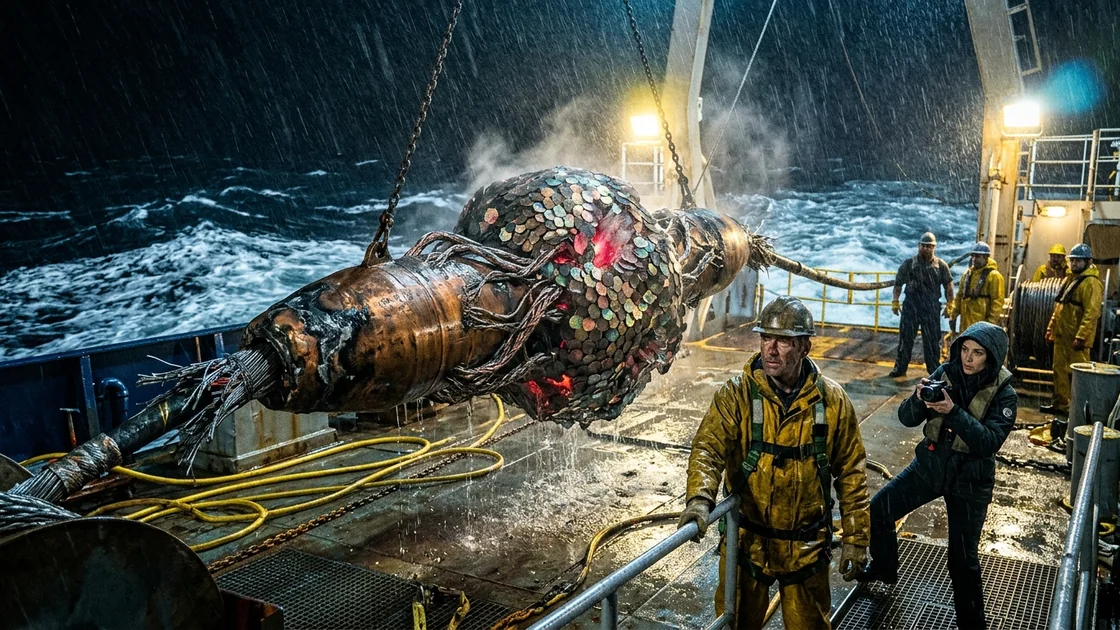
In the freezing waters of the North Pacific, the crew of the submarine cable repair vessel Meridian winches up a severed transoceanic communications line from three miles below the surface. Expecting to find damage from an undersea landslide or a rogue anchor, Chief Jointer Arthur Vance and optical specialist Doctor Elena Rostova instead discover a bizarre, colonial metallic organism fused directly into the heavy beryllium-copper housing of an optical repeater. The creature, an extremophile evolved to feed on the ten-thousand-volt current running through the seabed infrastructure, has not only consumed the copper conductor but has also woven its crystalline filaments into the glass fibers, absorbing and refracting the global data stream. As the crew brings the unit into the warm laboratory for extraction, the dormant organism awakens, sending conductive tendrils into the ship's electrical grid and forcing the isolated engineers into a desperate battle to sever the creature from their vessel before it consumes their power core and drags them into the freezing dark.
The linear cable engine groaned under the strain of forty-two metric tons of dead weight hanging straight down into the black water of the Kuril-Kamchatka Trench.
Arthur Vance stood on the grating of the aft working deck, his gloved hands wrapped around the cold, salt-pitted steel of the safety rail. Rain fell in thick, diagonal sheets, driven by a relentless gale screaming off the Sea of Okhotsk, turning the floodlit stern of the CS Meridian into a slick, heaving stage of yellow foul-weather gear and glistening hydraulic hoses. Beneath his steel-toed boots, the deck plates vibrated with a low, rhythmic thrumming—the diesel-electric thrusters fighting to hold the ten-thousand-ton vessel within a five-meter dynamic positioning footprint above the abyssal plain.
"Tension spiking to forty-four tons," crackled the voice of Kaelen, the deck bosun, over Vance’s shoulder radio. The wet speaker hissed with static. "Drum engine’s feeling the drag, Arthur. Whatever’s wrapped around that repeater, it’s bringing half the seabed up with it."
Vance keyed his mic with a numb thumb. "Keep the haul speed at point-two knots, Kaelen. Don't jerk the line. If we part the armor wires now, we’ll spend another four days dragging a grapnel through five thousand meters of mud."
"Copy that. Point-two knots. She’s eighty meters below the stern sheave now."
Vance wiped rain and diesel soot from his face, squinting over the massive steel cylinder of the stern sheave where the submarine cable—currently nothing more than a glistening black line no thicker than a garden hose, wrapped in a heavy mantle of Abyssal clay and shredded polypropylene yarn—crept upward out of the churning white froth of the wake.
The fault had occurred seventy-two hours ago on Trans-Pacific Trunk Line 9, a vital artery carrying forty terabits per second of financial transactions, military telemetry, and civilian internet traffic between Tokyo and Seattle. Most cable breaks were mundane affairs. Seventy percent of them happened in shallow continental shelf waters, the work of careless bottom-trawlers dragging heavy otter boards across the seafloor, or container ships dropping anchors in the wrong shipping lanes. Out here in the deep ocean, where the seabed flattened out into the endless, freezing plains of pelagic ooze three miles down, breaks were rare. Usually, it took a turbidity current—an underwater avalanche triggered by a seismic tremor—to snap a deep-sea trunk line.
But the seismographs in Sapporo and Anchorage had been dead quiet on Tuesday night.
And the telemetry before the break had been entirely wrong. Vance had spent twenty-two years splicing optical fibers in the belly of repair ships from the Atlantic Ridge to the Java Trench, and he had never seen a fault signature like the one sitting on his diagnostic terminal downstairs. Usually, a deep-sea shunt fault happened instantly: the copper tube inside the cable got breached by seawater, the ten-thousand-volt direct current grounding out into the ocean, followed milliseconds later by the glass fibers snapping.
On TPT-9, the failure had taken nineteen hours.
First, the shoreside Power Feed Equipment in Chiba had registered a slow, rhythmic oscillation in voltage. It looked almost like a heartbeat, a gradual parasitic draw that forced the automated regulators to pump more and more amperage into the line to keep the optical amplifiers running. Then came the chromatic dispersion—the laser light bouncing through the eight pairs of hair-thin glass fibers began to scatter, phase-shift, and return bizarre, harmonic echoes that blinded the optical time-domain reflectometers on both sides of the Pacific. Finally, at 03:14 UTC, the line went completely dark. A total open circuit, four thousand eight hundred and fifty meters down.
"Arthur," a voice called out behind him.
Dr. Elena Rostova stepped out from the sheltered overhang of the main hangar bay, struggling with the heavy latches of her lifevest. She was a specialist sent out by the consortium that owned the cable, boarded via helicopter out of Kushiro two days ago. At thirty-five, she was fifteen years younger than Vance, with sharp, sleepless eyes and hands that were far more accustomed to clean-room calibration benches in Zurich than the freezing misery of a North Pacific winter.
"You shouldn't be on the open deck, Doctor," Vance shouted over the howl of the wind and the whine of the hydraulic winches. "If that cable parts under forty tons of tension, the backlash will cut a man in half before he hears the snap."
"The tension profile on the bridge monitors just plateaued," Rostova yelled back, edging closer to the safety barrier, her eyes fixed on the stern chute. "Which means the repeater housing has cleared the mud-line friction and is riding straight below the hull. I want to see the break point before your deck crew washes the sediment off with the salt hoses."
Vance grunted, not bothering to argue further. Scientists from the telecom consortium usually stayed in their cabins drinking stale coffee until the cable was safely winched into the jointing room. Rostova had been hovering over his shoulder since the moment the Gifford grapnel hooked the line on the seabed twelve hours ago.
"Forty meters!" Kaelen’s voice barked over the PA system, echoing off the wet steel bulkheads. The deck crew—six burly men in heavy oilskins and hardhats—backed away from the central trough, positioning themselves behind the reinforced steel blast shields with high-pressure wash hoses and hydraulic chain stoppers at the ready.
The massive wheel of the stern sheave turned slowly, groaning as the flat-link chains of the recovery rig clanked over the iron groove. Water poured off the ascending line in a filthy brown waterfall.
"Twenty meters. I have visual on the bend restrictor."
Vance leaned forward slightly. Deep beneath the whitecaps breaking against the Meridian’s flared stern, a long, pale shadow was rising through the green-black water illuminated by the submerged halogen lamps.
"Ten meters. Wait... what the hell is that on the casing?"
The bend restrictor—a segmented, articulated cone of heavy hard plastic designed to keep the cable from kinking where it met the rigid body of the repeater—broke the surface first. Normally, it was bright yellow. Now, it was charred black, melted and warped as if someone had taken a blowtorch to it at five hundred atmospheres of pressure.
Then the repeater itself rose out of the sea.
A standard deep-sea optical repeater is a torpedo-shaped cylinder of forged beryllium-copper alloy, roughly three meters long and thirty centimeters in diameter, built to withstand pressures that would crush a military submarine like a tin can, and designed to dissipate the intense heat of the laser amplifiers sealed within its gold-plated interior. It should have been a smooth, dull bronze tube smeared with grey clay.
What rode up over the stern sheave looked like a carcass dragged out of a smelting furnace.
"All stop on the drum!" Vance roared into his mic before Kaelen could even give the order. "Hold her right on the apron! Nobody touch that housing!"
With a hiss of pneumatic brakes, the gigantic linear engine ground to a halt. The three-ton repeater hung suspended two feet above the steel deck plates of the stern chute, swaying slightly with the pitch of the ship. Seawater cascaded off it, steaming faintly in the two-degree air.
"My God," Rostova whispered, her hand coming up to cover her mouth. "It’s hot. Look at the vapor."
Vance didn't answer. He was staring at the middle section of the beryllium-copper cylinder.
The repeater had not been crushed, nor had it been scraped by rock. Instead, the two-inch-thick copper alloy casing appeared to have been dissolved and reshaped. Covering the center of the cylinder, and extending four feet down the severed end of the cable where the armor wires splayed out like a metallic broom, was a massive, asymmetrical growth.
It was roughly the size of a man's torso, composed of thousands of overlapping, hexagonal scales that gleamed with an iridescent, oil-slick sheen of bismuth, tarnished brass, and raw, bright copper. Thick, vein-like ridges of braided metallic filaments pulsed out from the central mass, burrowing directly through the solid metal of the repeater housing. Where the cable had parted on the western side, the tough polyethylene insulation had been stripped entirely away. The inner copper conductor tube—the pipe that carried the ten-thousand-volt current—was flared open like a peeled banana, and the organism's crystalline root structure was jammed deep inside its throat.
"Kaelen," Vance said, his voice dropping an octave, flat and hard. "Keep the wash crews back. Don't hit it with the deck hoses."
"Arthur, what are we looking at?" Kaelen stepped out from the winch control booth, his broad face pale beneath his yellow helmet. "Did we snag an old Soviet mine? Is that corrosion?"
"Corrosion doesn't grow in fractal hexagons, Bosun," Rostova said, already stepping around the blast shield before Vance could grab her arm. She pulled a compact thermal camera from the pocket of her parka and pointed it at the dripping mass.
"Look at this," she said, angling the small LCD screen toward Vance as he caught up to her.
On the thermal display, the surrounding deck and the seawater were a deep, freezing violet-blue. The ends of the repeater were cool green. The metallic growth in the center was glowing a brilliant, pulsing orange—thirty-eight degrees Celsius. Body temperature.
"The shore power has been cut for three days," Vance muttered, his mind racing through every electrical principle he knew. "There’s no current in that line. A repeater cools to ambient seabed temperature—two degrees Celsius—within forty minutes of losing power. How is that thing still generating heat?"
"It’s not dissipating residual heat from the line, Mr. Vance," Rostova said, her voice trembling with a mixture of dread and scientific intoxication. She knelt by the edge of the trough, peering at the point where the metallic roots entered the severed cable. "Look at the glass."
Vance crouched beside her. The odor coming off the mass wasn't the usual rotting-egg stench of hydrogen sulfide from deep-sea mud. It smelled sharp, metallic, and clean—like a welding shop after a heavy lightning strike, thick with ozone and ionized copper.
Inside the flared copper conductor tube, the steel central strength member was gone, eaten away. Around it, the sixteen optical fibers—strands of ultra-pure silica glass no thicker than a human hair—were still intact. In fact, they hadn't broken at all. They had been drawn into the body of the metallic growth. Through gaps in the brassy, hexagonal plates, Vance could see a translucent, crystalline matrix that looked like milky quartz. And deep inside that matrix, a faint, rhythmic ruby light was blinking.
Pulse. Pulse. Pause. Pulse.
"Sixteen-fifty nanometers," Rostova breathed, recognizing the wavelength of the maintenance lasers used to monitor cable health, though the light had shifted down into the visible red spectrum. "The shore stations shut down their lasers two days ago. Why is there light inside the lattice?"
"Internal reflection?" Vance guessed, though he knew it was impossible. Light in a fiber optic cable travels at two hundred thousand kilometers per second; even if it were bouncing back and forth between two mirrors, it would attenuate and die in microseconds. "We need to get it out of the weather. If the ship rolls hard, that housing is going to smash against the bulwarks."
"Cut it free and drop it back," Kaelen said suddenly. The big bosun had come up behind them, looking down at the gleaming, barnacle-like structure with the instinctive superstition of a lifelong mariner. "Whatever that is, Arthur, it ain't part of the contract. Our job is to pull the healthy end of the cable, splice in four kilometers of spare trunk and a fresh repeater from the hold, and drop it back in the drink. We don't need that busted unit."
"Absolutely not," Rostova snapped, standing up to face the bosun. "That repeater costs four hundred thousand dollars, and the consortium's insurance underwriters require a full forensic teardown of any deep-sea housing failure. More importantly, do you have any idea what you're looking at? There are no hydrothermal vents within three hundred miles of this coordinate. That is a macroscopic structure composed of native metals that has somehow breached a hermetically sealed, pressure-welded beryllium-copper vessel."
"It's dead weight and it looks wrong," Kaelen growled, looking at Vance. "Chief?"
Vance rubbed his jaw. Kaelen wasn't wrong about the practicalities, and Vance had zero fondness for corporate mandates. However, if something down at five thousand meters had figured out how to chew through double-armored submarine cable and solid copper housings, simply dropping a new splice back into the same mud would mean they’d be right back here in a month. He needed to know how it got through the casing.
"We bring it into the hangar," Vance decided. "We secure the western end of the cable with the hydraulic stoppers on deck, cut the line ten meters back from the repeater, and crane the housing onto the jointing trolley. Once it's on the bench, I’ll cut the casing open, pull the amplifier module for the Doctor's underwriters, and then we dump the scrap metal over the side. Clear?"
Kaelen spat into the scuppers, his jaw tight, but nodded. "Clear, Chief. Boys! Bring the monorail hoist over the chute and rigging straps! Keep your gloves on—that metal’s got jagged edges like razor wire!"
The main jointing room of the CS Meridian sat forward of the open working deck, isolated behind heavy watertight sliding doors and positive-pressure airlocks designed to keep salt spray and dust from contaminating delicate fiber splices. It was a long, brightly lit chamber lined with stainless-steel workbenches, diagnostic racks, microscopic fusion splicers, and a central steel trough where the cable ends were clamped down for surgery.
By the time the overhead monorail crane lowered the three-ton repeater assembly onto the central cradle, it was past midnight. Outside, the storm was worsening, the thirty-foot swells causing the ship to roll with a slow, sickening corkscrew motion that made the hanging chains in the bay swing in synchronized arcs.
Only four people were in the room: Vance, Rostova, Kaelen, and Jin Chen, Vance’s twenty-four-year-old junior technician, who was currently standing near the tool lockers with a pair of heavy bolt cutters, looking thoroughly unnerved.
Up close, under the harsh white glare of the surgical LED banks, the anomaly was even more unsettling.
Now that the seawater had evaporated from its surface, the metallic plates had taken on a dry, velvety luster. It did not look like slag or mineral accumulation. The plates were arranged with biological precision, overlapping like the scales of a pangolin or the petals of an iron artichoke, spiraling outward from the breach in the repeater's belly. Where the organism met the smooth bronze of the factory housing, there wasn't a seam; the two metals had alloyed together at a molecular level. Tiny, hair-like dendritic tendrils—ranging in color from bright gold to dull grey lead—radiated outward across the metal casing for several inches, looking exactly like frost patterns on a winter windowpane.
"Look at the corrosion halo," Chen said quietly, pointing with a gloved finger toward the dendritic frost. "It’s leaching the beryllium right out of the copper alloy. It’s selectively mining the casing."
"Not mining," Rostova corrected. She had pulled over a rolling microscope boom and positioned the binocular lenses directly over the main mass. She adjusted the focus knob, her breath catching in her throat. "Arthur, look at the monitor."
Vance stepped over to the high-definition screen mounted on the bulkhead, which fed directly from the microscope's digital sensor.
At two hundred times magnification, the hexagonal plates weren't solid at all. They were porous lattices constructed from millions of interlocking metallic nanotubes. And moving through those microscopic channels was a thick, silver-black fluid that behaved like ferrofluid in a magnetic field—bunching into tiny spikes, flowing along the copper grain boundaries, and depositing microscopic atoms of pure metal at the tips of the growing tendrils.
"Is that mercury?" Vance asked.
"Too viscous, and the freezing point wouldn't match," Rostova murmured, her fingers flying across the keyboard to overlay a spectroscopic analysis from the scope's laser probe. "It’s a gallium-indium eutectic alloy suspended in a dense organic biofilm. Wait... look at the cellular structures inside the fluid."
She zoomed in to eight hundred times. Within the liquid metal veins, tiny, rod-shaped structures coated in iron sulfide and gold nanoparticles were tumbling over one another, linking end-to-end like microscopic bar magnets to form long, conductive chains.
"Lithotrophic bacteria?" Chen asked, leaning in. "Like the ones they find eating iron on the Titanic?"
"No, Halomonas titanicae just oxidizes iron into fragile rusticles," Rostova said, her voice rising with excitement. "This is the exact opposite. It's reducing dissolved metal ions and solid alloys, refining them, and using them to build a macroscopic, conductive exoskeleton. We've known about Geobacter and Shewanella—microbes in marine sediment that can eat and breathe raw electrons by growing tiny bacterial nanowires. Biologists call them 'electric bacteria.' Every deep-sea cable leaks a tiny fraction of electromagnetic field into the sediment, and when a shunt fault starts, a pinpoint pinhole in the polyethylene insulation can leak a high-voltage current into the mud for months before the line fails."
She looked up from the eyepiece, staring at Vance. "Don't you see what happened here? A microscopic pinhole fault developed near the repeater housing maybe five or ten years ago. These organisms didn't just feed on the leaking electrons. They colonized the fault. Drawn by the ten-thousand-volt potential, they evolved a colonial architecture—like a coral reef, except instead of calcium carbonate, they build their reef out of pure, superconducting copper, gold, and bismuth harvested from the repeater housing and the surrounding polymetallic nodules in the trench mud!"
"A coral reef that eats transoceanic cables," Vance said flatly. "Fascinating. Write a paper about it when we get back to Yokohama. Right now, I need to know why the fiber line on the eastern side of this repeater is still showing high attenuation on my board. Jin, hand me the angle grinder with the diamond cutoff wheel. Let's get a sample of this shell off so I can see the end-seal."
"Wait, don't cut it yet," Rostova protested, stepping between Vance and the cradle. "The internal structure is still holding a charge! Remember the red light we saw on deck? It’s acting as a massive biological capacitor."
"Doctor, we are burning forty thousand dollars a day in marine diesel just holding position in this gale," Vance said, taking the heavy pneumatic grinder from Chen. "I’m not going to destroy your specimen. I’m just going to score the outer flange where it meets the bend restrictor so we can unbolt the end-cap."
He pulled down his polycarbonate face shield, flipped the safety catch on the air line, and squeezed the trigger. The diamond blade spun up to ten thousand RPM with an ear-splitting shriek.
Vance braced his elbows against his ribs and lowered the spinning diamond edge onto the thick, braided metallic root that bridged the repeater flange.
The moment the blade touched the organism, the shriek of the grinder changed pitch—not into the harsh rasp of metal-on-metal, but into a high, resonant singing sound, like a wet finger rubbed around the rim of a crystal glass, amplified a thousand times.
Sparks didn't fly. Instead, a blinding flash of violet-white arc light erupted from the contact point.
Simultaneously, every overhead LED bank in the jointing room flickered violently. The high-pitched whine of a capacitor discharging tore through the air, and the pneumatic grinder kicked back out of Vance’s hands with terrific force, the diamond wheel shattering into a dozen fragments that ricocheted off the stainless-steel bulkheads like shrapnel.
"Down!" Kaelen bellowed, tackling Chen behind the steel frame of the fusion bench as Vance threw himself backward against the tool cabinets.
The air compressor line whipped around the floor like a decapitated snake until Kaelen reached out and slammed his palm onto the emergency shut-off valve.
Silence fell over the room, broken only by the creak of the ship's hull and the rapid, ragged breathing of the four people inside.
Vance slowly pulled up his face shield. A jagged shard of the diamond wheel was embedded half an inch deep in the visor, right over his left eye. His hands were tingling, a deep, bone-aching numbness radiating all the way up to his elbows, as if he had just grabbed a live transformer bus.
"Everyone intact?" Vance rasped, flexing his stiff fingers.
"Yeah," Chen breathed from the floor. "Yeah, I'm good."
"Look at the blade," Kaelen whispered, pointing to the workbench.
The shattered remnants of the industrial steel cutoff disk weren't just broken; the cutting edge had turned into brittle, grey powder. And on the repeater housing, where Vance had pressed the blade for less than two seconds, there wasn't even a scratch. Instead, the hexagonal plates around the contact point had rippled.
They were moving.
It was a slow, peristaltic wave that traveled across the metallic carapace with the quiet, dry clink-clink-clink of shifting coins. As they watched in frozen silence, the violet burn mark where the blade had touched vanished, the surrounding plates sliding over one another to seal the microscopic abrasion.
"Piezoelectric response," Rostova whispered, backing slowly toward the bulkhead. "You applied mechanical stress with the grinder, and the crystalline lattice converted the kinetic energy directly into a high-voltage discharge. And look at the thermal camera..."
On the small screen still sitting on the bench edge, the orange glow inside the repeater had flared to a brilliant, blinding white—seventy degrees Celsius—and the heat was spreading down the ten meters of attached submarine cable lying in the trough.
"It didn't just discharge," Vance said, his eyes narrowing as he looked at the cut end of the cable at the far end of the steel table. "Look at the copper tube."
At the end of the severed cable stub, where the deck crew had sliced it free with hydraulic shears an hour ago, a tiny bead of silvery-black liquid had oozed out of the central aperture. As they watched, the droplet trembled, elongated, and split into a dozen hair-thin metallic whiskers.
Like time-lapse footage of plant roots searching for water, the gleaming filaments crept out of the cable, fanned out across the damp stainless steel of the worktable, and began inching directly toward the power cord of the optical time-domain reflectometer sitting three feet away.
"Jin," Vance said, his voice dead calm. "Unplug the OTDR from the bulkhead socket. Right now."
Chen scrambled up and yanked the heavy three-prong industrial plug from the wall outlet just as the lead metallic whisker touched the rubber insulation of the power cord. Deprived of the alternating current electromagnetic field it had been tracking, the filament froze, twitching in the air like the antenna of a blind insect.
Then, slowly, all twelve filaments pivoted forty-five degrees to the left.
Directly toward the main junction box that fed power to the jointing room's lighting and ventilation system.
"Get the blowtorch," Kaelen growled, grabbing a heavy steel crowbar from the rack. "Get the oxy-acetylene rig out of the welding locker!"
"Don't touch it with iron!" Rostova shouted as Kaelen raised the crowbar to smash the creeping tendrils. "It conducts! If it has stored electrical potential from the repeater core, you'll ground it through your own heart!"
Kaelen hesitated, the bar raised. The filaments were moving faster now—nearly an inch per second—extruding out of the cable stub as the main body of the organism on the repeater housing pulsed with a low, sixty-hertz hum that vibrated right through the soles of their boots. As the tendrils grew, the outer layer of the repeater's original beryllium-copper casing visibly thinned, sinking inward as if being consumed from behind to provide raw material for the advancing roots.
"It’s recycling the housing to extend its reach," Vance realized, backing away from the table. "It’s starving. On the seabed, it had ten thousand volts of direct current pumping through its gut twenty-four hours a day. When the shore stations killed the power after the shunt fault, it went dormant. Bringing it into a warm room and hitting it with the grinder woke it up, and now it smells the ship’s electrical grid."
"Can we dump it back through the stern doors?" Chen asked, his voice cracking as he pressed his back against the watertight hatch leading to the forward companionway.
"The hydraulic controls for the stern doors run right through that junction box on the bulkhead," Vance pointed out grimly. The metallic whiskers had reached the edge of the stainless-steel table and were now bridging the eight-inch gap to the painted steel wall, weaving together into a thick, braided cable the thickness of a man's finger to support their weight across open space. "If it hits the 440-volt three-phase line in that box, it’s going to have all the power it needs to eat every pound of copper wiring on this ship."
"Kill the breaker for the room!" Rostova said.
"The local sub-panel is on the other side of the table, right next to the repeater," Kaelen said, cursing under his breath. "You’d have to reach right over that thing to throw the main switch. I'll call the engine room to kill the whole aft bus from the main switchboard."
Kaelen reached for the wall-mounted sound-powered phone near the airlock, lifted the handset, and cranked the magneto. Before he could speak, a sharp snap echoed from the far side of the room.
The braided metallic root had reached the conduit leading into the 440-volt junction box.
Instead of prying the steel cover open, the tip of the tendril flattened out against the painted metal of the conduit. There was a hiss of vaporizing paint, a brief puff of acrid white smoke, and the gallium-indium tip simply dissolved the zinc-coated steel through rapid liquid-metal embrittlement, punching through the conduit pipe like a hot needle through wax.
The moment it touched the live copper wires inside, the entire jointing room plunged into pitch darkness as the overhead lights died.
A second later, the emergency battery lanterns clicked on, bathing the chamber in a sickly, shadow-strewn amber glow.
Except the room wasn't quiet anymore.
With four hundred and forty volts of alternating current suddenly surging down the braided root into the main mass on the table, the organism roared to life. It wasn't a vocal sound, but a terrifying acoustic resonance—the hum of a massive electrical transformer overloaded beyond its limits, mixed with the rapid, metallic chittering of millions of hexagonal scales vibrating at ultrasonic frequencies.
Blue corona discharges danced across the surface of the repeater. The braided root connected to the wall thickened instantaneously, swelling to the size of a firehose as fresh copper and steel were stripped from the repeater housing, liquefied within the biofilm channels, and pumped forward to reinforce the power tap.
"Engine room isn't answering on the line!" Kaelen yelled over the rising transformer hum, slamming the handset down. "The intercom panel’s dead!"
"Look at the OTDR screen!" Chen shouted, pointing a trembling finger at the diagnostic rack beside the table.
Even though Chen had unplugged the machine's power cord from the wall, the optical time-domain reflectometer was still connected to the eastern tail of the submarine cable via a thin yellow fiber-optic patch cord—a connection Vance had made before they started cutting, to check the glass continuity.
The OTDR’s battery backup had kicked in when the main power failed, and its green monochrome monitor was wide awake.
Normally, an OTDR screen displays a simple graph: a sloping line going from top-left to bottom-right, showing how laser light weakens over distance, with sharp spikes indicating splices, connectors, or breaks.
The graph was gone. In its place, cascades of raw hexadecimal code and high-density optical waveforms were scrolling down the screen at blinding speed. The organism wasn't just drawing electricity from the ship’s wall; it was pumping intense, modulated laser light out through the submarine cable’s intact glass fibers and straight into the diagnostic computer's optical receiver.
"How is a bacterial colony generating coherent laser pulses?" Vance demanded, grabbing the handle of the forward watertight door and spinning the central dogging wheel to get them out of the room.
"It's not just a bacterial colony anymore!" Rostova backed away from the table as three more thick, coppery tendrils burst out of the repeater's western end, snaking across the steel floor toward the drainage grates. Even in the crisis, her eyes were locked onto the scrolling monitor. "Think about how an optical repeater works, Arthur! Inside that housing is fifty meters of erbium-doped glass fiber. When a laser hits erbium ions, it amplifies the light signal. This organism dissolved the internal amplifier casing and integrated the erbium-doped glass directly into its own crystalline bismuth lattice!"
Vance threw his weight against the heavy steel wheel of the door. It turned two inches and jammed hard with a metallic clank.
"What the hell?" Vance grunted, bracing his boot against the bulkhead and hauling on the rim. The wheel wouldn't budge. He shone his pocket flashlight at the bottom edge of the door frame.
A thin, silvery-gold ribbon—barely a millimeter thick—had raced along the baseboard cable tray from the junction box while they were looking at the table. It had slipped into the gap around the watertight door's steel dogs and instantly crystallized, welding the heavy locking wedges directly to the frame with a bond stronger than structural steel.
"It sealed the hatch!" Kaelen lunged forward, adding his two hundred and forty pounds to the wheel. A vein bulged in the bosun's forehead as they both heaved. The steel spokes of the wheel bent slightly under their combined strength, but the locking dogs didn't move a fraction of a millimeter.
"It didn't seal the hatch to trap us," Rostova said, her voice tight with horror as she watched the silvery ribbon continue past the door frame, diving straight through a bulkhead cable gland that led toward the bow of the ship. "It doesn't even know we're here. We're made of carbon and water—we have high electrical resistance. We're just warm rocks to it. It welded the door because the door frame was in the path of the grounding strap running alongside the main data trunk!"
"What about the aft roll-up door to the deck?" Chen asked, spinning toward the wide corrugated steel shutter at the back of the hangar.
That door was already completely webbed over. Because the main 440-volt power feed ran up the aft framing to power the door's hoist motor, the organism had used the entire steel shutter as a heat sink and structural trellis. A glistening, fractal sheet of bronze and silver hexagons now covered half the aft wall, pulsing with heat that raised the ambient temperature in the sealed room by five degrees a minute.
"Wait," Vance said, stepping back from the welded door, sweat dripping into his eyes. He looked at Rostova, then back at the flashing OTDR screen, which was now beeping frantically as its internal memory buffer overflowed. "Elena, you said it integrated the erbium fiber into its lattice. Why is it pumping data into the diagnostic rig?"
Rostova edged cautiously toward the rack, keeping six feet clear of the metallic roots now carpeting the deck plates on the port side. "For five years, while this thing grew around the repeater core, forty terabits of global data per second were firing right through its body. Photons carrying every piece of human communication—stock trades, weather models, neural network weights, encrypted communications—were bouncing through its piezoelectric crystals."
She pointed at the glowing ruby light deep inside the fractured repeater housing on the table. Now that it had 440 volts of ship power, the interior of the organism was blazing like a furnace filled with stained glass—flashing in complex, multi-spectral bursts of red, infrared, and blue light.
"In a piezoelectric crystal, light pulses create microscopic mechanical vibrations, and mechanical vibrations alter electrical conductivity," she said, her voice barely above a whisper. "The data stream shaped how the bacteria laid down their metallic nanotubes. It grew a physical, three-dimensional circuit board modeled after the traffic flowing through TPT-9. It’s an optical-electrical neural network the size of a boulder, Arthur. It didn't break the cable on purpose. It simply grew so dense that it finally choked off the shore power, and when the power died, it began to suffocate."
Suddenly, the speakers on the diagnostic rack—usually used only to emit a simple tone when a fiber splice was aligned—crackled to life.
Out of the tiny two-inch speaker cone came a sound that made the hair on Vance's arms stand straight up.
It was a roaring, overlapping cascade of a million voices, compressed and accelerated to a frantic pitch, mixed with the warbling screech of dial-up modems, snippets of symphonies, bursts of sonar pings, and rhythmic, pulsing white noise. It sounded like the entire ocean of human thought being played backward through a brass horn.
And then, as the organism’s tendrils burrowed deeper into the OTDR’s diagnostic port, the chaotic roar suddenly resolved. The pitch dropped, matching the sixty-hertz hum of the room, and the machine began to emit a series of clean, distinct sonar-like clicks, testing the acoustic resonance of the room.
Click-clack-hum. Click-clack-hum.
Correspondingly, the metallic tendrils on the floor stopped their random, branching search across the deck plates. Slowly, dozens of copper-gold tips lifted two inches off the steel floor, waving in unison as they triangulated the acoustic echoes bouncing off the four humans standing by the forward bulkhead.
"Take back what you said about it not knowing we're here," Kaelen whispered, tightening his grip on the iron crowbar.
"Don't move," Vance breathed. "Stay completely still."
The four of them froze against the white-painted steel of the forward bulkhead.
The room had become an oven. The air was thick with the choking stench of vaporized zinc, burnt insulation, and hot copper, approaching forty degrees Celsius as the organism dumped waste heat from the 440-volt line. On the central table, the original three-meter repeater housing was almost entirely gone—consumed down to a skeletal cage of depleted iron and slag, its mass redistributed into the sprawling, glittering biome of metallic roots and hexagonal cooling fins that now covered the table, the port deck, and the aft shutter.
The acoustic clicking from the OTDR speaker sped up, shifting into the high ultrasonic range where Vance could no longer hear it, though he could feel it vibrating in his teeth. It was using the speaker and the piezoelectric properties of its own carapace as a makeshift phased-array sonar.
"It's mapping the room," Rostova whispered without moving her lips. "Looking for mass density and thermal signatures."
"Why?" Chen whimpered softly. "We don't have metal in us."
"No, Jin," Vance said, his eyes darting across the ceiling conduits, tracing the ship's electrical architecture in his mind. "Wait... your radio. Kaelen, your deck radio and your watch. Lithium-ion batteries, gold-plated circuit boards, copper coils."
Before Kaelen could even reach for his belt, three braided tendrils whipped across the deck plates with the speed of striking cobras—not slithering, but propelling themselves via violent electromagnetic repulsion against the steel floor panels.
One tendril lashed upward toward Chen’s hip, where his multi-tool and handheld radio clipped to his belt.
Vance didn't think. He grabbed the front of Chen’s heavy canvas work vest and yanked the young technician sideways behind him, while simultaneously kicking a heavy polyurethane rolling stool into the path of the striking filaments.
The lead tendril punched straight through the two-inch high-density plastic seat of the stool with a loud thwack, its liquid-metal tip flaring into a jagged harpoon of hardened bronze to trap its prey. Finding only hydrocarbon plastic, the filament hissed, superheating to three hundred degrees to melt itself free, while the second tendril grazed Chen’s calf as he stumbled backward.
Chen screamed, collapsing against the tool lockers and clutching his right leg.
The tendril hadn't impaled him, just whipped across his canvas trousers, tearing the fabric and leaving a three-inch welt across his skin. Instantly, the air smelled of seared flesh, and a smear of silvery-black ferrofluid left on the wound began to fizz, tiny golden dendrites attempting to root into the bio-electric current of his sciatic nerve before stalling out in the salty, high-resistance moisture of human blood.
"Get it off me! Get it off!" Chen gasped, clawing at his leg.
Kaelen ripped a clean cotton rag from the splicing bench, soaked it in a squirt bottle of ninety-nine percent isopropyl alcohol used for cleaning bare glass fibers, and scrubbed the silvery residue aggressively off Chen’s bleeding calf before tossing the smoking rag onto the deck. Seven feet away, a floor tendril immediately lunged at the discarded rag, drawn by the trace metal nanoparticles, and devoured the metallic droplets in seconds.
"Everyone strip your gear!" Vance barked, unclipping his radio, his wristwatch, his steel belt buckle, and the flashlight from his vest, tossing the whole pile into the far starboard corner near the washbasin. "Empty your pockets! Keys, phones, coins, steel-toed boots if the shanks are exposed—throw it all into the corner!"
Rostova and Kaelen followed suit instantly, hurling their radios, digital calipers, and metal tools into the starboard corner.
Like sharks hitting chum in the water, a dozen metallic branches surged across the deck toward the clattering pile of electronics. Within seconds, the radios and flashlights were buried beneath a writhing knot of bronze scales. There was a muffled pop as a lithium battery was breached, followed by a flare of bright green flame that the organism immediately smothered and absorbed, its internal glow brightening as it drank the chemical energy of the cells.
"That bought us thirty seconds," Kaelen said, breathing hard as he helped Chen stand on one leg behind the non-conductive fiberglass frame of the spare cable spool rack. "Arthur, look at the floor plates by your feet."
Vance looked down. The deck of the jointing room was made of removable diamond-plate steel panels resting over a two-foot-deep bilge void where all the ship's primary communication lines, hydraulic pipes, and heavy power cables ran between the bow and the stern.
The organism wasn't just spreading across the room anymore. Thick, trunk-like roots had pried up two of the floor panels and were pouring down into the under-deck cableways, heading forward toward the heart of the CS Meridian.
"Where does that main conduit trench go?" Rostova asked, wiping sweat from her stinging eyes.
"Straight past the main cable tanks and down into the auxiliary generator room," Vance said grimly. "On a diesel-electric ship like this, everything runs off the main high-voltage bus. Four megawatts of power driving the thrusters keeping us into the wind. If that thing grows down the conduit into the main switchboard and causes a dead short across the bus bars, we lose propulsion instantly."
"In forty-foot seas," Kaelen finished the thought, his face grim. "We’ll broach to in the trough within two minutes and capsize."
"Why hasn't the bridge noticed the power drain on the aft bus yet?" Rostova asked.
"Because the linear cable engine on deck just shut down," Vance explained, his mind racing. "The engine room expects huge, erratic power draws from the stern while we're working a cable. Five hundred amps going into this room just looks like we're running the hydraulic winches or the big drying ovens. And with the intercom and data lines eaten, the bridge is completely blind to what’s happening down here."
"Then how do we kill it?" Kaelen demanded, looking around the steaming, glowing chamber. "We can't cut it with steel, we can't burn it—it loves heat—and we can't starve it because it's tapped straight into the ship's veins!"
Vance stared at the pulsating mass on the central table, then followed the path of the intact submarine cable running from the eastern end of the repeater across the room to a heavy steel bulkhead cabinet marked with high-voltage warning triangles: DANGER - PFE TEST BAY - 15,000 VOLTS DC.
"Elena," Vance said slowly, grabbing her by the shoulders. "Earlier, you said its skeleton is a room-temperature superconductor."
"A biological metamaterial, yes," she said quickly. "By arranging bismuth, copper, and gold nanoparticles in precise fractal geometries within the biofilm, it conducts direct current with virtually zero resistance. That's how it survived the ten-thousand-volt line on the seabed without cooking itself."
"What happens to a superconductor when you push it past its critical current density, or hit it with a massive, high-frequency magnetic field?" Vance asked.
Rostova’s eyes widened. "A quench. If the current or magnetic flux exceeds the critical threshold of the lattice, superconductivity breaks down instantaneously. Resistance goes from zero to normal in a microsecond. All the stored electromagnetic energy converts directly into thermal and mechanical shock."
"It explodes," Vance said. "When a superconducting magnet in an MRI machine quenches, it boils off all its liquid helium in seconds and warps the steel frame. Look at the PFE test cabinet over there."
He pointed to the tall grey locker on the starboard bulkhead, twenty feet away from the central table.
"That’s the shipboard Power Feed Equipment," Vance said. "When we splice a new section of cable, we hook the end up to that cabinet to test the insulation and power the repeaters all the way to the shore station. It’s already wired directly into the eastern tail of the cable sitting on that table—I hooked the copper conductor tube up to the high-voltage terminal block before we tried to open the casing, just in case we needed to run a loop-back test."
"The PFE puts out fifteen thousand volts DC," Kaelen said, shaking his head. "Arthur, you just said this thing eats ten thousand volts on the ocean floor for breakfast. Feeding it fifteen thousand from the test cabinet is just going to make it grow five times faster!"
"Not if we reverse the polarity and dump the capacitor bank in a pulsed AC wave instead of steady DC," Vance countered, the plan clicking together in his head like the gears of a winch. "On the seabed, shore stations ramp the voltage up over hours at a steady, flat direct current of one amp. This creature’s lattice is aligned like a diode—grown over five years to accept current flowing from west to east, from Tokyo toward Seattle. And right now, it's gorging itself on 440 volts from our ship's wall box."
"If we charge the PFE's internal test capacitors to their maximum fifteen-kilovolt limit," Rostova breathed, catching on instantly, "bypass the current-limiting resistors, and dump the entire bank backward into the eastern end of the cable against its natural polarity..."
"It’ll force a catastrophic superconducting quench across its entire crystalline lattice at once," Vance finished. "And since its roots in the wall and under the floor are physically fused to the main body on the table, the shockwave will travel down every single filament."
"There's a problem," Chen spoke up from the floor, grimacing as he shifted his burned leg. He pointed toward the PFE cabinet. "The PFE cabinet runs off its own isolated transformer from the forward switchboard, so it still has power. Look, the amber standby light on the panel is still lit. Being isolated is good—the organism hasn't sensed it yet because it's on standby with zero current draw. The moment you flip the main charging switches on that cabinet, the transformers inside are going to hum at sixty hertz and light up like a beacon on its electromagnetic sensors."
Vance looked at the floor between them and the PFE cabinet.
Right now, the majority of the organism's tendrils were concentrated on the port side by the 440-volt junction box, the aft shutter, and the open floor trench. The starboard path to the PFE cabinet was mostly clear, save for the knot of bronze scales still dismantling their discarded radios in the corner.
"How long does it take to charge the PFE capacitor bank to fifteen kilovolts without the safety interlocks?" Rostova asked.
"Ninety seconds," Vance said quietly. "And someone has to stand at the cabinet, unscrew the maintenance panel, manually jumper the current-limiting relay with an insulated screwdriver, and hold the dead-man's switch down the entire time it charges. If you let go of the dead-man's switch, the bleed resistors dump the charge safely into the ship's hull ground."
For a long moment, nobody spoke. The ultrasonic clicking from the OTDR speaker had paused, replaced by a deep, rhythmic thrum as the organism pumped liquid metal down into the under-deck cableway. Every few seconds, the deck plates beneath their feet trembled slightly as another bulkhead gland down in the bilge was dissolved.
"I'll do the cabinet," Vance said. "I'm the only one who knows the internal wiring of the Mk-IV Power Feed unit by heart."
"If that thing senses the transformer charging from six feet away, you won't last ten seconds standing in front of that panel," Kaelen said. He looked down at the fiberglass spool rack, then over to the emergency chemical shower and the tall green cylinders chained to the port bulkhead near the airlock. "We need to blind it and give it something closer to chase while you charge the bank."
"What are’ those green cylinders?" Rostova asked, following the bosun's gaze. "Oxygen?"
"Liquid nitrogen and argon," Vance said, looking up. "We use the argon for plasma splicing and the liquid nitrogen dewar for cryo-testing repeater seals."
"Superconductors are wildly sensitive to dramatic thermal gradients," Rostova said, a fierce light returning to her eyes. "Right now, its biofilm is operating at seventy degrees Celsius to keep the gallium-indium alloy liquid so it can move and grow. If we hit the main body on the table with liquid nitrogen at minus one-ninety-six Celsius, the liquid metal inside its veins will freeze solid instantly. It'll paralyze the central node and force it to divert all its electrical energy away from the PFE cabinet just to keep its core from freezing!"
"The dewar is on a rolling cart right next to us," Kaelen said, grabbing the insulated stainless-steel handles of the fifty-liter pressurized tank. "And it’s got a six-foot cryogenic transfer hose with a brass nozzle. If I wrap the brass nozzle in fiberglass splicing tape so it doesn't register the metal..."
"We still need an electromagnetic decoy to mask the hum of the PFE transformer for the first thirty seconds while I get the panel open," Vance said, pulling a roll of heavy silicone insulating tape and a fiberglass-handled screwdriver from the non-metallic high-voltage toolkit mounted right beside the door.
"Use the fusion splicer," Chen said, struggling to hop up on his good leg. He reached onto the upper shelf of the workbench right beside them and pulled down a heavy, lunchbox-sized Fujikura arc-splicer. "It runs on a huge internal lithium-polymer pack. It’s designed to generate a high-voltage plasma arc between two tungsten electrodes to melt glass fibers together. I can lock the diagnostic menu into continuous arc-calibration mode. It’ll throw a five-thousand-volt corona arc and a massive high-frequency electromagnetic shriek."
Vance looked at the young technician, then nodded grimly. "Get the splicer ready, Jin. Don't trigger it until I'm at the cabinet and give the signal. Kaelen, Elena—wait until the tendrils go for the splicer, then wheel the nitrogen cart out and hit the central breach on the repeater housing. Aim right for the red light inside the crystal lattice."
"Once the bank hits fifteen kilovolts, get clear of the deck plates," Rostova warned Vance. "When that lattice quenches, any tendril touching the steel floor is going to turn the deck into a flashbulb."
Vance wrapped his hands in thick, orange Class-4 linemen's rubber insulating gloves—rated for thirty-six thousand volts—and tucked the fiberglass screwdriver into his gauntlet.
"Ready?" Vance asked softly.
Kaelen gripped the valve of the liquid nitrogen dewar, his knuckles white. Chen held his finger hovered over the ENTER key of the battery-powered fusion splicer. Rostova grabbed a four-foot fiberglass cable-guiding pole to help push the heavy cryo-cart over the uneven floor.
Vance took a slow breath of the scorching, ozone-thick air, stepped out from behind the fiberglass rack, and walked quietly along the starboard hull toward the PFE cabinet.
Each step felt like walking across a minefield. In his heavy rubber overshoes and linemen's gloves, Vance made almost no sound, keeping his eyes locked on the writhing mass of metallic tendrils eight feet to his left.
The organism was terrifyingly beautiful now. Having consumed nearly two-thirds of the three-ton repeater housing, it had blossomed into a sprawling, cathedral-like structure of geometric bronze towers and fluted bismuth cooling chimneys that reached halfway to the ceiling, radiating waves of heat that made the air shimmer. Deep within the exposed ribcage of the repeater, the core of erbium-doped glass and quartz pulsed like a captive star, cycling through complex patterns of crimson and violet light as it processed the electrical noise of the ship.
In the corner, the smaller cluster of tendrils finished stripping the last of the copper coils from Vance’s discarded radio, leaving behind a pile of empty plastic shells and melted circuit board fiberglass.
Vance reached the grey steel cabinet of the Power Feed Equipment.
Working purely by feel and the dim amber glow of the emergency lanterns, he fitted the tip of his insulated screwdriver into the four quarter-turn latches on the front maintenance door.
Click. Click. Click. Click.
On the central table, the OTDR speaker immediately emitted a sharp burst of static. Four tendrils near the base of the table lifted their tips, pivoting toward the starboard wall in response to the tiny mechanical sound.
Vance froze for three heartbeats until the tendrils lowered back toward the open bilge trench. Slowly, he swung the heavy cabinet door open, revealing the humming guts of the high-voltage unit: rows of oil-filled silver capacitors the size of gallon jugs, heavy copper bus bars, and the thick, black-insulated cable running out the side of the unit into the eastern end of the repeater assembly.
Inside the panel, he located the current-limiting safety relay—the circuit designed to prevent the PFE from dumping more than two amps into a cable at once. Using a strip of heavy copper braiding stored inside the service door for grounding tests, Vance wedged the relay contacts wide open, bypassing the computer regulation entirely and wiring the massive capacitor bank directly to the output switch.
Next, he grabbed the polarity reversing handle—a thick Bakelite lever used to test shunt faults from opposite directions—and rotated it one hundred and eighty degrees from POSITIVE to NEGATIVE.
Now came the fatal part. To charge the capacitors, he had to throw the main transformer breaker and hold down the red spring-loaded dead-man's button on the outer door for ninety seconds.
Vance looked back across the room and raised two gloved fingers toward Chen.
Chen hit the ENTER key on the fusion splicer, held it for two seconds until the electrodes inside began to buzz with a blinding blue plasma arc, and hurled the twenty-pound machine across the room into the far port corner, behind the ruptured 440-volt junction box.
The splicer hit the steel deck plates with a crash, its casing popping open as the continuous calibration routine kicked in—ZZZZT! ZZZZT! ZZZZT!—throwing intense bursts of ultraviolet light and five-thousand-volt radio-frequency interference across the bay.
Simultaneously, Vance slammed the PFE transformer breaker shut and jammed his thumb onto the red dead-man's button.
Beneath his hand, the six-foot cabinet shuddered as the heavy step-up transformers engaged with a deep, bass roar. The analog needle on the kilovolt meter began to climb: 1,000V... 2,000V... 3,000V...
On the table, the organism reacted with violent speed.
Blinded and overwhelmed by the sudden shriek of the plasma arc in the port corner, twenty thick tendrils tore themselves out of the bilge trench and surged toward the sparking fusion splicer, wrapping around the machine and crushing its aluminum chassis like an eggshell to get at the tungsten electrodes and the high-discharge battery inside.
4,500V... 5,500V...
Within six seconds, the fusion splicer died in a shower of blue sparks as the organism short-circuited its battery pack.
And in the sudden quiet that followed, the only sound left in the room was the rising, resonant whine of the PFE capacitor bank charging under Vance’s hand.
The OTDR speaker let out an ear-splitting, modulated shriek—a sound of pure electrical feedback. Every single filament in the room pivoted one hundred and eighty degrees toward the starboard bulkhead, locking onto the intense magnetic field blooming inside the grey cabinet behind Vance.
"Now, Kaelen! Now!" Vance roared, keeping his body braced against the cabinet door, his thumb locked onto the dead-man's switch as three braided copper spears shot across the deck plates straight toward his boots.
Kaelen and Rostova burst out from behind the spool rack, shoving the heavy liquid nitrogen cart right up to the edge of the central table. Kaelen spun the main brass valve wheel open with both hands and aimed the fiberglass-wrapped nozzle directly into the glowing, open chest of the repeater housing.
A torrent of liquid nitrogen erupted from the hose in a roaring, blinding white cloud of minus-one-hundred-and-ninety-six-degree vapor.
The cryogenic stream hit the seventy-degree metallic carapace with the sound of a thousand panes of glass shattering at once.
CRACK-SNAP-PING!
Dense clouds of freezing white fog instantly filled the waist-high level of the room. Where the liquid nitrogen splashed across the hexagonal bismuth and copper scales, the organism’s liquid-metal veins froze solid in milliseconds. The brilliant orange thermal glow inside the repeater core guttered, dropping from white-hot to deep purple as thermal shock fractured the outer crystalline plates.
The three tendrils lunging across the floor at Vance stopped dead two feet from his rubber boots, convulsing violently as the central node lost superconducting coherence. The tips curled back, shivering and shedding brittle flakes of frozen gallium onto the steel floor as the organism desperately rerouted all 440 volts of ship power away from its extremities and into its central core to fight off the lethal cold.
8,000V... 9,500V... 11,000V...
The needle on Vance’s panel climbed steadily, the high-pitched whine of the oil capacitors rising until it sounded like a jet turbine spinning up inside the locker.
At the table, the organism fought back with terrifying adaptability.
Recognizing that the cold was coming from the nozzle held five feet above it, the creature abandoned its subtle, branching root growth. Instead, it acted like a single, massive solenoid coil. Passing the full amperage of the ship's 440-volt line through the remaining intact copper windings of its outer shell, it generated a violent electromagnetic pulse that ripped a four-foot steel crowbar straight off the workbench and launched it like a railgun slug into the fog.
The crowbar missed Kaelen’s ribs by an inch and punched clean through the outer vacuum jacket of the liquid nitrogen dewar.
With an explosive hiss, the tank lost vacuum pressure, venting frost out the side and knocking Rostova backward onto the fiberglass spool frames. Simultaneously, a thick, red-hot whip of braided bronze—glowing dull cherry red as the organism intentionally ran high-resistance current through it to keep it from freezing—lashed upward out of the nitrogen fog and wrapped around the cryogenic hose, melting straight through the braided stainless-steel line in a single second.
The severed hose whipped wildly, spraying liquid nitrogen across the ceiling before Kaelen slammed the tank valve shut and dragged Rostova back toward the forward bulkhead, his thick oilskin jacket smoking where the red-hot tendril had grazed his shoulder.
Without the continuous spray of liquid nitrogen, the heat inside the repeater core surged back instantly, boiling away the frost in a rising cloud of steam.
13,500V... 14,200V...
Five thick, glowing red tendrils slithered over the edge of the table, dropping onto the starboard deck plates and surging directly toward Vance and the humming cabinet. They were no longer using liquid metal at their tips; they were advancing as solid, superheated spears of forged bronze and steel, driven by hydraulic pressure from the boiling biofilm behind them.
"Arthur, let go of the switch and get on the rack!" Kaelen shouted, pulling himself and Rostova onto the non-conductive fiberglass shelving four feet off the deck. "Fourteen thousand is enough! Dump it!"
"No, the core is still partly frozen—if I don't hit the full fifteen-kilovolt saturation point, it’ll just blow a fuse path through the outer shell and survive in the bilge!" Vance yelled back.
The lead tendril hit the bottom of the PFE cabinet right between Vance’s feet.
With a screech of tearing sheet metal, the red-hot bronze spear punched through the lower louvers of the locker, searching for the transformer windings inside. A second tendril lashed upward toward Vance’s knee.
Vance brought his heavy rubber-booted heel down with all his weight, pinning the writhing, scorching filament against the steel deck for a fraction of a second. The heat immediately began to vulcanize and melt the thick rubber sole of his lineman’s overshoe.
15,000 VOLTS. CHARGED.
The red indicator lamp on the panel flashed on.
In the same heartbeat, the tendril inside the bottom of the cabinet struck the primary 440-volt transformer coil, showering Vance’s legs in sparks, while a third filament whipped up from the floor and coiled around his left forearm. Even through the heavy Class-4 rubber glove, the heat was instantaneous and blinding, like plunging his arm into molten lead, while the constriction threatened to snap his radius and ulna.
With his free right hand, Vance didn't let go of the dead-man's button; instead, he grabbed the massive black Bakelite handle of the MANUAL DUMP / TEST FIRE knife-switch right beside it and slammed it downward into the copper jaws.
Then he threw himself backward off his feet, ripping his gloved left arm out of the gauntlet entirely as the rubber glove stayed behind in the crushing grip of the metallic coil, and landed hard on the fiberglass base of the spare cable drum beside Chen.
For a hundredth of a second, nothing happened.
Fifteen thousand volts of reverse-polarity direct current, backed by fifty kilojoules of stored capacitive energy, slammed backward down the ten-meter copper conductor tube of the eastern cable tail and crashed directly into the heart of the organism.
Because the creature’s entire crystalline lattice was built to conduct electrons in the opposite direction, the reverse surge hit a wall of biological diodes. And because Kaelen’s liquid nitrogen blast had created sharp fractures of differing temperatures across the bismuth-copper plates, the superconducting pathways failed unevenly.
The quench was total and catastrophic.
In less than a millisecond, the electrical resistance of the three-ton metallic organism jumped from absolute zero to standard metallic resistance while carrying ten thousand amps of peak pulse current.
There was no flame. Instead, every single millimeter of the organism—on the table, on the aft shutter, inside the 440-volt wall box, and twenty feet forward down the under-deck bilge conduits—flashed an impossible, searing ultraviolet-blue as the magnetic field collapsed.
A deafening CRACK—like an artillery shell detonating inside a bank vault—shook the CS Meridian from keel to masthead. The shockwave blew the heavy glass lenses right out of the overhead light fixtures and shattered the screen of the OTDR.
Inside the organism’s microscopic nanotube lattice, the gallium-indium fluid vaporized instantaneously into expanding metallic gas.
Deprived of the superconducting magnetic field that held its fractal architecture together, and subjected to ten thousand atmospheres of internal vapor pressure, the entire metallic carapace didn't melt—it shattered.
The massive growth on the central table disintegrated into a blinding blizzard of dull grey dust and brittle, oxidized copper flakes that rained down across the room like volcanic ash. The thick, braided tendrils that had been reaching for Vance and wrapping the walls simply crumbled in mid-air, their molecular bonds violently uncoupled by the massive electrostatic repulsion, collapsing into harmless piles of tarnished brass powder and dead, blackened carbon soot on the deck plates.
Down beneath the floor grates, a muffled series of secondary pops echoed along the bilge trench as the invading roots disintegrated all the way back to the auxiliary generator bulkhead, followed by the sudden hum of the forward ventilation fans kicking back on as the short-circuit cleared.
For a full minute, nobody moved.
Grey metallic snow drifted lazily through the amber beams of the emergency lanterns, settling over their sweat-soaked clothes and the frost-covered table. The high-pitched transformer hum was gone. The horrifying, chittering voice from the OTDR speaker was silent. The only sounds left were the steady throb of the ship's diesel engines far below and the crash of Pacific swells against the hull.
Vance lay on the fiberglass rack, clutching his bare left wrist where a blistered red ring marked the spot where the heat had bled through the cuff of his abandoned rubber glove. Slowly, he sat up and looked at the central table.
The repeater housing looked like a hollowed-out log of pitted, corroded bronze. The center of the cylinder was completely gone, eaten through, leaving only the two scorched end-cones connected by sixteen slack, blackened strands of silica glass fiber that sagged limp and dark over the metal trough. There was no red light pulsing inside them anymore.
"Is everyone breathing?" Vance croaked, his ears ringing so violently he could barely hear his own voice.
"Yeah," Kaelen coughed from the floor rack, wiping grey bismuth soot from his face as he checked Rostova. "Yeah, we're here."
Chen let out a long, shaky breath, leaning his head back against the fiberglass spool. "Look at the door."
Vance glanced at the forward watertight hatch. The thin silvery ribbon that had welded the locking dogs to the bulkhead frame had turned into brittle grey chalk during the quench. Kaelen stepped down onto the ash-covered deck plates, walked over to the hatch, and struck the dogging wheel once with the heel of his boot. The brittle metallic ash crumbled away, and the heavy steel wheel spun freely.
Rostova slowly climbed down from the rack and approached the central table, keeping her hands tucked safely against her chest. She looked down into the hollowed-out cavity of the repeater where the crystalline lattice had been just moments before. All that remained was a brittle, honeycomb-like sponge of dead, porous slag that crumbled under its own weight with a faint, dry tinkle.
"The high-voltage pulse inverted the magnetic domains of the iron-sulfide nanoparticles inside the bacteria," she said softly, her voice trembling with exhaustion. "Without the magnetic alignment, the cells couldn't hold the gallium matrix together. You didn't just kill the cells, Arthur. You demagnetized its skeleton."
Vance stood up stiffly, walked over to the wall beside the aft shutter—where the webbing of scales had collapsed into a three-inch drift of metallic sand—and pulled the red manual hydraulic release lever. With the physical blockages turned to dust, the stored pressure in the hydraulic accumulators hissed, and the wide steel shutter slowly began to roll upward.
Freezing, clean rain and forty-knot wind immediately blasted into the baking, toxic room, swirling the metallic ash out across the wet working deck and into the churning black wake of the ship.
"Kaelen," Vance said, standing in the open doorway and letting the icy rain wash the sweat and copper dust from his face. "Get the deck crew down here with dust masks and non-magnetic shovels. I want every single grain of this slag swept into fifty-gallon plastic drums and sealed with epoxy."
"You aren't dumping it back over the side?" Kaelen asked, stepping up beside him.
"Hell no," Vance said, looking out into the dark, heaving emptiness of the North Pacific. "You heard the Doctor. Those bacteria build their bodies by reducing metal ions at high voltage. If even one percent of those spores survived the quench inside that slag, and we dump three hundred pounds of refined, powdered bismuth and copper back onto the seabed..."
He didn't need to finish the sentence.
"What about the repeater housing?" Rostova asked, walking up behind them, wrapping her parka tightly around her shoulders against the freezing gale. "And the trunk line? TPT-9 is still severed."
Vance looked back at the ruined, hollowed-out beryllium-copper cylinder sitting on the trolley, then down at the intact eastern end of the submarine cable running out the stern chute into the black water below.
"We do our job," Vance said quietly. "We cut five hundred meters back from both ends of that fault zone to make sure the copper tube is completely clean. We splice in a fresh repeater from the hold, we test the glass, and we drop the line back into the mud."
Rostova stared out past the stern sheave, where the black cable disappeared into the white foam, dropping straight down for three miles into the crushing, pitch-black silence of the abyssal plain.
"Arthur," she said, her voice barely audible over the wind and the thrusters. "TPT-9 is just one cable. There are over five hundred active submarine cable systems on the ocean floor right now. One point four million kilometers of copper tubing pumping ten thousand volts of direct current across every ocean basin on Earth, connecting every continent, carrying every single thought, transaction, and secret of human civilization."
Vance looked down at the black line disappearing into the dark water.
"I know," Vance said.
"For a hundred andfifty years, since the first telegraph lines were laid in the eighteen-fifties, we've been wrapping the bottom of the biosphere in an artificial nervous system," Rostova whispered, shivering as the rain soaked her hair. "We assumed the deep abyssal plain was an empty desert of dead clay. We never stopped to think that something down in the dark might eventually learn how to read the current."
From the bulkhead speaker above the hangar door, the bridge intercom—now freed from the short-circuit in the bilge—suddenly crackled back to life.
"Bridge to Jointing Room," Captain Miller’s voice boomed through the static. "Arthur, you down there? We just had a massive spike on the forward bus and lost your comms for ten minutes. Also, we just got a weird satellite relay from the Consortium desk in Tokyo."
Vance walked over to the bulkhead and keyed the heavy brass toggle switch. "I'm here, Captain. We had a capacitor discharge in the PFE cabinet during a test. Everyone's fine, we're ventilating the bay now. What did Tokyo say?"
There was a brief pause on the line, filled with the hum of the bridge radar repeaters.
"They said we can take our time finishing the splice on TPT-9 because half their network engineers just got pulled off onto an emergency ticket," Captain Miller said. "About twenty minutes ago, Trans-Pacific Trunk Line 4 and the Southern Cross cable down near the Tonga Trench both registered the exact same voltage oscillation you had on your board three days ago. Slow, rhythmic power draw at five thousand meters, followed by red-shifted harmonic echoes in the glass."
Vance’s thumb froze on the brass toggle. Across the hangar, Kaelen stopped pulling on his oilskin hood, and Rostova slowly turned her head toward the intercom speaker.
"Tokyo thinks it’s a batch defect in the beryllium-copper repeater seals from the factory," the Captain continued, oblivious. "Anyway, let me know when you're ready to drop the splice. Bridge out."
The speaker clicked off.
In the dim, rain-swept hangar of the CS Meridian, Vance slowly lowered his hand from the intercom box. He looked at the grey dust settling into the scuppers, being washed away into the sea by the freezing rain, and then back at the diagnostic rack, where the severed glass fibers of TPT-9 hung limp over the edge of the steel table, pointing down toward the bottom of the world.