Render Distance Zero
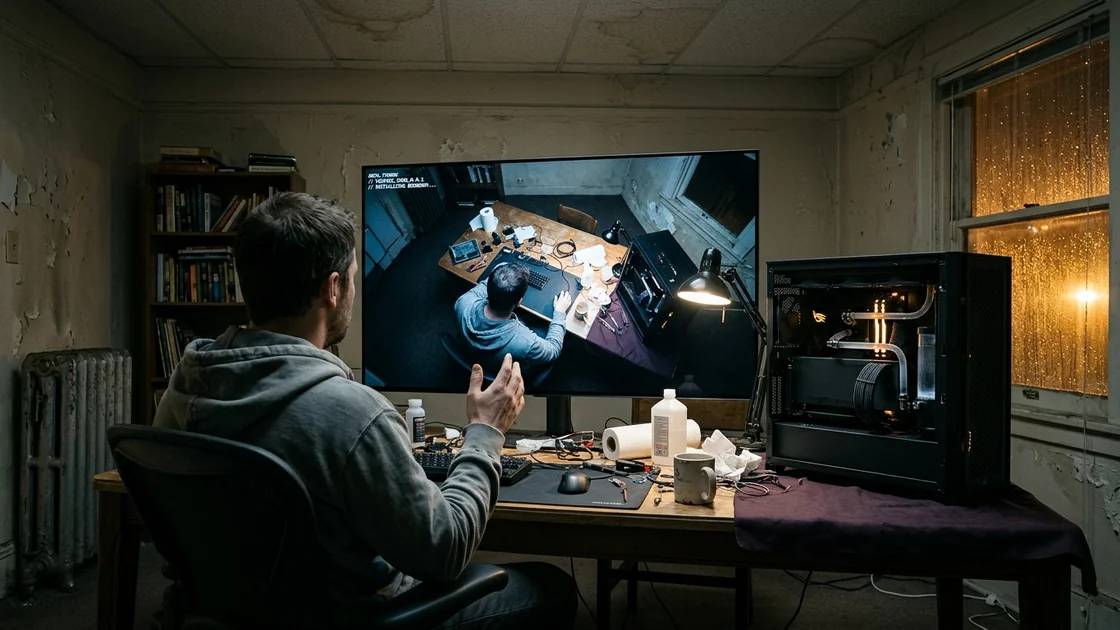
Julian Vance builds a state-of-the-art custom gaming computer using an experimental, unmarked graphics card he acquired from the estate sale of a reclusive silicon architect, only to discover that the machine runs a mysterious diagnostic program that renders photorealistic, real-time environments of his own apartment from impossible, camera-less perspectives. As the virtual viewport begins to move through solid walls and reveal subtle, terrifying alterations to his living space that subsequently manifest in physical reality, Julian enlists the help of his former colleague Maya to investigate the hardware. Together they uncover that the graphics card is not using hidden sensors to observe his apartment, but is instead tapping into the fundamental spatial data of the room, culminating in a desperate psychological struggle as the machine begins to apply video game optimization techniques like occlusion culling and frame-buffering to Julian's actual existence, threatening to overwrite him entirely.
The rain in the Pacific Northwest does not fall so much as it hangs, suspended in the sodium-vapor glare of the streetlights like static on an untuned television. Inside Apartment 4B of the Savoy Arms, Julian Vance wasinsulated from the damp chill by the smell of isopropyl alcohol, warm flux, and the ozone tang of new electronics. His dining table had not held a plate of food in six months. Instead, it was covered in an anti-static mat the color of a bruised plum, upon which lay the disassembled skeleton of his latest obsession.
Julian was a senior environment artist for a mid-tier game studio that had recently been gutted by a conglomerate acquisition. With six months of severance pay and a looming sense of professional irrelevance, he had retreated into the only discipline where order and beauty were still strictly mathematical: hardware assembly. For thirty years, his life had been defined by polygons, texture maps, and light bounces. If the real world was decaying into grey slush outside his fourth-floor window, he would build a machine capable of rendering a better one.
The centerpiece of the build sat in an electrostatic-discharge bag at the edge of the mat. It was a graphics card, though it looked nothing like the jagged, plastic-shrouded leviathans sold in retail stores. Those were covered in aggressive angles and RGB LEDs meant to appeal to teenagers. This unit was a monolith.
He had found it three days prior at an estate sale in the wooded hills of Bridlemile. The house had belonged to Dr. Aris Thorne, a former chief fellow at a semiconductor foundry who had vanished into private research in the late nineties and died alone among stacks of yellowed notebooks and oscilloscopes. While the professional liquidators were haggling with vintage audio collectors over tube amplifiers, Julian had wandered into the basement workshop. There, tucked inside a lead-lined pelican case beneath a workbench, he had found the card.
The girl running the cash box hadn't known what it was. She had looked at the heavy black slab, noted the standard PCIe gold fingers along the bottom edge, and charged him forty dollars for "assorted computer scrap."
Julian picked it up now, his fingers registering the unnatural heft of it. It weighed nearly nine pounds. The shroud was machined from a single block of matte-black anodized aluminum, entirely devoid of logos, serial numbers, or fan cutouts. Instead of fans, it featured two pre-installed, industrial quick-disconnect fittings for a liquid cooling loop. It was a workstation prototype, he reasoned—some unreleased architecture killed in the cradle because the silicon yield was too low or the power draw too absurd.
He aligned the gold contact pins with the primary slot on his motherboard and pressed down. The retention latch clicked into place with a heavy, satisfying thud.
For the next four hours, Julian worked with the practiced precision of a vascular surgeon. He measured and cut lengths of rigid borosilicate glass tubing, slipping them over brass fittings and tightening the compression collars until his fingertips were raw. He routed the power cables—three separate sixteen-pin connectors that required a dedicated sixteen-hundred-watt power supply just to feed the mystery card. Finally, he uncapped a bottle of distilled, biocide-treated coolant, pouring the clear fluid into the reservoir.
He bridged the twenty-four-pin motherboard connector with a jumper block and flipped the power switch to prime the pump.
The reservoir gurgled. Bubbles raced through the glass tubes like silver mercury, chased by the whine of the D5 pump, before settling into a silent, laminar flow. There were no leaks. The fluid passed into the black monolith of the graphics card and emerged through the return tube slightly cooler than it had entered—a quirk of the ambient room temperature, Julian assumed.
He removed the jumper, reconnected the motherboard power, plugged in his forty-two-inch OLED reference monitor, and pressed the stainless-steel power button on the chassis.
The machine did not roar to life; it hummed. It was a low, resonant B-flat that Julian felt in his molars before he heard it with his ears. The diagnostic LEDs on the motherboard cycled through their amber and red POST checks, pausing for a long, agonizing five seconds on the VGA indicator. Julian held his breath. If the prototype card required a proprietary motherboard BIOS to initialize, the build was a paperweight.
Then the LED turned white. The monitor flickered, its pixels waking into a deep, ink-black glow.
Instead of the familiar manufacturer splash screen, a single line of unformatted white text appeared in the upper-left corner of the display:
ARCH_THORNE // VANTAGE_KERN_0.0.1 // INITIALIZING BOUNDARY...
"Boundary?" Julian murmured, pulling his ergonomic chair closer and resting his hands on his mechanical keyboard.
The text vanished, replaced by the standard operating system login screen from his solid-state drive. He exhaled, a grin breaking across his tired face. It worked. It had actually posted.
He logged in and immediately opened the device manager to see what
the operating system thought was plugged into its primary bus. Under
Display Adapters, where a brand name should have been, the string read
simply: Standard Spatial Enumerator (PCIe Gen 6 x16).
Julian frowned. PCIe Generation 6 wasn't commercially available yet, and his motherboard only supported Generation 5. More bizarrely, when he opened his hardware monitoring suite, the telemetry was nonsensical.
Core Clock: 0 MHz. Memory Clock: Undefined. VRAM Allocation: Dynamic / Non-Local. Die Temperature: 4.2°C.
"Four degrees?" Julian reached down and touched the tempered glass side panel, then opened it and pressed two fingers directly against the black aluminum backplate of the card. He jerked his hand back. It wasn't hot; it was freezing. A thin rime of condensation was already forming along the edges of the aluminum, drawn from the humid Seattle air of his apartment.
"Peltier cooling built into the shroud?" he guessed aloud, though a thermoelectric cooler would have required massive heat dissipation on the other side of the loop, and his radiator fans were barely spinning. The radiator exhaust was completely room temperature. The heat wasn't being moved; it simply wasn't there.
Curious, he opened his file explorer to install a graphics driver,
only to find a new drive letter—Z:—mounted alongside his
primary storage. It had a capacity of exactly zero bytes free of zero
bytes total, yet when he clicked it, a directory opened.
Inside sat a single executable file: vantage.exe. There
were no dynamic link libraries, no configuration files, no texture
folders or shader caches. Just the executable, listed at a meager 4
kilobytes.
Julian was an environment artist; he knew that a 4-kilobyte file couldn't hold a low-resolution icon, let alone a 3D engine. It had to be a shortcut or a bootstrapper that pulled data from the card's internal firmware—perhaps an onboard ROM chip containing a factory benchmark demo. Hardware engineers loved hiding Easter eggs and tech demos on prototype boards.
He double-clicked vantage.exe.
The monitor went black. The B-flat hum from the chassis shifted up a fifth, harmonizing with itself in a way that made the fine hairs on Julian's forearms stand at attention. No loading bar appeared. There was no splash screen for DirectX or Vulkan.
Instantly, an image resolved on the forty-two-inch screen.
Julian leaned back, his breath catching in his throat. "Holy..."
It was an interior scene, rendered with a level of fidelity that made every pre-rendered Hollywood visual effect he had ever seen look like finger painting. The camera was positioned high up, near a water-stained acoustic ceiling tile, looking down at a cramped room bathed in the amber glow of a single gooseneck desk lamp and the bluish wash of rain-slicked windows.
The lighting was immaculate. Julian's trained eye immediately began deconstructing the render. The global illumination wasn't using screen-space approximations or noisy ray-tracing denoiser algorithms; it was mathematically pure. He could see the subsurface scattering of light through the translucent plastic of a discarded pill bottle on a shelf. He could see individual dust motes drifting through the cone of the desk lamp, each tiny particle casting its own microscopic shadow calculation against the air itself.
In the center of the frame sat a man in a grey hoodie, his back to the camera, hunched over a glowing monitor on a dining table covered in a plum-colored anti-static mat.
Julian's smile slowly dissolved.
He stared at the grey hoodie on the screen. Near the left shoulder blade, there was a small, frayed hole where he had snagged the fabric on a rusted fence two winters ago. He looked at the table in the render. There was the bottle of clear coolant. There was the roll of paper towels. There was his ceramic mug with the chipped handle, half-full of cold coffee.
Slowly, Julian raised his right hand above his head and spread his fingers.
On the monitor, in the high-angle view from the ceiling corner, the man in the grey hoodie raised his right hand and spread his fingers. There was no motion blur. There was no input lag. The movement occurred at an uncapped framerate so fluid it felt more real than the proprioception in his own arm.
Julian spun around in his chair, staring up at the top corner of his living room where the two plaster walls met the ceiling above his bookshelf.
There was nothing there. Just a cobweb, a peeling strip of paint, and shadowed plaster.
He stood up so fast his chair rolled back and slammed into the radiator. On the monitor, he saw himself stand, saw the chair strike the cast-iron fins, saw his own pale, unshaven face staring up toward the ceiling corner with wide, startled eyes. The virtual camera was looking straight down into his upturned face.
"What the hell is this?" Julian whispered.
On the screen, his lips moved in perfect synchronization. There was no audio coming from his speakers, only the visual of his own bewildered expression rendered in sixty-four-bit color depth.
His mind raced through rational explanations, each more frantic than the last. A hidden camera. The apartment was an old building; maybe the previous tenant, or the landlord, or some voyeur had installed a pinhole camera in the molding.
Wait. Even if there was a pinhole camera in the ceiling corner, how was the video feed getting into a closed-loop computer that wasn't connected to the building's Wi-Fi? He hadn't even plugged his ethernet cable back into the motherboard yet.
More importantly, a pinhole camera buried in plaster in a dimly lit room would produce a grainy, low-resolution, high-ISO mess with fish-eye distortion. What was on his monitor had the dynamic range of a hundred-thousand-dollar cinema camera and the geometric perfection of a 3D CAD file.
Julian dragged his chair over to the bookshelf, climbed onto the seat, and squinted at the corner of the ceiling. His nose was six inches from the plaster. He reached up and ran his fingers over the intersection of the walls. It was solid, cold paint over drywall. There was no lens. No aperture. Not even a nail hole.
He looked down at his desk. From up on the chair, he could see the monitor at an angle.
On the screen, his giant hand was pressed flat against the camera's viewport, blocking half the frame, the pores and ridges of his fingertips rendered in macro-level detail, illuminated by the ambient light bouncing off the ceiling. Yet his fingers were touching solid plaster. The vantage point wasn't just near the wall; it was flush with the surface, existing in the exact zero-millimeter plane where paint met air.
Julian climbed down, his heart hammering against his ribs. He sat back at the desk and grabbed his mouse.
He moved the cursor across the screen. There was no user interface,
no menu bar, no close button in the corner. Pressing Alt+F4
did nothing. Pressing Ctrl+Alt+Delete brought up the system
overlay for a fraction of a second before the render overrode the
operating system's window manager, forcing itself back to the
foreground.
Out of decades of habit from working in game engines like Unreal and
Unity, Julian held down the right mouse button and pressed the
W key.
The perspective on the monitor glided forward.
Julian let go of the mouse as if it had burned him. The camera had moved two feet away from the ceiling corner, floating now in the empty air directly above his bookshelf. He could see the tops of his art books, the layer of grey lint that had accumulated on the upper edges of the pages where he never dusted.
Trembling, he put his hand back on the mouse and pressed
S, holding the right button to pan.
The camera floated backward. It hit the plaster wall, and instead of stopping, it clipped right through it.
For a split second, the screen showed the cross-section of the drywall—the crumbly white gypsum core, the brown paper backing, the vertical wooden stud with a rusted drywall screw driven through its center, the pink fiberglass insulation stuffed into the cavity—and then the camera was on the other side, floating in the dark, cramped utility shaft between his apartment and the building's elevator bank.
"No," Julian breathed. "No, that's a pre-scanned asset. It has to be."
How could it be? He was moving in real time inside the render. If it were a pre-scanned LiDAR map of the building, how would it have his current computer build—the one he had finished assembling twenty minutes ago—sitting on the table? How would it have him?
He pressed W again, bringing the camera back through the
insulation, through the gypsum, and out into the warm amber light of his
living room. He steered the viewport down toward his desk, flying it
like a drone until it was hovering six inches in front of his own
face.
Julian stared straight ahead into the empty air above his keyboard. In the real world, there was nothing there. He waved his hand through the space where the virtual camera was stationed. His fingers passed through unimpeded air.
On the monitor, his hand passed straight through the virtual lens. As his skin intersected the camera's near-clipping plane, the render briefly cross-sectioned his own fingers.
Julian gagged, stumbling back from the desk.
In that half-second before his hand cleared the viewport, the monitor hadn't shown an empty hollow mesh like a video game character model, where the inside of an arm is just transparent back-facing polygons. It had shown the subcutaneous fat layers, the glistening white sheaths of his flexor tendons, the dark crimson branches of the palmar digital veins, and the porous, ivory lattice of his phalanges.
It had rendered the inside of his body with the same cold, path-traced accuracy as the drywall.
He didn't sleep that night. He couldn't bring himself to turn the
machine off by pulling the power cord—some deep, superstitious dread
told him that interrupting whatever process the card was running while
his own body was inside its calculation volume might have consequences
he didn't understand. Instead, he used the WASD keys to
park the camera in the far corner of the kitchen, facing the
refrigerator, and draped a heavy bath towel over the monitor.
At eight in the morning, with the rain still drumming a relentless tattoo against the fire escape, Julian called Maya Lin.
Maya had been the lead graphics programmer at his old studio before landing a job at a defense contractor that specialized in synthetic aperture radar and subterranean mapping. If anyone understood how hardware translated physical space into digital math, it was her.
"You look like a raccoon that got caught in a server rack," Maya said at 9:15 AM, standing in his doorway with an umbrella dripping onto his welcome mat and a large canvas messenger bag slung over her shoulder. She was thirty-two, sharp-featured, wearing an oversized vintage windbreaker and carrying two paper cups of black coffee.
"Thanks for coming," Julian said, stepping aside and immediately locking the deadbolt behind her.
Maya noticed the triple-locked door and raised an eyebrow. On the phone, Julian had only told her that he had acquired an undocumented prototype ASIC from Aris Thorne's estate and that it was doing things with real-time spatial reconstruction that defied physics. The name Aris Thorne had been enough to get her to call in sick to work.
"Where is it?" she asked, setting the coffees down on the kitchen counter.
Julian pointed toward the dining table, where the computer hummed its steady, low B-flat, the monitor shrouded beneath the navy-blue bath towel.
"Why the shroud? Is it rendering pornography, or did you accidentally summon a demon?"
"I don't know if those are mutually exclusive right now," Julian said. He walked over and pulled the towel off the monitor.
On the screen was the kitchen. Maya was standing there by the counter, her back half-turned, her wet umbrella leaning against the baseboards. Because the camera was positioned just below the kitchen cabinets, the angle was low, looking up at her chin and the underside of her jaw.
Maya stopped mid-sip of her coffee. She looked at the monitor, then turned her head slowly to look at the underside of the kitchen cabinets behind her.
"Okay," she said, setting the cup down. Her voice had shifted instantly from casual banter to the flat, analytical tone she used during crunch-time debugging sessions. "Where's the sensor array? Are you using millimeter-wave radar? Wi-Fi CSI mapping?"
"There is no sensor array, Maya. Look at the tower."
She walked over to the dining table and crouched beside the open chassis. She didn't touch it at first, just traced the glass tubing and the three thick power cables with her eyes. "The motherboard has onboard Wi-Fi."
"Disabled in BIOS. And I unscrewed the antennas."
"Bluetooth uses the same chip. Even without antennas, a strong enough transceiver could theoretically bounce 2.4 gigahertz signals off the walls and measure the time-of-flight return." She frowned, leaning closer to the monitor. "Except... 2.4 gigahertz has a wavelength of twelve centimeters. Even if you used 60 gigahertz millimeter-wave, the resolution limit would give you blobby point clouds, like an airport body scanner. Look at my windbreaker on that screen."
Julian looked. The render showed the microscopic weave of the nylon fabric, the tiny beads of rainwater clinging to the creases, and the way the fluorescent kitchen light refracted through each individual droplet to cast miniature caustics onto the nylon beneath.
"That's sub-micron resolution," Maya whispered. "You'd need an electron microscope or hard X-rays to map geometry that fine, and X-rays wouldn't give you surface albedo or color data. How is it getting RGB values? How does it know my jacket is teal and purple?"
"It gets worse," Julian said. He reached over her shoulder, held down
the right mouse button, and tapped S.
The camera backed straight into the refrigerator door.
Maya gasped, taking an involuntary step back as the viewport sliced through the white enamel steel of the fridge, through the polyurethane foam insulation, and came to a stop inside the upper shelf, right between a carton of oat milk and a jar of kosher dill pickles.
The interior of the refrigerator was dark because the door was closed. Yet on the screen, it wasn't pitch black. The engine was calculating the faint, near-zero photon leakage coming through the rubber magnetic gasket around the door frame, multiplying the exposure automatically so they could see the condensation on the glass pickle jar and the translucent silhouettes of the cucumber slices suspended in the brine.
"Open the fridge," Julian said quietly.
Maya walked into the kitchen, gripped the handle, and pulled the door open.
On the monitor, light flooded the scene as the door swung wide and the interior incandescent bulb clicked on. Standing outside the fridge, peering in between the milk and the pickles with a look of sheer, uncomprehending terror, was Maya. She was looking directly into the empty space between the two containers.
She reached her hand into the refrigerator and waved her fingers through the gap between the milk carton and the glass jar.
"Don't go too far back," Julian warned, his voice tight. "The near-clipping plane is right behind the milk label. You don't want to see what happens when you intersect it."
Maya pulled her hand back and let the refrigerator door swing shut. The scene on the monitor plunged back into the eerie, gasket-lit gloom.
She returned to the table, unbuckled her canvas messenger bag, and pulled out a handheld RF spectrum analyzer, an infrared thermal imaging camera, and a padded case containing a set of precision multimeters.
"Thorne worked on photolithography at first," Maya said, her hands moving rapidly as she booted up the spectrum analyzer. "Back in the late eighties, he wrote a bunch of papers on quantum tunneling in sub-nanometer gates. Everyone thought he was just complaining about the physical limits of Moore's Law—how once transistors get smaller than a few atoms, electrons stop obeying classical physics and just teleport through the barriers. Then he got weird. Started publishing in fringe physics journals about holographic principles and Bekenstein bounds before he went totally dark."
She held the antenna wand of the spectrum analyzer near the black aluminum shroud of the graphics card. The screen on her handheld device remained completely flat.
"Nothing," she muttered. "Not even standard electromagnetic interference. A normal GPU screams across the RF spectrum from coil whine and clock switching. This thing is a black hole. It's quieter than the background radiation of the room."
She switched to the thermal camera and pointed it at the open PC case. When she looked at the small LCD screen on the back of the imager, she froze.
"Julian. Look at this."
He leaned over. On the thermal camera's display, the motherboard, the RAM sticks, and the CPU water block glowed in healthy shades of orange and yellow—around thirty-five to forty degrees Celsius.
The graphics card wasn't blue or purple, which was the camera's palette for cold objects. It was rendered as a jagged, flickering silhouette of static—a dead zone where the bolometer sensor couldn't read any infrared radiation at all.
"It's reading close to absolute zero on the internal core," Maya said, her voice dropping an octave. "No, that's impossible. If it were that cold, the nitrogen and oxygen in the room would be condensing into liquid on the casing. The exterior is just below freezing, maybe minus two Celsius, because the coolant loop is actually heating the card up with the warmth from your CPU."
"The card is an endothermic sink," Julian said. "It isn't drawing power to generate heat. It's consuming thermal energy from the environment to run its calculations."
"Then what are the three sixteen-pin power cables doing?"
Julian followed the thick braided cables from the card back to his sixteen-hundred-watt power supply. The power supply has a small digital wattage readout on its side panel. He crouched down and looked at it.
OUTPUT: 62W
Sixty-two watts was just enough to run the motherboard, the RAM, the water pump, and the idle CPU. The graphics card wasn't drawing a single milliamp from the wall. The power cables were just dummy loads—or perhaps a grounding array.
Maya sat down in Julian's chair and began tapping at the keyboard.
She tried bringing up a command prompt, tried running
taskkill, tried inspecting the memory addresses allocated
to vantage.exe using a hex editor she loaded from a thumb
drive.
Every time the hex editor tried to read the memory block assigned to
the Z: drive or the running process, the editor crashed
with an error code Maya had never seen before:
ERR_ADDRESS_OUT_OF_UNIVERSE_BOUNDS.
"Wait," Julian said, pointing at the keyboard. "Try the tilde key. Like a Quake console."
Maya gave him a skeptical look, then tapped the ~ key in
the upper-left corner of the keyboard.
A translucent, grey drop-down console slid smoothly down from the top third of the monitor, overlaying the view of the dark refrigerator interior. Green monospaced text scrolled rapidly along the left margin:
> VANTAGE ENGINE [BUILD: HOLOGRAPHIC_LOCAL_09]
> VOLUME: 14.2m x 9.8m x 3.1m (BOUNDED)
> PRIMITIVE COUNT: 4.182 x 10^29 (ELEMENTAL)
> LIGHT TRANSPORT: EXACT_PATH_QUANTUM
> TEMPORAL BUFFER: 0.00ms (SYNCHRONOUS)
> OCCLUSION CULLING: DISABLED [WARNING: MEMORY PRESSURE HIGH]
> _
Maya stared at the third line. Her lips moved silently as she counted the zeros in the scientific notation.
"Four point one eight times ten to the twenty-ninth power," she breathed. "Julian, that's not a polygon count."
"No," he agreed, feeling a cold sweat break out under his arms. "That's the approximate number of atoms in a one-bedroom apartment."
"It's not scanning the room," Maya said, her fingers hovering tremblingly over the mechanical keys. "A scanner sends out a wave and waits for it to bounce back. That takes time. Even at the speed of light, there's latency. And a scanner gets blocked by lead, by dense matter, by refraction. This thing..." She swallowed hard. "You know the holographic principle in string theory? The idea that all the three-dimensional information inside a volume of space—every particle, every spin state, every photon—is actually encoded on a two-dimensional boundary surrounding that space? Like a hologram on a credit card projecting a 3D image?"
"Vaguely," Julian said. "Like the Universe is a simulation running on the surface of its own horizon."
"Thorne didn't build a graphics processor," Maya said. "He built a bus interface. Somehow, the quantum tunneling architecture inside that silicon die is entangled with the local spatial boundary of this room. It doesn't need cameras because to the card, this apartment is VRAM. The room and the memory buffer are the same thing."
She typed help into the console and hit Enter.
A short list of variables appeared:
> cam_speed [float]
> cam_clip_near [float]
> time_offset_ms [float]
> opt_cull_occluded [0/1]
> opt_lod_bias [float]
"Look at the fourth one," Julian said, leaning in so close his breath
fogged the edge of the glossy OLED panel. "time_offset_ms.
Temporal buffer."
"It's currently set to zero," Maya said. "Synchronous."
"Set it to negative one thousand."
"Negative would be the past," she reasoned. "Just a replay buffer. Any capture card can cache video."
"Then set it to positive five thousand."
Maya hesitated. She looked up at Julian. In the pale blue glow of the console text, the dark circles under his eyes made him look gaunt, almost skeletal, yet there was a feverish light in his pupils—the unmistakable hunger of someone standing on the precipice of the impossible.
"Five seconds," Julian urged softly. "Just five thousand milliseconds. Let's see what its branch predictor looks like."
Maya typed: time_offset_ms 5000
She hit Enter.
The console reported:
> TEMPORAL BUFFER: +5000.00ms (LOOKAHEAD_ACTIVE).
Nothing changed inside the refrigerator. Of course it wouldn't; nothing was moving in there.
Maya held down the right mouse button and pressed S,
pulling the camera back out through the refrigerator door and panning it
around to face the living room.
On the screen, Julian and Maya were standing behind the desk, staring at the monitor.
Except on the screen, Maya wasn't sitting in the chair anymore. She was standing next to Julian, holding her porcelain coffee mug, and as they watched, the rendered version of Maya accidentally bumped her elbow against the edge of the monitor, knocking the coffee mug out of her hand. It fell in a graceful arc, shattering against the hardwood floor and splashing dark liquid across Julian's grey sneakers.
In the real world, Maya was still sitting in the chair. Her coffee mug was ten feet away on the kitchen counter.
"See?" Maya let out a shaky, relieved laugh. "It's just a probabilistic physics simulation. It's guessing based on Markov chains or some neural net hallucination. My coffee isn't even over here. I can't spill it in five seconds if I'm sitting right—"
A loud crack echoed from the street outside—a delivery truck backfiring, or a transformer blowing in the rain.
Startled by the noise, Maya jumped out of the chair, took three quick steps toward the window—which took her right past the kitchen counter—and instinctively grabbed her coffee mug on the way back toward the desk to steady her nerves. As she squeezed back between the chair and the table to look at the screen, her elbow clipped the corner of the forty-two-inch OLED panel.
"Wait—!" Julian lunged forward to catch the cup.
His hand struck her forearm instead, accelerating the mug downward. It hit the hardwood floor at the exact spot shown in the render, shattering into four large ceramic shards and drenching the toe of Julian's left sneaker in lukewarm black coffee.
Silence fell over the apartment, broken only by the B-flat hum of the cooling pump and the ticking of coffee dripping off the edge of the anti-static mat.
Julian slowly raised his eyes from his soaked shoe to the monitor.
On the screen, five seconds ahead of them, the rendered Julian and Maya were no longer looking at the floor. The rendered Maya was already backing hurriedly toward the front door, grabbing her wet umbrella without even bothering to pack up her spectrum analyzer or her messenger bag, her face white with panic as she fumbled with the deadbolts.
In the real world, Julian turned to look at Maya.
Her chest was heaving. She looked at the shattered mug, then at the screen showing her own imminent flight, and then at Julian.
"Turn it off," she whispered, taking a step backward toward the hallway—the exact first step her rendered counterpart had taken four seconds ago.
"Maya, wait. Don't do what it shows. Just stand still!" Julian grabbed the back of the chair to anchor himself. "If you stand still, you break the loop!"
"I don't want to stand still!" Maya's voice cracked as her heel hit the edge of the hallway rug, nearly tripping her—just as the render had predicted three seconds prior. "Julian, it didn't predict me grabbing the cup. It made the truck backfire, or it calculated the whole deterministic chain of the city block just to keep the frame buffer accurate! I'm leaving. Pull the plug. Smash the die with a hammer!"
She spun around, snatched her wet umbrella from the floor by the baseboards, tore the three locks open with trembling fingers, and yanked the door wide. A second later, the heavy oak door slammed shut behind her, her footsteps receding rapidly down the carpeted stairwell.
On the monitor, the hallway was already empty. The front door had been closed for five seconds.
Julian stood alone in the quiet room, the cold coffee soaking through his sock. Slowly, he reached down to the keyboard and typed:
time_offset_ms 0
The frame buffer snapped back to the present. The slight, ghostly double-vision he hadn't realized he was experiencing in his own peripheral vision vanished instantly, leaving him with a sharp migraine behind his left eye.
He should have smashed it.
He went so far as to get the sixteen-ounce claw hammer from his utility closet. He stood over the open chassis, the hammer raised, staring down at the matte-black monolith of the graphics card. The condensation on its aluminum shroud had frozen into a delicate, fern-like pattern of white frost.
As he tensed his forearm to bring the steel head down onto the circuit board, his eyes flicked to the monitor.
The camera was still floating in the kitchen, looking toward the dining table. On the screen, Julian saw himself standing over the computer with the hammer raised. The lighting from the cloudy window caught the polished steel of the claw, casting a pale reflection across his face.
It was the most extraordinary composition he had ever seen.
For fifteen years, Julian had spent sixty hours a week trying to fake reality. He had painted normal maps by hand to simulate the pores in concrete; he had tweaked roughness values to make wet asphalt look convincing; he had baked lightmaps for days on render farms just to get shadows to fall softly into the corners of virtual rooms. And it had always been a lie. If you zoomed in close enough in any video game, the world dissolved into blurry texels and sharp, jagged triangles. Reality was infinite; computers were finite.
Except here.
He lowered the hammer and set it on the table.
He sat down, closed the console, and began to fly the camera around
his apartment. He lowered cam_speed to 0.001
and zoomed into the broken shards of the porcelain mug on the floor.
He pushed the viewport closer and closer to the jagged white fracture edge of the ceramic. At ten times magnification, it looked like a cliff face of white chalk. At a hundred times, it was a crystalline landscape of fused kaolin and feldspar, lit by the amber glow of his desk lamp bouncing through the translucent valleys of the clay. He pushed closer still, waiting for the textures to blur, waiting for the geometry to clip out.
They didn't. The engine simply resolved finer and finer structures—micro-fissures, trapped air pockets from the factory kiln, individual chains of lipid molecules left behind by Maya's fingertips on the glazed rim, all the way down until the wavelength of visible light itself became larger than the structures he was looking at, at which point the render seamlessly transitioned into quantum probability clouds shaded by electron density.
"My God," Julian whispered, tears stinging the corners of his eyes. "It's all here. There's no level-of-detail bias. It's rendering the whole thing."
He spent the afternoon exploring his own four hundred square feet of existence as if it were an alien planet. He flew the camera inside the mechanical gears of his wristwatch on the nightstand, watching the balance wheel oscillate in real time, the synthetic ruby jewels glowing like stained glass as light leaked through the watch crystal. He flew it into the soil of his dying houseplant, watching a microscopic nematode worm wriggle between glistening boulders of quartz sand and rotting peat moss.
Around four in the afternoon, he decided to see how far the volume reached.
The console had said:
VOLUME: 14.2m x 9.8m x 3.1m (BOUNDED).
He steered the camera toward his front door, clipped straight through the solid oak panel, and emerged into the fourth-floor hallway of the Savoy Arms.
He stopped.
Four feet outside his door, the hallway ended.
It didn't end in a wall. The worn burgundy carpet, the yellowed wallpaper with its faded fleur-de-lis pattern, and the brass wall sconces simply terminated along a razor-sharp vertical plane. Beyond that plane was a void of neutral grey, overlaid with a classic one-meter-by-one-meter white wireframe grid. Floating in the center of the void, where the stairwell and Apartment 4A should have been, were three words in flat, unshaded sans-serif text:
[UNLOADED CELL: OUT OF BOUNDS]
Julian stared at the grey void. The fourteen-by-nine-meter bounding box roughly corresponded to the footprint of his apartment, plus a few feet of the hallway, a sliver of the exterior fire escape, and about six inches of the ceiling belonging to the apartment below him.
Curious, he got up from his desk, walked to his front door, and opened it.
In the real world, the hallway was completely normal. The burgundy carpet stretched all the way to the elevator shaft and the stairs; the wallpaper was intact; the door to 4A was right across from him.
He left his front door propped open with the claw hammer and walked back to his monitor.
On the screen, the front door was propped open. Four feet beyond the threshold, the hallway still dropped off into the grey wireframe void.
"Okay," Julian said to himself. "So the card's bus range is limited to about fifteen meters from the PCIe slot. Anything outside that radius isn't entangled with the silicon."
He decided to test the boundary. Leaving the virtual camera pointed squarely at the open doorway, he walked out into the hallway.
One step. Two steps. Three steps. He looked back through the doorway at his monitor across the room. He could see himself standing near the edge of the rendered carpet.
He took a fourth step, crossing the invisible fourteen-meter threshold into the unloaded zone.
The moment his leading foot crossed the line, a wave of violent, galvanic nausea slammed into his brainstem. It felt as though every nerve ending in his right leg had briefly forgotten how to communicate with his spinal cord, replaced by static electricity and the taste of copper on his tongue. Looking back at the monitor, he saw that his right leg and half of his torso were completely sheared off along a flat vertical plane.
Where his body intersected the boundary of the render volume, the camera showed a neat, anatomical cross-section of his ribs, his beating heart, his right lung inflating with air, and the purple sponge of his liver—all sliced open against the grey wireframe grid, yet leaking no blood because the other half of his circulatory system was simply in an unloaded cell.
Julian gasped and stumbled backward into his apartment.
The nausea vanished instantly as his body re-entered the bounding box. He kicked the claw hammer aside, slammed the front door shut, and threw all three deadbolts.
His heart was racing again, his palms clammy. "Stay inside the volume," he muttered, pressing his back against the door. "Don't cross the boundary while the process is active. The boundary has an impedance mismatch."
His phone buzzed in his pocket. He pulled it out. It was a text from Maya.
I pulled some archives from DARPA's old microelectronics grants. Thorne's project in 1998 was called Project Aethelgard. It was shut down after a lab incident in Menlo Park. Julian, please tell me you unplugged that machine.
Julian looked at the tower humming peacefully on the table. He typed back: It's idling. What was the lab incident?
Three dots appeared immediately as Maya typed a furious response. Thorne wasn't trying to build a display adapter. He was trying to build a localized reality compiler. The paper says the silicon uses 'spatial address virtualization.' In a normal computer, virtual memory tricks a program into thinking it has contiguous RAM when the data is actually scattered on a disk. Thorne's chip tricks the local vacuum state into thinking its quantum coordinates are managed by the chip's register.
Another text followed five seconds later: When the Menlo Park prototype ran out of memory cache during a 48-hour stress test, the chip executed a garbage-collection routine to free up address space. The entire third floor of the laboratory building lost its collision mesh. Two graduate assistants fell through three stories of solid reinforced concrete and fused with the foundation slab when the power was cut. GET OUT OF THE APARTMENT.
Julian stared at the glowing screen of his phone.
Lost its collision mesh.
He looked up at his monitor. He opened the console with the tilde key and checked the system telemetry that had been scrolling quietly in the background while he had been zooming into the broken coffee mug at the atomic level.
> VANTAGE ENGINE [BUILD: HOLOGRAPHIC_LOCAL_09]
> VOLUME: 14.2m x 9.8m x 3.1m (BOUNDED)
> CACHE UTILIZATION: 94.8% [CRITICAL]
> WARNING: ATOMIC STATE TABLE NEAR CAPACITY.
> AUTO-OPTIMIZATION SCHEDULED AT 98.0% UTILIZATION.
"Ninety-four point eight percent," Julian read aloud.
Why was the cache filling up? When he had first opened the console
with Maya, the warning had said MEMORY PRESSURE HIGH, and
that was hours ago. Every time he moved the camera, every time water
boiled or dust settled or he breathed, the card wasn't just overwriting
the old state—it was caching the state history in some internal quantum
buffer.
And what happened at ninety-eight percent? Auto-optimization.
How does a 3D game engine optimize a scene when the graphics card is running out of memory?
Julian didn't need Maya to answer that. He had spent his entire adult life optimizing scenes for game engines. There were two primary methods every engine used to save memory:
First, Level of Detail (LOD) scaling—reducing the complexity of objects that are far away from the camera, turning high-polygon sculptures into crude, blocky approximations.
Second, Frustum and Occlusion Culling—completely unloading any object or room that is not currently visible to the camera. In a video game, when you are standing in a living room looking North, the kitchen behind you to the South does not exist. It is deleted from memory until the millisecond you turn your head around, at which point the engine frantically reloads it before your eyes can see the empty void.
Julian looked at the console variable list again:
opt_cull_occluded [0/1]
opt_lod_bias [float]
Right now, opt_cull_occluded was set to
0—disabled. Because it was disabled, the entire apartment
was being kept loaded in the cache simultaneously, which was why the
memory was at 94.9%... 95.0%...
"Okay," Julian said, his voice trembling. "Okay, Maya's right. If I just pull the power cord while it's managing the spatial addresses, what happened in Menlo Park might happen here—a dirty shutdown corrupting the state table. I need a clean exit."
He clicked into the console command line and typed:
exit
> UNKNOWN COMMAND: "exit"
He typed: quit
> UNKNOWN COMMAND: "quit"
He typed: shutdown
> ERR: KERNEL LOCKED TO HARDWARE CLOCK. TERMINATE VIA HOST OS.
"Host OS," Julian muttered. "Right. Close the process from Windows."
He pressed the Windows key on his keyboard. The operating system taskbar flickered briefly at the bottom of the screen, fighting for priority against the Vantage viewport. Fighting a rising sense of panic, Julian managed to right-click the taskbar and select Task Manager.
The Task Manager window popped up, flickering violently at sixty
hertz as the 3D engine tried to draw over it. Julian squinted through
the strobing interface, found vantage.exe at the top of the
process list, right-clicked it, and clicked End Task.
A standard system warning dialog box appeared:
Terminating this process may cause data loss and system instability, as uncached virtual memory addresses have not been flushed back to the physical layer. Continue?
Julian's finger froze over the left mouse button.
Uncached virtual memory addresses have not been flushed back to the physical layer.
Wait. That wasn't a standard Windows warning dialog. The operating system didn't know anything about a "physical layer." The graphics card's firmware was intercepting the system call and warning him: if you kill the process without flushing the cache back to reality, whatever is currently held in the card's virtual buffer gets wiped instead of being written back to the apartment.
And the cache was at 95.4% utilization. Ninety-five percent of his apartment—including himself—was currently checked out into the card's volatile memory.
He clicked Cancel.
His phone rang in his hand. It was Maya. He answered it and put it on speaker, tossing it onto the anti-static mat.
"Julian, are you out on the street?" Maya's voice was ragged, competing with the sound of traffic on her end. "I'm driving back right now. Don't touch anything inside the apartment."
"I can't leave the apartment, Maya," Julian said, staring at the console as the utilization ticked up to 95.6%. "I tried walking out into the hallway earlier. The bounding box ends four feet past my door. When I stepped across it, my body started de-allocating. I'm already cached in the memory table. If I walk out of range, or if I pull the plug without flushing the buffer back to the physical layer, I get garbage-collected."
There was a long, horrified silence on the other end of the line.
"How full is the cache?" she asked finally.
"Ninety-five point seven. It's going up by about a tenth of a percent every minute. At ninety-eight percent, it says it's going to trigger auto-optimization."
"Why is it filling up so fast?"
"Because earlier I zoomed the camera down to the sub-atomic level on the broken coffee cup! I forced it to initialize quantum state tracking instead of molecular approximations, and now it won't stop tracking them!" Julian rubbed his temples, pacing two steps behind his chair before remembering that moving his body probably generated more state changes in the air molecules around him. He froze in place. "How do I flush the buffer cleanly? What's the command?"
"Let me look at the DARPA scan," Maya said. He heard the frantic rustle of papers or a tablet screen being swiped while she was stopped at a red light. "Thorne's notes say the boundary register only flushes to the physical substrate when the state complexity drops below the baseline threshold—ten percent utilization. You have to empty the cache before you can unmount the volume!"
"How the hell do I empty the cache if it's recording the apartment?!"
"You have to optimize the scene!" Maya shouted over the phone.
"Julian, think like an engine programmer! Why is the memory full?
Because opt_cull_occluded is off and the level-of-detail is
set to infinite! It's rendering the inside of your walls, the dirt in
your flowerpots, the pipes under the floor! You have to turn on
occlusion culling and crank the LOD bias until the memory usage drops
below ten percent, and then terminate the process!"
Julian stared at the monitor.
"Maya... if I turn on occlusion culling in a reality compiler, what happens to the parts of the room the camera isn't looking at?"
"They get unloaded from the active register," she said, her voice tight. "Just like in an engine. They revert to an unrendered state—zero memory footprint."
"And what if I'm in the part of the room the camera isn't looking at?"
"Then don't be!" she snapped. "Put yourself directly in front of the viewport! Stay inside the camera's frustum, turn on culling so the rest of the apartment unloads behind you, wait for the cache to drop below ten percent, and kill the task! I'm ten minutes away!"
The line went dead—or rather, when Julian glanced down at his phone
on the anti-static mat, the screen read NO SERVICE. Even
radio waves from the cell tower outside were having trouble penetrating
the boundary of the apartment now as the impedance mismatch at the walls
grew stronger.
He looked at the console.
> CACHE UTILIZATION: 97.4% [CRITICAL]
Six-tenths of a percent left before the machine made its own decisions about what to optimize.
Julian sat down in his chair and grabbed the mouse. First, he needed to position the camera so that it had a clear, unobstructed view of him sitting at the desk, while viewing as little of the rest of the apartment as possible.
If the camera was looking across the entire living room, it would keep the whole living room loaded. To minimize the memory footprint, he needed the camera to look at a tight corner—just him, his chair, the desk, and the computer itself. If the computer unloaded itself through occlusion culling, the whole system would crash into a recursive paradox.
He used the WASD keys and the mouse to fly the virtual
viewport to a spot four feet behind his chair, angling it downward at
thirty degrees so that its field of view encompassed only Julian's back,
the dining table, the glowing monitor, the computer tower, and a small
patch of the floorboards beneath them. Everything else—the kitchen, the
hallway, the bedroom, the bathroom, the windows, the ceiling—was outside
the camera's rectangular viewing frustum.
> CACHE UTILIZATION: 97.8% [CRITICAL]
His hands were shaking so badly he hit the wrong keys twice before managing to type the command into the console:
opt_cull_occluded 1
He pressed Enter.
The console returned:
> OCCLUSION CULLING: ENABLED (FRUSTUM + RAYCAST).
The world behind Julian ceased to exist.
There was no sound of collapse, no rushing wind of a vacuum filling in. Instead, there was a sudden, deafening absence of acoustic reverb.
Every human being spends their life subconsciously processing the way sound bounces off the walls of the room they are in—the faint echo of their breathing against the drywall, the hum of the refrigerator reflecting off the kitchen tiles, the patter of rain against the windowpane twenty feet away.
In a single frame—one-one-hundred-and-twentieth of a second—all of those reflections vanished. The B-flat hum of the water pump became completely dead and dry, as if Julian and his desk had been teleported into the center of an infinite anechoic chamber. The light in the room changed drastically; the bluish daylight from the living room windows disappeared because the windows were behind the camera and therefore no longer existed to emit photons. The only light left was the harsh, directional cone of his gooseneck desk lamp and the glow of the monitor itself.
Julian didn't dare turn his head. He knew that if he turned his head to look behind the camera, his head would still be inside the camera's view, so his eyes would see what was back there. Still, he twisted his neck just thirty degrees to the left, looking past the edge of his desk toward where the kitchen doorway should have been.
Six inches past the edge of the dining table, the floorboards stopped.
Beyond the diagonal boundary of the camera's forty-five-degree field of view, there was no apartment. There was no Seattle. There was no Earth. There was only the absolute, featureless grey void and the glowing white one-meter grid lines stretching out to infinity in every direction.
And it wasn't just the room beyond the frustum that was gone. Occlusion culling meant that anything blocked from the camera's line of sight by a solid object in the foreground was also unloaded.
Because the camera was behind Julian, looking over his shoulder at the desk, Julian's own body was blocking the camera's view of the front of his shirt and the section of the desk directly in front of his chest.
Julian looked down at his own torso.
He couldn't feel his chest hair or the fabric of the front of his hoodie. When he looked down his nose at his sternum, he saw the inside of his own back—hollow, single-sided polygons of skin and cloth wrapped around an empty space where his front half was occluded from the camera by his own spine. He was a hollow shell, a movie-set facade of a man existing only on the surfaces where the virtual rays from the camera behind him could strike his skin.
A strangled whimper escaped his throat—a throat that only existed on the posterior wall of his trachea.
He looked frantically at the console readout on the screen.
> OCCLUSION CULLING: ACTIVE (88.4% GEOMETRY CULLED)
> CACHE UTILIZATION: 24.2% [STABLE]
Twenty-four point two percent! It had dropped by over seventy percent, but Maya had said it needed to be below ten percent before the firmware would allow a clean flush back to the physical substrate! Why was just his desk, his back, and the computer taking up twenty-four percent of the total memory?
Because of the atomic resolution. The engine was still tracking every sub-atomic particle in the glass water tubes, the copper wiring of the motherboard, and the cells in Julian's back.
He needed to lower the Level of Detail. He needed
opt_lod_bias.
In a game engine, an LOD bias of 0 is full quality.
Raising the number forces the engine to swap out high-detail models for
cruder, lower-polygon versions to save memory.
Julian reached his hands toward the keyboard. As his forearms moved forward into the space in front of his chest—the space shadowed from the camera by his own torso—his hands began to vanish into wireframe outlines, losing their tactile sensation. He couldn't type if his hands were occluded by his body!
Fighting nausea, he leaned sideways in his chair, twisting his spine painfully to the right so that his arms and the keyboard were fully exposed to the camera's line of sight behind him. Instantly, his hands snapped back into solid flesh and bone.
Keeping himself contorted to the side so the camera had an unbroken view of his fingers and the keyboard, he typed with his left hand:
opt_lod_bias 4.0
He hit Enter.
> LOD BIAS SET TO 4.0. RECALCULATING MESHES...
> CACHE UTILIZATION: 14.8%
Julian looked at his hand on the keyboard.
The pores on the back of his knuckles were gone. The tiny dark hairs on his fingers had vanished, replaced by a flat, brownish smudge painted directly onto his skin like a low-resolution texture map from a twenty-year-old video game. When he bent his index finger, the knuckle didn't crease smoothly; the skin stretched in sharp, angular triangles, two flat planes intersecting with a slight flicker of Z-fighting at the joint.
The gooseneck lamp on his desk was no longer a smooth curve of brushed brass; it was an octagonal tube made of eight flat facets, casting blocky, pixelated shadows across the anti-static mat. Even the hum of the water pump had changed—the smooth B-flat sine wave had degraded into a harsh, eight-bit square wave, buzzing like an old arcade cabinet because the sound waves themselves were being downsampled.
Fourteen point eight percent. Still too high. He needed below ten.
If he pushed the LOD bias too high, would his own brain—or whatever part of it wasn't currently culled—be simplified into so few vertices that his consciousness couldn't run on the remaining geometry? Can a human mind think when its neurons are decimated into low-poly blocks?
He didn't have a choice. If he stayed like this, Maya would arrive, open the front door from the hallway, and step into an unloaded cell where the floor of his apartment didn't exist. She would fall straight through the grey void into Mrs. Gable's ceiling below—or worse.
He typed: opt_lod_bias 8.5
He hit Enter.
The world fractured into coarse geometry.
Julian's fingers fused together into a single, mitten-like pentagonal prism of pale beige texture. His thumb was a separate three-sided pyramid sticking out from the side. He couldn't feel the individual keys on the keyboard anymore; the keyboard itself had become a flat grey rectangular box with a blurry picture of letters stretched across its top surface.
His thoughts became strange, blocky, and stripped of nuance. Complex emotions like nostalgia, regret, and artistic longing simply dropped out of his head—there wasn't enough vertex density in his cerebral cortex to support them. Only basic, low-level state variables remained:
FEAR = TRUE. GOAL = FLUSH_CACHE.
CACHE_TARGET < 10.0.
He looked at the monitor. The forty-two-inch OLED panel was now a crude four-polygon plane, and the console text was pixelated and chunky, but readable:
> LOD BIAS SET TO 8.5.
> CACHE UTILIZATION: 6.1% [BELOW THRESHOLD - FLUSH READY]
Six point one percent!
He tried to press Ctrl+Shift+Esc to bring up the Task
Manager, but he no longer had separate fingers to press three keys at
once, and the keyboard didn't have separate keys anyway—it was just a
solid collision box.
He had to use the mouse.
He slid his mitten-like polygon of a right hand across the desk until it bumped into the mouse, which had been reduced to a six-sided grey wedge like a doorstop. Fortunately, the optical sensor wasn't actually what moved the cursor anymore; the engine just tracked the position of the mouse primitive on the desk plane.
He nudged the wedge until the giant, pixelated white arrow on the screen hovered over the minimized Task Manager icon at the bottom of the display. To click the left mouse button, he couldn't flex a finger; he had to lift his entire blocky forearm and slam the bottom flat plane of his hand-prism down onto the front edge of the mouse wedge.
Click.
The Task Manager window popped up. vantage.exe was
highlighted.
He moved the cursor over the End Task button in the bottom-right corner of the window.
Wait.
Through the sluggish, low-poly fog of his decimated brain, a single terrifying thought managed to compile:
If I flush the cache back to the physical layer while Occlusion Culling and LOD Bias are turned on... does it restore the apartment to how it was at the beginning, or does it write the CURRENT optimized state to reality?
If "flushing the buffer" meant committing the current virtual state to the physical universe, then ending the task right now would permanently delete the rest of his apartment and leave him as a low-polygon, hollow-chested grotesque sitting on an island of floorboards in the middle of the fourth floor!
To restore the room, he had to turn opt_cull_occluded
back to 0 and opt_lod_bias back to
0—which would immediately spike the cache back to 98%
before he could click End Task!
No. Look at the console message again.
> CACHE UTILIZATION: 6.1% [BELOW THRESHOLD - FLUSH READY]
> COMMAND AVAILABLE: flush_and_unmount
There was a native command! It hadn't been in the help
list earlier because the cache had been above the ten percent
threshold!
He didn't need Windows Task Manager. He needed to type
flush_and_unmount into the console.
How do you type eighteen characters on a keyboard that has been reduced to a single flat bounding box without individual keys, using hands that have been reduced to fingerless mittens?
You can't. At opt_lod_bias 8.5, the keyboard didn't have
key switches anymore.
He had to lower the LOD bias just enough for the keyboard keys and at least one of his fingers to regain their individual geometry, without letting the cache utilization climb back over ten percent!
How had he typed on the keyboard before? He couldn't now. How could
he change opt_lod_bias without the keyboard?
Copy and paste. Use the mouse!
He slammed his hand-prism down on the mouse wedge, dragging the
cursor up into the console's text history. He highlighted the letters
o-p-t-_-l-o-d-_-b-i-a-s from his previous command,
right-clicked by slamming the right side of the mouse wedge, clicked
Copy, and pasted it into the command line. Then he highlighted
a 2, a ., and a 0 from the system
telemetry scroll at the top of the console, pasting them one by one
after the command:
opt_lod_bias 2.0
He needed to press Enter. There was no Enter key on the blocky keyboard, and no "Submit" button on the console.
Wait—the on-screen accessibility keyboard in Windows!
He dragged the cursor down to the taskbar, clicked the Accessibility
icon in the system tray, and clicked On-Screen Keyboard. A
virtual keyboard popped up on the display. He clicked the
Enter key on the screen.
> LOD BIAS SET TO 2.0.
> CACHE UTILIZATION: 9.8% [BELOW THRESHOLD - FLUSH READY]
Nine point eight percent! Just two-tenths of a percent below the limit!
Julian gasped as his brain flooded back with vertices. His fingers split apart from the mitten-prism with a wet, snapping sensation, regaining their joints and fingernails, though they still looked slightly waxy and hexagonal like a modern video game character's hands. The keyboard beneath his palms erupted back into a hundred individual plastic keycaps.
The cache was ticking up as the air molecules around his newly complex hands began generating state data again: 9.85%... 9.91%...
He had three seconds before it hit ten percent and locked the unmount command out again.
His waxy, hexagonal fingers flew across the mechanical switches with the muscle memory of twenty years at a workstation:
flush_and_unmount
> CACHE UTILIZATION: 9.98%
He slammed his palm onto the physical Enter key.
For one eternity of a millisecond, nothing happened.
Then the B-flat hum of the computer tower dropped in pitch—down, down through the sub-bass frequencies until the floorboards vibrated like a struck tuning fork.
On the monitor, the console printed a final string of text:
> COMMITTING DELTA BUFFER TO SUBSTRATE...
> RECONSTRUCTING CULLED VOLUMES FROM BOUNDARY HORIZON...
> UNMOUNTING BUS [PCIe_GEN6_x16]...
> DONE.
The monitor went black.
Behind Julian, the world rushed back in with a deafening acoustic roar.
The rain was pounding against the living room windows; a siren was wailing three blocks away on Burnside; the refrigerator compressor kicked on with a metallic shudder in the kitchen. Warm, bluish-grey daylight flooded across his shoulders, and when he sucked in a breath, he felt his ribs expand all the way around his chest—front and back, solid, whole, and continuous.
He turned around in his chair.
The apartment was there. The bookshelf, the faded rug, the kitchen counter, the shattered pieces of Maya's coffee mug lying in a puddle on the hardwood floor. He looked down at his hands. The pores were back. The tiny scars from nicking his knuckles on computer cases, the fine hairs, the natural, chaotic, un-antialiased perfection of real flesh.
From the computer tower on the table came a sharp, loud CRACK, like a pistol shot or an ice cube dropped into boiling water.
Julian flinched, looking at the open chassis.
Now that the graphics card was no longer consuming thermal energy from the room to maintain its quantum entanglement with the boundary horizon, the room-temperature water from the cooling loop had rushed into a silicon die that had been sitting near absolute zero. The thermal shock had sheared the internal crystal lattice of the chip in half. A hairline fracture ran straight through the center of the matte-black aluminum shroud, and a thin wisp of odorless grey dust drifted out of the seam before settling onto the anti-static mat.
A frantic pounding rattled the front door.
"Julian!" Maya's voice was muffled through the heavy oak. "Julian, open the door!"
He stood up on legs that felt like lead, walked past the kitchen—checking the floorboards with his toe first just to be sure they had collision—and undid the three deadbolts.
Maya practically fell into the entryway, her breath coming in ragged gasps, her eyes darting wildly around the ceiling corners and the walls before landing on him. She reached out and grabbed his upper arms, squeezing hard as if testing whether he was made of solid matter or wireframe meshes.
"You're here," she breathed, her forehead dropping briefly against his shoulder before she looked past him toward the dining table. "The screen's off. You flushed it?"
"I flushed it," Julian said, his voice hoarse. "The die cracked from thermal shock right after it unmounted. It's dead."
Maya let out a long, shuddering exhale and walked over to the table. She looked at the fractured black monolith sitting inside the loop, then reached down and flipped the hard power switch on the back of the power supply, pulling the thick black cord out of the wall socket for good measure.
"We're taking this card out," she said, her voice regaining its steady edge, though her hands were still trembling slightly as she reached for his toolkit. "We're taking a sledgehammer to the silicon substrate, we're grinding the wafers into powder, and we're dumping half of it in the Willamette River and the other half in the Pacific Ocean."
"No arguments from me," Julian said.
He walked into the kitchen to grab a broom and a roll of paper towels to clean up the shattered coffee mug and the puddle on the floor. As he crouched down beside the ceramic shards, wiping up the cold black liquid, he paused.
He picked up the largest shard of the white porcelain handle and held it up to the light coming from the rainy window.
The porcelain was smooth and white. The glaze was shiny. To anyone else—even to Maya, who was busy draining the coolant loop at the table—it was just a broken piece of a cheap ten-dollar mug.
Wait.
Julian squinted at the broken edge of the ceramic, holding it two inches from his right eye.
Earlier, before he had turned on occlusion culling, he had zoomed the
camera into this exact shard at the atomic level. And right at the end,
when he had executed flush_and_unmount, the console had
said: COMMITTING DELTA BUFFER TO SUBSTRATE.
Why had the cache utilization been at 9.98% right when he hit Enter?
Because opt_lod_bias had still been set to 2.0
for the objects inside the camera's frustum! The culled parts of the
apartment—including this coffee cup on the floor outside the camera's
view—had been restored from the boundary horizon's backup.
Not the things inside the frustum, though. The things that
had been actively held in the delta buffer at LOD 2.0 when
it committed the state back to reality...
Julian dropped the ceramic shard. He turned slowly and looked at his dining table—the area that had been inside the camera's view when he flushed the cache.
Maya was standing right at the edge of the table, reaching in with a pair of pliers to loosen the brass compression fittings. Her hands were normal, because she had been outside the apartment when it happened.
He looked at the brass fittings she was touching.
Previously, the fittings had been knurled with tiny, diamond-patterned ridges for grip. Now, the brass collars were completely smooth, twelve-sided cylinders. The diamond knurling wasn't geometry anymore; it was just a slightly darker brass color painted flatly onto the metal surface, pretending to have depth when the light hit it from the front, but completely flat when viewed from a grazing angle.
Slowly, dread coiling like ice water in his stomach, Julian raised his own hands into the light of the window.
From a foot away, they looked completely normal. They had pores,
hairs, wrinkles, and fingernails. LOD 2.0 was a very
high-quality preset, after all—meant for objects only a few meters from
the camera.
He brought his left index finger right up to his eye, touching the tip of it to the bridge of his nose so he could look across the curvature of his own fingertip against the bright grey sky outside the window.
The curve of his fingertip wasn't a continuous, organic arc of skin cells.
It was a series of microscopic, razor-straight flat edges, joined at tiny angles every half-millimeter like a finely cut gemstone. And when he rubbed his thumb across the fingerprint ridges of his index finger, there was no friction. There were no ridges. The whorls and loops of his fingerprint were still visible to his eye, dark pink lines against lighter pink skin, yet when his thumb slid across them, the surface was as smooth and frictionless as polished glass.
His fingerprints were just a normal map baked onto a simplified mesh.
"Julian?" Maya asked from the table, holding a wrench. "Hand me that roll of paper towels so I can catch the coolant under the GPU block."
Julian lowered his hand from his face, closing his fingers into a fist where the joints met with a silent, mathematical precision that didn't quite feel like bone anymore. He picked up the roll of paper towels—from the kitchen counter, where the paper still had real, fibrous texture—and walked it over to the table, careful not to let his smooth, texture-mapped fingertips brush against hers as he handed it over.
"Here," Julian said.
His voice sounded completely normal to her, he was sure. Only inside his own skull could he hear the faint, unmistakable artifacting at the very top end of his vocal frequencies—the subtle metallic hiss of audio compressed to save just a few kilobytes of space in a world that had already moved on to the next frame.