Leveraging the Light
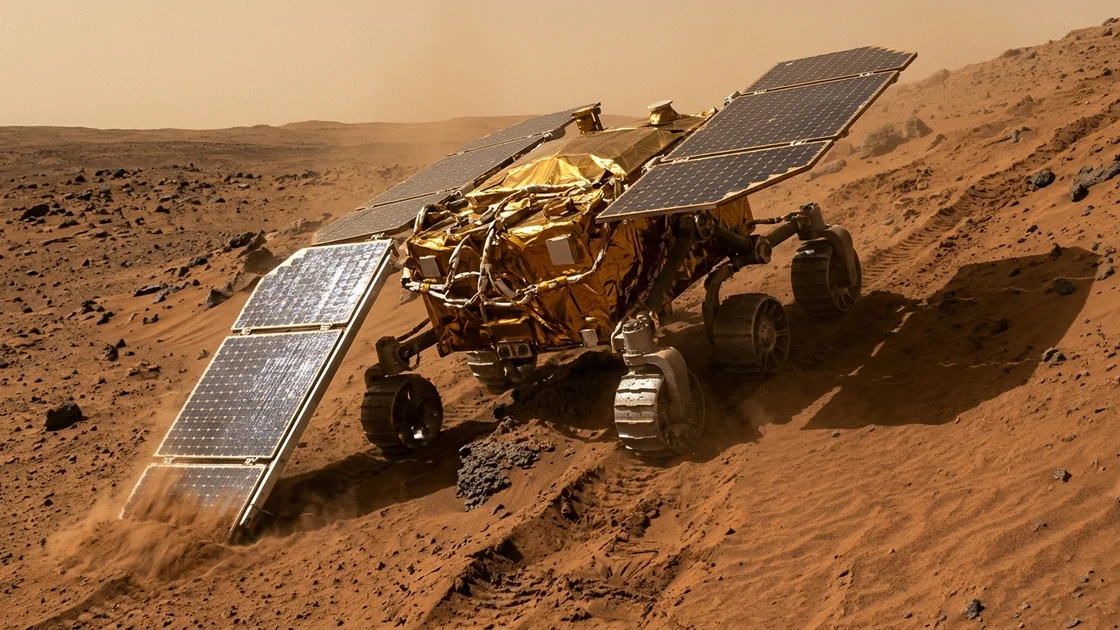
Elena Rostova faces the impossible task of rescuing the Meridian rover after it breaks through a fragile Martian crust and suffers a catastrophic failure in its primary mobility controller. With the rover trapped at a fatal angle away from the winter sun and its batteries rapidly freezing, mission management prepares to declare the spacecraft lost. Refusing to surrender, Elena discovers that the high-torque actuators designed to tilt the rover's solar panels are controlled by an independent power unit that survived the electrical short. Alongside a small team of exhausted engineers, she must write an unorthodox software patch to bypass the rover's hard-coded safety limits, vibrate the solar wings to fluidize the surrounding sand, and use the fragile panels as mechanical crutches to drag the crippled machine back into the sunlight before the cold of the Martian night silences it forever.
The telemetry did not scream when the rover died; it simply stopped changing.
On the central projection wall of the Surface Operations room, the three-dimensional kinematic model of the Meridian rover hung suspended in a wireframe purgatory. Its six titanium wheels were rendered in bright, angry crimson—the visualization software’s shorthand for a bus-wide hardware fault. The rover was pitched forward at twenty-six degrees and rolled nineteen degrees to port, its belly pan wedged against a jagged shelf of vesicular basalt while its right-side bogie sank deep into a pocket of fine, ferric sulfate powder.
Elena Rostova stared at the hexadecimal readout scrolling down her secondary monitor, her coffee going tepid in a cardboard cup between her hands. The numbers were coming in from the Mars Reconnaissance Orbiter relay pass, delayed by fourteen minutes and twenty-two seconds of light-time across the vacuum of the inner solar system. Every packet told the same bleak story.
"Main Mobility Assembly is completely unresponsive," said Marcus Vance, the Flight Director for Sol 814. His voice was flat, stripped of panic by twenty years of institutional training, though the muscle ticking in his jaw betrayed him. He stood behind the central console, arms crossed tight over his chest. "We tried switching to the B-side redundant bus on the Goldstone pass. The solid-state power switches tripped within four milliseconds. Whatever shorted inside the Motor Control Assembly when the right middle wheel stalled didn't just blow the bridge; it welded the backplane."
"Show me the current curve from the stall event again," Elena said, leaning forward until her nose was six inches from the glass of her workstation. As Lead Mobility Engineer, the wheels were her domain—her children, her responsibility, and right now, her failure.
Across the aisle, Sanjay Patel, the Tactical Uplink Lead, flicked two fingers across his trackpad. A high-resolution plot bloomed on Elena’s screen. It showed the last sixty seconds of Meridian's drive across the northern rim of Meridiani Planum’s southern extension—a region the science team had poetically dubbed the Shattered Pavement.
For fifty-two seconds, the current draw on the six drive actuators had hummed along at a nominal 1.2 amps per wheel. Then, at 14:02:11 Local Mean Solar Time, the left front wheel had broken through a four-centimeter crust of cemented duricrust. The rover had lurched downward into a hidden sublimation cavern—an ancient pocket where subsurface ice had vanished eons ago, leaving behind a void filled with talcum-soft dust.
Instinctively, the onboard autonomous navigation software had tried to claw its way out. It had commanded maximum torque to all six wheels while simultaneously articulating the steering actuators to crab sideways.
"There," Elena whispered, tracing the jagged spike with the tip of her mechanical pencil. "Right at 14:02:19. The right rear wheel bound up against the basalt lip. The actuator drew nineteen amps, the back-EMF spiked when the rock under the wheel gave way and slammed the suspension stops, and the voltage regulator on the MCA board went supernova."
"It cooked itself," Sanjay murmured. "Fused the copper traces across the isolation barrier. Every time the flight computer tries to ping the wheel controllers or the robotic arm azimuth joint, it sees a dead short to ground and trips the main breaker to protect the central avionics."
"So the wheels are bricks," Vance said. It wasn't a question. "What about the robotic arm? Can we unstow the turret, plant the abrasion tool into the dirt in front of the chassis, and pull ourselves forward?"
Elena shook her head before the arm engineer two rows up could even key his mic. "The arm shares the same Motor Control Assembly multiplexor, Marcus. That’s how we saved four kilograms on launch mass, remember? The mobility and manipulation actuators are multiplexed through the same high-power H-bridge array. With the MCA shorted out, we can't move a single wheel, we can't steer, and we can't unlatch the robotic arm."
Silence settled over the operations room, heavy and suffocating. The ventilation system hummed a low C-sharp, blowing chilled California air over thirty engineers who were all mentally calculating the same brutal equation.
Meridian was a solar-powered scout rover. Unlike its massive, nuclear-powered cousins Curiosity and Perseverance, which carried plutonium-dioxide pellets to keep their internal organs warm and their batteries charged regardless of the season, Meridian had been built fast and lean under the Discovery Program budget cap. It relied entirely on two expansive, gull-wing solar arrays that flanked its central warm electronics box.
Right now, it was late autumn in the southern hemisphere of Mars. The sun was already low in the northern sky. And Meridian had pitched nose-first into a south-facing pit.
"Give me the thermal and power projection," Vance said, turning toward the Power Systems desk.
Sarah Lin, a diminutive woman wearing an oversized fleece jacket despite the room's warmth, swallowed hard. "With our current attitude—twenty-six degrees nose down, azimuth one-seventy-four—the solar arrays are catching the sun at an incidence angle of seventy-eight degrees at local noon. Combined with a tau of 0.9 from the regional dust haze, we’re generating less than ninety watt-hours per sol."
"And survival power?" Vance asked.
"To keep the lithium-ion batteries above minus forty degrees Celsius, the survival heaters draw one hundred and sixty watt-hours per sol," Sarah said quietly. "Right now, we’re running on battery reserves. The State of Charge is at forty-two percent. By dawn on Sol 816, the batteries will hit their low-voltage cutoff. The heaters will shut down. By noon on Sol 817, the electrolyte in the cells will freeze solid, and the thermal cycling will shear the solder joints on the main flight computer."
Seventy-two hours. In seventy-two hours, a four-hundred-million-dollar marvel of human ingenuity, a machine Elena had spent seven years of her life designing, testing, and driving across twelve kilometers of alien desert, would become an extraordinarily expensive piece of modern art buried in a ditch.
Vance closed his eyes for three seconds. When he opened them, he looked older. "All right. I want the Anomaly Response Team in Conference Room 4B in twenty minutes. We’ll run the fault-tree analysis from the top. See if there’s any way to blow the shorted traces clear by over-volting the bus—a fuse-clearing burn. Science team, start putting together a high-priority observation package for the mast cameras and the spectrometer. If we're stationary for the next two sols, we are going to squeeze every last drop of data out of that hole before the batteries die."
People began to stand up, the quiet rustle of papers and the clink of coffee mugs sounding like a funeral procession.
Elena didn't move. Her eyes were fixed on the wireframe model on the big screen. Around the crimson wheels and the crimson robotic arm, the rest of the rover's chassis was rendered in cool, nominal green. The high-gain antenna gimbal was green. The mast pan-and-tilt unit was green.
And stretching out to either side of the rover’s body, like the wings of a metallic albatross, the dual-axis solar arrays were glowing a steady, unbothered emerald.
The Anomaly Response meeting was an exercise in bureaucratic grief.
For three hours, the graybeards from the Electrical Power Systems division argued with the veterans from Avionics about whether they could intentionally short the lithium-ion batteries across the dead Motor Control Assembly to vaporize the fused copper bridge. By five o'clock in the evening, thermal modeling on the lab's supercomputers proved that the required current surge would melt the primary harness connector before it cleared the fault inside the MCA, instantly killing the rover two days early.
By seven o'clock, the word end-of-mission was being used without anyone flinching. The Associate Administrator at Headquarters in Washington had been briefed. Public Affairs was quietly drafting a tribute press release celebrating Meridian’s exceeded ninety-sol warranty.
Elena slipped out of the conference room at 7:45 PM. She didn't go back to her cubicle. Instead, she walked down the hill through the cooling Pasadena twilight, past the brutalist concrete plazas where deer sometimes wandered down from the San Gabriel Mountains, toward a cavernous, corrugated-steel warehouse at the edge of the complex: Building 212. The In-Situ Instrument Laboratory. Everyone just called it the Mars Yard.
She badged through the heavy security door. The floodlights inside the high bay were already on, casting a harsh, sodium-vapor glare that closely mimicked the color temperature of the Martian sky. The room smelled of crushed red cinder, dry silica dust, and machine oil.
In the center of a forty-by-forty-meter sandbox sat Meridian's twin.
Officially designated the Surface System Testbed, the engineers called her Terra. Because Earth’s gravity was nearly three times stronger than Mars’s, Terra was stripped of her internal radiation shielding and thermal insulation, her chassis machined from lighter magnesium alloys so that her total mass on Earth exerted the exact same ground pressure and suspension kinematics as Meridian did on the plains of Mars.
Elena stepped over the low yellow chain bordering the sandbox, her boots sinking slightly into the Mojave-sourced volcanic sand. She walked up to Terra and laid a hand on the cool gold Kapton tape wrapping the rover's belly.
"Hey, girl," she murmured.
She crouched down, peering underneath the chassis, then stood up and examined the wing roots where the solar arrays met the central body.
Meridian had been designed during a brief window when NASA was obsessed with surviving Martian dust storms using mechanical mitigation. After watching Opportunity and InSight slowly choke to death under layers of electrostatic dust, the design team had rejected flat, fixed solar decks. Instead, they had given Meridian two articulated wings, each measuring one point eight meters long and ninety centimeters wide. Each wing was mounted on a two-degree-of-freedom shoulder joint at the forward corners of the chassis.
They could pitch up and down by ninety degrees, and they could roll—tilting inward toward the rover's spine or outward toward the ground—by seventy-five degrees. The idea was simple: in the winter, you tilted the wings up to catch the low sun; after a dust storm, you tilted them vertical and snapped them against their mechanical hard-stops to shake the dust off like a wet dog.
"Those actuators aren't on the MCA," Elena said aloud to the empty warehouse.
"Of course they aren't," a voice rasped from the shadows near the control booth.
Elena jumped, knocking her shin against Terra's front left wheel cleave. She spun around. Sitting on an overturned plastic milk crate by the diagnostic racks, nursing a diet soda, was Artie Miller. Artie was sixty-four, wore suspenders over flannel shirts regardless of the California heat, and had written the low-level bootloaders for everything from Pathfinder to the Ingenuity helicopter.
"Jesus, Artie. How long have you been sitting there?"
"Since Vance started talking about vaporizing the wiring harness," Artie said, taking a slow sip of his soda. "I figured if they were going to cremate the kid, I didn't want to watch them design the matches. Why aren't you up there helping them write the obituary?"
Elena turned back to the testbed rover, her mind racing now, the fragments of a schematic she hadn't looked at since the Critical Design Review four years ago assembling themselves behind her eyes. "Artie, what drives the solar array deployment and tilt actuators?"
Artie squinted at her through his thick bifocals. "The PDMU. Power Distribution and Management Unit. It’s a completely independent box. Had to be—when the rover wakes up from a cold reboot in the dark, the main flight computer isn't even powered on yet. The PDMU has its own radiation-hardened microcontroller that reads the coarse sun sensors and tilts the wings toward the brightest patch of sky until there’s enough voltage on the bus to boot the RAD750 main processor."
"Right," Elena said, her heartbeat picking up speed. She pulled a small steel tape measure from her belt clip and hooked it onto the outer edge of Terra's left solar wing. "And what kind of motors are in those shoulder joints?"
"Maxon brushless DC motors mated to 160:1 harmonic drive gearheads," Artie recited instantly. "We needed high holding torque so a sixty-meter-per-second perihelion wind gust wouldn't fold the panels back over the chassis like an umbrella. They're stout little bastards. About a hundred and四十 Newton-meters of stall torque at the output shaft."
Elena pulled the tape measure down at an angle toward the sand. "If we roll the left wing outward to its maximum limit—seventy-five degrees down—and pitch it forward thirty degrees... the outer corner of the solar panel frame reaches eleven centimeters below the bottom plane of the rover's belly pan."
Artie lowered his soda can. He looked at the rover, then at the tape measure, then at Elena’s face. "Elena. Those are carbon-fiber composite substrates covered in triple-junction gallium-arsenide solar cells that cost twelve thousand dollars per square foot. They are not shovels."
"The rover weighs three hundred and ten kilograms," Elena said, talking faster now, pacing around the front of Terra. "On Mars, that’s about eleven hundred and thirty Newtons of downward force. Right now, Meridian is high-centered. Her belly pan is resting on a lip of vesicular basalt, and her wheels are buried in loose sulfate fines. She doesn't need to drive miles, Artie. She’s nose-down in a two-meter crater. If we can drag her backward just forty centimeters—just enough to clear the basalt lip under her belly and let the rear bogie settle into the lower trench—her pitch angle will shift from minus twenty-six degrees to plus four degrees."
"Plus four puts the arrays back in the sun," Artie whispered.
"Plus four gives us two hundred and eighty watt-hours per sol. She survives the winter. She stays alive indefinitely as a stationary lander, or..." Elena stopped, her eyes widening. "Or if it works once, it works a thousand times."
Artie slowly stood up, his knees popping in the quiet bay. He walked over to the sandbox, stepping over the chain, and examined the aluminum stiffening spar that ran along the leading edge of the solar wing.
"Let's say you didn't snap the carbon fiber like a dry Ritz cracker the second it touched the dirt," Artie said, playing devil's advocate the way only a senior systems engineer could. "Look at the geometry. If you push the wings down into the sand in front of the rover and sweep them back to push the chassis upward and backward, you're pushing against loose talcum powder. The wing tips will just slice right through the regolith. You won't get any purchase. Meanwhile, the belly pan is scraped up against solid volcanic rock. The static friction of titanium on basalt is going to beat a thin composite blade slicing through dust every day of the week."
Elena bit her lip. He was right. A paddle only worked in water because you could move it fast enough to generate dynamic drag. Solar array actuators moved at a glacial pace—half a degree per second. Slicing a two-centimeter-thick panel edge through dry sand at half a degree per second wouldn't move the rover a millimeter; it would just plow two neat little furrows in the dust.
Unless they didn't slice it edge-on. And unless the sand wasn't acting like a solid under the chassis.
"Wait," Elena said. "Look at the two axes. Pitch and roll. If we pitch the wings all the way forward—ninety degrees—so the solar cells are facing straight ahead like two giant bulldozer blades... and then we roll them down into the dirt..."
"Then you're pressing the flat face of the panel against the slope in front of the rover," Artie said, his grey eyebrows rising. "Wait a minute. If you pitch them to ninety degrees first, then roll them down seventy-five degrees, the bottom edge of the wing acts like a foot. And when you un-pitch them back toward zero degrees, you're sweeping the flat face of the panel against the soil."
"Like a sea turtle," Elena breathed. "Or someone on crutches."
"You’d crush the solar cells on the outer twenty centimeters of the wing," Artie pointed out.
"The cells are wired in isolated strings with bypass diodes!" Elena countered, grabbing Artie’s sleeve. "We designed them to survive micrometeorite impacts! Even if we crack the cover glass and short out the outermost string on both wings, we only lose twelve percent of the array's generating capacity. Eighty-eight percent of alive is infinitely better than a hundred percent of frozen dead!"
Artie stared at the wing assembly for a long time. Then he shook his head and let out a low, dry chuckle that turned into a cough. "You're out of your mind, Rostova. You know why?"
"Why?"
"Because you can't command those angles." Artie tapped the black anodized housing of the PDMU sitting on the open equipment shelf of the testbed rack. "The flight software on the RAD750 doesn't have direct motor-phase control over the solar wings. It only sends high-level table requests to the PDMU—stuff like Go To Sun-Track Mode or Go To Stow Position. The actual motor commutation and limit-checking happens inside the PDMU’s microcontroller. And that microcontroller has hard-coded software stops in its EEPROM. It will never allow you to roll the wings down past forty-five degrees if the pitch angle is greater than thirty, specifically to prevent the panels from striking the ground on uneven terrain."
Elena felt a cold weight drop into her stomach. "Can we override the limit tables by changing a parameter file?"
"They aren't parameters in RAM, kid. They're compiled constants inside the PDMU firmware," Artie said softly. "Written in 8051 assembly language back in 2018 by a contractor in Denver who probably retired three years ago. To make those wings touch the dirt, you don't just need a command sequence. You have to write a custom firmware patch, upload it through the main flight computer over a slow serial bus, flash the PDMU's reprogrammable PROM while it's actively managing the rover's power bus without dropping the main voltage rail, and turn a sun-tracking power regulator into a six-state robotic locomotion controller."
He looked at his watch. "And you have to design it, code it, test it in this sandbox, convince Marcus Vance and the safety board not to have us committed to a psychiatric facility, and uplink it to Mars before the Goldstone pass in thirty-eight hours."
Elena looked from Artie's weathered face to the gleaming, immobile wings of the testbed rover.
"Do you still have the source code for the PDMU?" she asked.
Artie grinned, showing a crooked canine. "I'm a digital hoarder, Elena. I have the source code for the toaster in the third-floor breakroom. Come on. Put the coffee pot on."
By 10:00 PM, they had recruited two co-conspirators.
Elena called Sanjay Patel back before he even made it onto the 210 Freeway, luring him back to the lab with the promise of "doing something profoundly illegal to the flight software." Ten minutes later, Sarah Lin from Power Systems walked into Building 212 carrying a box of stale donuts and three massive three-ring binders labeled PDMU ELECTRICAL INTERFACE CONTROL DOCUMENT - REV F.
"Artie called me," Sarah said, dropping the binders onto the folding table beside the sandbox with a heavy thud. "He told me you were planning to use my pristine, fragile, flight-grade photovoltaic arrays as earth-moving equipment. I figured if someone is going to mutilate my power system, I should be the one holding the scalpel."
"Glad to have you, Sarah," Elena said, already elbow-deep in the sandbox alongside two lab technicians she had bribed with thirty dollars' worth of late-night Thai food.
Using laser scan data from Meridian's hazard avoidance cameras—the last pictures taken right after the rover broke through the crust—Elena and the techs were meticulously reconstructing the death trap on Mars inside the Pasadena sandbox.
They hauled in three hundred-pound blocks of jagged vesicular basalt from the rock pile at the back of the yard, burying them at a precise twenty-six-degree slope. Over and around the rocks, they poured buckets of "Mars-1A" simulant mixed with crushed ferric sulfate—a hyper-fine, rust-colored powder so light and electrostatic that it hung in the air like reddish smoke and coated their teeth with a metallic tang.
When the pit was ready, they used the overhead gantry crane to hoist Terra into the air, tilting the testbed rover in its harness before lowering it gently into the artificial crater.
As the crane cables went slack, Terra settled with a sickening crunch. Her belly pan ground hard against the basalt lip. Her right wheels vanished up to their hubs in the powdery sulfate pocket. The rover listed twenty-six degrees forward and nineteen degrees to port.
Looking at the physical twin trapped in the dirt right in front of her, Elena felt a sudden, visceral wave of vertigo. On a computer screen, it was just numbers and wireframes. Here, under the orange sodium lights, she could see just how helpless the machine was. It looked like an exhausted beetle wedged in a footprint.
"Okay," Elena said, wiping red dust from her forehead with the back of her wrist. "We have physical parity. Artie, Sanjay—where are we on the code?"
Inside the glass-walled control booth at the edge of the pit, Artie and Sanjay were hunched over a dual-monitor Linux terminal, their faces illuminated by cascades of green and amber text.
"I found the repository for the PDMU microcontroller," Artie shouted through the open door of the booth. "It’s an radiation-hardened 8051 core running at twelve megahertz with thirty-two kilobytes of program memory. The whole thing is a single infinite loop running on a ten-millisecond hardware timer interrupt."
Elena and Sarah walked into the booth, crowding behind their chairs.
"Look right here," Sanjay said, pointing to a block of assembly
instructions on the left monitor. "Subroutine
CHK_GIMBAL_ENV. Every ten milliseconds, the PDMU reads the
resolvers on the four wing actuators—Left Pitch, Left Roll, Right Pitch,
Right Roll. It compares those sixteen-bit angles against a lookup table
in ROM. If pitch plus roll exceeds the collision envelope, it
immediately cuts the PWM signal to the H-bridges and sets an error
flag."
"Can we just NOP it out?" Elena asked, referring to the
No Operation assembly instruction—the classic programmer’s
trick of overwriting unwanted safety checks with blank bytes that did
nothing.
"If we just overwrite the safety check with NOPs, we still have a bigger problem," Sanjay said, rubbing his temples. "The main flight computer can only command wing positions at a resolution of one degree, and it only sends those commands once every five seconds. Why? Because the sun moves slowly! Nobody ever designed the serial link between the main computer and the PDMU for real-time trajectory control. If we try to coordinate a complex multi-axis digging motion from the main computer over a 9600-baud serial line, the wings will jerk, stall, and desynchronize. One wing will take the entire load of the rover and snap."
"So the coordination can't come from the main flight computer," Sarah said, leaning over Artie’s shoulder. "The gait algorithm has to live entirely inside the PDMU."
"Bingo," Artie grunted. "We have to hollow out the sun-tracking algorithm inside the PDMU’s thirty-two kilobytes of memory and replace it with a closed-loop locomotion state machine. When we send the trigger byte from the main computer, the PDMU takes over completely. It reads the motor currents and joint resolvers at a hundred hertz and moves both wings in lockstep."
Elena stared at the code. "How much free space is left in the PDMU’s thirty-two-kilobyte PROM?"
Artie ran a compiler script. A summary line spat out at the bottom of the terminal.
BYTES USED: 31,412 / 32,768. FREE: 1,356 BYTES.
"Thirteen hundred bytes," Sanjay breathed. "We have to write a synchronized four-axis robotic kinematics controller, with current-limiting fault protection, in less than one point three kilobytes of machine code."
"I put a rover on Mars in 1997 with less memory than a greeting card that plays Happy Birthday," Artie snapped, cracking his knuckles. "Thirteen hundred bytes is a luxury apartment. Just tell me what you want the wings to do, Elena."
Elena grabbed a dry-erase marker and turned to the whiteboard on the booth wall. Quickly, she sketched the side profile of the trapped rover, the basalt lip beneath its belly, and the two wings.
"We can't push forward," she said, drawing arrows. "The front wheels are buried behind a vertical wall of compacted duricrust. Our only way out is backward—up the twenty-six-degree slope we slid down. To go backward, the wings have to reach forward, plant themselves in the dirt ahead of the rover's center of mass, push down to lift the belly pan off the basalt lip, and then sweep toward the rear."
She wrote out four distinct states on the board:
- FEATHER: Roll wings up to +15 degrees (clear of the ground). Pitch wings forward to +85 degrees (blades vertical, facing the front of the rover).
- PLANT: Roll wings straight down into the dirt to -70 degrees.
- LIFT & SWEEP: Hold roll at -70 degrees while driving pitch backward from +85 degrees to +20 degrees. The flat back-faces of the solar panels press against the soil trench and lever the rover uphill.
- RELEASE: Roll wings up out of the dirt, return to State 1.
"Let's test the raw kinematics right now," Elena said. "Artie, compile a quick-and-dirty bypass that just disables the envelope check on Terra's PDMU. Let's manually step the motors through those four states in the pit and see what happens to the chassis."
It took forty minutes for Artie to patch the assembly file, calculate the new checksum so the bootloader wouldn't reject the corrupted image, and flash it onto Terra's testbed PDMU board via a ribbon cable.
At 11:30 PM, they stood around the edge of the sand pit. Sanjay sat at the portable console, his fingers poised over the command script.
"Executing State One: Feather," Sanjay called out.
With a high-pitched harmonic whine that echoed off the steel walls of the warehouse, Terra's two broad solar wings rose slightly, then rotated smoothly around their longitudinal axes until both panels stood nearly vertical, their dark crystalline faces gleaming like twin shields beside the rover's front wheels.
"Clearance looks good," Elena said, crouched in the sand three feet away with a flashlight. "We missed the front hazard camera housing by two centimeters. Take us to State Two: Plant."
Sanjay hit enter.
The shoulder joints groaned. Because the rover was rolled nineteen degrees to the left, the left wing hit the dirt first. Its lower aluminum frame bit into the loose sulfate powder. The motor current on the Left Roll actuator climbed from 0.4 amps to 2.1 amps. A second later, the right wing swung down all the way to minus seventy degrees, barely scraping the higher slope on the starboard side.
"Wait," Sarah said, watching the telemetry strip chart on the portable monitor. "Because of the nineteen-degree roll angle, the left wing is buried ten centimeters deep, and the right wing is barely touching the surface. If we sweep right now, all the torque goes through the left wing."
"Let's see how much purchase we get first," Elena said grimly. "Sanjay, give me State Three. Slow ramp. Half speed."
"Sweeping pitch from eighty-five down to twenty," Sanjay said.
The pitch actuators engaged. The left wing pressed flat against the bank of red simulant in front of the left front wheel. The sand compressed. The aluminum frame flexed visibly—bowing backward by nearly a centimeter under the load. The harmonic drive whine dropped an octave as the motor fought the resistance.
Under the rover's belly, the titanium pan scraped against the basalt block with a sound like fingernails on a chalkboard.
The rover pitched up by half a degree. The belly pan lifted two millimeters—and then, with a sharp, terrifying CRACK, the left solar wing’s root hinge twisted, the carbon-fiber composite delaminated along the main spar, and the rover dropped right back down onto the rock.
"ABORT!" Elena yelled.
Sanjay slapped the emergency stop button, cutting power to the testbed rack. The high-pitched whine died instantly, leaving only the sound of a trickle of red sand sliding back into the rut left by the broken wing.
Elena dropped to her knees in the dirt beside Terra, shining her flashlight onto the underside of the left solar array. A jagged white tear ran twelve centimeters down the woven black carbon-fiber backing sheet where the titanium root bracket was bonded to the panel.
Sarah knelt beside her, letting out a long, shaky breath. "Well. That was an eighty-thousand-dollar sound."
"It's a spare mechanical engineering test unit," Elena said automatically, though her stomach was churning. Her mind was locked on the telemetry numbers she had seen right before the delamination. "Sarah, what was the motor current when the spar cracked?"
"Four point eight amps on Left Pitch," Sarah said, checking her tablet. "That equates to about ninety-five Newton-meters of torque at the hinge. The actuator didn't even stall. The harmonic drive was completely fine—it's just stronger than the glue holding the wing onto the bracket."
Elena sat back on her heels in the red dust, rubbing her eyes. Around her, the warehouse felt colder. It was past midnight. Thirty-six hours left until the Goldstone uplink pass.
"Artie was right," Sanjay said quietly from the edge of the pit. "The static friction of the belly pan on the basalt, combined with the six dead wheels buried up to their rims in sand, is acting like an anchor. The wheels can't turn because the shorted MCA is acting as an electromagnetic brake—actually, worse than that, the 240:1 planetary gearboxes in the wheel hubs are completely non-backdrivable. Even if the MCA wasn't shorted, you can't roll a locked rover wheel. You have to drag all six wheels through the sand like cinderblocks."
Elena stared at the buried wheels. Six titanium cylinders, each twenty-five centimeters in diameter, fitted with aggressive machined cleats designed to grip soil and never let go. Now that the motors were dead, those cleats were doing their job in reverse: anchoring Meridian into its grave.
To drag six locked, cleated wheels uphill while scraping a titanium belly pan over volcanic rock required roughly seven hundred Newtons of drawbar pull. And the carbon-fiber wing spars failed at three hundred and fifty Newtons per wing.
The physics didn't close. The numbers were off by a factor of two.
"We can't lift the rover," Elena whispered. "And we can't drag the cleats through dry, compacted regolith."
She reached out and shoved her fingers into the Mars-1A simulant around the front left wheel. It was surprisingly firm once compressed; the jagged, microscopic grains locked together under pressure—a phenomenon soil physicists called dilatancy. To push a locked wheel through it, you had to shear an entire wedge of soil in front of the tire.
She pulled her hand back and tapped the side of the tire with her flashlight. A tiny puff of dust settled around the cleats.
Tap. Tap. Tap.
As she tapped the aluminum wheel hub rapidly with the butt of the steel flashlight, the sand immediately touching the vibrating metal did something strange. The tiny, steep cliff of compressed dust collapsed, flowing outward like brown water around her boots.
Elena froze. The flashlight remained pressed against the wheel.
"Granular fluidization," she breathed.
"What?" Artie asked, leaning over the safety chain.
Elena scrambled up out of the pit, red dust coating her jeans from hip to ankle. "In 2019, when we were testing the Rosalind Franklin soil drill in Turin, we got the drill string stuck in compacted dry basaltic sand. We couldn't pull it out with a five-hundred-Newton winch. So how did we free it? We ran the piezoelectric percussion hammer at sixty hertz with zero downward weight. The vibration broke the inter-granular friction chains in the sand. For ten centimeters around the drill rod, the sand turned into a liquid. We pulled it out with two fingers."
She spun toward Artie and Sanjay. "How fast can the PDMU switch the motor H-bridges?"
Artie blinked behind his glasses. "The PWM carrier frequency is twenty kilohertz. The control loop runs at a hundred hertz—every ten milliseconds. Which means we can reverse the polarity of the motor torque every ten milliseconds."
"Fifty hertz," Elena said, her voice rising with a fierce, sudden electricity. "If we oscillate the solar array actuators back and forth by half a degree at fifty hertz while they're planted in the dirt and pressing against the chassis hard-stops..."
"You turn the entire rover into a fifty-hertz tuning fork," Sanjay said, his eyes going wide. "The vibrations travel straight down the wing roots, through the magnesium chassis, down the suspension bogies, and into the buried wheels!"
"And into the sand directly around the solar panel blades," Sarah added, catching the wave of realization. "Wait—if you vibrate the wings at fifty hertz while applying a slow, steady backward sweep, you aren't plowing solid dirt anymore! You're fluidizing the regolith under the wheels, reducing the sliding friction of the belly pan on the rock through micro-slippage, and swimming through liquified sand!"
"Can the wing spars take fifty-hertz vibration without delaminating?" Sanjay asked.
"Vibration doesn't break carbon fiber; peak bending moment breaks carbon fiber!" Elena said, practically running back into the control booth. "We broke the wing because we let the current climb to 4.8 amps! Sarah, the PDMU monitors actuator current on every ten-millisecond tick, right?"
"Yes," Sarah said, flipping rapidly through her binder to the analog-to-digital converter schematics. "Channel four through seven on the multiplexer. Eight-bit resolution. One count equals twenty-five milliamps."
"Then we don't command position during the sweep!" Elena slammed her palm onto the whiteboard next to State 3. "We command torque! We set a hard current ceiling inside the assembly code—say, 2.5 amps per motor, half of what broke the spar. As the wing sweeps backward, the moment the current hits 2.5 amps, the motor backs off for one tick—ten milliseconds—then slams forward again for twenty milliseconds! It’s an impact wrench! A hammer-drill!"
Artie stared at the whiteboard, his jaw working silently as he mentally translated differential equations into eight-bit assembly instructions.
"A bang-bang current controller superimposed on a trajectory ramp,"
Artie muttered. "No floating-point math. Just comparing the raw
eight-bit ADC register against a hexadecimal constant 0x64.
If greater than 0x64, invert the direction pin on Port B
for one cycle. If less than 0x64, step the resolver target
forward."
He looked up at Elena, and for the first time all night, the cynical veil was completely gone from the old programmer's eyes. "Elena, that whole routine will take less than ninety bytes of code."
"And what about the nineteen-degree roll?" Sarah asked urgently. "If the left wing hits the dirt ten centimeters before the right wing, how do they synchronize without a terrain map?"
"They don't use angles to find the ground," Elena said, the entire architecture crystallizing in her mind with terrifying clarity. "In State Two—Plant—both wings roll downward independently until their roll-motor current hits 1.5 amps. That means both wings have firmly planted themselves into whatever slope is beneath them, regardless of the rover's tilt! Only when both wings register 1.5 amps of ground contact pressure does the state machine transition to State Three and start the synchronized fifty-hertz backward sweep!"
Nobody spoke for five seconds. In the quiet control booth, the only sound was the ticking of the cooling fans in the server rack.
"It's adaptive," Sanjay whispered. "It doesn't care about the rock geometry. It feels for the ground using motor stall current, locks both crutches in place, vibrates the chassis to liquify the sand trap, and hammers itself uphill without ever exceeding fifty percent of the structural limit of the wings."
"Replace the cracked wing on Terra," Elena said, her voice steady and cold as steel. "We have two flight-spare panels in bonded storage in Building 180. I'll sign the emergency requisition form myself. Artie, write the fifty-hertz current-limiting loop. We test again at 4:00 AM."
Getting a flight-spare solar wing out of bonded storage at two in the morning required waking up the Night Shift Quality Assurance supervisor, who threatened to call JPL Security until Elena showed him her badge and told him that Marcus Vance would personally fire him at 8:00 AM if he didn't unlock the cage. It was a complete bluff—Vance didn't even know they were in the building—but the sheer, bloodshot ferocity in Elena’s eyes convinced the man to turn the key.
By 3:45 AM, the damaged left wing on Terra had been unbolted and replaced with the pristine spare.
Inside the booth, Artie had finished coding what he named
MOD_CRUTCH.ASM. The entire patch was 842 bytes long. To
make room for it inside the PDMU's cramped memory, they had completely
deleted the routine that calculated the seasonal equation of time for
autonomous solar tracking—a feature Meridian wouldn't need if
Earth simply uploaded updated sun-pointing tables once a week.
At 4:15 AM, Elena stood beside the sand pit once more. Her back ached, her throat felt like it was coated in iron filings from breathing the suspended sulfate dust, and her hands were trembling slightly from four consecutive shots of espresso.
"All right," she said into her headset mic. "Patch is flashed to the testbed PDMU. All six wheel drive harnesses are physically shorted at the breakout box to simulate the fused MCA on Mars. Terra is sitting at minus twenty-six degrees pitch, nineteen degrees port roll, belly pan hard on the basalt. Sanjay, send the magic byte."
Inside the booth, Sanjay typed 0xAA into the PDMU
command register and hit return.
Terra's wings rose into the Feather position, rotating until their faces pointed toward the front of the pit.
Then, State Two began. Both wings swung downward toward the dirt.
The left wing hit the low side of the trench first. Its motor hummed, pressed twelve centimeters into the loose powder, hit the 1.5-amp threshold, and stopped, holding pressure. Half a second later, the right wing swung down past horizontal, found the higher bank of basaltic sand on the starboard side, compressed the dirt until its current reached 1.5 amps, and locked.
The rover looked like a metallic praying mantis bracing itself in the sand.
"Both wings report ground lock," Sarah called out, her eyes glued to the current traces. "Transitioning to State Three: Vibro-Sweep."
A sound erupted from the sand pit that none of them had ever heard a spacecraft make.
It wasn't the smooth, quiet whir of robotic actuators. It was a low, angry, fifty-hertz growl—brrrrrrrrrrrt—as the four harmonic drives rapidly hammered back and forth against their current limits.
Elena shone her beam onto the buried wheels.
The effect was instantaneous and breathtaking. As the fifty-hertz vibration coursed through the magnesium frame, the sharp ridges of rusty sulfate powder clinging to the wheel rims dissolved. The sand around the six locked tires began to shimmer and flow downhill like hot cocoa. Beneath the rover, the titanium belly pan chattered against the volcanic rock—micro-vibrations breaking the static friction bond thousands of times per second.
Slowly, inexorably, the two broad solar wings pressed backward against the trench walls. Whenever the load on the left wing approached 2.5 amps, the actuator stuttered—rat-tat-tat-tat—shedding the peak bending load while keeping the momentum going, transferring the weight briefly to the right wing before re-engaging.
The carbon-fiber panels bowed four millimeters—well within their elastic limit—and held.
Terra moved.
Inch by agonizing inch, the three-hundred-kilogram machine slid backward up the slope. Its locked wheels plowed through the liquefied dust like skis through slush. The nose rose. The belly pan scraped over the sharp lip of the basalt shelf with a metallic screech, balanced on the edge for two heart-stopping seconds while the actuators hammered furiously, and then slid clear off the back of the rock, dropping into the softer sand behind it.
At +20 degrees of pitch, the state machine hit its end-of-stroke limit. Both wings rolled smoothly upward out of the dirt, returning to State One, paused for two seconds to let the motor windings cool, and then plunged back down into the sand thirty centimeters further up the slope for a second stroke.
By the end of the third stroke, Terra had dragged herself forty-eight centimeters backward out of the hole. Her pitch angle on the inclinometer display read +3.2 degrees. Her roll was down to six degrees.
When the third cycle finished, the state machine automatically exited
MOD_CRUTCH and reverted to default safe mode, rotating both
solar wings flat toward the overhead sodium floodlights.
In the sudden quiet of the high bay, the only sound was the soft hiss of settling dust.
Elena walked over to the rover and dropped to her knees, running her fingers across the solar cells on the outer edges of the wings. The protective cerium-doped cover glass on the bottom four centimeters was scratched and frosted by the abrasive volcanic sand, and a tiny chip had flaked off the aluminum bezel on the left tip.
"Sarah?" Elena asked softly, her voice cracking. "Check the array continuity."
Inside the booth, Sarah flipped on the overhead solar simulator lamps and read the voltage output from the testbed wings.
"All strings intact," Sarah whispered over the net. "Zero open circuits. Zero shorted bypass diodes. Peak current never exceeded two point four amps on any joint."
Sanjay leaned out the door of the control booth, a massive, delirious grin splitting his face. "She swam right out of the grave, Elena! Fifty-two seconds! Three strokes!"
Elena leaned her forehead against the warm gold foil of the rover's side panel and closed her eyes. For five seconds, she let herself feel the rush of triumph. Then she opened her eyes and looked at the digital wall clock above the crane bay.
04:42:19 AM.
The Goldstone DSN pass—the last high-bandwidth X-band uplink window before Meridian’s batteries dipped below the voltage required to flash the PDMU EEPROM—was at 11:15 AM.
Six and a half hours. And they hadn't even told the Flight Director yet.
At 7:30 AM, Conference Room 4B smelled of cheap cologne, peppermint antacids, and impending defeat.
Marcus Vance sat at the head of the long mahogany table, flanked by Dr. Harrison Cole, the Project Manager, and Linda Sterling, the Chief of Mission Assurance. Around the perimeter sat the division chiefs, looking grey and hollowed out after a night of fruitless simulations. On the screen behind Vance was a power-depletion graph showing Meridian's battery charge crossing the red thermal-death line at 04:00 UTC the next morning.
"So that’s the consensus from Avionics and Power," Vance was saying as he signed a stack of risk-waiver forms. "The bus-clearing burn has a ninety-four percent probability of blowing the main battery pyro-fuse and blinding the spacecraft instantly. Rather than kill her today, we leave the mobility bus isolated, turn off the non-essential heaters to conserve power for the mast camera and Mossbauer spectrometer, and collect thirty-six hours of high-resolution geochemistry on the interior of the sublimation pit before she freezes."
He capped his pen. "It’s not the end we wanted for Meridian, folks, but eight hundred and fourteen sols on a ninety-sol warranty is a hell of a run—"
The double doors at the back of the room banged open.
Twenty-five heads turned in unison.
Elena stood in the doorway. She looked like she had personally walked back from Meridiani Planum. Her hair was frizzed and dusted with rust-colored powder, her jeans were caked in red mud at the knees, and there was a smudge of black molybdenum grease across her left cheekbone. Behind her stood Artie Miller holding a ruggedized laptop, Sarah Lin clutching her three-ring binders, and Sanjay Patel carrying a USB drive like it contained the nuclear launch codes.
"Elena?" Vance frowned, half-rising from his chair. "Where have you been? Your deputy had to brief the mobility fault tree at six."
"The mobility fault tree is irrelevant, Marcus," Elena said, walking straight down the center aisle without waiting to be invited. She unplugged the HDMI cable from the podium laptop and jammed it into Artie’s machine. "We aren't going to use the wheels. We're going to drag Meridian backward out of the pit using the solar array tilt actuators."
A profound, stunned silence fell over the room.
Dr. Cole blinked slowly, looking from Elena to Vance. "Did she just say the solar arrays?"
"Watch," Elena commanded.
Sanjay hit play on the video file they had recorded in Building 212 an hour earlier. On the main projection screen, the high-definition footage of Terra wedged in the basalt trap appeared. The room watched in utter disbelief as the testbed rover folded its priceless gallium-arsenide wings forward like shields, plunged them into the dirt, and let out a ferocious fifty-hertz roar through the conference room speakers—vibrating the surrounding sand into liquid slurry while levering the three-hundred-kilogram chassis backward off the rock shelf in three smooth, insectoid heaves.
When the video ended, nobody breathed.
Then Linda Sterling, the Mission Assurance chief, leaned forward, her eyes narrowing to razor slits. "Tell me I did not just watch you intentionally drive flight-grade solar panels into basaltic regolith while oscillating harmonic drives at fifty hertz."
"We used a flight-spare wing," Elena said evenly. "And we didn't break a single cell string. Sarah, show them the telemetry."
Sarah stepped up and slapped four printed strip-charts onto the mahogany table in front of Vance, Cole, and Sterling. "The motor currents are hardware-limited in the control loop to two point five amps—less than fifty percent of the structural delamination threshold we found during destructive testing on the non-flight prototype wing at midnight. The fifty-hertz oscillation fluidizes the sulfate fines around the locked wheels, cutting the required drawbar pull from seven hundred Newtons down to two hundred and eighty."
"Destructive testing?" Cole repeated, his voice rising an octave. "You broke a testbed wing last night without an approved Test Procedure?!"
"We had thirty-eight hours before the rover freezes to death, Harry!" Artie barked from the back of the table, his suspenders straining as he leaned on his knuckles. "If we waited for your configuration control board to approve a Test Procedure, Meridian would be a popsicle by Tuesday! Listen to her!"
Vance held up a hand, silencing both Cole and Artie. His eyes hadn't left the freeze-frame on the projection screen showing Terra sitting level at the top of the trench, her panels bathed in light.
"How are you commanding that trajectory?" Vance asked quietly. "The PDMU doesn't take real-time joint-angle streams from the RAD750."
"We wrote an 842-byte assembly patch that flashes directly into the PDMU's EEPROM, overwriting the seasonal solar ephemeris table," Sanjay said, stepping forward. "It’s a self-contained four-state machine. It uses the actuator current sensors to feel for the ground, automatically compensates for the nineteen-degree roll angle, executes three fifty-hertz vibro-sweeps, and then immediately restores the default sun-pointing mode."
Linda Sterling shook her head violently. "Absolutely not. Out of the question. Do you have any idea what happens if you flash the PDMU EEPROM in flight and a single cosmic ray flips a bit during the write cycle, or the voltage rail droops while the charge pumps are active? You brick the Power Distribution Unit! The rover dies instantly! Not in thirty-six hours—in thirty-six milliseconds! We lose the final science package, we lose the geochemistry data from the pit, and we go down in history as the cowboys who lobotomized a working lander on its deathbed!"
"It's not a lander, Linda! It's a rover!" Elena slammed her hand down on the table, making the coffee cups rattle. The exhaustion and terror of the last eighteen hours boiled over into a sharp, incandescent focus. "And that 'final science package' you're protecting is thirty-six hours of staring at the same dirt we've been looking at for two years! If we do nothing, Meridian is dead by Sol 817. One hundred percent probability of loss of mission. Yes, flashing the PDMU carries risk! Yes, a sharp buried rock we can't see on the Hazcams could puncture a solar wing! Everything on Mars is a risk!"
She leaned across the table, looking directly into Marcus Vance's eyes.
"We ran that patch eleven times in a row in the Mars Yard between 4:00 AM and 7:00 AM," Elena said, her voice dropping to a fierce whisper. "We buried rocks in the path of the wings. We tilted the rover to thirty-two degrees. We ran it with simulated brownouts on the twenty-eight-volt bus. Every single time, she crawled out of that hole. Give me the 11:15 Goldstone pass, Marcus. Let her fight."
Vance looked down at the strip-charts. Then he looked at the battery depletion curve on the side screen. Finally, he looked at Dr. Cole.
"Harry," Vance said softly. "If we hand NASA Headquarters thirty-six hours of Mossbauer spectra of iron sulfate and a dead rover on Thursday, nobody says a word. We followed the book. If we uplink an unverified 8051 assembly hack that uses solar panels as shovels, and we snap both wings off on international television..."
Cole took off his glasses and pinched the bridge of his nose. For a long moment, the veteran manager looked at Elena's mud-caked jeans and Artie’s bloodshot eyes.
"When Spirit got bogged down in Troy back in 2009," Cole said quietly, "we spent eight months running simulations on Earth, terrified of breaking a wheel or making it worse. And while we were being careful in conference rooms, the Martian winter came and froze her to death in the sand. I was the Deputy Flight Director on that mission. I swore I would never watch another rover freeze while we held meetings."
He put his glasses back on and looked at Linda Sterling. "The rover is already dead, Linda. Anything we get after noon tomorrow is gravy. Marcus, verify the checksums on Artie's patch on the Avionics Testbed. If it doesn't crash the bus simulator by 10:30 AM, put it on the Goldstone beam."
By 11:00 AM, the Surface Operations room was standing-room only. Word had spread through the lab like wildfire across dry brush. Engineers from the Europa Clipper team, navigators from Voyager, and scientists from Caltech were packed three deep behind the glass observation partition.
Elena sat at the Mobility console, though she had finally taken five minutes to wash the mud off her face in the restroom sink. Beside her, Sanjay was running the final command-sequence verification against the Integrated Test Laboratory simulator.
"ITL confirms clean flash," Sanjay announced over the voice loop, his
voice tight. "Bus voltage droop during EEPROM write was twenty
millivolts—well inside the margin. Checksum matches 0x4F9A.
The command file SOL815_CRUTCH_V1.CMD is wrapped and staged
at the Deep Space Network station at Goldstone, DSS-14."
At the center console, Marcus Vance keyed his headset. "Poll the room for uplink."
"Power," Vance called.
"Power is Go," Sarah Lin replied. "Battery state of charge on Meridian is down to twenty-nine percent. Internal warm electronics box temperature is minus twenty-eight Celsius. It’s now or never, Flight."
"Avionics."
"Avionics is Go."
"Flight Software."
Artie Miller leaned over Sanjay’s console and keyed the mic himself. "Software is Go. May the ghosts of Bell Labs have mercy on our souls."
"Mobility," Vance said, looking straight at Elena.
Elena looked at the wireframe model on the big wall. Still pitched at twenty-six degrees. Still glowing angry red at the wheels and vibrant green at the wings.
"Mobility is Go," she said.
"Goldstone, this is Meridian Flight," Vance said. "Radiate
SOL815_CRUTCH_V1."
"Copy, Flight. Radiating now," the DSN operator's voice crackled back from the Mojave desert. "Twenty kilowatts on the X-band carrier. Bits are leaving the dish."
On the big screen, a progress bar crept from left to right as the 842 bytes of assembly code—padded with error-correcting Reed-Solomon blocks and wrapped in spacecraft authentication headers—streamed upward at the speed of light toward a rusty speck of dust two hundred and fifty million kilometers away.
"Radiation complete at 11:16:04," Sanjay said. "One-way light time is fourteen minutes, twenty-four seconds. The spacecraft will receive the patch at 11:30:28, flash the PDMU at 11:31:00, and execute the first stroke at 11:31:15."
"Which means," Sarah murmured, checking her watch, "that we won't see the telemetry from the execution until the Mars Odyssey UHF relay pass hits the ground at 11:46 AM."
Thirty minutes of waiting in the dark.
For the first fifteen minutes, nobody moved. People stared at the wall clocks as if willpower could bend the speed of light. At 11:31 AM, Elena closed her eyes. Right now—at this exact physical instant in the universe—Meridian was waking up in the freezing Martian afternoon, rewriting her own instincts, and plunging her fragile glass wings into the red dirt.
Or she was already dead, her power unit bricked by a stray voltage spike.
At 11:44 AM, the Odyssey orbiter rose above the western horizon of Meridiani Planum and locked onto Meridian's UHF whip antenna. Fourteen minutes later, at 11:46:12 AM Earth Received Time, the telemetry packets hit the seventy-meter dish in Canberra, Australia, flashed across undersea fiber-optic cables beneath the Pacific Ocean, and burst onto the screens in Pasadena.
"We have UHF lock!" the telecom engineer shouted. "Data rate is a hundred and twenty-eight kilobits per second! Telemetry stream is live!"
"Carrier is steady!" Sarah cried out, half-standing at her console. "The twenty-eight-volt bus is alive! The EEPROM flash worked! The PDMU didn't brick!"
A ragged cheer went up from the observation gallery, quickly shushed by Vance.
"Talk to me, Mobility!" Vance ordered. "Are we moving?"
Elena’s eyes darted across the incoming telemetry table. Because the UHF pass was real-time, the numbers were updating every two seconds.
PDMU_STATE: 02 (PLANT)
"She’s in State Two!" Elena called out. "Left wing roll angle minus forty-eight degrees, current 1.52 amps—ground lock! Right wing roll angle minus sixty-six degrees, current 1.50 amps—ground lock! Both wings are planted in the trench!"
On the big screen, the animated wireframe model suddenly jerked to life as the visualization software digested the unfamiliar joint angles, folding the green wings down beneath the rover's chin like insect legs.
PDMU_STATE: 03 (VIBRO_SWEEP_1)
"State Three active!" Sarah read off the power board. "Fifty-hertz oscillation confirmed! Actuator currents oscillating between 1.8 and 2.4 amps! Battery voltage holding at twenty-four pointtwo volts!"
"Inclinometer!" Elena gripped the edge of her desk so hard her fingernails turned white. "Pitch is changing! Minus twenty-six... minus twenty-four point eight... minus twenty-three point one! She’s lifting off the basalt shelf! Roll is dropping—seventeen degrees, sixteen degrees!"
The wireframe rover on the central screen tilted upward, its nose rising out of the simulated terrain mesh.
"Stroke One complete!" Sanjay yelled. "Pitch is minus十九 degrees! The rover has translated fourteen centimeters uphill! Returning to State One for the second stroke!"
People were hugging each other in the back rows. Dr. Cole let out a breath he looked like he’d been holding since dawn.
"Planting for Stroke Two," Elena reported, watching the numbers reset. "Left wing planted at minus fifty-two degrees. Right wing planted at minus sixty-one degrees. Transitioning to State Three... sweeping..."
Suddenly, an amber warning box flashed across Sarah’s screen, accompanied by a sharp two-tone klaxon from the console speaker.
WARN: PDMU_RIGHT_PITCH_STALL_TIMEOUT
Elena’s blood turned to ice.
On the telemetry display, the Left Pitch angle was sweeping smoothly backward—seventy degrees, sixty-five, sixty—while the Right Pitch angle was frozen solid at seventy-two degrees.
"What happened?!" Vance barked.
"Right wing caught on something under the sand!" Elena said, her hands flying over her keyboard to pull up the high-rate motor diagnostics. "A buried cobble or a jagged lip on the basalt block! Every time the Right Pitch actuator tries to advance, it hits the 2.5-amp limit immediately and backs off for ten milliseconds! It’s caught in a limit-cycle loop—hammering against solid rock while the left wing keeps sweeping backward!"
"Look at the yaw angle!" Sanjay pointed at the screen.
Because the left wing was pushing while the right wing was pinned, the rover wasn't sliding straight uphill anymore. It was pivoting clockwise around the trapped right wing—slewing its rear end sideways toward the deeper part of the sulfate pit!
"Roll is increasing again!" Sarah shouted. "Eighteen degrees...二十 degrees... twenty-two degrees! If the left wing finishes its stroke while the right wing is pinned, it’s going to twist the right shoulder bracket past its lateral shear limit or dump the rover sideways into the hole!"
"How long until the stroke times out?" Vance demanded.
"The watchdog timer for State Three is ninety seconds," Artie said, his face pale. "It started twenty seconds ago. Because the right motor is pulsing below the 2.5-amp cutoff, the PDMU doesn't know it's stuck—it just thinks it's hammering through heavy dirt! By the time the ninety-second timer expires, the left wing will have torqued the chassis thirty degrees sideways!"
"Send an abort!" Sterling yelled from the back.
"Any command we send right now takes fourteen minutes to get there!" Sanjay shot back. "Wait—no! What we're seeing on the screen right now happened fourteen minutes ago! Stroke Two is already over on Mars!"
The room froze. The brutal tyranny of interplanetary physics crashed down on them all at once. They weren't controlling a rover; they were watching a ghost from fourteen minutes in the past.
"Wait," Elena said, her brain working at lightspeed through the panic. "Look at the mission clock! Our script commanded three strokes with a ten-minute cool-down pause between Stroke Two and Stroke Three so the harmonic drive windings wouldn't overheat in the thin atmosphere!"
She pointed to the countdown timer at the top of the screen.
"Stroke Two ended on Mars twelve minutes ago! Which means right now, in real time on Mars, the rover is sitting at the end of its ten-minute thermal pause, twisted sideways with its right wing wedged under a rock, about to initiate Stroke Three in two minutes and forty seconds!"
"And our light-time is fourteen minutes!" Vance said. "Even if we send a stop command right now, it gets there eleven minutes after Stroke Three executes and rips the right wing off!"
"Then why hasn't Stroke Three started on our telemetry?" Sarah asked.
"Because the ten-minute pause just started on our telemetry stream!" Elena spun toward Sanjay. "Wait—why did we put a ten-minute pause between Stroke Two and Three? How does the PDMU count ten minutes?!"
Artie’s eyes widened behind his glasses. "It doesn't have a real-time
clock! It counts ten-millisecond interrupts from the external crystal
oscillator—sixty thousand ticks! Wait... no! To save code bytes in
MOD_CRUTCH, I didn't write a twenty-four-bit counter for
the pause! I made the PDMU wait for the CLEAR_TO_PROCEED
flag from the main flight computer's thermal monitor!"
Elena grabbed Artie by both shoulders. "Say that again!"
"The main flight computer checks the motor thermistors after Stroke Two! It waits until the winding temperature drops below forty Celsius—which took twelve minutes in the sandbox—before it sends the trigger byte for Stroke Three!"
"Check the motor temperatures on the screen right now!" Elena shouted at Sarah.
Sarah pulled up the thermal plot. "On Earth, the warehouse was twenty degrees Celsius, so the motors cooled down in twelve minutes! On Mars, it’s minus sixty outside, but there’s almost no atmospheric convection, and the right motor just spent ninety seconds hammering against a rock at 2.5 amps! Its winding temperature spiked to sixty-eight degrees Celsius! At the current radiative cooling rate in a six-millibar atmosphere, that motor won't cool down to forty Celsius for another seventeen minutes!"
Elena did the math in her head in half a second.
The event on screen had happened fourteen minutes ago. If the cooling took seventeen minutes instead of ten, then in real-time on Mars, Stroke Three hadn't started yet! They had a window of two minutes and fifty seconds!
"If we let Stroke Three run, it starts from State One—Feather," Elena said, her voice razor-sharp. "To feather the wings, the code rolls both wings up to +15 degrees before pitching them forward. If the right wing tip is wedged under an overhanging basalt ledge, rolling it straight up will snap the spar!"
"Then we just send 0x00 to kill the state machine and
leave her where she is!" Vance said, already reaching for his mic key.
"Look at the pitch angle right now, Elena! Even with the slew on Stroke
Two, she's at minus eleven degrees! That’s fifteen degrees better than
we started!"
"Minus eleven degrees only gives us one hundred and thirty watt-hours per sol!" Sarah cried out. "She still freezes to death in five sols instead of two! We need at least zero degrees!"
"How is the wing wedged?" Elena stared at the telemetry from the end of Stroke Two, which had just finished playing out on the screen. The right wing had stopped at +72 degrees pitch and -61 degrees roll. "When the rover slewed clockwise during the left wing's push, it drove the leading edge of the right solar panel twenty millimeters sideways underneath the basalt lip that used to be under our belly pan!"
To free it, you couldn't lift it up (Roll +), and you couldn't push it backward (Pitch -). You had to pitch it slightly forward (+85 degrees) while holding it down in the dirt to slide the blade out from under the rock overhang, before rolling it upward!
"Sanjay!" Elena vaulted over the low partition separating their consoles, landing beside his chair. "Can we poke a single byte directly into the PDMU's RAM without reflashing the EEPROM?"
"Yes!" Artie yelled, shoving his way right behind her. "Command
POKE_MEM_DIRECT! It writes a single byte to any RAM address
in less than four milliseconds!"
"In MOD_CRUTCH, State Four—Release—rolls the wings up
first, then pitches them forward to Feather," Elena said, pointing at
the assembly listing still open on Artie's laptop. "What happens if we
overwrite the register that holds the State Transition order so it
executes the Pitch-Forward subroutine before the Roll-Up
subroutine?"
Artie’s fingers blurred over the keyboard, scrolling through the raw
symbol table. "Address 0x014C in scratchpad RAM! Right now,
the jump offset is 0x12—which jumps to
ROLL_UP. If we overwrite address 0x014C with
0x28, it skips ROLL_UP, jumps straight to
PITCH_FWD_85, pulls the wing forward out from under the
rock ledge while it’s still down in the trench, and then loops back to
ROLL_UP on the next cycle!"
"One byte," Sanjay breathed. "A four-byte command packet. We don't even need Goldstone's full sequence check—we can radiate it blind in Emergency Command Mode!"
"Time remaining before the motor hits forty Celsius on Mars?" Vance demanded, his eyes locked on Sarah's thermal decay curve.
"Sixteen minutes, forty seconds from the timestamp!" Sarah shouted. "Which means two minutes and sixteen seconds from right now on Earth!"
"Build the packet!" Vance roared. "Linda, waive the dual-verification check! Goldstone, clear the uplink buffer and stand by for a real-time emergency command!"
Sanjay’s fingers hammered the keys. He typed the raw hexadecimal string into the command line:
CMD_RAW: 0x7E 0x01 0x4C 0x28 [CRC: 0x9B]
"Check it, Artie!" Sanjay gasped.
Artie pressed his glasses against his nose, reading the binary
bit-by-bit. "0x7E is PDMU Direct Poke. 0x014C
is the state jump pointer. 0x28 is the address of
PITCH_FWD. Checksum 0x9B is valid!"
"One minute, forty seconds to thermal trigger!" Sarah called out.
"Goldstone, radiate!" Vance shouted.
Sanjay hit the Enter key with such force the plastic keycap cracked.
"Bits are in the air at 11:48:02!" the DSN operator confirmed. "Arrival at Mars at 12:02:26 UTC!"
Elena stared at the thermal projection graph on Sarah's screen. The red line showing the cooling curve of the Right Pitch motor was sliding steadily downward toward the forty-degree threshold line where the rover's main computer would automatically unleash Stroke Three.
If the motor cooled ten seconds faster than Sarah’s thermodynamic model predicted—if a light breeze blew across the crater rim on Mars and chilled the housing—Meridian would trigger the unpatched release routine at 12:02:15, yank its trapped right wing straight upward against three hundred pounds of volcanic basalt, and tear its own arm off eleven seconds before Elena's four-byte fix arrived from Earth.
Nobody spoke. Nobody moved.
Fourteen minutes is an eternity when you are listening to the hum of cooling fans.
Elena watched the seconds tick by on the UTC display. 11:55. 12:00. 12:02.
At 12:02:26 UTC, the radio wave carrying four bytes of human desperation washed across the rust-colored plains of Meridiani Planum at three hundred thousand kilometers per second.
Fourteen minutes and twenty-four seconds later, at 12:16:50 AM in Pasadena, the answer came back from the sky.
"Thermal trigger approaching on telemetry!" Sarah whispered, her voice trembling. "Right Pitch motor is at forty point four Celsius... forty point two... forty point one..."
On the screen, the temperature hit 40.0 degrees Celsius at timestamp 12:02:31 Spacecraft Event Time.
Five seconds after the emergency command had arrived.
"Command received!" Sanjay screamed, pointing at the command-counter
register as it ticked upward by one. "RAM address 0x014C
reads 0x28! Five seconds to spare!"
"State transition!" Elena cried out, grabbing the back of Sanjay’s chair.
On the telemetry display, instead of rolling upward into the rock overhang, the Right Pitch angle ticked smoothly forward: 72 degrees... 76... 81... 85 degrees. The current barely rose above 0.8 amps as the carbon-fiber blade slid effortlessly forward out from underneath the jagged basalt lip.
Half a second later, the Roll actuators engaged. Both wings rose smoothly out of the trench to +15 degrees, completely clear of the obstacle.
Then they plunged back down into the dirt for the final stroke.
Brrrrrrrrrrrrt.
Across two hundred and fifty million kilometers of empty space, they watched the numbers dance as the fifty-hertz vibration liquefied the Martian dust one last time. Both wings caught solid ground. Both wings swept backward in perfect synchronization, hammering against the 2.5-amp limit like twin pistons.
The pitch angle climbed past zero.
PITCH: +0.4 DEG... +1.8 DEG... +3.1 DEG... +4.6 DEG.
ROLL: 4.2 DEG PORT.
PDMU_STATE: 00 (SUN_TRACK_NOMINAL)
On the big wall screen, the wireframe rover reached the top of the slope, leveled out on the flat bedrock behind the collapsed pit, and spread its broad green wings wide toward the northern sky.
"Power!" Vance barked, though his voice was thick with emotion.
Sarah had both hands over her mouth, tears spilling freely down her cheeks as she looked at her monitor. "Solar array current has jumped from zero point four amps to six point eight amps! We are generating three hundred and ten watt-hours per sol! Battery charge is climbing! Internal temperatures are stabilizing!"
The operations room erupted.
Headsets were thrown into the air. Papers flew like confetti. Artie Miller let out a whoop that sounded like a steam whistle and enveloped Sanjay in a bear hug that lifted the younger engineer four inches off the floor. At the front console, Marcus Vance dropped back into his chair, buried his face in his hands, and laughed until his shoulders shook.
Elena didn't cheer. She couldn't; her legs had suddenly forgotten how to support her weight. She sank down into her chair at the Mobility console, watching a new data file slowly rasterize line-by-line on her secondary monitor.
It was a low-resolution thumbnail image from the Rear Hazard
Avoidance Camera, taken automatically when MOD_CRUTCH
exited back to safe mode.
The picture showed the collapsed sublimation pit in front of the rover—a jagged, lethal maw of dark basalt and treacherous dust that had been meant to be Meridian’s tomb. Leading out of the pit were two deep, chaotic troughs plowed by the locked titanium wheels.
And flanking those tracks on either side, pressed neatly into the virgin Martian dust like the brushstrokes of an impossibly distant artist, were three pairs of broad, sweeping wing-prints.
Artie walked over and leaned against the partition beside her console, looking down at the greyscale image.
"Well, kid," the old coder said softly, tapping the screen with a calloused knuckle. "Looks like you don't drive a rover anymore. You fly a sea turtle."
Elena looked at the wing-prints in the dust, then up at the orbital map showing five hundred kilometers of unexplored plains stretching out toward the horizon of Schiaparelli Crater. The wheels were dead forever. They would never roll another meter.
"Artie," Elena said, a slow, dangerous smile curving the corners of her mouth as she reached for her mechanical pencil. "If we optimize the fifty-hertz duty cycle and rewrite the state machine to alternate left and right strokes..."
Artie groaned, though his eyes were already sparkling behind his bifocals. "How fast do you think she can swim?"
"About two meters an hour," Elena said, pulling a fresh pad of graph paper toward her. "Which means if we start coding now, we can make the ridge by spring."