Drift in the Cesium Vault
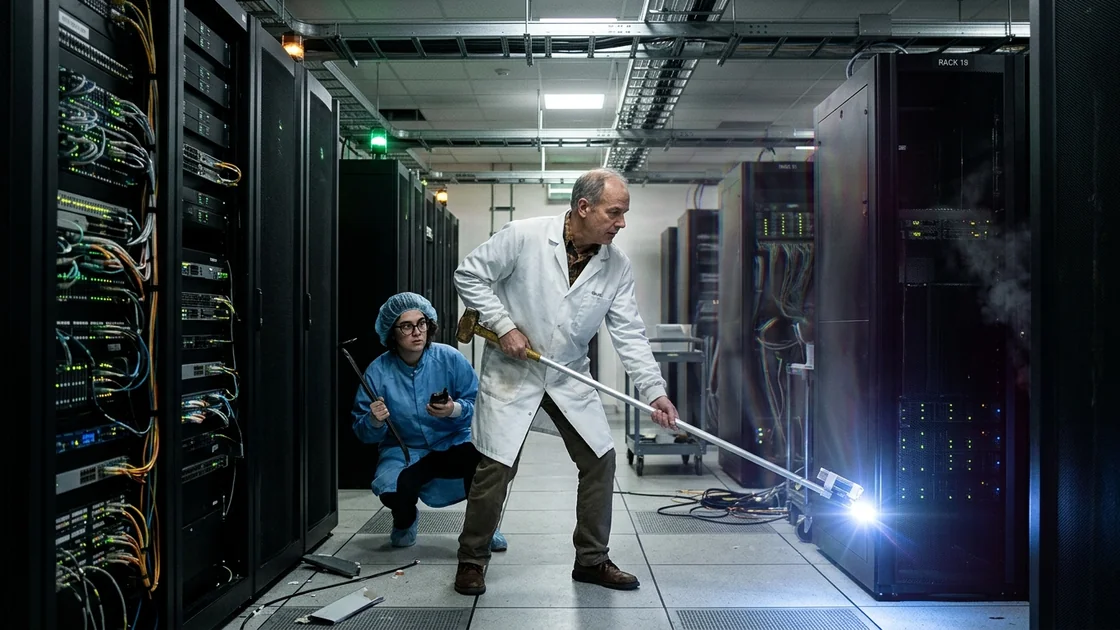
Arthur Pendelton is a senior metrologist working deep beneath the Colorado mountains, maintaining the primary atomic clock array that synchronizes global infrastructure. During a solitary night shift, he discovers a statistically impossible anomaly where identical server racks within the same climate-controlled vault are recording time at steadily diverging rates. As he investigates the localized temporal drift with the help of a night-shift network engineer, Arthur uncovers a dangerous feedback loop between the facility's optical lattices and its new quantum routing hardware. Together they must navigate a rapidly fracturing spatial-temporal gradient inside the bunker to sever the array before the discrepancy collapses the outside world's systems and traps them in stagnant time.
The sound of time passing at the Subterranean Chronometric Facility was not a tick, nor was it a chime. It was a low, continuous sixty-hertz hum produced by forty-two liquid-chilled server racks, layered beneath the rhythmic, pneumatic sigh of the helium cryocoolers.
Arthur Pendelton sat at his glass-topped console in the center of Vault B, nursing a ceramic mug of coffee that had gone tepid forty-seven minutes ago. He knew it was forty-seven minutes because he did not look at a wristwatch. He hadn't worn a wristwatch since 1998. Instead, his eyes were constantly drawn to the upper-left corner of his primary monitor, where the Master Ensemble Readout displayed Modified Julian Date and Coordinated Universal Time out to the fifteenth decimal place.
The last three digits—the femtoseconds—were a blur of green phosphor, cycling faster than the human optic nerve could register. Everything to the left of the decimal point was rock solid. Everything to the right, down to the picosecond, was Arthur’s responsibility.
Four hundred feet of Pre-Cambrian granite sat above his head, shielding the vault from cosmic rays, solar wind variations, and the electromagnetic chatter of the surface world. The room itself was a sixty-by-sixty-foot cube suspended on giant elastomeric seismic dampeners, isolated from the surrounding rock by a three-foot air gap and wrapped in four layers of mu-metal shielding to block out the Earth’s own magnetic field. The temperature was maintained at a rigid twenty-one point zero degrees Celsius, fluctuating by no more than a hundredth of a degree across any given twenty-four-hour cycle.
It was the quietest, most stable room on the planet. It had to be. The pulses generated in this room dictated the timing of global stock exchanges, the handoffs between cellular towers, the synchronization of continental power grids, and the phase alignment of the GPS satellite constellation orbiting twelve thousand miles overhead. If Vault B coughed, ships ran aground and power transformers exploded from coast to coast.
Arthur took a sip of the cold coffee, grimaced, and set the mug back down on its cork coaster, careful to align the handle at a forty-five-degree angle to the edge of the desk. He was fifty-eight years old, with thinning gray hair combed neatly across a freckled scalp, wearing a standard-issue static-dissipative lab coat over a flannel shirt. For twenty-two years, he had worked the graveyard rotation. He preferred the night shift because the daytime administrators weren't around to open the inner airlock doors, bringing in their body heat, their stray static charges, and their annoying habit of walking too heavily on the raised aluminum floor tiles. Even on seismic springs, a two-hundred-pound man walking down Aisle 3 created a micro-phonic vibration that Arthur had to scrub out of the hydrogen maser phase-noise plots.
At 02:14:00 UTC, the automated diagnostic chime sounded. It was a soft, synthesized C-sharp that meant the hourly Three-Cornered Hat comparison had finished compiling.
Arthur slid his chair over to the secondary terminal, his rubber casters whispering against the anti-static floor mat. The Three-Cornered Hat was a statistical method used in metrology to compare three or more clocks against one another simultaneously. Because no clock is perfect, there is no absolute "true" time against which to measure a single atomic oscillator. Instead, the system measured the difference between Clock A and Clock B, Clock B and Clock C, and Clock C and Clock A. By solving the resulting system of equations, the computer could isolate the individual drift and noise variance of each unit in the array.
He tapped the spacebar to bring up the Modified Allan Deviation graphs. He expected to see the usual flat, downward-sloping lines—a neat overlapping bundle of colored traces showing that the twelve primary Cesium-133 fountains, the eight Hydrogen Masers, and the four experimental Strontium-87 optical lattices were all marching in lockstep within a margin of zero point zero two picoseconds.
Twenty-three of the traces were tightly bundled at the bottom of the logarithmic scale, right where they belonged.
The twenty-fourth trace—rendered in bright magenta—was climbing toward the top right corner of the screen at a steep, terrifying forty-five-degree angle.
Arthur blinked, leaning closer to the monitor. His breath fogged the anti-glare coating slightly before the laminar airflow from the ceiling vents swept the moisture away.
"That’s a bit dramatic," he muttered to the empty room.
He clicked on the magenta line to pull up its hardware identifier. He expected it to be Maser 03, which had been showing signs of cavity pulling all week due to a degraded varactor diode in its thermal control loop.
The identifier box popped up:
CH_19_DMTD_B — RACK 19 / PRIMARY CESIUM FOUNTAIN 04.
Arthur frowned. Cesium Fountain 04 wasn't even housed in Rack 19. The physical physics package of Fountain 04—the ten-foot-tall vacuum column where lasers cooled balls of cesium atoms to a hair above absolute zero and tossed them upward through a microwave cavity—was located in the adjacent chamber, Vault A. Vault B housed the measurement electronics, the phase micro-steppers, the optical frequency combs, and the Dual-Mixer Time Difference (DMTD) server racks that actually counted the ticks and synthesized the timescale.
Fountain 04’s output signal was split at the vault bulkhead via a phase-stabilized, temperature-compensated optical fiber splitter. One leg went to Rack 04 (the primary measurement node), and the redundant leg went to Rack 19 (the secondary verification node). Both racks were measuring the exact same atomic clock. They were counting the exact same microwave transitions from the exact same cloud of cesium atoms.
Arthur pulled up the raw phase-difference log between Rack 04 and Rack 19.
At 01:00 UTC, the difference between the two racks had been 0.0004 nanoseconds—well within the thermal noise floor of the photo-detectors. At 01:15 UTC, the difference was 1.2 nanoseconds. At 01:30 UTC, it was 4.8 nanoseconds. At 02:00 UTC, it was 19.6 nanoseconds. Right now, at 02:16 UTC, the live counter showed Rack 19 was ahead of Rack 04 by 31.408 nanoseconds, and the last three digits were spinning upward like a taxi meter on the autobahn.
"Phase-lock loop slipped," Arthur said aloud, his voice sounding small and flat against the acoustic baffles lining the walls. "Has to be. A bad splice on the fiber run under the floor, or the local rubidium reference oscillator in nineteen lost its oven regulation."
It was an annoying fault, the kind that required pulling floor tiles and swearing at tiny gold-plated SMA connectors with a torque wrench, but it wasn't unprecedented. Electronics failed. Capacitors dried out. Photodiodes developed dark-current spikes.
Still, thirty-one nanoseconds was an eternity in this room. Light travels roughly one foot in a nanosecond. A thirty-one-nanosecond error meant that, as far as Rack 19 was concerned, the signal from Fountain 04 had traveled thirty-one feet less distance than the signal arriving at Rack 04. If the ensemble algorithm hadn't automatically flagged Rack 19 as an outlier and weighted its vote down to zero at the ten-nanosecond threshold, the facility's master output would have been dragged off course.
Arthur stood up, his knees popping softly, and walked over to the tool crib near the inner airlock. He clipped an electrostatic discharge strap to his left wrist, grabbed a portable optical power meter, a can of compressed dry nitrogen, and a calibrated eight-inch-pound SMA wrench.
He walked down the center main aisle toward the back of the vault.
The racks were arranged in four neat rows of ten, with two master routing racks at the front. They were towering monoliths of matte-black anodized aluminum, each seven feet tall, their front mesh doors glowing with vertical strips of green, blue, and amber status LEDs. The air in the "cold aisles"—where the perforated floor tiles blew chilled air upward into the server intakes—was crisp and smelled faintly of ozone and machine oil. The "hot aisles" at the rear of the racks, where the exhaust fans vented, were normally three degrees warmer.
Arthur turned left into the aisle between Row 1 and Row 2, stopping in front of Rack 04.
He opened the perforated front door. The diagnostic panel on the
Dual-Mixer chassis showed solid green across all sixteen channels. The
local Rubidium oscillator locked light was steady. The temperature
readout on the chassis faceplate read 21.02 °C. The
internal fiber interferometer—which bounced a laser beam back and forth
down the fiber-optic cable to cancel out any stretching or shrinking of
the glass caused by vibration—showed a phase correction factor of
0.002 ps. Dead flat.
"Okay, Four," Arthur murmured, patting the side of the black cabinet. "You're doing your job. Let’s go see what your brother is smoking."
He walked back out to the main aisle and headed toward Row 3, where Racks 15 through 25 were lined up. As he passed Rack 16, he noticed something peculiar.
He stopped. He tilted his head.
Arthur had worked in this room for over two decades. A sonar operator on a submarine learns to recognize the exact acoustic signature of every pump, shaft bearing, and turbine blade on his boat; when a bearing wears down by a micron, the operator hears the pitch change before the vibration sensors ever trip an alarm. Arthur had the same relationship with the three hundred and二十 cooling fans inside Vault B. They were brushless DC axial fans, all running off the same regulated forty-eight-volt bus, all spinning at precisely 3,200 revolutions per minute. Together, they produced a uniform, velvety F-natural drone.
Standing between Rack 17 and Rack 18, the drone was developing a beat frequency.
Wub-wub-wub-wub.
It was a slow, rhythmic modulation, the kind of sound two guitar strings make when they are tuned almost, but not quite, to the same note. The sound coming from the end of the aisle—where Racks 19 and 20 sat—was pitched slightly higher. Not by much. Maybe a few cents of a semitone. Just enough to set up an acoustic interference pattern in the narrow canyon between the server cabinets.
"Fan bearing going dry on nineteen?" he wondered. If a fan was spinning faster, its pulse-width modulation controller might be shorting out, running it at full voltage instead of the regulated duty cycle. If the fan was running hot or vibrating, that could explain why the DMTD blades inside Rack 19 were drifting. Mechanical vibration causes micro-fractures in the crystal oscillators, inducing phase jitter through acceleration sensitivity.
He walked down to Rack 19 and swung the front mesh door open.
The sound hit him immediately. It wasn't a dry bearing. There was no scraping, no metallic whine, no rattle of an unbalanced impeller. The six fans at the bottom of the rack were humming smoothly, cleanly—just at a higher pitch than the fans in Rack 15 a few yards behind him.
Arthur looked at the digital tachometer on the fan controller module at the top of the rack.
It read: 3200 RPM.
He frowned. He pulled a small tuning fork from his breast pocket—an old habit from his days working on mechanical acoustic resonators—and tapped it against his knuckle, holding it near his ear, then holding it near the rack intake. The rack’s acoustic fundamental was sitting at roughly 91.4 Hertz, instead of the 89.6 Hertz produced by the rest of the room.
Yet the hall-effect sensors inside the fan hubs, which counted every rotation of the magnetic rotor against the rack's internal clock, insisted the blades were spinning at exactly 3,200 RPM.
"If the fans are spinning faster, the tach should read 3,260," Arthur whispered. "Unless the clock timing the tachometer is running fast, too."
A cold prickle moved up the back of his neck, right beneath the collar of his lab coat.
Wait. Think through the math. If the rack’s internal quartz crystal—the cheap, basic clock on the motherboard that runs the fan controller—was running fast, it would count more ticks per fan rotation, which would make the controller think the fan was spinning slower, so the controller would speed the fan up to compensate. Okay. That made sense. A bad crystal on the environmental control board.
Except the environmental control board didn't share a clock with the Dual-Mixer Time Difference chassis. The DMTD chassis ran off a high-stability BVA quartz oscillator disciplined by the facility's primary Hydrogen Maser bus. And the environmental board was completely isolated on its own power rail.
For both the fan controller and the ultra-precise DMTD metrology blades to be running fast simultaneously, two completely independent timing circuits—one a five-dollar surface-mount chip from Taiwan, the other a quarter-million-dollar custom-grown quartz resonator in a dual-vacuum Dewar—would have to fail in the exact same direction, by the exact same proportional fraction, at the exact same time.
Arthur knelt down on the cold aluminum floor tiles and plugged his wrist strap into the grounding jack on Rack 19's frame. He pulled out the keyboard tray on the rack’s local crash-cart monitor and woke the screen.
He didn't just look at Fountain 04's channel. He pulled up all sixteen channels on Rack 19.
Rack 19 didn't just monitor Fountain 04. It also took reference feeds from Maser 01, Maser 02, Strontium Lattice 01, and the transatlantic fiber link from the Physikalisch-Technische Bundesanstalt in Braunschweig, Germany.
Every single channel on Rack 19 was drifting negatively at the exact same rate.
According to Rack 19, Fountain 04 was running slow. Maser 01 was running slow. The Strontium Lattice was running slow. The master clock in Germany was running slow.
Every clock in the world hadn't suddenly slowed down at 1:00 AM. Rack 19 was speeding up. Everything inside Rack 19 was experiencing more ticks per second than the universe outside its frame.
"No," Arthur said firmly, shaking his head. "No, that's a common-mode reference error. The reference input to the DMTD mixer is slipping phase."
If the common reference oscillator feeding the mixer ports on Rack 19 was losing frequency—dropping from 100 Megahertz down to 99.999999 Megahertz—then every external clock compared against it would appear to be changing speed at the exact same rate. That was basic metrology 101. Common-mode failure.
Except... if the reference oscillator in Rack 19 was running slow, it would make external clocks look fast. Here, Rack 19's local timestamps were ahead of the ensemble, meaning its local reference was running fast. How does a stress-compensated, doubly-rotated SC-cut quartz crystal suddenly increase its resonant frequency without jumping to an overtone mode? And even if the crystal was aging upward due to some freak outgassing event inside its vacuum can, that still didn't explain the cooling fans! The cooling fans weren't wired to the BVA quartz oscillator!
Arthur pulled a BNC coaxial patch cable from his pocket. He disconnected the auxiliary 10 MHz test output from Rack 18—right next to him, literally three inches away across a bolted steel frame divider—and plugged it directly into the front-panel frequency counter on Rack 19.
Rack 18 and Rack 19 were bolted together in the same row. Their power came from the same overhead busway. Their cooling air came up through the same two-foot-square perforated tile under Arthur’s knees.
The frequency counter on Rack 19 blinked, integrating the 10 MHz sine wave coming from Rack 18 over a ten-second gate time.
The display updated: 9,999,999.984102 Hz.
Arthur stared at the amber digits.
An error of sixteen millihertz on a ten-megahertz carrier.
In the world of consumer electronics, that was nothing. In Vault B, a fractional frequency offset of \(1.6 \times 10^{-9}\) was the equivalent of a nuclear detonation. The Hydrogen Masers driving that 10 MHz bus had a stability of \(1 \times 10^{-15}\). For Rack 19 to read Rack 18’s output as being off by parts in ten to the ninth meant one of two things: either the frequency counter's internal gate timer was radically broken, or the electromagnetic wave traveling through the eighteen-inch coaxial cable between the two racks was being redshifted as it crossed the three-inch gap between the cabinets.
Arthur reached over, opened the door of Rack 18, and did the exact reverse. He took the 10 MHz test output from Rack 19 and plugged it into the frequency counter on Rack 18.
Ten seconds passed. The gate light blinked.
Rack 18’s display updated: 10,000,000.015898 Hz.
Arthur sat back on his heels, the SMA torque wrench slipping from his fingers and clattering against the perforated aluminum floor.
The numbers were exact reciprocals. Rack 19 saw Rack 18 running slow by 15.898 millihertz. Rack 18 saw Rack 19 running fast by 15.898 millihertz.
This eliminated the possibility of a broken counter circuit. A faulty gate circuit or a noisy trigger threshold doesn't invert symmetrically when you swap the source and the load. It was a genuine, physical frequency shift occurring between the two racks.
In physics, there are only two ways to shift the frequency of an oscillator relative to an observer without touching the hardware. The first is the Doppler effect: Rack 18 and Rack 19 would have to be moving away from or toward each other at roughly half a meter per second. Since both racks were bolted to the concrete sub-floor with half-inch steel anchor bolts and weren't currently crashing through the walls of the bunker, the Doppler effect was out.
The second way is general relativity: gravitational time dilation. Clocks closer to a massive object—deep in a gravitational well—tick slower than clocks higher up. The Strontium optical clocks in Vault A were so sensitive they could measure the gravitational redshift caused by lifting the clock two centimeters higher off the floor.
Arthur did the mental math, his lips moving silently. Gravitational redshift near Earth's surface is \(g \Delta h / c^2\), which works out to roughly \(1.09 \times 10^{-16}\) per meter of elevation change. To get a frequency shift of \(1.6 \times 10^{-9}\), Rack 19 would have to be at a higher gravitational potential than Rack 18 equivalent to an altitude difference of... fourteen million meters.
Rack 19 would have to be orbiting in deep space, halfway to the moon, or there would have to be a microscopic black hole with the mass of a small asteroid sitting directly underneath Rack 18, pulling its local spacetime downward without exerting enough tidal force to rip the server room apart.
Neither of which was happening. Arthur’s coffee mug wasn't sliding sideways across his desk. His keys weren't being ripped out of his pocket toward the floor under Rack 18.
And as he watched the counter on Rack 18, the ten-second gate blinked again.
10,000,000.018412 Hz.
Ten seconds later:
10,000,000.021905 Hz.
The gap was widening. The rate of time inside Rack 19 was accelerating away from the rest of the room.
Arthur stood up so fast his ESD strap yanked taut against his wrist, nearly pulling the banana plug out of the rack frame. He ripped the velcro cuff off his arm and hurried back down the aisle toward his central console.
As he walked from Rack 19 back to the center of the room, he felt it in his inner ear. It was a subtle, nauseating sensation, like stepping off a moving walkway at an airport that had been running just a fraction of a mile per hour faster than your walking stride. A tiny vertigo spike behind his eyes.
Back at his desk, he pulled up the facility-wide environmental and geophysical telemetry.
Gravimeter 01 (Superconducting Nb sphere, North Corner):
9.80541204 m/s² — NOMINAL. Gravimeter 02 (South Corner):
9.80541203 m/s² — NOMINAL. Borehole Tiltmeter Array:
0.0001 arcseconds — NOMINAL. Three-Axis Fluxgate
Magnetometer: 0.04 Milligauss — NOMINAL.
There was no gravitational anomaly. There was no magnetic spike. The temperature across all sixty-four thermistors distributed throughout the room was flat at twenty-one degrees—except for two thermistors.
Thermistor 19-Top and Thermistor 19-Bottom, mounted inside Rack 19,
were reading 20.84 °C and falling.
Arthur stared at the thermal map. Why would a rack whose fans were spinning faster, and whose electronics were clocking at a higher frequency, be getting colder? Faster switching in CMOS transistors generates more heat, not less.
Unless you looked at it from the outside. Temperature is just the average kinetic energy of molecules bouncing around. No, wait—radiative heat transfer and thermal conductivity are rate-dependent processes: watts are joules per second. If the air blowing up through the floor tile into Rack 19 was coming from the normal-time plenum beneath the floor, and passing through a volume of space where time was running faster, how did the heat exchange balance across the boundary?
He was getting ahead of himself. He was a metrologist, an engineer who maintained lasers and microwave cavities, not a theoretical physicist, and certainly not someone who believed that a forty-two-unit standard EIA server cabinet could spontaneously detach itself from the local Minkowski metric.
He needed to check the rest of the room. The Three-Cornered Hat algorithm only ran once an hour on the primary ensemble channels. What if other racks were drifting, too, and just hadn't tripped the hard alarms yet because they were only handling secondary network distribution?
Arthur opened the command-line terminal for the White Rabbit Precision Time Protocol switch fabric. Every single rack in Vault B—all forty-two of them—had a fiber-optic management link back to the central switch at Rack 01. The switch continuously measured the round-trip loop delay and phase offset of every rack’s backplane clock at a rate of ten thousand times a second. Usually, the network engineer on duty kept that data buffered in a circular log that nobody ever looked at unless a fiber transceiver died.
Arthur typed in the query script to dump the live phase-slope derivatives across all forty-two nodes, mapping them onto the physical floor plan of Vault B.
The 2D grid rendered on his right-hand monitor. Each rack was represented as a rectangle, color-coded by its fractional frequency offset (\(y\)) relative to Rack 01 at the front of the room. Green was zero offset (\(< 10^{-14}\)). Yellow was parts in \(10^{12}\). Orange was parts in \(10^{10}\). Red was anything worse than \(10^{-9}\).
Arthur’s breath caught in his throat.
It wasn't just Rack 19.
The floor plan looked like a Doppler radar map of a supercell thunderstorm forming inside the bunker.
Row 1 (Racks 01 through 10) was mostly green, except for Racks 07 and 08, which were glowing a sickly, pale blue—indicating a negative frequency offset. They were running slower than Rack 01 by \(4.2 \times 10^{-11}\).
Row 2 (Racks 11 through 20) showed a sharp gradient. Rack 15 was yellow. Rack 17 was orange. Rack 18 was dark orange. Rack 19 was flashing bright crimson, now sitting at \(+3.8 \times 10^{-9}\). Rack 20 was orange again.
Row 3 (Racks 21 through 30) had a cluster of deep indigo blue centered around Rack 27, where the local clocks were dragging behind the master reference by nearly eighty nanoseconds and decelerating at \(-1.1 \times 10^{-9}\).
Row 4 (Racks 31 through 40)—the newest row, installed only three months ago during the Department of Energy’s "Next-Gen Sync" upgrade—was a checkerboard of alternating red and blue spikes. Rack 34 was red. Rack 35 was blue. Rack 36 was red. Rack 37 was blue.
Time inside Vault B wasn't just drifting. It was wrinkling. Like a bedsheet being pinched and twisted at half a dozen different points across the mattress, the rate of elapsed time was forming peaks and troughs centered directly on the server cabinets.
Arthur reached for the red desk phone—an old-fashioned analog landline wired directly through the blast doors to the Surface Annex control room four hundred feet above.
He picked up the handset. The dial tone sounded normal. He punched in extension 404.
It rang four times before someone picked up, the sound of a chair squeaking and a bag of chips rustling in the background.
"NetOps, this is Rostova," a woman’s voice said, sounding half-asleep and mildly annoyed. Elena Rostova was twenty-nine, a contractor brought in from MIT Lincoln Lab to oversee the Row 4 quantum-key-distribution routing tables. She usually spent her night shifts in the surface annex watching packet-loss monitors and playing chess against a neural net on her laptop.
"Elena, it's Arthur down in B," he said, keeping his voice as level and professional as he could manage. "Are you seeing any framing errors on the uplink trunks from the vault?"
"Hold on, let me pull up the dashboard," she said. Her mechanical keyboard clacked rapidly over the line. "Uh... actually, yeah. Wait a second. Trunk B-03—that’s the aggregate feed coming off Row 4—is throwing cyclic redundancy check warnings. Not drops, just... jitter buffer overflows on the ingress ports, and buffer underflows on the adjacent ports. I was literally just about to run a BERT test on the vertical riser cable. Did you bump the patch panel in Rack 41 while you were cleaning?"
"I haven't touched Rack 41," Arthur said. "Elena, what did you guys run on Row 4 tonight? Did you push a firmware update to the White Rabbit switches?"
"At two in the morning on a Tuesday? No, Arthur, we're on a change
freeze until Friday because of the Treasury Department settlement
window," she replied, her tone sharpening as she clearly clicked through
deeper diagnostic menus on her end. "Whoa. Okay, that's weird. The PTP
slave locks on Racks 34 through 39 just dropped out of
PHASE_ALIGNED state. They're all reporting wild path-delay
asymmetry. Why would the optical path delay change on a five-meter
jumper cable inside a climate-controlled room?"
"It’s not the path delay," Arthur said, looking back at the crimson and indigo squares pulsing on his monitor. "And it’s not confined to Row 4. My Three-Cornered Hat on the primary cesium channels just blew up. Rack 19 is currently forty-six nanoseconds ahead of Rack 04, and Rack 27 is ninety nanoseconds behind."
There was a pause on the line. Elena knew enough about atomic metrology to understand what that meant. If a technician told her a server clock was off by fifty milliseconds, that was a software bug in NTP. If Arthur Pendelton told her two DMTD racks in Vault B were off by ninety nanoseconds and diverging, that meant the sky was falling.
"Did the maser distribution amp fail?" she asked, the sleepiness completely gone from her voice.
"No. I just walked over to 18 and 19 with a six-inch coax jumper and cross-checked their ten-megahertz test ports," Arthur said. He swallowed against a dry throat. "Elena, Rack 19’s cooling fans are humming in F-sharp. The thermistor inside the cabinet says it's dropping toward twenty degrees Celsius. You need to come down here right now, and you need to bring the keys to the Row 4 cages."
"What do you mean the fans are humming in F-sharp?"
"Just get on the elevator, Elena. Please."
It took twelve minutes for Elena to descend in the freight elevator, pass through the biometric man-trap, don a clean-room smock and static booties in the gowning vestibule, and cycle through the heavy steel inner airlock of Vault B.
During those twelve minutes, Arthur didn't sit still. He went into the side equipment bay that connected Vault B to Vault A and rolled out the "Cart."
The Cart was a four-hundred-pound pneumatic-tired aluminum trolley that carried a transportable Strontium-87 Optical Lattice Clock—developed three years ago by NIST to map gravitational anomalies over volcanic magma chambers. It was a marvel of compact engineering: a laser-cooled atomic trap, an ultra-stable reference cavity made of zero-expansion glass, and a femtosecond optical frequency comb, all running off an onboard bank of lithium-iron-phosphate batteries. It didn't need to be plugged into the wall. It didn't need a fiber-optic link to the rest of the room. It was an entirely self-contained island of absolute time, accurate to one part in ten to the eighteenth.
Arthur wheeled the Cart out into the main aisle of Vault B and connected a long, fifty-meter spool of phase-stabilized coaxial cable from the Cart’s RF down-converter output back to the master Time-Interval Counter sitting on his central console desk.
When the inner airlock door hissed open and the heavy locking lugs retracted with a loud clank, Elena stepped into the vault. She was short, with dark, messy hair shoved hastily under a blue bouffant hairnet, her thick-rimmed glasses sliding down her nose as she took in the sight of Arthur pushing a half-million-dollar portable optical clock down Aisle 2 like a grocery cart.
"Arthur, what is going on?" she asked, hurrying over to the central desk. Her footsteps made the suspended floor hum slightly. "Upstairs, the master boundary clock just threw a major alarm. It’s saying the phase variance between Redundant Feed A and Redundant Feed B has exceeded one microsecond. If it hits ten microseconds, the automated failover switch is going to declare the entire mountain offline and cut the national grid over to the backup array in Maryland!"
"Don't look at the boundary clock," Arthur called out from halfway down Row 2. "Look at the Tektronix counter on my desk. The amber display on the top shelf. It's comparing the portable Strontium clock on this cart against the desk reference."
Elena leaned over his console, squinting at the twelve-digit
frequency counter. "Okay. It says 10,000,000.000000 Hz.
Last digit is flickering between zero and one. Looks totally
locked."
"That's because I'm standing next to Rack 12, which is still in the green zone," Arthur said. "Watch the counter while I push the cart twelve feet forward toward Rack 19."
Arthur braced his hands on the push-bar of the Cart and rolled it slowly down the perforated floor tiles.
Pass Rack 14. Pass Rack 15. Pass Rack 16.
As the front casters of the cart rolled across the seam between Floor Tile 16 and Floor Tile 17, Arthur felt it again—that bizarre, syrupy tug in his inner ear, except this time it was stronger. His left hand, which was slightly closer to the face of Rack 17, felt tingles of pins and needles, as if the blood pressure in his fingertips didn't quite match the blood pressure in his wrist.
"Arthur!" Elena’s voice echoed sharply across the tops of the server cabinets. "What did you just touch?!"
"Nothing!" Arthur called back, stopping the cart directly in front of Rack 19. "I didn't touch a single dial! What does the counter say?"
"It’s... it’s climbing! 10,000,000.042... wait, it just
updated—10,000,000.118 Hz!" Elena ran around the edge of
the desk and came to the mouth of Aisle 2, staring down the narrow
corridor at him. "Arthur, that's a portable optical clock on battery
power! How can pushing it down the hallway shift its output by a tenth
of a hertz?! Did a magnet quench in Vault A? Is there a massive magnetic
field down that aisle shifting the Zeeman splitting in the strontium
trap?"
"A Zeeman shift that big would tear the steel doors right off these racks and pin my belt buckle to the ceiling!" Arthur said. He held up his hand, showing her the steel SMA wrench he was holding. He let it go. It fell straight down and bounced off the rubber toe of his shoe with a dull thud. "No magnetic field. And look at the laser lock monitors on the cart—the narrow-line clock laser is still locked straight to the center of the atomic transition. The clock isn't malfunctioning, Elena."
He looked at the front of Rack 19. The green status LEDs on the DMTD cards usually blinked at a steady 1 Hz heartbeat—one second on, one second off, synchronized across every rack in the room so that looking down an aisle was like watching a single, unified pulse of green light.
Right now, Rack 19’s heartbeat LEDs were blinking noticeably faster than Rack 16’s LEDs just six feet away. You didn't need a femtosecond counter to see it anymore. You could see the phase slip with the naked human eye. Within ten blinks, Rack 19 had gained half a cycle on Rack 16.
"Look at the one-PPS heartbeat LEDs down the row," Arthur said quietly.
Elena took two steps into the aisle and froze. Her mouth dropped open slightly behind her clean-room mask.
Up and down Row 2, the 1-Pulse-Per-Second lights—which were driven directly by the hardware dividers of each rack’s local timebase—were completely out of sync, rippling in a chaotic wave centered on Rack 19.
"That's impossible," Elena whispered. "Even if the clock dividers went crazy, a 118-millihertz shift on a 10-megahertz carrier wouldn't make a visible difference on a one-hertz LED within ten seconds! That's a... that's a five percent shift! Why does the LED look five percent faster while your coax cable only shows parts in ten to the eighth?"
Arthur stared at the coaxial cable snaking along the floor from his cart back toward the desk at the front of the aisle.
Wait. She was right.
If Rack 19’s 1-Hz LED was gaining half a cycle in ten seconds, that meant time inside Rack 19 was running roughly five percent faster (\(5 \times 10^{-2}\)) than time at the end of the aisle! Five percent! Why had his frequency counter only shown a shift of \(10^{-8}\) earlier, and \(10^{-7}\) just now?
Arthur looked down at the placement of his cart. The cart was in the aisle, two feet away from the front door of Rack 19.
"The gradient," Arthur breathed, his heart hammering against his ribs. "It’s an inverse-cube or exponential decay from the backplane of the rack! Out here in the aisle, two feet away, the shift is parts in ten to the eight. Inside the rack chassis, right against the motherboard, it's already in the percents!"
To prove it, he unclipped the optical probe from the side of the cart—a small sensor wand used to read optical test ports—and reached inside the open door of Rack 19, holding the wand half an inch from the main backplane bus.
Down at the central desk, the Tektronix counter let out a sharp,
shrill BEEP as its phase-lock tracking loop lost lock
completely, the display flashing OVFL — OUT OF RANGE.
Arthur yanked his hand back out of the cabinet as if he had reached into an oven.
His fingers were freezing cold, and his fingernails felt strange—throbbing with a dull, pressurized ache. For the three seconds his hand had been inside the boundary of Rack 19's frame, the blood in his fingers had experienced roughly a hundred and fifty milliseconds more time than the blood in his forearm. The arterial flow going into his wrist hadn't matched the venous return rate coming out of his palm.
He stumbled backward, pulling the cart with him, retreating down the aisle until he was standing next to Elena at the main cross-corridor. He cradled his right hand against his chest, flexing his stiff, aching fingers.
"Arthur, what happened to your hand?!" Elena demanded, her eyes wide behind her glasses.
"Don't reach inside the racks," he said, his voice shaking for the first time in twenty-two years. "Whatever is happening, the boundary layer is right inside the Faraday cage mesh of the cabinets. Inside Rack 19, time is running five to ten percent faster than out here. Inside Rack 27 over in Row 3, it's running slower."
Elena looked from Arthur's pale face to the rows of black cabinets humming around them, then back to the overflowing frequency counter on the desk. Her mind—trained in quantum information theory and network topology—was visibly racing to process what her eyes were seeing against everything she had learned at MIT.
"Time doesn't just change speed inside a server rack, Arthur," she said, though her voice lacked conviction, trembling at the edges. "To curve spacetime by five percent over a distance of two feet, the tidal forces would shred steel into monoatomic dust! We would be spaghettified on the floor right now!"
"Only if the spatial components of the metric tensor are curved along with the temporal component," Arthur said. He had spent twenty years reading every paper published in Physical Review Letters on relativistic geodesy and clock-comparison tests of Lorentz invariance. When you live alone in a cabin in Nederland and spend eight hours a night watching cesium atoms fall through microwave cavities, you read a lot of theory. "Standard gravity bends space and time together because mass-energy couples through Einstein's field equations. There is no excess mass in Rack 19. The gravimeters are dead flat. It's a pure temporal phase gradient—a shift in \(g_{00}\) without a corresponding spatial curvature gradient!"
"That violates conservation of energy!" Elena protested.
"Does it? Tell me why Rack 19 is getting colder while Rack 27 is heating up!" Arthur pointed back toward the thermal monitor on his desk.
Elena turned to look at the thermal map. Sure enough, the blue
"slow-time" racks in Row 3 and Row 4 were glowing bright red on the
infrared thermal overlay, their internal temperatures climbing past
24.5 °C, while the fast-time racks were dropping below
19.0 °C.
"Energy is conserved across the whole system," Arthur said, the pieces clicking together in his head with a cold, terrifying clarity. "A fast rack and a slow rack are coupled together. Every photon or electron leaving a slow rack and entering a fast rack is redshifted; everything going the other way is blueshifted. The thermal energy is being pumped from the fast zones into the slow zones to balance the total Hamiltonian of the room! Elena, what did you guys install in Row 4 three months ago? Tell me everything. Not the press-release version. The actual hardware."
Elena swallowed hard, her hands gripping the edge of the glass desk so tightly her knuckles turned white.
"Row 4 is the QEDH array," she said rapidly. "Quantum Entanglement Distribution Hub. It’s a DARPA and DOE joint project. Standard fiber-optic time transfer—like White Rabbit—is limited by variations in the refractive index of the glass and security vulnerabilities like man-in-the-middle delay spoofing. So we built a continuous-variable quantum phase-locking system."
"I know about the entangled photon sources in Rack 31," Arthur said impatiently. "They generate polarization-entangled photon pairs at 1550 nanometers and send them out over the fiber trunks. That's just quantum cryptography. It can't bend time."
"We aren't using photons anymore," Elena said quietly.
Arthur stopped flexing his hand and stared at her. "What?"
"Photons decohered too fast in the under-floor patch panels," she said, talking faster now, the words tumbling out. "Six weeks ago, during the scheduled maintenance window when you were on vacation in Utah, the Sandia team came down and swapped the blades in Racks 34 through 40. And they put transponder bridges into Racks 07, 19, and 27 to tie the legacy ensemble into the new matrix. They aren't entangling photons, Arthur. They’re entangling macroscopic acoustic phonon modes in bulk silicon-carbide resonators inside the server backplanes, coupled directly to the optical frequency combs!"
Arthur felt the blood drain from his face. "You coupled macroscopic quantum-entangled mechanical resonators directly to the feedback loops of my optical frequency combs?"
"Wait, hear me out!" Elena held up her hands. "The math worked! If you entangle the phonon state of Crystal A in Rack 19 with Crystal B in Rack 27, and you perform a continuous weak quantum non-demolition measurement on their relative phase, you can force both oscillators into a decoherence-free subspace! According to the Sandia physicists, it creates a 'virtual zero-length baseline' between the racks. Any local phase noise in one rack is instantly compensated in the conjugate rack via quantum steering of the phase micro-steppers!"
"You can't steer phase instantaneously without a classical channel!" Arthur shouted, his voice bouncing off the acoustic tiles. "And you didn't account for the local gravitational potential difference between the racks, did you?!"
Elena blinked. "What gravitational potential difference? The floor of Vault B is laser-leveled to within fifty microns!"
"The floor isn't flat in spacetime, Elena!" Arthur grabbed a dry-erase marker from his desk tray and scribbled furiously right on the glass tabletop. "Rack 19 sits four meters closer to the granite wall of the north fault line than Rack 27! And the cooling water main runs directly underneath Row 3, shifting the local mass density by three tons! Not to mention the Sagnac effect from the Earth's rotation across a sixty-foot baseline! In normal metrology, we calculate those tiny relativistic potentials—parts in ten to the eighteen—and we put a static software offset in the phase steppers so the clocks don't fight gravity!"
He slammed the marker down.
"If you hard-coupled the quantum wavefunctions of macroscopic resonators across the room, and you set the optical combs to force their proper times (\(\tau\)) to be identical through continuous non-demolition projection—without putting in a relativistic metric offset—the system will try to zero out the gravitational redshift between the racks!"
Elena stared at the equations scribbled on the glass desk. Her lips parted as she followed the feedback loop.
"Oh, God," she whispered. "The optical combs have a loop bandwidth of five hundred kilohertz. Every two microseconds, the measurement apparatus projects the entangled state and applies a phase-kick to cancel the natural relativistic drift. Because the quantum state is non-local, the phase-kick creates a Berry phase accumulation in the silicon-carbide lattice..."
"...which the dual-mixer reads as a real frequency error, so it ramps the feedback gain higher on the next cycle," Arthur finished. "It’s a parametric runaway oscillator! Instead of the clocks adjusting their numbers to match spacetime, the macroscopic entangled network is pumping vacuum polarization energy between the racks to force local spacetime to match the faulty calibration table! Rack 19 is being pushed into a positive temporal potential spike, and Rack 27 is being driven into a sink!"
As if to punctuate his sentence, a loud CRACK echoed from the back of Row 3.
It sounded like a rifle shot, or a thick pane of tempered glass shattering under extreme thermal stress.
Both of them spun around. Down at the end of Aisle 3, a wisp of white vapor was curling out from the top of Rack 27—except the vapor wasn't rising like normal smoke.
It emerged from the top vent of the cabinet, billowed outward by two inches, and then seemed to freeze in mid-air, hanging like a sculpted piece of cotton candy just outside the sheet-metal frame, scrolling upward at a snail's pace once it crossed into the normal time of the aisle.
At the same time, the overhead fluorescent light fixture hanging directly between Rack 19 and Rack 27 began to flicker violently. The four-foot glass tube turned pale violet at the end closer to Rack 19—its mercury vapor emission lines blueshifting toward the ultraviolet—while the end closer to Rack 27 dimmed to a murky, dull orange.
And then the facility alarms went off.
Not the polite C-sharp chime on Arthur’s console. The main klaxon mounted above the inner airlock door—a harsh, mechanical horn accompanied by a rotating amber strobe—began to wail.
WARNING: CONTAINMENT INTEGRITY FAULT. SEISMIC / BAROMETRIC SHEAR DETECTED IN VAULT B. AIRLOCK SEALING IN THIRTY SECONDS.
"What is that?!" Elena yelled over the klaxon, covering her ears. "Why does the building think there's a barometric breach?!"
"Because air molecules crossing the boundary of Rack 19 are coming out faster than they went in, creating a localized pressure wave, while Rack 27 is acting like a vacuum pump because air entering it slows down!" Arthur ran toward the airlock door, grabbing the manual override handle.
He pulled down on the heavy red lever. Nothing happened. The small
LCD screen next to the airlock read:
FAILSAFE ENGAGED — DIFFERENTIAL PRESSURE SENSOR FAULT — MANUAL OVERRIDE LOCKED BY SURFACE MASTER.
Six seconds later, the pneumatic rams inside the eight-inch-thick steel airlock door fired with a deafening THUD. Four titanium dogs slid into the frame, sealing them inside the sixty-foot cube.
Elena ran up beside him, grabbing the handle and pulling uselessly. "Wait—why didn't the thirty-second countdown finish?! It said thirty seconds six seconds ago!"
Arthur looked up at the emergency controller box mounted above the doorframe. Its logic wiring ran through the cable tray directly over the top of Row 2—right through the upper plume of Rack 19’s fast-time field.
"Thirty seconds passed inside the conduit over Row 2," Arthur said grimly.
He turned back toward the room. The acoustic interference pattern he had heard twenty minutes ago was no longer a subtle wub-wub-wub. It was a cacophony. The room sounded like an orchestra pit tumbling down a flight of stairs. From the right side of the room came the high, mosquito-like whine of fans spinning at effective speeds of eight or nine thousand RPM; from the left side came a low, sub-audible bass rumble that vibrated the fillings in Arthur’s teeth, as the fans in Racks 26, 27, and 28 slowed to a crawl relative to the center aisle.
Worse, the regions were expanding.
Earlier, the boundary layer had been confined inside the Faraday mesh of the server doors. Now, looking down the main aisle, Arthur could see a faint, shimmering distortion in the air extending three feet out into the walkways around Racks 07, 19, 27, and nearly the entirety of Row 4. It looked like heat haze rising off summer asphalt, except it had a subtle chromatic fringe—objects viewed through the shimmer near Rack 19 looked slightly sharp and bluish, while the floor tiles near Rack 27 looked dim, reddish, and strangely elongated, as if viewed through the bottom of a thick glass bottle.
"We have to kill the power!" Elena said, running back toward the central console desk. "If we drop the main circuit breakers for Vault B, the optical combs and the phonon drivers lose power, the entanglement decoheres, and the metric relaxes back to flat!"
"The main breakers aren't in this room, Elena! They're in the Power Distribution Room outside the airlock to keep 60-hertz transformer hum out of the vault!" Arthur followed her back to the desk. "We can send an EPO—Emergency Power Off—signal from the console, or hit the big red mushroom button by the door!"
Elena detoured to the wall beside the airlock, flipped up the clear
plastic safety cover over the EMERGENCY POWER OFF button,
and slammed her palm against the red plunger.
The button clicked inward and latched.
Nothing happened. The lights stayed on. The server racks kept humming their fractured, dissonant chord.
"Why didn't it trip?!" she cried, hitting the button twice more. "That's a hardwired shunt-trip loop!"
"No, it was upgraded two years ago to a redundant PLC safety bus running over the facility fiber loop so it wouldn't introduce ground-loop currents through the mu-metal shield!" Arthur was already typing furiously at his console, trying to bring up the SCADA power management screen.
He hit Enter to execute the remote breaker open command.
On the screen, a red error dialogue popped up:
MODBUS TCP ERROR: PACKET TIMESTAMP INVALID. TIME-TO-LIVE (TTL) EXPIRED OR FUTURE-DATED. COMMAND REJECTED BY ANTI-SPOOFING FIREWALL.
Arthur stared at the screen. "The cybersecurity firewall upstairs is rejecting all packets coming out of Vault B because our timestamps don't match the surface clock anymore! And the analog telephone line—"
He picked up the red analog handset from his desk and put it to his ear.
Instead of a dial tone, he heard a bizarre, garbled screech, followed by what sounded like a human voice speaking at one-quarter speed—a deep, monstrous, drawn-out groan: "Aaaaarrrr-thuuuuurrrr... Rooooossss-toooo-vaaaaa..."
Wait. If the voice coming from upstairs sounded slowed down, that meant...
Arthur dropped the handset onto the glass desk as if it had bitten him.
"Arthur? Whose voice was that?" Elena asked, terrified.
"That was the surface annex trying to call us," Arthur said, looking around the central desk area with sudden horror. "Elena, the center of the room isn't at zero offset anymore. The fast zones around Rack 19 and Row 4 aren't balanced with the slow zones! The average metric of the whole vault is tipping negative—or right here at the desk, we're sitting in the outer edge of Rack 07 and Rack 27's slow-time trough! The surface is moving faster than us! That's why the airlock door closed in six seconds—it didn't speed up in the conduit; we slowed down here at the front of the room!"
He looked at the master UTC readout on his screen, then looked at the live transatlantic fiber feed coming in from Germany on the raw, unbuffered optical oscilloscope trace.
The pulses from Germany were arriving at four times their normal frequency.
Inside the center of Vault B, time was already running at one-quarter the speed of the outside world. For every minute Arthur and Elena stood at the central desk, four minutes were passing on the surface.
"If they're four times faster than us, why haven't they cut the power from the outside?!" Elena asked, panic rising in her chest.
"Because from their perspective, the fiber trunks from Vault B stopped sending valid packets twenty minutes ago, and our differential pressure sensor tripped a containment lockdown!" Arthur said. "Standard protocol for a Vault B containment lockdown—in case of a rubidium fire or a beryllium laser tube rupture—is to keep the negative-pressure HVAC and internal power systems running for four hours until the hazmat team from Denver arrives! They won't pull the main breakers because they think the scrubbers need power! And they can't see us on the security cameras because the video encoder in Rack 01 is running at a quarter of their frame rate—to them, our camera feed just froze!"
"Four hours?!" Elena grabbed her hair through her blue clean-room cap. "If this is an exponential runaway, in four hours of surface time, the slow zones will drop toward zero! An event horizon! And the fast zones will hit infinite frequency and vaporize!"
"Not if we break the feedback loop manually," Arthur said.
He pointed past the rows of servers toward the back corners of the room.
"The power comes into this room through two solid copper DC busbars at the base of Rack 01 and Rack 42, and the optical entanglement loop passes through the Master Optical Distribution Patch Panel inside Rack 31. If we pull the physical fiber trunks out of Rack 31, and smash the local optical frequency comb cavity in Rack 19 so it stops pumping the conjugate bridge, the quantum state collapses instantly. No software packets. Just raw physical disconnection."
Elena looked down the main aisle toward Row 4, where Rack 31 sat, and Row 2, where Rack 19 sat.
Between the central desk and the back half of the room, the air was now visibly warping like water swirling around boulders in a fast-moving river.
The fluorescent tubes overhead were popping one by one as the thermal and temporal shear across their four-foot lengths shattered the glass envelopes. Glass shards fell from the ceiling—and Arthur watched in hypnotic dread as a piece of broken fluorescent glass fell through the air near Rack 20. The top half of the shard fell at normal speed; as it entered the outer fringe of Rack 27’s slow zone three feet above the floor, it seemed to hit an invisible pillow of molasses, decelerating sharply without shattering, drifting lazily toward the aluminum tiles while dust motes three feet to its left streaked downward like tiny meteors in Rack 19’s fast zone.
"We can't walk through that!" Elena said, her voice trembling. "Arthur, you put your hand inside a five-percent gradient for three seconds and your fingers turned purple! Out there in the aisles, the gradients between the rows are colliding! If your head is in a zone moving at 0.5x and your feet are in a zone moving at 2.0x, your heart won't be able to pump blood to your brain! The nerve impulses from your spine to your legs will desynchronize! You’ll stroke out or fibrillate before you take three steps!"
"Wait," Arthur said. His eyes locked onto the right-hand monitor on his desk—the 2D floor-plan map showing the live phase-slope derivatives from the White Rabbit switch fabric.
Half the sensors were maxed out, showing solid blocks of red (fast) and deep blue (slow).
Between every red peak and every blue trough, however, there had to be a zero-crossing.
It was the Intermediate Value Theorem—basic calculus. If a continuous mathematical function is positive at Point A (\(+50\%\)) and negative at Point B (\(-50\%\)), there must be a line between Point A and Point B where the function equals exactly zero.
On the monitor, threading between the crimson bloom around Rack 19 and the indigo sinkhole around Rack 27, was a narrow, winding ribbon of bright green. A contour line of flat spacetime—an isochrone—where the positive phase-pumping of Row 2 and the negative phase-sinking of Row 3 canceled each other out perfectly.
"Look at the map," Arthur said, grabbing Elena by the shoulder and pointing at the screen. "Look at the green contour lines! The fields are interfering destructively along the boundaries between the conjugate pairs! There’s a null path—a ridge of normal time—winding diagonally from the front of Aisle 2, cutting through the gap where Rack 15 was decommissioned last year, and leading straight between Rack 19 and Rack 27 over to Row 4!"
Elena squinted at the screen. The green ribbon was barely eighteen inches wide in some places, flanked on the left by blinding red and on the right by deep, stagnant blue. Worse, the contour wasn't completely static; as the power levels in the racks fluctuated, the green path swayed slightly left and right by a few inches every few seconds, like a narrow suspension bridge swinging in a gale.
"And how are we supposed to see an invisible mathematical contour line once we step away from this monitor?!" she asked.
Arthur didn't answer with words. Instead, he turned to the portable Strontium clock cart sitting six feet away, and then looked at the equipment shelf at the back of his console.
He grabbed two items: a battery-powered acoustic function generator with an external speaker—which they used for testing microphonic vibration sensitivity in the masers—and a spool of cheap, plastic-jacketed optical fiber connected to a high-intensity red visual fault locator laser (a "red light pen" used by technicians to find breaks in fiber cables because the bright red laser light leaks out through sharp bends).
"Acoustic Doppler and visual timing," Arthur said rapidly, his hands moving with the practiced dexterity of a man who had built laboratory test rigs his entire adult life. "Look: I set the speaker on my desk here to emit a continuous, pure 440-Hertz tone—an A-note. As we move through the room, as long as our ears stay on the same temporal contour as this desk, that note stays at 440 Hertz. If you step two inches to the left into a fast zone, the sound waves coming from the desk will drop in pitch—they'll sound flat! If you step two inches to the right into a slow zone, the sound from the desk will jump up in pitch—it'll sound sharp!"
Elena’s eyes widened. "An acoustic guide-beam! Like an old World War II radio navigation beacon where the pilot listens for the steady tone between the Morse code A and N quadrants!"
"Exactly!" Arthur flipped the switch on the function generator. A pure, piercing 440-Hertz sine wave filled the center of the vault, cutting cleanly through the chaotic, polyphonic drone of the server fans. "And for our feet, so we don't step into a shear zone before our ears register it—"
He grabbed a two-meter aluminum broom handle from the clean-room maintenance closet, taped the portable battery-powered 10-Hz strobe tachometer from his tool crib to the end of the pole, and turned it on. The LED strobe at the tip of the six-foot pole began flashing rapidly—ten times a second.
"Hold this out in front of you like a blind man’s cane," Arthur said, handing her a second strobe light from the spare parts bin while keeping the pole for himself. "Wave it side to side. Where the time rate is normal, the strobe flashes look steady. Where it hits a fast gradient, the circuit at the tip of the pole speeds up—the light will blur into a solid beam! Where it hits a slow gradient, the flashes will slow down to a crawl! Keep your body where the light flashes at ten hertz and the tone in your ears stays at A-440!"
"What do we need to carry?" Elena asked, her scientist’s brain overriding her terror now that she had an actionable algorithm. She grabbed a heavy steel pry-bar from the tool crib and tucked it under her arm.
"You take Rack 31 at the head of Row 4—you know the QEDH optical patch panel layout better than I do," Arthur said, picking up a five-pound brass non-magnetic sledgehammer used for seating seismic isolation pins. "Rip out every fiber jumper in the entanglement manifold. Don't unclip them—just use the pry-bar and shear the glass right off the bulkhead! I'm going straight to the gap behind Rack 19 to smash the master Titanium-Sapphire frequency comb cavity. We have to do it within a few seconds of each other, or the asymmetric collapse might dump all the stored phase energy into whichever rack is left standing!"
"Got it," she said, breathing hard. She switched on her handheld strobe light.
"Stay right behind me until we reach the cross-aisle at the gap in Row 2," Arthur instructed. "Keep your elbows tucked in against your ribs. Don't let an arm swing out of the green zone. Ready?"
Elena nodded once, her jaw set.
Arthur extended the six-foot aluminum pole in front of him and took his first step off the anti-static mat of the central console.
The first ten feet down the center aisle were easy. The 440-Hertz reference tone behind them remained pure and steady, and the white LED strobe at the tip of Arthur’s pole blinked at a crisp, hypnotic ten flashes per second.
Then they reached the mouth of Aisle 2, where the slow trough from Rack 07 met the expanding fast ridge from Rack 19.
Arthur swept the pole two feet to his left, toward Rack 07.
Instantly, the blinking light at the tip of the pole sluggishly dragged to a halt—blink... pause... blink—while the aluminum pole itself seemed to bend downward slightly in his hands. It wasn't actually bending; the light rays reflecting off the front half of the pole were taking longer to traverse the slow-time bubble than the light reflecting off the handle near his hands, creating a grotesque optical refraction that made the metal shaft look broken, like a straw sitting in a glass of water.
At the same time, Arthur felt a sharp tug against the knuckles of his left hand holding the pole—a sudden, icy numbness as radiative heat from his warm skin flowed into the slow-time boundary and failed to reflect back at the normal rate.
He swept the pole to the right, toward Rack 12 and the outer plume of Rack 19.
The strobe at the tip instantly blurred into a solid, dazzlingly bright bluish-white point of light, and the air around the tip of the pole hissed loudly, as the 10-Hz electronic whine of the strobe’s capacitor circuit shifted upward into a high-pitched squeal.
Directly between the two—cutting diagonally at a thirty-degree angle toward the empty bay of Rack 15—the strobe flashed cleanly at ten hertz.
"Follow my heels," Arthur shouted over the roar of the room. "Step exactly where I step!"
He moved forward, sliding his feet carefully across the perforated aluminum tiles rather than lifting them high, keeping his torso twisted sideways to minimize his profile. The green zone here was barely twenty inches wide.
Two steps in, Arthur tilted his head slightly to the right to look at Rack 14.
Immediately, the 440-Hertz reference tone in his right ear dropped half an octave—turning into a low, mournful foghorn—while his left ear, still inside the null corridor, heard the normal A-note.
The sensory mismatch between his left and right vestibulocochlear nerves hit his brain stem like a physical blow. The room spun violently sideways. Nausea surged up his throat, sour and hot, and his knees buckled as his motor cortex received two conflicting timestamps from his inner ears.
A hand grabbed the back of his lab coat collar and yanked his head five inches back to the left.
"Head straight, Arthur!" Elena’s voice barked from six inches behind his shoulder. "Don't turn your head! Keep both ears on the centerline!"
The two tones in his ears snapped back into unison—a single, clean 440-Hertz note. The vertigo vanished instantly, though cold sweat was now pouring down his temples, stinging his eyes.
"Thanks," he gasped, gripping the brass sledgehammer tightly against his chest with one hand while guiding the strobe-pole with the other. "Watch the floor ahead—the path bends around Rack 14!"
They shuffled sideways through the empty frame of Bay 15—the only spot in Row 2 where a cabinet had been removed for upgrades, leaving a three-foot pass-through into the hot aisle between Row 2 and Row 3.
Stepping into the hot aisle between Rack 19 and Rack 27 was like stepping into the eye of a hurricane made of broken glass and invisible gears.
On their right stood the rear exhaust doors of Racks 18, 19, and 20. Inside those black mesh doors, time was now running so fast that the amber and green status LEDs on the network cards had shifted up the electromagnetic spectrum; the green LEDs looked deep violet, and the infrared optical transceivers—normally completely invisible to the human eye—were glowing a visible, angry cherry-red as their 850-nanometer laser light was blueshifted into the human visual range! The exhaust air blasting out of the back of Rack 19 hit the boundary layer four inches outside the cabinet door and decelerated violently, creating a standing shockwave of compressed, shimmering air that roared like a blowtorch and radiated an eerie, Cherenkov-like acoustic crackle.
On their left, just four feet away across the narrow aisle, stood the rear of Rack 27.
Rack 27 was completely dark.
Not because its power was off. Its LEDs had redshifted down into the far-infrared, completely below human vision. The interior of the cabinet looked like a block of solid, pitch-black obsidian, absorbing the ambient light of the room and returning nothing. A wrench that Arthur had left on the folding service tray on the back of Rack 26 earlier that week had vibrated off the tray; it was currently hanging three feet above the floor, suspended in mid-fall inside the deep indigo sinkhole, dropping at less than a millimeter per minute.
Between the screaming violet furnace of Rack 19 and the dead black monolith of Rack 27 ran the neutral ridge—now pinched down to scarcely fourteen inches wide.
Arthur could feel the temporal shear pressing against both sides of his body like two invisible walls of moving water. On his right sleeve, the static-dissipative polyester fabric was fluttering frantically at thirty cycles per second in the high-frequency turbulence shedding off Rack 19; on his left sleeve, the fabric felt heavy as lead, dragging through air that had the effective viscosity of cold tar.
"Here's where we split!" Arthur shouted, keeping his eyes locked straight ahead on his strobe light. "Row 4 is six feet straight ahead through the gap in Row 3! Does your strobe show a path to Rack 31?!"
Elena pointed her handheld strobe through the gap between Rack 28 and Rack 29. The white flashes traced a narrow, curving arc that hugged the floor tiles right up to the front of Rack 31.
"I see it! It drops low—I’ll have to crouch below waist height to stay in the green!" she yelled back. "How are you going to hit Rack 19 if you can't reach into the fast zone?!"
Arthur looked at the five-pound brass sledgehammer in his hand, and then at the six-foot aluminum broom handle.
"I don't have to reach my hand in," Arthur said grimly. "I just have to swing the hammer across the boundary! Give me ten seconds to get my footing, then tear that patch panel apart on three!"
Elena nodded, dropped into a low crouch to stay inside the dipping contour line, and scrambled through the gap into Aisle 4, her strobe light flashing steadily ahead of her.
Arthur turned ninety degrees in place—careful to pivot right on the balls of his feet so his spine never left the fourteen-inch null line—until he was facing the rear door of Rack 19 from sixteen inches away.
Through the perforated steel mesh of the rear door, at waist height, sat the gold-anodized housing of the Titanium-Sapphire Optical Frequency Comb. Inside that housing, a sapphire crystal pumped by a green diode laser was generating a train of femtosecond pulses bounced between two ultra-high-reflectivity mirrors. It was the heartbeat of the entanglement bridge.
To smash it, he had to drive the head of the sledgehammer through the outer mesh door and straight into the optical breadboard eight inches inside the cabinet.
Wait. Think about the physics of swinging a hammer into a region where time is running twenty or thirty times faster.
As the brass head of the hammer crosses the boundary layer four inches in front of the rack, the front face of the hammer enters the fast-time zone before the back of the hammer head, and before the wooden handle in Arthur's hands. From the perspective of the fast-time zone, the hammer is entering extremely slowly—inching forward at a twentieth of its normal velocity. Because momentum is mass times distance divided by time (\(p = m \cdot dx/dt\)), as \(dt\) explodes inside the fast zone, the effective kinetic velocity of the hammer relative to the rack drops to almost zero! Swinging a hammer from a slow zone into a fast zone would be like trying to smash a window underwater—the fast-moving air molecules and the mismatch in the rate of mechanical stress wave propagation through the steel mesh would deflect the hammer or shatter the handle right at the boundary line!
Conversely, anything moving from a fast zone into a slow zone carries an enormous multiplication of effective velocity—which was why the exhaust air coming out of Rack 19 was hitting the aisle like a supersonic jet!
"Think, Arthur, think!" he muttered, sweat dripping off the tip of his nose as the 440-Hertz tone behind him began to waver—wub-wub-wub—indicating that the null ridge he was standing on was shrinking, squeezed between the expanding fields of Rack 19 and Rack 27. He had less than twelve inches of safe space left. His shoulder blades were touching the cold, molasses-thick boundary of Rack 27 behind him, while his belt buckle was blistering hot from the blueshifted thermal radiation pouring off Rack 19 in front of him.
If he couldn't swing the hammer in with kinetic force... he didn't need kinetic force! He just needed to push the head of the hammer across the boundary slowly, let the entire brass head sit inside the fast zone where its internal atomic lattice was synchronized to Rack 19's fast time, and let gravity—or rather, the massive temporal potential gradient itself—accelerate it!
No, even simpler: the optical comb was mounted on a slide-out server rail! If he hooked the claw of the pry-tool—or the T-handle of the rack latch—and pulled the chassis out of the fast zone into the normal aisle, the chassis itself would experience a violent deceleration shear as it crossed the boundary line, ripping its own internal waveguides apart!
No, if he pulled matter from a fast zone into a slow zone, the thermal and kinetic energy inside it would blueshift outward—it could explode in his face!
What about the liquid nitrogen Dewar sitting on top of Rack 18 right next to it? No.
Look at the hammer. It had a fiberglass handle wrapped in rubber. If he pushed the brass head straight into the fast-time stream of the exhaust fans, the molecular bombardment of the high-speed air wasn't enough to stop five pounds of solid brass if he braced it with his body weight like a battering ram. In fact, once the front millimeter of the brass head touched the spinning, high-frequency mechanical frame of the optical cavity, the acoustic vibrations inside the fast zone would travel backward up the brass head and shatter the crystal by sheer impedance mismatch!
In wave physics, when a high-frequency wave hits a boundary where the wave speed drops by a factor of twenty, ninety-nine percent of the energy reflects straight back into the source!
He didn't need to smash the optical cavity with his own muscle speed. He just had to bridge the boundary with a solid conductor of mechanical stress—jam the steel pole and the brass hammer directly against the optical housing so that Rack 19’s own internal micro-vibrations hit a wall of "slow" mass and reflected back into the laser cavity with twenty times the destructive phase amplitude!
"Arthur!" Elena’s voice rang out from Row 4, pitched slightly high because she was crouching near a slow fringe. "I have the pry-bar wedged behind the main trunk bundle in Rack 31! The field is squeezing me against the floor—I can't hold this position! Count it down!"
"One!" Arthur yelled.
He wedged the heel of his boot against the base of Rack 27’s frame behind him—careful not to let his ankle cross into the black zone—and gripped the end of the fiberglass sledgehammer handle with both hands.
"Two!"
He aimed the flat brass face of the hammer directly at the glowing violet mesh covering the Titanium-Sapphire comb housing in Rack 19.
"Three!"
Arthur lunged forward four inches—staying just inside the razor-thin green line—and drove the brass head of the hammer straight through the shimmering boundary layer like a spear.
The moment the front inch of the brass hammer crossed into Rack 19’s fast zone, the resistance was incredible. It felt like shoving a shovel into wet, vibrating concrete. Because the atoms at the front of the hammer were now oscillating in a frame of reference running thirty times faster than the fiberglass handle in Arthur’s hands, the shear stress right at the boundary line emitted a blinding flash of triboluminescent blue light and a shriek like a circular saw cutting through titanium.
Arthur grit his teeth until he tasted blood, locked his elbows, and threw every ounce of his one-hundred-and-seventy-pound frame behind the handle, forcing the brass head three inches deeper until it slammed squarely against the gold housing of the optical frequency comb.
Inside Rack 19, from the perspective of the laser cavity, an unstoppable, infinitely rigid relativistic wall of brass had just materialized against its mirror mount. The high-frequency acoustic phonons inside the silicon-carbide resonator tried to propagate into the brass head, hit the temporal discontinuity where time slowed by thirty-fold, and reflected straight back into the crystal lattice as a massive shockwave.
CRACK-PING!
Inside the violet glow of Rack 19, the zero-expansion glass cavity of the optical comb shattered into a million glittering pieces.
At the exact same split second, one row over, came the sound of tearing metal and snapping glass—SCREEEE-SNAP!—as Elena wrenched her steel pry-bar backward, shearing all sixty-four single-mode quantum-entangled optical fibers clean off the backplane of Rack 31.
For a fraction of a second—perhaps a millisecond, perhaps an hour, though no clock in the room could have measured it—there was absolute, dead silence.
The 440-Hertz tone disappeared. The fan hum vanished.
And then the wrinkled metric of Vault B snapped flat.
When you stretch a rubber sheet into peaks and troughs and suddenly let go of all the pinch points at once, the sheet doesn't just gently settle back to horizontal. It snaps back through equilibrium, sending a standing wave reverberating to the walls.
The stored vacuum phase energy and the barometric pressure differentials that had been bottled up inside the fast and slow zones released simultaneously.
A booming, sub-bass shockwave—like a lightning strike hitting ten feet away—erupted outward from Rows 2, 3, and 4.
Arthur felt the fiberglass handle of the sledgehammer rip out of his hands—the front half of the brass head had actually sheared cleanly off at the temporal boundary line, pulverized into warm brass dust that sprayed across the floor tiles. The barometric blast wave caught him square in the chest and lifted him off his feet, throwing him backward through the empty bay of Rack 15.
As he flew backward through the air, he saw the wrench that had been hanging motionless behind Rack 26 suddenly drop like a stone and clang against the floor. He saw the pitch-black interior of Rack 27 flash bright orange as ten seconds of trapped, redshifted infrared radiation and delayed fan exhaust erupted outward in a single hot belch of ozone-scented air.
Arthur hit the main center aisle on his back, sliding ten feet across the smooth aluminum tiles until his shoulder blades bumped up against the base of his central console desk.
Across the room, every single circuit breaker on the internal PDU sub-panels tripped in a rapid-fire cascade—clack-clack-clack-clack-clack!—as the sudden equalization of phase across the power buses induced a massive back-EMF surge.
The remaining overhead fluorescent lights winked out.
The forty-two server racks spun down together, their three hundred and twenty cooling fans dropping in pitch in complete, glorious, unified harmony—a single, dying chord that faded from F-natural down into silence over ten seconds.
The green emergency battery floodlights mounted near the ceiling clicked on, bathing the dark vault in a soft, pale glow.
Arthur lay on the cold aluminum floor, staring up at the acoustic tiles on the ceiling, listening to the sound of his own ragged breathing.
His chest hurt where the pressure wave had hit him, and his right hand throbbed with a dull, persistent ache. Slowly, cautiously, he turned his head to the left, and then to the right.
No vertigo. No nausea. Both of his inner ears agreed on what time it was.
From behind the central desk, the battery-powered function generator was still humming steadily. Both of his ears heard the exact same, pure 440-Hertz A-note.
"Elena?" he called out, his voice raspy in the quiet room. "Elena, are you okay?!"
From the back of Row 4 came a muffled cough, followed by the metallic clatter of a steel pry-bar being dropped onto the floor tiles.
"I'm here!" she called back, her voice shaking but entirely normal in pitch and cadence. A moment later, she appeared at the end of Aisle 4, holding her glasses—which had one cracked lens—in one hand while brushing fiberglass dust and shattered quartz fibers off her blue clean-room smock with the other. "I think the air blast from Rack 34 blew my hairnet completely off, and I bruised both my knees on the floor tiles, but... all my parts seem to be in the same century."
She walked down the aisle toward him, her boots clicking evenly against the metal floor. No Doppler shift. No shimmer in the air.
Arthur let out a long, shuddering breath and pushed himself up into a sitting position, leaning his back against the base of his desk. He reached up, fumbled blindly on the glass desktop until his fingers found the toggle switch of the 440-Hertz function generator, and clicked it off.
Blessed, uniform silence settled over Vault B.
Then, from the front of the room, the heavy titanium locking lugs of the inner airlock door cycled open with a loud pneumatic hiss.
The red light above the door turned green, and the intercom speaker crackled to life—speaking at normal human speed.
"Vault B, this is Surface Security and NetOps! We just lost all telemetry from the primary array and your differential pressure sensor just cleared! Arthur? Elena? Are you guys in there? What just happened?!"
Elena looked down at Arthur. Arthur looked up at Elena.
Then they both looked over at the portable Strontium clock cart, which had rolled into the corner near Rack 02 and was still humming quietly on its internal lithium batteries, its laser lock lights glowing a steady, unbothered green.
On Arthur’s desk, powered by the uninterruptible battery backup beneath the console, a single monochrome liquid-crystal display was still lit. It was the legacy backup timing receiver, connected via a simple, uncompensated burial coaxial cable to the old naval VLF radio antenna on the mountain peak above—an analog system designed in 1974 that knew nothing of quantum entanglement, optical frequency combs, or macroscopic phonon bridges.
It displayed the time in plain amber block digits:
03:41:12 UTC.
According to the wall clock that had been running on the central console before the crash, they had only been in the vault together for thirty-four minutes. Outside the mountain, an hour and fifteen minutes had passed. They were forty-one minutes younger than the rest of the human race.
Arthur slowly got to his feet, wincing as his stiff knees straightened. He picked up his cold mug of coffee from the desk. The ceramic mug had a hairline crack running down its side from the acoustic shockwave, and the coffee inside was now iced-coffee cold, having sat near the edge of the slow-time trough for the better part of an hour.
He set the mug back down on its cork coaster, carefully aligning the handle at a forty-five-degree angle to the edge of the desk.
"Tell them," Arthur said, walking over to the wall intercom and pressing the talk button with his bruised right thumb, "that we had a catastrophic phase-lock runaway on the experimental Row 4 routing matrix, which induced a common-mode power surge across the Dual-Mixer racks."
He looked back at Elena, who was staring down Aisle 2 at the pile of warm brass dust lying on the floor in front of the shattered mesh door of Rack 19.
"And tell the Sandia team," Arthur added into the microphone, his voice calm, dry, and entirely matter-of-fact, "that we are rolling the master timescale back to the analog Hydrogen Masers and standard Cesium fountains until further notice. If anyone tries to bring another quantum-entangled resonator through that airlock while I’m on shift, I’m going to hit it with a hammer before they even take it out of the box."
He released the button, turned back to his console, and began the long, quiet process of bringing the clocks back into phase, one picosecond at a time.