Copper, Solder, and Breath
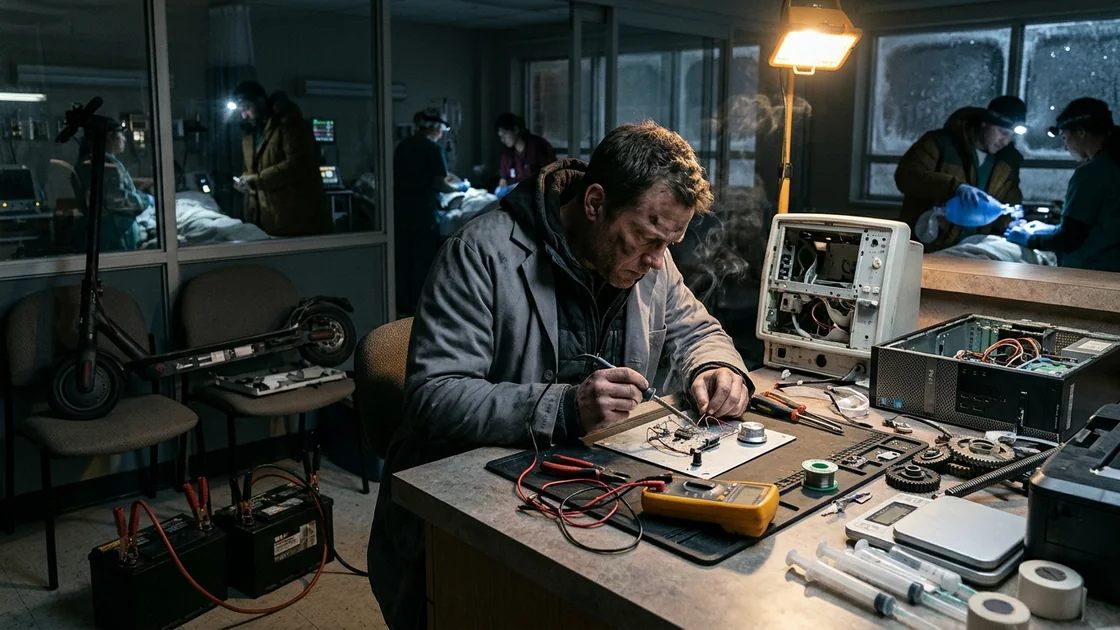
When a catastrophic ice storm severs the municipal power grid and a violent electrical surge destroys the backup generators at St. Jude Metropolitan Hospital, lead biomedical engineer Marcus Vance is left with a dark building and failing life-support systems. Cut off from emergency rescue by impassable roads and crippled by a depleted supply of proprietary replacement parts, Marcus must scavenge the hospital for consumer electronics to keep four critical patients alive through the night. Working from a makeshift workbench in the freezing intensive care unit, he harvests power supplies from desktop computers, stepper motors from office printers, transistors from an electric scooter, and sensors from laundry machines. Alongside intensivists and exhausted nurses manually ventilating patients in the dark, Marcus battles time, decaying battery chemistry, and the unforgiving laws of electricity to solder together a crude, pulsing life-support network before the last battery dies.
The fluorescent tubes in the sub-basement workshop did not flicker before they died; they gave a high, thin whine like a mosquito trapped against glass, flared a violent magenta, and went black.
Half a second later, the floor shuddered. It was not the rumble of thunder from the ice storm raging above the city, nor was it the familiar, rhythmic cough of the three Caterpillar diesel generators waking up in the vault across the corridor. It was a sharp, concussive crack that Marcus Vance felt in the fillings of his molars, followed immediately by the acrid, unmistakable stench of vaporized copper and burning phenolic resin.
Marcus did not move for three seconds. He sat on his vinyl stool in the pitch dark, his fingers still pinched around the barrel of a temperature-controlled Weller soldering iron that was already cooling in his grip. On the antistatic mat before him lay the disassembled mainboard of a Baxter infusion pump, its surface-mount capacitors invisible in the sudden void.
Then his emergency work light clicked on. The old halogen lamp on the shelf above his bench, wired to an ancient marine deep-cycle battery he kept on a trickle charger out of sheer professional paranoia, cast a harsh, amber cone across the concrete room.
"That wasn't the transfer switch," Marcus murmured to the empty room. "That was the bus."
He stood up, his knees popping in the cold, and reached for his Fluke multimeter before he even grabbed his flashlight. He clipped the meter to his belt, swept a handful of insulated screwdrivers and diagonal cutters into the pockets of his gray shop coat, and pushed through the heavy fire doors into the main utility corridor.
The smell out here was thick enough to chew. Gray smoke curled lazily from the louvers of the primary switchgear room fifty feet away. The red emergency exit signs, which should have been glowing off the central inverter bank, were dark. Only the self-contained battery packs bolted to the cinderblock walls—the cheap, frog-eyed units Facilities bought in bulk—offered any light, slicing the haze with overlapping beams of weak yellow.
The metal door to the generator vault burst open. Harlan Miller, the chief stationary engineer, stumbled out backwards, dragging a twenty-pound carbon dioxide fire extinguisher whose horn was crusted with white frost. Harlan’s face was smeared with soot, and his gray mustache was singed on the left side.
"Stay back, Marc!" Harlan coughed, dropping the extinguisher with a heavy metallic clang. He leaned against the tiled wall, chest heaving. "Don't open that door until the Halon clears the back half."
Marcus stopped beside him, shining his flashlight into Harlan’s eyes to check his pupils. They constricted evenly. "What happened? Did the grid drop?"
"Ice took down the high-tension lines over the river," Harlan wheezed, wiping his mouth with the back of a greasy forearm. "Substation seven blew. When it went, it didn't trip clean. Sent a massive phase-to-ground fault right down our primary feed before the breakers at the street could open. Our automatic transfer switch tried to throw over to the diesels at the exact millisecond the surge hit."
Marcus felt his stomach drop into his shoes. "It arced across the gap."
"Welded the main contactor bars together," Harlan said, his voice hollow. "Connected the number one generator directly to a grounded municipal grid out of phase. The alternator windings exploded. Took out the main distribution panel, fried the PLC controller for generators two and three, and blew the main breaker on the central UPS battery bank right off the wall. The copper bus bars in there look like abstract art."
Marcus looked up at the ceiling, as if he could see through four floors of poured concrete and rebar to the Intensive Care Unit and the Neonatal ward above. "How long until you can bypass the panel and manual-start gen three?"
Harlan looked at him. The older man had worked in this basement for thirty-two years; Marcus had never seen him look afraid until right now.
"You're not hearing me, Marc. The transfer switch housing is melted slag. The primary distribution bus is gone. Even if I hot-wired the number three Cat with a screwdriver and a prayer, there's no intact copper between the vault and the risers. We don't have emergency power. We don't have the red outlets. We have whatever is inside the walls of the machines upstairs, and nothing else."
Marcus didn't waste breath swearing. He turned and ran for the stairwell.
St. Jude Metropolitan was an older urban hospital, built like a wedding cake of brick and limestone in the late seventies and retrofitted piece by piece over four decades. Outside, a once-in-a-century freezing rain had been falling since noon, coating the metropolis in two inches of solid glaze. Two hours ago, the news in the breakroom had reported that the interstate was a parking lot of jackknifed semi-trucks and downed power poles. Even the National Guard Humvees were sliding into ditches. No ambulances were getting in, and more importantly, no patients were getting transferred out.
Marcus took the stairs two at a time, his boots echoing in the concrete shaft. By the fourth floor, his lungs were burning. He pushed through the heavy door marked 4 WEST - MEDICAL/SURGICAL ICU and stepped into controlled chaos.
The silence was the wrongest part. A modern ICU is a symphony of low-level white noise: the rhythmic whoosh-click of ventilators, the constant chime of infusion pumps, the hum of negative-pressure air handlers, the cooling fans of central telemetry monitors.
Now, the air handlers were dead. In their place was a deafening, discordant choir of high-pitched piezoelectric alarms. Every battery-backed monitor, pump, and ventilator on the floor was screaming that it had lost AC power. Flashing yellow and red LEDs reflected off the linoleum floor and the glass partitions of the twelve patient bays.
"Silence the non-criticals!" a voice cut through the din.
Dr. Elena Rostova stood at the central nurses' station, her white coat discarded, the sleeves of her navy scrubs pushed up past her elbows. She was forty-five, a pulmonary intensivist who had trained in St. Petersburg before moving to the States, and she possessed the emotional reactivity of a granite boulder. Seeing Marcus emerge from the stairwell, she pointed a penlight directly at his chest.
"Vance. Tell me the red outlets are coming back in thirty seconds."
Marcus walked briskly to the desk, setting his heavy canvas tool bag down. "They aren't coming back at all tonight, Dr. Rostova. A surge from the street took out the main distribution bus in the basement. The generators are isolated from the building risers."
The three nurses clustered around the central desk froze. One of them, a young guy named Tariq who had only been off orientation for a month, looked toward Bay 4. "We have eight intubated patients on this floor, Marcus. And three on continuous renal replacement."
"Disconnect the dialysis machines immediately and return the blood manually with the hand cranks," Elena ordered without looking away from Marcus. "What about our internal batteries?"
Marcus pulled a laminated clipboard from the rack behind the desk—his own monthly preventive maintenance log—though he already knew the numbers by heart. "The patient monitors will run for three hours, maybe four if you kill the screens and just use the audio pulse-ox. The Alaris infusion pumps have about four hours if you're only running one or two channels per brain."
"And the vents?" Elena asked.
Marcus swallowed hard. Six months ago, he had submitted a capital requisition to the hospital’s vice president of operations for twelve thousand dollars to replace the internal backup batteries across the fleet of sixteen Hamilton and Puritan Bennett ventilators. The batteries were sealed lead-acid bricks and older lithium-ion packs that had been cooked by years of constant float-charging. The VP had denied the request, citing an upcoming lease refresh scheduled for the next fiscal quarter.
"The four newer Hamiltons in Bays 1 through 4 have fresh lithium packs," Marcus said quietly. "If we dim the displays and turn off the heated humidifiers, you'll get five, maybe six hours out of them. Bays 5, 6, and 7 are on the older Puritan Bennetts. Those batteries are sulfated. They passed the thirty-minute load test last month by the skin of their teeth. They'll be dead in twenty-five minutes."
"What about Bay 8?" Tariq asked, his voice rising an octave. "Mr. Henderson is in Bay 8. His vent isn't even alarming. It's completely black."
Marcus was already moving toward Bay 8. Inside the glass-walled room, a sixty-year-old man with severe acute respiratory distress syndrome lay sedated. Beside the bed stood a Maquet Servo-i ventilator. Its screen was dead. No cooling fan spun. No alarm sounded. At the head of the bed, a respiratory therapist was already squeezing a blue silicone Ambu-bag attached to the endotracheal tube, counting softly under her breath: One-two-three, squeeze. One-two-three, squeeze.
Marcus dropped to his knees behind the ventilator, popped the service latch with a flathead screwdriver, and pulled the lower power module cover off. The smell of cooked electronics hit him immediately—the same pungent, fishy odor of boiled electrolytic fluid and cracked epoxy he had smelled in the basement.
He shone his flashlight onto the primary power supply board. The surge hadn't just tripped the breaker; because Bay 8 was the closest outlet to the main electrical riser shaft on the fourth floor, the transient spike had jumped right across the isolation transformer. The primary switching MOSFETs were blown clean in half, their black epoxy cases shattered like miniature firecrackers, leaving soot craters on the green fiberglass board. Even worse, the surge had blown backward through the DC charging circuit and fused the internal battery protection relay.
"The power board is cremated," Marcus said, standing up and wiping black carbon off his thumb. "The battery is probably intact, but the DC-to-DC converter board that feeds the turbine and the proportional valves is fused."
Elena stepped into the doorway of Bay 8. "Can you swap a board from an unused vent in the storage closet?"
"We don't have any vents in the storage closet," the respiratory therapist said between squeezes of the bag. "Flu season. Every single unit in the house is deployed. We actually rented three yesterday, and they're down in the ER."
"And I don't have a spare power board in the shop," Marcus said, the familiar anger at modern medical manufacturing tightening his jaw. "The manufacturer classifies the power module as a factory-service-only assembly. They won't sell us the schematics, and they won't sell us component-level parts. You have to ship the whole brick back to New Jersey and wait ten days."
Elena looked at the patient on the bed, then at the respiratory therapist's hands on the bag. "Mr. Henderson is on sixteen of PEEP and eighty percent oxygen. If we bag him by hand without precise pressure regulation for six hours, we're either going to collapse his alveoli or blow his lungs out. And when Bays 5, 6, and 7 lose their batteries in twenty minutes, we will have four patients requiring manual ventilation."
She turned her gray eyes back to Marcus. "There are four nurses, one therapist, and two doctors on this unit, Mr. Vance. If four of us are tied to bedsides squeezing rubber bags eighty thousand times until sunrise, nobody can mix pressors, nobody can draw gasses, and nobody can run a code. Your hands get cramp after forty minutes of bagging a stiff lung. After two hours, you lose rhythm. Fix the machines."
"With what?" Marcus asked. "I have a drawer full of resistors and a few linear regulators downstairs, Doc, not a factory warehouse."
"This building has ten stories full of offices, breakrooms, labs, and lounges," Elena said coldly. "Everything in it runs on electricity. Go take what you need. If administration complains when the sun comes up, tell them to send the invoice to me."
Before Marcus could answer, the emergency stairwell door banged open again. A pediatric resident stumbled onto the floor, her breath coming in ragged gasps, her glasses fogged.
"Dr. Rostova!" she called out. "Is Biomed up here? The phones are dead—the PBX server room lost its UPS!"
"He's right here, Sam," Elena said. "What's happening on Five?"
Sam, a first-year resident who looked barely old enough to rent a car, grabbed the edge of the nurses' desk. "NICU. Most of our isolettes and vents switched to battery fine, except Bed 3. The baby born at twenty-five weeks yesterday—the Mora infant. She's on a Medfusion syringe pump delivering high-dose norepinephrine. When the power blinked, the pump's AC adapter smoked and popped the main control board. We tried to swap her to a backup pump, and the backup threw a fatal motor rotor error the second we turned it on. We have no other micro-infusion pumps left on the floor."
Marcus winced. "You can't run a neonate's pressors on a standard adult volumetric pump?"
"No!" Sam said, her voice cracking with panic. "She weighs six hundred grams! Her total infusion rate is zero-point-four milliliters an hour! A standard peristaltic pump isn't accurate below five milliliters an hour—it pulses too much. If she gets a bolus, she'll stroke out and bleed into her brain. If the flow stops for more than ninety seconds, her blood pressure bottoms out and her heart stops. Dr. Chen is sitting by the isolette right now pushing the syringe plunger by hand a fraction of a millimeter every thirty seconds using a stopwatch, and his thumb is already shaking!"
Marcus looked from Sam's terrified face to Elena's grim, expectant stare. Behind them, in Bay 8, the rhythmic huff-huff of the manual resuscitator bag sounded painfully fragile against the encroaching cold of the unheated building.
Marcus reached into his pocket, pulled out a stubby dry-erase marker, and walked straight to the wide glass window of the central nurses' station. Ignoring the taped-up shift schedules, he ripped them down and began writing on the glass in thick black block letters.
PROBLEM 1: MAQUET SERVO-I (BAY 8) - Needs 24V DC @ 10A continuous, 12V DC @ 5A, 5V DC logic. Blower MOSFET bridge blown. PROBLEM 2: PB-840 VENTS (BAYS 5, 6, 7) - Need external 24V/48V high-amp DC bus before internal SLA batteries die (T-minus 20 mins). PROBLEM 3: NICU BED 3 - Precision linear actuator. 0.4 mL/hr continuous drive for 10mL syringe.
He capped the marker with his teeth, his mind shifting gears. The bureaucratic rules that governed his daily life—FDA Section 510(k) compliance, OEM service manuals, UL 60601-1 medical electrical safety standards, hospital liability waivers—all evaporated into the freezing air. Down at the bottom of every three-hundred-thousand-dollar medical device, beneath the molded antimicrobial plastic and the proprietary software locks, it was all just physics. A ventilator was an air pump and two valves. A syringe driver was a threaded rod turned by a motor. Electricity didn't care if the logo on the casing said General Electric or Black & Decker.
"Sam," Marcus said, spinning around. "Can you push a heavy cart?"
"Yes," she said immediately.
"Tariq," Marcus pointed at the ICU nurse. "Whose electric scooter is chained to the radiator in the staff locker room?"
Tariq blinked. "That's mine. It's a Dualtron. Two thousand watts. Why?"
"Give me the keys to the padlock, and tell me you're okay taking the bus next week."
Tariq didn't hesitate; he dug into his scrub pocket and tossed the keys through the air. "Take it apart."
"I need ten minutes to stop the bleeding on Bays 5, 6, and 7," Marcus told Elena. "Then I'm fixing Bay 8 and the baby. Clear off the long charting counter at the end of the station. That's my bench now."
The first twenty minutes were a race against lead-acid chemistry.
Marcus didn't need delicate micro-soldering to save the three Puritan Bennett ventilators in Bays 5, 6, and 7; he needed raw, dumb amperage. Those older machines ran on internal 24-volt and 48-volt sealed battery packs—essentially blocks of small motorcycle batteries wired in series inside a plastic tray. The electronics inside the vents were fine; their internal batteries were just exhausted from age.
"The parking garage," Marcus told Sam as they sprinted down the back service stairs, pushing an empty steel linen cart that rattled like a machine gun on every landing. "Level B1 is the physicians' lot. It's heated, or it was an hour ago. The batteries in those cars will still be warm."
They burst out into the subterranean garage. The air smelled of wet concrete and melting road salt. Marcus shone his beam down the row of luxury sedans and SUVs until he spotted two older domestic pickup trucks—a Ford F-250 belonging to one of the orthopedic surgeons and a Chevy Silverado parked beside it.
"Why the trucks?" Sam asked, holding the flashlight while Marcus jammed a flathead screwdriver through the plastic grille of the Ford to pop the hood latch manually.
"Because try getting the battery out of a newer German sedan without a metric triple-square socket set and twenty minutes to take the windshield cowling off," Marcus grunted. The hood sprung up. "And diesels have dual batteries. Two Group 65 lead-acids right on top."
With an adjustable wrench from his belt, he spun the brass terminal nuts loose, not bothering to be gentle with the plastic hold-down brackets—he simply pried them until the brittle nylon snapped in the cold. He lifted the first sixty-pound battery out, muscles straining in his back, and dropped it onto the steel shelf of the linen cart. The cart sagged and groaned. Within six minutes, they had four massive truck batteries and two sets of heavy-gauge copper jumper cables scavenged from the truck beds.
"Wait," Sam said as they muscled the heavy carttoward the stairwell. "How are we getting three hundred pounds of lead up four flights of stairs without an elevator?"
Marcus stopped at the base of the stairs, chest heaving. He looked at the four batteries, then at his watch. Thirteen minutes left before the low-voltage alarms in Bays 5, 6, and 7 transitioned to dead silence.
"We carry them one by one," Marcus said, grabbing the plastic strap of the first battery with both hands. "And you go get two people from the ER or security to meet us on the second floor landing. Move!"
By the time the fourth battery was slammed onto the floor of the 4 West ICU, Marcus couldn't feel his fingers, and sweat was soaking through the back of his thermal undershirt despite the fifty-five-degree air. In Bay 5, the Puritan Bennett ventilator had just shifted from its intermittent yellow advisory tone to the rapid, screaming red cadence of BATTERY DEPLETED - IMMINENT SHUTDOWN.
"Bay 5 first!" Elena barked from across the unit, where she was adjusting a manual drip roller clamp by flashlight.
Marcus didn't bother with connectors. He dropped to his stomach in front of the ventilator in Bay 5, yanked the lower battery drawer straight out until the plastic latch broke, and exposed the two heavy 12-volt internal gel cells wired in series. With his heavy diagonal cutters, he snipped the red positive and black negative leads right off the dying internal batteries, leaving three inches of thick 10-gauge wire sticking out of the ventilator's harness.
He stripped an inch of insulation off both wires with his teeth and cutters. Beside him, Sam shoved two of the truck batteries together on the linoleum floor.
"Hold the flashlight steady on the terminals," Marcus ordered. "Don't touch the metal cart."
He took a pair of heavy jumper cables, clamped one end from the negative post of the first truck battery to the positive post of the second, creating a crude 24-volt bank capable of delivering eight hundred cold-cranking amps. Then he took the bare copper wires coming out of the ventilator's belly, twisted them tightly around the jaws of the remaining jumper clamps, and wrapped the raw junctions in three layers of black 3M electrical tape.
"Connecting negative," Marcus muttered, clamping the black jaw to the negative post. He held the red clamp an inch above the positive terminal. "Stand clear of the screen."
He slapped the red clamp down onto the lead post.
A fat blue spark snapped in the dim room, smelling briefly of ozone. Instantly, the frantic red alarm on the ventilator died. The cooling fan inside the machine surged back up to full pitch with an audible sigh, and the status indicator flipped to solid green, reading EXTERNAL DC POWER.
Marcus let out a breath he felt like he'd been holding since the basement. "That'll run Bay 5 for three days straight."
"Six and Seven are screaming!" Tariq called out.
Marcus grabbed his cutters and dragged the remaining two truck batteries down the hall. Within eight minutes, using a daisy-chained harness he spliced together from a ripped-out floor buffer power cord found in the janitor's closet, Bays 6 and 7 were bridged in parallel onto the second pair of truck batteries.
The immediate threat of four simultaneous manual baggings was gone. Only Bay 8—Mr. Henderson—remained on hand ventilation, the respiratory therapist's forehead shining with sweat as she squeezed the bag in the dark.
Marcus walked back to the central nurses' station, his hands shaking slightly from the adrenaline dump and the heavy lifting. He looked at the clock on the wall—an old battery-operated quartz clock that ticked loudly in the quiet. It was 11:42 PM.
"Now the hard stuff," Marcus said.
"Dr. Chen says his thumb is cramping so badly he almost dropped the syringe," Sam said as she dumped an armload of scavenged electronics onto the long laminate counter at the nurses' station.
Marcus had sent her and an orderly named Devon on a targeted looting spree through the third-floor administrative offices and the second-floor outpatient clinics while he had wired up the truck batteries. The counter now looked like the back room of a pawn shop after an earthquake. There were two Dell OptiPlex desktop computers from billing, an HP LaserJet multifunction scanner-printer from medical records, a programmable Cuisinart drip coffee maker from the doctors' lounge, an old countertop toaster oven from the physical therapy occupational kitchen, a Bose wave radio from the chief of surgery's office, and Tariq’s massive black dual-motor electric scooter resting upside down on two chairs.
At the far end of the counter, Marcus had set up his portable butane soldering iron—a blue plastic Portasol unit that hissed softly like an angry cat, its catalytic tip glowing dull orange—alongside his multimeter, a roll of 60/40 tin-lead rosin-core solder he kept hidden from the safety inspectors who insisted on lead-free, and a pair of needle-nose pliers.
"We do the baby's syringe pump first," Marcus said, grabbing the HP LaserJet printer and slamming it onto the counter. "Because if Dr. Chen's hand slips and pushes half a milliliter of norepinephrine into a six-hundred-gram preemie, we don't have a patient anymore. And I can use the parts left over from this to fix Mr. Henderson's vent."
He didn't bother with the screws on the printer's beige plastic housing. He jammed the claw end of a small pry bar into the seam of the scanner bed and wrenched upward. The ABS plastic shrieked and cracked, sending fragments skittering across the floor. He ripped the glass flatbed off, tossing it into a biohazard bin, and peered into the belly of the scanner mechanism.
"What are you looking for?" Sam asked, leaning over the counter with a penlight clamped between her teeth so both her hands were free to assist.
"Precision," Marcus said, his fingers working a miniature Torx driver down into the chassis. "A volumetric pump just squeezes tubing in a circle. A syringe pump is a linear actuator. It has to push the plunger of a plastic syringe forward at a rate so slow you can't even see it moving with the naked eye. To do that without pulsing, you need a fine-pitch lead screw and a stepper motor."
He pulled two assemblies out of the ruined printer: the scanner bar drive mechanism, which used a rubber belt, and the paper feed alignment carriage from the lower laser assembly, which used a gleaming, machined steel threaded rod coupled directly to a Nema-17 bipolar stepper motor.
"Look at that," Marcus breathed, holding the steel rod up to Sam's light. "The scanner carriage uses a timing belt—too much backlash and elasticity. If the pressure in the baby's IV line builds up, the belt stretches, then snaps forward and gives a bolus. No good. But the laser alignment drive..." He ran his thumbnail down the threads of the steel rod. "That's a metric M6 lead screw with a one-millimeter pitch. One full three-hundred-and-sixty-degree rotation of this rod moves the carriage exactly one millimeter forward. Zero slip."
"Okay," Sam said, her medical brain catching up to the mechanical reality. "A standard ten-milliliter BD syringe has an internal barrel length of about sixty millimeters for the full ten mils. That's six millimeters per milliliter. If the baby needs zero-point-four milliliters per hour..."
"Then the plunger has to move two-point-four millimeters per hour," Marcus finished, grabbing his dry-erase marker and scrawling the numbers on the glass partition behind the desk. "Since the screw pitch is one millimeter per revolution, the motor has to turn exactly two-point-four revolutions per hour. This is a standard one-point-eight-degree stepper motor—two hundred full steps per revolution."
He multiplied the numbers on the glass in three frantic strokes.
2.4 rev/hr × 200 steps/rev = 480 steps per hour. 480 steps / 60 minutes = 8 steps per minute. 1 step every 7.5 seconds.
Marcus tapped the marker against his teeth. "If we full-step it once every seven and a half seconds, the drug delivery will still be slightly pulsatile—a tiny micro-drop every seven seconds. Norepinephrine has a half-life of two minutes, so that might be okay, but if we can half-step or micro-step it, or gear it down..."
He looked back into the gutted carcass of the printer. Right next to where the motor had sat was a reduction gearbox made of white Delrin plastic gears that drove the fuser roller. He popped the gear train out and counted the teeth with the tip of his scalpel.
"Four-to-one reduction," Marcus said, his eyes brightening. "If we leave the four-to-one reduction gear on the motor shaft driving the lead screw, the motor has to turn four times as much for the same distance. That's thirty-two steps per minute. Roughly one microscopic pulse every one-point-eight seconds. Smooth as silk."
"How do you make the motor step every one-point-eight seconds?" Sam asked. "Don't you need a computer to write code for that?"
"If I had an Arduino and a laptop with full battery, sure," Marcus said, shoving the printer carcass onto the floor and pulling the broken Medfusion syringe pump that Sam had brought down from the NICU onto the mat. "Wait—what did you say happened to the backup pump upstairs? The one that threw the rotor error?"
"It powers on," Sam said, "its battery is totally fine! It just screams MOTOR FAULT and refuses to turn the screw."
Marcus stopped. He stared at the broken Medfusion pump in front of him—the one whose mainboard had been fried by the AC surge. Its mechanical frame, the stainless steel slide clamp that held the syringe barrel, and the brass half-nut carriage that pushed the plunger were completely intact.
"The mechanical drive on this one is fine, and the electronics are dead," Marcus said slowly. "Upstairs, the electronics are fine, and the optical encoder on the motor shaft is probably just dirty or cracked."
"Can you just swap the motors between the two pumps?" Sam asked hopefully.
"No, because the manufacturer glues the motor into the potted housing and marries the serial number of the optical encoder to the mainboard ROM in factory calibration. If you swap them without the proprietary dealer software dongle to clear the checksum, both pumps brick themselves as a 'safety feature.'" Marcus spat the last two words like battery acid. "God bless intellectual property law."
He ripped the fried circuit board out of the Medfusion casing before him, leaving only the sleek aluminum chassis, the syringe clamp, and the internal lead screw mechanism. He peered at the Medfusion's native motor. It was a tiny, two-phase bipolar stepper motor, already mated to a precision swiss gearhead.
He didn't even need the printer's lead screw. The medical-grade lead screw and gearhead were sitting right here in the broken pump! All he needed was a brain to send four electrical pulses in sequence to the four wires coming out of the pump's existing motor, and a way to time those pulses to the exact millisecond.
"Hand me that toaster oven," Marcus said. "And the Bose radio."
He cracked the control panel of the cheap toaster oven open with his pliers. Cheap appliances produced after the late nineties often used anonymous epoxy "glob-top" microcontrollers, which were useless for salvaging. But this toaster oven had belonged to the occupational therapy clinic since at least 1994. Sitting right in the middle of the single-sided phenolic circuit board, flanked by two bulging electrolytic capacitors and a relay, was a tiny, eight-legged black cockroach of a chip.
Marcus wiped the grease off the top of the chip with his thumb and squinted under the penlight.
NE555P.
"The triple-five timer," Marcus whispered, a genuine grin breaking across his stubbled face. "Hans Camenzind, you magnificent bastard. Half the world runs on this chip."
With his butane soldering iron hot, he melted the solder joints on the underside of the toaster board and flicked the 555 timer free with the tip of a dental pick. Next, he needed something to translate the single rhythmic heartbeat of the 555 timer into the four-phase quadrature sequence required to make a stepper motor rotate.
He cracked open the Dell OptiPlex desktop computer, pulled out the CD-ROM drive, and pried its green logic board off the bottom. Mounted near the spindle connector was a standard L293D dual H-bridge motor driver chip, and right beside it on an older I/O expansion card in the computer's PCI slot were two 74HC-series CMOS logic chips—a flip-flop and an XOR gate.
"Sam, go to the Audiology clinic on the second floor," Marcus said without looking up as he began desoldering the chips from the CD-ROM board. "Break the lock on the calibration cabinet. Inside, there's a box of spare parts for the audiometers. I need a ten-turn precision wire-wound potentiometer—it looks like a heavy silver cylinder with a dial knob and three brass lugs on the back—and a handful of metal-film resistors. Not the brown carbon ones. The blue ones. They don't drift when the room temperature changes."
Sam vanished at a dead run.
While she was gone, Marcus took the blank copper-clad shield plate from the inside of the computer's power supply and used it as a ground plane. He didn't have a breadboard or a printed circuit board, so he built the circuit "dead-bug" style—gluing the black integrated circuits upside down onto the sheet metal with drops of cyanoacrylate superglue from the nurses' suture cart, their tiny silver legs sticking straight up into the air like dead beetles.
His hands moved with twenty years of muscle memory. The ICU around him faded to a dull roar of muffled voices and the hiss of oxygen cylinders. There was only the orange glow of the catalytic iron, the sweet, piney smoke of melting rosin flux, and the microscopic geometry of pinouts he had memorized in trade school a lifetime ago.
Pin 1 to ground. Pin 8 to positive voltage. Pin 4 tied high so it wouldn't reset. He bridged Pins 2 and 6 together to put the 555 into astable oscillator mode—a free-running electronic metronome. From Pin 3, the output, he ran a hair-thin strand of copper wire stripped from an Ethernet cable over to the clock input of the flip-flop chip, wiring its outputs in a gray-code feedback loop into the H-bridge driver from the CD-ROM drive.
Sam skidded back to the station, panting, and dumped a plastic organizer tray onto the counter. "Blue resistors and silver dials!"
"Perfect." Marcus plucked a hundred-kilohm ten-turn Bourns potentiometer from the tray. Because it took ten full rotations of the knob to sweep through its resistance range, he could tune the speed of the motor with razor-sharp precision. He soldered it in series with a high-grade polypropylene capacitor he pulled from the Bose radio's crossover network—polypropylene wouldn't change capacitance as the hospital got colder tonight, unlike cheap ceramic or electrolytic caps.
He wired the four output pins of the H-bridge directly to the four color-coded wires of the Medfusion syringe pump's internal stepper motor. For power, he grabbed two 9-volt batteries from the crash cart's spare laryngoscope drawer, wired them in series for 18 volts, and ran them through a 12-volt linear voltage regulator (an LM7812 pulled from the coffee maker) so that even as the batteries drained over the next ten hours, the voltage feeding the timer and motor would remain rock-steady at 12.0 volts until the very end.
"Okay," Marcus breathed, setting the iron down. The whole circuit sat exposed on the sheet metal plate, taped to the top of the gutted Medfusion pump housing like a metallic parasite. "Now we calibrate. Do we have a gram scale in the pharmacy pod?"
"Better," Elena’s voice said from behind him. She stepped up to the counter and set down a digital analytical milligram scale—which ran on four AA batteries—taken from the clinical pathology lab down the hall, along with a ten-milliliter syringe filled with sterile water and a micro-bore IV extension set.
Marcus clamped the water-filled syringe into the pump housing and engaged the brass drive nut onto the plunger flange. He touched the battery leads together.
Nothing smoked. Instead, from inside the pump housing came a tiny, almost imperceptible tick... tick... tick... at about two pulses per second.
Marcus primed the tubing until a tiny bead of water hung from the tip of the needle, wiped it dry, and placed the tip into a small plastic medicine cup tared to zero on the analytical scale.
"One milliliter of water weighs exactly one gram," Marcus said, his fingers resting lightly on the brass shaft of the ten-turn potentiometer, his eyes glued to his watch and the scale's LCD readout. "At zero-point-four milliliters per hour, we need to see zero-point-zero-six-six grams accumulate in this cup every ten minutes. Or six-point-six milligrams every sixty seconds."
For the next four minutes, the three of them stood in total silence around the glowing green digits of the lab scale.
At sixty seconds, the scale read 0.009 g. Too fast.
Marcus turned the potentiometer knob counterclockwise by three-quarters of a turn. The tick... tick... slowed fractionally. He wiped the cup, re-zeroed the scale, and timed another sixty seconds.
0.006 g.
Another sixty seconds: 0.013 g.
Another sixty seconds: 0.020 g.
Sixty-six milligrams over ten minutes. Zero-point-four milliliters per hour.
Marcus took a piece of surgical silk tape and taped the knob of the potentiometer down to the metal chassis so it couldn't be bumped.
"Take it to the fifth floor," Marcus told Sam, handing her the bizarre, clicking hybrid of medical aluminum and computer scrap. "Tell Dr. Chen to swap his syringe into this carriage, prime the slack out by turning the brass gear half a turn by hand until it catches, and then let go. Check the scale weight of those batteries every two hours—I put a voltage tap on the side. If it drops below fourteen volts on the meter, snap two fresh nine-volts in without disconnecting the first pair."
Sam cradled the machine like it was made of spun glass and bolted for the stairwell.
Marcus didn't watch her go. He rolled his neck until it cracked, looked over at Bay 8 where the respiratory therapist and Tariq were trading off on the manual resuscitator bag over Mr. Henderson, and reached for the Maquet ventilator power module.
"He's desaturating," Elena said quietly, stepping out of Bay 8 ten minutes later. Her stethoscope hung crookedly around her neck. "His SpO2 is down to eighty-four percent. Tariq is doing his best with the Ambu-bag, and we have a spring-loaded PEEP valve on the exhalation port, but Mr. Henderson’s lungs are stiff as leather from the pneumonia. Without the ventilator's constant turbine pressure and exact inspiratory-to-expiratory timing, his lower lobes are collapsing between breaths."
Marcus was already wrist-deep in the two Dell desktop computers on the counter. "Give me thirty minutes, Doc. Maybe forty."
"You have twenty before his pH drops low enough to trigger a cardiac arrest from respiratory acidosis," Elena said. It wasn't a threat; it was a clinical weather report. She walked back into Bay 8 to draw an arterial blood gas by flashlight.
Marcus stared at the charred power supply and motor-driver board he had pulled from the Maquet Servo-i ventilator. He had two distinct problems to solve, and both of them were lethal if he got the math wrong.
First, the ventilator needed a massive, clean supply of 24-volt DC power to run its internal brushless blower turbine and high-speed proportional solenoid valves, plus 12 volts and 5 volts for the microprocessor motherboard and sensors. A car battery bank like the ones he had used on the older Puritan Bennetts wouldn't work here; when fully charged, two truck batteries in series sat at 25.6 volts, and under heavy blower load they sagged to 21 volts. The older vents had internal regulators to smooth that out; in this Maquet, the internal regulator was the board that had exploded. If he fed raw, unregulated battery voltage straight into the Maquet's logic bus, he would fry the main CPU, and Mr. Henderson would die.
He needed a tightly regulated switching power supply. And sitting right in front of him, inside the two Dell office computers, were two 300-watt ATX computer power supplies.
"Okay, think," Marcus muttered to himself, yanking the two steel ATX power boxes out of the computer cases and cutting their wiring harnesses free with his heavy snips.
A single computer power supply produced rock-solid regulated +12V, +5V, and +3.3V rails. To get the 24 volts the ventilator's turbine and valves needed, he had to wire the +12V rails of the two separate computer power supplies in series: +12V plus +12V equals +24V.
Wait. Marcus froze with his wire strippers halfway through a yellow 12-volt bundle.
The chassis ground.
In a standard PC power supply, the black DC negative return wires are bolted directly to the metal casing of the power supply, which is in turn connected to the green safety ground prong of the AC power cord. If he wired Power Supply A's +12V output into Power Supply B's negative black wires to stack them to 24 volts, and both power supplies shared a common ground through their metal cases or their power cords, Power Supply A would short-circuit straight to ground through Power Supply B's chassis. It would trip the internal crowbar protection instantly—or explode.
"You have to float the second supply," Marcus whispered.
He unscrewed the lid of the second Dell power supply. Inside, the circuit board was mounted on four brass standoffs, and one corner screw had a toothed lock-washer that connected the DC negative trace on the board directly to the steel box. With a pair of pliers, he wrenched that corner standoff out, slipped a thick nylon insulating washer from a broken IV pole between the circuit board and the metal case, and clipped the green earth-ground wire coming from the power cord receptacle right inside the box.
Now Power Supply B's DC output was galvanically isolated from its own chassis. Just to be completely sure nobody in the ICU touched the two metal boxes simultaneously and felt a stray capacitive tingle, he grabbed a roll of thick rubberized silicone tape and mummified the entire second power supply until no bare steel showed, then duct-taped the two boxes together into a single twin-brick.
He twisted the green PS_ON wire (Pin 16 on the motherboard connector) to a black ground wire on both units so they would turn on without a computer motherboard attached. Then he grabbed two heavy five-watt ceramic power resistors he had scavenged from the Bose radio's power board and soldered them across the red +5V and black ground wires of each supply—older ATX supplies required a dummy load on the 5-volt rail to keep the 12-volt rail from sagging under heavy current surges.
"Power supply done," Marcus said, wiping sweat from his eyes. "Wait—what do I plug the AC cords into? The wall outlets are dead!"
He looked down at the floor. When he and Sam had raided the IT closet on the third floor earlier, he had grabbed two beige APC uninterruptible power supply units—the shoebox-sized battery backups that sat under receptionists' desks. Those units were useless for running a whole ventilator directly because their tiny internal 7-amp-hour batteries would die in ten minutes, and their modified-sine-wave inverters made medical power supplies overheat.
Unless you feed the APC inverter with a truck battery.
Marcus kicked the plastic cover off one of the APC desk units, ripped out its tiny motorcycle-sized battery, and extended its internal battery leads with 8-gauge wire out onto the floor, clamping them onto the massive 800-amp truck battery sitting outside Bay 7. The APC unit beeped once, its green ONLINE light glowing steadily as it inverted the truck battery's endless 12-volt DC reserve into 120-volt AC power. He plugged his twin-ATX computer supply brick into the back of the APC inverter.
The cooling fans on both Dell power supplies spun to life with a gentle hum. Marcus touched his Fluke multimeter probes to the bridged output wires: 24.12 Volts DC. 12.04 Volts DC. 5.01 Volts DC.
Solid as bedrock.
Now for the second half of the problem: the blown MOSFET bridge on the ventilator's turbine driver board.
Marcus pulled the Maquet's damaged circuit board closer under the halogen lamp. The ventilator worked by spinning a high-speed, low-inertia blower turbine to create continuous airway pressure, while two electromagnetic proportional valves modulated the flow in and out of the patient's lungs based on commands from the intact microprocessor board. The microprocessor was fine—it was sending out low-voltage Pulse Width Modulation (PWM) signals—but the four power transistors (MOSFETs) that acted as the heavy-duty switches to dump 24 volts into the blower motor had been blown off the board by the surge.
He couldn't use parts from the printer or the toaster oven for this; the ventilator's blower pulled spikes of fifteen amps every time the patient inhaled. Small transistors would vaporize in a second.
Marcus turned toward Tariq’s upside-down Dualtron electric scooter.
"Sorry, Tariq," Marcus muttered, grabbing a 4-millimeter hex key and ripping the aluminum deck plate off the bottom of the scooter.
Nestled inside the scooter's frame, potted in gray thermal silicone between two massive lithium battery packs, were two brushed-aluminum boxes: 60-volt, 40-amp brushless motor controllers.
Marcus pried the cover off the rear controller. Lined up along a thick copper heatsink bar were twelve TO-220 package N-channel power MOSFETs—Infineon IRFB4110s, each one capable of switching a hundred volts at over a hundred amps with an internal resistance of mere milliohms. They were absolute monsters, designed to haul a two-hundred-pound human up a steep hill at thirty miles an hour. Running a half-horsepower medical air blower would be a walk in the park for them.
He tried to melt the solder holding the MOSFETs to the scooter's controller board using his little blue butane iron, but the scooter's circuit board had thick two-ounce copper pours designed to dissipate heat. The little iron couldn't get the joint hot enough; the aluminum heatsink was sucking all the thermal energy away.
"Come on, come on," Marcus growled, turning the butane valve on the iron all the way up until the catalytic mesh flared bright white.
The iron sputtered, coughed, and died.
Marcus shook the blue plastic cylinder next to his ear. Empty. Not a drop of liquid butane left. And his AC-powered Weller soldering station was four floors down in a basement with no electricity.
In Bay 8, the alarm on the battery-powered portable pulse oximeter clipped to Mr. Henderson's finger began to beep in a slow, descending minor key. Beep... boop... boop...
"Marcus!" Elena’s voice rang out from the doorway of Bay 8. "His saturation is seventy-eight percent! Heart rate is dropping—he's going bradycardic from hypoxia! How much longer?"
Marcus stared at the cold soldering iron in his hand, then at the four heavy-duty transistors still trapped in the scooter's controller board, and the four empty, scorched pads waiting on the ventilator board. He couldn't twist-and-tape high-frequency PWM motor lines; the contact resistance would arc, generate inductive voltage spikes, and destroy the ventilator's main computer in three breaths. They had to be soldered.
How do you melt lead at seven hundred degrees Fahrenheit with no gas and no wall power?
Joule heating. Resistance.
Marcus's eyes snapped to the crash cart sitting by Bay 6. Clipped to the lower rail of the cart was an old-fashioned, heavy yellow emergency hand lantern—the kind that took a massive, square 6-volt spring-top battery.
He lunged across the unit, unclipped the yellow lantern, and smashed it against the concrete structural column beside the desk. The plastic housing shattered, and the heavy square battery tumbled out. Using his diagonal cutters like tin snips, he peeled the thin steel jacket off the battery, exposing four fat cylindrical zinc-carbon cells packed in pitch inside.
His fingers came away black with manganese dioxide paste, but he didn't care. He grabbed the center rod sticking out of the middle of the first cell with his pliers and pulled. Out slid a solid rod of compressed carbon graphite, three inches long and as thick as a carpenter's pencil.
He took a pair of heavy-gauge copper wires, clamped one end directly to the positive terminal of the 12-volt truck battery on the floor, and clamped the other end tightly around the top of the carbon graphite rod using a pair of locking surgical hemostats wrapped in rubber glove material for a handle. Then he took a second wire from the negative post of the truck battery and clipped it directly to the copper ground tab of the MOSFET heatsink on the scooter board.
"Don't look directly at the tip," Marcus warned nobody in particular, squinting his eyes as he touched the tip of the carbon pencil to the back of the first transistor.
Two hundred amps of current surged from the truck battery through the high-resistance carbon rod. Instantly, the tip of the graphite pencil flared to a blinding, incandescent cherry-red—over a thousand degrees. Within two seconds, the heavy lead-free solder on the scooter board turned into a shimmering puddle of liquid silver.
One. Two. Three. Four.
He flicked the four heavy MOSFETs free onto the antistatic mat like hot chestnuts. Then, instead of risking the violent heat of the carbon arc directly on the delicate fiberglass traces of the Maquet ventilator board, he clamped the glowing red carbon rod right against the shaft of his dead butane soldering iron for ten seconds, transferring the heat into the copper tip of the tool, disconnected the battery clip, and used the residual heat of the iron to delicately solder six-inch color-coded jumper wires from the ventilator board's gate, drain, and source pads out to the legs of the scooter transistors.
He bolted the four scooter MOSFETs onto an aluminum kidney basin from a dressing kit to act as a makeshift heatsink, smeared white ultrasound gel between the transistors and the metal basin when he realized he had no thermal paste—it would dry out in ten hours, so he layered a thin smear of Vaseline petrolatum ointment over the edges to trap the moisture—and carried the whole sprawling apparatus into Bay 8.
Mr. Henderson's lips were dusky gray-blue under the tape holding his breathing tube. The pulse oximeter read 74%... 73%... His heart rate on the portable monitor was down to 42 beats per minute.
"Step back from the head of the bed," Marcus said, dropping to his knees behind the dead Maquet ventilator.
He plugged the multi-pin ribbon cable from the ventilator's intact logic board back into his modified driver board. He connected the heavy red, yellow, and black bundles from his twin-Dell ATX power supply brick into the main DC distribution bus inside the ventilator's lower cabinet, leaving the service door wide open with the aluminum kidney basin full of scooter transistors resting on a dry towel on the floor.
"Powering on," Marcus said, flipping the switch on the APC inverter hooked to the truck battery in the hall.
The Dell power supplies whirred. Inside the ventilator, a relay clicked loudly.
For two agonizing seconds, the screen on the Maquet remained black. Then the backlight flashed on. The boot screen appeared, running its self-test bars across the bottom.
SYSTEM CHECK... OK. BATTERY MODULE COMMUNICATION ERROR - OPERATING ON EXTERNAL DC.
The blower turbine inside the machine spun up with a clean, powerful whistle. On the floor, the four Infineon scooter transistors sitting in the Vaseline-smeared kidney basin barely got warm.
"Connect him!" Elena barked.
Tariq popped the manual Ambu-bag off the endotracheal tube and snapped the ventilator's dual-limb breathing circuit onto the hub.
Whoosh... click. Whoosh... click.
On the ventilator's glowing screen, the yellow pressure waveform rose to a crisp plateau of twenty-eight centimeters of water, held for one point two seconds, and dropped smoothly back to an end-expiratory baseline of sixteen—sixteen of PEEP, held steady by the proportional valves.
Everyone in the room stared at the portable pulse oximeter.
For fifteen seconds, the numbers didn't move. Then the heart rate climbed: 48... 56... 68... 79.
The oxygen saturation ticked upward, the tone of the beep rising in pitch with every beat: 78%... 83%... 89%... 93%... 95%.
The gray tinge around Mr. Henderson's nose faded back to pink.
Tariq slumped back against the glass wall, sliding down until he was sitting on the floor, his cramped hands resting open on his knees. Elena let out a long, slow breath that fogged in the chilly room, then looked down at the tangle of computer boxes, truck batteries, jumper cables, and surgical kidney basins humming quietly behind the bed.
"Does that pass Joint Commission inspection, Mr. Vance?" she asked softly.
"If a Joint Commission inspector walks in here tonight," Marcus said, leaning his forehead against the cool metal frame of the bed, "I'm putting him on the manual bag."
By 2:30 AM, the enemy was no longer electrical failure; it was thermodynamics and condensation.
With the hospital's central steam boilers shut down—their electronic ignition controllers, circulation pumps, and induced-draft blowers all dead—the residual heat in the massive brick building had bled out through a thousand double-paned windows into the howling ice storm. The ambient temperature in the 4 West ICU had dropped to forty-six degrees Fahrenheit.
Patients were buried under mountains of wool blankets heated earlier in the evening and wrapped in reflective mylar space blankets raided from the ambulances stuck in the ER bay. Nurses worked in down parkas and knit hats, their breath puffing white as they charted by headlamp.
Marcus was sitting at his workbench at the nurses' station, his burnt fingertips wrapped in gauze, methodically rotating a single spare truck battery through a manual charging cycle he had rigged in the outdoor ambulance bay using the alternator of a running diesel ambulance whose rear wheels were frozen to the pavement. Every hour, he and the orderly, Devon, hauled a freshly topped-off battery upstairs on a hand truck to keep the ICU's makeshift DC microgrid above twelve volts.
Then the ventilator in Bay 5—one of the older Puritan Bennetts running off his first truck battery bank—began to cough.
It wasn't an electrical alarm at first. It was a physical shudder in the expiratory limb of the breathing tubing. Instead of the smooth whoosh-click, the machine was going whoosh-chatter-chatter-click, and the high-pressure alarm began to shriek, cutting off the breath early.
Marcus was inside Bay 5 in five seconds. The patient was a forty-year-old woman recovering from a ruptured abdominal aortic aneurysm. On the ventilator's display, the expiratory pressure reading was bouncing wildly between zero and forty centimeters of water, even when the patient wasn't breathing out.
"Water in the transducer line," Elena said, appearing at his shoulder, her breath pluming in the flashlight beam. "Because the heated wire humidifiers are turned off to save battery, and the room is forty-five degrees, the patient's warm exhaled breath is condensing into liquid water inside the expiratory block."
"Normally the internal heater in the exhalation housing boils that condensation off," Marcus said, pulling the expiratory cassette out and dumping a tablespoon of cold water onto the floor. "Wait—it's worse than water."
He shone his light inside the port where the internal differential pressure transducer sat. When the water had pooled inside the unheated housing, a nurse earlier had tried to clear the blockage by flushing air through the sensor port with a fifty-milliliter syringe. The sudden blast of manual pressure had ruptured the microscopic silicon diaphragm inside the onboard piezoresistive pressure sensor.
Marcus plugged the cassette back in. Instantly, the ventilator read that the patient's airway pressure was 99 cmH2O, panicked, opened the emergency safety dump valve to prevent blowing the patient's lungs up, and refused to deliver a breath.
"The internal pressure sensor is ruptured," Marcus said grimly. "The computer thinks her lungs are over-pressurized, so it dumps the air to atmosphere. We can't bypass it in software—the safety routine is hard-coded into the supervisory chip."
"Bag her," Elena told Tariq, who was already reaching for the wall-mounted Ambu-bag with a look of sheer despair on his exhausted face. She looked at Marcus. "Can you fool the computer into thinking the pressure is normal?"
"If I just solder a fixed voltage divider onto the sensor pins so the computer always sees ten centimeters of pressure," Marcus said, thinking fast, "the machine won't dump the breath—Wait. No. If I blind the pressure sensor with a dummy signal, how does the ventilator know when to stop pushing air in? This patient is on pressure-controlled ventilation! Without real-time pressure feedback, the blower will just keep cramming air into her chest until her lungs actually rupture!"
He needed a real, working air pressure sensor that could measure between zero and fifty centimeters of water column—roughly zero to zero-point-seven pounds per square inch. It was a tiny, feather-light range of pressure. An automotive tire pressure sensor or an oil pressure sender from the garage wouldn't even register until ten PSI.
Where in a hospital do you find a low-range electronic air pressure transducer that measures inches of water column?
Marcus stood completely still in the freezing hallway, his eyes closed, mentally walking through every floor of St. Jude Metropolitan.
Inches of water column.
Not inches of mercury. Inches of water.
His eyes flew open. "The basement. The commercial laundry room."
"A washing machine?" Elena asked, her eyebrows rising even through her exhaustion.
"How do you think a five-hundred-pound industrial Unimac washing machine knows how deep the water in the drum is?" Marcus said, already backing toward the stairwell door. "It traps a column of air in a plastic tube attached to the bottom of the tub. As the water rises twenty inches up the drum, the weight of the water compresses the air in the tube and pushes against a solid-state piezoresistive pressure transducer on the control board! Twenty inches of water is fifty centimeters of water—the exact range of a human lung!"
He took the stairs three at a time going down. The sub-basement laundry room was a cavern of stainless steel monsters smelling of damp lint and bleach. He climbed behind the newest fifty-pound extractor-washer, popped the top service panel off with his screwdriver, and followed a clear quarter-inch vinyl tube rising from the outer drum up to the main green circuit board.
Right where the tube pushed onto a barbed plastic nipple sat a white ceramic disc with six pins: a Freescale MPX-series integrated silicon pressure sensor, designed specifically to measure zero to ten kilopascals—zero to a hundred centimeters of water!
He snipped the vinyl tube, broke the sensor's mounting tabs off the washing machine board, and paused. He looked at the part number stamped on the sensor with his flashlight.
It was an unamplified Wheatstone bridge sensor. When air pressure pushed on it, it didn't put out a clean zero-to-five-volt signal like the ventilator's broken sensor had; it only put out a tiny, raw differential change of twenty millivolts. To make the ventilator's computer read it, he had to amplify that twenty-millivolt whisper by a factor of two hundred.
He needed an instrumentation operational amplifier—an op-amp chip.
On his way back up the stairs, he ducked into an empty patient room on the third floor, ripped the small Swing-Arm patient television off the wall bracket, smashed the plastic back cover off with the heel of his boot, and scanned the audio circuit board near the headphone jack. Right there sat a dual low-noise operational amplifier chip—a Texas Instruments TL072—used to boost the pre-amp audio signal before sending it to the little speaker under the patient's pillow.
Back at the fourth-floor nurses' station, his hands moving with frantic, practiced economy, Marcus heated the shaft of his dead soldering iron with the glowing carbon battery rod once more. He soldered the washing machine sensor and the television audio amplifier chip together on the back of an old metal clipboard, using another ten-turn potentiometer from the audiology tray to adjust the gain (the volume knob, essentially) and a second potentiometer to adjust the zero-offset baseline.
He carried the clipboard into Bay 5. He pulled the clear silicone pressure-sensing tube off the ventilator's broken internal sensor port, stretched it over the barbed plastic nipple of the washing machine sensor, and soldered three jumper wires from his television audio amplifier straight onto the three signal pins where the ventilator's original sensor had lived.
"How do we calibrate the pressure?" Elena asked, holding the flashlight steady over the open side panel of the Puritan Bennett. "If the gain is wrong and the machine thinks forty centimeters of pressure is only ten, we're back to blowing a pneumothorax."
"We don't need a fancy digital pressure gauge to calibrate centimeters of water," Marcus said, grabbing a clear plastic three-foot length of spare IV tubing and taping it vertically against the metal pole of an IV stand beside the bed. "Centimeters of water isn't an abstract unit, Doc. It literally means centimeters of water."
He poured sterile saline into the U-shaped bend at the bottom of the clear vertical tube until a column of liquid sat balanced in both halves, then connected a T-piece from the patient's airway circuit to one side of the U-tube and to his washing machine sensor simultaneously.
He grabbed a regular tape measure from the nurses' drawer and taped it right alongside the vertical tube of water.
"Tariq," Marcus said, "connect the Ambu-bag to the T-piece and squeeze until the water in this tube rises exactly twenty centimeters up the tape measure. Hold it there."
Tariq squeezed the bag, watching the meniscus of water climb the clear plastic tube until it sat dead even with the 20 cm mark on the yellow tape measure.
Marcus watched the ventilator's digital screen. Right now, with twenty centimeters of real physical water pressure applied, the screen read 64 cmH2O. The television amplifier's volume was turned up too high.
With a tiny flathead screwdriver, Marcus turned the brass screw on the gain potentiometer down, watching the numbers on the ventilator screen drop smoothly: 50... 40... 30... 22... 20.
"Release the bag to zero," Marcus said.
Tariq let go. The water column dropped back to zero. The ventilator screen read 2 cmH2O. Marcus tweaked the second offset knob until the screen read 0.0.
"Squeeze to thirty centimeters on the water tube," Marcus said.
Tariq squeezed. The water hit thirty centimeters on the tape measure. The ventilator's screen read 30.1 cmH2O.
Marcus let out a ragged laugh that sounded half like a sob. "An eighty-dollar washing machine part and a fifty-cent television chip. Hook her back up."
Tariq reconnected the patient. The Puritan Bennett cycled smoothly, the pressure waveform tracing a textbook curve across the green electroluminescent display, regulated by a sensor designed to wash bedsheets.
The darkest hour was between four and five in the morning.
Nothing exploded during that hour, which somehow made it harder to stay awake. The adrenaline had metabolized into a gray, leaden ache behind Marcus's eyes and down his lower back. The ICU was a cave of shadows and frost.
Yet, in the quiet, the floor had developed its own strange, mechanical pulse.
In Bay 8, the Dell computer power supplies hummed in harmony with the Maquet blower, while Marcus occasionally spooned another dab of Vaseline onto the kidney-basin heatsink when the scooter MOSFETs began to dry out. In Bay 5, the television audio board taped to the metal clipboard ticked softly with every breath. Upstairs on the fifth floor, Sam sent a runner down every forty minutes with a scrap of paper showing that Baby Mora’s heart rate was 145, her mean arterial pressure was a textbook 32, and the printer-and-toaster-oven syringe driver hadn't missed a microgram.
At 4:40 AM, the APC inverter feeding Bay 8 gave a long, low warning tone.
Marcus, who had been sitting on an overturned milk crate in the middle of the hallway watching five different voltmeters at once like a submarine engineer in a torpedoed hull, forced himself to stand. The truck battery feeding the inverter had finally dropped to 10.8 volts under the heavy, continuous draw of the Maquet's blower turbine. If it hit 10.5, the inverter would cut out to protect itself.
Devon, the orderly, was three floors down hauling the freshly charged spare battery up from the ambulance bay, and he was five minutes away. Five minutes was three minutes too slow.
Marcus didn't panic. He walked over to the nurses' station, grabbed the second, unused lithium battery pack he had pulled out of Tariq’s Dualtron electric scooter earlier—a massive 60-volt lithium-ion brick—and grabbed the headlight assembly he had unscrewed from the scooter's handlebars. The scooter had an internal 60V-to-12V DC-DC buck converter module built right into the frame to run its LED headlights and horn, rated at fifteen amps.
Using two pairs of vice-grips as heavy clamps, he bridged the scooter's 12-volt accessory converter in parallel across the sagging truck battery terminals through a heavy alternator diode he had pried out of the broken Ford pickup's fuse box so the two batteries wouldn't fight each other.
The voltmeter on the Bay 8 bus climbed immediately from 10.8 volts back to 12.2 volts. The inverter stopped beeping.
Elena walked up beside him in the dim corridor and handed him a styrofoam cup. It was lukewarm instant coffee, heated over a single canned Sterno fuel gel canister someone had found in the catering closet on the first floor.
Marcus took the cup with both gauze-wrapped hands, letting the weak heat soak into his palms.
"How did you learn to do this?" Elena asked quietly, leaning her shoulder against the wall beside him. Across the hall, through the glass of Bay 8, Mr. Henderson’s chest rose and fell in steady, mechanical rhythm. "They don't teach washing-machine lithography in hospital orientation."
Marcus took a sip of the bitter coffee. "My dad had a television and appliance repair shop in Gary, Indiana, back when people actually fixed things instead of throwing them in a landfill. When I was ten, he wouldn't let me have an Atari unless I pulled one out of the junk pile behind the shop and found the blown capacitor on the board myself."
He looked down at his soot-stained Fluke multimeter, its yellow rubber holster scarred from twenty years of drops.
"Now everything comes in a sealed white plastic box with security screws and encrypted firmware," Marcus said softly. "The manufacturers tell the hospital administrators that it's safer if guys like me aren't allowed inside the case—that we're just parts-swappers and sticker-placers. And nine hundred and ninety-nine days out of a thousand, when the trucks are running on the highway and the lights are on, maybe they're right."
Elena looked down the hallway at the four glowing ventilator screens, the thick black jumper cables snaking across the linoleum like veins, and the blinking LEDs of scavenged office equipment keeping four human beings tethered to the earth.
"Not on the thousandth day," she said.
At 6:14 AM, the sky outside the frosted fourth-floor windows shifted from pitch black to the bruised, slate gray of a winter dawn. Down on the street below, the flashing amber lights of two municipal snowplows and a massive utility line truck finally crawled past the intersection, chewing through the glazed ice behind a cloud of rock salt.
Three minutes later, a deep, tectonic vibration rose through the concrete structural columns from four floors below.
Marcus froze, setting his coffee cup down on the counter. He knew that frequency. It was 1,800 revolutions per minute. Sixty cycles per second.
Harlan Miller had bypassed the melted transfer switch vault and spliced number three generator directly into the hospital's main vertical bus riser.
A second later, the contactors in the fourth-floor electrical closet clunked shut with the sound of a gunshot.
All down the corridor of 4 West, the overhead fluorescent panels flickered once, twice, and blazed to life in stark, clinical white. In the ceiling grates, the massive HVAC blowers roared awake, pushing a wave of warm, dry air into the freezing unit. On the walls behind every bed, the little green LEDs on the red emergency power outlets winked on, and the central telemetry monitors at the nurses' station chimed their startup chords in unison.
A ragged cheer went up from the nurses down in Bays 1 through 4. Sam appeared in the doorway from the stairwell, laughing and holding both thumbs up.
Marcus didn't cheer. He stood in front of the central station under the sudden, blinding glare of the fluorescent lights, looking at his workbench.
In the bright light of morning, the things he had built looked almost absurd—fragile, monstrous sculptures of cracked printer plastic, computer sheet metal, masking tape, alligator clips, and Vaseline-smeared surgical pans. Yet right beside them, Mr. Henderson's oxygen saturation read a rock-solid 98%, and the woman in Bay 5 was beginning to stir against her sedation, her vitals completely stable.
Elena walked out of Bay 8, squinting in the bright overhead light. She looked at the functioning wall outlets, then looked at Marcus.
"Should we plug Mr. Henderson's ventilator back into the wall?" Tariq asked, his hand hovering near the power cord.
"Touch that cord and I'll break your wrist," Marcus and Elena said at the exact same time.
Elena allowed herself a tiny, fleeting smile at the corner of her mouth. "The clinical respiratory department has two spare Servo-i ventilators locked in the outpatient pulmonary lab in the annex building across the street. Now that the plows are through and the elevators are running, we'll have security bring them over, warm them up, and swap Bay 5 and Bay 8 onto factory machines at eight o'clock."
Marcus nodded slowly. He walked over to the glass window of the nurses' station, picked up a dry surgical sponge, and wiped away the black marker equations he had scrawled across the glass seven hours ago.
One by one, he began to pack his screwdrivers, his pliers, and his dead blue soldering iron back into his canvas bag. At the bottom of the bag, right next to his digital multimeter, he carefully tucked the half-burned carbon graphite rod from the broken lantern battery. You never knew when you might need to melt lead in the dark again.
He slung the heavy bag over his shoulder, nodded once to Dr. Rostova, and walked toward the elevator to go down to the basement and see if Harlan needed a hand with the switchgear.